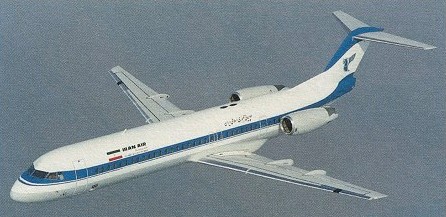
Fokker F-100

When Fokker announced a successor to the F27 in November 1983, they also launched a similar follow-on to the Fellowship jet airliner. Derived from the proven F28 Mk 4000 airframe, the new aircraft was designated the Fokker 100 roughly reflecting the number of passenger seats offered. Re-engined with new-technology fuel-efficient Rolls-Royce Tay turbofans and with a longer fuselage and redesigned and extended wings, other features include modernised systems incorporating a ‘glass cockpit’ and a revised cabin interior. Production is shared with Deutsche Airbus, Shorts, Grumman, Rolls-Royce and Dowty Rotol, with assembly and flight testing carried out by Fokker at Schiphol. IPTN of Indonesia also supply components.

Fokker F-100 Article

The F100 flight test programme involved two prototypes, the first making its maiden flight on 30 November 1986 followed by the second on 25 February 1987. Certification of the Tay 620-15 powered version was achieved in November 1987 and first customer delivery was made to Swissair in February 1988. The uprated Tay 650 version, ordered by US Air was certificated in July 1989 and delivered to the airline the same month. By mid-1991 Fokker had received orders for 232 F100s and had delivered 70. Options available on Tay 650 aircraft from 1993 include a higher gross weight of 45810kg and an integral wing centre-section fuel tank giving improvements in range between 160 and 450km. Another option available from 1994 will be a quick-change version equipped with a cargo door 3.4 by 1.9m installed on the port side of the fuselage ahead of the wing, together with a specially designed cabin interior. Conversion time (by three men) is claimed to be 20 minutes, enabling 88 passengers to be carried by day and an 11,500kg payload by night over 2800 km.
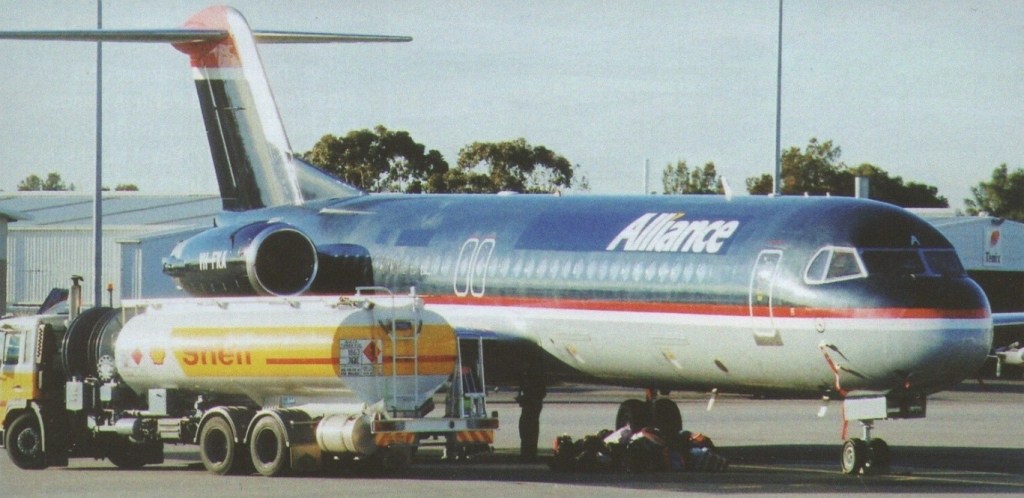
Alliance Airlines Fokker 100 VH-FKA – ex-US Airways – 1988

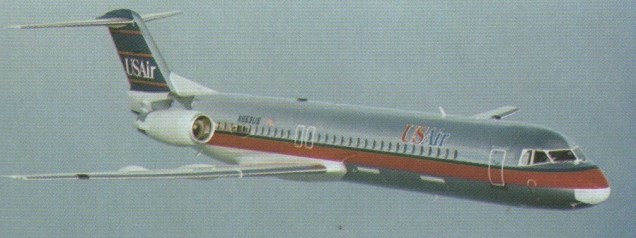
On 24 July 1989 USAir was the launch customer for the Fokker 100.
Rekkof Restart was formed with intention of restarting production of the Fokker 50 and 100, having bought tooling and rented the production factory in 1998.

Engine: 2 x Rolls-Royce Tay 650-15 turbofans, 6849kg
Max take-off weight: 43090 kg / 94998 lb
Empty weight: 24375 kg / 53738 lb
Wingspan: 28.0 m / 91 ft 10 in
Length: 35.5 m / 116 ft 6 in
Height: 8.5 m / 27 ft 11 in
Wing area: 93.5 sq.m / 1006.42 sq ft
Cruise speed: 837 km/h / 520 mph
Ceiling; 10670 m / 35000 ft
Range: 2956 km / 1837 miles
Passengers: 107
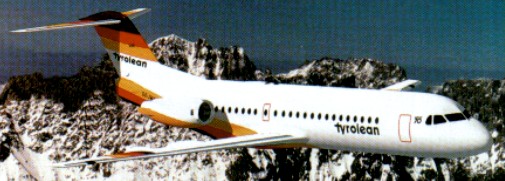
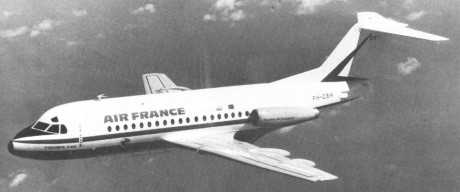
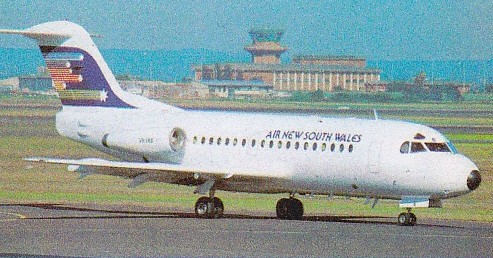
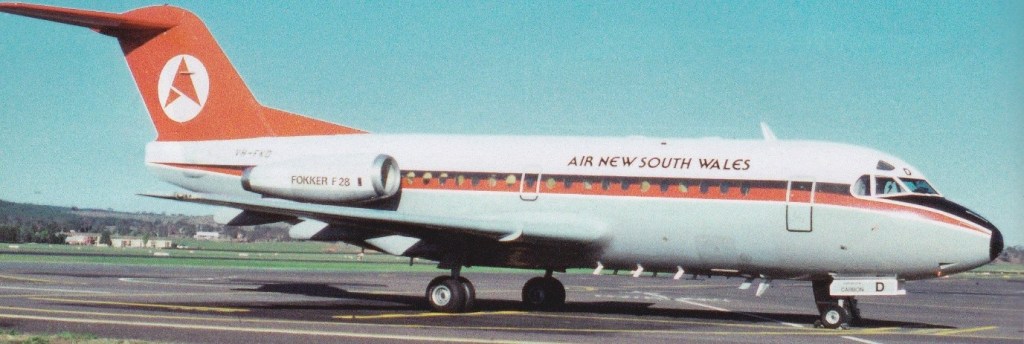
Fokker F-28 Fellowship

First details of the new Fokker F28 Fellowship were released in April 1962, and, with financial backing from the Netherlands government and risk-sharing support from MBB in West Germany and Shorts in the UK, a decision was made in 1964 to begin development and production of this new airliner.

Fokker F-28 Fellowship Article

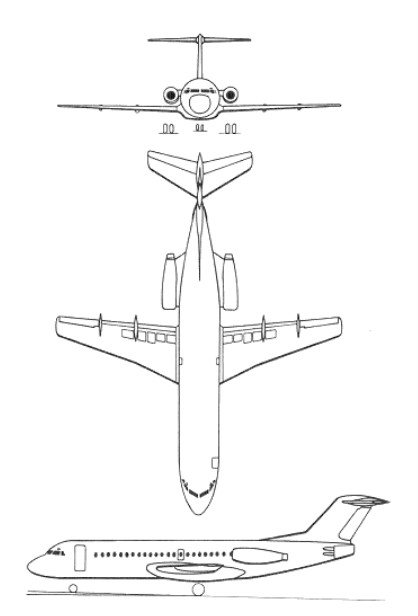
A cantilever low/mid-wing monoplane configuration with a circular-section fuselage, a T-tail unit with swept surfaces and retractable tricycle landing gear, the F28 was designed for two Rolls-Royce RB183 turbofan engines.
Highly manoeuvrable in flight, it is designed for STOL with a wing sweepback of only 16 degrees for good handling at low speed, leading-edge slats and double-slotted flaps. There are no thrust-reversers; instead, the F 28 has powerful air brakes which, uniquely, form the tail end of the fuselage, and highly effective wheel brakes.
The first of three prototypes made its maiden flight on 9 May 1967, and certification and delivery of the first production aircraft was achieved on 24 February 1969. This initial F28 Mk 1000 short-fuselage version could seat 55 to 65 passengers and was powered by two 4468kg thrust RB183-2 Mk 555-15 turbofans. It was available optionally as the F28 Mk 1000C for all-cargo or mixed passenger/cargo operations with a large cargo door incorporated in the port side of the forward fuselage, aft of the standard passenger door.
Production was shared by Fokker-VFW of the Netherlands in association with MBB and VFW Fokker in Germany and Short Brothers in Great Britain. Shorts of Belfast designed the rear fuselage, MBB of West Germany the pods for the Rolls-Royce Spey turbofan engines, and Fokker’s German partner VFW, the tail and other fuselage sections.

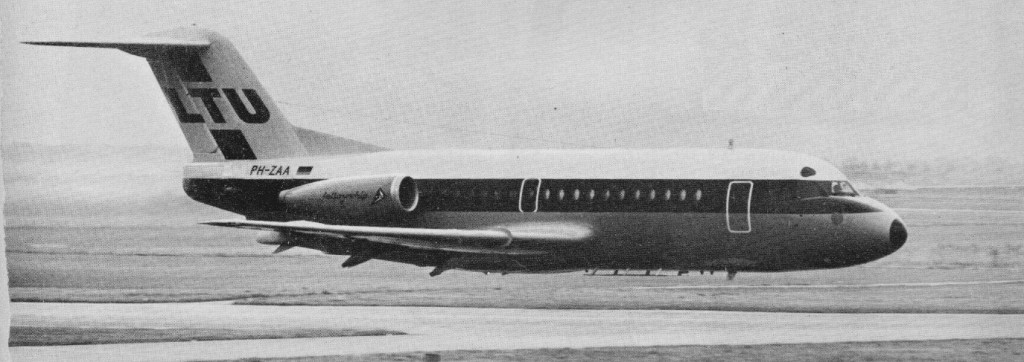
Fourth F-28 the day after its first flight

The fourth built, the first to be delivered, Fellowship A-4, went to Lufttransport Unternehmen L.T.U. of Dusseldorf, Germany.

This aircraft can take off from 6,000-foot long runways, or at altitudes as high as 15,000 feet. The generally similar F28 Mk 2000 differed only in having the fuselage lengthened by 2.21m to accommodate a maximum of 79 passengers. Later production versions were the F28 Mk 3000 and F28 Mk 4000 with the fuselage lengths of the Mks 1000 and 2000 respectively.
The Mk 3000 is similar to the Mk 4000 with a short fuselage and seating for 65. The Mk 4000 is a long-fuselage version with high-density seating for up to 85. The F28 Mk 3000 was offered with a 15-seat executive interior, and the F28 Mk 4000 has maximum seating capacity for 85 passengers. Sales reached 241 before the Fellowship gave way to the Fokker 100 on the production line in 1987.
The Mk 6000 is a long version with slatted wings and seating for up to 79 passengers.
In mid-1991 Fokker stated that over 200 F28s were still in service and at least half of these were expected to be hush-kitted to Category 3 standard beginning in 1994, enabling them to continue in service for another 15 years.

Engine: 2 x Rolls-Royce “Spey 555-15”, 43.8kN
Max take-off weight: 24720 kg / 54499 lb
Empty weight: 14100 kg / 31085 lb
Wingspan: 23.6 m / 77 ft 5 in
Length: 27.4 m / 89 ft 11 in
Height: 8.5 m / 27 ft 11 in
Wing area: 76.5 sq.m / 823.44 sq ft
Max. speed: M0.76
Cruise speed: 849 km/h / 528 mph
Range w/max.fuel: 1990 km / 1237 miles
Range w/max.payload: 1043 km / 648 miles
Crew: 2
Passengers: 40-65

Fokker F 28 Fellowship Mk. 4000
Engine : 2 x Rolls Royce RB 183-2 Spey Mk 555-15H, 43851 N / 4470 kp
Length : 97.146 ft / 29.61 m
Height: 27.789 ft / 8.47 m
Wingspan : 82.251 ft / 25.07 m
Wing area : 850.356 sq.ft / 79.0 sq.m
Max take off weight : 71001.0 lb / 32200.0 kg
Weight empty : 37743.0 lb / 17117.0 kg
Fuel capacity: 2,558–3,430 gals
Cruising speed : 423 kts / 783 km/h
Cruising altitude : 31988 ft / 9750 m
Service ceiling: 35,000 ft
Wing loading : 83.64 lb/sq.ft / 408.0 kg/sq.m
Range : 2230 nm / 4130 km
Range (max. weight) : 1010 nm / 1870 km
Takeoff distance: 5,217 ft.
Landing distance: 3,166 ft.
Threshold speed: 127 mph;
Crew : 2
Payload : 85 Pax.

Fokker S.14

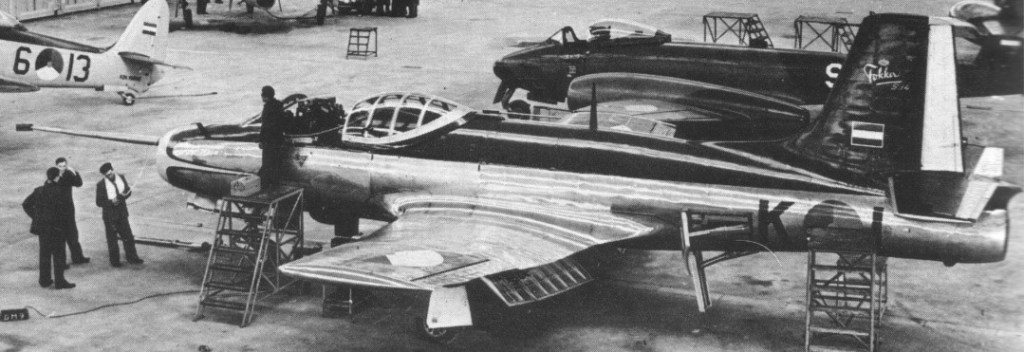
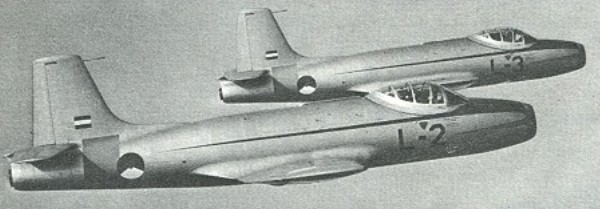
The Fokker S.14 Mach-Trainer secured its place in aviation history by being the first Fokker-designed jet aircraft, the first jet-propelled trainer designed as such, and the first aircraft of its type to enter production.
The low-wing all-metal S.14 was powered by a Rolls-Royce Derwent turbojet with a bifurcated inlet in the nose. The outlet was in the extreme tail, aft of the horizontal tail surfaces, which were set somewhat aft of the fin and rudder. The nosewheel of the tricycle landing gear retracted forwards into the underside of the nose while the main units retracted inwards into the undersides of the wings. Pupil and instructor were seated side-by-side under a short, broad raised canopy set well forward on the circular-section fuselage. Martin-Baker ejector seats were standard.

Fokker S.14 Article

Test pilot Gerben Sonderman made the first test flight on 19 May 1951 from Schiphol. On a second flight during the same day the landing gear failed and the prototype was damaged in the subsequent belly-landing. However, the aircraft was repaired and displayed at the 1951 Paris Salon in June of that year.

A series of 20 S.14s was ordered by the Royal Dutch air arm, the Koninklike Luchtmacht, the first being flown initially on 15 January 1955. The prototype bore the serial K-1 and was powered by a Derwent V engine, while the production machines were serialled from L-1 to L-20 and had Derwent VIIIs. The S.14s served at four air stations: Twenthe, Ypenburg, Gilze-Rijen and Soesterberg. Aircraft L-4 was demonstrated in the USA during 1955, but crashed on 20 October that year at Hagerstown, Maryland, killing Gerben Sonderman. Aircraft L-8 took part in the London-Paris air race, known as the Arch to Arc since it started at Marble Arch and ended at the Arc de Triomphe. The last two S.14s were withdrawn from Dutch service on 29 March 1965. Serialled L-17 and L-19, they are preserved at the Museums at Schiphol and Soesterberg respectively.

The original K-1 prototype was re-engined with a 2313kg thrust Rolls-Royce Nene 3 engine in 1953 and given the specially selected civil registration PH-XIV on 24 October 1960. It was then used by the Lucht en Ruuimtevaart Laboratorium (Dutch National Aeronautical and Space Laboratory) until scrapped on 4 March 1966.

S.14 was a promising aircraft, and the American Fairchild factory bought the rights for licensed production, but as a result of the MDAP military aid programme many countries were provided with the Lockheed T.33, a two seat version of the F. 80 jet fighter.

Fifty S.14s were to be built in Brazil, but production was cancelled.

Engine: 1 x Rolls-Royce Derwent VIII turbojet, 1575kg / 3,470 lbst
Max take-off weight: 5350 kg / 11795 lb
Loaded weight: 3765 kg / 8300 lb
Wingspan: 12.00 m / 39 ft 4 in
Length: 13.30 m / 43 ft 8 in
Height: 4.70 m / 15 ft 5 in
Wing area: 31.80 sq.m / 342.29 sq ft
Max. speed: 730 km/h / 454 mph
Cruise speed: 570 km/h / 354 mph
Ceiling: 11200 m / 36750 ft
Range: 965 km / 600 miles

FMA IA.63 Pampa

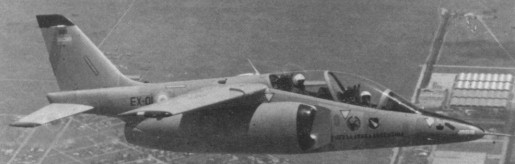
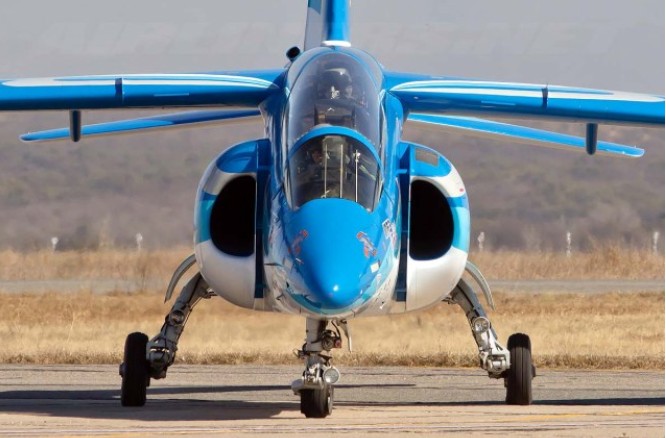
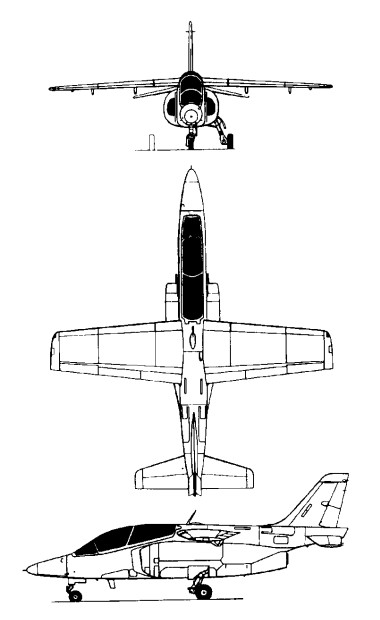
Work on the IA.63 began in 1979 by the Fabrica Militar de Aviones and by early 1980 a straight-wing configuration powered by a single TFE 731 had been decided upon. Dornier provided technical assistance in the design and development stages, and also in the construc¬tion of the wing and tail surfaces of the proto¬types. The first flight took place on October 6, 1984, and by March 1986 three prototypes were flying. Construction of three flying prototypes was initiated in March 1981 and the first IA-63 flew on 6 October 1984.

FMA IA.63 Pampa Article

A cantilever shoulder-wing monoplane, the fuselage incorporates a tricycle landing gear, a single turbofan engine and a pressurised cockpit with tandem seats for the pupil and instructor on zero/zero ejection seats.

Argentine

Delive¬ries of 64 IA-63As to the Argentine air force began in May 1988. The FAA requirement was for 64 aircraft, The IA-63A can also be used for weapon training with a 30mm Defa cannon pod on the fuselage centreline, and other ordnance on four under¬wing pylons, though better capability in this and the light attack roles is offered by the IA-63B under development in the early 1990s with the 4,300-lb (1,950-kg) thrust TFE731-5 turbofan and a head-up display tied into a more capable nay/attack system.

Powered by a Garrett TFE 731 turbo-fan engine providing 3500 lbs thrust, the Pampa “is capable of carrying a large and varied weapons load and a HUD and Weapons Aiming Computer System are being incorporated in future deliveries to meet Argentine Air Forces requirements”. Pampa promotional material emphasises the type’s fuel endurance of around 2.8 hours at 300 knots and a STOL/grass strip capability. Maximum speed is listed at 400 knots.
In 1990, FMA teamed with LTV to offer a version of the IA 63, designated Pampa 2000, to compete for the Joint Services Primary Aircraft Training System (JPATS) search for a common US trainer.

AT-63 Pampa Phase III

IA.63 Pampa
Engine: 1 x Garrett TFE731-2-2N turbofan, 3,500lb st (15,75 kN).
Installed thrust: 15.6 kN.
Span: 9.69 m / 31 ft 9 in.
Length: 10.93 m / 35 ft 10 in.
Height: 4.29 m / 14 ft 1 in
Wing area: 15.63 sq.m / 168.24 sq ft.
Empty wt: 2627 kg / 6219 lb.
MTOW: 5000 kg / 11023 lb
Warload: 1160 kg.
Max speed: 755 kph / 469 mph.
Initial ROC: 1813 m / min.
Ceiling: 12,900 m / 42300 ft.
T/O run: 400 m.
Ldg run: 515 m.
Fuel internal: 980 lt (+400 lt).
Range w/max.fuel: 1500 km / 932 miles.
Hardpoints: 5.
Crew: 2

IA-63A Pampa
Engine: one 4300-lb thrust Garrett TFE731-2-2N turbofan.
Maximum speed 509 mph (819 km/h) at 22,965 ft (7,000 m)
Initial climb rate 5,950 ft (1,813 m) per minute
Service ceiling 42,325 ft (12,900m)
Radius 223 miles (360 km) on a hi-lo-hi mission with a 2,205-lb (1,000-kg) warload
Empty weight 6,219 lb (2,821 kg)
Maximum take-off 11.023 lb (5,000 kg).
Wing span 31 ft 9.25 in (9.686 m)
Length 35 ft 9.25 in (10.90 m)
Height 14 ft 1 in (4.29 m)
Wing area 168.2 sq ft (15.63 sq.m)
Armament: provision for a 30-mm cannon pod and up to 2,866 lb (1,300 kg) of disposable stores.

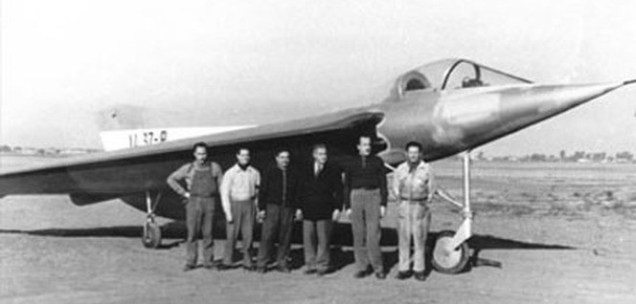
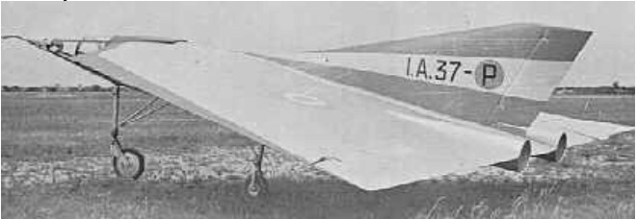
DINFIA I.A.37 / Horton H I.Ae 37P

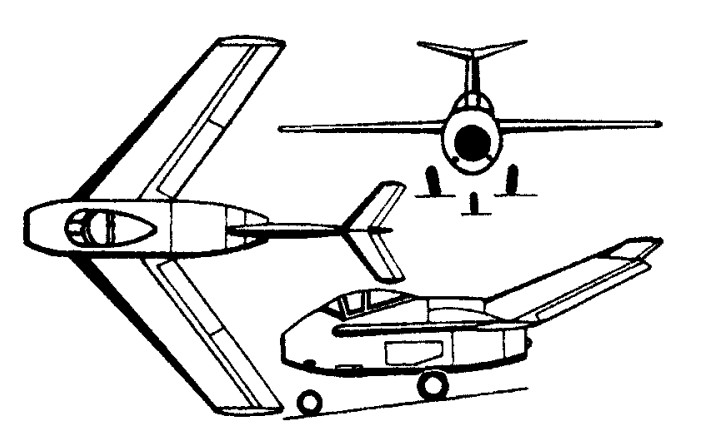
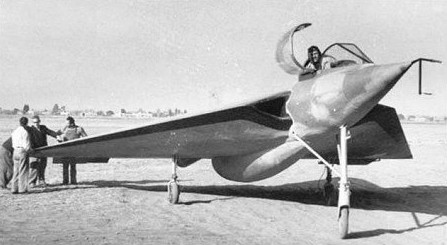
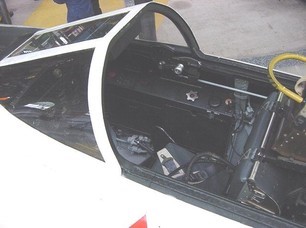
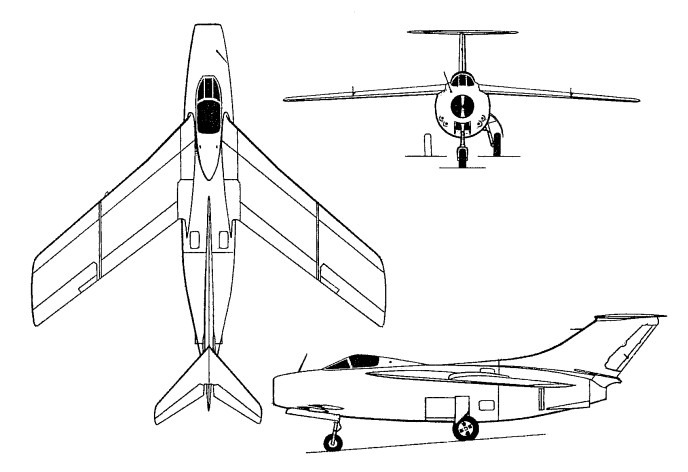
The FMA I.Ae. 37 was a prototype jet fighter developed in Argentina during the 1950s.

It never flew and was cancelled in 1960.

I. Ae. 37P

Engine; 1 x 1832kg Rolls-Royce Derwent 5 turbojet
Wingspan; 9.78 m / 32 ft 1 in
Length; 11.00 m / 36 ft 1 in
Height; 3.98 m / 13 ft 1 in
Max take-off weight; 4800 kg / 10582 lb
Empty weight; 3300 kg / 7275 lb
Max. speed; 902 km/h / 560 mph
Ceiling; 12000 m / 39350 ft
Range; 1000 km / 621 miles
Crew; 1

FMA IA.33 Pulqui II

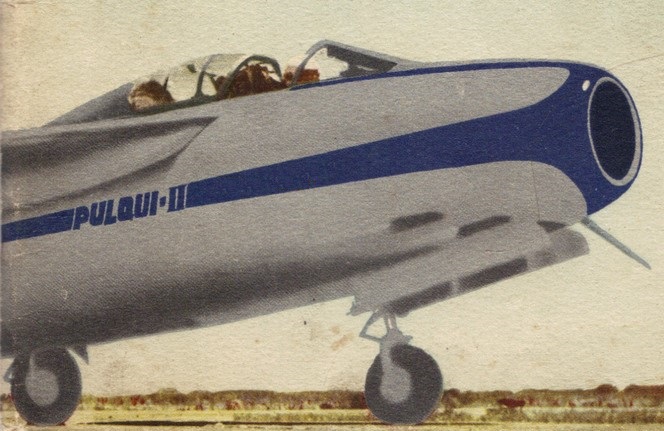
Intended to replace the Gloster Meteor F.Mk 4s in service with the Argentine air force, the I.Ae.33 Pulqui II (Arrow II) was designed by a team headed by Dr Kurt Tank, roughly inspired by the Ta 183. Tank arrived in Argentina in 1947, not speaking Spanish but with the plans for the German project TA-83 from the factory Focke Wulf. The first plane that Tank made in Argentina was a copy of the TA-83 which was his starting point.

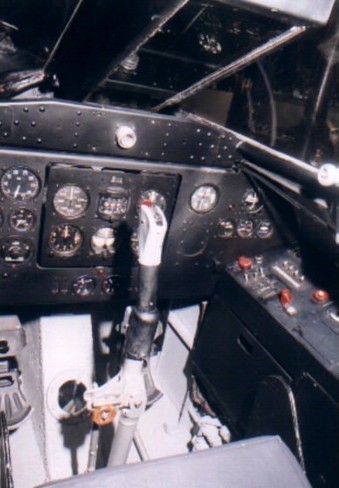
It embodied some of the results of the advanced research carried out in Germany during World War II, incorporating a shoulder-mounted wing with 40deg of sweep-back, and a T-tail with all-swept surfaces. Landing gear was retractable tricycle-type and power provided by a Rolls-Royce Nene turbojet mounted in the rear fuselage. The pilot was accommodated on an ejection-seat in a pressurised cockpit, protected by armour and a bulletproof windscreen, and a sliding canopy that could be jettisoned in emergency, and auto pilot.

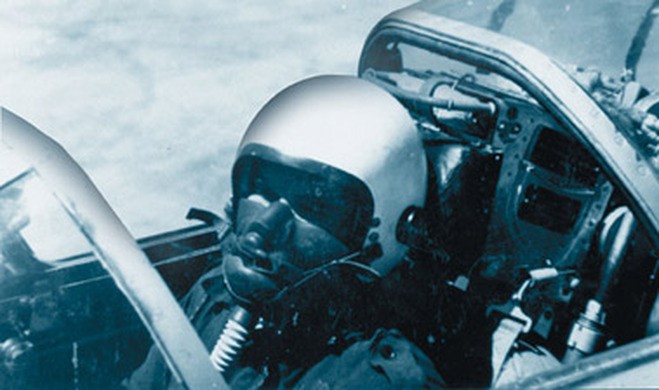
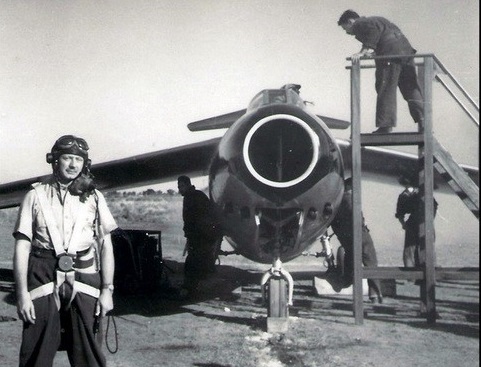
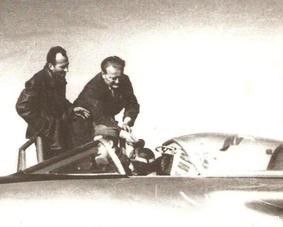
By 1950 the first prototype of the Pulqui II was ready for testing. It was piloted for the first time by Captain Edmundo Weiss on June 27, 1950.

Captain Edmundo Weiss is with the Pulqui II

It had its official debut on February 8, 1951. Tank called Peron in Buenos Aires from Cordoba and advised him that the airplane would arrive to the airport before the President himself. Sure enough, he was correct. During the presentation ceremony Peron expressed his admiration and gratitude for Tank.

The Pulqui II’s first tragedy occurred in May of that year after 28 test flights when a defect caused the death of Captain Vedania Mannuwal, a fighter pilot. This led to the third prototype and many more test flights. Two days before the newest version was to be presented to Peron in October of 1952, another crash cost the life of Otto Behrens who was an important part of the entire process. (Otto Behrens, the test pilot died; a few days before his death he said that the airplane was “the worst he had ever experienced as a test pilot”). His death was mourned by the entire country, especially the Germans now working in Argentina. By 1953 the fourth prototype was ready for testing. It was not until 18 September 1959 that the last was flown.

Unfortunately, just when the project was ready to bear fruit, a coup turned the country upside down. Many of the scientist and engineers associated with the project were forced from the country, including Kurt Tank. The new government showed little interest in keeping the project alive, although those who remained struggled to make it work. In a desperate attempt to change momentum, FMA planned a high profile test flight from Cordoba to Moron back to Cordoba including three quick rounds over the Buenos Aires airport, without supplementary fuel tanks. The pilot, Captain Rogelio Balado, was able to make the entire trip, but a fault in the system caused a lack of oxygen for him and he crashed on landing in Cordoba.

In 1954 a world tour was planned to exhibit the airplane to possible buyers. FMA also received visitors from the USSR, US (from the company that manufactured the P-86 Sabre) and Egypt who were interested in the airplane.

Brigadier Ahrens from the Argentina Air Force approached FMA requesting an estimate on the fabrication of 100 Pulquis. He was advised that 10 could be available immediately and that number 100 would be finished within 5 years. Ahrens decided to give the contract to the Americans for 100 F-86 Sabres because they would be available immediately. This basically ruined FMA’s future possibilities to export the Pulqui II.

In the intervening period the Dr Tank and his team had left Argentina. These factors, coupled with serious financial problems, meant that development was initially halted in 1953, and finally cancelled with the fall of Peron in 1955.

I.Ae.33
Engine; 1 x Rolls-Royce Nene, 2268kg
Wingspan; 10.60 m / 34 ft 9 in
Length; 11.68 m / 38 ft 4 in
Height; 3.50 m / 11 ft 6 in
Wing area; 25.10 sq.m / 270.17 sq ft
Max take-off weight; 5550 kg / 12236 lb
Empty weight; 3600 kg / 7937 lb
Max. speed; 1050 km/h / 652 mph
Ceiling; 15000 m / 49200 ft
Crew; 1
Armament; 4 x 20mm cannon

FMA IA.27 Pulqui

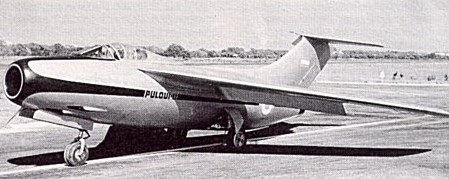
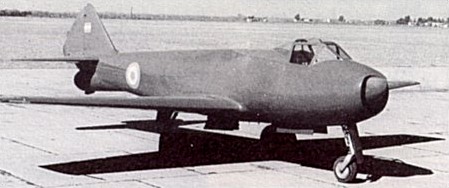
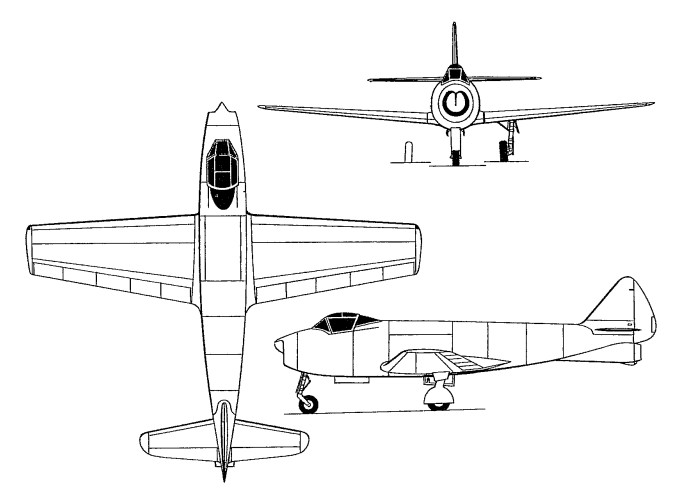
Designed by Emile Dewoitine, the I.Ae.27 Pulqui (Arrow) was the first single-seat fighter to be designed in Argentina as well as the first turbojet-powered aircraft to be built and flown in Argentina.

FMA IA.27 Pulqui Article

A cantilever low-wing monoplane of all-metal construction, the Pulqui had a conventional tail unit, retractable tricycle landing gear, and accommodation for the pilot well forward on the fuselage beneath a jettisonable canopy. Power was provided by a Rolls-Royce Derwent turbojet mounted in the aft fuselage.
First flown on 9 August 1947, the Pulqui performance was well below estimates and development was abandoned.

I.Ae.27
Engine; 1 x Rolls-Royce Derwent, 1633kg
Wingspan; 11.25 m / 36 ft 11 in
Length; 9.69 m / 31 ft 9 in
Height; 3.39 m / 11 ft 1 in
Wing area; 19.70 sq.m / 212.05 sq ft
Max take-off weight; 3600 kg / 7937 lb
Empty weight; 2358 kg / 5199 lb
Max. speed; 720 km/h / 447 mph
Ceiling; 15500 m / 50850 ft
Range; 900 km / 559 miles
Crew; 1
Armament; 1 x 20mm cannon