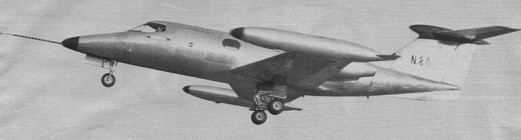
Gates SAAC-23 / Lear Jet 23

Bill Lear Snr saw the cancelled Swiss FFA P-16 jet fighter as a basis for a twin-jet executive aircraft. He initiated preliminary design work at St Gallen, Switzerland, in November 1959 and sold his electronics company to the Siegler Corporation.

Using the basic design of the P 16’s wing, large tip fuel tanks and cruciform tail (hard tooling for which already existed), designed a compact fuselage that held two pilots and seven passengers. The engines were to be the civilian version of the military¬ proven General Electric J 85, which put out 2,850 pounds of thrust.

But the project soon bogged down, partly because of the Swiss Government’s rigidly structured bureaucracy and partly because Lear found himself constantly at odds with people who literally and figuratively didn’t speak his language. The final nail in the coffin may have been the Government’s attempt to tax the project before there was even sheet metal in the jigs. By early 1962, Lear was making arrangements to return to the U.S.

The SAAC designation was left behind, and the airplane became known simply as the Lear Jet Model 23.
While the competition featured cabins that were similiar in size to existing corporate aircraft, Lear produced a smaller, circular cross section that was both light and very strong.

When the number one airplane was still a few months from its first flight, Lear heard rumblings about the cruciform tail: some engineers doubted that the elevator, with its fixed horizontal stabilizer, would be able to hold up the nose in forward CG. Lear put the project behind schedule in order to install a T tail.

The prototype Lear Jet Model 23 (N801L) flew on 7 October 1963. Lear had hoped to save time by obtaining the type certificate under FAR Part 23 (the rules for aircraft under 12,500 pounds gross weight) rather than the more stringent Part 25, which governs transport category aircraft. But the Wichita FAA, then not very familiar with jets, tacked on some additional requirements that threatened to slow down certification. In reality, the airplane met or exceeded the most important of Part 25 criteria; the main exception was the bird proof windshield, later added as part of the changeover to the Model 24.

One of the FAAs additions required that Lear establish balanced field lengths; and it was here that disaster struck. Testing for single engine climb performance, with an FAA test pilot in the left seat and Lear’s pilot in the right, N801 Lima left the ground with one engine actually shut down (normally not done until the very end of the testing phase) and the spoilers inadvertently extended. In this configuration, it was something of a miracle that the airplane flew at all; as it was, even with the gear retracted, it refused to climb much beyond ground effect, and it just managed to clear some trees at the end of the field.

In the cockpit, meanwhile, confusion reigned: an engine restart was unsuccessful because of improper procedure, and neither pilot thought to check spoiler position. Soon the airplane began to settle slowly and, with a field just ahead, the pilots elected to put the gear down and ride it in. The loss of this prototype should have been a crippling blow.
The second and third prototype aircraft being first flown on 5 March and 15 May 1964 respectively. On July 31, 1964, less than two months after the accident and nine and a half months from the Lear Jet’s first flight, FAA Administrator Najeeb Halaby personally flew to Wichita to present the type certificate to Lear. The provisional airworthiness certificate took the plane out of the experimental class and authorised flights anywhere in the US for demonstration and service testing. Bill Lear promptly flew his jet to New York in 2 hr 21 min. The planned price of the Lear 23 was $575,000.

The first production Lear Jet was rolled out 20 months after ground was broken for the factory. Built in 135 days, it was delivered to the Rexall Drug & Chemical Corp of Cincinnati, Ohio, on 13 October 1964.

A new wing, incorporating milled skins to replace the use of built up material, was added at the 20th plane on the Lear Jet production line at Wichita.
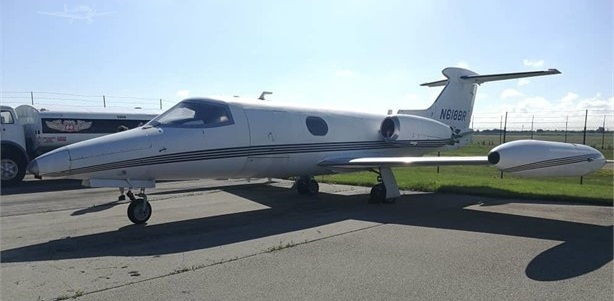
Lear increased production to 10 airplanes per month. While the plant was being expanded, he began work on re-certifying the airplane under Part 25 (this later became the Model 24), developing a stretched version (the Model 25).

In 1965 a Lear 23 established a Los Angeles to New York and return record of 10 hrs 52 min flying time, and a time-to-climb record to 40,000 ft – 7 min 21 sec – with seven people on board.
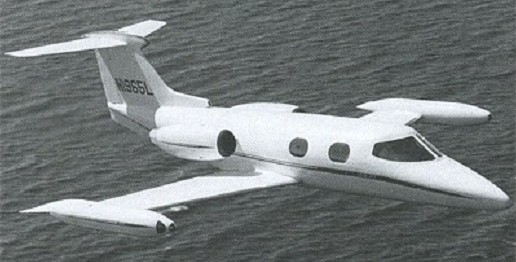
Distinguishing a Model 23 from a 24, however, is tougher, mainly because most of the changes were internal (improvements in the various systems) and on paper (weight and performance numbers). The two most obvious external differences are the vortex generators¬small metal tabs that project above the wing ahead of the ailerons and the windshield. A Model 23 has a set of vortex generators on the underside of the wing as well as the upper surface; 24s have them only on the upper surface. The Model 24’s windshield, befitting a transport category airplane, is a bird proof design with a T shaped stiffener on the vertical post separating the two halves; if this stiffener is missing, you are looking at a Model 23. The factory’s records, in 1978, indicated that 12 of the 88 Model 23s still flying were Model 24s in every respect except serial number.)

Intended for single-pilot operation the basic layout was for a crew of two and for five to seven passengers.
There were 104 Model 23s built, although the serial numbers only run from 001 through 099. The difference is five A models, the existence of which stems from the backlog of orders just after the airplane received its type certificate. Lear, during the course of a normal day’s wheeling and dealing, would promise yet another airplane to a special customer. To keep this person from having to wait a year for delivery, Lear would sneak him in at the head of the line by creating an A model and bumping all the numbers back one.
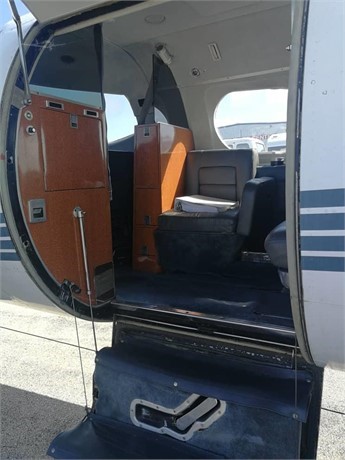
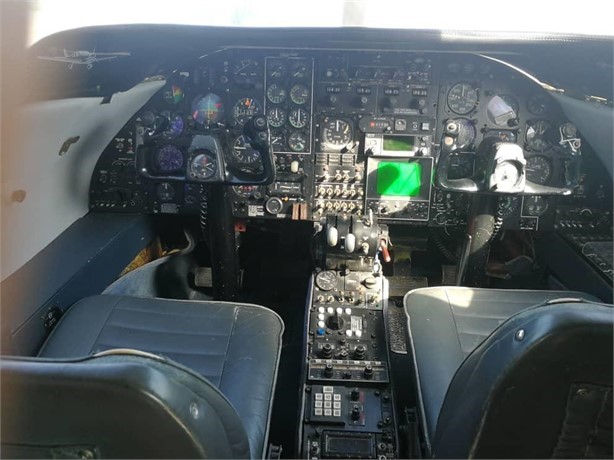
In those days, there was no such thing as a standard Learjet. True, the basic airframe/engine combination had been frozen by the type certificate, but the systems and, in particular, the instrument panel were considered fair game for new ideas. The first 30 production aircraft to be completed were powered by 1293kg thrust General Electric CJ610-1 turbojets, but the remainder of the production run of a little over 100 Lear Jet 23s had CJ610-4s of similar thrust. To Lear, all Learjets, even those brought in for routine maintenance, were prototypes. As a result, pilots about to fly an airplane only a few serial numbers away from their usual one still had to take time to locate switches in the cockpit. The first 14 air¬planes provide the most extreme example of this. They all had left hand control panels, so confident was Lear that single pilot certification was just around the corner.
012 set three official world records during a round robin flight between Los Angeles and New York, making the trip in 10 hours and 21 minutes, with two refueling stops.
055 set a time to climb record. With seven people on board, it went to 40,000 feet in seven minutes and 21 seconds, a record that later fell to a Model 25.

Several Model 23s have passed the 10,000 hour mark.
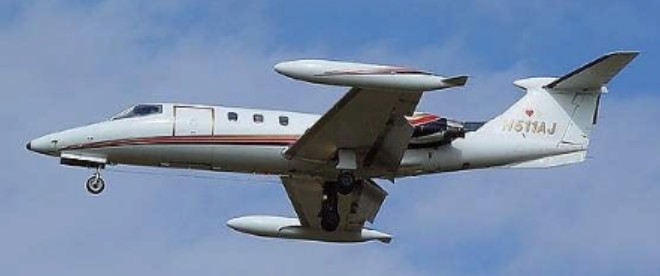
Engine: 2 x GE CJ610-1.
MTOW: 12,500 lb.

Engine: 2 x General Electric CJ610-4 turbojets, 1293kg
Max take-off weight: 5670 kg / 12500 lb
Empty weight: 2790 kg / 6151 lb
Wingspan: 10.85 m / 35 ft 7 in
Length: 13.18 m / 43 ft 3 in
Height: 3.84 m / 12 ft 7 in
Wing area: 21.46 sq.m / 230.99 sq ft
Max. speed: 903 km/h / 561 mph
Cruise speed: 781 km/h / 485 mph
Ceiling: 13715 m / 45000 ft
Range: 2945 km / 1830 miles
ROC: 6,900 fpm.
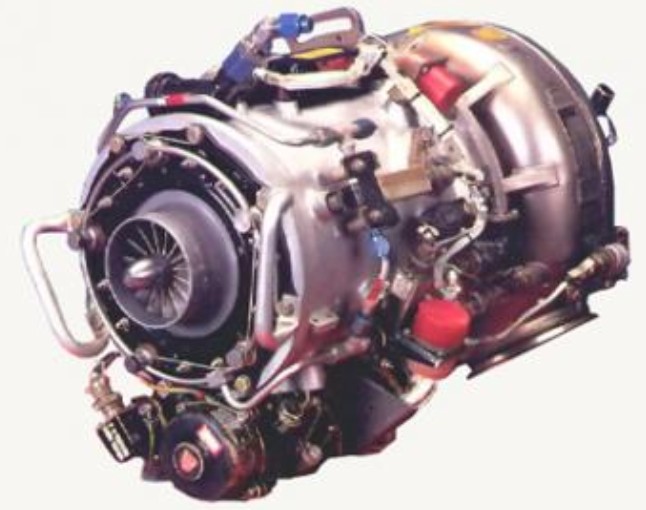
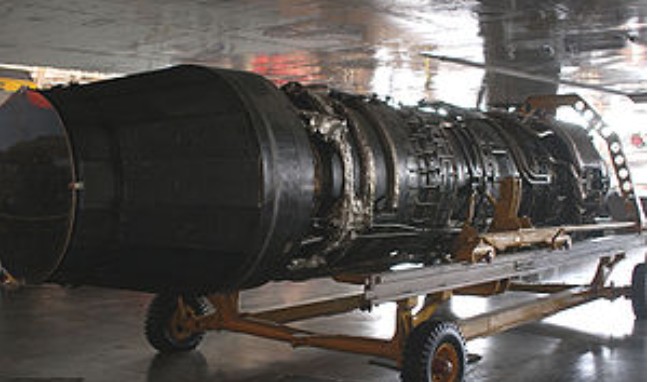
Garrett JFS100

Originally the JFS-100 was a starter motor designed and produced by Garrett. It was used, among others, on A7, F16 and F15, but also in non-aviation applications such as power generators.

It provided a power of 90 hp at 72,000 rev / min for a specific fuel consumption of 1.2 lbs / hp / hr.

JFS-100 turbojet has been converted for propulsion of cars, kart and motorcycle.

Aviation conversions include:

Mitchell B-10 of Jim Gordon
Bede BD-5J of Bill Brooks

The Mitchell B-10J is a package available from Jim Gordon’s Micro Aviation. The US$5200 package includes a Garrett JFS100-13 originally used as a starter for the TF-41 engine in the A-7 Corsair. Including throttle package, lubrication and tailpipe assembly, the engine weight is 53 lb, and replaces the Zenoah.

Garrett J97

The General Electric J97 is a single-shaft turbojet engine designed and built by General Electric as a compact high-performance engine for light attack fighters and eventually a number of drone projects.

The J97 was based on GE’s General Electric GE1/J1 series of turbojets and the engine development was financed by the United States Air Force. The original application was to be the Northrop P-530 (which later evolved into the YF-17), but it was ultimately only used in several small drone aircraft.

Variants:

J97-GE-100
Standard Variant

J97-GE-17
Variant of the engine with 11,760 lbf (52,300 N) of thrust proposed for use in the Super Dynamics O4-1B Robin supersonic business jet.

Applications:
Boeing YQM-94
Ryan AQM-91 Firefly

Specifications:
J97-GE-100
Type: Turbojet engine
Length: 109.5in (2.78m)
Diameter: 24.4in (0.62m)
Dry weight: 694lb (315kg)
Compressor: 14-stage
Combustors: annular
Turbine: two-stage
Maximum thrust: Take-off 5,270lb (23.4kN) dry, 8,000lb (35kN) afterburner
Thrust-to-weight ratio: 11.5:1

Garrett YJ93 / 7E

YJ93-GE-3

The General Electric YJ93 turbojet engine was designed as the powerplant for both the North American XB-70 Valkyrie bomber and the North American XF-108 Rapier interceptor. The YJ93 was a single-shaft axial-flow turbojet with a variable-stator compressor and a fully variable convergent/divergent exhaust nozzle. The maximum sea-level thrust was 28,800 lbf (128 kN).

The YJ93 started as the General Electric X275, an enlarged version of the J79 turbojet. This evolved to the X279 when Mach 3 cruise became a requirement, and ultimately became the YJ93.

The YJ93 produced nearly twice the thrust of the J79 but was only 1500 lb heavier and very little larger.

Top – J79, Bottom – YJ93

The engine used a special high-temperature JP-6 fuel. The six YJ93 engines in the XB-70 Valkyrie were capable of producing a thrust to weight ratio of 5, allowing for a speed of 2,000 mph (3,200 km/h) (approximately Mach 3) at an altitude of 70,000 feet (21,000 m).

The XF-108 interceptor was cancelled outright and the B-70 project was reoriented to a research project only.

GE4/J5P
Type: Turbojet
Length: 6.2 m (237 in)
Diameter: 1.33 m (52.5 in)
Dry weight:
Compressor: 11-stage axial
Turbine: Two-stage axial
Fuel type: Special high-temperature JP-6 Fuel
Maximum thrust: 19,000 lbf (85 kN) / (28,800 lbf (128 kN) with afterburner)
Specific fuel consumption: 0.700 lb/(h·lbf) or 19.8 g/(s·kN) / (1.800 lb/(h·lbf) or 51.0 g/(s·kN) with afterburner)

Garrett TFE731 / AlliedSignal TFE731 / Honeywell TFE731

Honeywell TFE731-60

The Honeywell TFE731 is a family of geared turbofan engines commonly used on business jet aircraft. The engine was originally designed and built by Garrett AiResearch, and due to mergers was later produced by AlliedSignal and then Honeywell Aerospace.

The TFE731 was based on the core of the TSCP700, which was specifically developed for use as the auxiliary power unit (APU) on the McDonnell Douglas DC-10. The design featured two important factors: low fuel consumption, and low noise profiles that met the newly established U.S. noise abatement regulations.

The first test run of the TFE731 occurred in 1970 at Garrett’s plant in Torrance, California. The first production model, the TFE731-2, began rolling off the assembly line in August, 1972, and was used on the Learjet 35/36 and Dassault Falcon 10, both of which entered production in 1973.

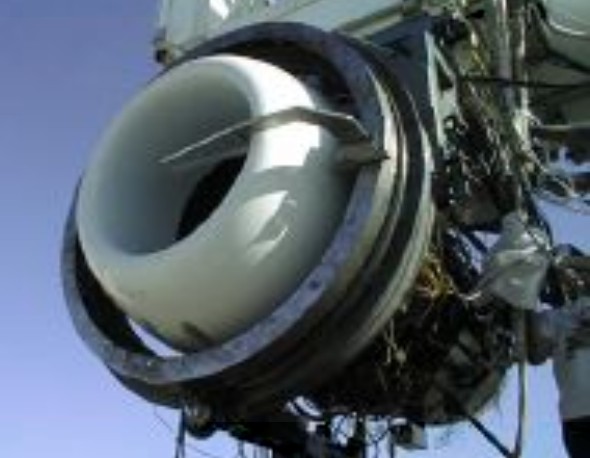
The TFE731-60 has an inlet diameter of 0.787 m. The fan consists of 22 fan blades, 52 exit-guide vanes, and ten struts, and is driven by a gearbox. The five-stage compressor has four axial (LP) stages and one radial or centrifugal (HP) stage.

The TFE731-3 was developed for use in the Lockheed JetStar re-engining program, and subsequent versions of it have been used on a number of aircraft, including the Learjet 55.

At mid-1977, production of the geared two-shaft 3,500 lb TFE731-2 turbofan and the 3,700 lb TFE731-3 was running at 30-35 units per month. By September, such was the US and overseas demand for the engine, Garrett decided to increase shipments of the TFE731 (and the ATF3) to a total of around 550 units a year by 1980. Mid-1977 saw delivery of the 5,000th TPE331, and total flight time reached 11 million hours. The engine powered 44 types of aircraft. The Cessna 700 Citation III was to be the first application for the 4,000 lb-thrust TFE731-4.

In 1975, the TFE731 was named Aviation Product of the Year by Ziff-Davis Publishing Company.

The -5 model was certified in 1982, and a decade later, an engine utilizing the TFE731-5 power section and a TFE731-3 fan was built and designated the TFE731-4, intended to power the Cessna Citation 650 Citation VII aircraft.

The TFE731-50 version, based on the -60 used on the Falcon 900DX, underwent its flight test program in 2005. Honeywell has developed this engine complete with nacelle as a candidate to retrofit a number of aircraft equipped with older engines.

Since the engine was introduced in 1972, over 11,000 engines have been built, flying over 100 million flight-hours.

Variants

TFE731-2
AIDC AT-3
CASA C-101
Dassault Falcon 10
FMA IA 63 Pampa
Hongdu JL-8
Learjet 31
Learjet 35/Learjet C-21

TFE731-3
Boeing Skyfox
British Aerospace BAe 125 Series 700
Cessna Citation III
Cessna Citation VI
Dassault Falcon 50
Learjet 55
Lockheed 731 Jetstar/Jetstar II
IAI 1124 Westwind I
Hawker HS125 series

TFE731-4
Aero L-139 (prototype only)
Cessna Citation VII

TFE731-5
Hawker 800/850XP
Dassault Falcon 20 (retrofit)

TFE731-20
Learjet 40
Learjet 45

TFE731-40
Gulfstream G100/G150 (formerly IAI 1125 Astra SPX)
C-38 Courier
FMA IA 63 Pampa

TFE731-50
Hawker 900XP

TFE731-60
Dassault Falcon 900DX

TFE731-1100
IAI 1124A Westwind II

Specifications:

TFE731-2
Type: Turbofan
Length: 50 in (127 cm)
Diameter: 39 in (100 cm)
Dry weight: 734 lb (333 kg)
Compressor: 1 stage fan, 4 axial high pressure compressor stages, 1 centrifugal high pressure compressor stage
Combustors: Annular
Turbine: 1 stage high pressure turbine, 3 stage low pressure turbine
Maximum thrust: 3500 lbf (15.6 kN)
Overall pressure ratio: 13:1
Specific fuel consumption: 0.5 lb/lbf-hr
Thrust-to-weight ratio: 4.7:1

TFE731-3
Single-stage geared fan
Four-stage l-p compressor
Single-stage centrifugal h-p compressor
Annular reverse-flow combustor
Single-stage h-p turbine
Three-stage l-p turbine
Take-off pwr: 3,700 lb
Bypass ratio: 2-79:1
Pressure ratio: 14-6:1
Mass flow: 120-3 lb/sec
Length: 49-73in
Width: 34-20in
Height: 39-36in
Weight: 736 lb

Garrett/ITEC F124 / TFE1042 / F125 / Honeywell/ITEC F124 / F125 / TFE1042

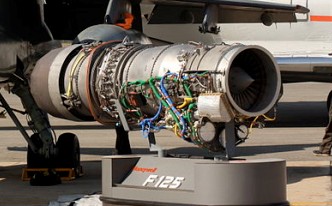
The Honeywell/ITEC F124 is a low-bypass turbofan engine derived from the civilian Honeywell TFE731. The F125 is an afterburning version of the engine. The engine began development in the late 1970s for the Republic of China (Taiwan) Air Force AIDC F-CK Indigenous Defence Fighter (IDF), and it first ran in 1979. The F124/F125 engine has since been proposed for use on other aircraft, such as the T-45 Goshawk and the SEPECAT Jaguar, and powers the Aero L-159 Alca and the Alenia Aermacchi M-346.

The F124 engine is fundamentally a low bypass, two spool engine (meaning that there are two rotational shafts, a high pressure shaft and a low pressure shaft. The fan/low pressure compressor section is made of three stages with titanium blades. The first stage has 30 un-shrouded blades, and the overall pressure ratio for the three stage fan section is 2.5:1. Some of the air is bypassed (Bypass ratio of 0.472:1), and the rest is fed to the high pressure compressor section.

The high pressure compressor (HPC) of the F124 is a fairly unique design among gas turbine engines; it employs both axial and a centrifugal compressors in a single design. There are four axial stages that lead to a fifth centrifugal stage. All the blades and the impeller are made from titanium.

The compressed air is combusted in an annular combustor and then exhausted to a single stage high pressure turbine (HPT) followed by a single stage low pressure turbine. The HPT is air-cooled. The exhaust is mixed, meaning the bypass air from the fan and the exhaust from the core exit through a common nozzle. In the F125 variant of the engine, the exhaust passes through the afterburner section. The F124 does not have an afterburner.

By 2004 at total of 460 F124 had been built with an estimated unit cost in 2006 of USD$2.5 million.

In 1978, Garrett announced joint research on the TFE1042 afterburner with Swedish company Volvo Flygmotor AB in order to provide an engine for the AIDC F-CK Indigenous Defence Fighter (IDF) being developed for the Republic of China (Taiwan) Air Force (ROCAF). The TFE731 Model 1042 was touted as a low bypass ratio “military derivative of the proven commercial TFE731 engine” and “provides efficient, reliable, cost effective propulsion for the next generation of light strike and advanced trainer aircraft”, with thrust of 4260 lbf (18.9 kN) dry and 6790 lbf (30.2 kN) with afterburner. After initial negotiation, the investment was going to be divided between Garrett, Volvo, AIDC, and Italian company Piaggio. The development would consist of the non-afterburning TFE1042-6 for light attack aircraft/advanced trainer, and TFE1042-7 for the AMX or F-5 upgrade. Garrett would be responsible for the core engine, and Volvo would be responsible for the fan section and the afterburner. The engine first ran for 3 hours at a Volvo test facility in 1979.

AIDC also suggested upgrading TFE1042-7 to 8000 lbf (31 to 36 kN) thrust as twin engine solution, in order to compete with General Electric F404 for applications such as the JAS 39 Gripen. However, the Gripen project decided to continue with a single engine F404 variant, built by Volvo, and Volvo left the project to at that point to focus on the Gripen work. Piaggio asked to participate at a later date due to financial reasons and left the program as well. Thus only Garrett and AIDC invested in the new International Turbine Engine Corporation (ITEC), with the contract signed in 1982.

In 1988, ITEC decided to invest in the 12,000 lb TFE1088-12, which was re-designated as TFE1042-70A (for political reason as well). Preliminary study had shown that IDF could supercruise with the new engine. At the same time, GE decided to enter the market with J101/SF, a smaller version of F404. However after the IDF order was cut in half due to budget concerns, the TFE1088-12 engine upgrade plan ended as well. The F-CK IDF first flew in 1989, and aircraft were delivered through 1999.

In the early 1990s, the United States Navy considered the re-engining their fleet of T-45 Goshawk trainer aircraft with the F124. In 1994, after flight testing a T-45 with the engine, the USN elected not to do that.

The possibility of a F124-powered T-45 arose again in 1996 when McDonnell Douglas offered an F124-engined T-45 to the Royal Australian Air Force as a competitor for their trainer requirement. BAe wanted to offer the F124 as an option on their entry for the RAAF trainer requirement, the BAE Hawk (which the T-45 is based on), but ITEC refused to give BAe permission to offer it. ITEC’s decision turned out to be a mistake, as the RAAF select the Hawk as their trainer. However, after the selection of the aircraft, the RAAF decided to have a separate competition between the F124 and the Rolls-Royce Turbomeca Adour (which was BAe’s selection) to power the new trainers. In 1997 the RAAF elected to used the Adour engine, effectively ending the F124’s chances of being used on Hawk or T-45 aircraft.

In 1994, the F124 engine was selected to power the Czech Aero L-159 Alca light combat aircraft. The combination first flew in 1997.

In 2000, Alenia Aermacchi announced that their new M-346 trainer/light attack aircraft would be powered by the F124 engine, choosing it over its common rival, the Adour. In 2009, the United Arab Emirates announced that their M-346 trainers would be powered by the F124-GA-200.

The F124 engine powered the Boeing X-45A unmanned combat air vehicle demonstrator in the early 2000s.

The afterburning F125 engine is being considered, as of 2009, by the Indian Air Force as a replacement for the Rolls-Royce Turbomeca Adour engines in their SEPECAT Jaguar aircraft. The new engine would be both lighter and more powerful. It was successfully demonstrated in 2007.

Variants:
F124-GA-100
This is the original variant of the engine. It powered the Boeing X-45 demonstrator.

F124-GA-200
Slightly de-rated variant of the F124-GA-100; the maximum thrust is 6250 lbf (27.80 kN) and the engine weighs 28 lb (13 kg) less. This variant utilizes an all new accessory gearbox, as well as other small upgrades. This variant is used in the Aermacchi M-346.

F124-GA-400
Variation of the F124-GA-100, modified for the T-45 Goshawk and the BAE Hawk. The engine was flight tested in the T-45, but the United States Navy decided not to re-engine the aircraft with this engine.

F125-GA-100
Also known as the TFE1042-70. This is the basic afterburning variant of the engine. Used in the AIDC F-CK-1 Ching-kuo.

F125X
Proposed advanced variant of the F125 engine, with a maximum thrust of 12,500 lbf (56 kN).

F125XX
Further advanced variant of the F125 engine, this one producing 16,400 lbf (73 kN) of thrust. If it were built, there would have been a related F124XX non-afterburning variant, producing only 10,800 lbf (48 kN) of thrust.

Applications:
F124
Alenia Aermacchi M-346 Master
Aero L-159 Alca
Boeing X-45

F125
AIDC F-CK-1 Ching-kuo

Specifications:
F124-GA-100
Type: Turbofan
Length: 67 in (170 cm)
Diameter: 36 in (91 cm)
Dry weight: 1178 lb (536 kg)
Compressor: 3 axial fan (low pressure compressor) stages, 4 axial high pressure compressor stages, 1 centrifugal high pressure compressor stage
Turbine: 1 stage high pressure turbine, 1 stage low pressure turbine
Maximum thrust: 6300 lbf (28 kN)
Overall pressure ratio: 19.4:1
Bypass ratio: 0.472:1
Specific fuel consumption: 0.81 lb/lbf-hr (82.6 kg/kN-hr)
Thrust-to-weight ratio: 5.3:1

Garrett F109 / TFE109

The Garrett F109 (Company designation TFE109) was a small turbofan engine developed for the Fairchild T-46 by Garrett AiResearch. With the United States Air Force’s cancellation of the T-46 program in 1986, further development of the engine ceased,and with it the civil TFE109 version.

Applications:
Fairchild T-46
Promavia Jet Squalus

Specifications:
Type: Turbofan
Length: 942 mm (37.1 in)
Diameter: 523 mm (20.6 in)
Dry weight: 182 kg (400 lb)
Maximum thrust: (Max takeoff) 5.92 kN (1,330 lb st),(Max continuous at 9,145 M/30,000 ft at Mach 0.5) 1.78 kN (400 lb st)
Specific fuel consumption: (At max takeoff) 11.10 mg/Ns (0.392 lb/hr/lb st)

Garrett ATF3 / F104 / Honeywell ATF3 / F104

The Garrett ATF3 (US military designation F104) is a 3-spool turbofan engine developed at the California division of Garrett AiResearch. Due to mergers it was supported by Honeywell Aerospace.

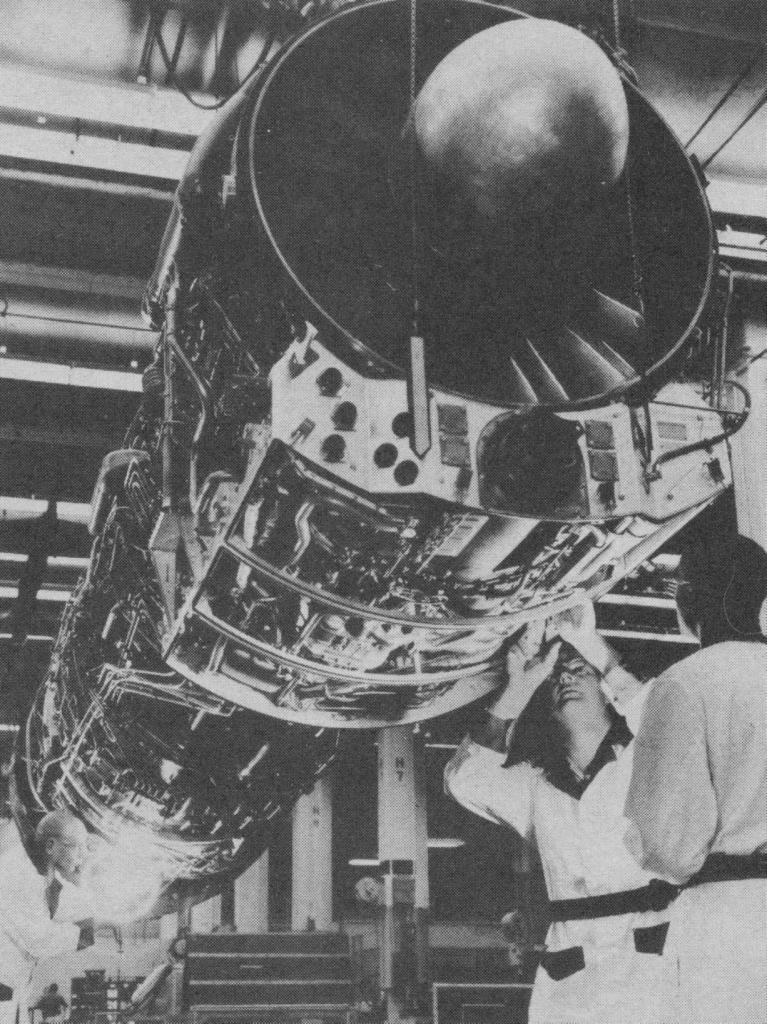
First run in 1968, the engine is unusual as the core flow path is twice reversed 180 deg. Aft of the fan, the axial compressor has five stages, after which the gas path progresses to the aft end of the engine. There, it is reversed 180 deg and flows through a centrifugal compressor stage, the combustors and then the turbine stages. Beyond this, the flow is then reversed 180 deg again to exit in the fan bypass duct. All engine accessories are mounted on the aft end of the engine under an engine tail-cone.

The engine was first flown in the Teledyne Ryan YQM-98 Compass Cope R high altitude UAV, as the YF104-GA-100. The engine proved to have a very low infrared signature, as the hot turbine was not externally visible and the core exhaust mixed with the bypass air before exiting the engine. The pilots of U-2 high altitude chase planes reported being unable pick up the YQM-98A with either radar or IR sensors. It was later used in the Northrop Tacit Blue stealth demonstrator because of these characteristics.

Certification of the Garrett ATF 3 was obtained in mid-May 1981. With initial production committed to the Guardian, the 5450 lb / 2468 kg ATF-3-6 was not available for commercial models until 1983.

The most significant application of the engine was on the Dassault HU-25 Guardian, developed for the US Coast Guard. It was also used on the Dassault Falcon 20G and Dassault Falcon 200.

The ATF3 was “selected by North American Rockwell for its new Series 60 Sabreliner business jet. . . . however, the ATF3 developed engineering and production problems. Delivery schedules were not met. North American Rockwell brought a $60 million suit against Garrett. . . . The suit was settled out of court for less than $5 million cash. The engine was ultimately selected for a version of the Dassault Falcon ordered by the U.S. Coast Guard for offshore surveillance”.

Applications:
Dassault Falcon 20G
Dassault Falcon 200
Dassault HU-25 Guardian
Northrop Tacit Blue
Ryan YQM-98 Compass Cope R
Vought ATLAS Lightweight Fighter series (projected baseline powerplant [ATF3-6 variant])

Specifications:
Type: Three shaft axial-flow turbofan
Length: 102.0 in (2,591 mm)
Diameter: 33.6 in (853 mm)
Dry weight: 1,125 lb (510 kg
Compressor: Single Stage Low Pressure Fan, 5 stage intermediate pressure axial compressor and single stage high pressure centrifugal compressor
Combustors: Reverse flow annular type
Turbine: 3 stage: single stage High Pressure, three stage intermediate pressure and two stage Low Pressure
Maximum thrust: 5,440 lbf (24.20 kN) – Take off, 1,055 lbf (4.69 kN) Cruise

Garrett TPE331 / TSE331 / T76 / Honeywell TPE331 / AlliedSignal TPE-331

TPE331-14

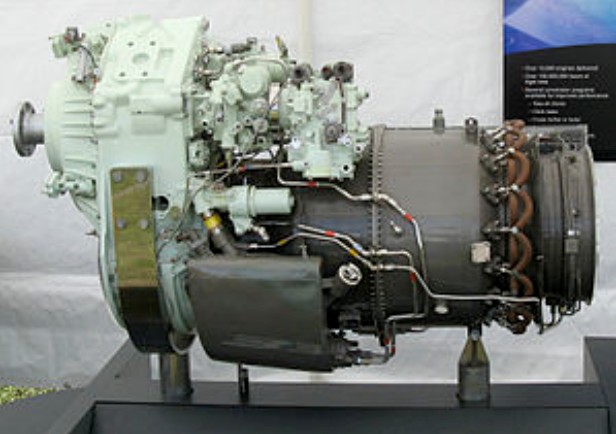
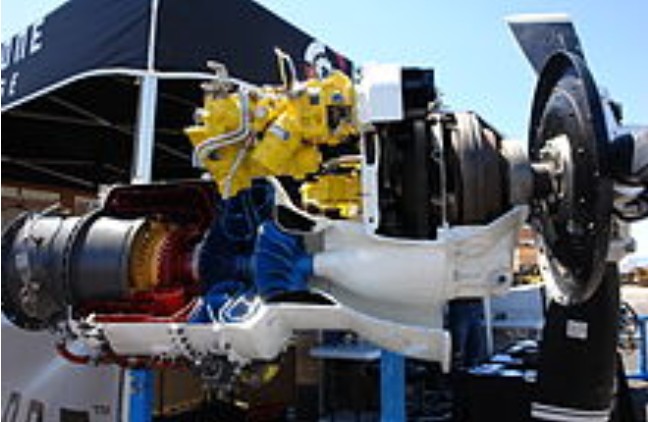
The Garrett AiResearch TPE331 is a turboprop engine originally designed by Garrett AiResearch, and produced under their new name Honeywell Aerospace since 1999.

The TPE331 originated in 1961 as a gas turbine (the “331”) to power helicopters. It first went into production in 1963. More than 700 had been shipped by the end of 1973. It was designed to be both a turboshaft (TSE331) and a turboprop (TPE331), but the turboshaft version never went into production. Over 14,000 TPE331s have been sold since the first engine was produced in 1963, installed on the Aero Commander in 1964 and put into production on the Aero Commander Turbo Commander in June 1965.

The TPE331 family includes 18 models and 106 configurations, the engines range from 575 shaft horsepower to 1650 shp The military version is designated the T76.

The T76 single-shaft military turboprop derivative of the TSE331 turboshaft of the early 1960s has only one application in the Rockwell OV-10 Bronco counter-insurgency aircraft. Some OV-10A, B and C variants have been built with the T76-G-10 and -12 (handed for clockwise and anti-clockwise rotation).

In October 1976 the OV-10D Night Observation Surveillance (NOS) variant of the OV-10A made its first flight, re-engined with the1,040 s.h.p. T76-G-420 and -421. A further 32 OV-10E and-10F Broncos were also ordered.

The configuration of the T76 is the same as that of the civil TPE331 except for the use of a chin intake rather than an above-the-gearbox inlet.

Applications:

Aero/Rockwell Turbo Commander 680/690/840/960/1000
Antonov An-38
Ayres Thrush
BAe Jetstream 31/32
BAe Jetstream 41
Beech Model 18
Beech King Air B100
CASA C-212 Aviocar
Cessna 441 Conquest II
Cessna Skymaster
Comp Air 9
Conroy Stolifter
de Havilland Dove
Dornier Do 228
Epic Escape
Fairchild Swearingen Metroliner
FMA IA 58 Pucará
General Atomics MQ-9 Reaper
Grumman Ag Cat
Grumman S-2 Tracker
Handley Page Jetstream
Marsh S-2F3AT Turbo Tracker
Mitsubishi MU-2
North American Rockwell OV-10 Bronco
PAC Fletcher
Pilatus/Fairchild PC-6C Turbo-Porter
Piper Cheyenne 400
RUAG Do 228NG
Short SC.7 Skyvan
Short Tucano
Swearingen Merlin
Volpar Model 4000

Specifications:

TPE331-43A
Type: Single-shaft turboprop with integral gearbox
Length: 46 in (1168 mm),
Diameter: 21 in (533 mm)
Dry weight: 336 lb (153 kg)
Compressor: Two-stage centrifugal
Combustors: Reverse annular
Turbine: Three-stage axial
Maximum power output: 575 hp (429 kW)

Fuji T-1 Hatsitaka

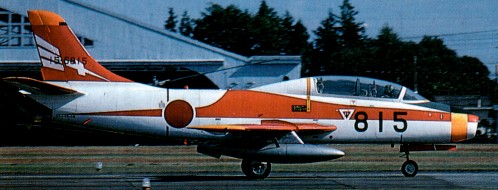
First post-war jet aircraft of Japanese design, the prototype T1F2 flew for the first time on January 19, 1958, powered by a 4,000 lb thrust Bristol Siddeley Orpheus 805 turbo-jet. Two production batches of 20 of this version were built as standard two-seat intermediate jet trainers for the Japanese Air Self-Defence Force, under the designation T1A.

Fuji T-1 Hatsitaka Article

They were followed by the all-Japanese T1F1 (JASDF designation TIB) with a 2,645 lb thrust J3 IHI 3 turbojet produced by Ishikawajima-Harima. The prototype of this version flew on May 17, 1960, and 20 production models were ordered by the JASDF for delivery between August 1962 and March 1963.

Fuji T1F2 (T1A)

T1A / T1F2
Engine: 1 x 4,000 lbs.t. (1814 kgp) Bristol Siddeley Orpheus 80506.
Span: 34 ft 5.5 in (10.5 m)
Length: 39 ft 9.25 in (12.12 m)
Wing area: 239 sq.ft (22.22 sq.m)
Height: 13ft 3in
Empty weight: 5,335 lb (2 420 kg)
Loaded weight: 9,150 lb (4 238 kg)
Gross weight: 10,6701b
Max speed: 576 mph (921 kph) at 20,000ft (6100 m)
Cruise: 397 mph (640 kph)
Initial climb: 3,460 fpm (17.3 m/sec)
Ceiling: 52,490 ft (16000 m)
Range: 806 mls (1297 km).
Max rate of climb at SL: 6,100 ft/min

T1B / T1F1
Engine: 1 x 2,645 lbs.t. (1200 kgp) J3 IHI 3.