Grumman G-93 F9F Panther / Cougar / G-99

F9F Cougar

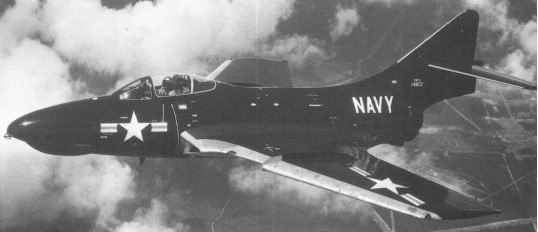
The first jet-powered ‘cat’ to be produced by Grumman and the first carrier borne jet to get into combat, the F9F Panther performed Korea where it constituted the backbone of US Navy and US Marine Corps air power, and by the time production ceased in late 1952 close to 1,400 had been built.

The Cougar was a swept-wing development of the earlier G-79 Panther. The fuselage was similar but the wings and tailplane were swept at 35 deg. The original layout of this single-seat carrier-based fighter provided for the installation of four wing-mounted Westinghouse 19XB-2B (Navy J30) axial-flow jets. But this arrangement was abandoned in favour of one fuselage-mounted high-powered turbojet engine before prototype construction began, a change prompted by the successful tests conducted by the Navy in December 1946 with two imported Rolls-Royce Nene engines. Grumman then turned its attentions to a single-seat single engine jet day fighter, two prototypes duly being ordered with the designation XF9F-2. Powered by an imported Rolls-Royce Nene engine, the first of these made its maiden flight on 24 November 1947 and such was the promise shown that substantial orders were soon forth¬coming for production-configured F9F-2 aircraft fitted with the licence-built Pratt & Whitney J42 copy of the Nene turbojet and British made Stanley Model 22G ejection seat.

The second prototype was similarly fitted, but the third (the XF9F-3) had an Allison J33 engine. Production aircraft were divided between Nene and Allison-powered models, the former engines licence-built by Pratt & Whitney as J42s.

The first production F9F-2, powered by a 22.24kN J42-P-6, flew for the first time on 24 November 1948. The 20.46kN J33-A-8-powered prototype flew for the first time on 15 August 1948 and a total of 418 of both versions were built. However the F9F-2 proved to be the better version and the F9F-3s were re-engined to F9F-2 standard.

Although the F9F-2 was the initial production model, the honour of being the first variant to enter service fell to the F9F-3, which used the slightly less powerful Allison J33 engine. This joined US Navy Fighter Squadron VF-51 during May 1949 but in the event only 54 F9F-3s were completed, most being modified later to F9F-2 standard. The next version to appear was the F9F-4 (73 of which were ordered originally) with the Allison J33-A-16, but none was completed and the contracts were combined with those for more than 580 27.80kN Pratt & Whitney J48-P-4/6A-engined F9F-5s (which flew for the first time on 21 December 1949). The F9F-2, -3, -4 and -5 were in service in 1955.

The most prolific variant was the F9F-5 which was powered by the Pratt & Whitney J48, a licence-built Rolls-Royce Tay, and redesigned fin and rudder. Over 600 were completed by the time production ceased at the end of 1952, this total including a small number of F9F-5P aircraft for photo reconnaissance duties. F9F-5P is long-nosed photo-reconnaissance version. Later machines can be seen with flight refuelling nose-probe.
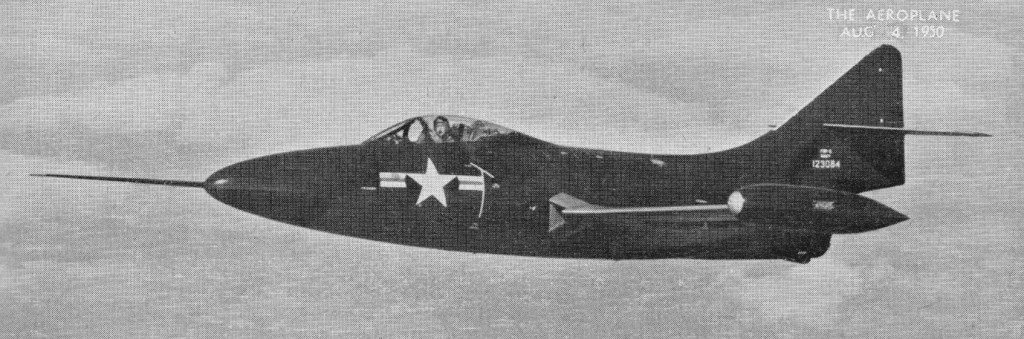
F9F-5 Panther

The F9F-5 was the last version to see squadron service, being finally retired by VAH-7 in October 1958, although many Panthers continued to fly after that date with training units, and as F9F-5KD (from 1962 DF-9E) drone targets and controllers for missile trials.
The F9F-4 was powered by an Allison J33-A-16 engine. The F9F-5P was a photographic-reconnaissance version with a longer camera nose.

First flown in prototype form as the XF9F-6 on 20 September 1951, the Grumman F9F Cougar evolved from the earlier F9F Panther series of fighter aircraft. It differed mainly from its predecessors by virtue of posses¬sing swept wings and tailplane, thus earning the distinction of being the first swept-wing carrierborne type to enter service. Apart from this, changes were kept to a minimum to facilitate rapid production. Indeed, the new Cougar entered service just 14 months after its maiden flight took place, initial exam¬ples of the 32.25kN Pratt & Whitney J48-P-8-engined F9F-6 (later designated F-9F) joining VF-32 of the Atlantic Fleet naval air force during November 1951.

F9F-5 Cougar

Shortly after this, deliveries to Pacific Fleet units got under way, and the type was very soon introduced to combat in Korea. Production of the F9F-6 totalled 706 aircraft, 60 of which were completed as unarmed F9F-6P machines for reconnaiss¬ance duties with a longer nose to accommodate K-17 and tri-metrogon cameras, and these were followed by the F9F-7 (F-9H) which was pow¬ered by an Allison J33-A-16A turbojet. This proved to be only a temporary change, and after completing 168 F9F-7s Grum¬man reverted to the Pratt & Whitney J48 engine for the F9F-8 (which bore the Grumman design designation G-99) (F-9J), which became the definitive Cougar, well over 1,000 being completed in three basic variants. First to appear was the F9F-8 (601 built). Movable leading-edge slats were replaced by fixed cambered leading-edge extensions outboard of the wing fences. Total internal fuel capacity was increased by 530 litres. Large numbers were later modified to F9F-8B (AF-9J) standard with provision for air-to-surface guided missiles. The first production F9F-8 flew on 18 January 1954.

Grumman F9F Cougar / Panther Article

Some 110 of a photo-reconnaissance version designated F9F-8P (RF-9J) flew for the first time on 21 August 1955 and had an extended nose for the cameras.
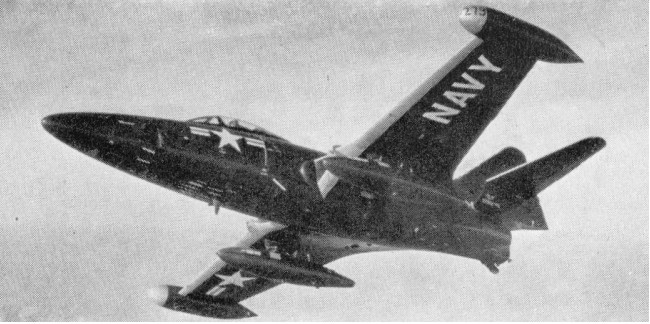
F9F-5P

The Cougar also lent itself to the training of future naval aviators; a prototype two-seat YF9F-8T first flown on 4 April 1956 was followed by 399 F9F-8T (TF-9J) production examples, some of which remained in use with Naval Air Training Command until well into the 1970s. The F8F-8T was armed with two 20mm cannon and was 23 inch longer than the original cougar. Production of this version ended on the last day of 1959.

As far as front-line units were concerned, the Cougar disappeared from the scene early in 1960, the last operational version being the F9F-8P, but many continued to fly long after that date with the Reserve Force and with Air Training Command. Surplus aircraft became F9F-6K (QF-9F) and F9F-6K2 (QF-9G) target drones or F9F-6D (DF-9F) drone directors.
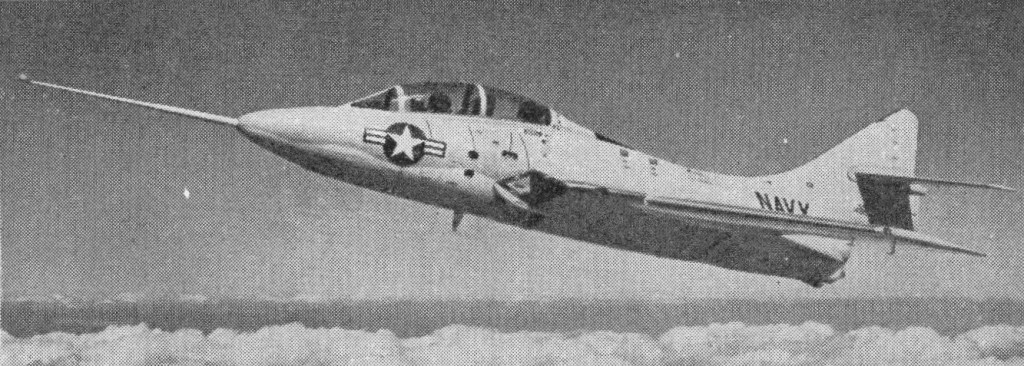
F9F-8T Cougar

Panthers are remembered for recording a victory against an enemy jet aircraft, a MiG-15, on 9 November 1950.

Replica: Gros F9F Panther

Gallery

F9F-5 Panther
Engine: one 3175-kg (7,000-lb) thrust Pratt & Whitney 148-P-6A turbojet
Maximum speed 932 km/h (579 mph) at 1525 m (5,000 ft)
Cruise speed: 774 km/h / 481 mph
Service ceiling 13380 m (43,900 ft)
Range 2092 km (1,300 miles)
Empty weight 4603 kg (10,147 lb)
Maximum take-off 8492 kg (18,721 lb)
Wingspan 11.58 m (38 ft 0 in)
Length 11.58 m(38 ft 0 in)
Height 3.73 m (12 ft 3 in)
Wing area 23.23 sq.m (250 sq ft).
Armament: four 20-mm cannon, plus up to 1361 kg (3,000 lb) of external ordnance.
Crew: 1

F9F-5 Cougar
Naval fighter
Engine: Pratt & Whitney J48-P-8 turbojet with afterburner, 7200 lb. thrust
Wingspan: 36 ft. 5 in
Length: 42 ft. 3 in
Loaded weight: approx. 20,000 lb.
Max. speed: 690 m.p.h.
Ceiling. 50,000 ft.
Range: approx. 1,000 miles.
Crew: 1
Armament: 4×20 mm. Cannon

F9F-5P
Naval photo-reconnaissance aircraft
Engine: Pratt & Whitney 148-P-6A turbojet, 6,250 lb. thrust
Wingspan: 38 ft
Max. speed: 625 m.p.h.
Loaded weight: 15,750 lb.
Ceiling: over 50,000 ft.
Max. range: 1,200 miles.
Crew: 1.
Armament: None

F9F-6
Engine: Pratt & Whitney J48-P-6A, 6,250 lb (2 835 kg).

F9F-7
Engine: Allison J33-A-16, 6,250 lb (2 835 kg).

F9F-8 Cougar
Engine: one 3289-kg (7, 250-lb) thrust Pratt & Whitney J48-P-8A turbojet.
Maximum speed 1033 km/h (642 mph) at sea level
Service ceiling 12800 m (42,000 ft)
Range 1690 km(l,050 miles)
Empty weight 5382 kg (11,866 lb)
Maximum take-off 11232 kg (24,763 lb)
Wingspan 10.52 m (34 ft 6 in)
Length 12.73 m(41 ft 9 in)
Height 3.72 m (12 ft 2.5 in)
Wing area 31.31 sq.m (337 sq.ft).
Armament: four 20-mm cannon, plus up to 1814 kg (4,000 lb) external ordnance

F9F-8P

TF-9J
Engine: 1 x Pratt & Whitney J48-P-8A turbojet, 32.0kN
Max take-off weight: 9344 kg / 20600 lb
Wingspan: 10.52 m / 34 ft 6 in
Length: 13.54 m / 44 ft 5 in
Height: 3.73 m / 12 ft 3 in
Service ceiling: 15240 m / 50000 ft
Range: 966 km / 600 miles
Armament: 2 x 20mm cannon, 907kg external

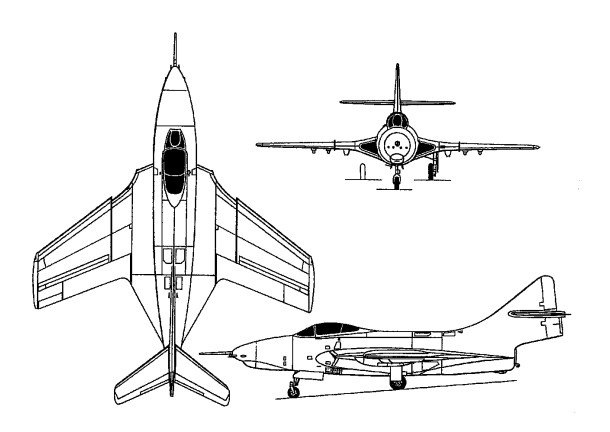
Grumman F9F Panther
Grumman F9F Cougar

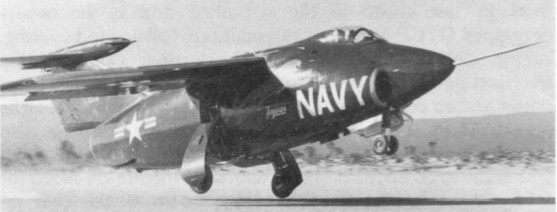
Grumman G-83 / XF10F Jaguar

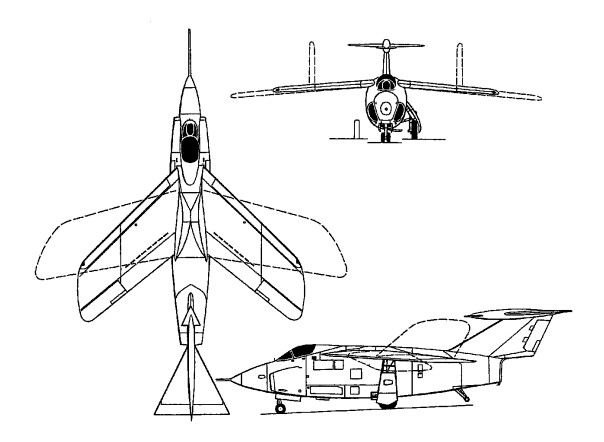
Greater success attended the development of variable-geometry wings, which allow the use of a minimum-sweep position for take-off and landing, an intermediate-sweep position for fuel-economical cruise, and a maximum-sweep position for high dash performance. The navy’s first essay in this field was the Grumman XF10F Jaguar, which was conceived in 1948 as a possible successor to the F9F Panther. The aerodynamic features of a variable-geometry type had already been explored in a number of aircraft, most notably the Westland Pterodactyl IV developed in the UK during the early 1930s, the Messerschmitt P.1011 designed in Germany during World War II, and the experimental Bell X-5 sponsored by NACA and the LTSAF with the ultimate purpose of validating a fighter-type wing with sweep variable between 20 deg and 60 deg. The X-5 had not flown when Grumman set to work on the Jaguar, but a considerable quantity of engineering data was available and this proved valuable to the Grumman engineers, who were faced with a host of problems.
Originally the XF10F had been planned as a development of the Panther with clipped delta flying surfaces. Designed as a transonic single-seat shipboard fighter with an internal armament of four 20-mm cannon and provision for an external bomb load of up to 4,000 lb (1814 kg). The sweep angle of the wings could be varied hydraulically between 13.5 and 42.5 deg, and high-lift devices consisted of full-span slats and an 80 per cent Fowler flap. The concept was then refined to the point at which a tilting variable-incidence wing was in adopted for reduction of the take-off and landing speeds. The navy then added additional responsibilities to the basic fighter-role, and these so increased the structure weight that the company came up with the notion of providing a variable-geometry wing. Further refinement was added after this when it was decided to allow the wing to be swept at any angle between the minimum- and maximum-sweep angles. The provision of such wings increased the type’s weight by 2200 lb (998 kg) but reduced landing speed from 132.5 mph (213 km/h) to 109 mph (175 km/h). The Jaguar was also provided with an advanced control system that included a delta surface forward of the fin to act as a servo for the all-moving tailplane and so improve control response at transonic speed.
The tailplane was operated by a novel arrangement where the pilot controlled a small delta-wing airfoil at the tip of the tail bullet. This in turn moved the main elevator Unfortunately, a lag in the response between stick and surface usually resulted in a Pilot Induced Oscillation (PIO) and the Jaguar was virtually uncontrollable much of the time.

The engineering of so complex an aeroplane took considerably longer than expected, and it was May 1953 before the XF10F prototype flew, three years behind schedule. The Jaguar was intended to be powered by a Westinghouse XJ40-WE-8 turbojet rated at 7,400 lb (3 357 kg) military thrust and 10,900 lb (4 944 kg) with full reheat, but when flight trials were initiated on 19 May 1952, a J40-WE-6 rated at 6,800 lb (3 084 kg) was fitted. The novel servo-control system for the tailplane proved far too slow in operation, and was replaced by a conventional powered tailplane, but it soon became clear that considerable revision of the basic design would have to be undertaken before production aircraft could be considered. Numerous problems arose during the test programme and as some of these could not be resolved, trials terminated with the 32nd flight on 25 April 1953. Orders had been placed for 112 production F10F-1s, but 100 of these were cancelled on 1 April 1953 and the remaining 12 on the following 12 June.

Empty weight, 20,426 lb (9 265kg).
Max loaded weight, 35,450 lb (16080 kg).
Span (min sweep), 50 ft 7 in (15,42 m), (max sweep), 36 ft 8 in (11, 17 m).
Length, 54 ft 5 in (16,59 m).
Height, 16 ft 3 in (4,95 m).
Wing area (min sweep), 467 sq ft (43,38sq.m), (max sweep), 450 sq ft (41,81sq.m).
Max. speed: 1143 km/h / 710 mph
Range: 2687 km / 1670 miles

Grumman A-6 Intruder / A2F

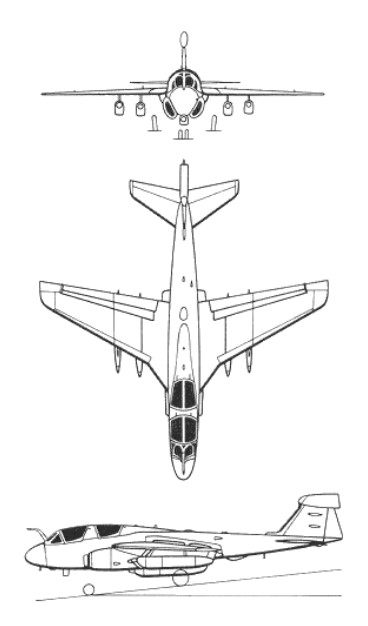
EA-6B

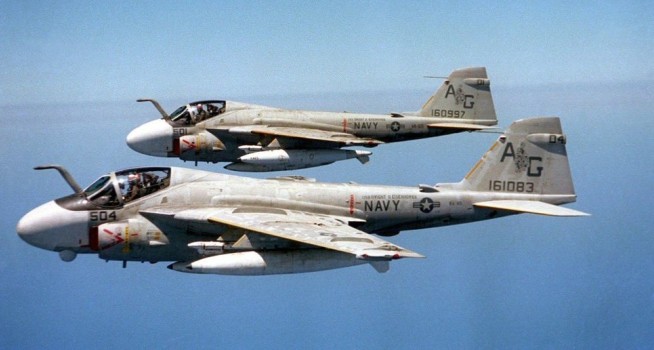
Tasked with finding and attacking targets under night or all weather conditions for the U.S. Navy/Marine Corps, A2F-1 Intruders were designed and developed by the Grumman Aerospace Corporation. The first trials aircraft flew on 19 April 1960 and eight YA2F-1 Intruder prototypes were delivered to the US Navy for evaluation, with original tilt able tailpipes and powered by two Pratt & Whitney J52-P-6 engines of 8500 lb.

Grumman A-6 Intruder Article

The A2F-1 was designed to deliver nuclear or conventional weapons with great accuracy on targets that are completely obscured by bad weather or darkness. A digital integrated attack navigation system enables the pilot to set course for the target and then leave the aeroplane to fly itself. Two TV-type screens enable him to “see” the ground and target whatever the conditions. At the target the aircraft is capable of dropping its weapons and turn for home automatically.

The slightly swept tail surfaces have a variable incidence tailplane. Lateral control is by inset spoilers forward of the trailing edge flaps which extend over almost the full wing span. Full span leading edge flaps are fitted. The outer wings fold upward and inward for ship-board stowage. Sideways opening air-brakes are on each side of the rear fuselage. The tricycle undercarriage has twin nose-wheels and a single wheel on each main unit. The nosewheel retracts rearward and main units forward.

The first prototype flew in November 1960.

A2F-1 Intruder

The first US Navy attack squadron to receive the Grumman A 6A Intruder, VA 42, re-equipped with the type at Oceana NAS, Virginia, in 1963.

In August 1964 it was reported that South Africa, rebuffed by the US State Department in bid to buy Grumman Intruders because of its race policies, was buying British Buccaneers instead.

From the A 6A was evolved the initial EA 6A ECM version for the Navy, its potential such that an advanced ECM version was developed in late 1966.

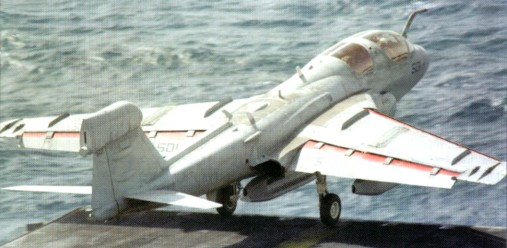
A development contract was issued in autumn 1966 and the EA-6B Prowler is externally similar to basic A-6 except longer nose enclosing four-seat cockpit and large pod on fin. First flown on 25 May 1968, delivery of first 12 production aircraft started January 1971. The first flew with an ALQ-99 jamming system which has evolved from being able to cope only with individual emitters (EXCAP), through several emitters (ICAP), to groups of weapons systems such as an air defence complex (ICAP¬ 2). The last of 170 was delivered on 29 July 1991.

The Grumman EA 6B was the Navy’s first aircraft to be purpose designed and built for tactical electronic warfare, two of the crew being ECM officers to operate the airborne equipment which can detect, identify, locate, and jam the emissions of hostile radars.
Eight Prowlers were deliv¬ered to the US Navy in 1986, and plans call for production of the current ICAP-2 (Improved Capability) EA-6B shipborne electronic warfare aircraft to continue until at least 1991. Earlier EA-6Bs are being upgraded to ICAP-2 standard, which includes power management, improved emitter identification and correlation, and better reliability and maintainability. The first ICAP-2 flew in June 1980. EA-6Bs can now carry Harm anti-radiation missiles.

The A-6E began to enter service in 1972.

On 22 March 1974 Grumman flew the first A-6E TRAM version of the Intruder, this incorporating a turreted electro-optical sensor package for the delivery of laser-guided weapons; the TRAM target recognition attack multi-sensor) added infra-red and laser equipment to the full A-6 avionics systems.

Grumman A-6/TRAM Intruder Article

An advanced version of the Intruder subsonic all-weather carrier-borne strike aircraft, the A-6F, was scheduled to fly during 1987. Production deliveries will begin in 1989, against US Navy/USMC requirements for 150 aircraft. A-6F improvements include a new Norden high-resolution synthetic-aperture radar, stand-off ASM, and AIM-120 Amraam/ AIM-9 Sidewinder AAM capability. The A-6F will be powered by two 40.07kN General Electric unreheated F404 turbofans, will have a new wing designed by the Boeing Military Airplane Company, and will be fitted with a new CRT¬ based cockpit and digital avionics. Much of the avionics being carried in five external pods.

The new Boeing wing, which is to be retro-fitted to all existing A-6E/KA-6Ds from 1987, will offer an 8,000hr service life. A-6E target recognition and attack multisensor (Tram) production continues, and 12 were delivered in 1986. The modification of earlier A-6Es to accept Tram turrets also progresses. The tram turret houses both a Flir system and a laser tracker/designator.
The KA-6D is a flight-refuelling tanker converted from the original A-6A Intruders or from older A-6Es.

On 3 April 1989 an A-6E made its first test flight fitted with Boeing-built composite wings.

A total of 482 A 6 were built.

Northrop Grumman undertook EA-6B Prowler remanufacturing,

The US Navy continued to fund the A-6F in 1988 although production was no longer planned. Two A-6Fs were flying, the third, intended as a test-bed for the digital avionics suite, entered testing in late August 1988.

Gallery

A2F-1
Engines: 2 x Pratt Pratt & Whitney J52-P-6, 8500 lb
Wingspan: 53 ft
Length: 53 ft 5 in
Height: 15 ft 1.75 in
Empty weight: 24,000 lb
MTOW: 54,000 lb
Max speed: 720 mph at SL
Max cruise: 685 mph at SL
Hardpoints: 4 wing, 1 fuselage

A-6
Engines: 2 x Pratt & Whitney J-52-P-8A, 41.3kN
Weight empty : 26008.0 lb / 11795.0 kg
Max take-off weight: 27500 kg / 60627 lb
Wingspan: 16.2 m / 53 ft 2 in
Length: 16.3 m / 53 ft 6 in
Height: 15.584 ft / 4.750 m
Wing area: 49.2 sq.m / 529.58 sq ft
Wing loading: 114.39 lb/sq.ft / 558.00 kg/sq.m
Max. speed: 1000 km/h / 621 mph
Cruise speed: 770 km/h / 478 mph
Ceiling: 12700 m / 41650 ft
Range w/max.fuel; 5000 km / 3107 miles
Crew: 2
Armament : 6804kg ext. (5 pt.)

EA-6A Prowler

KA-6D Intruder

A-6E Intruder
Engine: 2 x P&W J52 P 8A, 9,300lb turbojet.
Installed thrust (dry): 83 kN.
Span: 16.2 m.
Length: 16.7 m.
Wing area: 49.1 sq.m.
Empty wt: 12,000 kg.
MTOW: 26,580 kg.
Warload: 8165 kg.
Max speed: 1040 kph.
Initial ROC: 2300 m / min.
Ceiling: 12,950 m.
Fuel internal: 9030 lt.
Max range: 4399 km.
Air refuel: Yes.
Combat radius hi-lo-hi: 1415 km.

A-6F Intruder

EA-6B Prowler
Engine: 2 x P&W J52-P-408 turbojet, 11,200 lb thrust.
Installed thrust: 99.6 kN.
Span: 16.2 m / 53 ft 2 in
Length: 18.2 m
Wing area: 49.1 sq.m / 528.51 sq ft
Height: 5.0 m / 16 ft 5 in
Empty wt: 15686 kg / 34582 lb
MTOW: 26535-28655 kg / 58500 – 63174 lb
Max speed: 965 km/h / 600 mph
Cruise speed: 850 km/h / 528 mph
Initial ROC: 2540 m / min.
Ceiling: 11,600 m / 38050 ft
T/O run: 815 m.
Ldg run: 655 m.
Fuel internal: 8870 lt.
Range: 535 km.
Endurance: 1 hr loiter.
Range w/max.fuel: 4000 km / 2486 miles
Crew: 4

A2F-1
Engines: 2 x Pratt & Whitney J52-P-6, 8500 lb

Grumman EA-6B Prowler

Gross JG-2

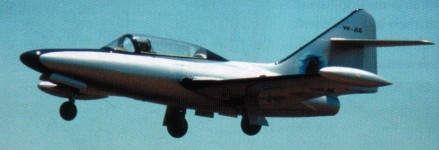
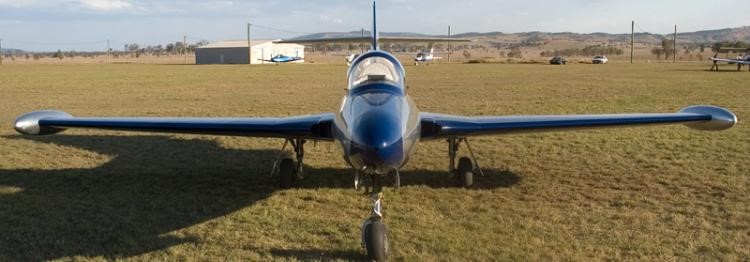
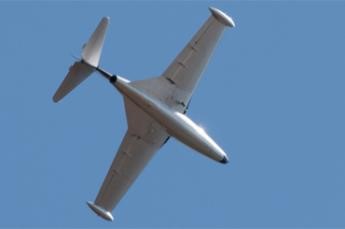
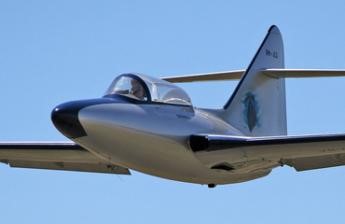
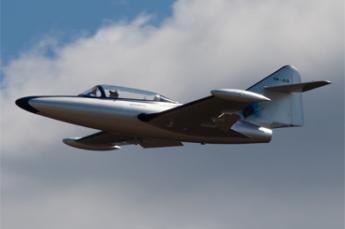
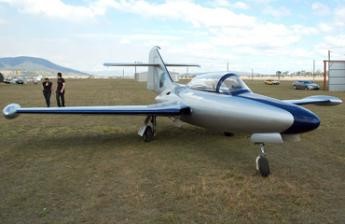
Designer and builder, John Gross, built the 3/4 scale replica Grumman F9F Panther at a Mt Cotton property a few miles south east of Archerfield (Australia).

After 8 years of work, the homebuilt JG-2 took-off for the first flight on April 1 2006 at Kingaroy airport.

Power is from a GE T58-8F turbojet.

Grob G-180 SPn

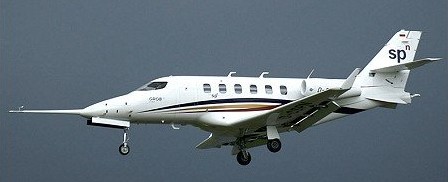
The Grob G-180 SPn (or spn) is a low-wing twin-engined corporate jet projected by Grob Aircraft in 2005. It can land on both paved surfaces and unimproved runway capability.

Engines: 2 x 1270kg Williams FJ44-3A turbofans
Max take-off weight: 6300 kg / 13889 lb
Wingspan: 14.86 m / 49 ft 9 in
Length: 14.81 m / 49 ft 7 in
Height: 5.12 m / 17 ft 10 in
Cruise speed: 754 km/h / 469 mph
Ceiling: 12497 m / 41000 ft
Range: 3334 km / 2072 miles

Gluhareff EMG-300

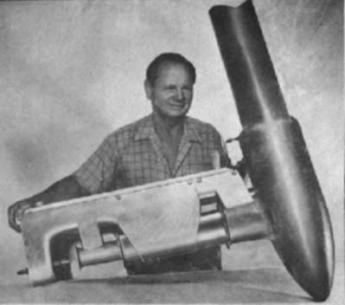
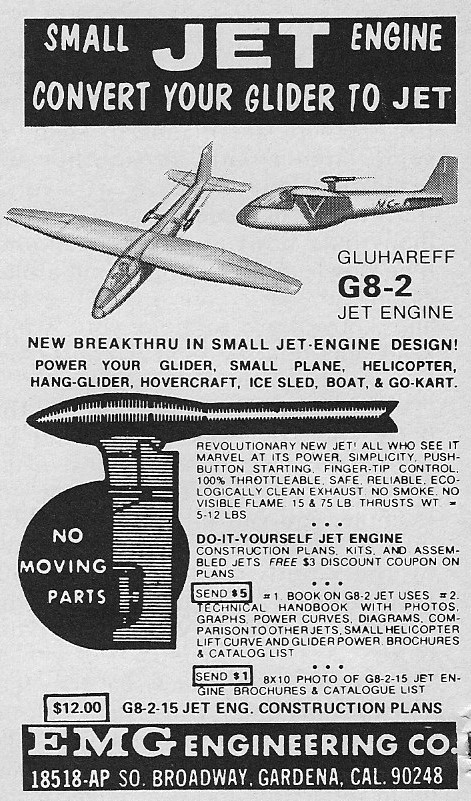
Mr. Gluhareff pioneered the use of liquid propane as a fuel for jet engines and a series of ultra-light portable one-man-helicopters, MEG-1X, MEG-2X and MEG-3X which were designed and built by his own company, Gluhareff Helicopters Corporation. All of which were powered by the G8-2 Pressure Jet Engine on the blade tip and test flown by Eugene M. Gluhareff.
In 1972 Mr. Gluhareff returned to research and design under his own company name of EMG Engineering in Gardena, California. There he continued his work on the G8-2 Pressure Jet Engines which ranged from five pounds of thrust to 700 pounds of thrust.
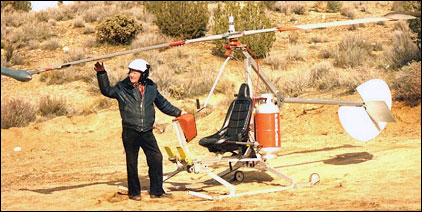
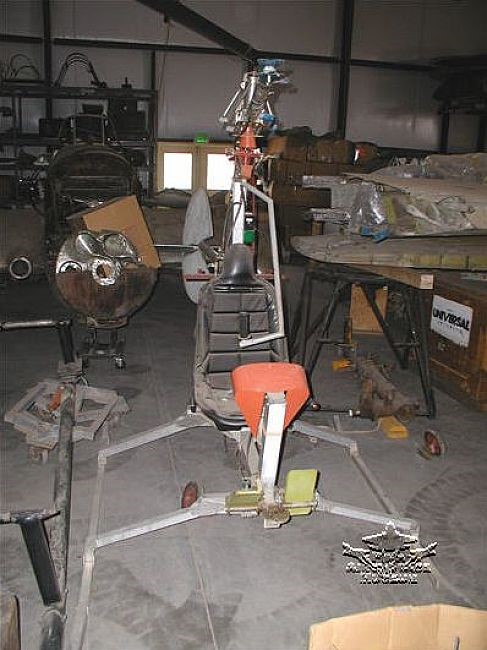
Mr. Gluhareff designed, built and tested his own one-man tip jet helicopter, the EMG-300 in the early 90’s. Its successful test flight marked the realization of Mr. Gluhareff’s lifelong dream to design what he called a “Flying Motorcycle”.
The EMG-300 was his last design before his death in 1994, it had completed an initial series of test flights, but was not completely tested at the time of his death.

EMG-300
Engine: 2 x G8-2-20H jet engines 10kg of thrust each
Fuel: liquid propane
Fuel capacity: 70 litres
Rotor diameter: 7.3m
Fuselage length: 4.57m
Height: 2.1m
Empty weight: 109kg
Take-off weight: 208kg
Maximum speed without canopy (est.): 112km/h
Maximum speed with canopy (est.): 193km/h
Range: 280km
Endurance: 2.5hr

Gluhareff MEG-3X

Mr. Gluhareff pioneered the use of liquid propane as a fuel for jet engines and a series of ultra-light portable one-man-helicopters, MEG-1X, MEG-2X and MEG-3X which were designed and built by his own company, Gluhareff Helicopters Corporation. All of which were powered by the G8-2 Pressure Jet Engine on the blade tip and test flown by Eugene M. Gluhareff.
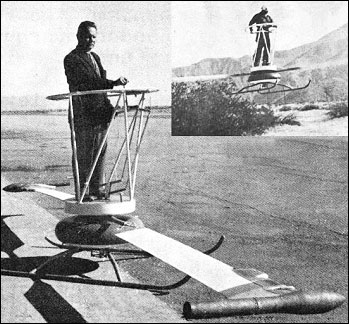
Eugene Gluhareffs tip-mounted G8-2 engine MEG-3X was based on a dish-shaped platform on which the pilot would stand and a two-blade rotor revolving underneath the platform. No commercial development was undertaken.

Gluhareff MEG-2X

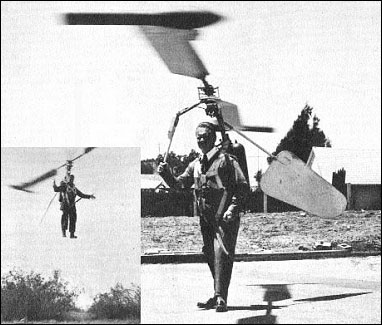
Mr. Gluhareff pioneered the use of liquid propane as a fuel for jet engines and a series of ultra-light portable one-man-helicopters, MEG-1X, MEG-2X and MEG-3X which were designed and built by his own company, Gluhareff Helicopters Corporation. All of which were powered by the G8-2 Pressure Jet Engine on the blade tip and test flown by Eugene M. Gluhareff.
The MEG-1X personal strap-on helicopter rig with a tip-mounted G8-2 engine was followed by the MEG-2X which had a two-blade rotor. No commercial development was undertaken.

Gluhareff MEG-1X

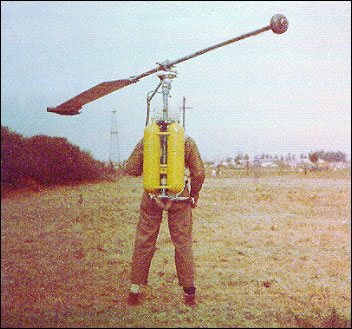
Eugene Gluhareff established a development company in 1952 to carry out research into pressure-jet powered light helicopters. Mr. Gluhareff pioneered the use of liquid propane as a fuel for jet engines and a series of ultra-light portable one-man-helicopters, MEG-1X, MEG-2X and MEG-3X which were designed and built by his own company, Gluhareff Helicopters Corporation. All of which were powered by the G8-2 Pressure Jet Engine on the blade tip and test flown by Eugene M. Gluhareff.
He built the MEG-1X personal strap-on helicopter rig which used a single-blade rotor with a tip-mounted G8-2 engine and followed this with the MEG-2X which had a two-blade rotor. No commercial development was undertaken.

MEG-1x
Take-off weight: 104kg
Max speed: 88.5km/h
Hovering ceiling: 1500m
Endurance: 14-18min