Westinghouse 24C / J34

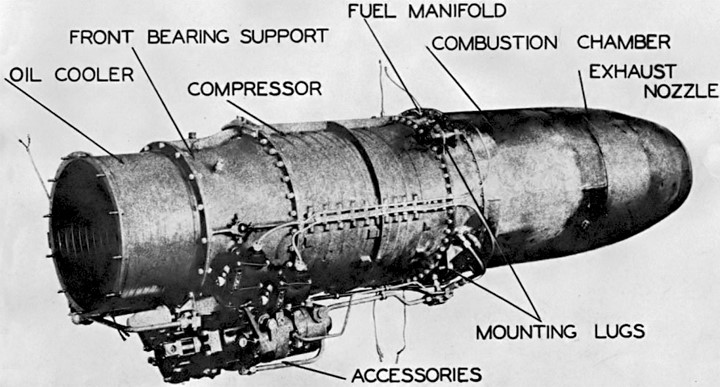
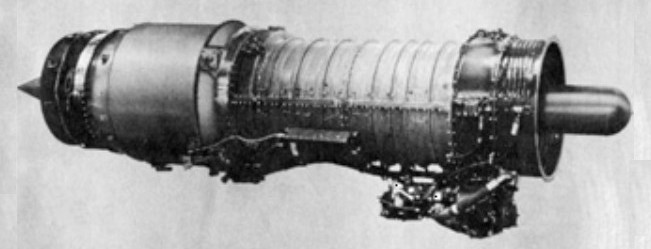
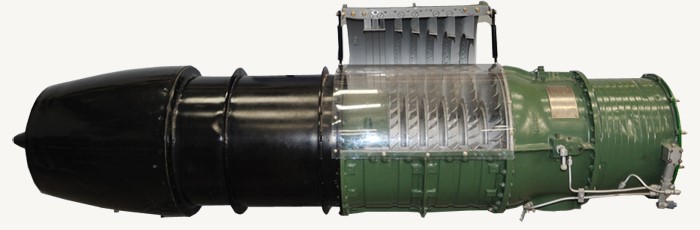
The Westinghouse J34, company designation Westinghouse 24C, was a turbojet engine developed by Westinghouse Aviation Gas Turbine Division in the late 1940s. First run on 11 January 1947, the 24C was essentially an enlarged version of the earlier Westinghouse J30, the J34 produced 3,000 pounds of thrust, twice as much as the J30.

It first flew in 1947. Built in an era of rapidly advancing gas turbine engine technology, the J34 was largely obsolete before it saw service, and often served as an interim engine. For instance, the Douglas X-3 “Stiletto” was equipped with two J34 engines when the intended Westinghouse J46 engine proved to be unsuitable.
J34-WE34

Developed during the transition from piston-engined aircraft to jets, the J34 was sometimes fitted to aircraft as a supplement to other powerplants, as with the Lockheed P-2 Neptune and Douglas Skyrocket (fitted with radial piston engines and a rocket engine, respectively).

Later models produced as much as 4,900 lbs with the addition of an afterburner. The afterburner was developed by Solar Aircraft, the first U.S. company to produce a practical afterburner.

The J46 engine was developed as a larger, more powerful version of Westinghouse’s J34 engine, about 50% larger.

Variants:
J34-WE-2: 3,000 lb (13.4 kN) thrust
XJ34-WE-7: 3,000 lb (13.4 kN) thrust
J34-WE-13: 3,000 lb (13.38 kN) thrust
J34-WE-15: 3,000 lb (13.4 kN) thrust
J34-WE-15: 4,100 lb (18.2 kN) thrust
J34-WE-17: 3,370 lb (15 kN) thrust (4,850 lb (21.6 kN) thrust with afterburner)
J34-WE-19: 3,250 lb (14.5 kN) thrust
J34-WE-22: 3,000 lb (13.3 kN) thrust
J34-WE-30A: 3,150 lb (14.0 kN) thrust (4,224 lb (18.78 kN) thrust with afterburner)
J43-WE-32: 3,000 lb (13.3 kN) thrust
J43-WE-32: 3,400 lb (15 kN) thrust
J34-WE-34: 3,250 lb (14.5 kN) thrust
J34-WE-34-1: 3,000 lb (13.3 kN) thrust
J34-WE-36: 3,400 lb (15 kN) thrust
J34-WE-36: 4,000 lb (17.8 kN) thrust
J34-WE-36-1: 3,400 lb (15 kN) thrust
J34-WE-38: 3,600 lb (1,630 kg) thrust
J34-WE-40: 3,000 lb (13 kN) thrust
J34-WE-41: (with afterburner)

Applications:
Fairchild C-119 Flying Boxcar (civilian variant modification)
Convair F2Y Sea Dart
Curtiss-Wright XF-87 Blackhawk
Douglas F3D Skyknight
Douglas Skyrocket
Douglas X-3 Stiletto
Lockheed XF-90
Lockheed P-2E/G/H Neptune
McDonnell 119/220
McDonnell F2H Banshee
McDonnell XF-85 Goblin
McDonnell XF-88 Voodoo
Ryan FR Fireball
Vought F6U Pirate
Vought F7U Cutlass

Ken Warby’s Spirit of Australia jet boat
Shockwave (Jet Truck)
Pyro (Jet Truck)

Specifications:
J34-WE-36
Type: Turbojet
Length: 112 in (2.84 m)
Diameter: 27 in (0.69 m)
Dry weight: 1207 lb (547.5 kg)
Compressor: Single-Spool, 11-stage Axial
Combustors: Annular
Turbine: 2-stage turbine
Maximum thrust: 3400 lbf (15.12 kN)
Overall pressure ratio: 4.35:1
Specific fuel consumption: 1.04 lb/hr-lb
Thrust-to-weight ratio: 2.82:1
Westinghouse J30 / 19 / 19B / 19XB

Westinghouse 19A

combustion chamber and a single stage turbine.

On 19 March 1943, the first run was made. The static thrust developed being 515 kg (1,135 lb). On 21 January 1944 the second prototype was flown for the first time, under a Vought FG-1 Corsair. It was developed into the smaller J32, and the Westinghouse J34, an enlarged version which produced 3,000 pounds of thrust.

Six 19A were built all together. It initially gave 1,200 pounds of thrust but improved to 1,600 in production versions.

The 19B was to have a static thrust of 613 Kg (1350 lb) and be used as the main propulsion engine for an aircraft, rather than just a booster. The layout of the compressor and turbine was similar to the 19A, but 4 extra stages were added to the compressor to give ten in all. The previous cannular combustion chamber was replaced by an annular one.

First flight was made on 28 September 1944, using a JM-1 Marauder as a test-bed.

The McDonnell XFD-1 Phamtom powered by two 19Bs made its first flight on January 26, 1945. The Northrop XP-79B was also powered by two 19Bs, but crashed on its first flight on September 12, 1945.

A total of 28 19B were ordered.

Westinghouse submitted to the Navy a proposal for improving the performance and decreasing the weight of the 19B. This reconfigured engine was designated 19XB. The 1,600 lb thrust of the 19XB was achieved primarily by adding 4 additional axial-flow compressor stages.

The 19XB was used in the Grumman WTB3F-1, Douglas XB-42A (as auxiliary engines) and the Northrop X-4. The primary application for the 19XB engine was the McDonnell FH-1 Phantom.

A total of 261 19XB engines were made.

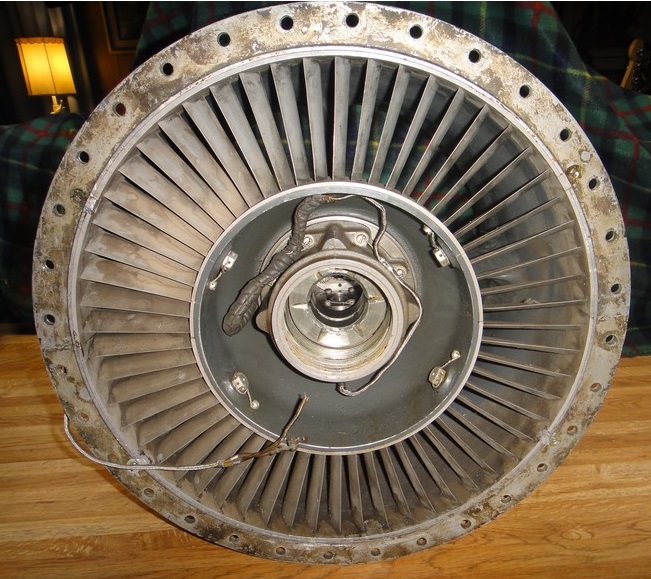
Inside/Rear view of 19XB2B Inlet
specific model: J30-P-20
Engine Spec Number: WAGT-19XB2B-102D
Accepted 12-23-47
(Courtesy Doug Colosio)

Variants:
19A
Prototypes and initial production

19B
Increased mass flow version delivering 1,400 lbf (6.23 kN) at 18,000 rpm at sea level

J30-WE-20
production engines delivering 1,600 lbf (7.1 kN) thrust

Applications:
Convair XF-92
McDonnell FH Phantom
Northrop XP-79
Northrop X-4 Bantam

Specifications:
Westinghouse 19A
Type: Axial flow turbojet
Length: 100 in (2,540.0 mm)
Diameter: 19 in (482.6 mm)
Dry weight: 830 lb (376.5 kg)
Compressor: 6-stage axial
Combustors: Annular stainless steel
Turbine: Single-stage axial
Fuel type: 100/130 gasoline
Oil system: pressure spray at 40 psi (275.8 kPa) dry sump, 60 S.U. secs (10.2 cs) (AN-0-6A) grade oil
Maximum thrust: 1,360 lbf (6.05 kN) at 18,000 rpm at sea level
Overall pressure ratio: 3:1
Turbine inlet temperature: 1,500 °F (816 °C)
Specific fuel consumption: 1.35 lb/lbf/hr (137.6 kg/kN/hr)
Thrust-to-weight ratio: 1.639 lbf/lb (0.016 kN/kg)
Normal thrust, static: 1,160 lbf (5.16 kN) at 18,000 rpm at sea level
Military thrust, flight: 660 lbf (2.94 kN) at 17,200 rpm at altitude
Normal thrust, flight: 570 lbf (2.54 kN) at 16,260 rpm at altitude

Westinghouse 19B
Type: Axial flow turbojet
Length: 104.5 in (2,654.3 mm)
Diameter: 19 in (482.6 mm)
Dry weight: 809 lb (367.0 kg)
Compressor: 6-stage axial
Combustors: Annular stainless steel
Turbine: Single-stage axial
Fuel type: 100/130 gasoline
Oil system: pressure spray at 40 psi (275.8 kPa) dry sump, 60 S.U. secs (10.2 cs) (AN-0-6A) grade oil
Maximum thrust: 1,400 lbf (6.23 kN) at 18,000 rpm at sea level
Overall pressure ratio: 3:1
Turbine inlet temperature: 1,500 °F (816 °C)
Specific fuel consumption: 1.28 lb/lbf/hr (130.48 kg/kN/hr)
Thrust-to-weight ratio: 1.724 lbf/lb (0.0169 kN/kg)
Normal thrust, static: 1,170 lbf (5.20 kN) at 17,000 rpm at sea level
Military thrust, flight: 525 lbf (2.34 kN) at 18,000 rpm at altitude
Normal thrust, flight: 465 lbf (2.07 kN) at 17,000 rpm at altitude

Vought F7U Cutlass

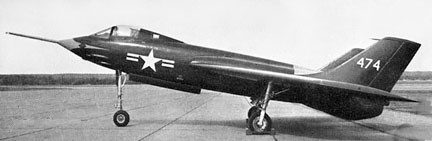
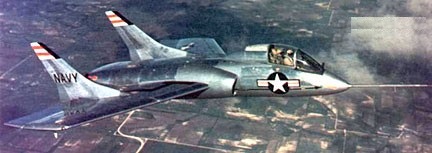
The Vought F7U Cutlass swept flying wing design had a large central nacelle and two substantial vertical tail surfaces. The first U.S. fighter designed from the start to use afterburners. Three prototype XF7U-1 (122472-122474) were built. The first flying on 29 September 1948.

Vought XF7U-1 122474

Vought F7U Cutlass Article

1950 production was 20 F7U-1 (124415-124434) as trainers.

Vought F7U-1 122474

S/ns 125322-125409 were assigned for F7U-2s, but production was cancelled.

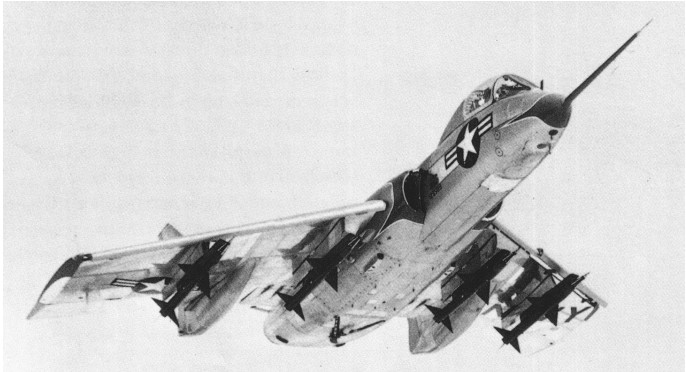
After 14 F7U-1’s, the Cutlass was in production for the U.S. Navy in 1951 as the F7U-3 interceptor and F7U-3P photo-reconnaissance aircraft with lengthened nose containing cameras. 288 F7U-3 (128451-128478 and 139868-139917 et al) were built, with a redesign, radar gunsight, four 20mm cannon; and two 4600 lb J46-WE-8A engines.

Vought F7U-3

Built in 1954 were the F7U-3M missile platform and F7U-3P photo-recon version.

Vought F7U-3P

Gallery

F7U-1 Cutlass
Engines: 2 x Westinghouse J34-WE-32, 3000 lb
Wingspan: 38’8″
Length: 39’7″
Speed: 672 mph
Range: 1170 mi
Ceiling: 41,400 ft
Armament: 6×20 mm. cannon
Seats: 1

F7U-3
Engines: 2 x J46-WE-8A, 4600 lb / 6100 lb afterburn
Wingspan: 38 ft 8 in
Length: 40 ft 10.5 in
Height: 11 ft 6.5 in
Empty weight: 13,100 lb
Normal loaded weight: 20,000 lb
Max weight: 23,000 lb
Max speed: 670 mph / 705 mph afterburn at SL
Max ROC: 13,000 fpm
Range: 660 mi
Ceiling: 40,000 ft
Armament: four 20m cannon
Bombload: 5400 lb

F7U-3P
Naval photo- reconnaissance aircraft
Engines: 2 x Westinghouse J46-WE-8A turbojets, 4,800 lb. thrust
Wingspan: 38 ft. 8 in.
Loaded weight: 20,000 lb
Max speed: 670 m.p.h.
Ceiling: Over 45,000 ft.
Crew: 1
Armament: None

Vought F6U-1 Pirate

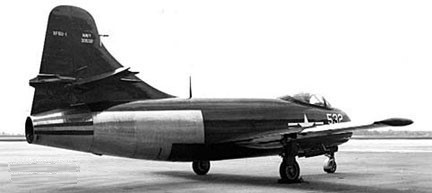
The Vought XF6U Pirate first flew on 2 October 1946. The Pirate was conceptually a less advanced aeroplane, although it did provide its pilot with excellent fields of vision from a bubble canopy very close to the nose. This cockpit position was made possible by the use of wing-root inlets for the 3000-lb (1361-kg) thrust Westinghouse J34-WE-2 2 turbojet. Three XF6U-1 were built (33532 to 33534) of which one was fitted with afterburner in Apr 1948, the first USN aircraft so equipped.

Vought XF6U-1 33532

Additional power was provided later by the 4200-lb (1905-kg) thrust J34-WE-30A engine, and this improved performance to the level at which 30 production aircraft were ordered.

The thirty F6U-1 were 122478 to 122507, of which 122483 was modified as an F6U-1P.

It took 18 months for these to reach the navy, and in this time the pace of development had been such that more modern types such as the Grumman F9F Panther and McDonnell F2H Banshee were offering much improved performance.

Vought F6U-1

Engine: 1 x Westinghouse J34-WE-22
Wingspan: 32’10”
Length: 35’8″
Speed: 600 mph
Range: 730 mi
Ceiling: 49,000 ft

Vortex Aircraft Co Phoenix Jet-TJ

tandem two-seat military primary jet and electronic warfare trainer, also suited to other military tasks and for use as a civil sporting aircraft. Developed from the Bede Jet Corporation BD-10 prototype first flown July 1992, via the later Peregrine Flight International Peregrine PJ-2. Major design review undertaken, with original supersonic wing replaced by subsonic and simpler wing of greater strength and carrying more fuel.

Visionaire VA-10 Vantage / Eviation Jets EV-20 Vantage Jet / Scaled Compsites Vantage

In early 1993, Jim Rice and Tom Stark of the fledgling VisionAire Corporation visited Scaled Composites with conceptual designs for a new single-engine business jet. Rice, a successful entrepreneur and general aviation pilot, had a vision that such an aircraft would be a market success; Stark, an experienced aerospace engineer and manager, shared that vision, and got to work making it a reality.

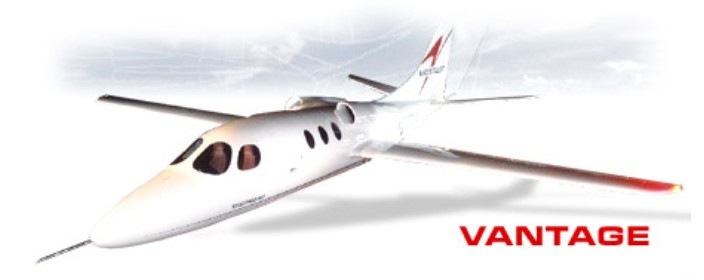
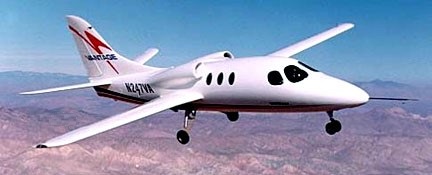
Following a design and feasibilty study performed by Scaled in late 1993, and a bit of time while Rice and Stark put together their financial backing, Scaled was given the go-ahead to build a proof-of-concept (POC) prototype on 8 March 1996. The Vantage differed from contemporary executive jets in that it was powered by a single engine, a Pratt & Whitney Canada JT15D turbofan buried in the rear fuselage, fed by twin air-inlets above the fuselage. It was of all-composite construction, and its wing was forward swept to reduce drag and to allow an unobstructed cabin by mounting the wing spar behind the cabin. It was planned to sell the Vantage for $1.65 million, compared with $3.3 million for the Cessna CitationJet.

Only one problem, though: they wanted to show photographs and films of the airplane flying at the 1996 National Business Aircraft Association (NBAA) convention, scheduled to begin on 19 November.

Under a $2.5 million fixed-price contract, Scaled rolled out the Vantage to a large group of customers and press just 8 months later (8 November), and performed a picture-perfect first flight on 16 November 1996 (piloted by Doug Shane). The photos made it to NBAA, and the Vantage POC got to work in flight testing.

VisionAire Vantage N247VA

Flight testing revealed several handling and aerodynamic problems, which resulted in a redesign of the aircraft in December 1998.

Delays to the program continued, while costs mounted, and in January 2003, with the company having already spent $110 million, requiring another $125 million to complete certification and owing $35 million, a Federal Judge ordered VisionAire liquidated to pay its debts in 2003.

The project was acquired by Eviation Jets, which planned to produce it as the redesigned EV-20 Vantage Jet. Eviation Jets acquired the Vantage technical drawings, trademarks and tooling from bankrupt VisionAire in October 2003 and established a subsidiary in São Paulo to lower its overheads. The Brazilian CTA authority has approved a formal application by Eviation Jets to participate in the certification of the EV-20 twin-turbo¬fan derivative of the VisionAire Vantage business jet. The US Federal Aviation Administration maintains a reciprocal agreement allowing the CTA to certificate aircraft in Brazil and receive dual certification in the USA. Eviation Jets do Brasil was responsible for attracting investment, and managing local subcontracts as well as company’s aerospace engineering team.

Following the purchase of the Vantage by Eviation Jets, the proposed EV-20 was envisioned as a twin-engine design with two 2,100lb-thrust (9.4kN) Williams FJ44-1AP turbofan engines, with a projected cruise speed of 424 knots (785.2 km/h) at 36,000 feet (10,972.8 m) with an approximate range of 1,300 nautical miles (2,407.6 km). In the executive configuration it would have provided room for eight passengers, or ten commuter passengers. It would incorporate Garmin G1000 avionics, and would be made entirely from composite materials. kBky 2006, initial review of the EV-20 design were completed and construction of a prototype aircraft was expected to begin, utilizing an outside fabricator for construction of the prototype.

The redesign of the Vantage from a single- to a twin-engine design proved troublesome; the company failed to progress with the development of the type, and in 2012 the EV-20 was repurchased by VisionAire; the aircraft’s design was returned to a single-engined configuration, and VisionAire stated in early 2013 that they planned to construct the Vantage in a factory in Newton, North Carolina, with the prototype scheduled to fly in 2014. However, at the end of 2015 no further progress has been announced; latest update on the company’s website is dated March 2013.

The Vantage Proof-of-Concept (POC) aircraft was stored at the VisionAire Jets facility at the Hickory Airport, Hickory North Carolina (2013). Only the one was ever built.

Specifications:

VisionAire Vantage
Engine: 1 × Williams FJ44-3AP turbofan, 3,045 lbf (13.54 kN) thrust
Length: 41 ft 1 1⁄4 in (12.529 m)
Wingspan: 47 ft 6 in (14.48 m)
Height: 14 ft 4 in (4.37 m)
Wing area: 234.0 sq ft (21.74 m2)
Aspect ratio: 10.2:1
Empty weight: 4,930 lb (2,236 kg)
Max takeoff weight: 8,200 lb (3,719 kg)
Fuel capacity: 240 US gal (908 l; 200 imp gal)
Maximum speed: 431 mph (694 km/h; 375 kn) (max cruise)
Cruise speed: 288 mph (250 kn; 463 km/h) (econ cruise)
Stall speed: 80 mph (70 kn; 129 km/h) (power off, flaps down)
Range: 1,150 mi (999 nmi; 1,851 km) (max fuel, six occupants)
Service ceiling: 41,000 ft (12,497 m)
Rate of climb: 4,000 ft/min (20 m/s)
Crew: 1
Capacity: 5 passengers

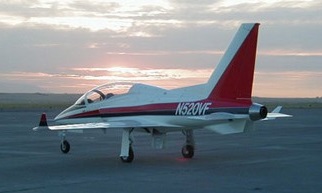
Viper Aircraft FanJet

FanJet Mk.II

The Scott brothers and Dan Hanchette created the Viper Aircraft Company in 1995.

The ViperJet was the first two seater jet on the kit market in the USA. Originally designed to be equipped with a Continental TS10 520 engine with a 5-blade fan, the Mark I has a Turbomeca Marbore II or IV.

First flight with a Marbore VI was planned for October 1999.

The Marbore was to be eventually replaced by a General Electric J85 (military version of the CJ-610 of the Learjet 23) to give the Viper Mk II.

Viper Mk.II

Prototype
Engine: Marbore VI, 1100 lb
MAUW: 3500 lb
Take-off SL (No flap): 2526 ft
Take-Off SL (10 deg.Flap): 1804 ft
Landing SL (Full Flap): 2624 ft
Max.Speed @ SL TAS: 370 mph
Max.Speed @ 10,000′ TAS: 391 mph
Max.Speed @ 15,000′ TAS: 404 mph
Max.Speed @ 25,000′ TAS: 416 mph
Max.Rate.Climb @ SL/260 mph: 4400 fpm
Seat: 2

Prototype
Engine: Marbore II, 880 lb
MAUW: 3500 lb
Take-off SL (No flap): 3516 ft
Take-Off SL (10 deg.Flap): 2418 ft
Landing SL (Full Flap): 2624 ft
Max.Speed @ SL TAS: 331 mph
Max.Speed @ 10,000′ TAS: 353 mph
Max.Speed @ 15,000′ TAS: 357 mph
Max.Speed @ 25,000′ TAS: 370 mph
Max.Rate.Climb @ SL/260 mph: 3100 fpm
Seat: 2

Engine: GE J-85-17A, 2850 lb
Cruise: 450 mph
Stall: 84 mph
Range: 1380 sm
Rate of climb: 10,000 fpm
Takeoff dist: 1200 ft
Landing dist: 2500 ft
Fuel capacity: 270 USG
Empty weight: 2750 lb
Gross weight: 5500 lb
Length: 25.5 ft
Wing span: 30 ft
Wing area: 130 sq.ft
Seats: 2 tandem
Cockpit width: 30 in
Landing gear: retractable nosewheel
LSA: no

Vickers VC-10

VC-10

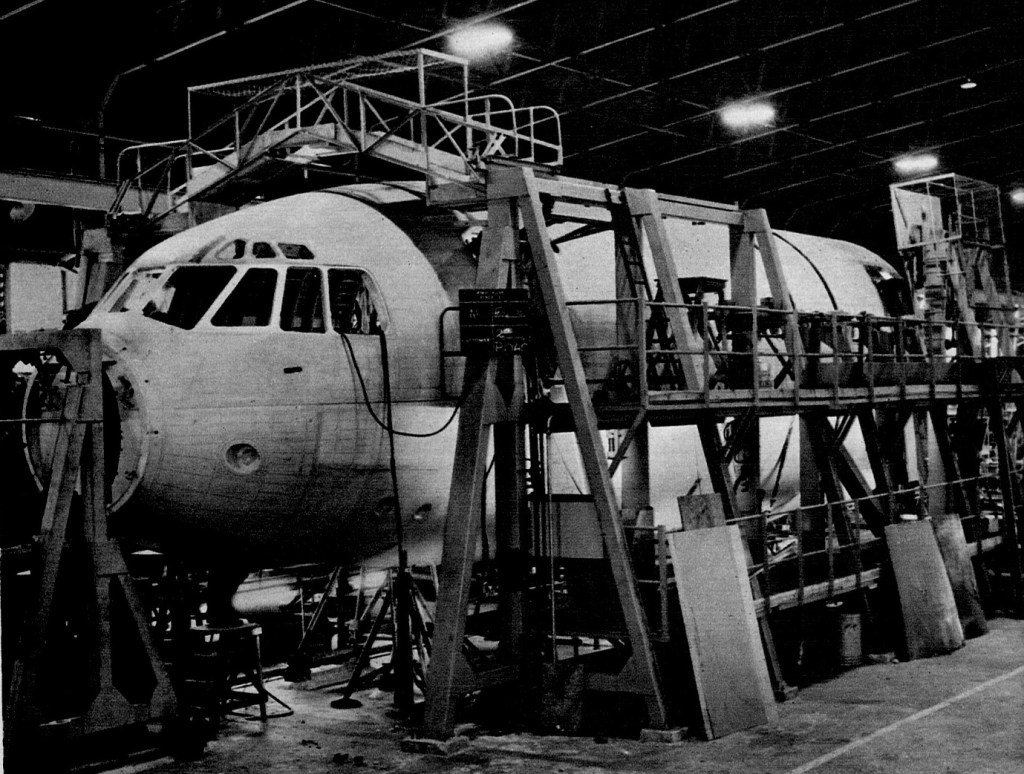
Vickers had honed the VC10 since the cancellation of the VC7/V1000 in 1955. As it became clear that BOAC would buy Boeing 707s for trans-oceanic routes, George Edwards aimed his design at their Medium-Range Empire routes to countries with undeveloped hot and high airports. Alongside this, he also had in mind the RAF’s need for a personnel/freight transport, again to ‘up-country’ destinations. Though in time the Super VC10 did come to fly the North Atlantic, its progenitor was never intended as a true long-ranger, nor was it ever a pure civilian machine. The VC10/Super VC10 needs 17 hydraulic actuators in their tailplanes. Much of its structure was famously milled from solid billets of metal.

Vickers VC-10 Article

A long range civil transport featuring rear mounted engines emerged when introduced, the VC10 tailored closely to the requirements of BOAC. The prototype (G ARTA) flew for the first time on 29 June 1962, powered by four Rolls-Royce Conway turbofan engines.

Vickers VC10 Srs1100

The VC10 entered service on BOAC’s route to West Africa on 29 April 1964. Four production variants and a modification of the prototype were produced: the Model 1101, of which 12 went to BOAC accommodated 16 first-class and 93 economy passengers; the Model 1102, of which two went to Ghana Airways, one with a large hydraulically operated cargo door between the standard passenger doors and both with 4% chord leading-edge extension from wing root to fence; the Model 1103, of which three went to British United Airways with cargo door and extended leading edge; Model 1106, of which 14 went to RAF Air Support Command with cargo door, folding hatracks, machined cargo floor, extended leading edge, 97kN Conway RCo.43 Mk 301 turbofans and fin fuel tank; and the Model 1109, the prototype brought up to airline standard for Laker Airways, with the Model 1106 wing. Standard engines for the VC10 were four 90.6kN Rolls-Royce Conway RCo. 42 turbofans in lateral pairs on each side of the rear fuselage. RAF basic transport version designated VC10 C.1. C.2 is the unconfirmed designation of flight refuelling tanker conversions of five VC10 and four Super VC10.

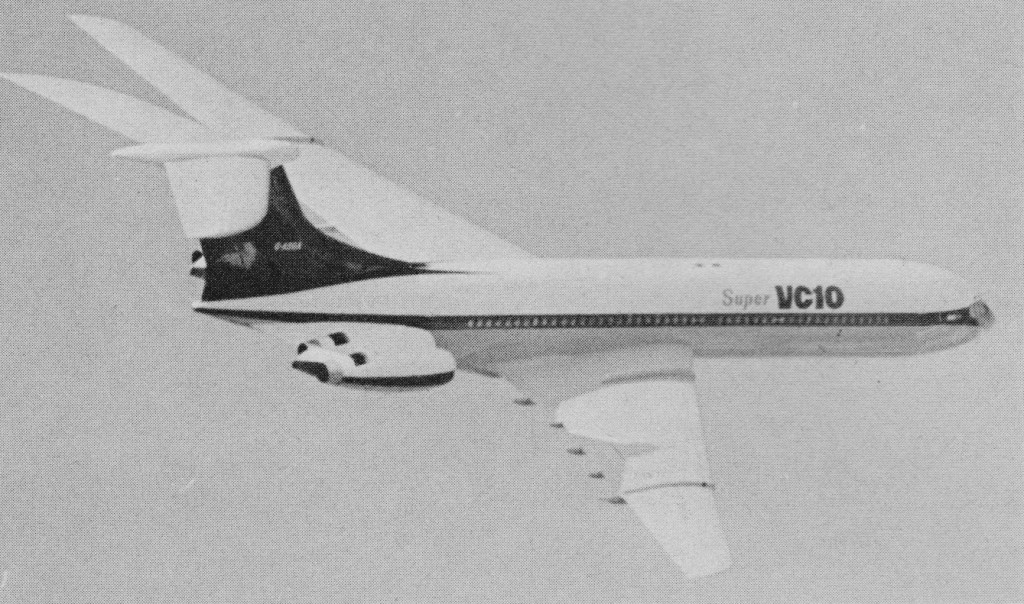
A developed version, the Super VC 10, with a longer fuselage, an improved wing leading edge and more powerful engines was able to accommodate up to 174 economy class passengers and had a maximum range of 4,720 miles (7,600 km).

Super VC-10

The stretched fuselage Super VC-10 overflew the 1964 Farnborough Air Show. Landings are made using two section flaps and deflecting leading edge slats.

Only 54 sold. Only nine of those built were for customers outside of Britain.

VC-10

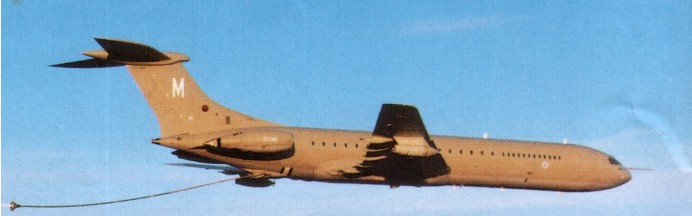
Eleven Super VC 10s, once operated by BOAC and British Airways, were pur¬chased by the RAF/Ministry of Defence in 1981 and flown into long term storage at Abingdom. In 1990 the decision to convert six of the stored airframes to three point refuelling tankers at British Aerospace’s Filton facility was announced.

Gallery

Engines: 4 x RR Conway RCo-42 turbo-jet, 93.4kN
Max take-off weight: 141521 kg / 312002 lb
Empty weight: 67094 kg / 147918 lb
Wingspan: 44.6 m / 146 ft 4 in
Length: 48.4 m / 158 ft 10 in
Height: 12.0 m / 39 ft 4 in
Wing area: 264.3 sq.m / 2844.90 sq ft
Cruise speed: 915 km/h / 569 mph
Range w/max.fuel: 8328 km / 5175 miles
Range w/max.payload: 6680 km / 4151 miles
Crew: 4-6
Passengers: 108-151

Engines: 4 x Rolls-Royce Conway RCo.42 turbofan, 20370 lb (9240 kg)
Wing span: 146 ft 2 in (44.55m)
Length: 158 ft 8 in (48.36m)
Wing area: 2,851 sq ft (264.9sq.m)
Gross weight: 314,000 lb (142,430 kg)
Max cruising speed: 568 mph (914 kph)
Typical range: 5,040 miles (8,115 km) with max payload
Crew: 3-4
Pax cap: 109

VC-10 Srs 1100
Engines: 4 x RR Conway, 21,000 lb
Wing span: 146 ft 2 in (44.55 m)
Length: 158 ft 8 in (48.36m)
Height: 39 ft 6 in (12.04 m)
Max TO wt: 312,000 lb (141,520 kg)
Max level speed: M0.86

Super VC 10
Engines 4 x 22,500 lb. (10,205 kg.) Rolls Royce Conway RCo.43 turbofan
Length 171.7 ft. (52.32 m.)
Wing span 146 ft 2 in (44.55 m.)
Height, 39 ft 6 in
Gross wing area, 2 932 sq.ft
Basic operational weight, 154 552 lb
Max. take-off, 335 000 lb
Max. landing, 267 000 lb
Max. payload (volume limited), 47,150 lb
Max. zero fuel, 215,000 lb
Total fuel, 154,700 lb
Power loading (max. take-off weight), 3.72 1b/1b
Wing loading (max. take-off weight), 114.2 lb/sq.ft
Wing loading (max. landing weight), 80.9 lb/sq.ft
Accommodation: 24 first-class at 46 in pitch and 103 coach class at 33 in pitch
Max. high density seating: 169 at 33 in pitch.
High-speed cruise, 500 kt. at 33 000 ft
Long-range cruise, 459 kt at 40 000 ft
Approach speed, 134 kt
Take-off field length, ISA at sea level, 8660 ft
Landing field length, ISA at sea level, 6830 ft
Range with allowances, max. fuel, 25,750 lb payload, 5 450 nm
Max. usable floor area, 1130 sq.ft
Max. usable cabin volume , 7600 cu.ft
Max. cabin length, 103 ft
Max. width, 137.8 in
Aisle height, 91 in.
Freight and baggage holds: 1930 cu.ft

Super VC-10

Vickers 660 Valiant

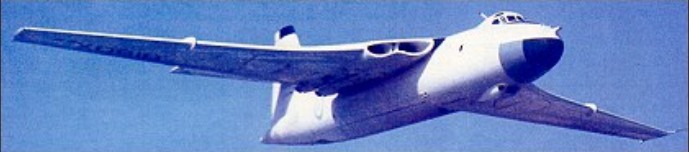
To meet the need for long range high altitude heavy bomber aircraft, capable of carrying nuclear weapons, the Avro Vulcan, along with the Handley Page Victor and Vickers Valiant, was developed in accordance with an Air Ministry specification that originated in 1947.

Vickers Valiant Article

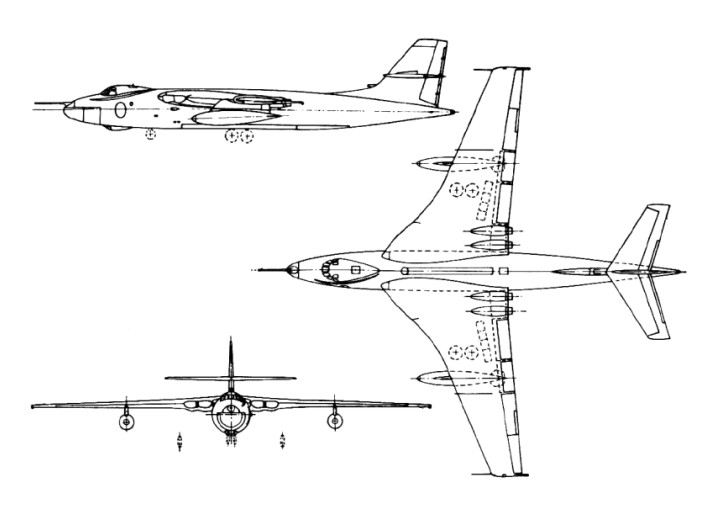
The Vickers Valiant was designed to Air Ministry specification B.9/48. It was a cantilever shoulder-wing monoplane of all-metal stressed-skin construction. The wing had compound sweepback on the leading edge, somewhat similar to that of the Handley Page Victor, air-brakes, double-slotted flaps and powered ailerons. The fuselage was a circular-section semi-monocoque structure, incorporating a pressurised cell to contain the crew of five, and a large bomb bay which later proved capable of accommodating a Blue Steel stand-off weapon. The tail unit was conventional, but the tailplane was mounted almost half-way up the fin to keep it clear of the efflux from the four turbojet engines, buried in the inner wing adjacent to the fuselage. Landing gear was of tricycle type electrically retracting tan¬dem main gears folding outwards. The Valiant was largely conventional in construction, with a giant radar in its underside, an inflight refuelling probe (added after delivery) above and a ventral blister for a visual bombing station. The main weapon bay could house all the UK’s nuclear bombs (or the Blue BoarTV guided bombs) or up to 21 HE bombs of 454 kg (1,000 lb) each. One unusual feature was the extensive use of electrical power for the actuation of practically all movable units, even powered controls. The only exception was a minor hydraulic system for brakes and powered steering, but even this had its pumps driven by electric motors.

Two prototypes were ordered initially, one to be powered by four Rolls-Royce RA.3 Avon 204 turbojets and the other by four Armstrong Siddeley Sapphires. The first prototype made its maiden flight on 18 May 1951, but was lost in an accident on 12 January 1952. The second prototype flew first on 11 April 1952, but was powered by RA.7 turbojets instead of the Sapphires as planned originally.

Vickers Valiant 2nd prototype

In spite of the fact that two types of so-called V bomber were already on order it was put into production as well, allegedly as an insurance against ‘failure’ of the others.

Named Valiant, B.1 began to enter service in January 1955, the first of the V-bombers to serve with the RAF. They were followed by B(PR).1 long-range strategic reconnaissance; B(PR)K.1 multi-purpose bomber, photo-reconnaissance, tanker; and BK.1 bomber/tanker aircraft. Production totalled 111 examples, including one B.2 pathfinder prototype. Used extensively in service, Valiants dropped the first British hydrogen and atomic bombs and during operations in the Suez campaign operated with high-explosive bombs.

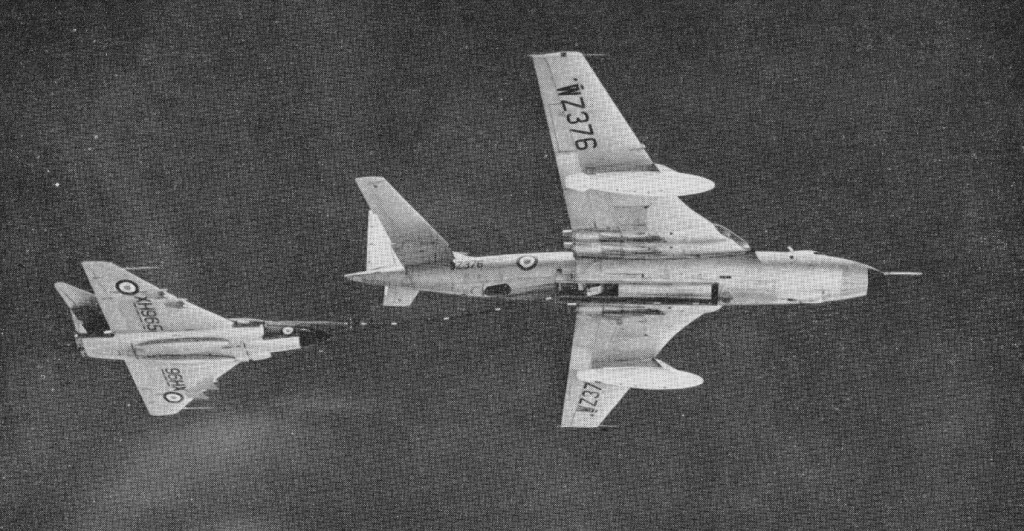
Javelin FAW.8 refuelling from a Vickers Valiant

Vickers built 108 including prototypes, and from January 1955 these served with 10 RAF squadrons. At first painted all in anti flash white, with very pale roundels and serials, they set a high standard in navigation and bombing, though most crews wished to forget their one taste of actual warfare when in late 1956 four squadrons bombed Egyptian targets during the ill starred Suez campaign. Valiants carried out all of the UK’s live air tests of nuclear weapons. There were reconnaissance, tanker and multi role versions, and from 1963 Valiants were given regular grey and green camouflage and assigned to low level missions using conventional bombs in support of SACEUR (Supreme Allied Commander, Europe) as a NATO force, though still based in the UK. By this time they were the RAF’s only inflight refuelling tanker force.

In the Autumn of 1957 these four Valiants, with two Vulcans, flew to the US to compete with USAF teams in anannual bombinng compteition. One Valiant came 11th of the 100 aircraft competing.

Intended for fast high-altitude strategic bombing, the Valiant – in company with other V-bombers – was switched to low-level operations. There seems little doubt that the stresses imposed by such a role accelerated the wingspan metal fatigue first reported in late 1964, and which led to the scrapping of all Valiants in January 1965.

The RAF did not buy the Valiant Mk 2, first flown in 1953, which was specially designed for low level operations. With just over 100 built at Brooklands aerodrome, production ended in the autumn of 1957.

Gallery

Vickers Valiant B.Mk.1
Engines: 4 x Rolls-Royce RA.28 Avon 204/205, 10,050 lb / 44.7kN
Wingspan: 34.85 m / 114 ft 4 in
Length: 32.99 m / 108 ft 3 in
Height: 9.8 m / 32 ft 2 in
Wing area: 219.43 sq.m / 2361.92 sq ft
Max take-off weight: 63503 kg / 140001 lb
Empty weight: 34419 kg / 75881 lb
Max fuel w/underwing tanks: 9972 gal
Max speed: 492 kts / 912 km/h / 567 mph at 30,000 ft
Max cruise: 553 mph at 30,000 ft
Service Ceiling: 16460 m / 54000 ft
Range w/max.fuel: 7242 km / 4500 miles
Bombload: 9525kg / 21,000 lb or 2 x 1615 flight refuelling tanks
Crew: 5

Valiant B(K)Mk.1
Type: five seat bomber and inflight refuelling tanker
Engines: 4 x 4763 kg (10,500 lb) thrust Rolls Royce Avon 201 turbojets
Max speed 912 km/h (567 mph) at 9145 m (30,000 ft)
Service ceiling: 16460 m (54,000 ft)
Range with reduced bombload 7242 km (4,500 miles)
Wing span: 34.85 m (114 ft 4 in)
Length (normal long ECM tailcone): 33.00m(108ft 3in)
Height: 9.81 m (32 ft 2 in)
Wing area: 219.44 sq.m (2,362.0 sq ft)
Bombload: 9526 kg (21,000 lb)

Vickers Valiant