Henschel Hs 132

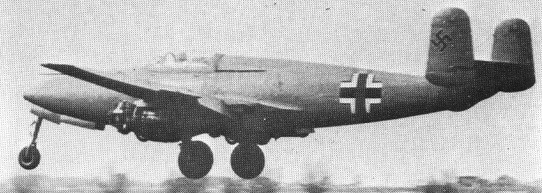
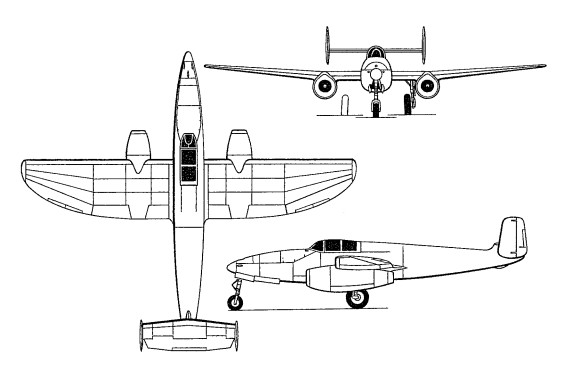
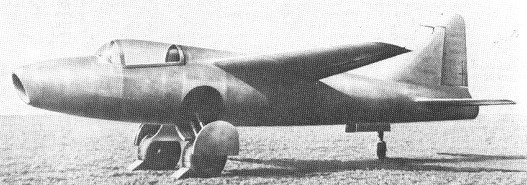
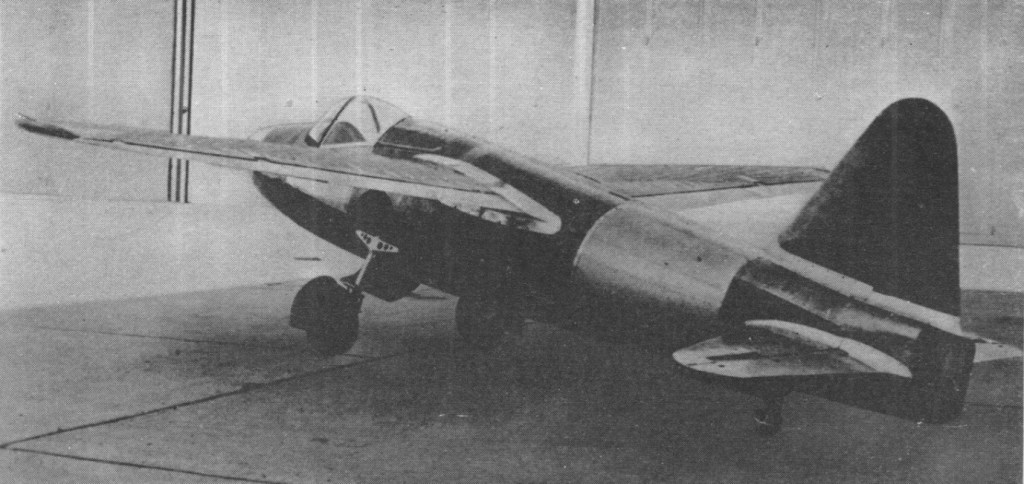
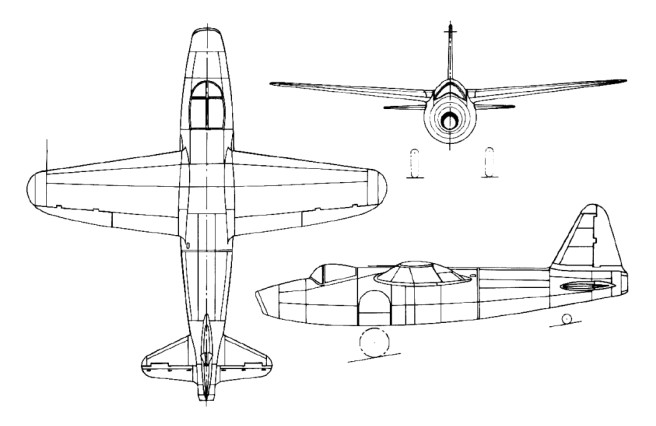
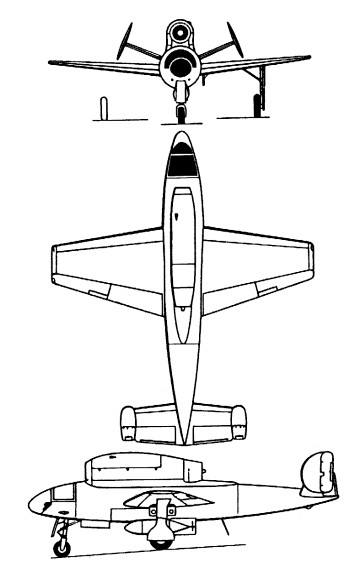
During the last half of 1943 experience showed that losses during convention¬al dive bombing with the Junkers Ju 87 were becoming prohibi¬tive without heavy fighter escort, parti¬cularly in the face of Soviet air presence on the Eastern Front. The Henschel company, with considerable experience in produc¬ing ground support aircraft, put for¬ward late in 1944 proposals for an essentially simple single jet attack bomber with a BMW 109 003E 2 tur¬bojet mounted above the fuselage. In essence the aircraft resembled the Heinkel He 162 with twin fins and rud¬ders, although the sharply tapered wing was mounted at mid fuselage depth; more significant, the pilot occu¬pied a prone position in the extreme nose so as to withstand the likely 12g forces expected to accompany shal¬low dive recovery. Simplified con¬struction with widespread use of wood in the structure was welcomed by the RLM and three prototypes were ordered, and commenced building in March 1945.

Only the Henschel Hs 132 VI powered by a 1,760 lb thrust BMW 003 engine had been completed (but not flown) by the war’s end, and all three aircraft were taken over by the Soviet forces in their advance from the east.

The first aircraft was to have carried a single 500 kg (1,102 1b) bomb recessed into the under-fuselage; the second, with Jumo 004 900 kg (1,984 1b) thrust engine com¬bined this load with two nose mounted 20 mm MG 151 cannon; and the third, with 1300 kg (2,866 1b) thrust Heinkel¬-Hirth 109 011A turbojet would carry a 1000 kg (2,205 1b) bomb, two 30 mm MK 103 and two 20 mm MG 151 guns. It was intended that the PC 1000RS Pol rocket assisted armour piercing bomb would be used for battlefield support attacks.

Hs 132 V1
Engine: one 800 kg (1,764 1b) thrust BMW 109 003E 2 turbojet.
Wingspan 7.20 m (23 ft 7.5 in)
Wing area 14.82 sq.m (159.4 sq.ft)
Length 8.90 m (29 ft 2.5 in)
Height 9ft 10 in
Maximum speed 780 kph (485 mph) at 6000 m (19,685 ft);
Service ceiling 10250 m (33,630 ft)
Range 680 km (423 miles)
Maximum take off weight 3400 kg (7,496 lb)
Armament: one 500 kg (1,102 lb) bomb under the fuselage.

Helwan HA-300

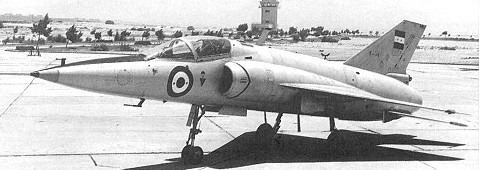
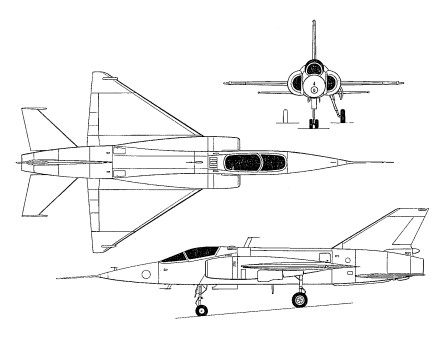
Originally conceived to meet a Spanish Ejercito del Aire requirement for a small M=1.5 interceptor and the design responsibility of a Germano-Spanish team supervised by Prof Willy Messerschmitt, the HA-300 programme was transferred to Egypt. Here development and construction was undertaken in Factory No 36 at Helwan, this being controlled by the Egyptian General Aero Organisation (EGAO). Originally designed for the proposed afterburning Orpheus BOr 12 turbojet, the HA-300 was modified for the Brandner-designed E-300 with a calculated afterburning rating of 4800kgp. The first V.1 prototype, powered by a 2200kgp Orpheus 703-S-10, was flown on 7 March 1964, a similarly-powered second V.2 prototype flying on 22 July 1965. The version flew supersonic.

The definitive third prototype with the E-300 engine commenced taxi trials in November 1969, but the HA-300 programme was then terminated without flight testing of this prototype being undertaken. It was anticipated that the E-300-powered HA-300 would be capable of attaining 12000m and M=2.0 within 2.5 min of take-off. The Orpheus-powered prototypes achieved approx M=1.13 during flight test.

Egypt’s HA-300 was test flown in the Spring of 1964 by an Indian pilot, showing no appreciable advantages over the MiG-21.

The HA-300 V.1 is displyed in the Deutsches Museum – Oberschleissheim and the Ha-300 V.2 and V.3 remained in Cairo.

Wingspan: 5.84 m / 19 ft 2 in
Length: 12.40 m / 40 ft 8 in
Height: 3.15 m / 10 ft 4 in
Wing area: 16.70 sq.m / 179.76 sq ft
Max. speed: 1490 km/h / 926 mph

Helicopter Technik München / HTM Sky-Trac 4 Aerocar / Wagner Sky-Trac 4 Aerocar

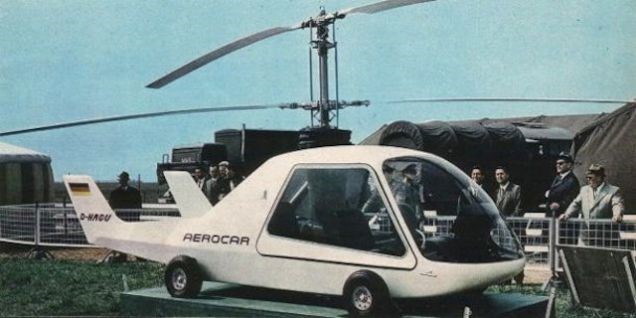
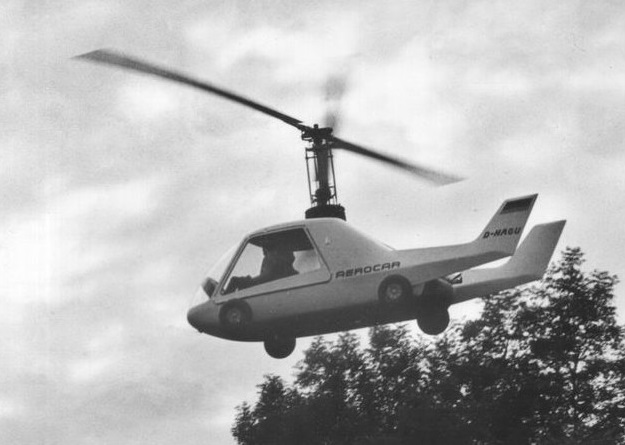
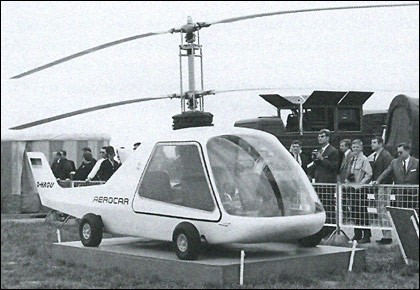
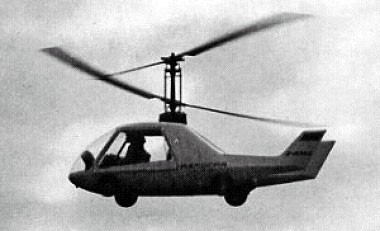
The Rotocar III has developed into the Aerocar. This has a 4-seat cabin, a twin tail assembly, and four road wheels hydraulically driven from the Oredon IV engine mounted behind the rotor pylon.

Wagner built a prototype (D-HAGU) Aerocar roadable helicopter, powered by a 260hp Franklin 6AS-335-B engine, which had a complete body shell. It was first flown in 1965. It was subsequently rebuilt with a Turbomeca Oredon turbine engine.

After extensive development work had been carried out, the Wagner designs were passed to a new company, Helikopter Technik Munchen (HTM) in 1971. HTM abandoned the Aerocar.

Heinkel-Hirth HeS 011 / 109-011

Starting in 1936, Junkers started a jet engine development project under the direction of Wagner and Müller, who worked on axial compressor designs. By 1940 they had progressed to the point of having a semi-working prototype, which could not run under its own power and required an external supply of compressed air.

Meanwhile, Hans Mauch, in charge of engine development at the RLM, decided that all engine development should take place at existing engine companies. In keeping with this new policy, he forced Junkers to divest itself of their internal engine teams. Müller and half of the existing Junkers team decamped and were happily accepted by Ernst Heinkel, who had started German jet development when he set up a lab for Hans von Ohain in 1937. The two teams worked on their designs in parallel for some time, von Ohain’s as the HeS 8 (or 109-001), and the Junkers team as the HeS 30 (109-006). Heinkel’s efforts were later re-organized at Hirth Motoren.

Helmut Schelp, who had taken over from Mauch, felt that the BMW 003 and Junkers Jumo 004 would reach production at about the same power levels long before either would be ready, and cancelled both of the Heinkel projects. He had outlined a new development plan, with three engine classes, the 003 and 004 were “Class 1” engines of under 1000 kg thrust suitable for small fighters, but only really useful in twin-engine designs. Schelp was much more interested developing a “Class II” engine of 1000–2000 kg, larger designs able to power a full-sized fighter design with a single engine. Schelp was also interested in seeing one of his own pet projects, the diagonal compressor, adopted. Schelp had earlier convinced Heinkel to put some effort into another pet project of his, a twin-compressor single-turbine turboprop, but had given up on this and instead offered Heinkel his new concept as a consolation prize.

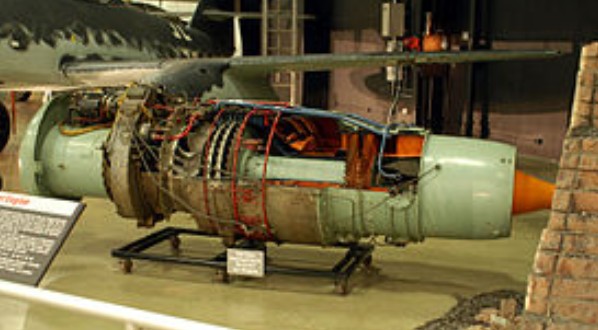
In some ways, the HeS 011 can be considered a combination of the two teams’ designs, a three-stage axial compressor from Müller’s team, combined with a single-stage centrifugal compressor from von Ohain’s, the two driven by a single two-stage turbine. It featured a unique compressor arrangement, combining a three-stage axial compressor with a “diagonal” stage similar to a centrifugal compressor directly forward of the three-stage axial compressor, along with a low-compression impeller in the intake, just ahead of the diagonal stage to smooth out airflow. The engine operated at somewhat higher thrust levels, about 2,700 lbf (12 kN), as opposed to about 1,750 to 2,000 lbf (7.8 to 8.8 kN) thrust for the 003 and 004 respectively. The 011 shared two features with the Jumo 004, with an engine-mounted Reidel two-stroke engine functioning as an APU to get the central shaft turning during engine startup, but mounted above the intake orifice within a Heinkel-crafted prefabricated sheet-metal intake passage instead of inside the intake diverter as the 004 had done, and also had a variable geometry exhaust nozzle, with a restrictive body of differing aerodynamic shape to the 004’s Zwiebel (onion) unit, that likewise traveled fore and aft in the nozzle to vary the thrust. Plans were also made for a turboprop version, the HeS 021, but the workload at Heinkel was so high that this project was later given to Daimler-Benz to complete.

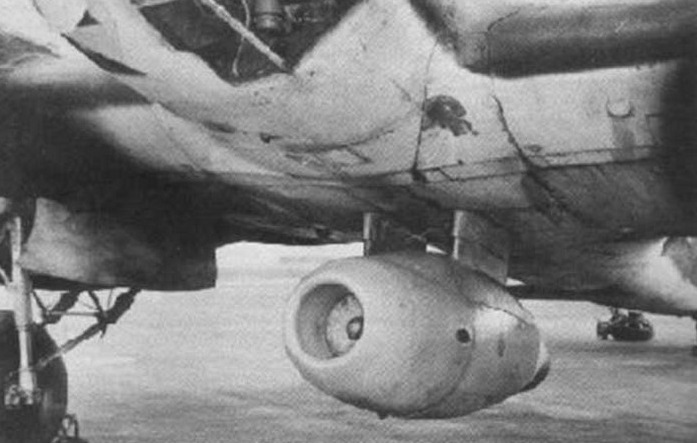
First run in September 1943, prototypes were available in 1944, and tested using a Heinkel He 111 bomber, mounting the engine on the external hardpoints under the fuselage.

Heinkel He.111 with He S011 test jet

Over the next year, practically all German aircraft designers based their projects on the 011. Like the nearly three hundred experimental examples built of the complex Jumo 222 piston engine, the HeS 011 turbojet never entered production, with only 19 prototypes built in total. One of these was mounted in the Messerschmitt Me P.1101 that was taken to the United States, forming the basis of the Bell X-5.

Two museum-preserved examples of the HeS 011 engine still exist in the United States, at the National Museum of the U.S. Air Force in Dayton, Ohio, and at the EAA AirVenture Museum in Oshkosh, Wisconsin.

Type: Turbojet
Length: 3450 mm (11 ft 3¾ in)
Diameter: 875 mm (34½ in)
Dry weight: 950 kg (2,094 lb)
Compressor: Diagonal + three stage axial
Combustors: 16 chambers
Turbine: Two stage axial.
Maximum thrust: 12.01 kN (2,700 lbf) at 10,000 rpm.
Thrust-to-weight ratio: 12.63 N/kg (1.29 lbf/lb)

Heinkel-Hirth HeS 40

The Heinkel HeS 40 (HeS – Heinkel Strahltriebwerk) was an experimental constant-volume jet engine designed by Adoph Müller’s team at Heinkel starting some time in 1940 or 41. It was based on the mechanical layout of the HeS 30, but replaced the conventional flame cans with oversized ones including large poppet valves that sealed off the chambers during firing. Constant-volume combustion, similar to the Otto cycle used in most piston engines, is considerably more fuel efficient than the constant-pressure combustion used in a typical jet engine.

The design was based on the HeS 30 not only to make parts more readily available as well as to make direct comparisons between the two easier. The main changes were to reduce the compression ratio of the compressor to about 2:1 (from 2.8:1), and add the new combustion chambers. The new chambers were considerably larger than the originals, forcing a reduction in the number from ten to six burners. The valve stems projected forward into streamlined fairings in the intake area behind the compressor.

The operational cycle of the engine is somewhat similar to a conventional six-cylinder engine. Slightly compressed air, similar to an automobile equipped with a turbocharger, was channeled into the cylinders in turn, closed off with the poppet valves, and then burned. By the time the combustion was complete the pressure in the flame cans would be much higher, although the actual compression ratio is not specified. The hot gas then blew through a turbine to extract power, instead of forcing a piston to move. Although there would be some loss of charge during the burning period, and thus the design would be less efficient than the true Otto cycle, it would nevertheless be somewhat more efficient than a traditional jet engine, at the cost of some complexity.

It appears the HeS 40 was never built, and remained a paper design. Nevertheless, work on the design was ended by 1942, by which point the HeS 30 was making good progress.

Heinkel-Hirth HeS 30 / 109-006 / Junkers Jumo 109-

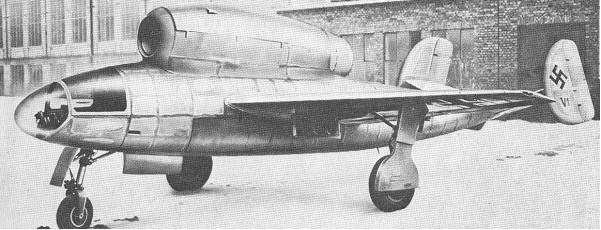
The HeS 30 (HeS – Heinkel Strahltriebwerk) was an early jet engine, originally designed by Adolf Müller at Junkers, but eventually built and tested at Heinkel. The first Jumo 109-009 was running by the summer of 1938, but the project and its staff were switched to Heinkel after Junkers’ engine division discovered that jet engine development work was being undertaken in secret under the auspices of the company’s airframe division.

The engine division of Junkers had already begun to move into turbojet development, and in the summer of 1931 it received a German air ministry contract for the new Jumo 1009-004. This was designed for a thrust of 1543 lb / 700 kg at a speed of 559 mph / 900 kph, and was schemed round an eight-stage axial compressor, six combustors, a single stage turbine designed with the aid of AEG’s turbine expertise and provision for afterburning.

It was possibly the best of the “Class I” engines, a class that included the more famous BMW 003 and Junkers Jumo 004, but work on the design was stopped by the Reichluftfahrtministerium (RLM) as they felt the Heinkel team should put all their efforts into other designs.

The HeS 30 was designed before the RLM introduced standardized naming for their engine projects. It was assigned the official name 109-006, and it was sometimes called the HeS 006 as a short form. Development ended just as these names were being introduced, so “HeS 30” naming is much more common.

Herbert Wagner started engine developments at Junkers in 1936, placing Adolf Müller in overall charge of the project. In 1938 Junkers purchased Junkers Motoren (Jumo), formerly a separate company. In October 1939, under pressure from the RLM, Junkers moved all their engine work to Jumo’s Dessau factories from their main plants at Magdeburg. Müller would have ended up in a subordinate role after the move, but decided to leave instead. He and about half of the original Junkers team were scooped up by Ernst Heinkel and moved to his Rostock campus, where Hans von Ohain was working on the Heinkel HeS 3 engine.

The first unit ran in November 1940, but was beset with so many technical problems that it was early 1942 before anything approaching reliability was attained; a Jumo 109-004A was flown for the first time under a Messerschmitt Bf 110 in March 1942, and other A-series engines were flown in prototypes of the Me 262.
In the production-configured B-series the quantity of strategic materials was halved, largely through replacement of castings by sheet metal construction. This reduced weight and the number of man-hours involved in construction.

Of all of the designs Müller brought with him, the HeS 30 was simplest and easiest to build. Müller had already built a test engine while still at Junkers, however it was only able to run at about half its designed RPM, which limited compression and required a continuous supply of external compressed air. The design was abandoned when Müller left, the Jumo team’s simpler design being used instead. Müller promised Heinkel he could have the engine up and running on a testbed within one year of completing the move, a promise he was ultimately unable to keep.

Key to the engine’s working cycle was an axial compressor of then-unique construction. Most German engines of the era had the stators do all of the actual compression, with the rotors speeding up the air for them to compress. In the HeS 30, the rotor and stators shared compression about 50-50, a design originally provided by Rudolph Friedrich of Junkers. Overall the engine had a five-stage compressor providing air at a compression ratio of 3:1 to ten flame cans, which powered a single-stage turbine. The turbine was also unique for the era, using a set of guide vanes that were adjustable for various operating speeds. Like most German axial engines, the engine also included a variable-geometry exhaust cone to lower back pressure when starting, and an electric starter motor.

Due to the move, it took considerable time for the team to restart work on the design, and even though three experimental engines were ordered as the 109-006 in 1939, it was not until May 1942 the first engine actually ran. In addition to problems with the move, the compressor turned out to provide more mass flow than initially suspected, forcing a redesign of the turbine. To add to the problems, Müller and Heinkel had an argument in May that eventually led to Müller resigning.

Work on the engine continued, and by October it was running at full speed. Of all of the early engines, the HeS 30 was by far the best design. It produced a thrust of 860 kg (1,895 lb), almost equidistant between the BMW 003’s 800 kg (1,780 lb) and the Jumo 004’s higher 900 kg (1,980 lb), but weighed only 390 kg (860 lb), providing a much better power-to-weight ratio than the dry weights of either the 003 at 562 kg (1,240 lb) or the 004 at 720 kg (1,585 lb). The HeS also had better specific fuel consumption and was also smaller in cross-section.

Helmut Schelp, in charge of engine development at the RLM, refused to give Heinkel a production contract, an event Hans von Ohain claims brought Ernst Heinkel near tears. Schelp noted that while the design was excellent, BMW and Jumo were so far ahead they simply did not need another “Class I” engine – something that would prove ironic in another two years when both of those engines were still not operational. It also appears he had some misgivings about the compressor arrangement, but if this was the case it was never official. He also cancelled von Ohain’s Heinkel HeS 8 at the same time.
Instead of yet another Class I engine, Schelp asked Heinkel to continue work on a Class II engine of about 1,300 kg thrust, which would be needed for reasonably sized single-engine fighters, and as a useful addition to twin-engine bombers. Thus work on the HeS 30 and HeS 008 ended, and Heinkel turned, grudgingly, to the Heinkel HeS 011, which would not enter production before the war ended. The remains of Müller’s team were then moved to the Heinkel-Hirth plants to work on the new engine.

Starting some time in 1940 or ’41, the basic mechanical layout of the HeS 30 was also used on an experimental constant-volume engine known as the Heinkel HeS 40.

The Jumo 109-004B-1 first ran in May 1943, and the use of blades of improved shape in the first two stages of the compressor helped to increase thrust to 1984 lb / 900 kg. This variant was quite rapidly cleared for production, the first units being delivered in March 1944 to power the Me 262A. Further development resulted in the Jumo 109-004B-4, with hollow rather than solid turbine blades, which entered production in December 1944, it was about to be supplanted by the 2315 lb / 1050 kg thrust Jumo 109-004D-4 as the war ended.

Specifications
Type: Turbojet
Length: 2.72m
Diameter: 0.62m
Dry weight: 390kg (860lb)
Compressor: Axial 5-stages
Combustors: 10 Cannular chambers
Turbine: Axial 1 stage
Fuel type: Gasoline
Oil system: pressure scavenge return
Maximum thrust: 860kp (1,896lb)
Overall pressure ratio: 3:1 Pressure ratio
Heinkel-Hirth HeS 8 / 109-001

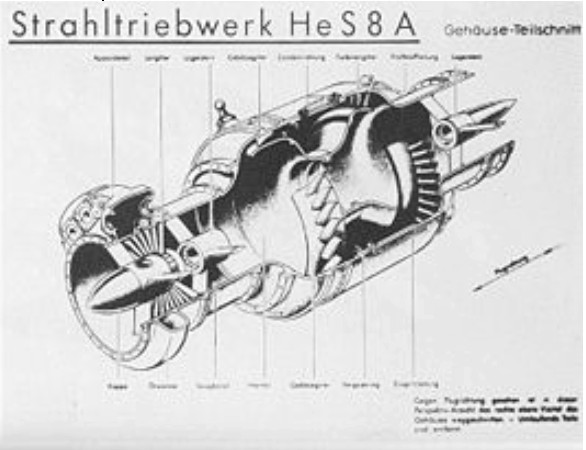
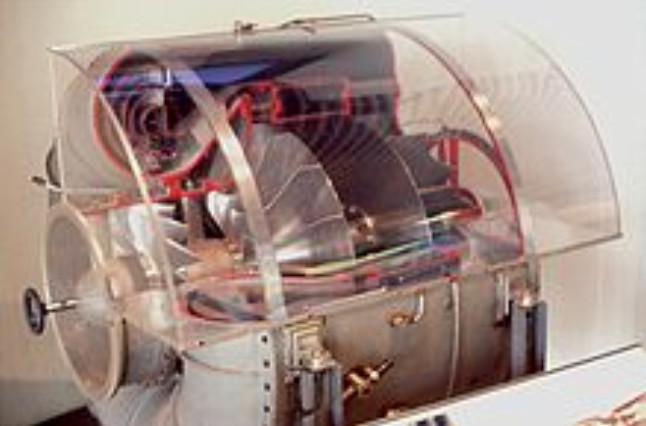
The Heinkel HeS 8 (prefix being an abbreviation for “Heinkel Strahltriebwerk”-Heinkel Jet Engine) was an early jet engine designed by Hans von Ohain while working at Heinkel, and first run in September 1940. It was the first jet engine to be financially supported by the RLM, bearing the official name 109-001.

The HeS 8 was intended to power the Heinkel He 280 twin-engine fighter, although both Heinkel and von Ohain preferred the axial HeS 30. A lengthy gestation period meant it was finally becoming ready for production at about the same time as the Junkers Jumo 004 and BMW 003. In 1942 work was ended on the HeS 8 and HeS 30, and Heinkel was ordered to move on to the larger Heinkel HeS 011 instead. The He 280 was left engineless, and was eventually abandoned.

By the time the HeS 3 program wound down in 1939, it appears that von Ohain no longer favoured the centrifugal compressor for jet engines. He had been “sold” on the axial compressor as early as 1938, after a meeting with D. Encke of AVA, but continued with the centrifugal design in the HeS 3 because it was much easier to work with. It is likely he would have developed an axial design as a follow-on to the HeS 3, but it appears the RLM was interested in keeping him working on centrifugal designs as a backup in case the various axial designs ran into problems.

The main problem with the centrifugal compressor was the large cross-sectional area. von Ohain had been looking at solutions to this problem as soon as the HeS 1 design was winding down in 1937. His first attempt at the HeS 3 was to separate the compressor and turbine —which were back-to-back in the HeS 1— and place the combustion chambers between them. Various problems in this original HeS 3 design forced them to abandon this layout for an updated HeS 3b, but it appears von Ohain felt it was still the best solution, and he returned to it for the HeS 8. The result was an engine that was only slightly wider than the compressor disk, whereas earlier models had piping lying outside the compressor disk and were therefore somewhat larger.

Another problem with the original engine series was that the compressor was fairly sensitive to disturbances in the intake airflow. To address this, the HeS 8 added a low-pressure impeller in the intake in front of the main compressor. The impeller did not add much to the compression, but by increasing pressure on the compressor face the airflow was greatly stabilized. The 14-blade impeller and 19-blade compressor were both made of milled aluminum. The 14-blade turbine was made of steel, and uncooled, which suggests turbine burnout would be common. The various components were connected together on a common tubular power shaft, supported by three ball races. The combustion chamber consisted of two diffusers that slowed the airflow from the compressor, and then injected fuel through 128 nozzles arranged in two sets at different “depths”. Various accessories, including the starter, were grouped around the intake and did not add to the overall diameter.

Work progressed slowly, and by the time the first He 280 prototype was ready in September 1940 the engine was nowhere near ready for flight. The prototype then started glider testing while work on the engines and additional airframes continued. The engines were finally considered ready to go in early 1941, although at only 500 kg thrust instead of the planned 700 kg. The engines were later fitted and the He 280 first took to the air on 2 April 1941, although the cowlings had to be left off as the engine proved to leak fuel. Three days later the aircraft was demonstrated for a party of RLM officials, who were impressed, and full backing for Heinkel’s program was forthcoming.

Development of the engine stalled at this point, and by early 1942 the thrust had crept up to only 550 kg. An attempt to improve the design by adding a single axial compressor stage behind the centrifugal compressor was used from V15 (the 15th prototype) on, and new airflow routing in the compressor started on V16. It appears about 30 engines were completed in total, the later models with the various improvements generating about 600 kg of thrust. But by this point the various all-axial designs, including Heinkel’s own HeS 30, were progressing nicely. Helmut Schelp, in charge of jet development at the RLM, decided that the 003 and 004 were “good enough”, and cancelled all work on Heinkel’s existing designs. Instead he asked them to move onto a “Class II” engine design, which would evolve as the Heinkel HeS 011.

Several modifications of the basic HeS 8 design were also explored over the project’s lifetime. The HeS 9 appears to be a modification adding a second axial compressor stage, and replacing the full centrifugal stage with a new “diagonal compressor” that Schelp favoured. Little is known about this design other than the fact that RLM ordered ten of them, but none was built. It appears it was this layout that was used to develop the 011. Another modification, the HeS 10, placed a complete HeS 8 engine inside a larger nacelle, and expanded the intake impellor to be larger than the engine. The HeS 10 appears to have been the first example of what would today be called a turbofan engine. In order to extract more power from the exhaust to drive the fan, an additional single axial-stage turbine was added behind the HeS 8’s existing centrifugal one. The only real difference between the HeS 10 and a modern turbofan engine was that the fan was not powered independently of the core, although, given the separate axial turbine stage, this would not have been difficult to arrange.

Specifications

V16 on
Type: Turbojet
Length: 2.400 m
Diameter: 0.775 m
Dry weight: 380 kg
Maximum thrust: 700 kg at 13,500 RPM planned, 600 kg delivered
Overall pressure ratio: 2.7:1

Heinkel-Hirth HeS 1 / HeS 3 / HeS 6

Heinkel HeS 3

In 1933, Hans von Ohain wrote his PhD thesis at the University of Göttingen on the topic of an optical microphone that could be used to record sound directly to film. Siemens bought the patent for RM 3,500, a princely sum. Ohain used the money to invest in his real interest, the gas turbine. In 1934 von Ohain contracted his mechanic, Max Hahn, to build a prototype of his concept. Later referred to as the “garage engine”, it quickly burned out due to the use of low-temperature metals. Nevertheless, it was successful and piqued the interest of his professor, Robert Pohl.

In February 1936, Pohl wrote to Ernst Heinkel on behalf of von Ohain, telling him of the design and its possibilities. Heinkel arranged a meeting where his engineers were able to grill von Ohain for hours, during which he flatly stated that the current garage engine”would never work but there was nothing wrong with the concept as a whole. The engineers were convinced, and in April, von Ohain and Hahn were set up at Heinkel’s works at the Marienehe airfield outside Rostock, Germany in Warnemünde.
Once moved, a study was made of the airflow in the engine, and several improvements made over a two-month period. Much happier with the results, they decided to produce a completely new engine incorporating all of these changes, running on hydrogen gas. The resulting Heinkel-Strahltriebwerk 1 (HeS 1), German for Heinkel Jet Engine 1, was built by hand-picking some of the best machinists in the company, much to the chagrin of the shop-floor supervisors. Hahn, meanwhile, worked on the combustion problem, an area he had some experience in.

The engine was extremely simple, made largely of sheet metal. Construction started late in the summer of 1936, and completed in March 1937. It ran two weeks later on hydrogen, but the high temperature exhaust led to considerable “burning” of the metal. The tests were otherwise successful, and in September the combustors were replaced and the engine was run on gasoline for the first time. This proved to clog up the combustors, so Hahn designed a new version based on his soldering torch, which proved to work much better. Although the engine was never intended to be a flight-quality design, it proved beyond a doubt that the basic concept was workable.

While work on the HeS 1 continued, the team had already moved on to the design of a flight-quality design, the HeS 3.

In some ways the HeS 3 design was simply a cleanup of the original HeS 1, converted to burn liquid fuel instead of the HeS 1’s hydrogen gas. von Ohain was also unhappy with the large external diameter of the HeS 1, and re-arranged the layout of the new engine to allow the parts to be “folded together” in a more compact layout.

The first HeS 3 design was generally similar to the HeS 1, using a 16-bladed centrifugal compressor supported by an 8-blade impeller to smooth out the airflow in the intake. The compressed air flowed into an annular combustion chamber arranged to lie between the compressor and turbine, which were separated much more than in the HeS 1 to allow this arrangement. The first example was bench tested around March 1938, but the arrangement led to a smaller than useful compressor and poor combustion.
A redesign started as the HeS 3b, which dispensed with the “folded” arrangement and returned to simpler flame cans for combustion. In order to keep the dimensions small, the widest part of the cans were arranged in front of the engine, the compressed air first flowing forward into the cans, and then rearward to the turbine. Although not as compact as the original design, the 3b was much simpler. Designed to run on gasoline, the fuel flow was preheated by running it over the rear roller bearing.

The engine was completed in early 1939, and was flight-tested under one of the remaining Heinkel He 118 dive bomber prototypes. The flight tests were carried out in extreme secrecy, taking off and landing under propeller power, and only flying in the early morning before other workers had arrived. Testing proceeded smoothly, but the engine eventually burned out its turbine.

A second engine was completed just after completion of the He 178 airframe, so it was decided to move directly to full flight tests. A short hop was made on 24 August during high-speed taxi tests, followed by full flight on 27 August, piloted by Erich Warsitz, the first aircraft to fly solely under jet power. Testing continued and in November the aircraft was demonstrated to RLM officials in hopes of receiving funding for the development of a larger engine, but nothing seemed forthcoming.

Hans Mauch later told von Ohain the RLM was in fact extremely impressed, but he was concerned that Heinkel’s airframe team did not have the knowledge to undertake engine development. Instead he and Helmut Schelp secretly visited a number of aircraft engine manufacturers to try to start programs there. Mauch left his position in 1939 leaving Schelp in command. Schelp was not as concerned about where development was taking place, and immediately started funding Heinkel to produce a more powerful engine.

Work on a larger version, the HeS 6, started immediately, and was tested under a Heinkel He 111 late in 1939. While successful, notably in terms of vastly improved fuel economy, the weight was considered excessive and the design was abandoned in favour of the more advanced Heinkel HeS 8.

HeS 3b
Length: 1.48 m
Diameter: 0.93 m
Weight: 360 kg
Thrust: 450 kgf (4.4 kN) @ 13,000 rpm and 800 km/h
Compression ratio: 2.8:1
Specific fuel consumption: 2.16 gal/(lb·h) [18.0 L/(kg·h)]

HeS 6
Weight: 420 kg
Thrust: 550 kgf (5.4 kN) @ 13,300 rpm and 800 km/h
Specific fuel consumption: 1.6 gal/(lb·h) [13.4 L/(kg·h)]

Heinkel He 280

He 280 V1

When work on the He 178 was discontinued in the autumn of 1939, effort was transferred to a more advanced twin-engined design which was to be powered by pairs of two new Heinkel turbojets, the HeS 8 and HeS 30. Design of the He 280, which started before the end of 1939, included a low wing with twin underslung turbojets tricycle landing gear and twin fins and rudders. Neither engine was ready for flight when the Heinkel He 280 prototype airframe was itself complete and first trial flights, which began on 22 September 1940, were unpowered, the aircraft being towed to release height behind a Heinkel He 111.

Heinkel He 280 Article

Despite the obvious need for low diameter engines, Dr von Ohain succeeded in developing the centrifugal flow HeS 8 (or 109 001) to produce 700 kg (1,543 1b) thrust installed in March 1941, and a pair of these engines powered the He 280 VI on its first powered flight on 2 April l941. For this first flight the engines were kept uncovered as during test runs fuel had gathered in the cowlings.
Fritz Schafer piloted the first powered flight, and the engines were producing little more than 500kg thrust, however, and although available thrust had risen to some 600kg by early 1943 when the second and third prototypes were flown, in April of that year BMW 109-003 engines were adopted.

A total of nine prototypes flew, including the He 280 V2 and He 280 V3 with HeS 8 engines (the former also being re engined with Jumo 109 004s). The He 280 V4 had BMW 109 003s and later with six Argus 109 014 pulsejets. The He 280 V5 flew first with HeS 8s and later with 109 003s. The He 280 V6 (as well as the V5) with three MG 151 20 mm can¬non, the He 280 V7 with 109 004s (and later tested as a high speed glider for aerodynamic research), the He 280 V8 with 109 004s and a V type tail unit, and the He 280 V9 with 109 003s.
Although production of the He 280 was planned, recurring complaints (which included structural weakness in the tail, together with tail flutter, and inadequate fuel and armament provision) caused the design to be abandoned in favour of the Messerschmitt Me 262,
It was from the He 280 V1 that the first ever bale out using an ejector seat was made when Argus test pilot Schenk abandoned the aircraft on 13 January 1942 when his controls locked from icing up during a towed test flight. This seat was powered by compressed air.

He 280 V5
Engines: two 750 kg (1,653 1b) thrust HeS 8A (109 001A) turbojets
Maximum short burst speed 900 kph (559 mph) at 6000 m (19,685 ft)
Normal max-speed 820 km/h
Initial climb rate 1145 m (3,755 ft) per minute
Estimated service ceiling 11500 m (37,730ft)
Range 650 km (404 miles)
Empty weight 3215 kg (7,088 lb)
Maximum take off weight 4310 kg (9,502 lb)
Wing span 12.20 m (40 ft 0 in)
Length 10.40 m (34 ft 1.5 in)
Height 3.06 m (10 ft 0.5 in)
Wing area 21.50 sq.m (231.5 sq ft).
Armament: three nose mounted 20¬mm MG 151 cannon.

Heinkl He 178

The first step in the development of this aeroplane was taken in March 1936 when Ernst Heinkel engaged the services of the German gas turbine pioneer Dr Hans Pabst von Ohain and his assistant Max Hahn. The first demonstration turbojet, the hydrogen-fuelled HeS 1, was bench running by September 1937, and a development of this engine, the HeS 3, was flight tested suspended beneath a Heinkel He 118 in 1938, using petrol as fuel, developing about 4.89kW.

By 1939, it had been decided to install a new version, the HeS 3b, in a special aircraft, the He 178, which commenced building that year; it was a shoulder wing aircraft with wings made largely of wood but with a semi-monocoque metal fuselage with fully retracting and faired in undercarriage. Tailwheel landing gear was incorporated, and the engine drew its air from an inlet in the nose and exhausted through a long jet pipe which extended to the extreme tail.

Heinkel He 178 Article

The first flight test of a jet powered aircraft took place in the morning of 27 August 1939. The Heinkel He 178 lifted off Marienche aerodrome by Flugkapitan Erich Warsitz under jet power. The jet engine: Hans von Ohain’s third prototype, the HeS 3B. In the cockpit sat Heinkel’s test pilot, Erich Warsitz. The He 178’s landing gear wasn’t retracted, so Warsitz had to keep speed down to about 200 mph. The 178 was damaged on its first flight when the engine ingested a bird which caused it to flame out, but the aircraft made a safe landing. The He 178 touched gently and rolled to stop before taxiing to where Hans and Ernst Heinkel were waiting. Hans immediately began an engine check. Heinkel watched and then announced that once the checks were complete the He 178 was to be left untouched. Heinkel’s reasoning was that the first flight was a success and, if nothing was disturbed, he’d have a functional prototype to ‘sell’ to the Berlin Air Ministry bureaucrats. The big sedan reappeared and the first jet aeroplane was towed away to storage. Then Heinkel brought out the champagne. The Heinkel flew one more time in the November of 1939 with a 590 kg (1,301 lb) thrust HeS 6 engine, but a number of airframe defects limited the speed to about 600 km/h (373 mph). It was next put in a museum in Berlin where it (and its engine) was destroyed during a bombing raid in 1943.
Although two prototypes were built only the first (the V1) ever flew.
Features of the design were the wooden wing (which limited high speed runs) and the angular intake (which injested FOD at a high rate from the grass at rpm above idle).
Only one He 178 was built.

He-178 V1
Engine: One Heinkel HE S3B centrifugal flow turbojet, 992lb (450kg) thrust, later improved to 1,102 lb (500kg)
Wing Span: 7.2m / 23 ft 7 in
Length: 7.48m / 24 ft 7 in
Height: 2.1 m / 6 ft 11 in
Wing area: 9.1 sq.m / 97.95 sq ft
Empty Weight: 1,560 kg / 3,439 lb
Loaded Weight: 1950 kg / 4,400 lb
Max Speed: 435 mph / 700 kph
Cruise speed: 580 km/h / 360 mph
Landing speed 165 km/h / 103 mph
Crew: 1