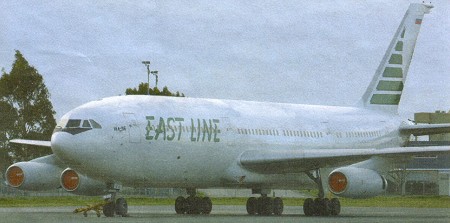
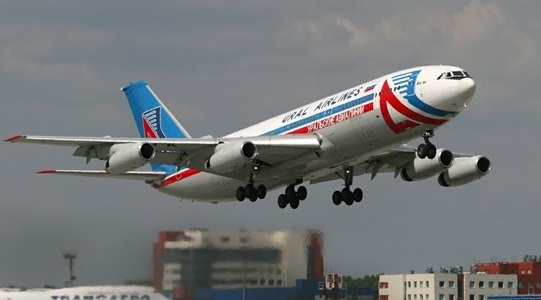
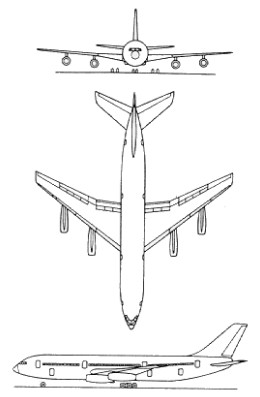
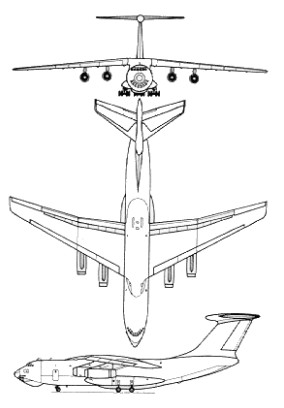
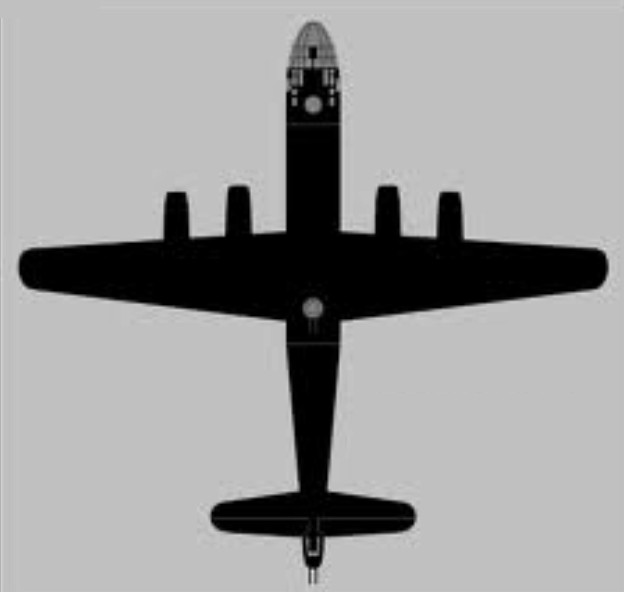
The llyushin Il-86, which has the NATO reporting name ‘Camber’, was the Soviet Union’s first wide-body civil transport. Of low/mid-wing monoplane configuration, it has a circular-section pressurised fuselage with a maximum internal width of 5.70m, and is powered by four Kuznetsov NK-86 turbofan engines pylon-mounted beneath the wings. Accommodation is provided for a crew of three or four on the flight deck, and there is seating for a maximum of 350 passengers, distributed between three cabins which are separated by wardrobes. Access is via three lower-deck airstair-type doors which allow the aircraft to be operated without conventional airport loading/unloading bridges. The airstairs reach down to ground level and, after boarding, passengers can deposit their baggage in lower-deck stowage positions before climbing an internal fixed staircase to the passenger cabin.
Construction of two prototypes began in 1974 and the first (SSSR 86000) flew on 22 December 1976 piloted by a crew under the command of A. Kuziietsov. The maiden flight took it from the old Moscow Central Airport of Khodinka to the official flight test centre. The flight lasted 40 minutes.
The four NK-86 turbofans fitted to the Il-86 are rated at 28,660 lbs static thrust, and all possess combined thrust reversers/ noise attenuators.
The Il-86 first production aircraft flew in October 1977 and deliveries to Aeroflot began in September 1979.
The Il-86 entered regular service with Aeroflot at the end of 1980, after production examples had made proving flights on typical routes from Moscow. The 350-seat Il-86 made return flights three times a week between Moscow and Tashkent.
Since then between 80 and 85 have entered service out of an order for 100. Although most former Eastern Bloc airlines, and particularly CSA and LOT, were mentioned as potential export customers, no orders have materialised and the type remains peculiar to Aeroflot.
Designed to carry 350 passengers on routes of up to 3600 kilometres, the Il-86 has suffered in service due to Aeroflot’s shortage of long range equipment. To solve this predicament, 20 of the 100 ordered by the airline have had oceanic navigation equipment installed for flights to Central and South America with two or more en route stops.
Domestic operations began on 26 December 1980 followed by international services in July 1981.
103 built before production ended.
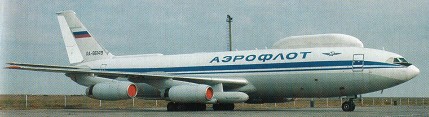
A strategic-command-post version of the IL-86 became the IL-80 Maxdome.
Four Illyushin Il-80 airborne command post flew with the 1338 Test Centr at Chkalovsky. They wore civil registration and pseudo Aeroflot colour schemes.
Engine: 4 x Kusnezow NK 86, 127.5kN / 28,660 lbs Length: 195.341 ft / 59.54 m Width of hull: 19.948 ft / 6.08 m Height: 51.87 ft / 15.81 m Wingspan: 48.3 m / 158 ft 6 in Wing area: 3552.12 sqft / 330.0 sqm Height: 15.7 m / 51 ft 6 in Max take off weight: 454230.0 lb / 206000.0 kg Max. payload weight: 92610.0 lb / 42000.0 kg Landing speed: 130 kts / 240 km/h Cruising speed: 513 kts / 950 km/h Max. speed: 950 km/h / 590 mph Service ceiling: 10000 m / 32800 ft Take off distance: 7546 ft / 2300 m Landing distance: 8530 ft / 2600 m Cruising altitude: 36089 ft / 11000 m Wing loading: 127.92 lb/sq.ft / 624.00 kg/sq.m Range w/max.fuel: 5250 km / 3262 miles Range w/max.payload: 3300 km / 2051 miles Crew: 3 Payload: 350 pax
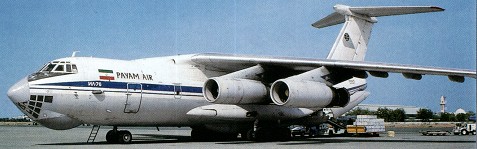
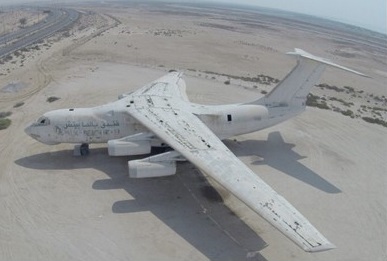
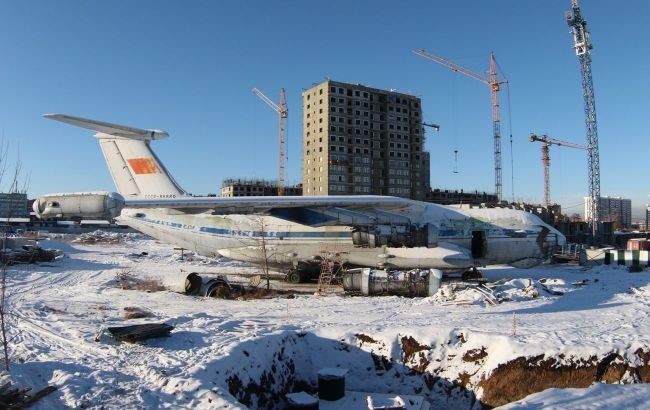
The llyushin Il‑76 was designed as a heavy transport for operations onto short unprepared strips in the Russian “outback” and entered Aeroflot service as the production IL‑76T in 1978.
Originally designed to carry 40 tonnes of freight in excess of 3500 nm using relatively short, unprepared runways, the Il-76 first flew on 25 March 1971, NATO code name ‘Candid’. Test flying continued until 1975 when the type was put into production at the Tashkent factory. During the same year the II-76 established 25 international records for speed and altitude with payload.
The design was prepared to meet a basic need in the Soviet Union for a really capable freighter which, while carrying large indivisible loads, with a high cruising speed and intercontinental range, could operate from relatively poor airstrips. The result is a very useful aircraft which, though initially being used by Aeroflot in 1975 and 1976-80 plans for opening up Siberia the far north and far east of the Soviet Union is a strategic and tactical transport for military use.
The production II-76T ‘Candid A’, with greater cargo capacity and higher gross weights, went into service with Aeroflot on domestic routes early in 1978, and the Moscow-Japan international route in April the same year. It has fitted reversers, a high lift wing for good STOL performance and a high-flotation landing gear with 20 wheels. The big fuselage is fully pressurised and incorporates a powerful auxiliary power unit and freight handling systems.
The four-turbofan Il-76M/MD Candid long-range transport continues to replace Soviet Military Transport Aviation (VTA) An-12 Cubs at a rate of about 30 a year, and now accounts for around half the VTA fleet, with some 310 in service according to US estimates. Deliveries to India, which has ordered 20 to replace An-12s, began in February 1985. In Indian service the Il-76 is named Gajaraj. About 100 have been exported to civil users including Libyan Arab Airlines, Syrianair and, more recently, Cubana, while military customers include the Czech, Polish, Algerian, and Iraqi. The Il-76TD Candid A entered service in late 1982.
The exact time of the start of work on the Il-76PP is not known, but general information points to the mid-1980s. The Il-76PP was only produced in a single example in Russia and remained in the experimental development phase without moving to serial production.
Il-76PP jamming aircraft.
It is known that the Il-76PP was converted from a serial Il-76MD transport aircraft, with work carried out at the Beriev Design Bureau in Taganrog. This factory specializes in radar surveillance aircraft, such as the A-50. The Il-76PP was reportedly intended primarily to jam Western air defense systems, including Patriot systems.
The most notable feature of the Il-76PP was the Landysh electronic warfare (EW) system, also used on Su-24MP aircraft. Defence Express suggests that the Landysh could have been the reason why this project was not realized.
To solve this problem, the aircraft designers installed two additional generators based on the AI-24VT aircraft engine. Each of them was to power four alternators on board the IL-76PP. However, this was not enough to reliably power the electronic warfare equipment.
Another problem was that during the work and tests, the designers of the IL-76PP failed to achieve electromagnetic compatibility between the aircraft’s onboard equipment and the Landysh complex, whose containers were installed on the wingtips.
In other words, the IL-76PP turned out to be a monstrous and non-functional development that was unable to fulfill its main task. Because of this, in 1993 the aircraft was put into storage at the aforementioned training airfield in Irkutsk and remained there until 2024, when space was needed for new construction.
The military transport version, intended for the deployment of paratroops and troops, together with strategic heavy freighting, differs primarily by having military, rather than civil, avionics and equipment. The Soviet air force, with about 450 ‘Candids’ in service, also use the aircraft for firefighting (the II-76DMP), able to carry over 40 tons of water or retardant; as an engine testbed (the II-76LL); airborne early warning (as the A-50 ‘Mainstay’ in the USSR, and the ‘Adnan’ in Iraq) and for Antarctic support flights and cosmonaut training providing simulated weightlessness. Il-76TD (the civil variant is designated ‘T’, whilst the extended range model is assigned the suffix ‘M was one of two aircraft transferred to Aeroflot’s CUMVS, or International Air Services, after serving in Polar regions.
By early 1991 total production had reached about 680 aircraft. Over 700 had been built by early 1992 at the Chakalov Aircraft Production Plant near Tashkent. Over 100 have been exported and about 150 were in Aeroflot service by 1992.
From the moment it was put into service Il-76 has been the main heavy military and transport aircraft of the Russian air forces. More than 950 civilian, military and special modifications variants have been built. In a single-deck modification (with central seats) it can transport 145 military men and 126 paratroopers. In a double-deck version – up to 225 men.
According to the terms of the State contract 39 military and transport aircrafts Il-76MD-90A were to be built for the needs of the Ministry of Defense of the Russian Federation. Maximum load has been increased to 52 tons (compared to 48 tons of Il-76MD). Maximum takeoff weight has risen to 210 tons (190).
Il-78 Midas
A three-point hose-and-drogue tanker variant of the Il-76, the Il-78 Nato code name Midas, has been under development for some years, and is thought to have been deployed operationally early in 1987. The first Mainstay airborne early warning and control system (Awacs) derivative of the Candid is now operational, according to US claims. Four Mainstays were built for test and evaluation, and production is expected to reach five a year to replace the Tu-126 Moss.
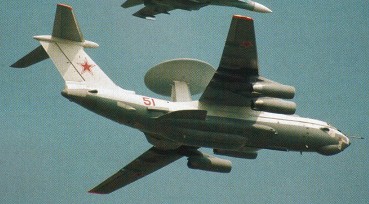
A-50
Succeeding the Tu-126 Moss with Voska PVO, Mainstay, derived from Il-76 Candid and referred to as A-50 ‘Mainstay’, is an AWAC aircraft possessing true overland lookdown capability. Powered by four 26,455 1 (12 000 kgp) Soloviev D¬3OKPs, it features a new IFF system and, apparently, a comprehensive ECM complement. About a half-dozen have attained Voyska PVO service mid-1987. A triple vertical tail arrangement of the prototype was not standardised for series production versions. In 1978 the first flight took place of the Beriev A-50 Mainstay airborne early warning and control aircraft, in Russian operational service since 1984. The A-50 is the ‘Adnan’ in Iraqi service.
A laser-gun test-bed aircraft based on the llyushin II-76 was produced by Beriev and has been flown since 1980s as the A-60.
Il-76 Engines: 4 x 26,455 lb (12,000 kg / 117.7kN) thrust Soloviev D-30KP two-shaft turbofans. Wingspan 165 ft 8 in (50.5 m) Length 152 ft 10½ in (46.59 m) Height 48 ft 5 in (14.76 m). Empty weight, about 159,000 lb (72.000 kg) Maximum loaded weight 346,125 lb (157,000 kg). Maximum speed, about 560 mph (900 kph) Maximum cruising speed 528 mph (850 km/h) Normal long-range cruising height 42,650 ft (13,000 m) Range with maximum payload: 88,185 lb (40.000 kg) 3,100 miles (5000 km). Range w/max.fuel: 5000 km / 3107 miles Armament: normally none / 2 x 23mm machine-guns Crew: 4
Il-76M Candid B Engine: 4 x Soloviev D-30KP turbofan. Installed thrust: 470.8 kN. Span: 50.5 m. Length: 46.6 m. Wing area: 300 sq.m. Empty wt: 61,000 kg. MTOW: 170,000 kg. Payload: 40,000 kg. Cruise speed: 100 kph. Ceiling: 15,500 m. T/O run: 850 m. Ldg run: 460 m. Fuel internal: 82,000 lt. Range: 5000 km. Capacity: 90 pax. Air refuel: No.
Il-76MD Maximum takeoff weight: 190 ton Maximum load: 48 ton
Il-76MD-90A Maximum takeoff weight: 210 ton Fuel capacity: 109500 litres The total of tanks of the aircraft is. Service life: 30 years / 10000 landings / 30 000 Flight hours
Il-76TD Engines: 4 x 26,455 lb (12,000 kg) thrust Soloviev D-30KP two-shaft turbofans. MTOW: 190,000 kg. Wing area: 300 sq.m. Sweepback: 25 deg Max payload: 50,000 kg (110,230 lb). Range: (50t payload) 4500 km Range: (20t payload), 8000 km. Cruise alt: 9000-12000m. Cruise speed: 750-800 kph. Hold cap: 3.4×3.4×24.5m.
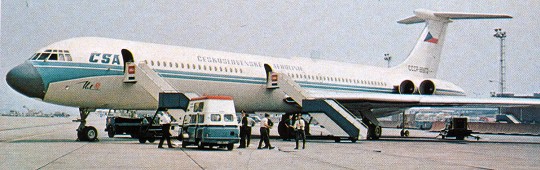
First flown in January 1963, the Il-62 was officially announced by the Soviet Prime Minister, Nikita Kruschev, in September 1962. The basic IL-62 was announced to carry up to 186 passengers, but other seating arrangements provide more leg room with 114 or 168 passengers.
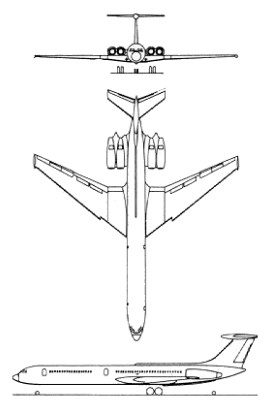
A cantilever low-wing monoplane with swept wings, a T-tail with all swept surfaces, retractable tricycle landing gear and four engines mounted in pairs on each side of the rear fuselage. The II-62 has the NATO reporting name ‘Classic’. The crew has five members, named Ship’s Commander, Second Pilot, On-Board Mechanic, Navigator, and Radio Operator in Soviet parlance.
Ilyushin was aware that TsAGI’s aft-engined T-tailed layout imposed penalties on the Il-62. In particular, he knew that the tail moment arm was shorter, calling for a larger and heavier tailplane. So he decided to cheat a little. He moved the wing slightly ahead of its ‘classical’ position at the aircraft centre of gravity, correspondingly lengthening the tail moment arm. However, this left the landing gear in front of the aeroplane’s centre of gravity. The tail prop fixes this. It has a pair of castoring wheels, enabling it to be used while taxiing. In practice, when the Il-62 is loaded for a flight, the weight of passengers and luggage counterbalances that of the fuel in its swept wing, and the tail prop is retracted.
Initial flight trials proceeded rapidly, and the third prototype attended the 1965 Paris Air Salon. The flight-rated Kuznetsov NK-8 turbofans designed for the aircraft were not ready in time, and the prototype Il-62 originally flew with Lyulka turbojets. Production aircraft, however, were fitted with turbofans.
The Il-62’s layout was fixed at the prototype stage. Ilyushin froze the Il-62’s wing in 1967 and it remained unchanged ever since. A route-proving flight to Siberia was made in February 1966, and crew training began in August later in the year. Aeroflot took delivery of its first aircraft at the end of 1966, and regular services to Khabarovsk began in March. Initial operations had been on cargo services, but on 10 March passenger/mail services were inaugurated on the Moscow-Khabarovsk and Moscow-Novosibirsk routes. Services to Tashkent followed and finally, on 11 July 1967, an Il-62 made a route-proving flight from Moscow to Montreal. The new jet took over this ‘flagship’ weekly route from the Tu-114 a few months later, on 1 November 1967. Other international routes taken over by the Il-62 in 1967 included services to Delhi, Rome and Paris.
Most importantly, in November, Aeroflot Il-62s flew to Washington and other East Coast US airports in preparation for the opening of a Moscow-New York service. This, the first between the USA and the USSR, opened in July 1968. The airliner is capable of carrying more than 150 passengers and reserve fuel on a flight of more than 4,800 miles.
By the early 70s, the Il-62 was fitted with the promising new Solovyov D-30 turbofans, which had greater rated thrust and a more than doubled bypass ratio compared with the original NK-8s. They were also much quieter. A problem associated with the new engines was their larger frontal area which negated much of the benefits. Accordingly, Ilyushin put the Il-62 through a subtle aerodynamic slimming programme. This addressed the tailplane/fin bullet in particular. The resulting Il-62M was the last development of the Il-62. The M-model Il-62 was basically a re-engined Classic with an increased fuel capacity and a revised flight deck layout. The basic Il-62 was originally powered by four extremely thirsty Kuznetsov NK-8-4 turbofans, these engines being replaced by the more economical (and powerful) Solviev D-30KUs on the new production II-62M in 1971
Shown first at the Paris Air Show in 1971, the IL-62M200 is a high-density version of the IL-62 that seats a maximum 198 economy-class passengers or 161 in a mixed-class configuration. The newer deluxe model has the same outer dimensions as those found on the basic model, but an additional fuel tank in the tail of the plane plus improved turbofan engines give the airplane greater range and payload. The Russian airliner has two airflow guide vanes on the forward section of the fuselage, while the VC-10 builders placed air guide vanes on the top wing surface. Its flight controls are entirely human muscle-powered.
Apart from Aeroflot, the Il-62 saw service with a large number of Soviet client state airlines. Its exports began with CSA in 1969 and continued with Interflug, Zhongguo minhang zongju (“CAAC”), Lot, Tarom, Cubana, Chosonminhang, and Hang khong Viet Nam. Aircraft have been wet-leased to Air-India, Aeronica, MALÉV and others. The Il-62 base model stayed in production until 1979. One Il-62 has been photographed in Russian VVS markings, but no other military operators are known, and the VVS uses it as a staff transport. The Russian Ministry of Natural Emergencies also used a single Il-62 which it lost in a crash at Lisbon.
It is believed that more than 210 Il-62 have been built.
Il-62 Engines: 4 x 23,150 lb (10,500 kg) Kuznetsov NK8-4 turbofan. Length 174.25 ft (53.12m) Wing span 142 ft (43.30m) Height: 12.4 m / 40 ft 8 in Wing area: 279.6 sq.m / 3009.59 sq ft Max take-off weight: 157500 kg / 347230 lb Empty weight: 67800 kg / 149474 lb Fuel capacity 26,420. Max capacity: 186 passengers Max cruise 560 mph (900 kph). Cruise speed 510 mph. Landing speed 137 mph. Ceiling: 39,400 ft. Range 5,715 miles (9,200 km) with 22,050 lb (10,000 kg) payload. Range w/max.payload: 6700 km / 4163 miles Takeoff run 10,660 ft. Landing roll 9,185 ft Crew: 5
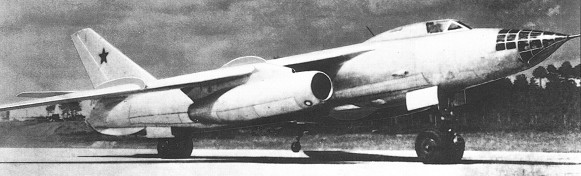
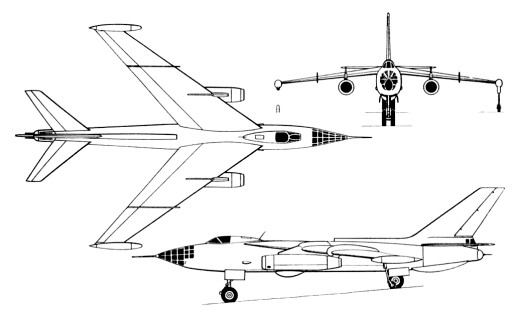
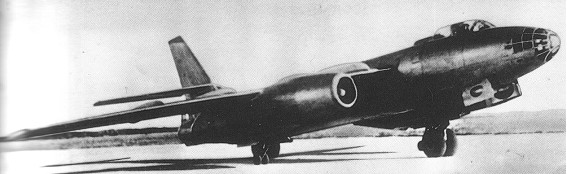
The Il-54 resulted from a 1953 requirement and first flew in early 1955. The type was typical of Soviet thinking for tactical bombers in the period: an oval-section fuselage with a completely glazed bombardier nose; a fighter-type canopy over the pilot and a barbette controlled by the tail gunner; tandem main landing gear units with stabilizing outriggers, and flying surfaces swept at 550 these last including high-set wings with the two 14,330-lb (6500-kg) thrust AL-1 turbojets pod-mounted below them. Flight trials confirmed that the Il-54 had transonic performance, with a maximum sea-level speed of 715 mph (150 km/h), but no production was authorized. One built.
Engine: 2 x AL-7F turbojets, 10000kg with afterburner Max take-off weight: 40660 kg / 89640 lb Empty weight: 24000 kg / 52911 lb Wingspan: 17.7 m / 58 ft 1 in Length: 28.9 m / 94 ft 10 in Wing area: 84.6 sq.m / 910.63 sq ft Max. Speed: 1250 km/h / 777 mph Cruise speed: 910 km/h / 565 mph Ceiling: 14000 m / 45950 ft Range: 2500 km / 1553 miles Armament: 4 x 23mm cannon, 5000kg bombs Crew: 3
After the Il-30, the Ilyushin design bureau then moved to a scaled-up version of the Il-28 as the Il-46 of 1954 with an uprated version of the Il-30’s powerplant, but this too failed to secure any production commitment. The bureau then moved logically to a fully swept version of the Il-30 that offered transonic capability with the possibility of supersonic speed in a shallow dive, the Il-54.
Engines: 2 x Lyulka AL-5 turbojet Maximum take off weight: 42,000 kg
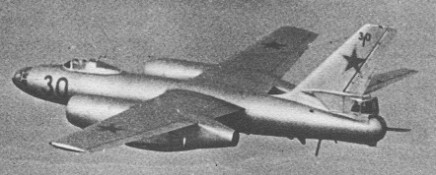
The Il-28 was upgraded in the Il-30 of 1951 with the Lyulka AL-5 turbojet and 35 degree swept wings to produce a speed of more than 621 mph (1000 km/h), but this had not been ordered into production. The Ilyushin design bureau then moved to a scaled-up version of the Il-28 as the Il-46.
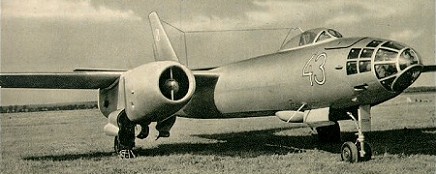
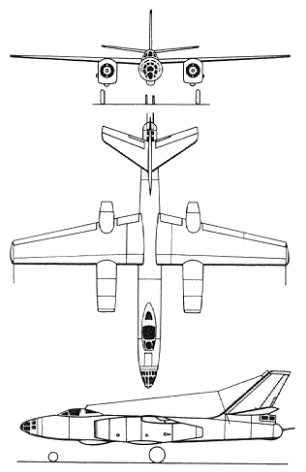
To a small extent, the Il-28 could trace its ancestry back to the first jet bomber, the German Arado Ar 234. Ilyushins first jet bomber, the Il-22, had closely resembled an enlarged Ar 234C, and several features of the German aircraft (the slim fuselage, shoulder-mounted unswept wing with underslung engines, and the large slotted flaps) were carried over into the Il-28. In December 1947, Ilyushin started development of a small, more compact bomber, trading range for speed and manoeuvrability. The pilot was seated to the bomb-aimer’s rear, above the nosewheel bay. A fighter-type canopy (the first on a Soviet bomber) provided adequate height for the pilot’s cockpit. The fuel was housed in five flexible tanks in the fuselage, forward and aft of the wing. The centre fuselage housed the bomb bay, large enough to house 12 551-lb (250-kg) FAB-250 bombs; the lower front fuselage accommodated a mapping radar and two NR-23 23-mm cannon.
The pressurized Il-K6 turret, mounting two 23-mm NR-23 cannon, was housed in the tail of the fuselage. The rear gunner was the only member of the crew without an ejection seat. The gunner doubled as the radio operator, the VHF and HF communications equipment being installed ahead of the turret.
The engines were ahead of the main wing structure, the jetpipes passed beneath the wing, and the single-wheel main landing gear units were located beneath the jetpipes.
The wings were built in upper and lower halves, which were joined together after hydraulics and other plumbing had been installed, and were built in sections to minimize the need for large production tools. The high wing eliminated the need for any complex carry-through structures around the fuselage and nacelles. Also, most of the fuselage and nacelle skins were single-curvature surfaces (much of the fuselage was an almost perfect cylinder.
A medium bomber, first flown on 8 August 1948, the Il-28 prototype flew on two RD-10 (Jumo 004 development) 2270kg thrust Klimov RD-45F turbojets, but the British Nene were substituted and, in VK-1 form, remained standard in the 10,000 or more subsequent examples.
In October 1948, the Il-28 was evaluated against the larger but similarly powered Tupolev Tu-78 in the light bomber role; the Ilyushin aircraft proved faster and more agile, and was selected as the replacement for the obsolescent Tu-2.
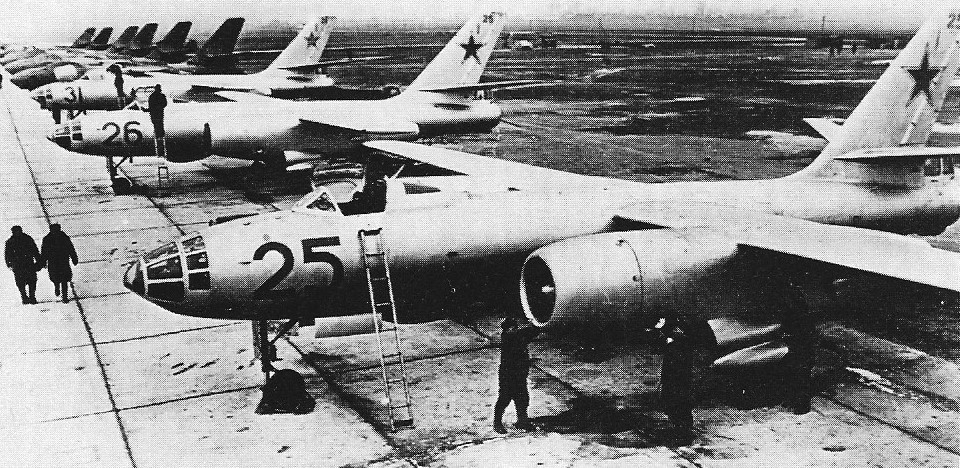
A formation of 25 pre-production Il-28s took part in the 1950 May Day Moscow fly-past, by which time large-scale production had been initiated at several factories. Series aircraft, which entered service with a large number of V-VS bomber regiments, incorporated aerodynamic refinements, Klimov VK-1 provision for detachable wingtip fuel tanks.
Preparations for large¬scale production were undertaken with great urgency, and the type entered service in September 1950. The only major change during development was the switch from the RD-45, used only in the prototype and pre-production aircraft, to the similarly sized but usefully more powerful VK-1.
The basic Il-28 remained virtually unchanged throughout its production life. The only visible alteration was the introduction of a small tail-warning radar, although the guns still had to be aimed manually. At least 3,000 were delivered from Soviet plants in 1950-60. (In the late 1950s, a few aircraft were produced by Czechoslovakia as B-228s.)
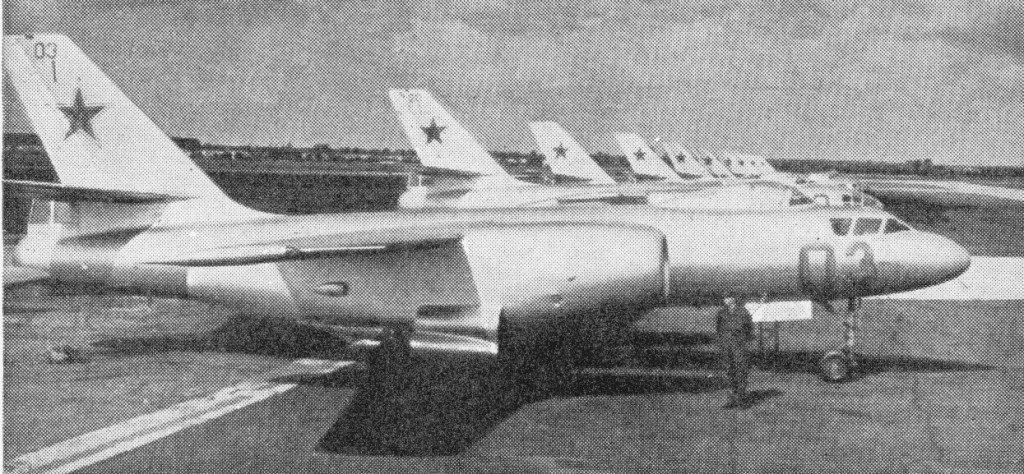
Known to NATO as Beagle, it equipped all the Warsaw Pact light bomber units in 1955-70 and was also adopted by the AV-MF as the II-28T torpedo bomber. Armed with two internally carried torpedoes, the Il-28Ts were replaced by Su-17s in the mid-1970s. The Il-28U dual trainer, NATO code name ‘Mascot’, has distinctive stepped cockpits, and the Il-28R reconnaissance versions (many probably converted bombers) carry a wide range of electronics and sensors’ and wing tip-tanks. No longer a front-line type in the Soviet Union, the Il-28 remained in service with some 15 air forces outside Europe, the most important being that of China where some hundreds were built under a licence granted before 1960.
Another version was unarmed and demilitarized, used by Aeroflot for high-speed package deliveries — for example, the matrices used to print Pravda throughout the USSR — and to gain jet experience in the civil environment before the introduction of the Tu-104. Later, some Il-28s were converted with radio control systems and used as target drones.
With its internal weapons bay, it could carry large conventional stores such as a 6,614-lb (3000-kg) bomb, or a tactical nuclear weapon.
The Il-28 rapidly became obsolete as a tactical combat aircraft, and it was replaced by the transonic Yak-28L from 1963—4 onwards.
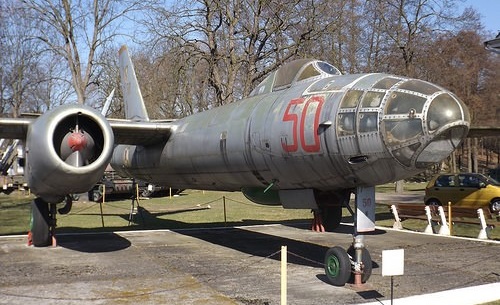
50 Ilyushin IL-28 B5 56538
The Il-28 was a standard type with Warsaw Pact forces, and was widely exported. The type saw some action in the Middle East and the Nigerian civil war in the late 1960s.
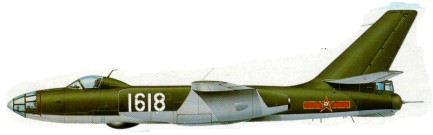
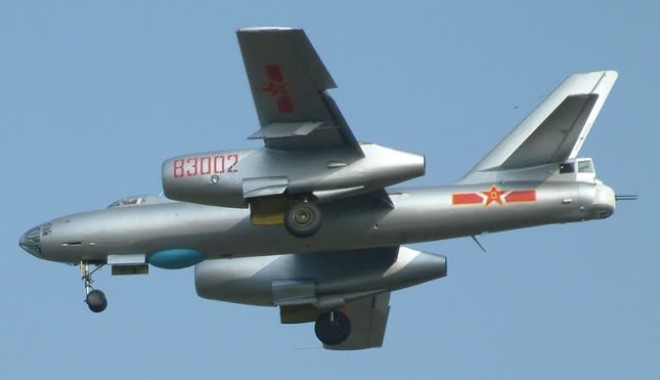
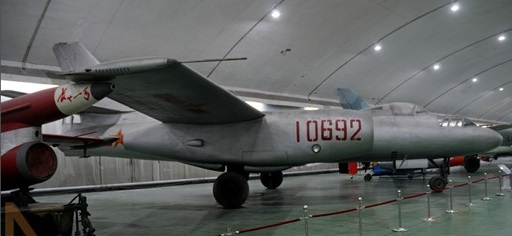
The biggest operator of the Il-28 outside the Soviet Union was China, which is believed to have received a substantial number of the type in the late 1950s. Shortly after the Sino-Soviet rift of 1959, engineers at China’s Harbin aircraft plant analysed and copied the Il-28 airframe and systems (the VK-1 engine was already in production for the MiG-17) and began to produce the aircraft at a low rate under the designation H-5 (sometimes rendered as B-B in the West) from 1966 to the 1980s. Like other Chinese-built Soviet types, the H-5 is a clone of the original: a copy so exact that it is almost indistinguishable from the Il-28. In 1980, it was reported that the H-5 was still in production at Harbin, and that more than 400 aircraft were in service, some carrying nuclear weapons.
H-5
In the bomber field, light duties were assigned to the Harbin twin-jet Hongjhaji 5 – alias Ilyushin Il-28 ‘Beagle’ – production having finally tailed off only in the early 1980s. Despite having flown as a prototype almost 40 years ago, on 8 August 1948, and having long since been withdrawn from first-line service by WarPac, the Il-28 tactical light bomber, in its H-5 version as built by Harbin provided the tactical bombing backbone of People’s Republic of China Air Force in 1987. Between 600 and 700 were built in China 1966-1982, some 500 serving with PRCAF and about 130 with PRC NavAir in 1987 Powered by two 5,952 lb St (2 700 kgp) turbojets based on Klimov VK- 1.
Harbin H-5
The Il-28U was known as HJ-5 in Chinese operational service.
HJ-5
In Europe the Romanian air force operated this type until December 2000.
Il-28 three-seat bomber and ground attack. Engines: 2 x 5952 lb (2700 kg) thrust Klimov VK-1 single-shaft centrifugal turbojets. Wing span excluding tip tanks: 21,45 m (70 ft 4.5 in). Length (typical): 17.65 m (57 ft 10.75 in). Height: 6,70 m (22 ft 0 in). Wing area: 60.80 sq.m (654.5 sq.ft). Max speed: 900 km/h (559 mph) at 4500 m (14.765 ft). Cruise speed: 800 km/h / 497 mph ROC: 2,953 ft (900 m)/min. Service ceiling: 12300 m (40,355 ft). Range at high altitude with maximum fuel 2180 km (1,355 miles). Range with bomb load: 684 miles (1100 km). Empty wt: 12890 kg (28,417 lb). MTOW in original bomber role: 21000 kg (46,296 lb). Armament: 4 x 23 mm NR-23 cannon, internal 3000 kg (6,614 lb) or two AV 45 36 torpedoes. Crew: 3
Ilyushins first jet bomber, the Il-22, had closely resembled an enlarged Ar 234C, and several features of the German aircraft (the slim fuselage, shoulder-mounted unswept wing with underslung engines, and the large slotted flaps) were carried over into the Il-28.
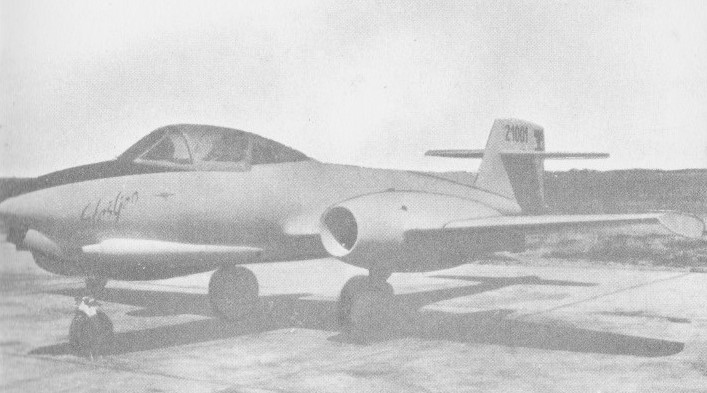
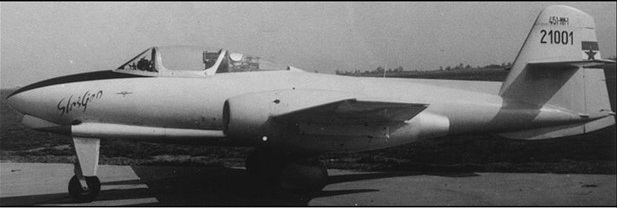
The J-451MM Stršljen is a development of the single seat 451M Zolja research aircraft, which was the first jet aircraft designed in Yugoslavia.
Ikarus J 451 MM Strsljen
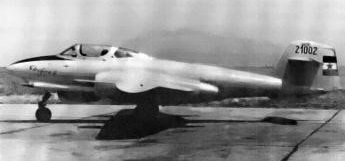
The Ikarus J-451MM Stršljen (“Hornet”) was developed in 1956 as a planned close support variant of the S-451M Zolja and test flown in 1957 by the Aeronautical Testing Centre. The design featured a tricycle undercarriage as opposed to the early tail dragger designs, more powerful Turbomeca Marboré turbojet engines and armament of 2 x 20mm Hispano-Suiza 404A cannons under the fuselage along with underwing rockets.
Ikarus J-451MM Stršljen (“Hornet”)
The airframe has low-set wings without sweepback, and un-swept tail surfaces, with the tailplane mounted part-way up the fin. The ailerons, elevators and rudder are conventional. The wingtips are turned down and a stabilising fin is under the nose. The outer wings fold upward for stowage and access to the engines.
The tricycle undercarriage has single wheels on each unit. The main wheels retract inward and nosewheel retracts forward.
Two cannon are located in fairings under the fuselage and underwing attachments hold up to four air-to-ground rockets.
Engines: 2 x Turbomeca Marbore, 880 lb Wingspan: 25 ft 10.5 in Wing area: 121.5 sq.ft Length: 26 ft 3 in Height: 5 ft 6 in Empty weight: 5370 lb Max speed: 497 mph at SL Service ceiling: 39,600 ft Range: 470 mi Armament: 2 x 20 mm Hispano cannon Hardpoints: 4
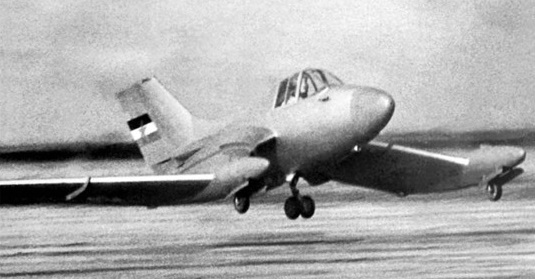
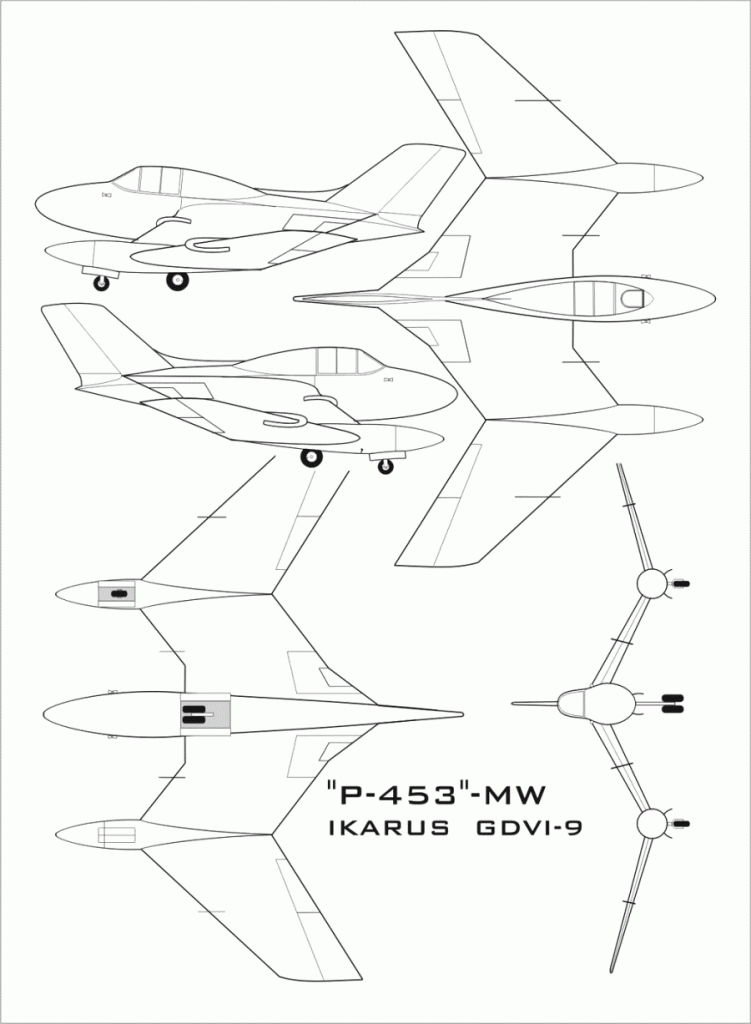
The Ikarus 453 (P-453-MW) was an aircraft designed in 1952. It featured reverse gull wings to accommodate two Turbomeca Marbore II turbojet engines in the nacelles on the wing. In 1952 the first flight was conducted without engines fitted (in glide mode) but it crashed and the project was cancelled (the pilot survived the incident).

 All Aero