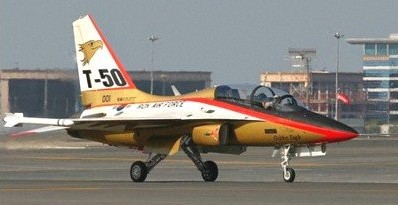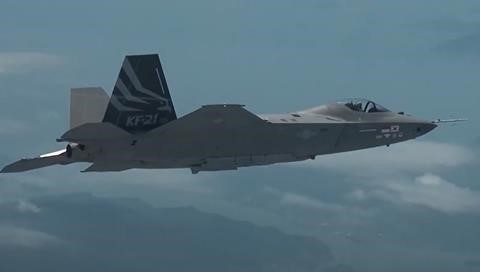
KAI KF-21 Boramae

Following the KF-21’s maiden flight on 19 July 2022, five additional prototypes were set to join the flight test campaign from October 2022, according to South Korea’s Defense Acquisition Program Administration (DAPA).

The developmental Korea Aerospace Industries (KAI) KF-21 Boramae fighter continued to expand its flight envelope in September 2022, with more prototypes set to join the testing campaign.

Overall, the development was expected to be completed by 2026.

DAPA’s programme update coincided with a 28 September ceremony at KAI’s factory at Sacheon attended by South Korean government officials and Indonesia’s defence establishment – Jakarta is a 20% partner in the W8.8 trillion ($6.15 billion) programme.

Eom also told Yonhap that Jakarta has paid just 30% of its share via unspecified “in-kind” payments, and that no payments have been made since 2017.

Jakarta’s tardiness with payments has been a persistent issue for the programme, although Indonesian president Joko Widodo and South Korean president Yoon Suk-Yeol reaffirmed their countries’ joint commitment to the KF-21 in July.

At present, 37 Indonesian personnel are in South Korea working on the project, and Herindra indicates that the aim is to raise this number to 100.

Powered by two GE Aviation F414 engines, the KF-21 will replace McDonnell Douglas F-4 Phantoms and Northrop F-5s in South Korean service. Seoul is expected to obtain 120 and Indonesia 50, while the former also hopes to sell the type on the export market.

At the DX Korea 2022 show, KAI displayed a model of a prospective naval variant, the KF-21N. Media reports indicate that the jet would be capable of operations from both catapult assisted take-off but arrested recovery and STOBAR short take-off but arrested recovery vessels.
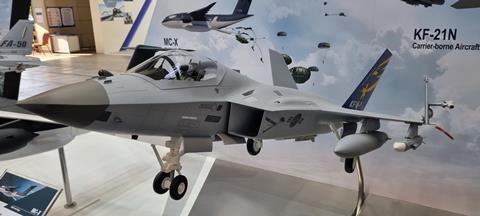
A model of the prospective naval variant of the KF-21, the ‘KF-21N’

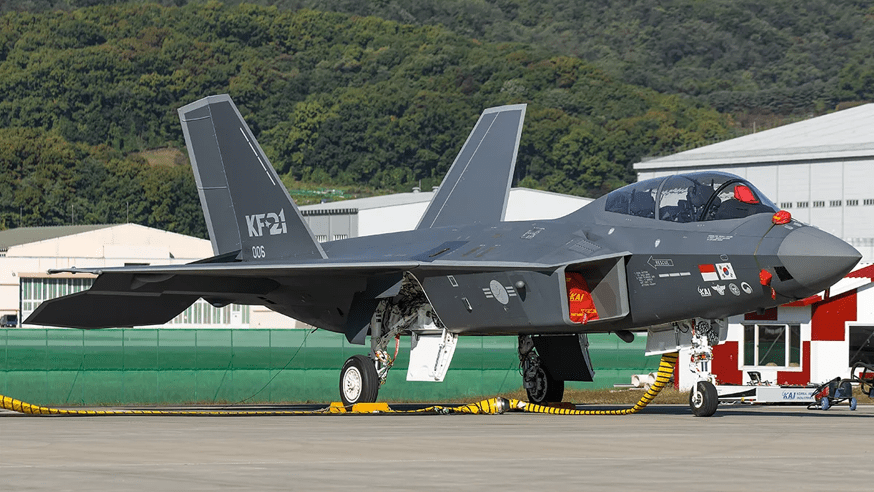
The KAI KF-21 Boramae (meaning “hawk” in Korean) represents South Korea’s emergence as a major player in the global aerospace industry.

Powered by two General Electric F414 engines—the same that power the Super Hornet—the KF-21 reaches Mach 1.8 (2,200 km/h).

At approximately $74 million per unit, it offers near-fifth-generation capabilities at fourth-generation prices.

With 120 aircraft planned for South Korean service by 2032.
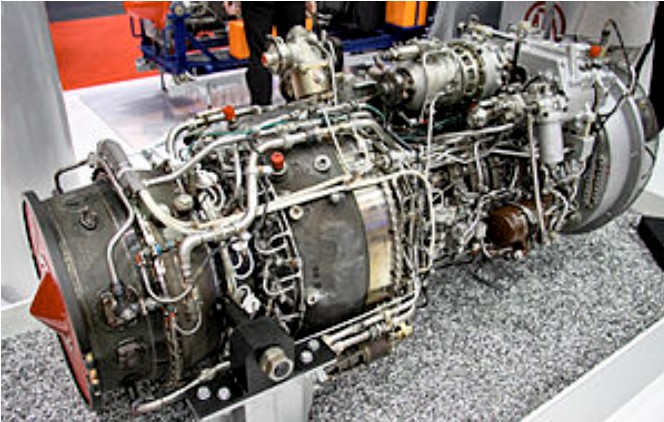
Kolesov RD-36-51

The Kolesov RD-36-51 was a supersonic turbojet engine used on the Tu-144D SST.

The RD-36-51 produced a thrust of 18,100 kgf (per one) and consumed 25,700 kg fuel per hour (per four) and gave the aircraft a maximum range of 6,500 km.

The engine was a replacement for the Kuznetsov NK-144 turbofan, and its use permitted significantly increased range particularly in supercruise.

Specifications:
RD-36-51
Type: Turbojet
Compressor: Axial
Maximum thrust: 24,000 kgf at takeoff and 5,400 kgf cruise
Specific fuel consumption: 1.23 lb/lbf h

Kokkola KO-04 Super Upstart

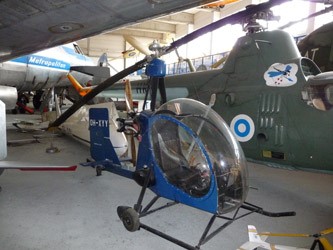
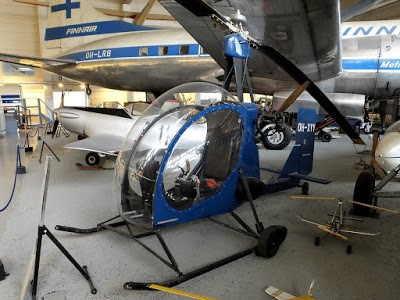
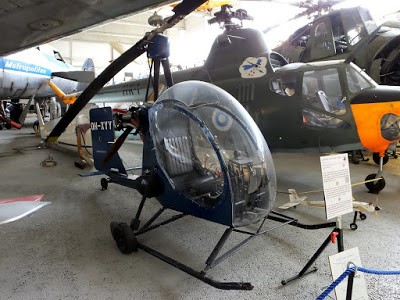
In 1968 the Kokkola Brothers, Kalevi and Seppo, designed the KO-04 Super Upstart autogiro or gyrocopter with rotor-tip thrusters for increased take-off performance. The plane was registered OH-XYY (Serial number 1) during 1969 – 1976, and after that it came in airworthy condition to the Finnish Aviation Museum. The plane was donated to the museum’s collection in the end of the 1990’s.

OH-XYY

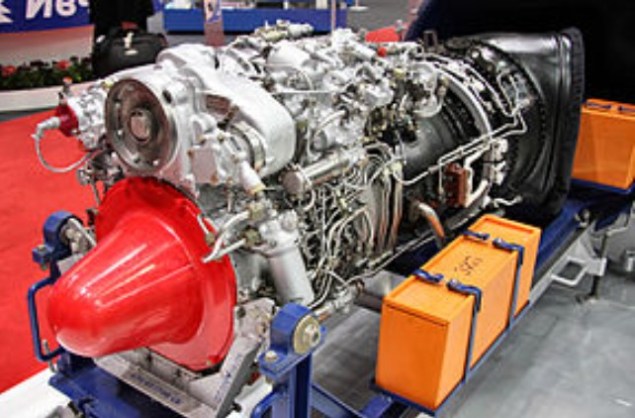
Klimov TV7-117

The TV7-117 is a Russian turboprop engine certified in 1997 to power the Ilyushin Il-114 regional commuter aircraft. The new engine features enhanced reliability, fuel economy and greater service life compared with its predecessors produced in the former Soviet Union. The engine has a modular design. The nine modules can be replaced in the field, which dramatically reduces costs and accelerates repair and maintenance. The engine has an electronic-hydromechanical control system.

The TV7-117 engine has been offered to power the newest Russian turboprop aircraft such as Ilyushin Il-112, MiG-110 and Tu-136. In addition, Klimov developed the TV7-117B turboshaft to power rotary-wing aircraft and marine drives for power high-speed boats and industrial electric power plants. The TV7-117 engine family are produced by Klimov JSC (St. Petersburg), Chernishov JSC (Moscow) and the Baranov JSC (Omsk).

Variants:
TV7-117SM is a variant that was introduced by Klimov in 2002 featuring a Full Authority Digital Electric Control (FADEC) system based on the BARK-12 or BARK-57 electroniс engine control unit, as well as improved reliability, manufacturability and maintainability. It features an enclosed centrifugal wheel that increases its power by 10% while maintaining all the other performance parameters. The Klimov Company holds a patent for the design and manufacturing of such wheels.

TV7-117B is a TV7-117 version that was developed into a turboshaft engine. It is used on modernized Mi-8 helicopters.

TV7-117V/VM is a model with the power shaft in front dedicated to the Mi-38 (VK-3000 family).

TV7-117VK is a version with the power shaft in the rear to upgrade Mi-28 and Ka50/Ka52 helicopters (VK-3000 family).

Applications:
Ilyushin Il-112
Ilyushin Il-114
Mil Mi-8
Mil Mi-17

Specifications:
TV7-117
Type: turboprop/turboshaft
Length: 2,136 mm (84.1 in)
Diameter: 940 mm (37 in)
Dry weight: 530 kg (1,170 lb)
Compressor: single shaft axial flow centrifugal compressor, 5 axial + 1 centrifugal stages
Combustors: annular
Turbine: 2-stage axial flow
Maximum power output: 2800 hp
Overall pressure ratio: 16 (ratio on takeoff)
Fuel consumption: 180 g/hp/hr (cruise)

Klimov TV2-117 / Isotov TV2-117

The Klimov TV2-117 (initially Isotov TV2-117) is a Soviet gas-turbine turboshaft engine intended for helicopter use. Developed in the early 1960s from the Klimov TV3-117 by the Isotov Design Bureau the engine became the first purpose built gas turbine engine for helicopter use by the Soviet Union with previous helicopter turbines being adapted aeroplane powerplants. First run in 1962, it was later produced by Klimov, production ending in 1997.

The TV2-117 is claimed to be the most popular helicopter powerplant worldwide with 23,000 built and has accumulated over 100 million hours in service.

Variants:
TV2-117
Base variant.

TV2-117A
Improved engine with more durable compressor stator blades.

TV2-117AG
Carbon sealed shaft bearings

TV2-117F
Limited production of engine certified to FAA airworthiness standards for Japan.

TV2-117TG
Multi-fuel variant, adapted to run on liquid petroleum gas and other fuels, such as gasoline and diesel fuel, and for use in cold climates.

Applications:
Antonov An-24 (intended coupled turboprop application)
Mil Mi-8
Mil Mi-14

Specifications:

TV-2 117
Type: Turboshaft
Length: 2,835 mm (9.301 ft)
Dry weight: 330 kg (728 lb) (minus accessories)
Compressor: Ten-stage axial flow
Combustors: Eight-chamber cannular
Turbine: Two-stage compressor turbine, two-stage power turbine
Maximum power output: 1,700 hp (1,268 kW)
Overall pressure ratio: 6.6:1 at 21,200 rpm
Specific fuel consumption: 0.606 lb/hr/shp

Klimov VK-800

The Klimov VK-2500 is a Russian turboshaft aero-engine, a high power derivative of the Klimov ТV7-117VMA engine also for hot and high.

It differs from the older versions in having an extended overhaul period of the engine hot components, extra gas-dynamic stability at varying duties, engine parameters accuracy and engine control quality, enhanced monitoring depth providing operation of the engine according to its technical condition and better weight characteristics and overall dimensions.

Variants:
VK-2500-01
Has 1750shp (1287kW) maximum continuous performance and a 2400 shp (1764kW) take-off performance

VK-2500-02
Has a 1500shp (1103kW) maximum continuous performance and a 2200 shp (1617kW) take-off performance

VK-2500-03
Has a 1500shp (1103kW) maximum continuous performance and a 2000 shp (1470kW) take-off performance

Applications:
Kamov Ka-50
Kamov Ka-52
Mil Mi-28

Specifications:
VK-2500
Type: Turboshaft
Dry weight: 300kg
Maximum power output: 1287kW (1750shp)
Specific fuel consumption: 0.22 kg/hp/hr

Klimov VK-2500

The Klimov VK-2500 is a Russian turboshaft aero-engine, a high power derivative of the Klimov ТV7-117VMA engine also for hot and high.

It differs from the older versions in having an extended overhaul period of the engine hot components, extra gas-dynamic stability at varying duties, engine parameters accuracy and engine control quality, enhanced monitoring depth providing operation of the engine according to its technical condition and better weight characteristics and overall dimensions.

Variants:
VK-2500-01
Has 1750shp (1287kW) maximum continuous performance and a 2400 shp (1764kW) take-off performance

VK-2500-02
Has a 1500shp (1103kW) maximum continuous performance and a 2200 shp (1617kW) take-off performance

VK-2500-03
Has a 1500shp (1103kW) maximum continuous performance and a 2000 shp (1470kW) take-off performance

Applications:
Kamov Ka-50
Kamov Ka-52
Mil Mi-28

Specifications:
VK-2500
Type: Turboshaft
Length:
Diameter:
Dry weight: 300kg
Compressor:
Maximum power output: 1287kW (1750shp)
Specific fuel consumption: 0.22 kg/hp/hr

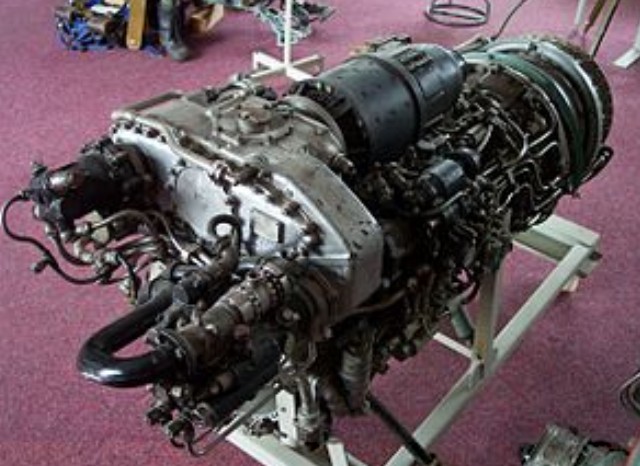
Klimov RD-500

The Klimov RD-500 was an unlicensed Soviet copy of the Rolls-Royce Derwent Mk.V turbojet that was sold to the Soviet Union in 1947.

Producing metric drawings and analyzing the materials used in the Derwent went fairly quickly, but finding a substitute for the high-temperature, creep-resistant Nimonic 80 steel alloy was a more difficult challenge. Eventually an alloy that matched Nimonic 80’s high-temperature properties was found in KhN 80T, but it was not creep-resistant. The first Derwent copy, designated as the RD-500 (Reaktivnyy Dvigatel’ — jet engine) after the Factory No. 500 where the engine was first produced, was being tested on 31 December 1947, but problems cropped up quickly. Combustion was uneven and this cracked the combustion chambers. This may have had something to do with the modifications made by the Soviets to the fuel, speed and starter systems. But these problems were resolved by September 1948 when the engine passed its 100-hour State acceptance test.

RD-500 was a close copy of the Derwent with a single-stage centrifugal compressor, nine combustion chambers and a single-stage turbine. It matched the Derwent’s thrust of 15.9 kN (3,506 lbf) and was only 13.7 kg (30 lb) heavier. The main problem with the engine in service was with its turbine blades, 30% of which failed inspection due to recrystallization after casting. The poor creep resistance of the KhN 80T alloy resulted in dangerous elongation of the turbine blades. Up to 40% of the early production RD-500s had to be individually adjusted before delivery and the service life of the engine never approached the 100 hours demonstrated in the acceptance test.

The Soviets had enormous problems building the engines to standard, as demonstrated in the 20,000 man-hours required to build a single engine in 1947. This figure dropped to a more reasonable 7,900 man-hours by November 1948 and declined further still to 4,734 man-hours by 1 March 1949, close to the target of 4,000 man-hours. Production by Factory No. 500 totaled 97 in 1948 and 462 in 1949. Factory No. 16 in Kazan was brought into the program and built 300 engines in 1949. Production was canceled around 1950 in favor of the superior Klimov VK-1 turbojet based on the Rolls-Royce Nene.

The RD-500 was used in a number of early Soviet jet fighters including the Lavochkin La-15, the Yakovlev Yak-25, and the Yakovlev Yak-30, but only the Yakovlev Yak-23 was accepted for service, albeit in small numbers.

Applications:
Lavochkin La-15
Mikoyan-Gurevich KSK test plane
Raduga KS-1 Komet
Yakovlev Yak-23
Yakovlev Yak-25
Yakovlev Yak-30
Yakovlev Yak-1000

Specifications:
RD-500
Type: Turbojet
Length: 2.11 metres (6 ft 11 in)
Diameter: 1.09 metres (3 ft 7 in)
Dry weight: 580.7 kg (1,280 lb)
Compressor: Single-stage centrifugal compressor
Combustors: Nine
Turbine: Single-stage
Maximum thrust: 15.9 kN (3,600 lbf)
Specific fuel consumption: 1.4
Thrust-to-weight ratio: 2.73

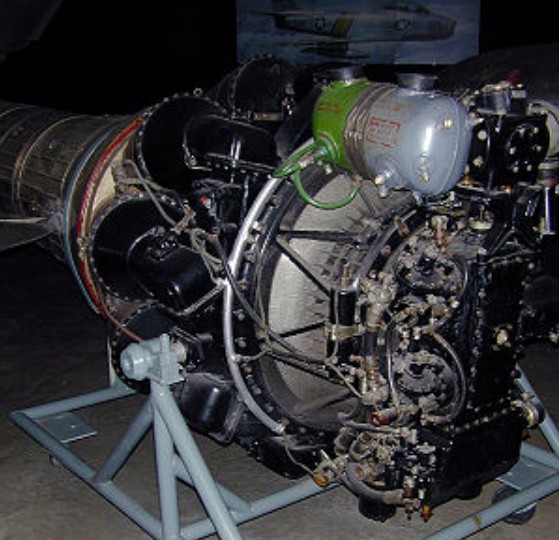
Klimov VK-1 / RD-45 / Shenyang PF-1

Klimov VK-1

Immediately after World War II, the Soviet Union manufactured copies of first generation German Junkers 004 and BMW 003 engines, which were advanced designs with poor durability, limited by Germany’s availability of rare metals at wartime. However in 1946, before the Cold War had really begun, the new British Labour government under the Prime Minister, Clement Attlee, keen to improve diplomatic relations with the Soviet Union, authorised Rolls-Royce to export 40 Rolls-Royce Nene centrifugal flow turbojet engines. In 1958 it was discovered during a visit to Beijing by Whitney Straight, then deputy chairman of Rolls-Royce, that this engine had been copied without license to power the MiG-15 ‘Fagot’, first as the RD-45, and after initial problems of metallurgy forced the Soviet engineers to develop a slightly redesigned (and metallurgically closer) copy, the engine had then entered production as the Klimov VK-1 (Rolls-Royce later attempted to claim £207m in license fees, without success).

It was developed by Vladimir Yakovlevich Klimov and first produced by the GAZ 116 works.

The RD-45 was further improved to produce the VK-1, which differed from the Nene in having larger combustion chambers, larger turbine, and revised airflow through the engine. The VK-1F added the afterburner.

The engine featured a centrifugal compressor, requiring a larger-diameter fuselage than aircraft featuring the more progressive axial compressor designs that had already appeared in WWII Germany and Britain. The engine was built under license in China as the WP-5.

Applications:
The VK-1 was used to power MiG-15 ‘Fagot’ and MiG-17 ‘Fresco’ fighters, as well as the Il-28 ‘Beagle’.

Specifications:
VK-1
Type: Turbojet
Length: 2,600 mm (102 in)
Diameter: 1,300 mm (51 in)
Dry weight: 872 kg (1,395 lb)
Compressor: Centrifugal compressor
Maximum thrust: 26.5 kN (5,955 lbf)
Specific fuel consumption: 109.1 kg/(kN·h) (1.07 lb/(lbf·h))
Thrust-to-weight ratio: 41.4 N/kg (4.27:1)