Lavochkin La-150

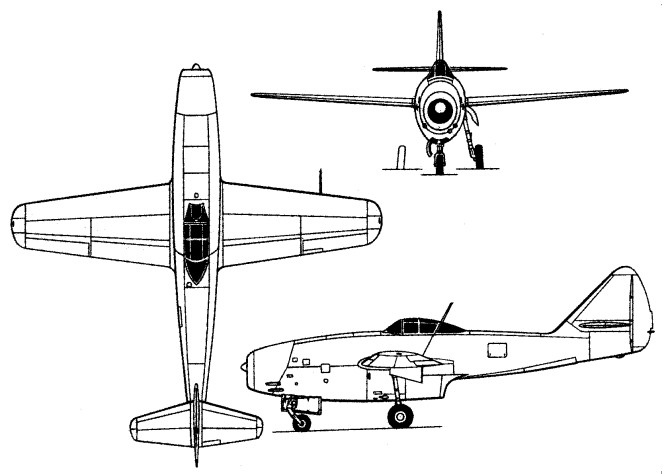
The Lavochkin bureau’s response to Yosif Stalin’s order of February 1945 to design and build a single-seat jet fighter around a Junkers Jumo 004B turbojet, was the La-150 of pod-and-boom layout with a shoulder-mounted wing.
Like the competitive designs from the Mikoyan-Gurevich and Yakovlev bureaux, the La-150 was awarded a prototype/pre-series aircraft order, the first of the prototypes flying in September 1946 powered by the Soviet derivative of the Junkers Jumo 004B axial-flow turbojet engine, the RD-10 rated at 900kg.

The February 1945 Soviet requirement for a jet-powered fighter specified a single 1984-lb (900-kg) thrust RD-10, and the limited power of this engine dictated that the designers had to exercise considerable ingenuity in keeping down weight and optimizing the engine installation. The Lavochkin team’s response was a small machine and a pod-and-boom fuselage allowing the use of an efficient straight-through design from the circular nose inlet to the nozzle under the boom. Five prototypes were built for trials from late 1946, but the type was beset by problems including a high structure weight and sluggish performance. Excessive dihedral effect resulting from the wing positioning was rectified on the second prototype by drooping the wingtips, but excessive oscillation of the tail surfaces at high speeds resulting from inadequate stiffness of the tailboom could not be overcome.

The Yak 17 Feather was slightly faster and lighter than its competitor, the La 150, and was substantially superior in range; rough field performance of the Yak 17 was very much better than that of the Lavochkin design, which had a heavy narrow track undercarriage. The La 150 was abandoned in April 1947 and the Yak 17 was ordered into production.

Max take-off weight: 2961 kg / 6528 lb
Empty weight: 2059 kg / 4539 lb
Wingspan: 8.20 m / 26 ft 11 in
Length: 9.42 m / 30 ft 11 in
Wing area: 12.15 sq.m / 130.78 sq ft
Max. speed: 805 km/h / 500 mph
Range: 500 km / 311 miles
Armament: 2 x 23mm NS-23 cannon.
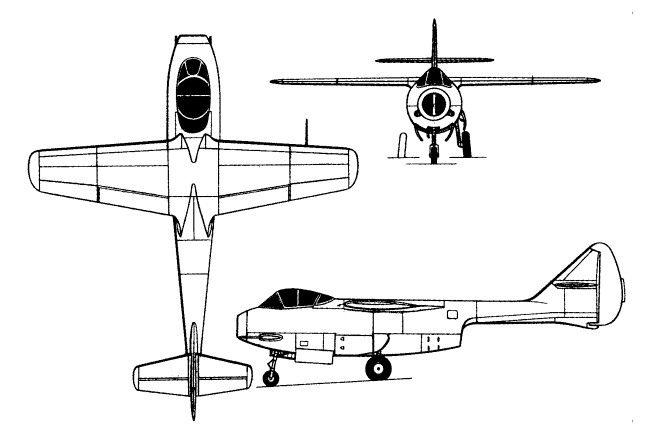
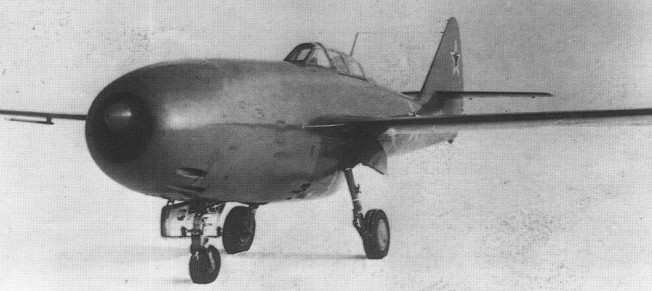
Lavochkin La-174TK

La-174TK

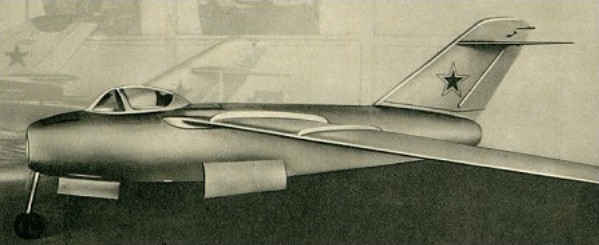
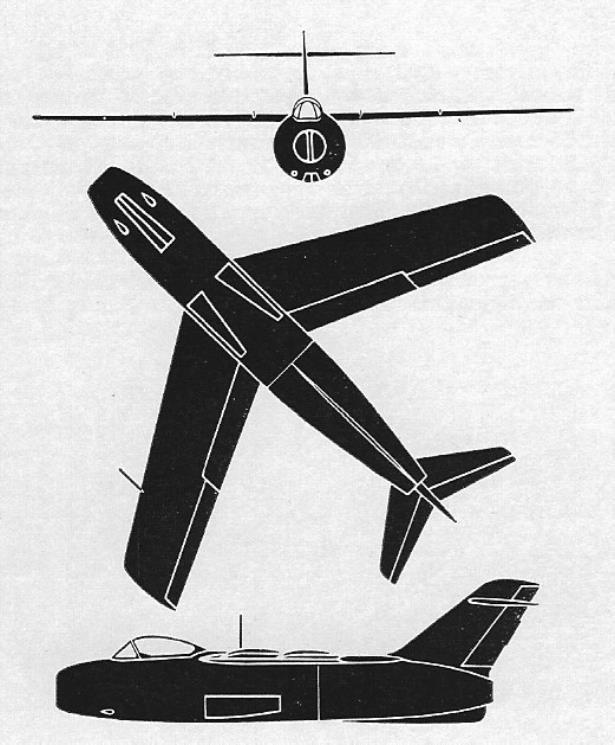
The final development of this straight-winged series was the La-174TK, which first flew January 1948 as a research type for the investigation of very thin, straight wings as an alternative to swept wings in overcoming compressibility problems.
The wing possessed a thickness ratio of only 6% (the “TK” suffix indicating Tonkoye Krylo, or Thin Wing) which the Lavochkin bureau believed might offer most of the advantages of a thicker sweptback wing while avoiding some of its disadvantages. The 6 per cent thickness/chord ratio was the smallest in the world at that time, and yielded performance benefits over the La-56. The basic configuration of the La-174TK reverted to that of the earlier La-152 series fighters, although the relationship was confined to a common design origin, with the single 1590kg NII-1 (RD-500) turbojet exhausting under the rear fuselage. Armament comprised three 23mm NS-23 cannon and flight testing commenced early 1948. Although lighter than the La-172, the La-174TK demonstrated inferior handling and performance characteristics, further development being discontinued.
The La-174TK was intended only for research and no production was ever planned.

La-174TK
Engine: 1590kg NII-1 (RD-500) turbojet
Wingspan: 8.64 m / 28 ft 4 in
Length: 9.41 m / 30 ft 10 in
Wing area: 13.52 sq.m / 145.53 sq ft
Max take-off weight: 3315 kg / 7308 lb
Empty weight: 2310 kg / 5093 lb
Max. speed: 970 km/h / 603 mph
Range: 960 km / 597 miles

Lavochkin La-15 / La-174D / La-180

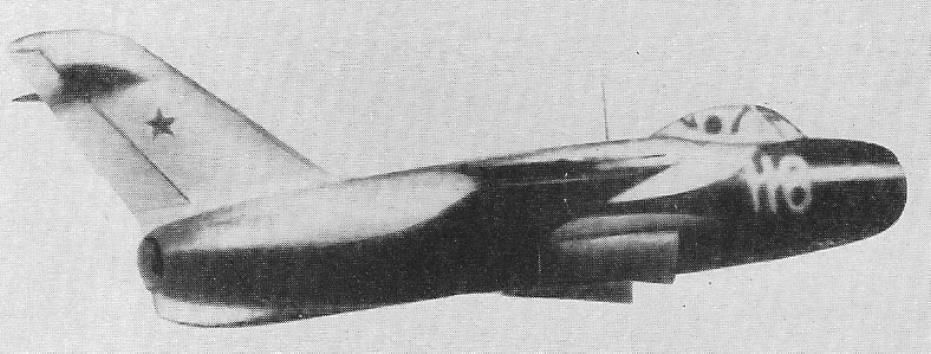
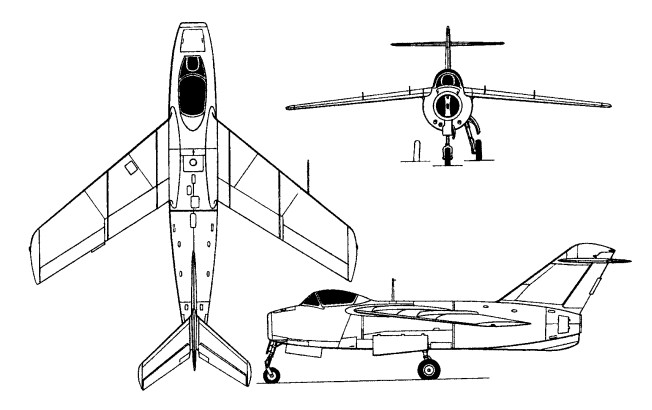
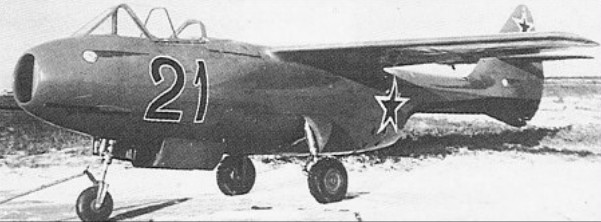
A replacement prototype for the La-172 was designated La-174D (the suffix signifying dubler, literally “replacement”), and entered flight test in August 1948. Lavochkin scaled down the basic La-174TK design to produce the La-174D tailored round the smaller Rolls-Royce Derwent turbojet. This differed in only minor respects from the preceding prototype, and series production was ordered during the same month as the La-15, armament being reduced from three to two 23mm NS-23 cannon, and 6 degrees of wing anhedral being added.

Type 21

The La-15 was powered by the RD-500 turbojet, the Soviet series version of the Derwent, deliveries to the VVS commencing in the late autumn of 1949.

Production plans for the La-15 were, in the event, scaled down because of difficulties experienced in manufacturing in sufficient quantity the numerous milled parts employed in the structure, but about 400 were produced, these remaining in VVS service until 1954.

A tandem two-seat conversion trainer version was evolved as the La-180, but only two examples of this variant were built.

La-15
Engine: RD-500 turbojet, 3527-lb (1600-kg) thrust
Max take-off weight: 3850 kg / 8488 lb
Empty weight: 2575 kg / 5677 lb
Wingspan: 8.8 m / 28 ft 10 in
Length: 9.0 m / 29 ft 6 in
Wing area: 16.2 sq.m / 174.38 sq ft
Max. speed: 1025 km/h / 637 mph
Ceiling: 13000 m / 42650 ft
Range: 1170 km / 727 miles

Type 21

Lavochkin La-126

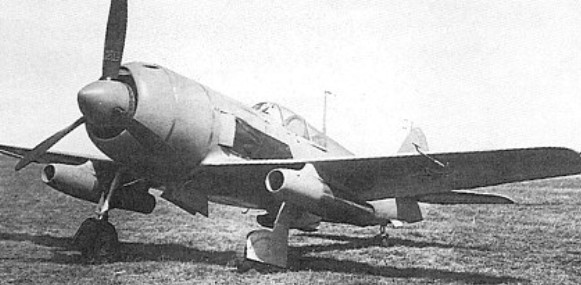
By the end of 1944, the Lavochkin bureau had abandoned further development of the mixed-construction La-7 in favour of an entirely new all-metal design bearing only a configurational similarity to its predecessor, and, early in 1945, work began on this as the La-126. The La-126 possessed no commonality with the Lavochkin bureau’s previous La-7 fighter, apart from an M-82FN (ASh-82FN) engine. It featured an all-metal monocoque fuselage and a TsAGI laminar-section wing. Armament was restricted to two 20mm ShVAK cannon and prototype flight testing was completed at the factory on 10 January 1945, but no production was undertaken, the La-126 serving as a basis for the La-130.
The prototype was subsequently fitted with two Bondaryuk VRD-430 ramjets as the La-126PVRD, and these, it was claimed, increased maximum speed in level flight by 100km/h. The La-126PVRD was tested between June and September 1946, attaining a max speed of 800km/h at 8000m.

Kuznetsov NK-144

The Kuznetsov NK-144 is an afterburning turbofan engine made by the Soviet Kuznetsov Design Bureau. Used on the early models of the Tupolev Tu-144 supersonic aircraft, it was very inefficient and was replaced with the Kolesov RD-36-51 turbojet engine.

Specifications:

NK-144
Thrust (kg): 28,660 (dry) 38,580 (wet)
Airflow: 551 lb/s
OPR: 14.2
BPR: 0.60
Spools: 2 2
SFC: 1.81 lb/lbf hour

Kuznetsov NK-32

The Kuznetsov NK-32 is a military specification afterburning 3-spool low bypass turbofan jet engine which powers the Tupolev Tu-160 supersonic bomber, and was fitted to the later model Tupolev Tu-144LL supersonic transport. It is the largest and most powerful engine ever fitted on a combat aircraft (however, higher thrust engines are fitted to civil aircraft such as General Electric GE90. Such engines sacrifice exhaust speed for higher thrust and hence cannot accelerate to supersonic speeds).
It produces 55,000 lbf (245 kN) of thrust in maximum afterburner.

Applications:
Tupolev Tu-160
Tupolev Tu-144LL

Specifications:
Type: Three-spool low-bypass afterburning turbofan
Length: 6,000 mm (20 ft)
Diameter: 1,460 mm (4.79 ft)
Dry weight: 3,400 kg (7,500 lb)
Compressor: 3-stage LP (fan), 5-stage IP, 7-stage HP
Combustors: annular
Turbine: 1-stage HP, 1-stage IP, 2-stage LP
Maximum thrust: Cruise thrust: 14 000 kgf (31,000 lbf, 137 kN), Afterburning thrust: 25 000 kgf (55,000 lbf, 245 kN)
Overall pressure ratio: 28.4
Bypass ratio: 1.4
Turbine inlet temperature: 1630 K (1357 °C)
Specific fuel consumption: (supersonic) 1.70 kg/kgf/hour (subsonic): 0.72-0.73 kg/kgf/hour
Thrust-to-weight ratio: 7.35 Kgf/kg

KAI Vikhr-1

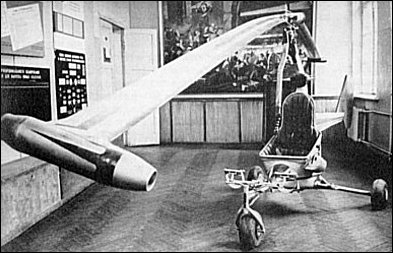
An experimental helicopter, built in 1956 by students at the Kuibushevskij Aviatsionnyj Institut. Single-seat machine was powered by pulse-jets attached to the tips of the main rotor blade. Pod and boom fuselage was very basic, pilot was seated in the ‘bare seat’ with control stick hanging from above.
The helicopter carried no tail rotor.