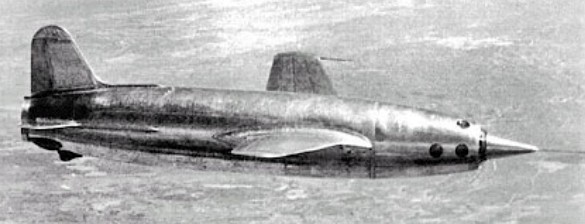
Two more examples of the Leduc 0.10 were built, the first an identical 0.10, the other differing only by having two wingtip-mounted turbojet engines to accelerate the aircraft to the ignition speed of the ramjets. This last aircraft, designated 0.16, was first flown on 8 February 1951, but the turbojet engines were later removed.
The Leduc 016 was developed with wingtip mounted Marbore I.
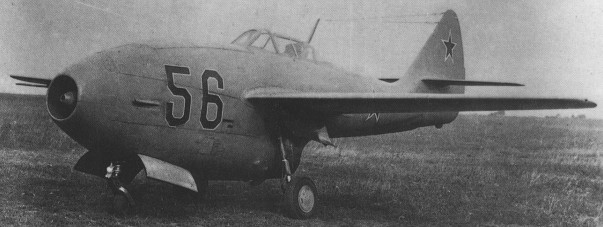
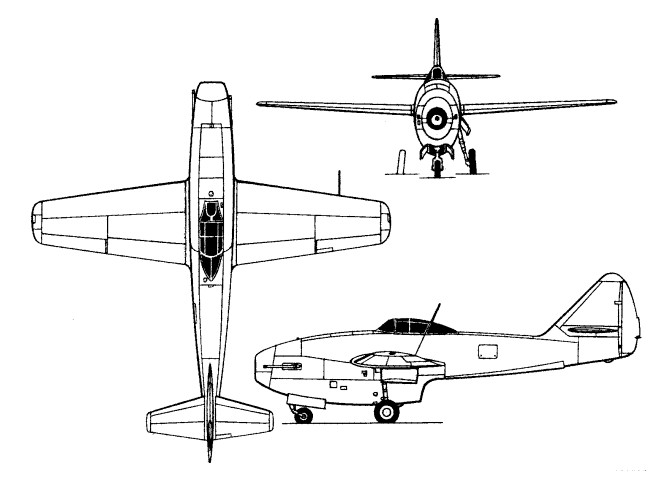
Rene Leduc in France had worked for many years on the development of a ramjet engine for aircraft propulsion. Known technically as an aero-thermo-dynamic-duct or athodyd, which has no major rotating components, a ramjet relies upon air being forced into an intake which is designed to ensure that the air loses kinetic energy but gains pressure energy as it passes through a diverging duct en route to a combustion chamber. There, burning fuel increases the total energy, causing the expanding gases to accelerate to atmosphere via an outlet venturi. Leduc’s first success had come in 1935 with a small but practical engine developing 4kg of thrust. It was not until after the end of World War II that Leduc was able to continue his experiments, building first the Leduc 0.10 with a tubular double-skinned fuselage in which the inner shell contained the pilot’s cockpit, surrounded by an outer shell which formed the inlet duct to the ramjet engine at the rear of the pilot’s position. First tested as a glider in October 1947, the Leduc 0.10 was carried on struts above a Sud-Est SE.161 Languedoc ‘motherplane’ which released it at appropriate altitude. The first powered flight was made on 21 April 1949, the SE.161 accelerating the Leduc 0.10 to a speed of approximately 322km/h to achieve the right pressure conditions for the ramjet to ignite and sustain power. During the first flight, of 12 minutes duration, a speed of 680km/h was attained on half power. The aircraft was flown subsequently on half power at a speed of 805km/h. The ramjet delivering 4409-lb (2000-kg) thrust, reached Mach 0.84. Two more examples were built, the first an identical 0.10, the other differing only by having two wingtip-mounted turbojet engines to accelerate the aircraft to the ignition speed of the ramjets. This last aircraft was designated 0.16.
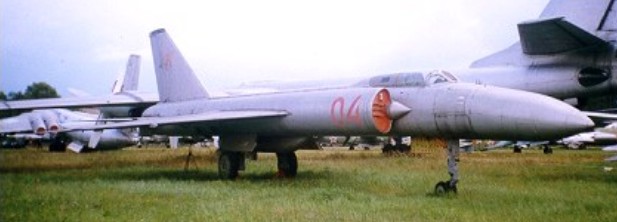
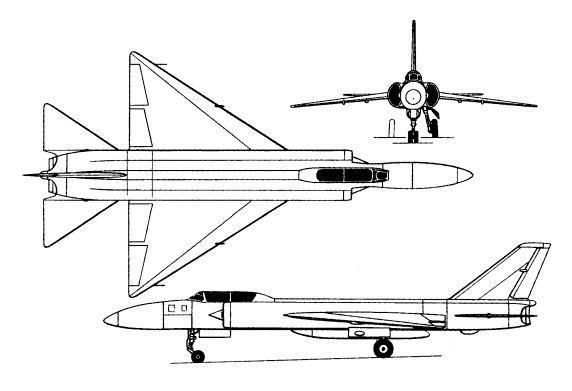
Planned in response to a January 1954 requirement for a super-interceptor able to cruise long distances at high altitudes with missiles able to provide a ‘snap-down’ attack capability against targets at lower altitudes, the La-250 was known unofficially as the Anaconda.
Featuring a 57 degree delta wing, slab delta tailplane, and a fuselage of near-constant cross section, the La-250 was powered by two Lyulka AL-7F turbojets each rated at 6500kg which were later to be fitted with afterburners boosting thrust to 9000kg. All control surfaces were fully powered with duplex systems and without manual reversion.
Intended armament was a pair of K-15 missiles that rode the beam of the Uragan (Hurricane) radar, which had a range of 30km. The missiles were cancelled and the radar never made it into an aircraft before the development was cut short.
Although the La-250 was intended as a single-seater in operational form, prototypes were completed as two-seaters to provide accommodation for a test observer, and the first of three flying examples was completed in July 1956.
The first flight was attempted on 16 July, but the test pilot, A G Kochetkov, encountered an unexpectedly rapid roll moment and lost control. Extensive testing of a systems rig followed before acceptable characteristics were attained and flight testing could be resumed. Investigation revealed a severe roll-coupling problem derived from the combination of a long heavy fuselage and small wings. Enormous effort went into the creation of a new electronic flight-control system, and a successful first flight was recorded in spring 1957.
The third La-250 had its nose lowered by six degrees to give better visibility on landing, the poor view forward having been determined as a factor in the second crash.
The second aircraft was lost in a landing accident on 28 November 1957, and the third aircraft also suffered a landing accident on 8 September 1958.
The flight test programme suffered continual delays as a result of poor engine reliability and the full testing had not been completed when the programme was cancelled just before Semyon Lavochkin’s death in 1960.
Max take-off weight: 30000 kg / 66139 lb Empty weight: 15000 kg / 33070 lb Wingspan: 13.90 m / 45 ft 7 in Length: 25.60 m / 83 ft 12 in Wing area: 80.0 sq.m / 861.11 sq ft Max. speed: 2000 km/h / 1243 mph Ceiling: 18000 m / 59050 ft Range: 2000 km / 1243 miles
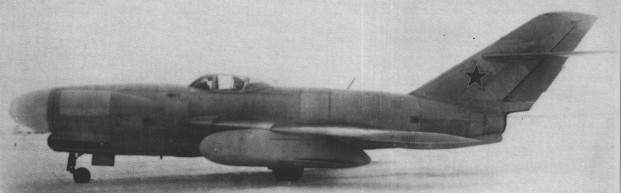
In January 1948 a requirement was formulated for a two-seat twin-engined all-weather interceptor.
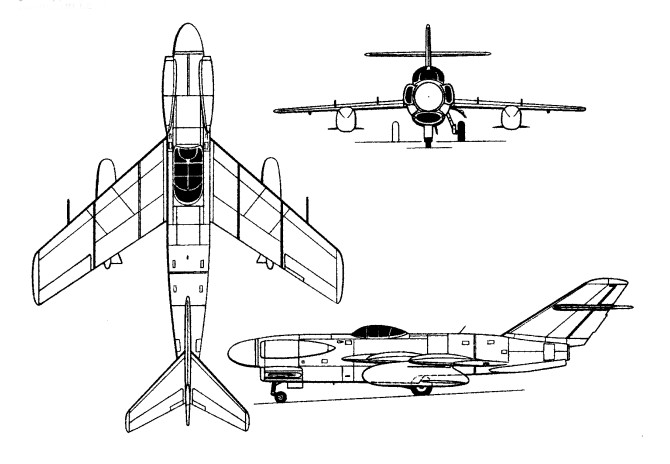
The La-200 was powered by two examples of an engine derived from the RD-45, the 5004-lb (2270-kg) thrust Klimov VK-1. These were located in a tandem arrangement, with the forward engine exhausting from the bottom of the central fuselage via an S-shaped jetpipe and the aft engine trough a nozzle at the tail, and were aspirated via an annular nose inlet round the centre body that accommodated the antenna of the search radar. The flying surfaces were swept at 40 degrees, and the crew of two was accommodated side-by-side under a large canopy.
Two were built, each powered by two 2700kg Klimov VK-1 turbojets mounted in tandem with the exhaust of the foremost engine ducted beneath the fuselage. The side-by-side seating for the two crew members was retained, and the centre and aft fuselage were comparatively unchanged, but the forward fuselage was entirely redesigned. The prototypes differed one from the other primarily in the location of the Torii (Thorium) AI radar, the first prototype having a conical intake centrebody and the second prototype having a radome underslung on the upper intake lip. Armament consisted of three 37mm N-37 cannon, one to port and two to starboard. The wing, sweptback 40 degrees at the leading edge, was largely occupied by integral tankage and two large underwing slipper-type auxiliary tanks could boost maximum range from 1165 to 2000km.
The first of two prototypes was flown on 9 September 1949, and the first and second flight test phases were completed by February and October 1950 respectively, Mach 0.946 being attained in level flight and Mach1.01 in a dive.
The range was 1243 miles (2000 km), but in November 1950 a range of 2175 miles (3500 km) was demanded, together with longer-range radar. The design was recast as the La¬200B with greater fuel capacity and a larger antenna for the more powerful radar. This led to a redesign of the nose. The extreme nose was formed by a large dielectric radome of more than 1.0m diameter. The early single-antenna Torii-A radar was replaced by a large RP-6 Sokol (Falcon) radar with three different scan modes, and twin ventral strakes supplanted the single strake of the second La-200. The additional fuel required to achieve the specified endurance was provided by increasing the capacity of each underwing tank from 1120 l to 2650 l. Two 3100kg Klimov VK-1 turbojets were installed, the forward engine’s air being supplied through a chin intake and that for the aft engine being provided by “elephant ear” type intakes on the sides of the extended nose. Armament remained three 37mm cannon.
The La-200B first flew on 3 July 1952, and while range was improved considerably, overall performance was reduced. A mock-up of the Sokol radar initially being fitted, tests with the radar installed commencing on 10 September. The second prototype joined the flight programme early 1951, the repositioned radar being of the improved Torii-A type, ammunition capacity being increased, a ventral keel being introduced and normal loaded weight rising to 10580kg. With the final NII VVS test phase completed in April 1952, a recommendation was made that series production of the La-200 should be initiated.
An extensive test programme was conducted, but, in the event, the competitive Yak-120 was selected to fulfil the requirement. The La-200B was beaten to a production order by the Yak-25.
La-200 (1st prototype) Max take-off weight: 10375 kg / 22873 lb Empty weight: 7090 kg / 15631 lb Wingspan: 12.92 m / 42 ft 5 in Length: 16.59 m / 54 ft 5 in Wing area: 40.18 sq.m / 432.49 sq ft Max. speed: 1090 km/h / 677 mph Range: 1165 km / 724 miles
La-200B Max take-off weight: 12700 kg / 27999 lb Empty weight: 8810 kg / 19423 lb Wing area: 40.00 sq.m / 430.56 sq ft Max. speed: 1030 km/h / 640 mph Range: 2800 km / 1740 miles
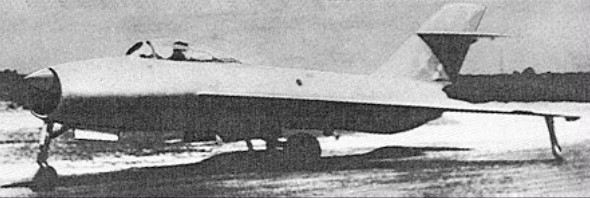
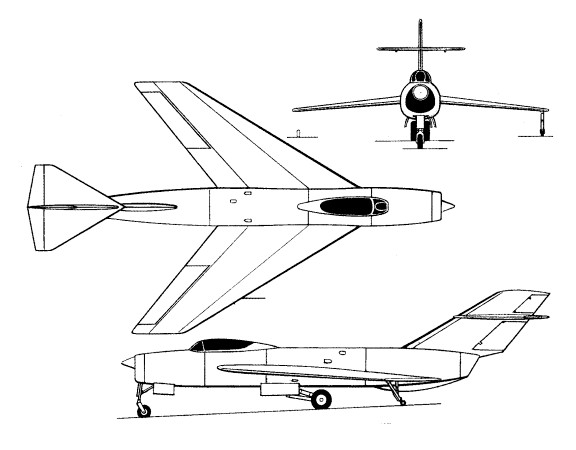
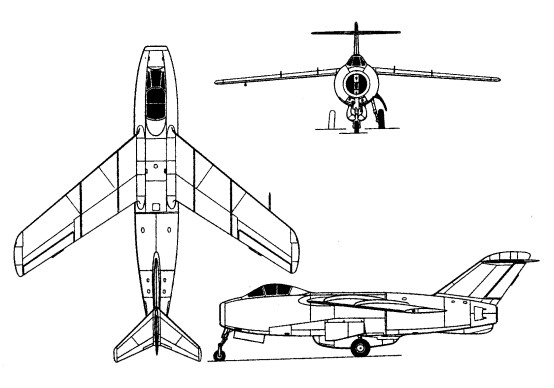
The La-190 was conceived to meet the October 1948 demand of Yosif Stalin for the “fastest fighter in the world”. Other contenders were the I-350, progenitor of the MiG-19, and the Yak-1000, which, in the event, was to be abandoned before flight testing. The requirement called for use of the new Lyulka AL-5 turbojet which had an initial rating of 4600kg.
The La-190 featured wings swept at 55 degrees and a delta tailplane located about three-fifths of the way up the broad-chord vertical tail. Equipped with a bicycle-type main undercarriage members with wingtip outrigger stabilising wheels, and an armament of two 37mm N-37 cannon. Integral fuel tankage occupying virtually the entire interspar box of the 6.1% thickness wing which featured machined upper and lower skins. All control surfaces were powered by irreversible actuators.
Although planned originally as a day fighter, the prototype was completed in limited all-weather form with a radar radome in the upper portion of the nose inlet.
The sole prototype La-190 was completed in February 1951. The AL-5 engine offered less thrust than predicted and its unreliability led to cancellation of the development programme after only eight flights.
A speed of 1190km/h at 5000m, or Mach1.03, was attained in level flight during one test in March 1951.
Engine: Lyulka AL-5 turbojet, 4600kg Max take-off weight: 9257 kg / 20408 lb Empty weight: 7315 kg / 16127 lb Wingspan: 9.90 m / 32 ft 6 in Length: 16.35 m / 53 ft 8 in Wing area: 38.93 sq.m / 419.04 sq ft Max. speed: 1190 km/h / 739 mph Range: 1150 km / 715 miles
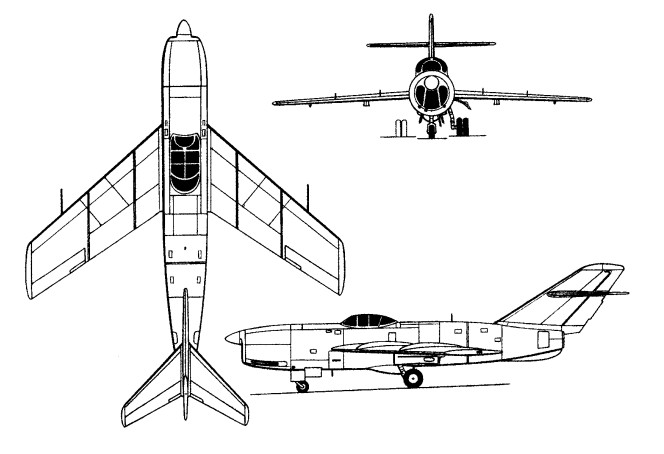
Combining a fuselage essentially similar to that of the Lavochkin La-168 with wings sweptback 45° at quarter-chord and several other aerodynamic refinements, the La-176 was flown in September 1948 with a 5004-lb / 2270kg RD-45F turbojet, and armament comprising one 37mm N-37 and two 23mm NS-23 cannon.
Re-engined with a Klimov VK-1 turbojet of 2700kg, the La-176 was claimed to have exceeded Mach=1.0 in a dive from 9050m to 6000m on 26 December 1948, test pilot of No.301 Factory, Captain Sokolovsky OV. It was initially believed that an ASI error had been involved, but the process was repeated six times during January 1949, 1105km/h being recorded at 7500m, this being equivalent to Mach=1.02. The La-176 thus became the first Soviet aircraft to achieve supersonic flight. Further development was abandoned shortly afterwards when the canopy locks failed at high speed, resulting in test pilot Î V Sokolovsky losing his life.
Max take-off weight: 4631 kg / 10210 lb Empty weight: 3111 kg / 6859 lb Wingspan: 8.59 m / 28 ft 2 in Length: 10.97 m / 35 ft 12 in Wing area: 18.25 sq.m / 196.44 sq ft Max. speed: 1043 km/h / 648 mph Range: 1000 km / 621 miles
To meet a requirement for a lighter “frontal fighter” powered by the Rolls-Royce Derwent turbojet, the Lavochkin bureau evolved two designs, the La-172 and the La-174TK. The La-172 was powered by an NII-1 turbojet (as the pre-series Soviet version of the Derwent was designated) rated at 1600kg, and entered flight test early in 1948, with armament comprising three 23-mm NS-23 cannon. Early in the test programme, while being flown by I Ye Fedorov, the La-172 suffered uncontrollable flutter at 8000m and entered a flat spin. Recovery was effected at 3000m, but the prototype was heavily damaged in a subsequent crash landing. Nevertheless, development was continued via the La-174D to result in the La-15.
Max take-off weight: 3708 kg / 8175 lb Empty weight: 2433 kg / 5364 lb Wingspan: 8.83 m / 28 ft 12 in Length: 9.56 m / 31 ft 4 in Wing area: 16.16 sq.m / 173.94 sq ft Max. speed: 1040 km/h / 646 mph Range: 1300 km / 808 miles
In March 1946, Yosif Stalin assigned the task of developing advanced single-seat fighters around the newly-acquired Rolls-Royce Nene turbojet to the design bureaux of Semyon A Lavochkin, Artem Mikoyan and Mikhail Gurevich, and Aleksandr Yakovlev on a competitive basis. The Lavochkin contender, the La-168, featured a shoulder-mounted wing sweptback 37° 20′ at the leading edge and fitted with Fowler flaps. An armament of two 23mm NS-23KM cannon and one 37mm N-37 cannon was fitted and power was provided by a 5000-lb / 2268kg Nene R.N.2 turbojet. The engine was located toward the tail, where it exhausted through a short jetpipe, and was aspirated from a circular nose inlet via bifurcated ducting round the pressurized cockpit. A T-tail was used to allow the location of the tailplane farther to the rear than would otherwise have been possible, improving longitudinal control. The La-168 was first flown on 22 April 1948, subsequently attaining 1084km/h at 2750m, representing Mach=0.914. During the test programme, the cockpit canopy collapsed when all three guns were fired simultaneously at 15000m, but the pilot succeeded in landing the aircraft. The La-168 test programme continued until 19 February 1949, but the Mikoyan-Gurevich bureau’s competitive I-310 (Type S) had meanwhile been selected for large-scale production as the MiG-15.
Max take-off weight: 4412 kg / 9727 lb Empty weight: 2973 kg / 6554 lb Wingspan: 9.50 m / 31 ft 2 in Length: 10.56 m / 34 ft 8 in Wing area: 18.08 sq.m / 194.61 sq ft Max. speed: 1084 km/h / 674 mph Range: 1275 km / 792 miles
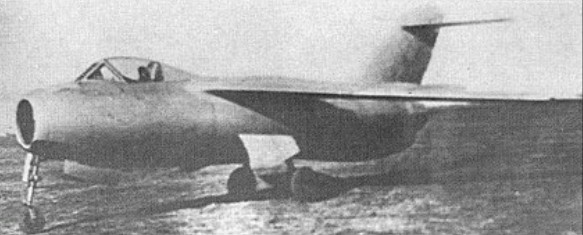
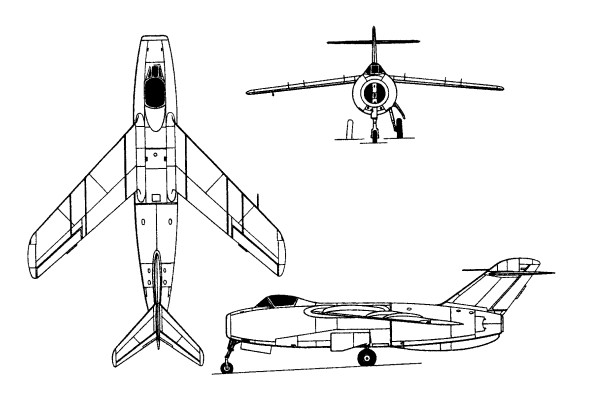
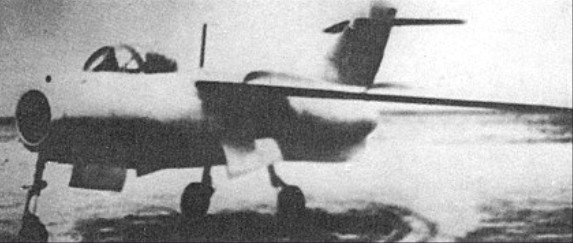
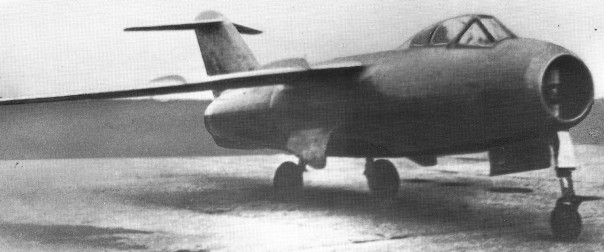
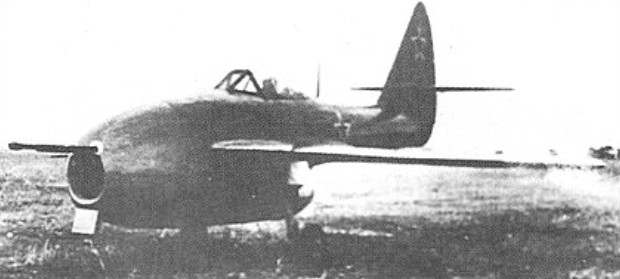
The Soviets’ first swept-wing aeroplane was the La-160, which was basically the La-154/156 with a lengthened fuselage and swept flying surfaces. Consequently known unofficially as the Strelka (Dart), the La-160 featured 35 degrees of leading-edge sweep on a wing of 9.5% thickness.
When initially flown on 24 June 1947, the La-160 was fitted with an RD-10 turbojet rated at 900kg, with which it could not get airborne fully laden.
After initial handling trials, the La-160 was fitted with an RD-10F which provided an afterburning thrust of 1170kg and with which, after diving and then levelling off, a speed of 1060km/h was allegedly attained at 5700m, this being equivalent to Mach=0.92.
The La-160 carried an armament of two 37mm NS-37 cannon, but was utilised primarily as a research vehicle in the development of more advanced fighters and no production was contemplated.
La-160 Max take-off weight: 4060 kg / 8951 lb Empty weight: 2738 kg / 6036 lb Wingspan: 8.95 m / 29 ft 4 in Length: 10.07 m / 33 ft 0 in Wing area: 15.90 sq.m / 171.15 sq ft Max. speed: 900 km/h / 559 mph
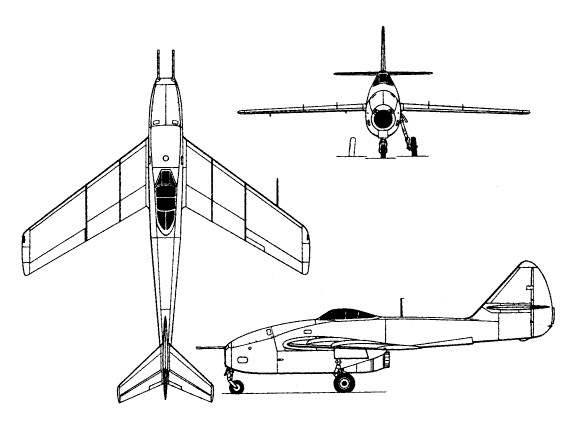
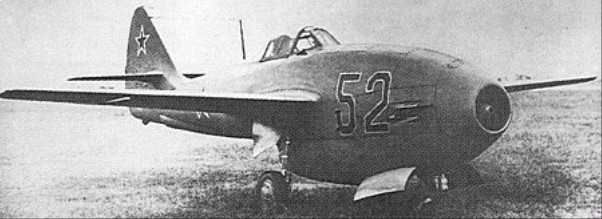
The La-152 wing, although similar in planform to that of the earlier La-150, employed a new profile of only 9.1% – the thinnest section adopted up to that time in the Soviet Union – and was lowered to mid position. The RD-10 turbojet was retained, but to avoid the duct losses suffered by the La-150, the power plant was installed in the extreme nose, exhausting beneath a sturdier rear fuselage. The CG position was restored by moving the cockpit aft, and armament was three 23mm NS-23 cannon.
Work on the La-152 was initiated by the Lavochkin bureau within two months of a start being made on the La-150, and factory flight testing began in October 1946, only a few weeks after the La-150 had entered flight test. Three prototypes were built in parallel, all similarly armed and differing primarily in power plant, the second and third aircraft being designated La-154 and La-156 respectively.
The La-154 was to have been fitted with a Lyulka TR-1 turbojet of 1350kg, but was never flown owing to difficulties with this engine.
After initial trials with a standard RD-10, the La-156, which had increased tankage and had initially flown in February 1947, was fitted with an RD-10F engine equipped with an afterburner extension boosting thrust by 30% (to 2425 lb / 1100 kg).
La-156
The RD-10F-equipped La-156 was flown for the first time in September 1947 – the first Soviet aircraft to fly with an afterburning engine – and attained a max speed of 905km/h at 2000m. The flight test programme continued until the end of January 1948.
La-152 Max take-off weight: 3239 kg / 7141 lb Empty weight: 2310 kg / 5093 lb Wingspan: 8.20 m / 26 ft 11 in Length: 9.12 m / 29 ft 11 in Wing area: 12.15 sq.m / 130.78 sq ft Max. speed: 778 km/h / 483 mph Range: 492 km / 306 miles

 All Aero