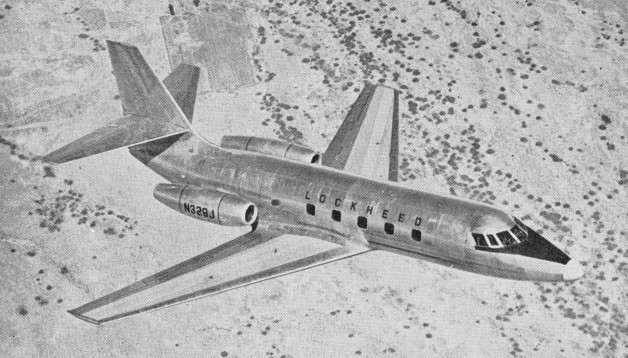
To meet a US Air Force requirement for an ‘off-the-shelf’ high-performance light transport, Lockheed developed the Lockheed 1329 JetStar. A low-wing monoplane with swept wings and swept tail surfaces, the JetStar was powered in prototype form by two 2200kg thrust Bristol Orpheus 1/5 turbojet engines. The JetStar flew 241 days after design began, in 1957. The first of two prototypes was flown on 4 September 1957, with flight testing proving satisfactory, but when planned licence-production of the Orpheus engine could not be finalised.
Lockheed chose to power the initial production version by four 1361kg thrust Pratt & Whitney JT12A-6 engines, mounted in pairs on each side of the rear fuselage. The anticipated military demand failed to materialise in any significant numbers, with the result that the majority of the 204 JetStars that were built, before production ended in 1980, were sold as business/executive aircraft.
As advertised – Dec 2011
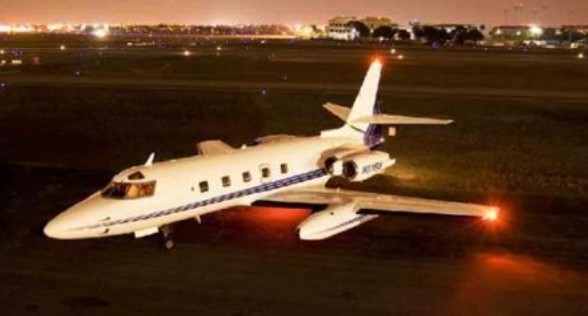
1977 LOCKHEAD JETSTAR II; A truly one-of-a-kind 12 passenger aircraft (including crew of 2 pilots and 1 flight attendant), powered by four 3,700 lbf (16.5 kN) thrust Garrett TFE731-3 turbofan engines and fitted with revised external fuel tanks. This is one of only 40 produced between 1976-1979, hand built in Marietta, Georgia USA; 30 still flying!
AiResearch Aviation Company’s 731 JetStar made its first flight on July 10 1976 from San Antonio, Texas. The TFE 731 is 10 inches larger in diameter than the JT12A, so the drag produced from the larger nacelles needed to house it would lessen the benefits of its lower fuel consumption. Also, the modified aircraft weighs 1,750 pounds more than its predecessor, so the gross weight would have to be increased in order to retain the same payload, but a high¬er gross weight means more drag. The TFE731 3 turbofan produces only 400 pounds more takeoff thrust than does the JT12A 8 turbojet, so there was not a significant amount of extra power to overcome drag.
Ed Swearin¬gen designed a TFE 731 installation for the JetStar. He also warped both ailerons so that the outer portions are biased slightly upward in neutral position to act as “reverse” flaps, thus forcing the inboard section of the wing to carry a greater share of the lifting loads. By designing a new fuel tank below the wing instead of wrapping it around the airfoil, Swearingen was able to reduce the size of the pod without sacrificing any fuel capacity and eliminate all nacelle flow disturbances caused by the tanks.
Wind tunnel studies showed that despite its larger nacelles, the overall drag of the 731 JetStar would be slightly less than that of the original JT12A powered version.
A supplemental type certificate for retro¬fitting Garrett TFE 731 3s to JetStars was granted to AiResearch on June 10, 1976, nearly two years after the aircraft’s first flight. Flight tests had demonstrated that the turbofan 731 JetStar exceeded the performance of its turbojet predecessor in take¬off, rate of climb, initial cruise altitude and cruise speed at altitude. The 731 JetStar will go 2104 nm with full IFR reserves.
Pro¬duction JetStar IIs differs only slightly as, because the aircraft is newly manufactured, the aft fuselage bulk¬heads can be relocated, rather than modified (as they must be on the 731 JetStar), to ac¬commodate the Garrett engines; thus the na¬celle installation is about 175 pounds lighter than the AiResearch arrangement. The first production example (N5527L) of the Lockheed 1329 25 JetStar II 12 seat executive transport made its first flight at Marietta, Georgia on 18 August 1976.
American Aviation Industries, founded 1985 and offered Lockheed JetStar business jet re-engining program as the FanStar.
JetStar I Original production version, differing from the first prototype by having increased fuel capacity provided by a permanently attached streamlined JuelI tank at mid-span of each wing, de-icing of wing and tail unit leading edges and Pratt & Whitney JT12A-6 engines; a slightly lengthened fuselage provided executive standard accommodation for a crew of two and 10 passengers; late production aircraft had 1497kg thrust JT12A-8 turbojet engines
JetStar 731 Conversion developed by AirResearch, replacing the Pratt & Whitney powerplants of Jet Star I aircraft with more fuel-efficient Garret TFE731-1 turbofan engines; about 60 JetStar Is were converted to this standard
JetStar II New production version incorporating Garrett TFE731-3 engines as standard and a number of refinements
C-140A Five aircraft for USAF, similar to early production JetStar Is and equipped for calibration of navigation beacons
C-140B Convertible cargo/passenger version for USAF, five built; generally similar to C-140A
VC-140B Designation of six additional production aircraft, generally similar to C-140A, except equipped as VIP transports; the five C-140Bs were also converted to this configuration
Specifications:
Lockheed JetStar II Engines: 4 x Garrett TFE731-3 turbofans, 1678kg Max take-off weight: 20185 kg / 44501 lb Loaded weight: 11294 kg / 24899 lb Wingspan: 16.59 m / 54 ft 5 in Length: 18.41 m / 60 ft 5 in Height: 6.22 m / 20 ft 5 in Wing area: 50.4 sq.m / 542.50 sq ft Max. speed: 880 km/h / 547 mph Ceiling: 13105 m / 43000 ft Range: 4820 km / 2995 miles
Lockheed 731 Jetstar-6, -8 Jetstar II (Airesearch conversion) Engines: 4 x Garrett TFE 731 3, 3,700 lbs Length: 60 ft. 5 in Height: 20 ft. 5 in Wingspan: 54 ft. 5 in Wing area: 542.5 sq. ft Airfoil: NACA 63A1 12 at root, NACA 63A309 modified at tip Aspect ratio: 5.27 Passenger seats: 10 Takeoff weight: 43,750 lbs Operating weight: 24,178 lbs Useful load: 19,572 lbs Payload with full fuel: 1,750 lbs Zero fuel weight: 27,000 lbs Fuel capacity: 2,640 USG/17,822 lbs Wing loading: 80.6 lb/sq.ft Power loading: 2.96 lbs/ft.sq Baggage area: 104.9 cu.ft Cabin pressure differential: 8.9 psi Cabin altitude @ 43,000 ft: 7,500 ft Balanced field length: 6,250 ft Takeoff safety speed: 145 knots Initial rate of climb: 4,200 fpm Gross takeoff climb rate, one engine out: 2,400 fpm @ 220 kt Engine out service ceiling: 37,000 ft Maximum operating altitude: 43,000 ft Maximum operating Mach: 0.82 M Maximum cruise: 475 kt / 0.82 M Normal cruise: 0.76 M Long range cruise: 438 kt / 0.72 M Maximum range, 45 minute reserve 2,770 nm Range max fuel/cruise: 2331 nm/4.9 hr Range max fuel / range: 2956 nm/ 6.8 hr Maneuvering speed (@ 20,000 ft. and 35,000 lb): 220 knots Stall speed, landing configuration: 108 knots Stall clean: 138 kt. 1.3 Vso: 140 kt Vmc: 103 kt
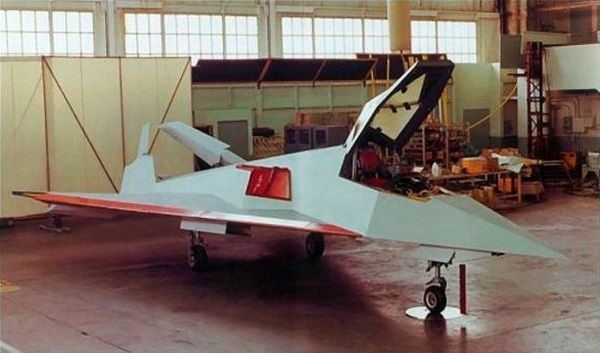
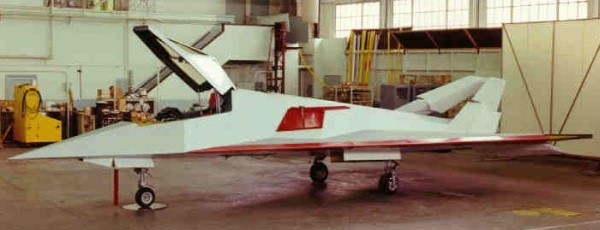
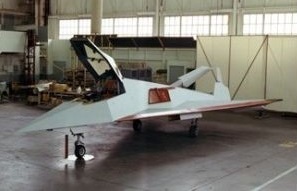
Lockheed’s Advanced Development Projects organisation at Burbank (ADP), more commonly known as ‘The Skunk Works’, had stealth projects accelerated in 1977, and the Lockheed design was airborne from Groom Lake airfield, on the Nevada test range, by early 1978, flown by ADP chief test pilot Bill Park. Although only half the size of the F-117A, this aircraft’s configuration was broadly similar, and by the end of 1978, Lockheed had received a USAF contract to develop a full-scale production version. It contained warranties covering the aircraft’s range, weapons delivery accuracy and radar cross section.
Promising XST test results led to the development of two scaled-up YF-117A-LO prototypes which were followed by 57 production F-117As ordered in batches during the fiscal years 1980 to 1986 plus 1988. The first pre-production aircraft flew for the first time on 18 June 1981, and the first F-117A was handed over to the USAF in August 1982.
The programme was directed from AFSC’s Aeronautical Systems Division (ASD) by General Richard Scofield, who later moved on to become the B-2 programme director. According to Ben Rich, head of Lockheed’s ADP, the F-117A was developed in significantly less time and for less cost than comparable fighter aircraft. Using the streamlined management methods for which the Skunk Works is famous, ADP and ASD personnel “guided the programme through every step in a non-adversarial, problem-solving atmosphere”. At some stage of the process, the codename Senior Trend was adopted.
Although the F-117 is a radical design, every opportunity to minimise risk was taken. A number of components and systems were adopted from existing aircraft rather than designed from scratch, and this inspired programme managers to approve low rate production concurrent to full scale development. Most importantly, the quad-redundant digital fly-by-wire flight control system from the GD F-16 was incorporated. This allowed artificial stability and, therefore, much greater freedom to maximise the aircraft’s shape for stealth. The ejection seat also came from the F-16, while the environmental control system was from Lockheed’s own C-130 Hercules. Brake hydraulics were from the Gulfstream III business jet, while many avionics black boxes were purchased “off the shelf”. Finally, General Electric produced a non-afterburning version of the F404 designated the F1D2. This produces about 12,000 lb st (53,43 kN).
All the F-117s were manufactured at the Skunk Works’ Burbank headquarters before being trucked or flown in sections to Groom Lake for final assembly and test flights. On 15 June 1981, Skunk Works’ test pilot Hal Farley flew the first F-117A. This was a pre-production machine which was to crash a year later (21 June 1982) near Groom Lake while Ken Dyson was at the controls: he survived. The first aircraft destined for the customer was flying in early 1982, and deliveries to Tonopah began later that year. Lockheed received a second contract which increased the number of F-117s on order to 59, and these were completed at a rate of up to eight aircraft per year throughout the ‘eighties. The last aircraft was delivered on 12 July this year, two months ahead of the original schedule. The stealth fighter has been worth $6.265 billion to Lockheed and other contractors, of which $2 billion was spent on development. These are the actual dollar amounts that have been spent over the life of the programme to date, ie, the “then-year” dollar cost. The flyaway cost per aircraft is $42.6m.
The US Air Force formed the 4450th Tactical Group at Nellis AFB in 1980, and began recruiting pilots and groundcrew for the new aircraft. The pilots were nearly all drawn from the tactical fighter community (the 4450th reported direct to Tactical Air Command headquarters at Langley AFB until 1985). A minimum of 1,000 hours of mainly fighter time was required. The unit’s first aircraft were 20 LTV A-7D Corsair II attack aircraft which could be flown during daylight hours, unlike the “Black Jet”. They were to play an important role in maintaining pilot proficiency. In the first few years of operations, F-117 pilots were getting less than 10 hours per month in the aircraft. Despite this, an initial operational capability on the stealth fighter was achieved at Tonopah in October 1983 by the 4450th Test Squadron.
But on the night of 11 July 1986, an aircraft crashed outside the Nevada range, near Bakersfield, California, killing the pilot. In the first case, Major Ross Mulhare flew article number 792 into a hillside. Such was the extent of the security cordon thrown around the wreckage that most observers soon concluded that a stealth aircraft had crashed. Within a month, reports surfaced that about 50 “F-19 Stealth Fighters” were already fully operational at Tonopah. In fact, it was to be another three years before this number of the classified aircraft was to be in service, and the nature of the F-19 – if it exists – remains a mystery. The Pentagon has not explained the out-of sequence F-117 designation, six numerals beyond the last known previous allocation, F-111.
The second fatal crash in October 1987, may have been caused by pilot fatigue. In the second, Major Michael Stewart crashed 815 into gently sloping desert terrain near Tonopah on the night of 14 October 1987. No distress calls were made and accident investigators could find no mechanical cause. Both men were considered excellent fighter pilots. But there was little or no moonlight on either occasion and spatial disorientation may have been another factor. Despite the difficulties, the build-up continued. Tactics were constantly refined, although portions of the flying envelope were still being explored as late as 1989. A second unit, the 4451st Test Squadron, achieved operational status in January 1987, while a third unit, the 4452nd Test Squadron, was devoted to training.
After being operational for nearly six years, the US Air Force lifted, in April 1989, the veil of secrecy over the F-117 programme. The US Air Force had rotated its personnel in and out of the F117 operating unit on three-year tours throughout that time. Based at the remote Tonopah Airfield, at the edge of the Nevada Test Range, the stealth fighter was flown only at night to preserve secrecy. The USAF had spent over $295m developing the run-down Tonopah airstrip into a modern fighter base, complete with 12,000-ft (3 660-m) runway, 54 individual hangars for single aircraft and some of the most sophisticated security systems ever seen outside Fort Knox.
Officially, nothing had been said since the Pentagon’s brief admission, in 1980, that stealth aircraft were being test-flown.
Once the aircraft’s existence had been officially acknowledged – and a single, deliberately misleading photograph released – daytime flights began and new pilots no longer had to face the prospect of soloing on the aircraft at night. There are no two-seat conversion trainers, but a ground simulator has been in use at Tonopah for the last few years, built and operated by CAE Link. Now that daytime flying was possible, the unit was able to dispense with the A-7D Corsairs, trading them for eight Northrop T-38 Talons. These are used by instructor pilots in the training squadron who can now fly ‘chase’ as newcomers make their first flights in the F-117. The T-38s are also used for proficiency flying, but only a quarter of the unit’s pilots are dual qualified on both types. Once posted to one of the two operational squadrons, pilots begin night-flying in earnest. A combat-ready F-117 pilot still flies two-thirds of his sorties at night. He gets from 15 to 20 hours flying per month, with three to four sorties each week.
In October 1989, the F-117A unit received a regular TAC “number plate” when the 4450th Tactical Group was redesignated the 37th Tactical Fighter Wing. The three squadrons became the 415th TFS Nightstalkers (ex-4450th TS); 416th TFS Ghostriders (ex-4451 st TS) and 417th TFTS Bandits. (ex-4452nd TS). Having reported to the Tactical Fighter Weapons Center at Nellis AFB since 1985, the F-117A wing commander now takes his orders from TAC’s 16th Air Force at Bergstrom AFB, Texas. In December 1989, those orders included the wing’s first operational mission – against Panama during Operation Just Cause. Apart from this confirmed excursion, the unit is rumoured to have made training deployments to the UK and elsewhere.
The radar cross section (RCS) of an airframe varies greatly with the angle of observation. The wavelength of the radar is also a significant factor. The RCS of the F-117 when illuminated from certain key frontal and rear aspects may be as little as 0.1 sq ft equivalent to a medium-sized bird. Some of the energy from an air defence radar striking an F-117 is absorbed by its coating or structure, but most is reflected as ‘spikes’ in carefully-controlled directions. Most of these directions lead away from the transmitter/receiver in question, whether it be ground-based (eg, a SAM system) or airborne in a fighter. Those spikes of energy that are returned are very narrow.
The F-117, therefore, owes most of its extraordinary shape to the need to control these spikes. The entire fuselage surface consists of flat planes or ‘facets’ set in a limited number of alignments. These limitations also define the degree of sweep for both wing and V-tail, and the wingtip and trailing edge configuration. The wing and V-tail are also faceted, to a less obvious degree. No detail has been overlooked in the effort to produce an aircraft which is fully faceted. Undercarriage and bomb-bay doors, together with canopy and sensor port surrounds, all have serrated edges conforming to the required alignments. The faceting even extends to the edges where control surfaces meet the main structure. There are six control surfaces. The wing trailing edge consists of an elevon/flaperon arrangement for roll and pitch, while the all-moving tails are rudders with no influence on the pitch axis, unlike other V-tail designs.
On the F-117, the two powerplants are buried deep in the airframe and their intakes are ‘guarded’ against radar penetration by grilles. These grilles are made of composite material, and the grid size is an appropriate fraction of the main threat radar wavelengths. They cover a much larger intake area than those on other F404-powered aircraft. The larger area presumably compensates for the restriction in airflow to the compressor face caused by the grilles. Another compensation is evident when the aircraft is manoeuvering on the ground: auxiliary blow-in doors open in the intake area immediately aft of the grilles.
In a stealth aircraft, the cockpit transparency must also prevent radar energy from penetrating to the interior. It does so by shape (divided into five flat sections) and content (a conductive coating is laminated to the plexiglass to provide an effective barrier). To protect the ports in the nose and under the forward fuselage through which the aircraft’s two primary sensors view, a different solution was required. Here, unwanted electromagnetic energy is kept at bay by a screen mesh, which evidently does not interfere with the transmission of laser and infrared energy.
Apart from faceting, the F-117 also gains stealthiness from the almost complete absence of surface discontinuity. Apart from the faceted pitot heads projecting from the pointed nose, all the other protuberances usually associated with a combat aircraft are either eliminated by removal or retraction. There are no external weapons pylons or fuel tanks. Anti-collision lights are displayed on training missions, but removed and the gaps faired over before combat. Some other lights which remain have special lenses which reduce their radar return. Aerials for radio and IFF transmissions are retractable – strict radio silence is observed during combat missions. This super-smooth finish, therefore, eliminates the possibility of a discontinuity returning radar energy to the receiver, either directly from a corner type of reflection, or indirectly through the phenomenon known as ‘creep’. This consists of a certain amount of radar energy flowing around any surface that it strikes until reaching a discontinuity from which it is reflected.
Large fairings aft of the national insignia in the mid-fuselage area, and foot-long cylinders extending beneath the fuselage immediately aft of the undercarriage are radar reflectors which are carried when the aircraft is operating in controlled airspace so that air traffic control radars can actually track the “Black Jet”.
Contrary to some of the early speculation, the F-117 is not a “plastic” aircraft. During the Have Blue era the all composite Windeck Eagle light aircraft was modified and tested by Lockheed for stealth potential as the YE-5A. But the problem of shielding the remaining metal parts (engine, hydraulics, undercarriage) remained, although the YE-5A did contain internal radar absorbent material (RAM) for this purpose. In the mid ‘seventies, composite manufacturing technology had not matured sufficiently for it to be a viable option for the construction of a combat aircraft. The Skunk Works decided that the primary structure of their stealth fighter could be aluminium, although extensive use would be made of RAM inserts and coatings. Significant progress has been made in the manufacture and deployment of RAM since Lockheed’s first, failed attempt to use it successfully on the U-2 in 1956. The heavy weight and limited durability of RAM coatings made them unsuitable for application to airborne vehicles in those days. Also, the range of frequencies at which they were effective was limited.
“Stealth technology does not involve a single technical approach, but rather a complex synthesis of many. Even if 1 were willing to describe it to you, 1 could not do it in a sentence or even a paragraph”. Thus spoke the US Under Secretary of Defense for Research and Engineering, Bill Perry, when the stealth programme was first unveiled in 1980. In addition to radar signature reduction, therefore, the F-117 is also designed to present minimal infrared, acoustic, electromagnetic and visual signatures.
The engine exhaust slots are about six feet (1,83 m) wide and divided by vanes into 12 separate ports. They are shielded from the ground by an upturned lip – the rearward extension of the fuselage. This lip has a somewhat jagged edge and is believed to consist of ceramic tiles for greater dispersion of heat. Even before reaching the slots, exhaust from the non-afterburning F404s is already cooled by mixing with a proportion of cool air, which enters the intake, but by-passes the compressor face, before these unusual outlets promote further rapid mixing with ambient air. The exhaust plume therefore presents only a negligible infrared target for heat-seeking missiles. The buried engine and its inlet/exhaust configuration also serve to reduce jet noise the F-117 is noticeably quieter in an overhead pass than other combat aircraft.
It carries no radar or active jamming system. Navigation is by inertial platform targeting and attack is performed by passive means alone: FLIR and laser. As for visual signature, the F- 117 employs no exotic technology to defeat the power of observation. It goes to war under cover of darkness.
The pilot has no rearward visibility whatsoever from the cockpit: “it feels like you are flying at the tip of a spear,” said one F-117A pilot. The thrust to weight ratio is no better than 0.5, and wing loading is 55 lbs/ sq ft. It is capable of high subsonic speed only. Stealth fighter pilots say that it handles like an F-15 or F-16.
There are no curved surfaces and the underside is completely flat. The prismatic forward fuselage is actually taller at 12 ft 5 in (3,78 m) than the highly swept V-tail, which extends the aircraft’s length to 65 ft 11 in (20,09 m). An uncompromised and highly swept-back wing leading edge allows a 43 ft 4 in (13,21 m) span. Maximum gross weight is officially stated to be 52,500 lb (23814 kg) – slightly more than the F/A-18, which has similar dimensions.
The F117 is a one-mission airplane: the night attack of critical, high leverage targets with pinpoint accuracy. The aircraft carries “a sophisticated INS” which appears to be the prime means of navigation. Satellite navigation using GPS is a possibility, if a small, conformal antenna has been fitted. The two large turrets housed in recesses in the nose and under the cockpit contain combined infrared and laser targeting sensors. They are known as the FLIR and DLIR (Downward-Looking Infra Red) respectively, and are wide field of view sensors. The digital avionics suite is said to be “state-of-the-art”, and based upon those in the F/A-18 which has three CRTs surrounding an information control panel and a HUD.
The weapons payload is not very great – perhaps 5,000 lb/2 270 kg – since all ordnance is carried internally in a bomb bay measuring some 16 ft (4,9 m) in length and 6 ft (1,83 m) in width. “Smart” bombs appear to be preferred: two laser-guided Mk 84 Paveway II 2,000-pounders. The imaging infrared guidance version of the GBU-15 (also based on the Mk 84) may also be an option. A submunitions dispenser designated BLU-109 is also mentioned as F-117 ordnance.
The F-117 apparently does straight and level attacks at 5,000 ft. The F-117 would conduct an attack mission cruising at an economical 20,000 ft (6 100 m) or more, it descends when approaching the target area, but only as low as necessary for the FLIR to perform satisfactorily. The DLIR’s function is to continue the imaging and designation of the target as the aircraft passes overhead. Compared with conventional low-level attacks, the F- 117 method allows targets to be detected at greater range, allows the pilot to retain broader situational awareness, and gives a more vertical bomb impact (enhancing accuracy and penetration).
The aircraft’s first combat mission to Panama was an inconclusive demonstration of its capability. The decision to employ F-117s in Operation Just Cause was a strange one. Unlike the Libyan raid, for which the F-117 was also available, there were no air defence fighters, radars or SAMs to contend with. USAF commanders said that the F-117 was chosen simply because it was considered more capable than any other available aircraft for the precision nightime delivery of 2,000-1b (907-kg) bombs. Six aircraft made a 5,200-naut mile (9 650-km) round trip from Tonopah, with multiple aerial refuellings. There were two sets of targets, each to be attacked by a pair of aircraft (the other two aircraft were backups). In the event, the ground commander called for only one target to be attacked: two F-117s were each to drop a 2,000-lb bomb in fields some 150 ft (46 m) from two army barrack blocks at Rio Hato. These were intended to disorient the occupants and distract their attention from a parachute landing of US forces which would closely follow the bomb drop.
The lead pilot was to deliver his bomb near the barracks to the left of the flight path. Number two was to use the first bomb hit as a reference point to drop his bomb near to the right barracks. But during the approach to Rio Hato, the lead pilot determined that the prevailing left-to-right wind over target might cause debris and smoke from his bomb to obscure the right barracks. He therefore announced that he was switching his attack to the right barracks, and that number two should adjust accordingly and attack the left barracks. Since the barracks were obscured by low cloud, the pilots were not able to acquire them through the FLIR or DLIR until they descended into the clear with a short distance to run. At this stage, the lead pilot apparently mistook the left barracks for the right barracks. His bomb actually achieved the required accuracy, against the target that he had originally nominated for himself. But his number two was still working to Plan B, and he therefore offset his bomb to the left of the first explosion, and missed the target area by almost 1,000 ft (305 m).
Production of 59 F-117As ended with final delivery on 12 July 1990. By July 1997 the Lockheed company set-up then included Lockheed Martin Skunk Works which undertook advanced, secret and innovative design/development, work including support and improvement of the F-117.
In January 1991 with the Gulf conflict and a major proportion of the USAF fleet (42 out of the surviving 54) were eventually based in Saudi Arabia with 415th Tactical Fighter Squadron ‘Nightstalkers’, the 416th TFS ‘Ghostriders’ and the 417th Tactical Fighter Training Squadron ‘Bandits’, all comprising the 37th Tactical Fighter Wing, one of whose aircraft dropped the very first bomb of Operation Desert Storm on 17 January 1991.
After repeated sightings by civilians, in July 2025 the US Air Force has finally acknowledged that it still operates the F-117 Nighthawk for training purposes.
Despite officially being retired from active service in 2008, the F-117 Nighthawk stealth bomber has been continuously sighted by civilians flying in the Nevada desert. After a long period of silence, the US Air Force recently acknowledged that the service continues to fly the stealth bomber, in limited numbers, largely in a testing and training role.
Stationed at the Tonopah Test Range Airport in Nevada and Groom Lake, more famously known as Area 51, multiple F-117s remain in flyable condition. The flights, originally classified and rarely acknowledged, have become more public over the last decade or so, thanks to sleuthing civilians who have sighted the aircraft multiple times—forcing the Air Force to acknowledge the truth.
The Air Force continues to operate the F-117 for several reasons. The aircraft offers a low-observable capability, making it ideal for developing and evaluating new radar systems, infrared tracking technologies, and stealth countermeasures. The F-117 can allow the United States to fine-tune its defensive abilities against adversary stealth aircraft. The F-117’s radar-evading abilities are outdated, but can still serve as an asset during exercises, simulating enemy stealth aircraft. The F-117’s stealthy adversary role is especially important as hostile states, such as Russia and China, develop their own fifth-generation fighters.
Moreover, the F-117 is most likely being used as a testbed for new stealth systems, such as radar-absorbent coatings, sensors, and possibly autonomous systems—all without risking damage or expensive modifications to more relevant and expensive aircraft like the F-22 Raptor or the forthcoming B-21 Raider. The F-117 experiments are expected to continue into the late 2020s, before gradually being drawn down.
However, despite its groundbreaking design, the F-117 had limitations. Most notably, the aircraft could not be exposed to moisture or rain, which would degrade its radar-absorbent materials (RAM). That limited the situations in which the F-117 was deployable. The aircraft also lacked defensive countermeasures, relying instead on precise mission planning and support from other aircraft. And when an F-117 was shot down by a surface-to-air missile over Serbia in 1999, the world saw that the invisible aircraft was not invincible.
F-117A Nighthawk Engines: 2 x General Electric F404-GE-F102 non-afterburning turbofan, 5400kg / 24 kN Length: 65 ft 11 in (20.3 m) Height: 12 ft 5 in (3.78 m) Wingspan: 43 ft 4 in (13.2 m) Wing area: 105.9 sq.m / 1139.90 sq ft Empty weight est: 13.381 kg (29,500 lb) Max take-off weight: 23814 kg / 52500 lb Max level speed Mach 0.98 / 1.040 km/h (656 mph) Service ceiling: 15,240m (50,000 ft) Range: 1663 nm / 3080 km Cruise speed: 0.9M Air refuelling: yes Armament: Internal 2268 kg (5,000 lb) Unit Cost: US$45 million. Crew: One.
Lockheed was one of at least five US aerospace companies which apparently received contracts in 1973 from the US Defense Advanced Projects Research Agency (DARPA) to study signature reduction techniques and their potential application to a manned combat aircraft. The effort was code-named Have Blue.
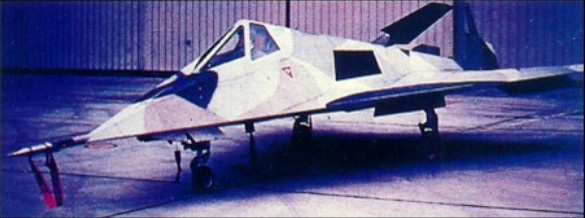
Lockheed’s Advanced Development Projects organisation at Burbank (ADP), more commonly known as ‘The Skunk Works’, already had practical experience in the design of stealth aircraft; low radar signature had been a significant consideration in the Blackbird family of Mach 3.0 reconnaissance aircraft. But rivals, such as General Dynamics, McDonnell Douglas and Northrop, were the then current manufacturers of fighter aircraft for the US military. Even to this day it has not been officially confirmed that Lockheed was the only Have Blue contractor to be funded as far as the hardware stage of an Experimental Stealth-Tactical (XST) prototype. It seems unlikely. It is known, however, that funding for this and other stealth projects was accelerated in 1977, and that the Lockheed design was airborne from the secluded and top secret Groom Lake airfield, on the Nevada test range in December 1977, flown by ADP chief test pilot Bill Park. Although only half the size of the F-117A, this aircraft’s configuration was broadly similar, except for the vertical tail surfaces. Apparently these were individually-mounted and inwardly canted, similar to those of the Blackbird series. The prototype Lockheed stealth aircraft was powered by two General Electric J85 turbojets and used an adapted F-16 fly-by-wire system.
Using special-access, fast-track procedures, the programme developed rapidly, despite the crash of a prototype at Groom Lake on 4 May 1978. After a hard landing which damaged the starboard undercarriage member, Bill Park elected to apply power and climb away in order to assess the damage. Following another abortive approach, he was obliged to eject, but sustained serious injuries and never flew the aircraft again. The landing problem was attributed to faulty fly-by-wire software; Ken Dyson took over as the contractor’s chief test pilot. There were at least two other Lockheed prototypes, however, and they were evidently flown with great success against various radars on the Nevada range. Ground test vehicles were sent for radar cross-section measurement on large-scale outdoor ranges, with similarly encouraging results. By the end of 1978, Lockheed had received a USAF contract to develop a full-scale production version. It contained warranties covering the aircraft’s range, weapons delivery accuracy and radar cross section.
Both prototypes ultimately crashed, one in May 1978 and the other in 1980, with their pilot’s ejecting.
The wreckage of the two Have Blue aircraft was buried within the Nellis Test Range. One was reportedly buried at the Groom Lake site just south of the hangar complex. Lockheed engineers have since searched for the buried Have Blue with a view to restoring it for display purposes, but despite their best efforts have been unable to locate the wrecked aircraft.
XST Engine: 2 x General Electric J85, 1270kg Max take-off weight: 5440 kg / 11993 lb Wingspan: 6.86 m / 22 ft 6 in Length: 11.58 m / 37 ft 12 in Height: 2.29 m / 7 ft 6 in Crew: 1
Lockheed were aware that USAF experience in Korea had shown the need for an air-superiority fighter able to operate from forward airfields and climb rapidly from the ground to engage in high-level combat. The Model 83 was designed to fulfil these roles, and in formulating his design “Kelly” Johnson attempted to keep it as cheap, small and readily maintainable as possible. Tendered to the USAF as an unsolicited proposal, it was necessary for competitive bids to be received and the USAF notified a formal requirement for such an aircraft in late 1952.
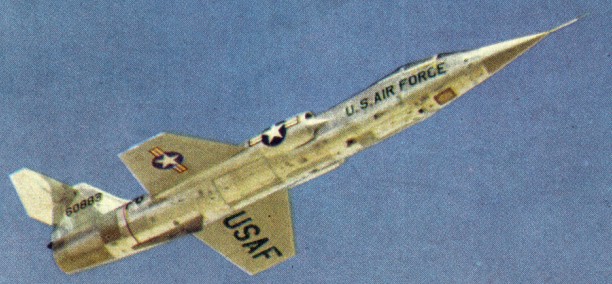
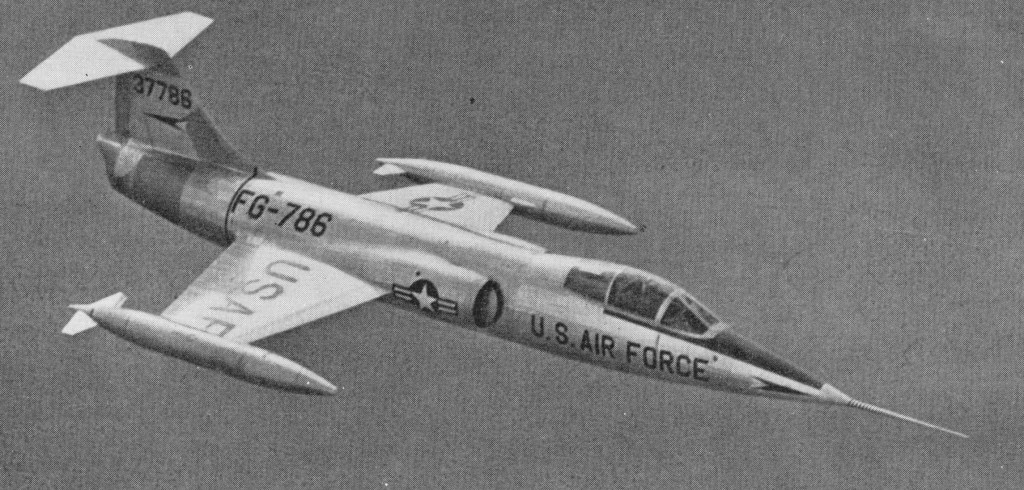
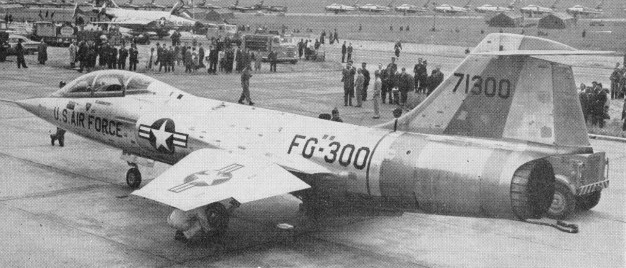
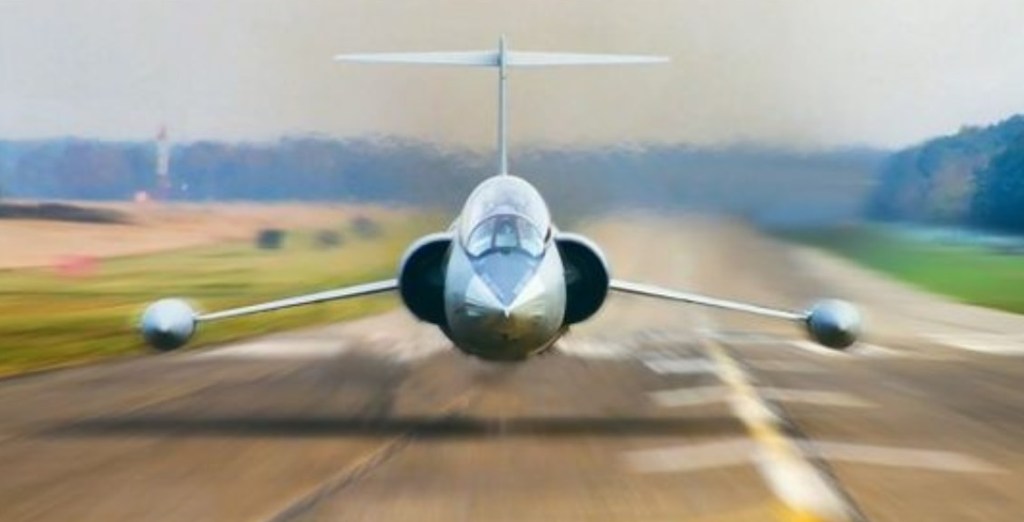
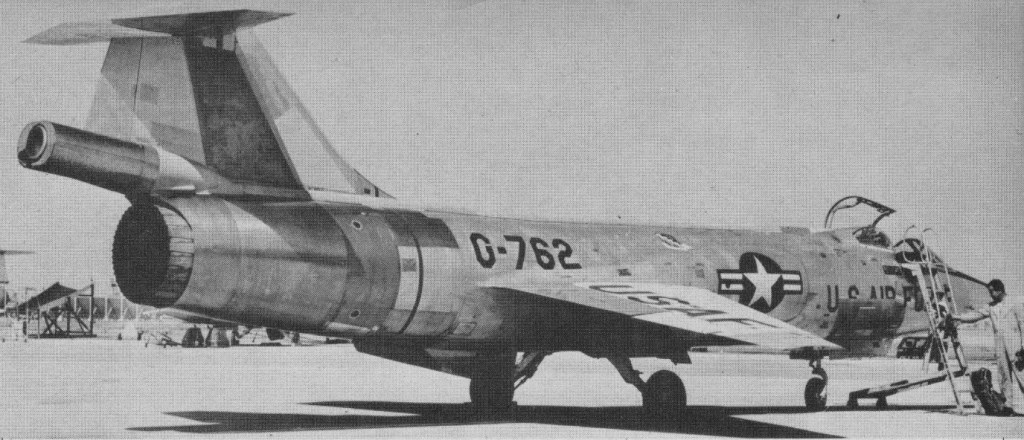
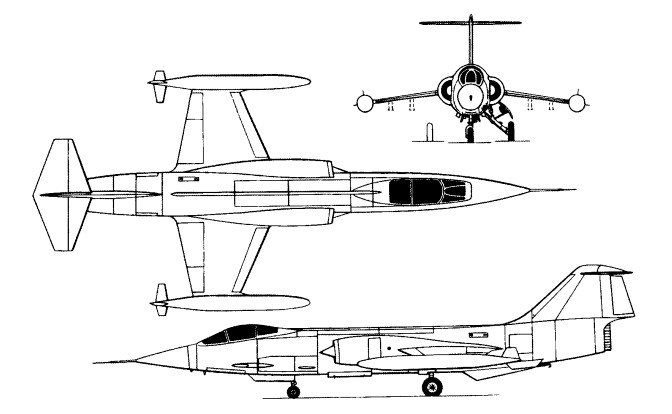
Submissions were received from North American and Republic; but as both of these companies were already heavily involved in fighter development and production, Lockheed’s proposal was selected cautiously: two XF-104 prototypes being ordered for development and testing. The long fuselage was tailored round the J79 engine, and the flying surfaces were small, unswept and very thin, with 10 degrees of anhedral. A token monoplane wing mid-set on the fuselage – this latter assembly wrapped tightly round a powerful turbojet engine – needle-nosed and T-tailed. All wheels, with a single wheel on each unit, retract forward into the fuselage. Able to demonstrate a level speed of around 2,250km/h and to climb to a height of 25km in about 4.5 minutes, the Press dubbed the Starfighter the “missile with a man in it”.
XF-104
The XF-104 had a narrower and shorter rear fuselage compared to the production models. The two prototypes had a 10,500 lb Wright J65-W-6 turbojet but all subsequent aircraft had a J79 turbojet.
The first of these flew on 28 February 1954, followed by test and evaluation aircraft. It was not until 26 January 1958 that the first production F-104A began to enter service – as interceptors – with Air Defense Command’s 83rd Fighter Interceptor Squadron. The US Air Force had already lost interest in the type and took only 296 Starfighters.
F-104A (170) and multi-mission F-104G (77) served with the USAF, as well as F-104B (26) and F-104D (21) two-seat operational-trainer counterparts of the A and C respectively.
Lockheed F-104B Starfighter
The type was then saved by the creation of the F-104G multi-role version for production by a multi-national European consor¬tium as well as for Japan.
Winner of a previous so-called ‘sale of the century’ and used by several NATO air arms for many years. During its heyday the Starfighter formed the backbone of the NATO alliance’s air power and a number of reconnaissance-configured aircraft were produced, sensor packages varying considerably according to the specialized requirements of the parent air arm.
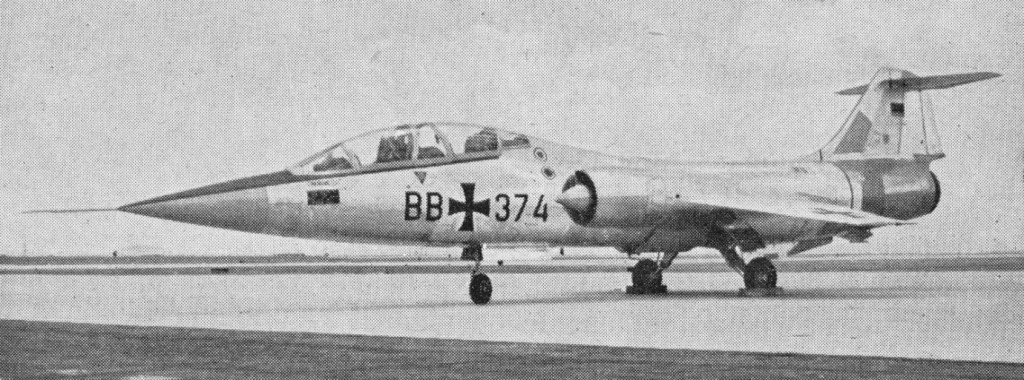
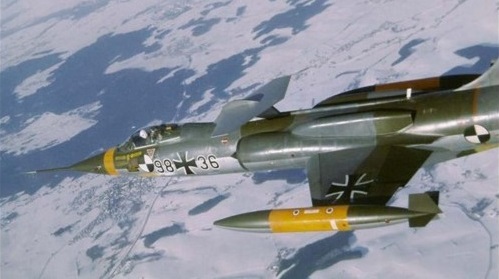
The German Luftwaffe, in their technological zeal, had insisted on overloading the F-104 with equipment which made it much heavier and more complex than the original model. The Starfighter programme began to go wrong after the first had been delivered in May 1961. The German pilots, even after extensive training in Arizona, were not fully experienced. The Starfighter, in the words of General Steinhoff, then inspector of the Luftwaffe, “was forever jealous of the pilot’s full attention. It rewarded discipline with deeds of airmanship; it could punish the dilatory of those who gave themselves to distractions. It was a marvel in capable hands, and merciless to the careless”.
Up to December 1968 ninety-one Starfighters crashed. With each series of Luftwaffe crashes the original choice of the Starfighter became more contentious, and by the time of the 1966 elections the Starfighter bribery scandal played a role in the fall of the Chancellor, Ludwig Erhard. Deliveries of 30 F-104F trainers to the Luftwaffe began in mid-1960.
F-104F
The most widespread variant was the RF-104G, which featured a belly fairing containing cameras, installation of these necessitating the removal of the M61 Vulcan rotary cannon armament. West Germany, Italy and the Netherlands all operated this variant of the Starfighter for a time, although the Netherlands used the standard F-104G for reconnaissance tasks, using the Orpheus pod to accomplish this mission. The German Luftwaffe and Marineflieger used the RTF-104G two-seater.
Following development by Lockheed of the multi-mission F-104G, more than 1,000 came from production lines in Belgium, Germany, Holland and Italy to equip the air forces of those nations. Similar versions were built under licence in Canada and Japan. Lockheed also built 179 F-104G for export or for supply to friendly nations through the Military Assistance Program. These were essentially similar in appearance to their European counterparts and were fitted with three Hycon KS-67A cameras, examples being delivered to Norway and Taiwan, most of the Norwegian specimens being passed on to Turkey.
In 1964 West Germany cut down the intended size of its Luftwaffe because of shortages of funds and manpower. They will reduce the nine F-104G Starfighter squadrons to seven, and two Fiat G.91 reconnaissance squadrons instead of four. First line strength will be 380 F-104G’s and 170 G.91’s.
F-104G 26+11
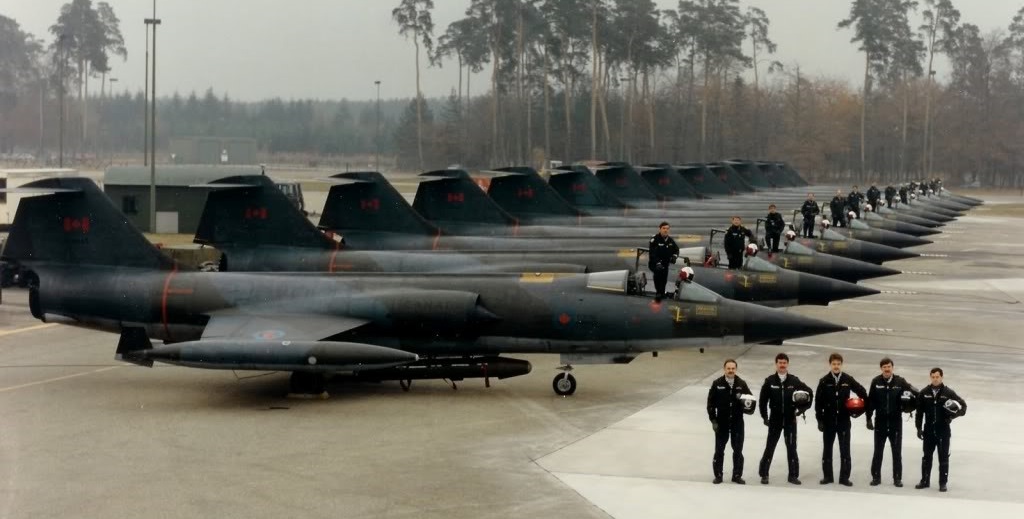
The Canadian built CF-104 Starfighter was one of the most successful jet fighter aircraft to serve with Canada’s Air Force. A total of 340 fighters were built under license by the Canadian government. The CF-104 was designed as a light-weight nuclear strike aircraft. The aircraft were retired from service in 1986 after being used for over 25 years until they were was replaced by the CF-18. Canada’s CF-104 (Canadian-built F-104G) was also originally engaged in reconnaissance duty, aircraft assigned to this task being fitted with a prominent belly-mounted pod containing a battery of Vinten cameras.
Canadair CF-104 Starfighter
Thirty-nine CF-104D models built by Lockheed were purchased by the Canadian Air Force for training.
The CF-104 (single seat version) was built in Canada under license by Canadair in Cartierville, Quebec. The first aircraft produced by Canadair flew in May 1961, with 200 single seaters (CF-104) being produced for the RCAF. 22 Lockheed-built two seaters (CF-104D) were also used by the RCAF. The aircraft in later years provided a measure of unparalleled stability in the low-level, high speed environment until phased out in 1986. The majority of the Starfighters were transferred to the Turkish Air Force. After the RCAF production order was filled in June 1963, Canadair produced another 140 aircraft for other countries.
On 19 May 1964 Jacqueline Cochran set a world speed record of 1429.297 mph for women flying an F-104G over a 10 mile straightline course at Edwards Air Force Base, California. The Mach 2.2 flight broke her similar mark of 1273.109 mph.
Production ended in America, but in 1966 the first prototype of the Aeritalia built F 104S flew for the first time. The Italian Air Force is receiving a total of 205 aircraft, and Turkey received 40 from 1974. Power is provided by one 17,900 lb thrust (with afterburning) General Electric J79 GE 19 turbojet engine. Armament in an air to air role consists of two Sparrow and two or four Sidewinder missiles, plus the 20 mm M 61 multi barrel cannon. In an attack role bombs, rockets, and other weapons up to a weight of 7,500 lb (3400 kg) can be carried on nine wing and fuselage stations.
Post-war Mitsubishi built Lockheed F-104J Starfighters with Kawasaki. Eventually Japan ordered 230 Starfighters – nearly all of them built under licence by Mitsubishi in Japan. Lockheed was estimated later to have paid bribes of about $1.5 million to Japanese officials, and a fee of $750,000 to Yoshio Kodama, one of the most powerful people in Japan.
Total Starfighter pro¬duction was 2,282 units.
A Starfighter, built from non-serviceable ex-military aircraft components by American Darryl Greenmayer over a ten-year period, was the fastest and most complex “homebuilt” aircraft ever completed. With this aircraft, prepared by American Jet Industries in California and known as the Red Baron RB-104 Starfighter, he raised the world speed record over a 3km low-level course to 988.26 mph / 1,590.45 kph on 24 October 1977 at Tonopah, Nevada. The RB-104 was lost in an accident in 1978.
For training in the aerospace field, three early Starfighters have been modified to NF-104A standard by the addition of a 6,000 lb thrust (2722 kgp) Rocketdyne AR-2 booster and reaction jet controls for exploration missions up to heights of nearly twenty five miles. USAF pilots training for the X-20 Dyna-Soar roles use the NF-104A to learn atmosphere re-entry techniques.
NF-104A
The NF-104A is designed to fly regularly to 25 miles altitude. The Rocketdyne engine is throttleable from 50 to 100% power. The NF-104A provides spaceflight experience at a fraction of X-15 operating costs.
The NF-104A was to zoom climb to over 90,000ft where atmospheric pressure was about 6 millibars. About 1% of the pressure at sea level. In the near vacuum the only way to control the plane at the top of its ballistic arc was with jets of hydrogen peroxide for pitch, yaw and roll control. The jet engine would be shut down at about 70,000ft to prevent it from exceeding temperature limits. If not shut down, the engine would have introduced yaw motion challenging the ability to control the aircraft. During the descent, at about Mach 1.8, enough air would pass through the intake ducts to allow a re-start or a dead-stick landing would be made. On 10 December 1963, Chuck Yeager reached 108,700 ft (Yeager wanted to set a new world altitude record) when a pitch up caused the NF-104A to fall on its back and enter a flat spin. At 14,000 ft hr ejected.
Versions F-104A (interceptor) F-104B (two-seat trainer) F-104C (tactical strike) F-104D(two-seat trainer) F-104G (definitive multi-role warplane with a strengthened structure, more power, and revised electronics) TF-104G (F-104G trainer) F-104J (F-104G ver¬sion for Japan) F-104S (improved air defense version developed in Italy) CF-104 CF-104D (CF-104 two-seat trainer). NF 104A RB-104
Specifications
F-l04A Armament: 1 x six-barrel M-21 20mm Vulcan cannon & 2 x Sidewinder AAMs.
F-l04G Engine: 1x 15,800-lb (7,167-kg) reheated thrust General Electric J79-GE-7 or llA turbojet or Turbo-Union J79-MTU-J1K. Wing span 21 ft 11 in (6.68 m) Wing area 196.1 sq ft (18.22 sq.m). Length 54 ft 9 in (16.69 m) Height 13 ft 6 in (4.11 m) Empty weight 14,900 lb (6,758 kg) Maximum take-off weight 28,779 lb (13,054 kg). Fuel capacity: 847 Imp.Gal External fuel: 2 x 162 Imp.Gal under wing, 2 x 142 Imp.Gal tip tanks Maximum speed 1,450 mph (2,333 km/h) or Mach 2.2 at 36,000 ft (10,975 m) Initial climb rate 55,000 ft (15,765 m) per minute Service ceiling 58,000 ft (17,680 m) Range 1,550 miles (2,495 km) Range w/max.payload: 370 km / 230 miles Armament: one 20-mm multi-barrel cannon Bombload: 4,310 lb (1,955 kg) of disposable stores. Crew: 1 Wheel tract: 8 ft 9 in Wheelbase: 15 ft 1 in
TF-l04G Seats: 2.
RF-104G Engine: one General Electric J79GE- 1 IA turbojet, 7167-kg (15, 800-1b) afterburning thrust. Maximum low level speed 1473 km/h (915 mph) or Mach 1.2 Maximum stabilized speed at 12190 m (40,000 ft) 2124 km/h (1,320 mph) or Mach 2.0 Tactical radius with external fuel 1110 km (690 miles) Empty weight 6486 kg (14,300 lb) Maximum take-off: 11352 kg (25, 027 lb). Wing span 6.68 m (21 ft 11 in) Length 16.69 m (54 ft 9 in) Height 4.11 m (13 ft 6 in) Wing area 18.22 sq.m (196.1 sq ft).
F 104S Wing span: 21 ft 11 in (6.68 m). Max speed: M2.2.
Lockheed CF-104D Mk.2 Engine: General Electric J79-19 turbojet 11,810 lbs. thrust, 17,900 lb. with afterburner Maximum Speed: Mach 2 Loaded weight: 26,800 lb (12,156 kg) Span: 21 ft 11 in (6.4 m) Length: 58 ft 3 in (17.7 m) Height: 13 ft 6 in (4.1 m) Wing area: 196 sq ft (18.2 sq m)
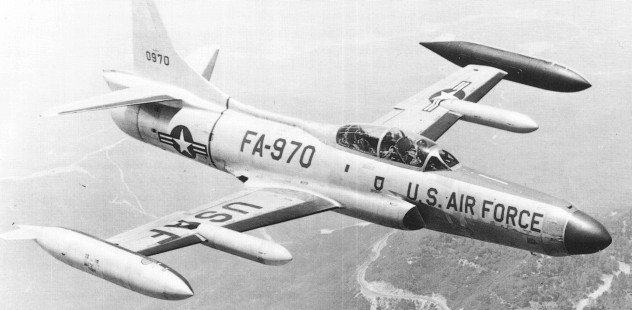
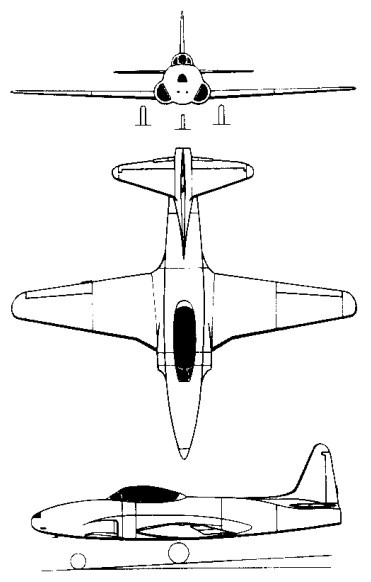
The F-94 Starfire was evolved to satisfy a requirement for a two-seat all-weather radar-equipped fighter. It originally used many of the main components and the production facilities of the two-seat T-33 trainer. The prototypes were converted T-33A, each with a new 26.69kN Allison J33-A-33 turbojet, radar equipment installed in the fuselage nose and accommodation for the radar operator in the rear cockpit. Its 1,200 lb. of electronic equipment includes automatic target location, tracking and rocket-firing radar. Armament of four 12.7mm guns was retained in the forward fuselage.
Deliveries of production F-94A began in June 1950. These incorporated the wings, landing gear and centre fuselage of the T-33, with a new nose and rear fuselage (former to house the radar and the latter for the afterburner installation). All hydraulic, electric and control systems were similar to those of the F-80C.
1948
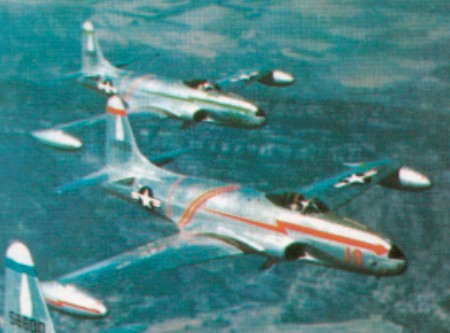
The F-94A were followed in 1951 by F-94B which differed in having square wingtips with centrally mounted Fletcher tip-tanks of larger capacity and improved shape, raised to the wing centre-line, and a revised hydraulic system.
The final version was the F-94C with a thinner wing, longer nose, swept horizontal tail surfaces, larger vertical surfaces, a more powerful engine, and the radome centred in the fuselage nose and surrounded by a ring of 24 air-to-air rockets housed in firing tubes, faired by a retractable shield. Two pods (one mounted on each wing) could together accommodate 24 more rockets. A total of 544kg of electronic equipment included automatic locating, tracking and firing instruments, Westinghouse autopilot, Sperry Zero-Reader, ILS, etc.
F-94C
A total of 854 production Starfires were built. The USAF’s first turbojet-powered all-weather interceptor, the type served primarily with Air Defense Command for national defence.
F-94C Engine: 1 x Pratt & Whitney J48-P-5 turbojet with afterburner, 6,250 lb / 28.2kN thrust Max take-off weight: 10970 kg / 24185 lb Empty weight: 5764 kg / 12708 lb Wingspan: 11.38 m / 37 ft 4 in Length: 13.56 m / 44 ft 6 in Height: 4.55 m / 14 ft 11 in Wing area: 21.63 sq.m / 232.82 sq ft Max. speed: 1030 km/h / 640 mph Ceiling: 15665 m / 51400 ft Range: 1296 km / 805 miles Armament: 48 x 2.75 in Crew: 2
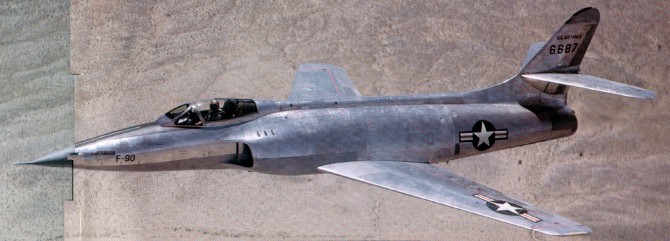
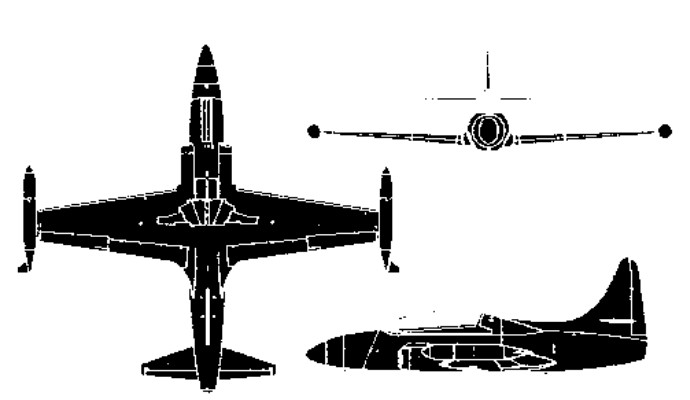
In 1946 the new Strategic Air Command of the USAAF placed an order for the development of a so-called penetration fighter; a long-range fighter able to fly ahead of the bomber force and sweep aside all fighter opposition. The XF-90 evolved over two years and resulted from 65 different designs created by Johnson’s engineers. These included butterfly-tailed aircraft, three-engine aircraft, ‘W’ winged designs. Lockheed’s Model 153 submission was thought to offer great potential and was ordered in the form of two XF-90 prototypes. The two prototypes were to be tested in a fly-off competition with the McDonnell XF-88 and North American YF-93A designs.
Developed by Clarence L. (Kelly) Johnson’s Lockheed fighter team, the design had a number of similarities to the company’s F-80 Shooting Star, but was of more advanced aerodynamic concept. It had a finely tapered forward fuselage, two laterally mounted 4200-lb (1905-kg) afterburning thrust Westinghouse J34-WE-11 turbojets, and flying surfaces swept at 35 degrees. A radius of about 1100 miles (1770-km) was provided by considerable internal fuel supplemented by jettisonable wingtip tanks. This was calculated to provide an escort capability into the western USSR from bases in West Germany, and a potent offensive punch was provided by a combination of four 20-mm cannon with six 0.5-in (12.7-mm) machine-guns. The final XF-90 had 12.7mm rivets in the wings and weighed as much as a DC-3.
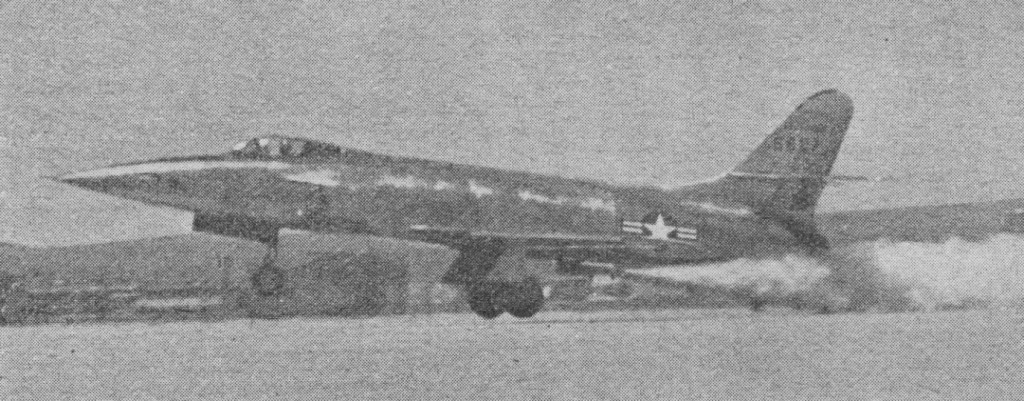
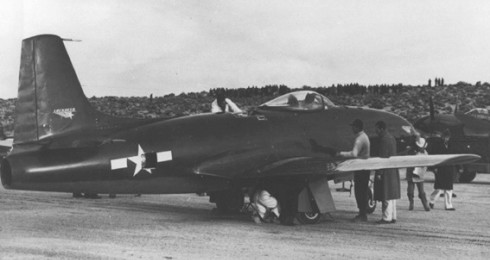
The first aeroplane flew on 4 June 1949 at Muroc, piloted by Tony LeVier. It cruised around 15,000 ft for 37 minutes. The twin Westinghouse J-34 were assisted by a pair of externally mounted JATO rockets for the gross weight of 26,000 lb.
XF-90 first take-off
It was immediately revealed to be drastically under-powered with twin 1406kg thrust Westinghouse J34-WE-11 turbojets. The XF-90 reached 1070km/h at 9784m in level flight and could easily be pushed through the sound barrier in a shallow dive. Throughout April and May 1950, above Muroc Dry Lake, Lockheed test pilot Tony LeVier put the XF-90 through high-speed dive tests. LeVier dived the XF-90 to Mach 1.12 on 17 May 1950.
The XF-90 stalled at 204km/h, making it no easy machine to control on the approach. Its take-off performance enabled it to clear a 15m obstacle in 2629m without the rocket-assisted take-off (RATO) units used in some tests. In the 1949 fly-off, the XF-88 came in first, the XF-90 second, and the YF-93A third, but by then the results were academic. With the September 1949 detonation of the Soviet Union’s first nuclear weapon, the USAF’s requirement was changing at this time, so the project was cancelled.
The second XF-90 was rigged with instruments on the ground and destroyed in the 1952 atomic bomb tests at Frenchman’s Flat, Nevada. Lockheed records indicate that the first XF-90 was shipped in 1953 to a National Advisory Committee for Aeronautics (NACA) laboratory in Cleveland, Ohio. Apparently, it was eventually broken up in tests at that NACA facility.
Engines: 2 x Westinghouse J34-WE-11 turbojets, 1406kg thrust Max take-off weight: 12300 kg / 27117 lb Empty weight: 8400 kg / 18519 lb Wingspan: 12.19 m / 39 ft 12 in Length: 17.12 m / 56 ft 2 in Height: 4.8 m / 15 ft 9 in Wing area: 32.05 sq.m / 344.98 sq ft Max. speed: 1070 km/h / 665 mph Ceiling: 11800 m / 38700 ft Range: 3700 km / 2299 miles
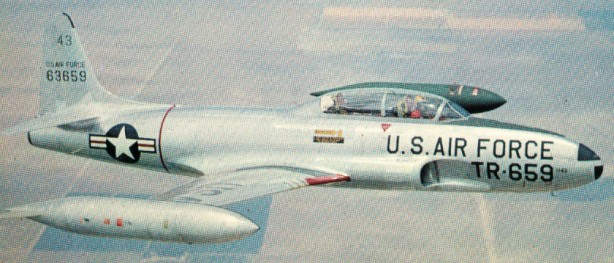
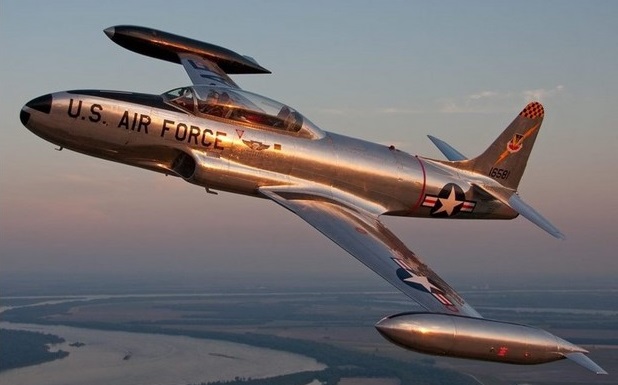
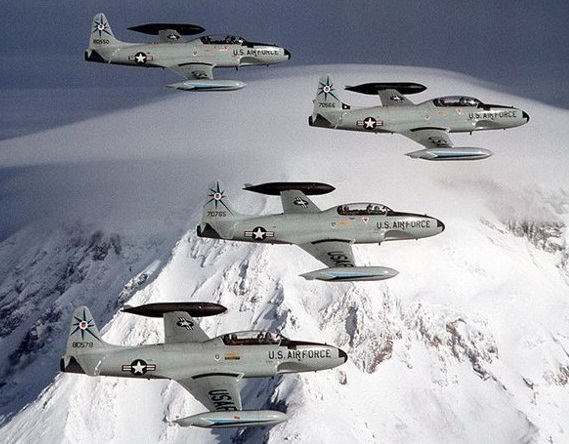
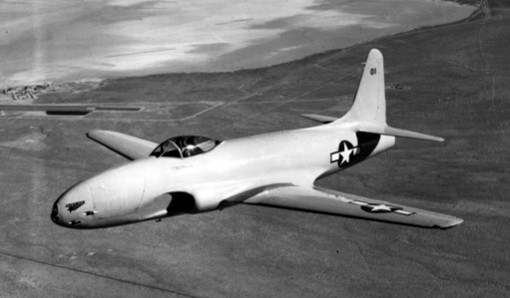
In December 1945 the USAAF began to receive its first jet fighter, the Lockheed P 80 Shooting Star, and it soon became clear that a trainer version was essential. Lockheed’s P-80 Shooting had developed into a lengthened-fuselage two-seat trainer version, designated originally TF-80C. The first of these flew on 22 March 1948.
In addition to the fuselage ‘stretch’, a second cockpit in tandem was provided with dual controls, the transparent canopy was extended to cover both cockpits and the armament of the F-80 was deleted. Original engines were Allison J33-35 single-shaft turbojet engines with a thrust rating of 5,200 lbs.
Test pilot Jim Fitzgerald was killed during an approach to landing in the first T-33 that Lockheed built.
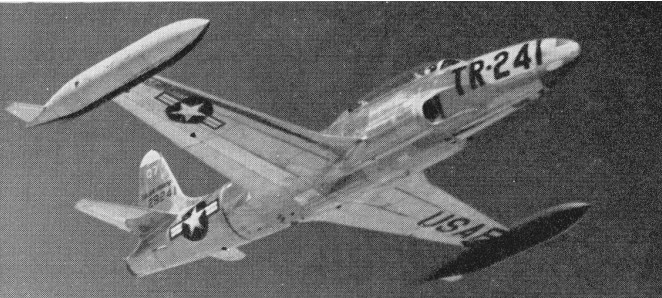
T-33A
The type eventually became the USAFs standard jet trainer, many being supplied to foreign nations under the Military Aid Program. 1,058 were supplied to friendly nations under the program. They were also built for service with the US Navy and Marine Corps under the designation TV-2, later T-33B.
TV-2 Seastar
A total of 128 TF-80C were built before the designation was changed to T-33A in May 1949.
Derived from T 33 as shipboard trainer, a total of 271 T-1 Seastar trainers were built for U.S. Navy during 1957 58.
Variants included small numbers modified as DT-33A drone directors and AT-33A armed close-support aircraft.
After a production run of 11 years the 5691th and last Lockheed T-33A Shooting Star was delivered by Lockheed at the beginning of August 1959.
A total of 5,691 were built by parent company, 656 built in Canada (by Canadair Ltd as CL 30 Silver Star with Nene 10), and 210 built in Japan (by Kawasaki). The aircraft was supplied to the air arms of some twenty-five countries.
In 1963 Libya started its own Air Force when the US turned over two T-33 and a C-47 at Wheelus AFB.
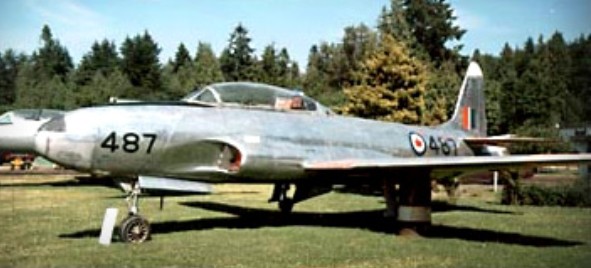
Canadair was given a contract in September 1951 to manufacture the T-33 with the first flight being in December 1952. The Canadair CL-30′ Silver Star’, later designated CT-133, was a tandem two-seat, armed trainer version of the T-33A, powered by a Rolls Royce Nene 10 turbojet, delivering 5,400 lb thrust. 636 were built under licence for the Royal Canadian Air Force from 1952. It was used as an instrument flight trainer whilst in service with the Canadian forces in Germany. The Silver Star Mks. 2 and 3 differed from the U.S. manufactured T-33A in being powered by a Rolls-Royce Nene 10 turbojet. Armament consisted of two nose-mounted 12.7 mm (0.5 in) machine-guns plus various light bombs, rockets and machine-gun pods. It had a service ceiling of 48,000 feet, a maximum speed of 600 mph at sea level and a cruising speed of 455 mph. The normal range was 1,025 miles and the maximum range was 1,275 miles. Canada gave T-33s to Bolivia, France, Greece, Portugal and Turkey under the Mutual Aid programme.
CL-30 Silver Star
By the end of 2000, 7 nations in the world still listed the T-33 as “in service.”
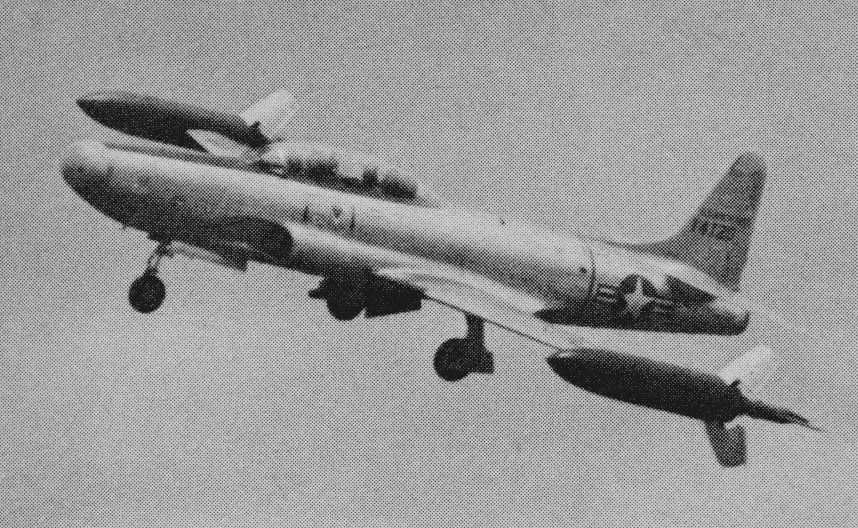
Circa 1964 a T-33, modified and operated for USAF Flight Dynamics Lab at Wright Patterson AFB, by Cornell Aeronautical Laboratory, has a variable drag system provided by servo-driven petals mounted on wing tanks. Simulation of flight path and handling qualities of lifting-body re-entry vehicles was made on both front and back of the power curve.
Cornell Aeronautical Laboratory modified T-33
Cornell Aero Lab at Cornell University in Ithaca, New York, had a variable-stability aircraft, a Lockheed NT-33A Shooting Star, which Neil Armstrong flew, testing experimental sidestick controller.
T-33 Engine: 1 x Allison J-33-A-5, 24.0kN Max take-off weight: 5900 kg / 13007 lb Empty weight: 3810 kg / 8400 lb Wingspan: 11.9 m / 39 ft 1 in Length: 11.5 m / 37 ft 9 in Height: 3.6 m / 11 ft 10 in Wing area: 22.0 sq.m / 236.81 sq ft Max. speed: 965 km/h / 600 mph Ceiling: 14700 m / 48250 ft Range w/max.fuel: 2150 km / 1336 miles Crew: 2
T-33A Engine: 5,400 lbs.t. (2450 kgp) Allison J33 A 35. Max level speed: 543 mph (874 kph). Max speed, 600 mph (966 kph) at sea level Cruise, 430 mph (692 kph) Initial climb, 5,525 fpm (28 m/sec) Service ceiling, 47,500 ft (14,477 m) Range, 1,345 mls (2164 km). Empty weight 8,084 lb (3 667 kg) MTOW, 11,965 lb (5428 kg). Wing span, 38 ft 10.5 in (11.85 m) Length 37 ft 9 in (11.49 m) Height: 14 ft 4 in (3.45 m) Wing area, 237 sq.ft (22 sq.m).
T-33A Engine one 5,400-lb. Allison J-33-A/4 turbojet with w/water-alcohol injection. Gross wt. 16,800. Empty wt. 8,440. Total fuel: 813 USG; 230 in each tip tank. Max Speed 525 mph. Long range cruise 455 mph. Range 1,000 nm. Ceiling 47,000′. Seats (ejection) 2.
T 1A Seastar Engine: 6,100 lbs.t. (2 767 kgp) Allison J33 A 22 turbojet. Max speed, 580 mph (933 kph) at 35,000ft (10 668 m) Cruise, 410 mph (660 kph) Initial climb, 6,330 fpm (32.1 m/sec) Service ceiling, 40,000ft (12 192 m) Range, 967 mls (1566 km). Empty weight, 11,965 lb (5 428 kg) Loaded weight, 15,500 lb (7 031 kg). Wing span, 42 ft 10 in (13.05 m) Length, 38 ft 6.5 in (11.73 m) Wing area, 240 sq.ft (22.3 sq.m).
Canadair CL-30 Engine: Rolls Royce Nene 10 turbojet, 5100 lb (2,315 kg) Span: 37 ft 7 in (11.48 m) without tip tanks Wing Span: 38 ft 10.5 in Length: 37 ft 9 in (11.49 m) Height: 11 ft 8 in (3.6 m) Wing area: 238 sq ft (22.11 sq m) Empty weight: 8,440 lb (3,832 kg) Loaded weight: 18,400 lb (8,217 kg) Maximum speed: Mach .787 Armament: Two .50 calibre Browning machine guns
In the spring of 1943 Allied intelligence became aware of the ME262 jet fighter, little was known about it but under the direction of Henry H. Arnold, the Commanding General of the U.S. Army Air Forces the decision was taken to bring the USA into the jet age. The development of the earlier XP59 Airacomet had not inspired confidence in the turbojet jet but with the reliability and power of the British developed engines increasing by the day the Americans decided that they could not afford to be left behind.
Arnold went to Lockheed and convinced them to build an airframe around the de Havilland Halford H1 (Goblin) which was already produced almost 2,300 lbs of thrust of the drawing board with promise of a great deal more. A design was submitted by what would be known as the ‘Skunk Works’ team led by Kelly Johnson claiming that the airframe could be built and ready for testing in 180 days, in the end it took just 143 being delivered to Muroc field (now Edwards AFB) on the 16th November 1943.
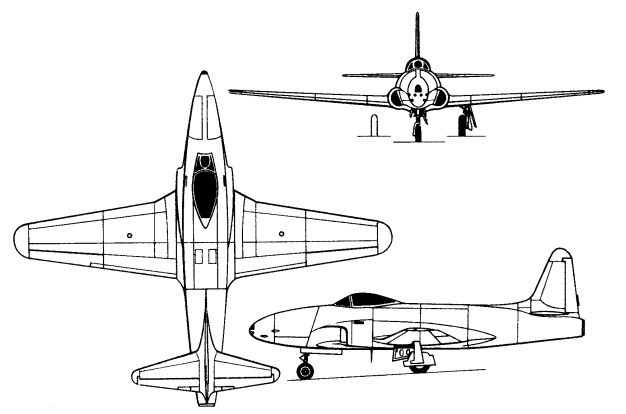
The design proved acceptable to the USAAF was a low-wing cantilever monoplane with a knife-edge laminar-flow wing section; engine within the rear fuselage; air intakes on each side of the fuselage forward of the wing leading edge; and retractable tricycle-type landing gear. Equally attractive was the company’s proposal to complete an initial prototype within 180 days and little time was lost in awarding contracts for three prototypes and 13 service trials aircraft. Work on the first prototype began in August 1943 and just 143 days later (on 8 January 1944) this aircraft flew for the first time.
XP-80
The first flight was delayed by foreign object damage which destroyed the engine on the first run up. A new engine was shipped from Britain allowing the first prototype (44-83020) nicknamed Lulu-Bell to get airbourne on the 8th January 1944. It was flown by Lockheed test pilot Tony LeVier. Service designation of the prototype was XP-80. Its power plant was a 13.34kN de Havilland H-1 turbojet.
Plans for this engine to be built by the Allis-Chalmers Company in America did not happen, so the next two prototypes each had a 16.68kN General Electric 1-40 turbojet, based on the Rolls Royce Derwent and also built by Allison as the J33. This was a larger and more powerful engine than the intended Allis-Chalmers J36, involving redesign which included increased span and length, a taller fin and strengthened landing gear. The exercise cost five months, for it was not until 10 June 1944 that the first of these two XP-80A was flown, by Tony Le Vier. Its first flight performance was not impressive and even with the technical difficulties rectified it was still considered worse than the H1 powered XP-80.
XP-80A 44-83021 Gray Ghost
The XP-80A’s were primarily testbeds for bigger engines and intake duct design, and consequently were larger and 25% heavier than the XP-80, a big factor in their poor performance. The P-80 testing program proved very dangerous. Milo Burcham was killed on 20 October 1944 while flying the third YP-80A, 44-83025 while the “Gray Ghost” was lost on a test flight on 20 March 1945, although pilot Tony LeVier escaped being able to bail out when the engine failed due to a turbine blade failure.
These two prototypes were designated XP-80A and were powered by the Allison-developed General Electric J33 engine of 1814-kg (4,000-1b) thrust, with low-set equi-tapered laminar-flow wings and engine air intakes set into the fuselage just forward of the wing roots, this version had a top speed of 898 km/h (558 mph) at sea level.
Thirteen development YP-80A aircraft for service trials, with J33-GE-9 or J33-GE-11 engines and an armament of six machine guns in the nose, started delivery to test establishments in October 1944 and it was aircraft of this type that arrived in Italy in May 1945. Two examples reached the Italian war zone just before VE-day, but failed to fly an operational sortie.
Ordered into quantity production during April 1944, the Shooting Star subsequently suffered cancellations after VJ-Day, but was proceeded with and as the P-80A attained operational service with the 412th Fighter Group during 1946, although poor serviceability and a very high accident rate significantly reduced its value. Production P-80A had wingtip tanks and provision for bombs, rockets and fuel tanks to be carried beneath the wings, plus six 12.7mm guns mounted in the fuselage nose.
Production deliveries of the P-80A did not start until December 1945, four months too late to see action against the Japanese.
The Shooting Star made a number of important flights, these including the first west-to-east trans-atlantic crossing by jet which was accomplished by 16 F-80s of the 56th Fighter Group in July 1948. One Shooting Star has set a world speed record of 1,003.91km/h on 19 June 1947. The P-80 designation changed to F-80 in 1948.
The second model to enter production was the F-80B, which featured numerous refinements such as thinner wing section with thicker skin, stronger bulkheads in the nose section to support greater fire-power, more power, stainless steel armoured engine compartment, provisions for JATO, and provision for rocket launchers. But only 240 of this model were completed before manufacture switched to the definitive F-80C. This possessed even greater power and also better armament and increased underwing weapons capability, no less than 670 being completed by the end of 1950, by which time the USA was in the Korean War.
The RF-80C being an unarmed photographic reconnaissance sub-variant.
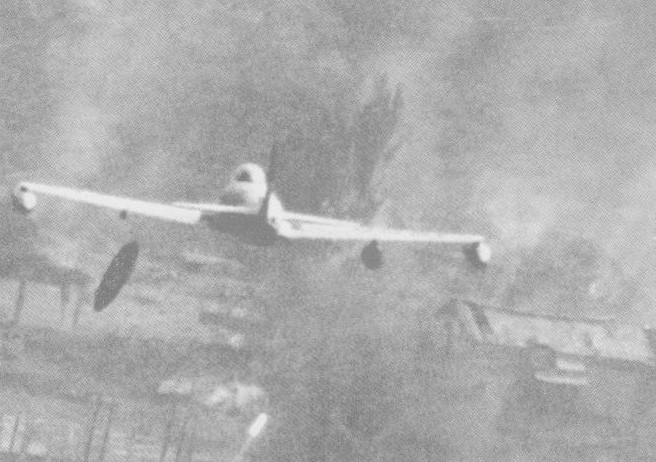
The F-80C saw extensive action in the Korean War, one highlight occurring on 8 November 1950 when an F-80C flown by Lieut Russell J. Brown succeeded in downing a MiG-15 in what was believed to be the first conclusive aerial combat between jet fighters. On the whole, though, the Shooting Star possessed inferior performance and was mainly employed as a fighter-bomber. For Korea, F-80 were adapted to carry two 227kg and four 118kg fragmentation bombs or two 450kg bombs plus eight rockets or four 40 US gallon napalm bombs.
F-80 Shooting Star, Suan, Korea
Variants have included reconnaissance RF-80, QF-80A and QF-80F drones, and one F-80C was converted as a prototype two-seat trainer.
XP-80 Engine: de Havilland Goblin centrifugal flow turbojet, 3000 lb Max speed: 502 mph.
P 80A Shooting Star Engine: one 1814 kg (4000 lb) thrust General Electric J33 A 11 tur¬bojet. Max speed 933 km/h (580 mph) at 8535 m (28,000ft) Initial climb rate 1395m (4,580ft) per minute Service ceiling 13715 m (45,000 ft) Range 870 km (540 miles) Empty weight: 3593 kg (7,920 lb) Maximum take off weight: 6577 kg (14,500 lb) Wing span 12.17 m (39 ft 11 in) Length 10.52 m (34 ft 6 in) Height 3.45 m (11 ft 4 in) Wing area 22.11 sq.m (238.0 sq.ft). Crew: 1 Armament: six 12.7mm (0.5 in) machine guns in the nose, 2 x 454kg Bomb / 10x 5″ Rockets.
F-80C Shooting Star Engine: one 2449-kg (5,400-lb) thrust Allison J33-A-35 turbojet Wingspan 12.15 m (39 ft 10.5 in) Wing area 22.02 sq.m (237 sq ft) Length 10.52 m (34 ft6 in) Height 3.45 m (11 ft 4 in) Wheel track: 8 ft 7 in Empty weight: 3738 kg (8,240 lb) Maximum take-off weight: 7646 kg (16,856 lb) Maximum speed 956 km/h (594 mph) at sea level Initial climb rate 2094 m (6,870 ft) per minute Service ceiling 13030 m (42,750 ft) Range 1706 krn (1,060miles) Max endurance: 3 hr 12 min Crew: 1 Armament: six 12.7-mm (0.5-in) M3 machine-guns, 907 kg (2,000 lb) external ordnance or 16 127-mm (5-in) rockets.
The Lockheed C-141 Starlifter was designed to a 1960 requirement as a military strategic airlifter.
First flown on 17 December 1963, production deliveries of an eventual 248 entering USAF service began in 1965 as the C 141A. By August 1964 the USAF had ordered 132 Starlifters.
The original Starlifter model, the C-141A, could carry 138 passengers, 80 litters for wounded, or ten standard 463L pallets with a total of 62,700 pounds (28,900 kg) of cargo.
A number were modified to allow the carriage of a containerized Minuteman ballistic missile.
The C-141 volume capacity was relatively low in comparison to its lifting capacity; it generally ran out of physical space long before it hit its weight limit.
It was reported in August 1964 that a $64,000,00 order was placed by Flying Tiger Line for eight Super Starlifters, a 168 ft long commercial growth version of the C-141. Deliveries planned for 1967 did not happen.
C-141A 66-0192
Lockheed produced the prototype C 141B version in 1977, a conversion of a standard C 141A with a 23 ft 4 in (7.11 m) longer fuselage, other airframe changes and flight refuelling equipment producing the C-141B, flown for the first time on 24 March 1977. The conversion program took place between 1977 and 1982. It was estimated that this stretching program was the equivalent of buying 90 new aircraft, in terms of increased capacity.
Additional ‘plug’ sections were added before and after the wings, lengthening the fuselage by 23 ft 4 in (7.11 m) The modifications raised the StarLifter’s carrying capacity from ten standard freight pallets to 13, or a similar rise in the 154 troops, from 123 paratroops. All C 141As were being brought up to the new C 141B standard.
Sixty-three aircraft have been upgraded to C-141C status, with improved avionics and navigation systems.
In 1994, thirteen C-141Bs were given SOLL II (Special Operations Low-Level II) modifications, which gave the aircraft a low-level night flying capability, enhanced navigation equipment, and improved defensive countermeasures. The USAF operates these aircraft for the Air Force Special Operations Command.
On 16 September 2004 the C-141 left service with active duty USAF units, being confined to reserve units for the remainder of its service life. As of September 25th, 2005, there were only 8 C-141 aircraft still flying (All from Wright-Patterson AFB) near Dayton, Ohio. One of them is the same aircraft that was used at the end of the Vietnam War to repatriate American POWs from North Vietnam, and was to be moved to the National Museum of the United States Air Force, also at WPAFB.
C 141A Engines: 4 x Pratt & Whitney TF33 P 7 turbofan, 21000 lb (9,525 kg) st. Wing span: 159 ft 11 in (48.74 m). Length: 145 ft 0 in (44,20 m). Height: 12.0 m / 39 ft 4 in Wing area: 299.8 sq.m / 3227.02 sq ft Gross weight: 316,600 lb (143,600 kg). Max speed: 571 mph (919 km/h) at 25,000 ft (7,620 m). Cruise speed: 885 km/h / 550 mph Ceiling: 12500 m / 41000 ft Capacity: 154 troops, 123 paratroops, 80 stretchers, 5,283 cu.ft (169.6cu.m) cargo Range w/max.fuel: 11400 km / 7084 miles Range w/max.payload: 6440 km / 4002 miles Typical range: 4080 miles (6,565 km) with 70,847 lb (32,136 kg) payload. Crew: 4
C 141B Engines: 4 x Pratt & Whitney TF33 P 7 turbofan, 21000 lb (9,525 kg) st. Length: 168 ft 4 in / 51.31 m Height: 12.0 m / 39 ft 4 in
In 1963 the USAF’s Military Air Transport Service issued a require¬ment for a very large logistics transport aircraft. Finally, this and other requirements evolved into specification CX HLS (Cargo. Experimental Heavy Logistics System) which demanded an aircraft capable of carry¬ing a payload of 56 700 kg (125 000 lb) over a range of 12 875 km (8000 miles) and twice that weight over shorter distances. It also had to be able to take off from the same runways as the smaller C 141 StarLifter and have the capacity to land on roughly prepared strips in combat areas. In May 1964 the Boeing, Douglas and Lockheed companies were asked to develop their submitted designs further. The gross weight requirement had by then been increased to 317 500 kg (700 000 lb), and General Electric and Pratt & Whitney were invited to design a suitable powerplant. Towards the end of the following year the choice was made in favour of a Lockheed/General Electric partnership, and the aircraft was officially designated C-5A Galaxy.
Eight test and evaluation machines were built, beginning in August 1966, the first C-5A Galaxy (#66-8303) was “rolled out” on 2 March 1968.
On June 30th 1968 Lockheed-Georgia Co. began flight testing with the aircraft’s first flight taking to the air under the call-sign “Allen-zero-three-heavy”, upon completion of testing the first C-5A was transferred to the Transitional Training Unit at Altus Air Force Base, OK, in December 1969.
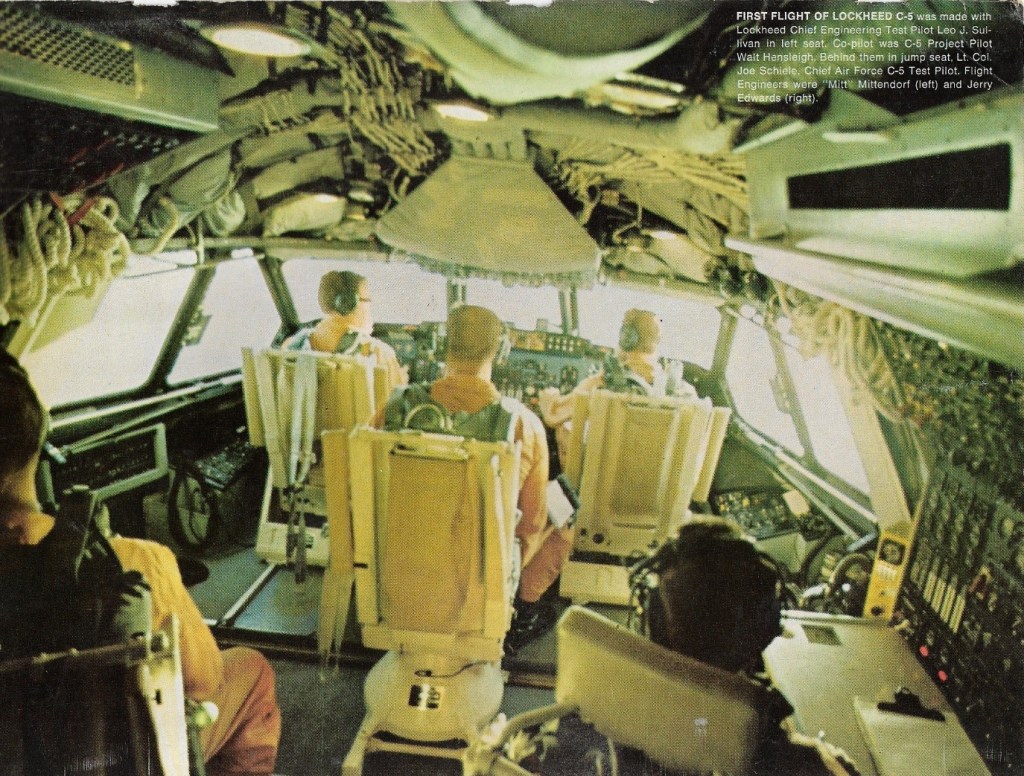
The first flight crew were Lockheed Chief Engineering Test Pilot Leo J. Sullivan in left seat. Co-pilot was C-5 Project Pilot Walt Hensleigh. Behind them in jump seat, Lt. Col. Joe Schiele, Chief Air Force C-5 Test Pilot. Flight Engineers were “Mitt” Mittendorf (left) and Jerry Edwards (right).
C-5 first flight
It is a high wing cantilever monoplane, with a semi monocoque two deck fuselage of aluminium and titanium alloy construction and a cantilever all metal ‘T’ tail. The nosewheel unit retracts rearward hydraulic¬ally, as do the four main undercarriage bogies, each consisting of two sets of wheels in tandem on each side of the fuselage. Powered by four General Electric TF39 GE 1 turbofan engines, each rated at 18600 kg (41005 lb) thrust at sea level, the Galaxy carries a maximum usable fuel load of 185 480 litres (40 800 Imp gal) and can be refuelled in flight from a KC 135 tanker via an inlet in a fairing on top of the forward fuselage, just aft of the flight deck. For takeoff, a fully loaded Galaxy needs 2135 m (7004 ft) of runway, but can land in 680 m (2230 ft).
A crew of five is normally carried, includ¬ing a loadmaster, and there is a forward rest area on the upper deck for 15 persons (relief crew, etc). Although intended primarily as a freighter, the basic version can carry 75 troops at the rear of the upper deck and 270 on the lower deck. Loads lifted have included a 35380 kg (78000 1b) Minuteman ICBM and its 3175 kg (7000 1b) launching cradle; two 44 905 kg (99 000 1b) M 48 tanks; or three Boeing Vertol Chinook heavy lift helicopters. Loading can be done from front or rear, or from both ends simultaneously. There is an upward hinged nose door and loading ramp at the front; the rear straight in loading ramp, when closed, forms part of the undersurface of the rear fuselage.
Flight testing of the Galaxy continued until the summer of 1971. Deliveries of production aircraft to Military Airlift Command began on December 17, 1971, (to the 437th Airlift Wing, Charleston Air Force Base, SC) and were completed in May 1973. The C 5A became operational in 1970, and from July of that year was flying regular trips to Southeast Asia and Europe; it was utilized extensively during the Vietnam war for rapid transport of heavy equipment. In 1978, a total of 77 still remained in the MAC inventory of the 81 aircraft built. These were in service with the 60th, 436th, 437th, and 443rd Military Airlift Wings, based at Travis Air Force Base, California; Dover, Delaware; Charles¬ton, South Carolina; and Altus, Oklahoma.
Throughout the 1970s, the Galaxy remained the world’s largest military transport aircraft, being almost as large and heavy as the later model Boeing 747 Jumbo jets. Lockheed has calculated that, if required by the USAF, it is capable of being optimized for payloads even greater than the present 100227 kg (220964 1b) maximum, without increasing the maximum takeoff weight.
These aircraft have been put to invaluable use on non military mercy missions to disaster stricken areas such as the floods in Chile in 1974 and those in Pakistan. Much needed equipment and supplies were taken to earthquake ravaged Nicaragua by Galaxy aircraft, and in early 1977 and 1978 they were used to ferry snow¬clearing equipment to several areas within the United States.
In the mid-1970s, wing cracks were found throughout the fleet. Consequently, all C-5A aircraft were restricted to a maximum of 50,000 pounds (22,680kg) of cargo each. To increase their lifting capability and service life, 77 C-5As underwent a re-winging program from 1981 to 1987. (In the redesigned wing, a new aluminum alloy was used that didn’t exist ten years prior.) The final re-winged C-5A was delivered in July 1986.
In January 1981 a C-5A at snow covered Griffiss Air Force Base a C-5A performed more exhaustive ground maneuvers on unprepared ‘off-runway’ surfaces, including taxiing, towing and cargo off-loading at gross weights from 425,000 to 665,000 lb. The tests were conducted by the Air Force Test and Evaluation Center, Kirkland AFB, New Mexico.
Some C-5s were transferred to the Air Reserve components starting with Kelly AFB, Texas, in 1985; followed by Stewart Air National Guard Base, NY; and Westover Air Reserve Base, MA.
In December 1985 Lockheed was awarded a contract to design a new wing for the Galaxy, increasing maximum take-off weight from 348,810kg to 379,660kg. By the end of 1986, 68 rewinged C-5As had been returned to service, and the 77-strong fleet was scheduled for completion by mid-1987. C-5Bs have the same wing, improved General Electric TF39 turbofans, updated avionics, and better fatigue and corrosion resistance.
C-5B
Two C-5As modified to carry outsized space cargoes as C-5Cs.
On 17 April 1989 Lockheed delivered its final C-5B to the USAF.
C-5 engines were upgraded as C-5M, from four General Electric TF-39 engines to General Electric CF6-80C2-L1F (F-138) commercial engines, which have 22 percent more thrust, a 30 percent shorter takeoff roll, and a 58 percent faster climb rate. June 2006 saw the first flight of the C-5M ‘Super Galaxy’ with a digital glass cockpit.
C-5A Galaxy Engines: 4 x GE TF-39-GE-1, 182.9kN / 41,000 lb Wing span: 222 ft 8.5 in (67.88 m) Wing area: 576.0 sq.m / 6200.01 sq ft Length: 247 ft 10 in (75.54 m) Height: 65 ft 1.5 in (19.85 m) Max TO wt: 764,500 lb (346,770 kg) Payload: 73pax, max 130950kg Max level speed: 571 mph (919 kph) Cruise speed: 871 km/h / 541 mph Service ceiling: 33802 ft / 10303 m Range w/max.fuel: 13472 km / 8371 miles Range w/max.payload: 5600 km / 3480 miles Take off distance : 12129 ft / 3697 m Landing distance : 4872 ft / 1485 m Crew: 6
C-5B Galaxy Engine: 4 x GE TF39 turbofan Installed thrust: 765 kN Wingspan: 67.9 m / 222 ft 9 in Height: 19.8 m / 65 ft 0 in Length: 75.5 m Wing area: 576.0 sq.m / 6200.01 sq ft Empty wt: 169,645 kg MTOW: 379,660 kg MLW: 288,630 kg Payload: 118,390 kg Max. speed: 920 km/h / 572 mph Cruise speed: 835 kph Initial ROC: 440 m / min Ceiling: 10,895 m T/O run: 2125 m Ldg run: 720 m Fuel internal: 193,640 lt Range with 118,390 kg payload: 5470 km Capacity: 75 pax Air refuel: Yes.
C-5M Super Galaxy Engines: 4 x GE CF6-80C2 turbofan Wingspan: 222.8 feet Length: 247.8 feet Height: 65.1 feet Empty weight: 400,000 lb Cargo capacity: 281,001 lb Cruise speed: Mach 0.77 Un-refuelled range: 5,524 sm (4,800 nm) with 120,000 lb of cargo Un-refuelled range: 7,000 nm no cargo









 All Aero