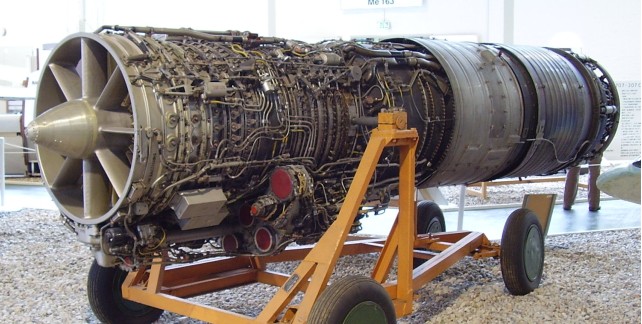
1961
Axial turbojet
Thrust: 11,000 kg
Applications:
Yakolov Yak-38
Tupolov Tu-28 / Tu-128
Sukhoi Su-17
Sukhoi Su-24
1961
Axial turbojet
Thrust: 11,000 kg
Applications:
Yakolov Yak-38
Tupolov Tu-28 / Tu-128
Sukhoi Su-17
Sukhoi Su-24
1949
7 stage axial flow turbojet
Thrust: 4600 kg at qualification in 1950
Applications:
Ilyushin IL-30
Ilyushin Il-46
Lavochkin Aircraft 190
Tupolov Tu-85
Yakolov Yak-1000
Sukhoi Su-17 (1949)
1945
Axial flow compressor turbojet
1250 kg thrust
Gu-VRD project
1938
Two stage centrifugal compressor turbojet
500 kg est thrust
Testbed only
In May 1944 Arkhip Lyulka was ordered to begin development of a turbojet with a thrust of 12.3 kN (2,800 lbf). He demonstrated an eight-stage axial-flow engine in March 1945 called the S-18. In early 1946 the Council of Ministers ordered that the S-18 be developed into an operational engine with a thrust of 15.5 kN (3,500 lbf). The TR-1 was developed in early 1946 and had its first static run on 9 August. It was the first indigenous Soviet jet engine. It was tested in the air on a pylon fitted to a Lend-Lease B-25 Mitchell piston-engined bomber.
The TR-1 was not a success, proving to have less thrust and a higher specific fuel consumption than designed. Its failure led directly to the cancellation of the first Soviet jet bomber, the Ilyushin Il-22.
Lyulka further developed the engine into the TR-1A of 20.5 kN of thrust, but its specific fuel consumption was very high and it too was cancelled.
Applications:
Alekseyev I-21
Ilyushin Il-22
Sukhoi Su-10
Sukhoi Su-11
Specifications:
Type: Turbojet
Dry weight: 885 kg (1,951 lb)
Compressor: eight-stage axial-flow
Turbine: single stage
Maximum thrust: 12.8 kN (2,900 lbf)
Specific fuel consumption: 129 – 137 kg/kN·h (1.27-1.35 lb/lbf·h)
Thrust-to-weight ratio: 14.5 N/kg (1.47 lbf/lb)
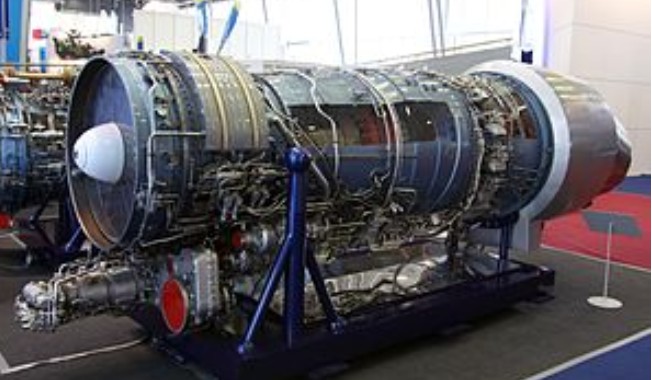
The Saturn AL-31 is a family of military twin spool turbofan turbofan engines. It was developed by Lyulka, later NPO Saturn, of the Soviet Union, originally for the Sukhoi Su-27 air superiority fighter. It produces a total thrust of 123 kN (27,600 lb) with afterburning in the AL-31F, 137 kN (30,800 lb) in the AL-31FM (AL-35F) and 142 kN (32,000 lb) in the AL-37FU variants. It powered all Su-27 derivatives and the Chengdu J-10 multirole jet fighter which was developed in China.
The AL-31FP and AL-37FU variants have thrust vectoring. The former is used in the Su-30MKI export version of the Su-30 for India & Sukhoi Su-30MKM for Malaysia . The AL-37FU can deflect its nozzle to a maximum of ±15° at a rate of 30°/sec. The vectoring nozzle is utilized primarily in the pitch plane. The Al-31FP is built in India by HAL at the Koraput facility under a deep technology transfer agreement.
It has a reputation for having a tremendous tolerance to severely disturbed air flow. In the twin-engined Su-27, the engines are interchangeable between left and right. The Mean Time Between Overhaul (MTBO) for the AL-31F is given at 1000 hours with a full-life span of 3000 hours. Some reports suggested that Russia was offering AL-31F to Iran to re-engine its F-14 Tomcat air fleet in the late 1990s.
According to Saturns Victor Mihailovic Chepkin, chief designer of the 117 and 117S engines, the Chinese WS-10 was developed with the aid of the AL-31s maintenance technical documentation. China can domestically produce most AL-31 parts for its own jet engine programs, but must import turbine blades from Russia.
The 117S (AL-41F1A) is an upgrade of the AL-31F based on the AL-41F intended to power the Su-35BM, producing 142 kN (32,000 lb) of thrust in afterburner and 86.3 kN (19,400 lb) dry. It features a fan 3% larger in diameter (932 millimetres (36.7 in) versus 905 millimetres (35.6 in)), advanced high- and low-pressure turbines, an all-new digital control system, and provisions for thrust-vectoring nozzles similar to the AL-31FP. This engine will have an assigned life of 4,000 hours and an MTBO of 1,000 hours. The first flight of this engine was completed in an Su-35BM on 20 February 2008. On 9 August 2010, Ufa-based company UMPO started supplying 117S engines (AL-41F1S) intended for Su-35S fighters.
The 117 (AL-41F1) is a 5th generation engine custom built for Russia’s fifth-generation stealth fighter jet PAK-FA according to Sukhoi General Director Mikhail Pogosyan. Mikhail Pogosyan has clarified that claims that fifth-generation fighter allegedly has an old engine are wrong. Though most parameters of the new 5th Gen Engine are classified General Director Mikhail Pogosyan provided some information on the new engine, The engine thrust was enlarged by 2.5 tonnes when compared with the AL-31 engine, while the engine weight was cut by 150 kilograms. That allowed the new jet to supercruise i.e. move at a supersonic cruise speed without the use of after burner.
The Saturn Research and Production center made digitally controlled system (FADEC) of Project 117 Engine.The new engine produces 33,000 lbs (147 kN) of thrust in afterburner has a Dry weight of 1420 kilogram and T:W ratio of 10.5:1.
Mikhail Pogosyan further mentioned that this engine (117) meets the client’s (Russian AirForce) requirements. This is not an intermediate product made particularly for test flights. The engine was to be installed in production PAK-FA fighter which will be supplied to the Russian Air Force and prospective foreign clients.
Bench testing of a radically new engine (the second stage) for the Russian fifth generation fighter aircraft PAK FA will start in 2014, said the general designer-director of the Scientific and Technical Center “Saturn”, Eugeny Marchuk “The engine will be ready in two years, and will begin bench testing then”, said Marchuk at the 11th International Conference” Aviation and Space – 2012 “, which opened at the Moscow Aviation Institute. According to him, the new “engine 117” will belong to the “5 +” generation and its characteristics will be superior to the existing foreign counterparts engine for fifth generation aircraft. “This is – a fundamentally new engine, The motor unit weight is 30% less (than the 117C – approx.), Life-cycle costs will by 30% less, and it should be cheaper, “- said Marchuk.
Variants:
Al-31F
The basic engine developed to power the Su-27 fighter
Builder: Salyut, UMPO
Year: 1981
Thrust: 123 kN (27,700 lbf)
Thrust vectoring: No
Aircraft: Su-27, Shenyang J-11, Sukhoi Su-30MKK, Sukhoi Su-30(Salyut)
Al-31FP
Improved variant for the Indian Su-30MKI with thrust vectoring
Builder: Salyut, HAL
Year: 2000
Thrust: 123 kN (27,700 lbf)
Thrust vectoring: Yes
Aircraft: Su-30 MKI, Sukhoi Su-30MKM
Al-31FN
Improved variant for the Chengdu J-10
Builder: Salyut
Year: 2002
Thrust: 125 kN (28,100 lbf)
Thrust vectoring: No
Aircraft: Chengdu J-10
Al-31FM1
Improved version for the Russian Air Force
Builder: Salyut
Year: 2007
Thrust: 132 kN (29,700 lbf)
Thrust vectoring: Yes
Aircraft: Su-27SM, Su-30, Su-34
Al-31FM2
Improved version for the Russian Air Force
Builder: Salyut
Year: 2012
Thrust: 145 kN (32,600 lbf)
Thrust vectoring: Yes
Aircraft: Su-27SM, Su-30, Su-34
Al-41F-1S (117S)
Advanced derivative for the Su-35
Builder: UMPO
Year: 2010
Thrust: 142 kN (31,900 lbf)
Thrust vectoring: Yes
Aircraft: Su-35
Al-37FU
Advanced derivative for the Su-37
Builder: UMPO
Thrust: 145 kN (32,600 lbf)
Thrust vectoring: Yes
Aircraft: Su-37
Al-41F-1 (117)
Advanced derivative for the Sukhoi PAK FA
Builder: UMPO
Year: 2010
Thrust: 147 kN (33,000 lbf)
Thrust vectoring: Yes
Aircraft: PAK FA prototype
Applications:
Sukhoi Su-27
Sukhoi Su-30
Sukhoi Su-34
Sukhoi Su-36
Sukhoi S-37 Berkut
Specifications:
AL-31F
Type: Two-shaft afterburning turbofan
Length: 4,990 millimetres (196 in)
Diameter: 905 millimetres (35.6 in) inlet; 1,280 millimetres (50 in) maximum external
Dry weight: 1,570 kilograms (3,460 lb)
Compressor: 4 fan and 9 compressor stages
Combustors: annular
Turbine: 2 single-staged turbines
Maximum thrust:
74.5 kilonewtons (16,700 lbf) military thrust
122.58 kilonewtons (27,560 lbf) with afterburner
Overall pressure ratio: 23
Bypass ratio: 0.59:1
Turbine inlet temperature: 1685 K (1,412 °C (2,574 °F))
Fuel consumption: 2.0 Kg/daN·h
Specific fuel consumption:
Military thrust: 0.67 lb/(lbf·h)
Full afterburner: 1.92 lb/(lbf·h)
Thrust-to-weight ratio: 4.77:1 (dry), 7.87:1 (afterburning)
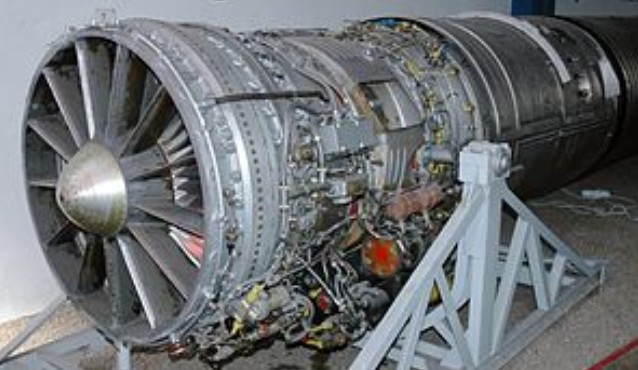
The Lyulka AL-7 was a 9 stage supersonic compressor turbojet designed by Arkhip Mikhailovich Lyulka and produced by his Lyulka design bureau. Produced between 1954 and 1970, the AL-7 had supersonic airflow through the first stage of the compressor. The TR-7 prototype developing 6,500 kgf (14,330 lbf, 63.7 kN) of thrust was tested in 1952, and the engine was initially intended for Ilyushin’s Il-54 bomber.
The afterburning version AL-7F was created in 1953. In April 1956, the Sukhoi S-1 prototype equipped with AL-7F exceeded Mach 2 at 18,000 m (70,900 ft), which lead to production of Su-7 ‘Fitter’ and Su-9 ‘Fishpot’ equipped with this engine. Later, the engine was adopted for Tu-128 ‘Fiddler’ in 1960, and for the AS-3 ‘Kangaroo’ cruise missile. The Beriev Be-10 jet flying boat used a non-afterburning AL-7PB with stainless steel compressor blades.
Applications:
Ilyushin Il-54
Sukhoi Su-7B
Tupolov Tu-98
Specifications:
AL-7F
Type: Afterburning turbojet
Dry weight: 2,010 kg (4,430 lb)
Compressor: 9-stage axial compressor
Maximum thrust:
67.1 kN (15,075 lbf) military power
98.1 kN (22,050 lbf) with afterburner
Overall pressure ratio: 9.5:1
Turbine inlet temperature: 860 deg C (1,580 deg F)
Specific fuel consumption:
95.0 kg/(h·kN) (0.94 lb/(h·lbf)) at idle
98.9 kg/(h·kN) (0.97 lb/(h·lbf)) military power
229.0 kg/(h·kN) with afterburner
Power-to-weight ratio: 3.4
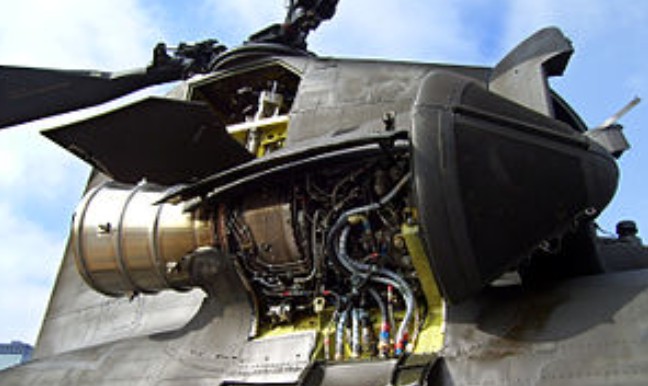
The Lycoming T55, (Company designation Lycoming LTC-4), is a turboshaft engine used on American helicopters and fixed-wing aircraft (in turboprop form), since the 1950s. It was designed at the Lycoming Turbine Engine Division in Stratford, Connecticut as a scaled-up version of the smaller Lycoming T53. Both engines are now produced by Honeywell Aerospace. The T55 also serves as the core of the Lycoming ALF 502 turbofan.
Applications:
Bell 309
Boeing CH-47 Chinook
Boeing Chinook (UK variants)
Boeing Model 360
Curtiss-Wright X-19
North American YAT-28E Trojan
Piper PA-48 Enforcer
H1 Unlimited hydroplane
Specifications:
T55-L-714A
Type: Turboshaft
Length: 1,196.3 mm (47.1 inches)
Diameter: 615.9 mm (24.3 inches)
Dry weight: 377kg (831 lbs)
Compressor: 7-stage axial compressor and 1-stage centrifugal compressor
Turbine: 2-stage gas producer and 2-stage free power
Maximum power output: 4,867 shp (3,631 kW)
Overall pressure ratio: 9.32
Turbine inlet temperature: 815C (power turbine inlet temperature)
Power-to-weight ratio: (4,867 shp / 831 lbs) ~ 5.8568:1 shp/lb

The Lycoming T53, (company designation LTC-1) is a turboshaft engine used on helicopters and fixed-wing aircraft (in turboprop form) since the 1950s. It was designed at the Lycoming Turbine Engine Division in Stratford, Connecticut by a team headed by Anselm Franz, who was the chief designer of the Junkers Jumo 004 during World War II. A much larger engine, similar in overall design, became the Lycoming T55. Both engines are produced by Honeywell Aerospace.
Variants:
Military designations:
T53-L-1B
860 hp (645 kW)
T53-L-11
825 hp (615 kW)
T53-L-13B
1400 shp (1044kW) improved L-11
T53-L-701
1,400 hp (1044 kW) Turboprop variant used on Mohawk and AIDC T-CH-1
T53-L-703
1,800 hp (1343 kW) improved durability variant of the L-13B
Civil designations
T5311A
1100 shp (820kW)
T5313A
1400 shp (1044kW) commercial variant of the L-13
T5313B
1400 shp (1044kW) commercial variant of the L-13
T5317A
1500 shp (1119kW) improved variant of the L-13
LTC1K-4K
1550 shp (1156kW) direct drive variant of the L-13B
Applications:
AIDC T-CH-1 (T53-L-701)
AIDC XC-2
Bell 204B (T5311A)
Bell 205A (T5313B)
Bell 205A-1 (T5313B and T5317A)
Bell AH-1 Cobra (T53-L-703)
Bell UH-1H Iroquois (T53-L-703)
Bell XV-15 (LTC1K-4K)
Boeing Vertol VZ-2 (YT53)
Canadair CL-84
Doak VZ-4
F+W C-3605
Grumman OV-1D Mohawk (T53-L-701)
Kaman HH-43 Huskie
Kaman K-1200 (T5317A)
Kaman K-MAX
Ryan VZ-3 Vertiplane
DB Class 210, diesel railway locomotive
Specifications:
T53-L-701
Type: Turboshaft
Length: 58.4in 1483mm
Diameter: 23in 584mm
Dry weight: 688 lb (312kg)
Compressor: 5-stage axial compressor and 1-stage centrifugal compressor
Maximum power output: 1,400 shp (1,044 kW)
Overall pressure ratio: (7.2 T53-L-32B)
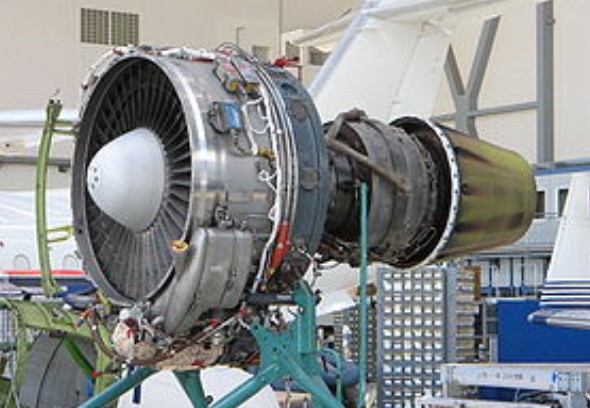
The original YF102 was developed at the Lycoming Turbine Engine Division in Stratford, Connecticut by adding a fan to the Lycoming T55 engine, which was used as the gas generator. The YF102-LD-100 was tested on an AJ Savage in the early 1970s. Six engines were built for the Northrop YA-9 prototype ground-attack aircraft. These engines were later reused in the C-8A Quiet Short-Haul Research Aircraft (QSRA).
The ALF 502 geared turbofan was certified in 1980, and used on the British Aerospace 146 and Bombardier Challenger 600
The improved, higher-thrust LF 507 was used on the Avro RJ update of the BAe 146.
Applications:
YF102
Northrop YA-9
C-8A Quiet Short-Haul Research Aircraft (QSRA)
ALF 502
Bombardier Challenger 600
British Aerospace 146
LF 507
Avro RJ
Specifications:
ALF502-R5
Type: High bypass geared turbofan
Length: 63.6 in (162 cm)
Diameter: Fan: 40.25 in (102 cm)
Dry weight: 1336 lb (606 kg)
Compressor: Single stage fan, single stage axial low pressure compressor, 7 stage axial and single stage centrifugal high pressure compressor
Combustors: Annular
Turbine: Two stage high pressure turbine, two stage low pressure turbine
Maximum thrust: 6,970 lbf (31 kN)
Bypass ratio: 5.7:1
Specific fuel consumption: 0.406 lb/lbf-h (41.4 kg/kN-hr)
Thrust-to-weight ratio: 5.1:1
 All Aero