In 1970, Xian Aircraft Factory proposed an upgraded four-engined version of their H-6 Tu-16 copy. The proposal was approved, while the PLAAF issued an extra requirement of capabilities against sea targets two years into development. To test their plans, Xian re-engined an H-6 with four Rolls-Royce Spey turbofans – two in the wing roots and two under the wings. Designated the H-6I, the prototype took flight in 1978. Performance gains were impressive – climb rate increased by 40%, and range increased by a third. Payload was also increased significantly. While Xian’s proposed H-8 was to use revised Spey engines mounted in underwing pylons to reduce maintenance costs, the program fell victim to downsizing efforts in 1980.
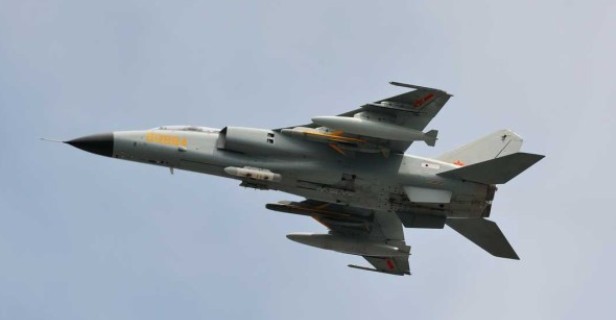
In the early 1970s, China was looking for a fighter-bomber to replace the H-5 (Il-28) and Q-5. Initially, China looked abroad for joint solutions, but when these efforts fell through, a program was started to develop a domestic design. Requirements soon emerged from the PLAAF and PLANAF requesting separate configurations. The PLAAF wanted side-by-side seating, terrain-following radar, and an extensive ECM suite, while the PLANAF requested tandem seating, all-weather performance, and reconnaissance capabilities. The PLAAF variant would be dropped fairly early on and by the end of 1988, Xian had developed a two-seat design with a shoulder mounted wing, powered by two Rolls-Royce Spey engines. While it was equipped with a powerful radar capable of tracking both aircraft and ships, the original design lacked any significant air-to-air capabilities. The aircraft was not without its teething issues. Flight testing was filled with major (often near catastrophic) malfunctions. The first flight ended early when violent vibrations shook off the majority of the cockpit instrumentation, and later tests ended when massive fuel leaks almost caused the aircraft to run out of fuel in flight. When the aircraft began operational evaluations, one aircraft lost its entire rudder in flight, making a successful emergency landing. Despite all of the issues, the PLAAF soon requested its own variant of the JH-7. Designated the JH-7A, the new aircraft was to have a stronger airframe and higher payload than the JH-7 and the capability to deploy various precision-guided weapons.
JH-7
After extensive testing and redesigns, JH-7s began to enter service with the PLANAF and PLAAF in 2004. Over 200 have entered service, providing the Chinese with a fairly capable replacement to their MiG-19-derived Q-5s. JH-7As continue to be upgraded with systems such as a newly developed helmet-mounted sight. Meanwhile, the Chinese are working on a more extensive upgrade to the design, designated the JH-7B. The JH-7B is to feature upgraded avionics, a reduced frontal RCS, aerial refueling capabilities, and upgraded engines producing 15% more thrust. Plans called for the JH-7B to enter production in 2015.
Xian JH-7A
China revealed a 20-year-old fighter/bomber at the Air Show China ‘98, held at Zhuhai. The aircraft, the FBC-1 Flying Leopard, is an export version of the JH-7 twin-seat strike fighter and actually flew in 1989, though its development programme dates back to the 1970s. This was the first time the aircraft has been flown in public. The aircraft was developed by the Xian Aircraft Design and Research Institute (ADRT) and is capable of Mach 1.7, and has a range of 890 nm.
The Xian factory reverse-engineered the MiG-21 and the resulting J-7 made its first flight in December 1964. Two years later, manufacture halted because of unexplained technical problems after only 70 had been built.
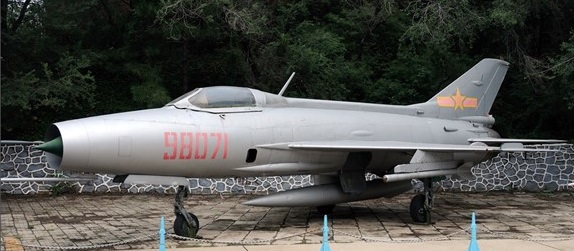
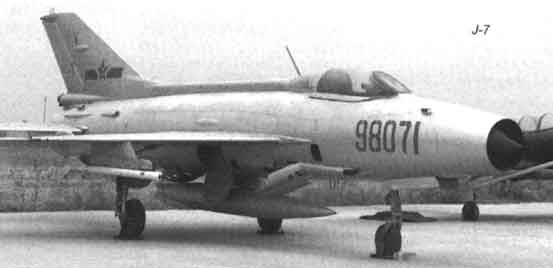
The early model J7I can be seen as the first variant of the type of full production standard. One difference with the MiG-21F-13 is the drag chute housing at the base of the tail.
J7I 98071
Meanwhile, in the common cause of communism, China was allowing Soviet supplies to pass through its territory bound for Vietnam, where the USA was embroiled in conflict. One day, several railway wagons containing dismantled MiG-21s went astray, and subsequently the J-7 re-entered production in modified form at Chengdu. The new J-7 II, a considerably upgraded Chinese development, entered production in the early 1980s, and by 1982 was being exported as the F-7B. China (Giuzhou) also produces the JJ-7 two-seat operational trainer, designated FT-7 for export (first flown in 1981). The JJ-7 dual seat version was originally built by Guizhou Aviation Industry Group (GAIG).
Despite Chinese denials, a number of F-7s have been confirmed in Iranian service, while Iraq has also received the type via assembly (by Chinese technicians) in Egypt.
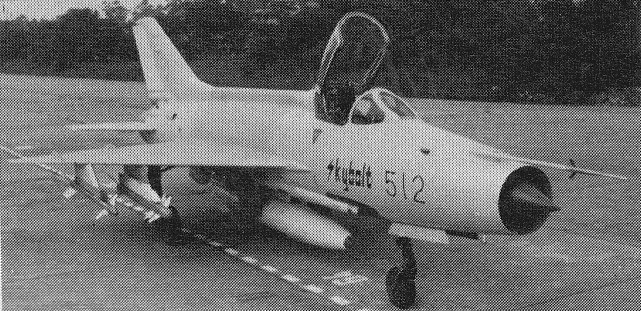
Details of the latest export version of the Chinese-built MiG-21 were released in 1984. Known as the F-7M Airguard and (as offered to Pakistan) F-7P Skybolt, this variant of the earlier F-7B is extensively modernised with Western avionics including ranging radar, a weapons aiming computer, a headup display, multimode radios, and IFF. Two additional wing hardpoints are fitted, and two fuselage cannon are carried, rather than the one carried by earlier models. Other changes include a revised canopy, an updated ejection seat, and a relocated brake-parachute housing.
With development of a successor to the J-7 (MiG-21) that formed the backbone of the PLAAF taking far longer than hoped, Chengdu began efforts to modernize the design. Work began in 1987, resulting in a major design overhaul. The wings were redesigned to have a double-delta planform, and the engine was replaced with a WP-13F engine. The primitive radar of the J-7 was replaced with the British Super Skyranger radar, and fuel capacity was increased. The modifications improved turn performance, and the takeoff roll was reduced from 1km to 600m. Upgrades to the cockpit included HOTAS controls, as well as the later addition of a helmet-mounted sight. Development proceeded quickly, with the first J-7E, as the new model was known, flying in 1990.
By the time the J-7E came about, most J-7 operators had since moved on to more capable designs. However, Pakistan, the largest non-Chinese J-7 operator, ordered significant numbers of the type. A special variant was developed to meet Pakistani requirements, integrating new western radars and the capability to mount AIM-9 AAMs.
Ever eager to develop anti-shipping platforms, the PLANAF also ordered a special J-7 variant with the ability to deploy AShMs (J-7EH). The J-7EH features the ability to carry antiship missiles, but, due to limitations with the radar, must receive targeting data from other aircraft.
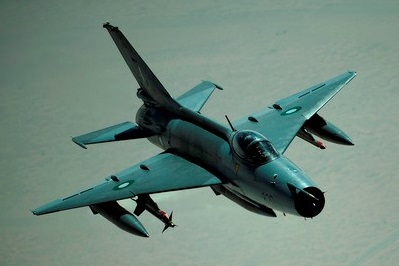
The derivative of the F-7M supplied to Pakistan as the F-7P Skybolt featured 20 PAF specified changes, including for four, rather than two, PL-5B or AKM-9 Sidewinders on pylons outboard of the main undercarriage attachment points. The Skybolt retains the two wing root-mounted Type 30-1 cannon ND MOST OF TE Western systems of the basic F-7M, although some equipment (eg. IFF) is installed in Pakistan.
F-7P Skybolt
The initial Pakistan Air Force order for 20 F-7P was fulfilled in August 1988 when the aircraft were ferried from Chengdu, but the Chengdu Aircraft Corporation was by then responsible for F-7 production.
After the final deliveries to Bangladesh, Chengdu shut down J-7 production in May 2013, marking the end of a 2,400 aircraft production run.
F-7M Airguard Engine: 1 x Wopen-7B (BM) Installed thrust (dry / reheat): 43 / 60 kN Span: 7.2 m Length: 13.9 m Wing area: 23 sq.m Empty wt: 5275 kg MTOW: 7531 kg Warload: 1800 kg Max speed: 2.05 Mach Initial ROC: 9000 m / min Ceiling: 18,700 m TO run: 700-950 m Ldg run: 600-900 m Combat radius lo-lo-lo: 370 km Air refuel: No Armament: 2 x 30 mm, 2 x AAM Hard points: 5
A 1961 split ending Soviet assistance, left the Chinese with the task of getting the Tu-16 into production as the Hongzhaji-6 (bomber aircraft no. 6). The Chinese spent two years in reverse-engineering the Tu-16 and its Mikulin AM-3 turbojets, and started production in 1962 for first deliveries in 1968. Since that time the Air Force of the People’s Liberation Army has received more than 100 H-6s for the strategic free-fall bomber and anti-ship roles, the latter with two missiles carried under the wings. Principal version – H-6 (sole production model in several variants up to at least the H-6D, or H-6 IV, which is believed to be the anti-ship type). Low-rate production of the Tu-16 Badger continues at Xian in 1987, and the H-6 is still the mainstay of China’s strategic nuclear bomber force. Local developments of the design include an anti-shipping version carrying C601 missiles and equipped with an under-nose search radar. A four-engined variant of the H-6 has also been reported. Customer: China 120+
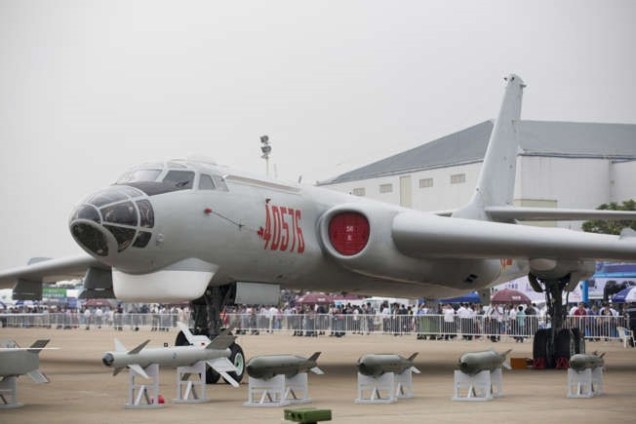
After decades of service, Xian finally performed a major overhaul of their H-6 (Tu-16) around the turn of the century. While previous modifications merely upgraded avionics of the design, the new variant developed, the H-6K, redesigned the airframe to extensively use composites, and replaced the old Chinese engines with Russian-made Saturn D-30KP turbofans. As Chinese bomber doctrine has long since shifted to the use of bombers as cruise-missile carriers, the bomb bay was replaced with larger fuel tanks, and the obsolete tailgun armament was replaced with an extensive ECM suite. Similarly, the glazed navigator position was replaced with a more powerful targeting radar. The H-6K first flew in January 2007, and after two years of testing, the bomber entered service with a combat radius nearly double that of the original H-6.
China International Aviation & Aerospace Exhibition in Zhuhai, China, 2014
About 150 of its bombers have been built, and about 120 were still operational in 2025. The H-6 has been upgraded to carry modern weapons, including hypersonic and nuclear-capable missiles.
China sold H-6s to both Egypt and Iraq, but those countries no longer have their bombers operational. According to the Center for Strategic and International Studies, Iraq’s four H-6s were destroyed while in service.
The H-6 has four crew and is powered by two Soloviev D-30KP-2 turbofan engines, each with 27,000 pounds of thrust. Its top speed is 670 mph, and its cruising speed is 477 mph. Its combat range is 2,200 miles. It can also carry 26,500 pounds of bombs, both guided and unguided (dumb bombs), but no longer carries free-fall nuclear bombs, as the H-6 could not be relied upon to penetrate an enemy’s air space.
Xian H-6 Type: six-seat strategic medium bomber and anti-ship missile carrier Engines: 2 x 20,944-lb (9,500-kg) thrust Xian WP-8 turbojets Maximum speed 616 mph (991 km/h) at 19,685 ft (6,000 m) Initial climb rate 4,100 ft (1,250 m) per minute Service ceiling 40,355 ft (12,300 m) Range 2,983 miles (4,800 km) with an 8,157-lb (3,700-kg) warload Empty weight about 82,010 lb (37,200 kg) Maximum take-off weight 158,733+ lb (72,000+ kg) Wing span 108 ft 1.2 in (32.95 m) Length 114 ft 2.1 in (34.80 m) Height 35 ft 5.2 in (10.80 m) Wing area 1,772.87 sq ft (164.70 sq.m) Armament: four 23-mm cannon in twin-gun dorsal and tail turrets, and up to 19,842 lb (9,000 kg) of bombs
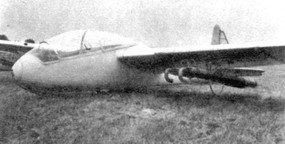
Stanislav Wojcicki designed in 1956 a pulse-jet giving about 10 kg of thrust. Four of these pulso were installed on a flying test bed, a two-seater glider Bocian. They were installed in pairs under the wings. In 1955, S.Wojcicki had also developed more powerful versions of 20, 40 and 70 Kgp.
The Bocian included an accelerometer for measuring horizontal accelerations.
The pulse was tested in two stages: first a 10 kg pulse, that start could only be performed in flight, then a group of four 8 kg pulse, allowing the autonomous takeoff of the Bocian.
These pulses had a consumption of 2 kg / kgf / h, a weight of 6 kg and a length of 2.80 m.
In the mid-1960s, engine manufacturer Williams Research developed a light turbofan engine, the “WR19”, with a thrust of 1.91 kN (195 kgp / 430 lbf), which was used in a “flying belt” that could be strapped on somebody’s back to allow flights of up to 20 minutes. It was a sexy toy but of no particular usefulness, and it was canceled in 1969.
Williams continued to tinker with the idea, coming up with a one-man flying platform powered by the WR19 or a derivative engine, known as the “WASP”, which was later renamed the “X-Jet”. This machine looked something like a flying trashcan on skids, and could carry a pilot directing the machine with two grip-type controls. It was evaluated in the 1980s; videos of its flight suggest it performed very nicely and was easy to handle. Noises were made about a more capable successor, but apparently its endurance was too limited and, as was the case with most of the other one-person flying machines, it was hard to understand that it offered any utility proportional to its expense and complexity.
One X-Jet is now on display at the USAF Museum in Ohio, while another is on display at the Seattle Museum of Flight. The WR19 and its descendants did prove to be useful powerplants for long-range cruise missiles.
In 1996, Williams teamed with NASA to develop a small and light turbofan engine, the FJX-2, for general aviation. The General Aviation Propulsion (GAP) program was part of NASA’s 1992 Advanced General Aviation Transport Experiments (AGATE) program; a joint NASA/industry venture to revitalize general aviation.
The FJX-2 is a high-bypass-ratio turbofan engine that produces 700 pounds of thrust, yet weighs only 85-100 lb, about one-fourth the weight of piston engine propulsion systems with similar capabilities. To keep costs low, the FJX-2 team applied many lessons learned from research of automotive gas turbine engines. Emphasis was placed on simplifying design and reducing the number of parts. Low-cost design techniques and advanced automated manufacturing methods have led to the first turbine engine that is cost competitive with piston engines.
The Williams F112 is a small turbofan engine made by Williams International designed to power cruise missiles. It has been used as the powerplant for the AGM-129 Advanced Cruise Missile and the AGM-86B advanced cruise missile, as well as the experimental X-36 and X-50.
Although Williams originally designed these small turbofans to power target drones while aiming for a contract in the Subsonic Cruise Armed Decoy (SCAD) program, it quickly became apparent that these were valuable tools to be used in the future to power advanced cruise missiles. Originally designated the F107-WR-14A6, then designated the F107-WR-103 by Williams then designated the F112-WR-100 by the USAF.
Though the true benefits that the F112 brought to the AGM-129 are classified, it has been said that the F112 increased the range of the AGM-129 to four times that of the AGM-86B. Another benefit is that the infrared heat signature has also been reduced or nearly eliminated, aiding the stealthiness of the AGM-129. This was accomplished with the use of high tech materials and coatings.
Applications: AGM-129 ACM Boeing X-50 McDonnell Douglas X-36
Specifications: Type: Twin-spool counter rotating turbofan Length: 29.5 in. Diameter: 12 in. (at widest point) Dry weight: 161 lb (99 lbs without accessories) Compressor: centrifugal Combustors: annular Turbine: axial Fuel type: heavy fuel Boron-Slurry (aka JP-10) Oil system: self contained 1.3 pints (0.61 liters) Maximum thrust: 1000 lb Overall pressure ratio: 30:1 Bypass ratio: 1:1 Turbine inlet temperature: TIT 2000 degs F (1093 degs C) with turbine blade cooling; 1750 degs F (954 degs C) without turbine blade cooling Specific fuel consumption: apprx 0.25lbs/lb/hr (but some calculations bring this number to 0.15 lbs/lb/hr) Thrust-to-weight ratio: 10 to 1
The Williams FJ33 is a family of turbofan jet engines intended for use in very light jet aircraft. The FJ33 is a scaled-down version of the FJ44 engine.
Engine configuration is believed to be a single stage fan, with booster stage/s, driven by a 2 stage LP turbine, supercharging a centrifugal HP compressor, driven by a single stage HP turbine. An annular combustor is featured.
The FJ33 has a dry weight of less than 300 lb (140 kg), overall diameter of 21.05 in (535 mm), 47.9 in (1,220 mm) overall length, and produces between 1,000 lbf (4,400 N) and 1,800 lbf (8,000 N) static thrust. Specific fuel consumption at 1,200 lbf (5,300 N) thrust (SLS, ISA) is understood to be 0.486 lb/(lbf·h) (13.8 g/(kN·s)).
The Williams F121 (company designation WR36-1) is a small turbofan engine designed for use in the AGM-136 Tacit Rainbow anti-radiation cruise missile.
The F121 engine had a rare set of design parameters as it is designed to be used only once. As a cruise missile engine, it was designed to have a long shelf life (be able to sit around unused for long periods of time) and then operate when needed for several hours. It was designed to power the AGM-136 Tacit Rainbow, which was to be a stand-off anti radiation missile. Its first flight was on July 30, 1984. The AGM-136 program was canceled several years later.
Another unique feature of the engine is that it was started with an explosive cartridge because it couldn’t start while still mated to its aircraft.
In the late 2000s, the engine was being used by the Naval Air Warfare Center at Naval Air Weapons Station China Lake to test fuel performance and additives.
Specifications: Type: Single Spool Turbofan Length: 40 in (1.01 m) Diameter: 8.5 in (0.22 m) Dry weight: 49 lb (22.22 kg) Compressor: 1 stage axial fan, 6-stage axial compressor Combustors: Turboméca Piméné-type Turbine: 2-stage axial Maximum thrust: 70 lbf (0.31 kN) Bypass ratio: 1.7:1 Thrust-to-weight ratio: 1.43:1










 All Aero