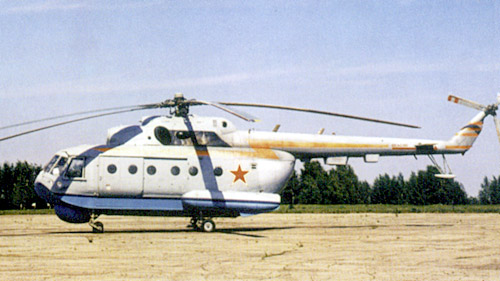
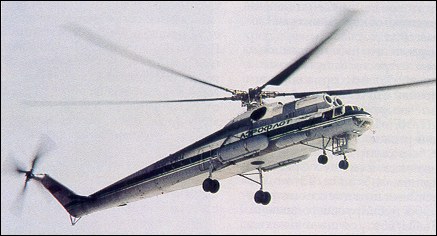
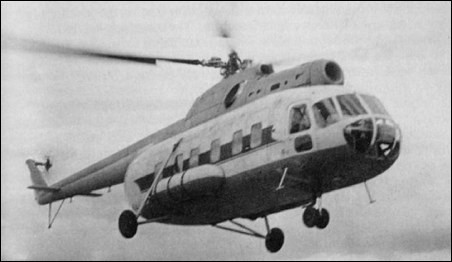
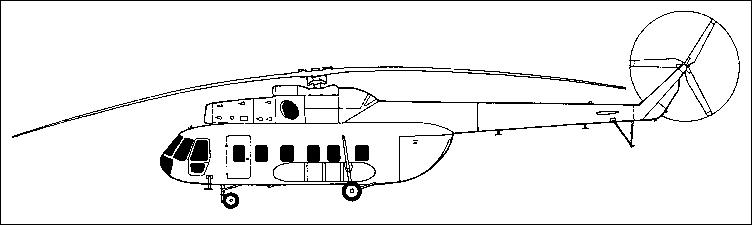
The Mi-14, allocated the NATO reporting name ‘Haze’, is an amphibious version of the Mi-8 intended to replace the Mi-4 in the ASW and mine counter-measure roles with the Soviet navy.
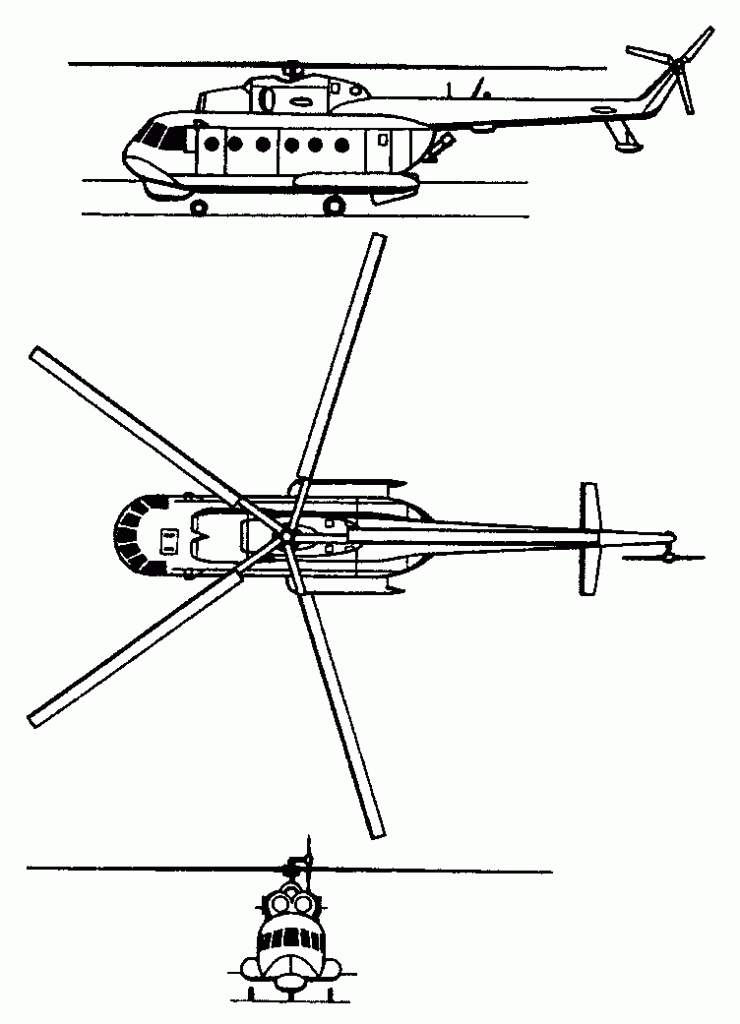
The prototype SSSR-11051, initially designated V-8G, then designated V-14, was first flown in September 1969 with a redesign watertight hull and sponsons containing fuel and a retractable undercarriage and with Mi-8 power plant. The sponson carry inflatable flotation bag each side at rear and small float the under tailboom. It has marine-type rudders on either side of the aft portion, into which the rear landing gear units retract. Two forward-retracting single-wheel nose units and two rearward-retracting twin-wheel main units. A fairing for the search radar is fitted under the nose, and a dipping sonar or magnetic anomaly detector beneath the root of the tail boom.
Production aircraft feature two 1,434kW Klimov TV3-117MT turboshafts, with a special anti-corrosion finish. Radar is the I-2M or I-2ME Initziativa undernose radar. Instrumentation includes RW3 radio altimeter, ARK-9 and ARK-U2 ADFs, DISS-15 Doppler, Chrom Nikiel IFF, AP34-B autopilot/autohover system and SAU-14 autocontrol system.
Using the twin powerplants and rotor system of the Mi-17, the ‘Haze’ went into service in 1977 and has become the basic shore-based helicopter with the Soviet navy for use in three distinct roles. Although amphibious, the Mi-14 is only intended for occasional operations from water. Initial deployment was with shore based antisubmarine units, although Haze was also expected to be oper¬ated from the Moskva Class helicopter car¬riers and the Kiev Class antisubmarine cruisers.
In the main cabin, which in transport versions can be equipped with 32 seats, a mission crew of three or four sit round a tactical display served by the radar, a towed MAD (magnetic anomaly detection) ‘bird’ and dipping sonar. Some ex¬amples have additional radio aerials and a few have a rescue hoist above the large sliding door on the left side. Fuel is housed in large tanks along the sides under the main floor, and poss-ibly also in the rear sponsons, leaving the central compartment free for use as a weapon bay, with belly doors.
Two versions have been identified: Haze A, the ASW variant with undernose search radar, towed MAD, and an internal weapons bay; and the Haze B mine countermeasures variant.
It was estimated in mid 1983 that there were 65 for the AV MF and 12 for Bulgaria. By 1991, about 230 had been delivered, with exports to Bulgaria, Cuba, East Germany, North Korea, Libya, Poland, Romania, Syria and Yugoslavia.
Mi-14BT (buksir-tralschik) (‘Haze-B’) Mine countermeasures version; fuselage strake, for hydraulic tubing, and air conditioning pod on starboard side of cabin; no MAD; container for searchlight, to observe MCM gear during deployment and retrieval, under tailboom forward of Doppler box.
Mi-14GP (gruzo-passazhirskyi) Conversion by Konvers Avia of military variants for civil use as cargo/passenger combi aircraft; 24 seats or 5,000kg payload. Two 1,434kW TV3-117M turboshafts.
Mi-14P (passazhirskyi) Conversion of military variants for civil use as passenger aircraft by Konvers Avia; 24 seats or 5,000kg payload. Two 1,434kW TV3-117M turboshafts.
Mi-14PL (protivo-lodoctinyi) (‘Haze-A’) Basic ASW version; four crew; large undernose radome; OKA-2 retractable sonar in starboard rear of planing bottom, forward of two probable sonobuoy or signal flare chutes; APM-60 towed Magnetic Anomaly Detection (MAD) bird stowed against rear of fuselage pod (moved to lower position on some aircraft); weapons include one AT-1 ASW or APR-2 torpedo, one 1kT ‘Skat’ nuclear depth bomb or eight PLAB-250, PLAB-50-64 or PLAB-MK depth charges or OMAB-25-120 or OMAB-MK in enclosed bay in bottom of hull; VAS-5M-3 liferaft (in all versions).
Mi-14PL ‘Strike’ Subvariant with provision for Kh-23 (AS-7 Kerry) air-to-surface missiles. Tested from 1983.
Mi-14PW Polish designation of Mi-14PL ‘Haze-A’
Mi-14PLM (protivo-lodochnyi mod) (‘Haze-A’) As Mi-14PL, but with updated equipment including rescue basket.
Mi-14PS (poiskovo-spasatelnyi) (‘Haze-C’) Search and rescue version, carrying 10 20-person liferafts; room for 10 survivors in cabin, including two on stretchers; provision for towing many more survivors in liferafts; fuselage strake and air conditioning pod as Mi-14BT; double-width sliding door at front of cabin on port side, with retractable rescue hoist able to lift up to three persons in basket; searchlight each side of nose and under tailboom; three crew.
Mi-14PX Single Polish Mi-14PL converted for SAR training. With all portable ASW equipment removed, extra liferafts and sponson-mounted searchlights.
Mi-14PZh Eliminator III Firefighting conversion.
Specifications:
Mi 14 ‘Haze’ Powerplant: two 2,200 shp (1641 kW) Isotov TV3 117A turboshafts Empty weight approx 800,0 kg (17,650 lb) Loaded weight approx 12000 kg (26,455 lb) Length overall about 25.30 m (83 ft 0 in) Height on ground 5. 65 m (18 ft 6½ in) Main rotor disc area 355.0 sq.m (3,828.0 sq ft).
Mi-14 Engine: 2 x Klimov TW3-117MT turboshaft Instant pwr: 1434 kW Rotor dia: 21.6 m Height: 6.93m Empty weight: 11750kg MTOW: 14,000 kg Fuselage length: 59 ft 8 in (18.2m) Max speed: 135 kts / 230km/h Cruising speed: 215km/h Service ceiling: 3500m Max range: 1135 km Service ceiling: 11,500 ft Crew: 4
Mil Mi 14 PL Engines: 2 x TW3-117M, 1923 shp Length: 60.302 ft / 18.38 m Height: 12.828 ft / 3.91 m Rotor diameter: 71.982 ft / 21.94 m Max take off weight: 30870.0 lb / 14000.0 kg Max. speed: 124 kts / 230 km/h Service ceiling: 13123 ft / 4000 m Range: 613 nm / 1135 km Crew: 4
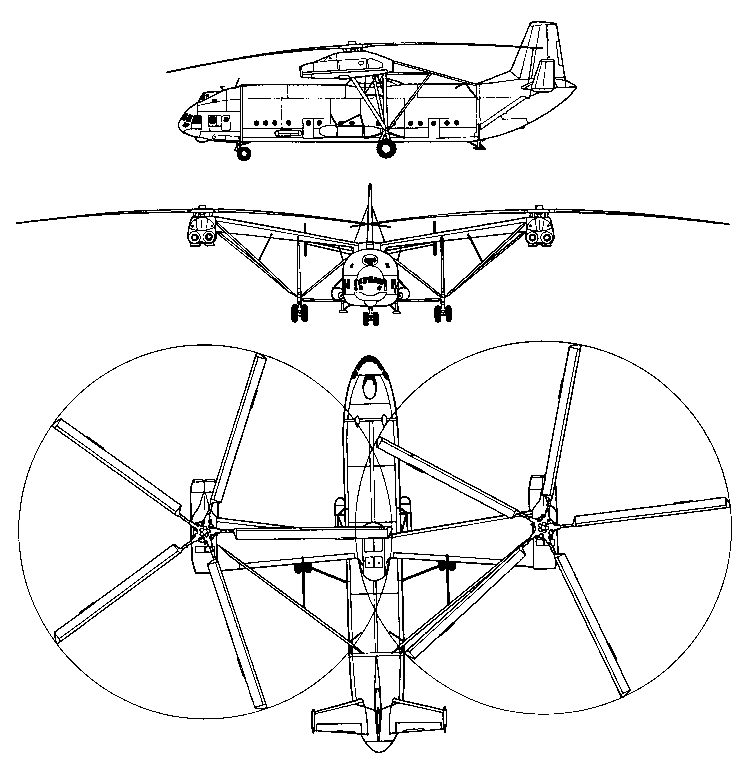
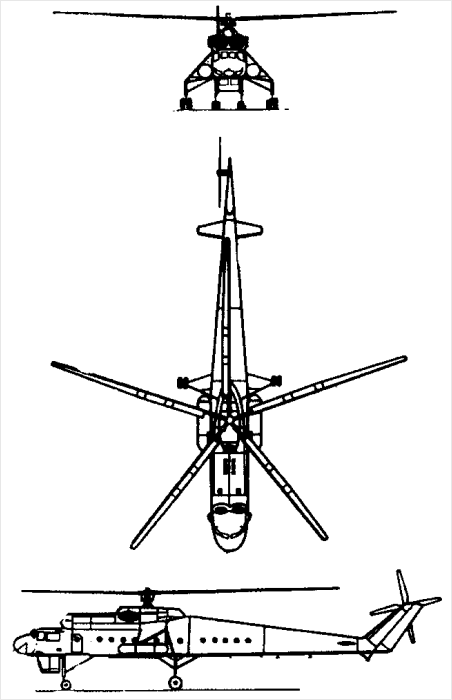
The origins of the V-12 / Mi-12 (NATO reporting name Homer) lie with a 1965 Soviet air force requirement for a heavy-lift helicopter able to carry major missile components. These would be brought into remote missile site areas by fixed-wing aircraft, notably the Antonov An-22, and then lifted from the airfield to the launch site by the new helicopter.
There also existed a civil requirement for such a machine, principally for use in developing Siberia which is resources-rich but communications-poor. The military specification, calling for a tandem-rotor configuration using dynamic system components from existing helicopters, and the V-12 has the same basic hold dimensions as the An-22: 4.4m by 4.4m, with length only 4.85m less than that of the An-22 at 28.15m.
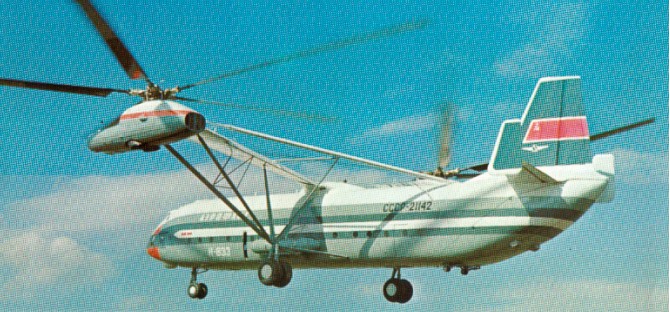
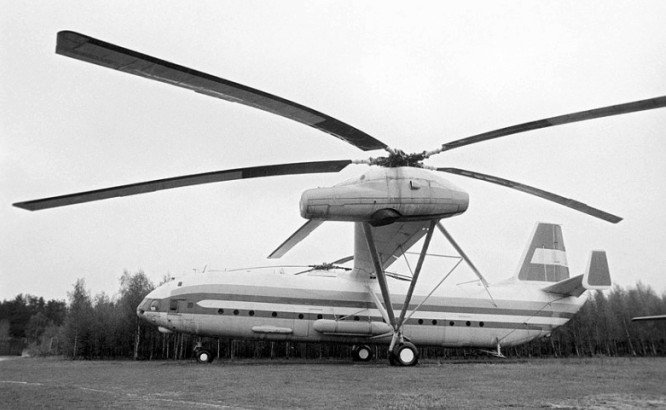
Although the requirement called for a tandem-rotor layout, Mil received early permission to concentrate instead on a twin side-by-side rotor configuration, which the design bureau claimed as having better reliability, fatigue life and stability. Thus the V-12, which first flew in the second half of 1968, appeared with a fuselage resembling that of a fixed-wing aircraft, from whose top spring two inversely tapered wings carrying the twin dynamic systems at their tips.
To avoid the task of developing new set of rotors, reduction gears and transmission, decision taken to double up Mi-6 dynamics and use two sets of Mi-6 engines, gearboxes and lifting rotors side-by-side, left rotor being mirror image, with small overlap.
The two engines are located side-by-side with twin intakes, and drive five-bladed metal rotors. The left rotor rotates anti-clockwise and the right unit clockwise; the two units are connected by transverse shafting to ensure synchronization and the continued rotation of both units in the event of engine failure at either wingtip. The lower part of each cowling can be dropped to form a working platform for mechanics.
The engines were 6500shp Soloviev D-25VF turbines giving the helicopter a maximum speed of 260km/h, with a 35400kg load and 500km range. The two 6500shp Soloviev D- 25VF turboshafts are uprated from the 5500shp of the Mi-6’s Soloviev D-25V by the addition of a zero stage to the compressor and by an increase of operating temperature. Rotor rpm reduced to 112; gearboxes linked by transverse shafting. Axes inclined forward 4deg 30min. Engine/rotor groups carried on wings of light-alloy stressed-skin construction with 8deg dihedral, sharp inverse taper and set at incidence 7deg root 14deg tip. Braced at root and tip to main landing gears with torque reacted by horizontal bracing to rear fuselage. Inner/outer trailing-edge flaps fixed in up position after flight trials. Fuel in outer wings and two external tanks; optional ferry tanks in cabin. Fixed twin-wheel landing gear with main tyres 1750 x 730mm, pneumatic brakes, and steerable nose tyres 1200 x 450mm. Large stressed-skin fuselage with crew door each side, three sliding side doors and full-section rear clamshell doors and ramp with left/right twin-wheel ventral bumpers. Aeroplane tail with fin, tabbed rudder, dihedralled tailplane with tabbed elevators, and endplate fins mounted vertically but toed inwards. Flight deck for pilot (left) with engineer behind and co-pilot (right) with elec-syst operator behind. Upper flight deck for nav with radio operator behind. Hydraulic flight control with emergency manual reversion. Autopilot with three-axis autostab; mapping radar under nose. AI-8 turbine APU for ground power and engine start. Main cabin 28.15m long, 4.4m square. Overhead gantry crane with four 1t hoists. Tip-up seats along sides (50 to 120).
Two V12 prototypes were built. Both prototypes had the same registration! This registration CCCP-21142 is in Cyrillic and means SSSR-75499. The first prototype was damaged in a heavy landing, but was repaired.
First hover 1967 terminated by impact with ground causing severe damage; cause coincidence of primary airframe aeroelastic freq with natural freq of control system, causing uncontrollable vertical oscillations.
The four Soloviev D-25 VF turboshaft engines had a combined output of 19388kW, enabling the V-12, first flown on 10 July 1968, to establish a series of records in February 1969. When submitted for ratification, was the first intimation received in the West of the existence of this giant helicopter. Later in the year, on 6 August 1969, the V-12 lifted a payload of 40204.5kg to a height of 2255m, establishing a record.
The first prototype was destroyed in a non-fatal landing accident during 1969, caused by engine failure.
The second prototype (21142, now at Monino), which was presented in the West at the 1971 Paris Air Show, and had set seven load-carrying records in 1969. On 22 February, a 31030kg load was lifted to 2951m and on August 6 1969, a load of 40,204.5kg was lifted to 2255m flown by Vasily Kolochenko. This was a new payload record for 2000m, and payload-to-height records for 35,000kg and 40,000kg.
No further development or production ensued.
The rebuilt first prototype Mil V-12 is located today next to the Mil Helicopter factory in Lyubertsi-Panki. The second prototype Mil V-12 CCCP-21142 is at the Central Museum of the Air Forces at Monino, located approximately 38 km from Moscow, Russia.
Mil V-12
Mil Mi-12 (V-12) Rotor dia: 114 ft 10 in (35 m) Overall rotors span: 67m Length: 121 ft 4.5 in (37 m) Height: 41 ft 0 in (12.5 m) Fuselage width: 4.4 m Engines: 4 x Soloviev D-25VF turboshaft, 6500 shp / 4780kW Empty weight: 60000kg Max TO wt: 231,500 lb (105,000 kg) Max level speed: 161 mph (260 kph). Cruising speed: 240km/h Service ceiling: 3500m Range: 800km Crew: 6-10
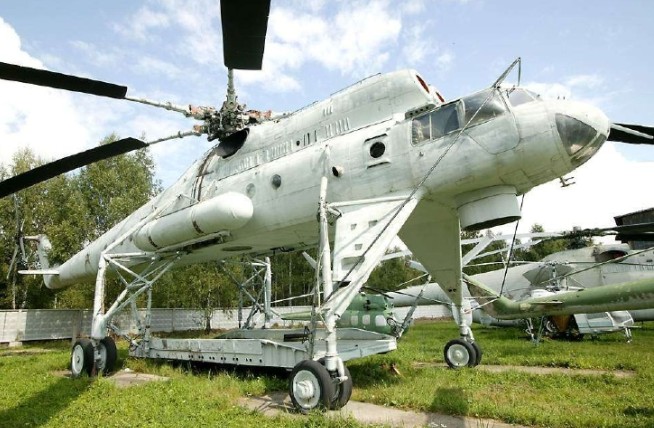
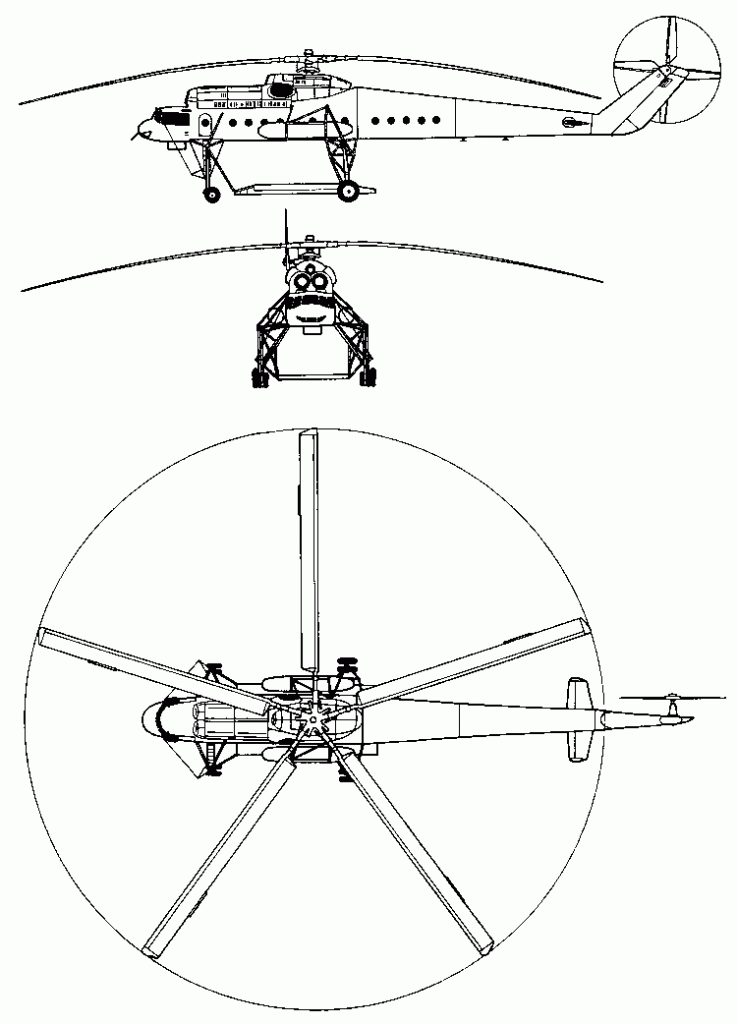
The V-10 prototype was a development of the Mi-6 heavylift helicopter, but optimised for the flying-crane role. Retaining basically the same rotor, transmission and powerplant, the V-10 had a slender fuselage and appears (falsely) to be much greater in length. The Mi-10 is 31.8cm shorter than the Mi-6. Wide-track stalky quadricycle landing gear is provided, so that the helicopter can taxi over a bulky load that is to be carried externally, and because it is intended to be used more extensively in the heavylift role than the Mi-6, it dispenses with the stub wings of this earlier helicopter. First flown during 1960, the V-10 entered production as the Mil Mi-10, then gaining the NATO reporting name ‘Harke’, and was first demonstrated publicly at Tushino in July 1961, Development aircraft had trapeze wires from above flight deck to front wheels for emergency crew escape in low hover. To counter side-thrust at tail and torque effects right legs 300mm shorter than left, crew cabin being canted to keep it laterally level on ground. The fuselage cabin is 14.04m long, 2.5m wide and 1.68m high for cargo and with 28 tip-up wall seats.
(Korotkonogii, short-legged) presaged by special Mi-10 flown 1965 with single centerline nose gear and single spatted main gears of min length and weight, used to lift 25,105kg to 2840m. This was restored to Mi-10R standard, but in 1966 OKB flew Mi-10K with four short landing gears reducing door sill height from almost 4 to 1.8m. New crew compartment with single pilot at original level and second in central all-glazed gondola facing aft with full controls for helicopter and load. Larger internal fuel cells, giving total with two external tanks of 9000 litres. Tail bumper and much narrower tail fin. Cleared for production October 1966, about 20 built. The Mi-10K differs from the Mi-10 by having an uprated 6500shp Soloviev D-25VF turboshafts in fully developed models. This allows a payload of 14,000kg in the slung mode, compared with the Mi-10’s 8000kg. The main cabin can be used for freight and/or passengers, the latter totalling 28 on tip-up seats.
First displayed publicly in Moscow on 26 March 1966, the USSR revealed for the first time the Mi-10K. At least one Mi-10K has been seen with a conventional tricycle undercarriage; this may have been the machine which in May 1965 established a new load-to-altitude record by lifting a weight of 25105kg to a height of 2840m.
Items which are interchangeable between the Mi-6 and Mi-10 include the power plant, transmission system and reduction gearboxes, swashplate assembly, main and tail rotors, control system and most items of equipment. The power of the Soloviev turboshaft engines remains constant up to 3,000m and to an ambient temperature of 40 deg C at sea level. The aircraft will maintain level flight on one engine. Full navigation equipment and an autopilot permit all-weather operation, by day and night.
The tall long-stroke quadricycle landing gear, with wheel track exceeding 6.0m and clearance under the fuselage of 3.75m with the aircraft fully loaded, enables the Mi-10 to taxi over a load it is to carry and to accommodate loads as bulky as a prefabricated building.
Use can be made of interchangeable wheeled cargo platforms which are held in place by hydraulic grips controllable from either the cockpit or a remote panel. Using these grips without a platform, cargoes up to 20m long, 10m wide and 3.1m high can be lifted and secured in 1.5 to 2 minutes. The cabin can accommodate additional freight or passengers.
The standard Mi-10 rotor system is the same as for the Mi-6, except that main rotor shaft is inclined forward at an angle of only 0 deg 45′. The landing gear is a non-retractable quadricycle type, with twin wheels on each unit. All units fitted with oleo-pneumatic shock-absorbers. Telescopic main legs. Main wheels size 1,230 x 260mm each with brake. Levered-suspension castoring nose units. Nosewheels size 950 x 250mm. All landing gear struts are faired. The port nose gear fairing incorporates steps to the crew door. Despite the height of the gear, the Mi-10 can make stable landing and take-off runs at speeds up to 100km/h.
Two 4,101kW Soloviev D-25V turboshaft engines, are mounted side by side above cabin, forward of main rotor drive-shaft. Single fuel tank in fuselage (731 litres) and two external tanks (3500 litres each) on sides of cabin 2400 litres (1920kg), with total capacity of 6,184kg. Provision for carrying two auxiliary tanks in cabin, to give total fuel capacity of 8,260kg. Provision for pressure-fuelling from ground whilst hovering. Engine cowling side panels (opened and closed hydraulically) can be used as maintenance platforms when open.
The maximum payload is 11000kg, but this can be increased to 14000kg by installing Soloviev D-25VF engines, each of which yield 6500shp.
Two pilots and flight engineer accommodated on flight deck, which has bulged side windows to provide an improved downward view. Flight deck is heated and ventilated and has provision for oxygen equipment. Crew door is immediately aft of flight deck on port side. Main cabin can be used for freight and/or passengers, 28 tip-up seats being installed along the side walls. Freight is loaded into this cabin through a door on the starboard side, aft of the rear landing gear struts, with the aid of a boom and 200kg capacity electric winch. In addition to the cargo platform described earlier, the Mi-10 has external sling gear as standard equipment. This can be used in conjunction with a winch controlled from a portable control panel inside the cabin. The winch can also be used to raise loads of up to 500kg while the aircraft is hovering on rescue and other duties, via a hatch in the cabin floor. AI-8 turbine APU permanently installed for electric/hydraulic power without main engines. Equipped with anticing as the Mi-6A.
Mi-10K
A closed-circuit TV system, with cameras scanning forward from under the rear fuselage and downward through the sling hatch, is used to observe the payload and main landing gear, touchdown being by this reference. The TV system replaces the retractable undernose ‘dustbin’ fitted originally.
Construction of both versions totalled 55 when production ended in 1971; manufacture was resumed briefly in 1977, but no new production figures have been quoted. Harke is operated by Aeroflot and by the Soviet forces in comparatively small numbers. The Mi 10K is not known to be in military service. All versions were grounded in August 1992.
Mi-10 Engine: 2 x D-25V turboshaft, rated at 4045kW Main rotor diameter: 35.0m Length without rotors: 32.86m Height: 7.8m Max take-off weight: 43450kg Empty weight: 24680kg Max speed: 235km/h Cruising speed: 220km/h Service ceiling: 3000m Range with 8,000kg payload: 420km Payload: 8000-12000kg
Mi-10 Engines: 2 x Soloviev D-25V single-shaft free-turbine engines driving common R-7 gearbox, 5,500 shp each. Main rotor diameter: 114 ft 10 in (35 m) Overall length (rotors turning): 137 ft 5½ in (41.89 m) Fuselage length: 107 ft 9¾ in (32.86 m) Height: 32 ft 2 in (9.8 m) Empty weight 60,185 lb (27.300 kg) Max loaded weight 96,340 lb (43.700 kg) Max speed: 124 mph (200 km/ h) Service ceiling: 9,842 ft (3000 m) Range: (with 12,000 kg platform load) 155 miles (250 km) Armament: normally none
Mi-10K Engine: 2 x Solovyov D-25V turboshaft, 4101kW Main rotor diameter: 114 ft 10 in (35 m) Overall length (rotors turning): 137 ft 5½ in (41.89 m) Fuselage length: 107 ft 9¾ in (32.86 m) Height: 25 ft 7 in (7.8 m) Empty weight 54,410 lb (24,680 kg) Max loaded weight 83,776 lb (38,000 kg) Service ceiling: 9,842 ft (3000 m) Armament: normally none. Range with typical payload: 250km Max payload: 11000kg
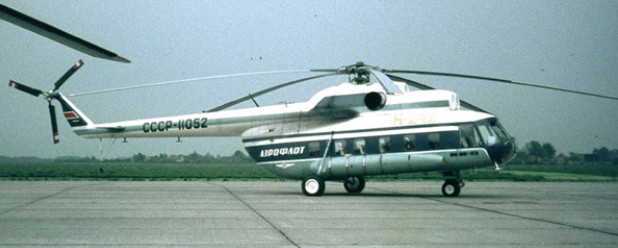
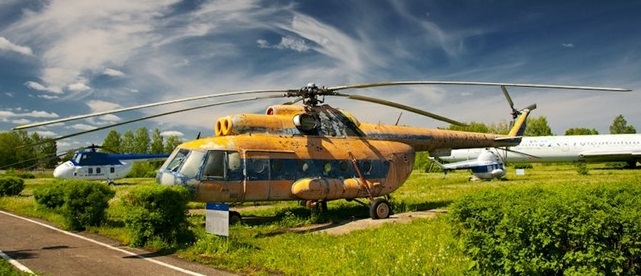
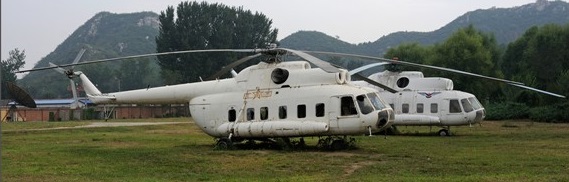
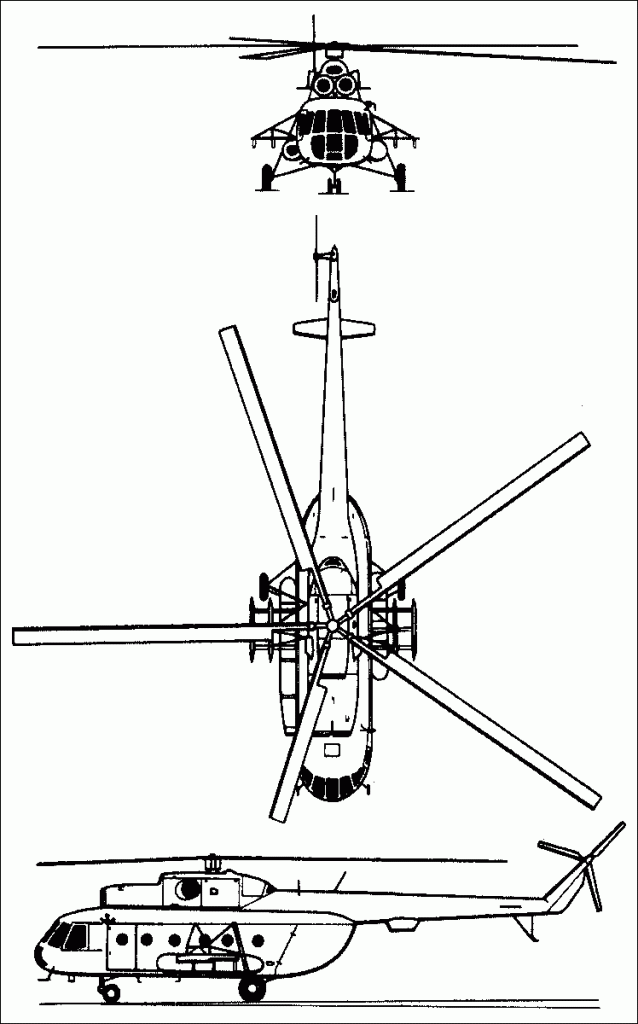
Designed originally in May 1960, the V-8 ‘Hip-A’ prototype helicopter was basically a turbine-powered version of the Mi-4, retaining initially its rotor, transmission and a number of other components. Intended powerplant was two Isotov turboshaft engines, but as these were not fully developed when the V-8 was nearing completion, it was powered instead by a single large 2700 shp Soloviev AI-24V turboshaft derated to the 2013kW limit of the transmission, for its first flight in 24 June 1960. However, the second machine (flown for the first time on 17 September 1962) introduced the Isotov TV2-117 engines, each then rated at 1119kW, and this became the standard installation on early production aircraft, designated Mil Mi-8 (NATO reporting name ‘Hip B’). The only other major change to be introduced since that time resulted from problems with the main rotor inherited from the Mi-4, replaced in 1964 by a five-bladed rotor of more advanced design in the ‘Hip-B’ prototype.
The fuselage is an all metal semi-monocoque in the pod and boom style. The rotor head has a conventional machined steel head spider with blades seated in oil-lubricated drag and flapping hinges. Collective pitch control is interlocked with the throttles and engine speeds and torques are automatically synchronized. The main rotor blades are all metal interchangeable blades of basic NACA 230 section, solidity 0.0777and employ automatic electkothermal de-icing and are fitted with an automatic gas pressure spar failure warning system. The main rotor shaft is inclined forward 4 degrees 30 minutes from the vertical. The blades are carried on a machined spider; pendulum vibration damper; and three-blade starboard tail rotor. The gear box is a VR-8 twin stage planetary reduction gearbox which drives the main rotor shaft and the intermediate and tail rotor gear boxes, the oil cooling fan, genera¬tors, and hydraulic pumps. The two 1500 shp Isotov turbo shafts with free turbines are automatic self governing of the main rotor speed, with a manual over-ride. Both engines drive the one main VR-8 two-stage planetary main reduction gearbox giving main rotor shaft/engine rpm ratio of 0.016:1and operate independently which permits flying the helicopter with one engine operative, when necessary. The transmission comprises gearbox, intermediate and tail rotor gearboxes, main rotor brake, and drives off main gearbox for tail rotor, fan, AC generator, hydraulic pumps and tachometer generators. The tail rotor pylon forms small vertical stabiliser and there is a horizontal stabiliser near the end of the tailboom; clamshell rear-loading freight doors.
Flying controls are mechanical with irreversible hydraulic boosters; main rotor collective pitch control linked to throttles.
The structure is all-metal; main rotor blades each have extruded light-alloy spar carrying root fitting, 21 honeycomb-filled trailing-edge pockets and blade tip; balance tab on each blade; each tail rotor blade made of spar and honeycomb-filled trailing-edge; semi-monocoque fuselage.
The undercarriage is a non-retractable tricycle type; steerable twin-wheel nose unit, locked in flight; single wheel on each main unit; oleo-pneumatic (gas) shock-absorbers. Mainwheel tyres 865 x 280mm; nosewheel tyres 595 x 185mm. Pneumatic brakes on mainwheels; pneumatic system can also recharge tyres in the field, using air stored in main landing gear struts. Optional mainwheel fairings.
Power is from two 1,250kW Klimov TV2-117A turboshafts (1,434 kW TV3-117MTs in Mi-8MT). Main rotor speed governed automatically, with manual override. Single flexible internal fuel tank, capacity 445 litres; two external tanks, each side of cabin, capacity 745 litres in port tank, 680 litres in starboard tank; total standard fuel capacity 1,870 litres. Provision for one or two ferry tanks in cabin, raising maximum total capacity to 3,700 litres. Fairing over starboard external tank houses optional cabin air conditioning equipment at front. Engine cowling side panels form maintenance platforms when open, with access via hatch on flight deck. Total oil capacity 60kg.
Two pilots side by side on flight deck, with provision for flight engineer’s station in between. Military versions can be fitted with external flight deck armour. Windscreen de-icing standard. Basic passenger version furnished with 24 to 26 four-abreast track-mounted tip-up seats at pitch of 72 to 75cm, with centre aisle 32cm wide; removable bar, wardrobe and baggage compartment. Seats and bulkheads of basic version quickly removable for cargo carrying. Mi-8T and standard military versions have cargo tiedown rings in floor, winch of 150kg capacity and pulley block system to facilitate loading of heavy freight, an external cargo sling system (capacity 3,000kg), and 24 tip-up seats along sidewalls of cabin. All versions can be converted for air ambulance duties, with accommodation for 12 stretchers and tip-up seat for medical attendant. Large windows on each side of flight deck slide rearward. Sliding, jettisonable main passenger door at front of cabin on port side; electrically operated rescue hoist (capacity 150kg) can be installed at this doorway. Rear of cabin made up of clamshell freight-loading doors, which are smaller on commercial versions, with downward-hinged passenger airstair door centrally at rear. Hook-on ramps used for vehicle loading.
The standard heating system can be replaced by full air conditioning system; heating of main cabin cut out when carrying refrigerated cargoes. Two independent hydraulic systems, each with own pump; operating pressure 44 to 64 bars. DC electrical supply from two 27V 18kW starter/generators and six 28Ah storage batteries; AC supply for automatically controlled electrothermal de-icing system and some radio equipment supplied by 208/115/36/7.5V 400Hz generator, with 36V three-phase standby system. Engine air intake de-icing standard. Provision for oxygen system for crew and, in ambulance version, for patients. Freon fire extinguishing system in power plant bays and service fuel tank compartments, actuated automatically or manually. Two portable fire extinguishers in cabin.
A four-axis autopilot to give yaw, roll and pitch stabilisation under any flight conditions, stabilisation of altitude in level flight or hover, and stabilisation of preset flying speed; Doppler radar box under tailboom.
Intended primarily for Aeroflot, the Mi-8 carries a 2- or 3-man crew and has seating accommodation for up to 28 passengers in its standard airline form. Alternative internal arrangements include a de luxe saloon cabin for executive travel or a cargo layout for an internal payload of 4000kg. Emergency conversion of the cargo model to a passenger carrier can be carried out quickly by installing 24 tip-up seats along the cabin sides. Clamshell rear doors are provided for loading large items of cargo or, in the ambulance role, 12 stretchers which can be carried with an accompanying medical attendant. Large numbers of Mi-8s are used by Aeroflot in the transport role, being deployed also for ice reconnaissance, rescue operations and logistic support, but even greater numbers are operated by the Soviet Union’s Frontal and Naval Aviation and, in addition, these helicopters have been supplied to the armed forces of about 40 other nations.
The Mi-8 can also be used as a rescue machine with a winch on the cabin side capable of lifting a 250kg load, or with an under-fuselage hook for an external sling load of about 2500kg.
The Mil Mi-8V is a 28-seat multi-role transport helicopter powered by two Izotov turboshaft engines. The Mi-8 was exported to over 50 countries.
The Mil Mi-8MTV-1 is a 24-seat multi-role transport helicopter powered by two Klimov TV3-117VM turboshaft engines.
Powered by 1,900 shp Isotov TV3-117MT engines replacing the 1,700 shp TV2-117As, Hip serves Frontal Aviation in several forms, the principal of these being the basic assault transport Hip-C, which can carry 128 57-mm rockets in four packs on lateral outriggers; Hip-D which performs electronic duties, and Hip-E is the heavily armed attack variant, fitted with a flexibly-mounted 12,7-mm gun in the nose and can carry 192 57-mrn rockets in six packs plus four AT-2 Swatter anti-armour missiles. Hip F is the export version of the Hip E, with six AT-3 Sagger missiles, while Hip G is another communications relay model. Hip J and Hip K are electronic warfare derivatives, used principally to jam communications.
The primary task of Hip is to deposit assault troops, equipment and supplies immediately behind the enemy lines and evacuate casualties, and for this purpose it can carry up to 28 fully-equipped troops, 8,820 lb (4 000 kg) of freight or 12 casualty litters.
The Mi-8 Salon is an executive transport.
The Mi-8PPA is a special communications jammer variant.
In 1981, the Mi-8 was replaced in production by the re-engined Mi-17 that was flown first as Mi-8MT in 1980.
More than 10,000 Mi-8 and Mi-17 Hips have been built in several models, and production of both the Mi-8 and Mi-17 continued in 1987. Many hundreds being exported to more than 40 operators.
Mi-8s, Mi-17s and Mi-171s were marketed and delivered from Kazan (Mi-8, Mi-17, Mi-172) and Ulan-Ude (Mi-8T, Mi-171) plants for civil and military use, including 2,800 exported; many Mi-8s converted to Mi-17 standard.
Mi-8 derivatives include Mi-9 tactical airborne command post (first flown 1977) and Mi-19 variant for use by commanders of tactical rocket units, Mi-17 (first flown August 1975) with change of engines and other modifications and Mi-171/Mi-172 export models, and lengthened Mi-173. The Mi-8PPA is a special communications jammer variant. The Mil Mi-14 ‘Haze’ anti-submarine helicopter is derived from the Mi-8.
Long-range modification: AEFT (Auxilliary External Fuel Tanks) by Aeroton adds another 1,900 litres in two internal tanks, plus same quantity in four external tanks on the stores pylons of the Mi-8T and Mi-8AT. Operational range with all six tanks is 1,100km; ferry range 1,600km.
All helicopters of Mi-8/Mi-17 series in Russian military service are known as Mi-8s of various subtypes, regardless of engines fitted.
Mi-8APS Military VIP transport with enhanced communications fit and more luxurious interior; used as Russian Presidential aircraft.
Mi-8AT Civil transport version produced by Ulan-Ude; TV2-117AG turboshafts; optional 8A-813 weather radar, DISS-32-90 Doppler radar and A-723 long-range radio navigation.
Mi-8ATS Agricultural helicopter with spray hoppers on each side, and with ‘wing’-type spraybars.
Mi-8AV Dedicated minelayer, despatching mines down steep, ladder-like slide projecting from gap between lower corners of clamshell doors.
Mi-8BT Equipped for minesweeping, towing sled from winch in cabin. Clamshell doors removed for missions.
Mi-8K Reconnaissance and artillery fire correction version; large window for camera in rear clamshell doors.
Mi-8MT Flying crane version with operator’s glazed gondola in place of rear clamshell doors. SSSR-254444 may have been the prototype. Designation re-used for Mi-17.
Mi-8P (‘Hip-C’) Civil passenger helicopter; standard seating for 28 to 32 persons in main cabin with large square windows.
Mi-8PD (punkt dowodzenia) Polish airborne command post version.
Mi-8PPA (‘Hip-K’) Active communications jammer; rectangular container and array of six cruciform dipole antennae each side of cabin; no Doppler box under tailboom; heat exchangers under front fuselage; some uprated to Mi-17 standard, with port-side tail rotor.
Mi-8PS (‘Hip-C’) Military VIP transport; basically as civil Mi-8 Salon.
Mi-8R Reconnaissance version.
Mi-8S (Salon) (‘Hip-C’) Original de luxe version of standard Mi-8; normally 11 passengers, on eight-place inward-facing couch on port side, two chairs and swivelling seat on starboard side, with table; square windows; air-to-ground radiotelephone and removable ventilation fans; compartment for attendant, with buffet and crew wardrobe forward of cabin; toilet (port) and passenger wardrobe (starboard) to each side of cabin rear entrance; alternative nine-passenger configuration; maximum T-O weight 10,400kg; range 380km with 30 minutes fuel reserve.
Mi-8SMV (‘Hip-J’) ECM version with R-949 jamming system; additional small boxes each side of fuselage, fore and aft of main landing gear legs. Also four containers with 32 droppable short-range jammers. Range 54 n miles (100 km; 62 miles).
Mi-8T (‘Hip-C’) Civil utility transport version, with TV2-117A turboshafts and circular cabin windows, built by Ulan-Ude plant. Alternative payloads include internal or external freight; 24 passengers on removable folding seats; 26 passengers on conventional seats; 12 stretcher patients or executive layout similar to Mi-8S.
Mi-8T (‘Hip-C’) Also available as standard assault transport of Russian Federation and Associated States (RFAS) army support forces; carrying 24 fully armed troops. Able to dispense 200 anti-personnel or anti-tank mines in flight, by conveyor belt through rear doors.
Mi-8TB (‘Hip-E’) Development of ‘Hip-C’; KV-4 flexibly mounted 12.7 mm machine gun, with 700 rounds, in nose; triple stores rack each side, to carry total 192 S-5 rockets in six UV-32-57 packs, plus four 9M17P Scorpion (AT-2 ‘Swatter’) anti-tank missiles (semi-automatic command to line of sight) on rails above racks; about 250 in RFAS ground forces; some uprated to Mi-17 standard as Mi-8MTV, with port-side tail rotor.
Mi-8TBK (‘Hip-F’) Export ‘Hip-E’; missiles changed to six 9M14 Malyutka (NATO AT-3 ‘Saggers’; manual command to line of sight).
Mi-8TG Modified TV2-117TG engines permit operation on Liquefied Petroleum Gas (LPG) and Kerosene. LPG contained in large tanks, on each side of cabin, under low pressure. Engines switch to Kerosene for take-off and landing. Reduced harmful exhaust emissions in flight offer anti-pollution benefits. Modification to operate on LPG requires no special equipment and can be effected on in-service Mi-8s at normal maintenance centre. Weights unchanged. Large external tanks, each side of cabin, reduce payload by 100 to 150kg over comparable ranges, with little effect on performance. First flight on LPG made 1987.
Mi-8T(K) Dedicated photo-reconnaissance platform with AFA-42/100 or AFA-A87P starboard oblique camera in forward part of the cabin, possibly with some onboard processing capability. May be used as fire correction platform.
Mi-8TM Upgraded civil transport version of Mi-8T; weather radar and rotor head integrity system.
Mi-8TP Military executive version; upgraded communications include R-832 radio with two-blade antennae under front fuselage and tailboom and R-111 with rod antenna lowered under cabin.
Mi-8TS (tropichesky sukhoi: tropical) Export version for hot and dusty climates.
Mi-8TV (vooruzhonnyi: armed) (‘Hip-C’) As Mi-8T, but with added twin-rack each side, to carry total of 64 57 mm S-5 rockets in four UV-16-57 packs, or bombs, for army assault forces.
Mi-8TZ Adapted to deliver fuel to front-line areas.
Mi-8 VIP De luxe version by Kazan; three crew and seven to nine passengers; main rotor has vibration damper; hinged airstair door; interior divided into vestibule, passenger cabin crew department, cloakroom and toilet; optional water heater, TV and GPS. Maximum take-off weight 12,000kg.
Mi-8VZPU (vozduzhnyi zapasnoi punkt upravlenya: airborne reserve command post) (‘Hip-D’) As ‘Hip-C’ but rectangular-section canisters on outer stores racks; two large dorsal antennae above forward part of tailboom; no armament.
Mi8AMT, Mi-8MT and Mi-8MTV are versions of the Mi-17, with more powerful turboshafts and port-side tail rotor.
Mi-8M see Mil Mi-17
Mi-9 (‘Hip-G’) Airborne command post variant of Mi-8; ‘hockey stick’ antennae projecting from rear of cabin and from undersurface of tailboom, aft of Doppler radar box; rearward inclined short whip antenna above forward end of tailboom; strakes on fuselage undersurface. Crew of three to six.
Specifications:
Mil Mi 8 Engine: 2 x Isotov TW 2-117A, 1479 shp Length: 60.072 ft / 18.31 m Height: 12.828 ft / 3.91 m Rotor diameter: 69.849 ft / 21.29 m Max take off weight: 26460.0 lb / 12000.0 kg Max. speed: 135 kts / 250 km/h Service ceiling: 14764 ft / 4500 m Range: 532 nm / 985 km Crew: 3
Mi-8 Hip E Engine: 2 x Isotov TV2 Installed pwr: 2535 kW Rotor dia: 21.3 m Fuselage length: 18.2 m No. Blades: 5 Empty wt: 6625 kg MTOW: 12,000 kg Payload: 4000 kg Max speed: 260 kph Ceiling: 4500 m HIGE: 1900 m HOGE: 800 m Fuel cap (+aux): 1870 lt ( 1830 lt ) Range: 465 km Crew: 2 Pax: 32
Mi-8T Engines: 2 x Klimov (Isotov) TV2-117A turboshaft, 1250 kW (1677 shp) Max speed: 140 kts / 250km/h Max cruise speed: 120 kts / 225km/h Service ceiling: 14,765 ft / 4500m HIGE: 6235 ft Range (24 pax + res): 500 km Empty Wt: 14,990 lbs / 6625kg MTOW: 26,455 lbs / 12000kg Rotor dia: 69 ft 10 in / 21.29m Length overall: 82 ft 10 in Fuselage length: 59 ft 8 in / 18.17m Height: 18 ft 7 in / 4.38m Fuselage width: 2.5m Disc area: 3932 sq.ft Pax: 24 Payload: 4000kg
The Mi-8 prototype incorporating an Mi-4 main rotor and transmission and one 2700shp Soloviev AI-24V turbine mounted on top of fuselage. First flown on 24 June 1961 and subsequently fitted with 5-blade rotor and two 1400shp Isotov TV2-117 engines, being the standard for the Mi-8.
V-8 Crew: 3 Passengers: 18 Engine: 1 x AI-24V turboshaft, 1425kW Main rotor diameter: 21.0m Max take-off weight: 11200kg Empty weight: 5726kg Payload: 1500-2000kg
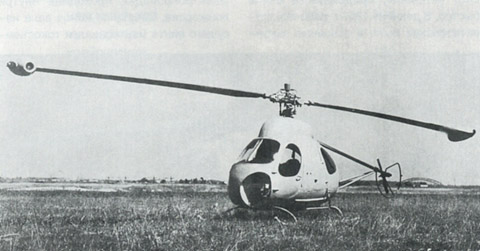
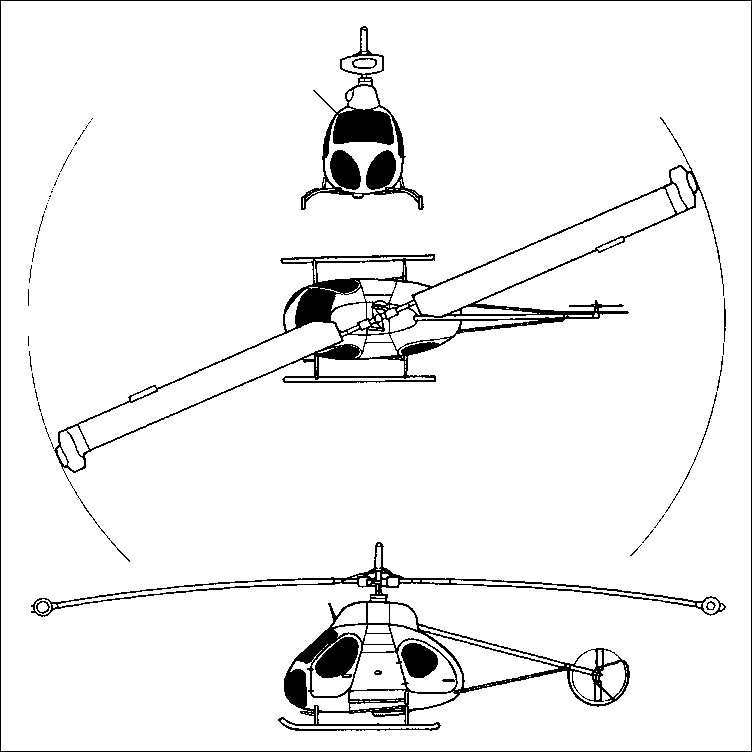
An experimental tip-drive helicopter completed in 1959. A 4-seat light helicopter with skid u/c, thin triangulated tail boom structure, powered was from two AI-7 tip-mounted ramjets. A pilot and three passengers were in a stressed-skin nacelle with three doors, tail on tubular boom, and kerosene tank in roof. The all-metal blades carrying subsonic tip ramjets. The hub was of design unlike other Mil helicopters. Inclined drive shaft to tail rotor.
One prototype was built and flown in 1959, but it is believed it never flew with more than the pilot on board.
Mil V-7 Engine: 2 x AI-7 Rotor diameter: 11.6m Loaded weight: 835kg Empty weight: 730kg
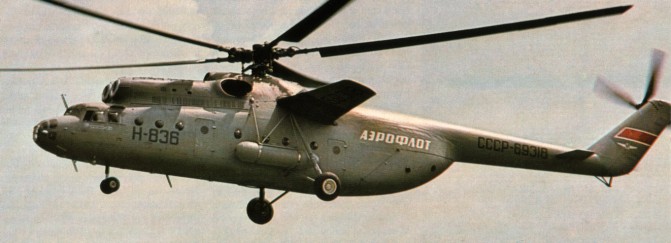
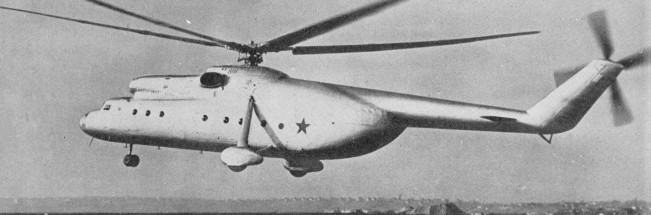
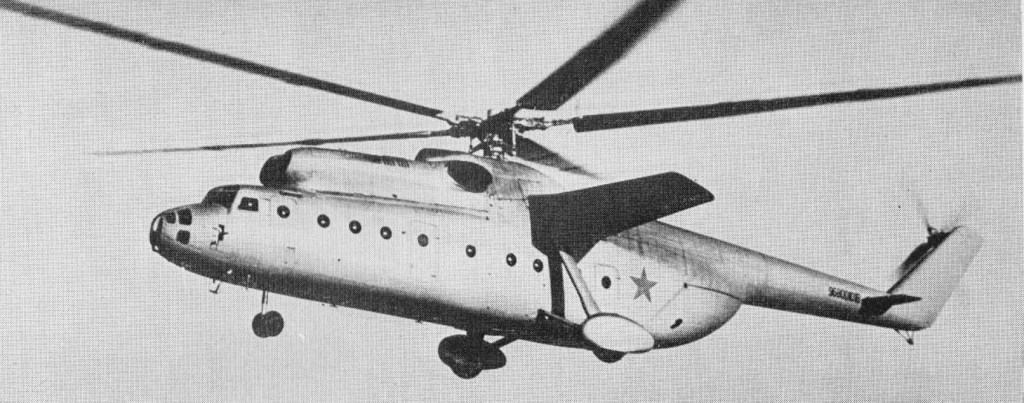
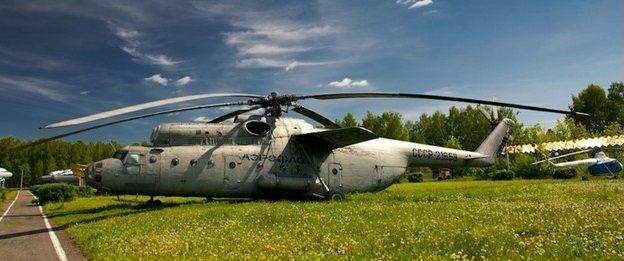
Developed to meet both VVS and Aeroflot requirements, the Mi-6 was also the first turbine-powered helicopter to enter production in the USSR. First flown in June 1957 by Rafail Kaprelian, five aircraft were involved in the development programme, which was completed very quickly for such a revolutionary aircraft, with production beginning in 1960. The first flown made its maiden flight originally without the shoulder-mounted stub wings which are sometimes fitted to production Mi-6’s. On October 30 1957 an Mi-6 lifted 12,000kg to 2432m.
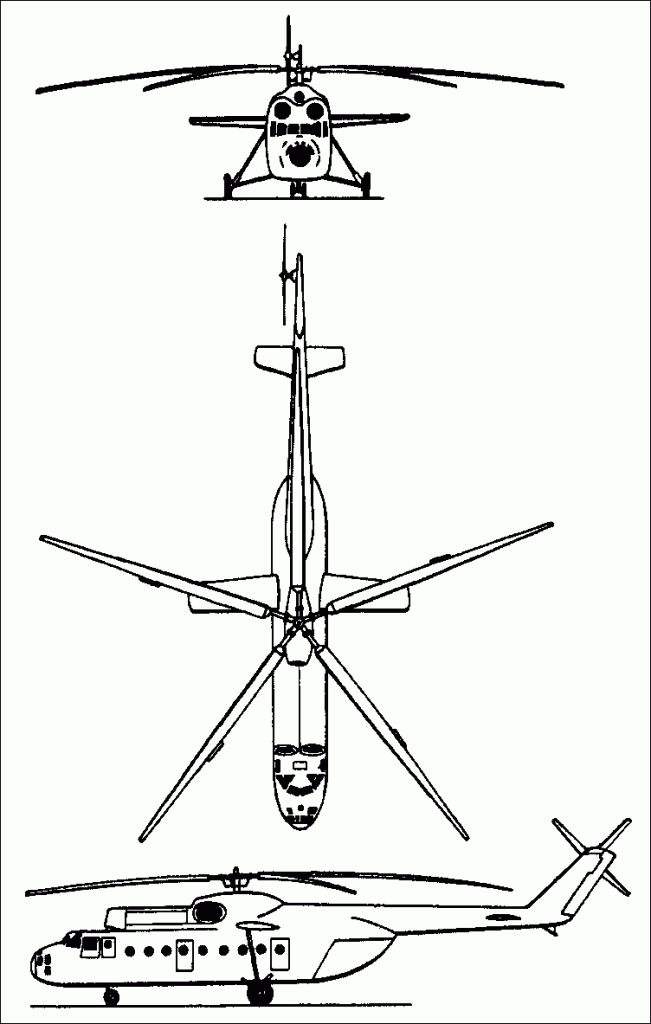
Of conventional helicopter configuration, the Mi-6 introduced two readily-detachable short-span shoulder wings which offload the rotor by some 20 per cent in cruising flight; for heavy-lift operations the stub wings are removed to give greater payload capability. For normal operations they can be fixed at either of two angles of incidence. Development by Mikhail L Mil’s design bureau at Zaporozhye of the dynamic system (rotors and shatting) of the Mi-6 was matched by Soloviev’s development of the R-7 gearbox, which weighs 7,054 lb (much more than the pair of engines).
When the Mi-6 first appeared, it was claimed to have a maximum passenger capacity of 120, with normal capacity for 70 to 80, each with 20kg of baggage. Such an airliner was built in 1967, but failed to proceed beyond the prototype stage. The standard capacity of 65 passengers in the convertible model is provided with tip-up seats along the cabin walls and with removable seats on the floor.
The prototypes were powered by two 4635shp Soloviev TV-25VM turboshafts, but production models have the 5500shp Soloviev D-25V developed models. Also fitted is a 100hp AI-8 auxiliary power unit for starting the engines in the absence of any external power source. The developed engines, which keep their rating at altitudes up to 3000m and so make possible operations in ‘hot and high’ conditions, also allowed some notable records, the most impressive being an altitude of 2840m with a 25,105kg payload on May 28, 1965.
In November 1959 an Mi-6 set a new 100km speed record at 167.206 mph.
The fuselage construction is a metal semi-monocoque pod-and-boom design, with large hydraulically operated clamshell doors at the rear of the pod. These doors, which can be removed to allow the carriage of outsize cargoes, cover an opening measuring 2.65m by 2.7m and leading into a hold with a volume of 62cu.m, measuring 12m by 2.65m by 2.5m. Freight is handled with the aid of an 800kg winch. As an alternative to internal freight, a load of 9000kg can be carried in a sling suspended from a cable on the aircraft’s centre of gravity, dropped through a hatch in the floor. The Mi-6 also has an electric winch for use when hovering which has a capacity of 500kg.
Five-blade main rotor and four-blade tail rotor. Main rotor blades each have tapered steel tube spar, to which are bonded built-up metal aerofoil sections. Conventional transmission. Main reduction gearbox drives tail rotor, fan AC generators and hydraulic pumps. Intermediate reduction gearbox fitted with special fan. Two small cantilever removable shoulder wings mounted above main landing gear struts, offload rotor by providing some 20% of total lift in cruising flight. The wings are removed in the fire-fighting variant, which can carry 12,000kg of water. Tail rotor support acts as vertical stabiliser.
The blades have coincident flapping and drag hinges and fixed tabs. Main rotor shaft inclined forward at 5 degrees to vertical. Control via large welded swashplate. Hydraulically actuated powered controls. Main rotor collective-pitch control interlocked with throttle controls. Variable incidence horizontal stabiliser near end of tailboom for trim purposes.
Power is from two 4,101kW Soloviev D-25V (TV-2BM) turboshafts, mounted side by side above cabin, forward of main rotor shaft. There are 11 internal fuel tanks, with total capacity of 6,315kg, and two external tanks, on each side of cabin, with total capacity of 3,490kg. Provision for two additional ferry tanks inside cabin, with total capacity of 3,490kg.
Crew of five, consisting of two pilots, navigator, flight engineer and radio operator. Four jettisonable doors and overhead hatch on flight deck. Electrothermal anti-icing system for glazing of flight deck and navigator’s compartment. Equipped normally for cargo operation, with easily removable tip-up seats along sidewalls. When these seats are supplemented by additional seats installed in centre of cabin, 65 to 90 passengers can be carried, with cargo or baggage in the aisles. Normal military seating is for 70 combat equipped troops. As an air ambulance, 41 stretcher cases and two medical attendants on tip-up seats can be carried. One of the attendant’s stations is provided with intercom to flight deck and provision is made for portable oxygen installations for the patients. Cabin floor is stressed for loadings of 2,000kg/sq.m, with provision for cargo tiedown rings. Rear clamshell doors and ramps are operated hydraulically. Standard equipment includes an electric winch of 800kg capacity and pulley block system. Central hatch in cabin floor for cargo sling system for bulky loads. Three jettisonable doors, fore and aft of main landing gear on port side and aft of landing gear on starboard side.
Some military Mi-6s have a 12.7 mm machine gun in the nose.
During flight trials in 1962 the Mi-6 (NATO code name Hook) established a number of impressive load-to-altitude and speed-with-payload records in 1959, most of which it bettered three years later when it set a total of eleven new FAI world records. In one of these, still unbeaten by early 1968, it lifted a payload of 20117kg. The normal load is limited to 26,450 lb (12,000 kg) internally, loaded via huge clamshell rear doors, or 19,840 lb (9000 kg) externally slung. It was also the world’s first twin-turboshaft helicopter, and the first to exceed 300km/h in level flight.
An initial batch of thirty production Mi-6’s was undertaken in 1958. Aeroftot was reported in 1963 to have introduced the big Mi‑6. It is being used at present to carry large and unwieldy loads such as pipes for natural gas and oil installations. Test pilot I.G. Drobishevsky has taken charge of Mi‑6 development for Aeroflot and is working on further applications such as the unloading of ships and the carriage of timber. The Mi-6’s in service with Aeroflot are employed mainly as freighters, in which role they have an internal capacity for 12000kg of payload. The standard passenger version seats 65 people normally, although up to 120 persons can be accommodated in a high density seating arrangement. If used as an ambulance, the Mi-6 can carry 41 stretchers and 2 medical attendants.
Major production version was the Mi-6A of which 864 were built at Rostov-on-Don (now Rostvertol) factory 1959-80, plus 50 at Moscow-Fili 1960-62.
The ‘Hook’ was exported to Algeria, Bulgaria, Egypt, Ethiopia, Indonesia, Iraq, Syria, Vietnam and Peru, where it was used by both the air force and army.
Flown by a crew of five, the Mi-6 has also seen extensive use with Aeroflot in civil engineering support work on projects such as bridge-laying, and as a versatile heavy transport in areas inaccessible to other vehicles. Most have the rotor unloaded in cruising flight (typically 150 mph) by a fixed wing of 50 ft 21 in span. These huge helicopters have played an active role in field exercises carrying troops (typically 68) and tactical missiles or vehicles. The under-fuselage hook can support an externally slung load of 9000kg.
Mi-6
Another version, developed into the Mil-10 ‘Harke’, is optimised as a flying crane, and the Mi-6 formed basis for Mi-22 airborne command post.
Mi-6 / Hook-A Basic transport with TV-2V. First 30 preproduction aircraft. Able to carry 70 combat-equipped troops or 65-90 civil passengers; also used in the air ambulance role, it can accommodate 41 stretcher cases and two medical attendants; can also be fitted for fire-fighting role with spraying or water bombing equipment; in the freight role the Mi-6 can carry an internal cargo payload of 12000 kg (26,455 lb)
Mi-6P (passazhirskyi) Airline-style seating for 80 passengers; rectangular windows.
Mi-6PS (poiskovo-spasetelnyi) Military SAR/medevac version, first noted in 1977.
Mi-6PZh and Mi-6PZh2 Firefighters with 21,000 litres capacity in single 12,000 litre metal tank and six 1,500 litre bag tanks suspended from the fuselage.
Mi-6S (sanitarnyi) Medevac version for 41 litters and two attendants.
Mi-6T Basic military transport with machine gun in nose glazing.
Mi-6TP (transportno-passazhirskyi) Convertible model with 65 folding seats.
Mi-6TZ (toplivo-zapravshchik) Tanker version for ground refuelling.
Mi-6VKP (vozduzhnyi komandnyi punkt) (‘Hook-B’) Command support version with dorsal ‘clothesline’ antenna; flat-bottom U-shape antenna under tailboom; large heat exchanger on starboard side of cabin; small cylindrical container aft of starboard rear cabin; small cylindrical container aft of starboard rear cabin door.
Mi-6VR (vodolei: Aquarius) Rotor systems testbed used in Mi-26 development; subsequently equipped as icing spray rig.
Mi-6AYaSh / Hook-D Airborne command post; flat-panel (reportedly SLAR), forward of external fuel tank as starboard side, many small antennas.
Mi-22 / Hook-C Developed command support version with single large dorsal blade antenna on forward part of tailboom; small antennae under fuselage; pole antenna on starboard main landing gear of some aircraft. Also known as Mi-6AYa or Mi-6VUS in service.
Specifications:
Mi-6 Engines: 2 x D-25A turboshaft, 4045kW Main rotor diameter: 35.0m Length with rotors turning: 41.74m Height: 9.16m Fuselage width: 3.2m Max take-off weight: 42500kg Empty weight: 27240kg Max speed: 300km/h Cruising speed: 250km/h Rate of climb: 6.5m/s Service ceiling: 4500m Hovering ceiling: 1000m Range with 8,000kg payload: 620km Range with max fuel: 1450km, payload: 12000kg Crew: 5 Passengers: 65
Mi 6 Engines: 2 x Solowjew D-25W, 5425 shp Length: 108.793 ft / 33.16 m Height: 32.349 ft / 9.86 m Wingspan: 114.829 ft / 35.0 m Max take off weight: 93712.5 lb / 42500.0 kg Weight empty: 60064.2 lb / 27240.0 kg Max. payload weight: 26460.0 lb / 12000.0 kg Max. speed: 162 kts / 300 km/h Cruising speed: 135 kts / 250 km/h Service ceiling: 14764 ft / 4500 m Cruising altitude: 3281 ft / 1000 m Maximum range: 783 nm / 1450 km Range: 783 nm / 1450 km Crew: 5 Payload: 65 Pax / 12000kg
Mi-6T Engines: 2 x Soloviev D-25V single-shaft free-turbine engines driving common R-7 gearbox, 5,500 shp (4045kW) each Main rotor diameter: 114 ft 10 in (35 m) Overall length (rotors turning): 136 ft 11½ in (41.74 m) Fuselage length: 108 ft 10½ in (33.18 m) Height: 32 ft 4 in (9.86 m) Empty weight (typical) 60,055 lb (27,240 kg) Max loaded weight 93,700 lb (42,500 kg) Max speed: 186 mph (300 km/h) (set 100 km circuit record at 211 36 mph, beyond flight manual limit) Cruise speed: 250km/h / 158 mph Service ceiling: 14,750 ft (4500 m) Range (with half payload) 404 miles (650 km) Range w/ aux. fuel: 1450km Armament: normally none, or 1 x 12.7 mm calibre Crew: Five – two pilots, flight engineer, navigator, and radio operator Payload: 70 troop or 17,640 lb (8000 kg)
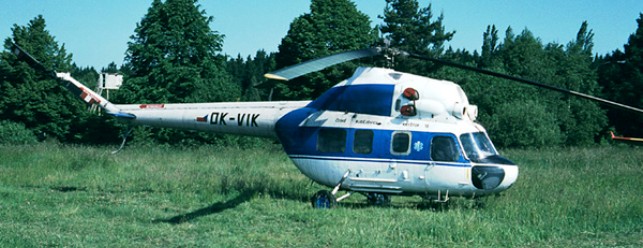
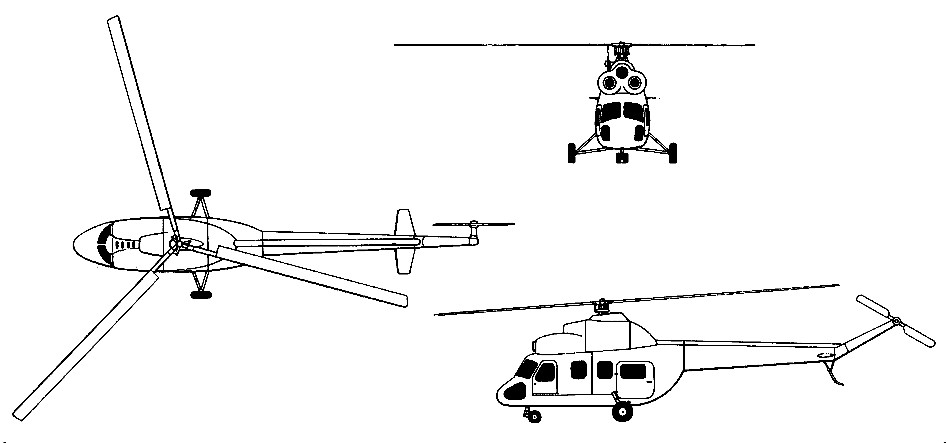
In the mid fifties, the Mil bureau decided to improve the performance of the Mi-1 by developing a turbine-powered version. The Mil Mi-2, which has the NATO reporting name Hoplite, was first announced in the autumn of 1961, and is essentially the Mi-1 updated in the light of operating experience with the Mi-6. The Mil Mi 2 is frequently referred to as V 2, the “V” indicating “Vertolet”, Russian for ‘rotary wing’.
Two of the new Isotov GTD-350 free-turbine engines were chosen. A free-turbine engine enables the r.p.m. of the rotor to be varied, whilst those of the engine are kept constant. For half the weight of the earlier piston engine, the two GTD-350 developed 40% more power. They were installed side-by-side above the fuselage, considerably increasing the available cabin space. Two 313kW Polish-built Isotov GTD-350 turboshafts, mounted side by side above cabin. Fuel in single rubber tank, capacity 600 litres, under cabin floor. Provision for carrying 238 litre external tank on each side of cabin. Refuelling point in starboard side of fuselage. Oil capacity 25 litres.
The first prototype, designated V-2 and then Mi-2, flew on 22 September 1961; it had the same rotor, transmission and tail unit as the Mi-1. After preliminary trials, a metal tail rotor was adopted (the Mi-1 had a wooden one) and later, from 1965, a new main rotor hub derived from that of the Mi-6.
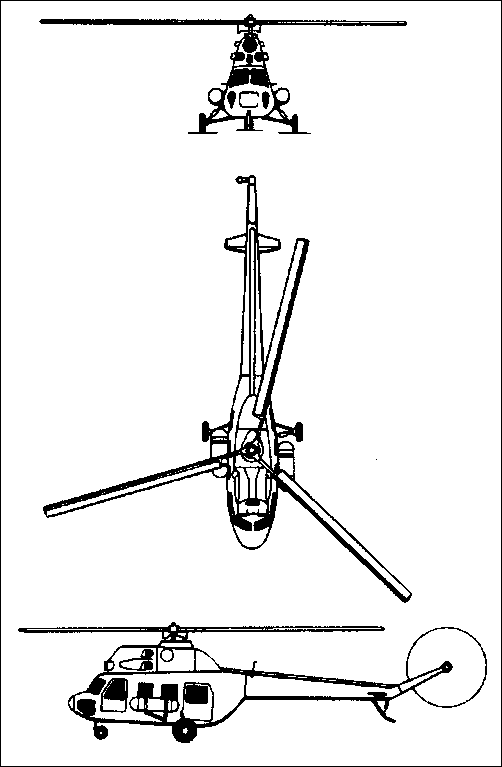
A completely new fuselage, all light-alloy monocoque with steel forgings at concentrated loads, the structural basis was a deep floor box carrying wheel or ski landing gears and housing flexible fuel cell of 600 litres. Normal accommodation for one pilot on flight deck (port side). Seats for up to eight passengers in air conditioned cabin, comprising back to back bench seats for three persons each, with two optional extra starboard side seats at rear, one behind the other. All passenger seats removable for carrying up to 700kg of internal freight. Access to cabin via forward-hinged doors on each side at front of cabin and aft on port side. Pilot’s sliding window jettisonable in emergency. Ambulance version has accommodation for four stretchers and medical attendant, or two stretchers and two sitting casualties. Side by side seats and dual controls in pilot training version. Cabin heating, ventilation and air conditioning standard. Option of four stretchers and attendant, or slung load of 1.2t or two 600 lit ag containers. All versions plumbed for two 250-lit auxiliary tanks on sides.
The three-blade main rotor has hydraulic blade vibration dampers; flapping, drag and pitch hinges on each blade; anti-flutter weights on leading-edges, balancing plates on trailing-edges. Coil spring counterbalance in main and tail rotor systems; pitch change centrifugal loads on tail rotor carried by ribbon-type steel torsion elements. Blades do not fold; rotor brake fitted. Main rotor blade section NACA 230-12M. Main rotor shaft driven via gearbox on each engine; three-stage WR-2 main gearbox, intermediate gearbox and tail rotor gearbox; main rotor/engine rpm ratio 1:24.6, tail rotor/engine rpm ratio 1:4.16; main gearbox provides drive for auxiliary systems and take-off for rotor brake; freewheel units permit disengagement of failed engine and autorotation.
Each individual rotor blade used to be of typical Mil construction, with some 20 bonded sections attached to a light alloy spar, with a light aluminium honeycomb trailing edge, the whole being covered in light alloy sheet. WSK-PZL-Swidnik have since developed a more advanced rotor blade based on an extruded duralumin spar with plastic sections and covering. Subsequently developed as production Mi-2 with bonded/welded fuselage, hub with hydraulic instead of friction dampers, bleed-air anticed intakes, tail rotor with bonded-metal honeycomb blades and electro-thermal de-icing on all blades.
Flying controls have a hydraulic system for cyclic and collective pitch control boosters; variable incidence horizontal stabiliser, controlled by collective pitch lever.
The landing gear is non-retractable tricycle type, plus tailskid. Twin-wheel nose unit. Single wheel on each main unit. Oleo-pneumatic shock-absorbers in all units, including tailskid. Main shock-absorbers designed to cope with both normal operating loads and possible ground resonance. Mainwheel tyres size 600 x 180, pressure 4.41 bars. Nosewheel tyres size 400 x 125, pressure 3.45 bars. Pneumatic brakes on mainwheels. Metal ski landing gear optional.
Systems include cabin heating, by engine bleed air, and ventilation; heat exchangers warm atmospheric air for ventilation system during cold weather. Hydraulic system, pressure 65 bars, for cyclic and collective pitch control boosters. Hydraulic fluid flow rate 7.5 litres/min. Vented reservoir, with gravity feed. Pneumatic system, pressure 49 bars, for mainwheel brakes. AC electrical system, with two STG-3 3kW engine-driven starter/generators and 208V 16kVA three-phase alternator. 24V DC system, with two 28Ah lead-acid batteries. Main and tail rotor blades de-iced electrically; engine air intake de-icing by engine bleed air. Electric de-icing of windscreen.
The FAI has certified as a world record the speed of 157.7mph (253.818 km/h) established in May 1963 over a 62.1 mile (100 km) closed circuit course by a twin turbine Mil Mi 2 (Hoplite) helicopter. The Russians had claimed a speed of 164mph (264 km/h). The type established a class speed record of 269.38km/h on June 20, 1965, when piloted by Tatyana Russyan.
(32 yellow) Mil Mi-2 511019039 – marked 02 yellow
The first production aircraft had 400shp engines, but from 1974 these were uprated to 450shp. Another modification was the use of fiberglass materials for the main rotor, tail rotor and stabilizer, to simplify production and improve performance. As the Russian plants were fully occupied with production of the Mi-8 and other heavy helicopters in the Mil series, an agreement was reached with WSK-Swidnik to manufacture the Mi-2 in Poland, and they took over production and development rights in 1964. The first Polish Mi-2 had flown before this in November 1963, and once trials were completed, large-scale production began in 1965. The first Polish-built production example flew on 4 November 1965.
In the ambulance role it can accommodate 4 stretchers and a medical attendant; as a freighter, it can carry 700kg of cargo. For flying crane or rescue duties it can be fitted with an under-fuselage hook for a sling load of 800kg or a winch over the cabin door capable of lifting up to 150kg.
In the Mi-2’s agricultural role, it can carry a hopper on either side of the cabin containing 450kg of dry chemical or 500l of liquid (can be replaced by additional fuel tanks) and either a spraybar to rear of cabin on each side or distributor for dry chemicals under each hopper. Swath width covered by spraying version is 40 to 45m.
For search and rescue, electric hoist, capacity 120kg, is fitted. In freight role an underfuselage hook can be fitted for suspended loads of up to 800kg. Polish press has illustrated version equipped for laying smokescreens. Electrically operated wiper for pilot’s windscreen. Freon fire extinguishing system, for engine bays and main gearbox compartment, can be actuated automatically or manually.
All production and development subsequently at WSK, involving 12 series versions including SAR, photo, anti-armour and gunship. One in service with the Polish Air Force was equipped with rocket launchers and air-to-ground missiles, slung from rails at the sides of the fuselage.
The Mi-2B has upgraded electrical and navigation systems.
The Mi-2 has undergone continuous refinement and adaptation to special versions and more than 5,250 had been built when production was suspended in 1991 pending privatisation of the company planned for 1992.
Further development of the Mi-2 has been undertaken by WSK-PZL-Swidnik with a view to selling the type to western countries. The late-1970s result is the Kania or Kitty Hawk, and Taurus, powered by two Allison turboshafts. Developed with co-operation from Allison in the USA, the Kania, which first flew on June 3, 1979, is an Mi-2 airframe powered by two Allison 250-C20B turboshafts.
The engine selected for the Kania is the Allison 250 turboshaft. WSK-PZL Swidnik have worked closely with the Detroit Diesel Allison Division of the General Motors Corporation on the installation of the two 250-C20B turboshafts, to ensure optimum location at minimum weight. The two Allison 250-C20B turboshafts, mounted side by side above cabin; each rated at 420shp / 317kW for T-O, 30 minutes twin-engine emergency power and one engine out maximum continuous power, and 370shp / 276kW for normal cruise. Automatic and manual torque sharing control systems standard. Two separate fuel boost systems, each with fuel filter bypass switch, fuel pressure gauge and switch, connected by crossfeed. Fuel tankage remains unaltered, compared with that of the Mi-2, standard usable fuel capacity of 600 litres, with provision for additional 423 litres usable in optional auxiliary tanks. Fuel quantity gauge and fuel reserve warning. Two separate oil systems, each with oil cooling, temperature and pressure gauges, oil filter bypass pop-up and chip warning. Each engine equipped with starter/generator, engine fuel pump effective for cruise after both boost pumps out, N1 and N2 tacho-generators, TOT gauge and switch, start counter, and ‘engine out’ warning. Dual engine inlet anti-icing standard, each engine compartment equipped with fire detection system and with automatic and manual fire extinguishing systems.
The smaller size of the Allison 250-C20B, compared with the Isotov GTD-350P used on the Mi-2, has made possible a smaller engine installation, and the opportunity has also been taken to recontour the nose. Rotor diameter has been increased by 6cm compared with the 14.5m of the Mi-2. The overall effect has been a reduction in empty weight of 262kg, though maximum take-off weight falls by only 150kg.
The design features a three-blade fully articulated main rotor and two-blade seesaw tail rotor. Main gearbox equipped with freewheel units, oil cooling system, oil temperature and pressure gauges and switches, tacho-generator with low- and high-rpm warning, air compressor and a spare power pad of 19.1kW at 8,000 rpm. Steel engine driveshafts, each with two crowned tooth couplings. Tail rotor driveshaft of duralumin tube, with similar crowned tooth couplings and anti-friction bearings. Hoist and cargo sling attachment points standard. Transmission includes main rotor, intermediate and tail rotor gearboxes, each with individual lubrication system. Glass fibre/epoxy blades on both rotors. Conventional semi-monocoque fuselage and circular-section tailboom. Glass fibre/epoxy horizontal stabiliser at end of tailboom.
Two prototypes were produced by converting Mi-2 airframes. The first prototype (SP-PSA) was flown on 3 June 1979 and was intended, like the standard Mi-2, to fulfil a variety of roles. It could accommodate a pilot and a maximum of nine passengers or, alternatively, pilot and copilot plus eight passengers, and the cabin seats were removable to allow use in the agricultural or air ambulance roles. Reconfigured it could carry up to 800kg of cargo, some externally slung.
Polish certification of the Kania was carried out in two stages. The first took place in 1979-81 and resulted, on 1 October 1981, in a supplementary type certificate to that of the Mi-2.
A further refined version, the Kania Model 1, has a redesigned cockpit and improved control systems, and is offered in several military configurations.
Accommodation is provided at the front of the cabin for a pilot and co-pilot or passenger, on separate seats, with eight more passengers seated on two three-abreast benches and one double or two single seats at the rear of the cabin. The Kania is intended as a general-purpose helicopter, and so the seating is removable to allow the carriage of freight, agricultural equipment and litters. Access to the cabin is gained by a small door on each side of the forward fuselage, and a larger door on the left side of the passenger compartment’s rear. To suit the type to western markets, the Kania is provided with an array of western avionics. These include dual instrument lighting systems, pilot’s cabin extension light and an adjustable landing light. Standard instrumentation includes King KX-175BE com/nav, KR-85 digital Automatic Direction Finding equipment and KT-76 transponder. An optional feature is a 16k VA AC generator for de-icing the pilot’s windscreen and cabin heating and air conditioning.
Standard equipment includes dual anti-collision lights, navigation lights, portable fire extinguisher, tool kit and first aid kit. Fluorescent tube cabin lighting and/or individual lights optional. According to mission, the Kania can be equipped with an 800kg capacity stabilised cargo sling; 120kg capacity hoist (275kg); stretchers and casualty care equipment; or equipment for a variety of agricultural duties. Polish Border Guard aircraft have Spectrolab SX-5 searchlight and HLU-100 loudspeaker system.
Flying controls have three hydraulic boosters for longitudinal lateral and collective pitch control augmentation.
The landing gear is non-retractable tricycle type, plus tailskid. Twin-wheel castoring and self-centring nose unit; single wheel on each main unit. Stomil Poznan tyres, sizes 600 x 180 mm (main) and 300 x 125 mm (nose); tyre pressure 4.0 and 3.5 bars respectively. Pneumatic brakes on mainwheels. Metal skis and emergency flotation bags optional.
The second stage of Polish certification, concerning a considerably improved Kania Model 1 version, was carried out during 1982-86 under the leadership of Stanislaw I Markisz. Improvements included among others, redesigned cockpit and cabin layout, engine and flight controls as well as engine and transmission cowlings. On 21 February 1986 this version of the Kania was granted a separate type certificate as an FAR Pt 29 (Transport Cat. B) day and night SVFR multipurpose utility helicopter with Cat. A engine isolation.
PZL Swidnik Kania (Kitty Hawk)
The number ultimately converted (to the Kania Model 1) is believed to have totalled four prototypes plus half a dozen definitive aircraft by January 1999. Production may have been discontinued in 2000.
Despite the lower power of the American engines, the performance of the Kania is comparable with that of the Mi-2 except in range, where the Kania appears to be superior by a small margin.
Polish production at standstill early 1992, but reported continuing on limited basis. A total of 5,450 were built for civil and military operators by January 1999, a majority exported.
In 1988, the PZL W-3 Sokol replaced the Mi-2 in production. PZL’s W-3 Sokol (Falcon), which flew in 1979, was based on the Mi-2 but had new engines, rotors and a larger cabin.
Mi-2 Standard civil version available as convertible 6/8-passenger or cargo transport, crop sprayer (identified as the Bazant), pilot trainer, aerial photography, photogrammetry or as freight hauler with external sling and electric hoist
Mi-2 Engine: 2 x PZL Rzeszow GTD-350 Instant pwr: 294 kW Rotor dia: 14.56 m MTOW: 3550 kg Payload: 800 kg Useful load: 1140 kg Max speed: 113 kts Max cruise: 105 kts Max range (ferry): 580 km HIGE: 5167 ft HOGE: 2870 ft Service ceiling: 13,123 ft Crew: 1 Pax: 8
Mi-2 Engine: 2 x Isotov GTD-350 Installed pwr: 670 kW Rotor dia: 14.5 m Fuselage length: 11.9 m No. Blades: 3 Empty wt: 2370 kg MTOW: 3700 kg Payload: 800 kg Max speed: 210 kph ROC: 270 m/min Ceiling: 4000 m HIGE: 2000 m HOGE: 1000 m Fuel cap (+aux): 600 lt (480 lt) Range: 440 km Crew: 1 Pax: 8
Mi-2B Different electrical system and more modern navigational aids; manufactured in same versions (except agricultural) as basic Mi-2, and has same flight performance; empty equipped weights 2,300kg for passenger version, 2,293kg for cargo version; T-O weight unchanged; no rotor blade de-icing. Production total not large.
Mi-2Ch Chekla Radiation reconnaissance and smoke-laying conversion.
Mi-2D Przetacznik Airborne Command Post with radio communication, cipher and telephone equipment.
Mi-2FM Kajman Photogrammetry version. Only two built.
Mi-2M Engines: 2 x Izotov GTD-350P turboshaft, 331kW Main rotor diameter: 14.5m Length with rotors turning: 17.42m Height: 3.75m Max take-off weight: 3550kg Empty weight: 2402kg Max speed: 210km/h Cruising speed: 200km/h Service ceiling: 4000m Range with max payload: 170km Payload: 800kg Crew: 1-2 Passengers: 8
Mi-2P Standard eight-seat passenger, convertible all-cargo version with external sling and electric hoist.
Mi-2 Platan Minelaying conversion.
Mi-2R Agricultural version for conventional or Ultra Low Volume (ULV) dusting and spraying. Chemical hoppers mounted on each side of the fuselage; capacity 500 litres liquid or 375kg dry chemicals. Empty weight 2,372kg.
Mi-2RL SAR and air ambulance version for land use fitted with an electric hoist
Mi-2RM Anakonda SAR version for naval use with two-person electric winch over port side door and air-droppable dinghies. Nine built for Polish Naval Air Arm.
Mi-2Ro Military reconnaissance version.
Mi-2RS Padalec Special contamination reconnaissance version.
Mi-2S Medevac version equipped for four litters plus attendant or two litters and two sitting patients.
Mi-2Sz Dual-control training version.
Mi-2T Military transport version.
Mi-2URN 1973 Combat support/armed reconnaissance version; as Mi-2US but with two Mars 2 launchers (each 16 S-5 57mm unguided rockets) instead of pylon-mounted gun pods; PKV gunsight in cockpit for aiming all weapons; in service from 1973.
Mi-2URP Salamandra 1976 Anti-tank version; cabin side outriggers for four 9M14M Malyutka (AT-3 ‘Sagger’) wire-guided missiles; four additional missiles in cargo compartment; in service from 1976.
Mi-2URPG Gniewosz Similar to Mi-2URP but with four Gad (9M32 Strela 2/SA-7 ‘Grail’) anti-aircraft missiles.
Mi-2US Adder Gunship version; 23mm NS-23KM cannon on port side of fuselage, two 7.62mm gun pods on each side pylon, two other 7.62mm PK-type pintle-mounted machine guns in rear of cabin.
UMi-2Ro Reconnaissance training version.
PZL-Swidnik Kania / Kitty Hawk Engines: two Alli¬son 250-C20B turboshafts Instant pwr: 313 kW Rotor dia: 14.56 m MTOW: 3550 kg Payload: 1200 kg Useful load: 1590 kg Max speed: 113 kts Max cruise: 113 kts Max range: 886 km HIGE: 8202 ft HOGE: 4511 ft Service ceiling: 13,123 ft Crew: 1 Pax: 9
PZL-Swidnik Kania Model 1 Engines: two Allison 250-C20B turboshafts, 314kW at take-off Main rotor diameter: 14.56m Length with rotors turning: 17.41m Height: 3.75m Max take-off weight: 3550kg Empty weight: 2140kg Cruising speed: 210km/h Service ceiling: 4000m Range with max payload: 497km
PZL-Swidnik Taurus two Alli¬son 250-C20B turboshafts
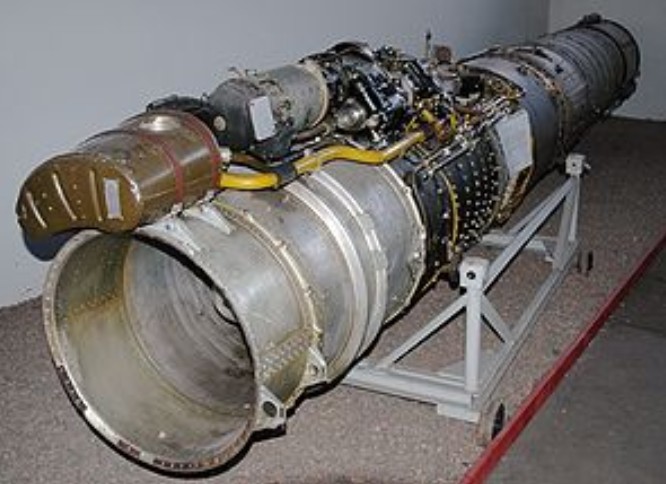
The Tumansky RD-9 (initially designated Mikulin AM-5) was an early Soviet turbojet engine, not based on pre-existing German or British designs. The AM-5 was available in 1952 and completed testing in 1953; it produced 5,732 lbf (25.50 kN) thrust without afterburner. AM-5 engine is notable for making possible the first Soviet supersonic interceptor MiG-19 and the first all-weather area interceptor Yak-25. When Sergei Tumansky replaced Alexander Mikulin as the OKB-24’s chief designer in 1956, the engine was renamed RD-9. The engine was later built under license in China as the WP-6.
Variants and applications: RD-9A
RD-9B Used in the East German civilian jetliner project Baade 152 in 1958 and 1959, replaced when Pirna 014 engines became available.
RD-9AK Non-afterburning versions for the Yak-25 and Yak-26.
RD-9AF-300 Afterburning version for the Yak-27 and Yak-28.
RD-9AF2-300 Afterburning version for the Yak-27 and Yak-28.
RD-9B Afterburning version for early MiG-19s.
RD-9BF-811 Afterburning version for later MiG-19s.
RD-9V Afterburning version used in the Ilyushin Il-40P.
WP-6 Chinese built version for the Shenyang J-6.
Specifications: RD-9BF-811 Type: Afterburning turbojet Length: 5,560 mm (219 in) Diameter: 670 mm (26 in) Dry weight: 725 kg (1,600 lb) Compressor: Axial compressor Maximum thrust: 3,000 kgf (6,600 lbf, 29 kN) military power, 3,750 kgf (8,300 lbf, 37 kN) with afterburner Specific fuel consumption: 104 kg/(h·kN) (1.02 lb/(h·lbf)) military power, 169 kg/(h·kN) (1.66 lb/(h·lbf)) with afterburner Thrust-to-weight ratio: 5.2:1
The Mikulin AM-3 (also called RD-3M) was a turbojet engine developed in the Soviet Union by Alexander Mikulin. The development of the high performance single-shaft engine began in 1948. The engine was used in different versions for the Tupolev Tu-16 and Tu-104, as well as the Myasishchev M-4. It had a single-stage blower and an eight-stage high pressure compressor, that were propelled by a two-stage high pressure turbine.
Variants: AM-3 first series version
AM-3A
AM-3D Version for M-4 with 85,6 kN thrust
AM-3M-200 AM-3M-500, AM-3M-500A: developed further versions with 93,1 kN
WP-8 Chinese copy of the AM-3 with 91,3 kN thrust for the Xian H-6 (reproduction of the Tu-16)
Specifications: Type: Turbojet engine Length: 5,380 mm Diameter: 1,400 mm Dry weight: 3,200 kg Compressor: Axial-flow Maximum thrust: 85,3 kN Specific fuel consumption: 0.932 kg (kN•h) Power-to-weight ratio:






 All Aero