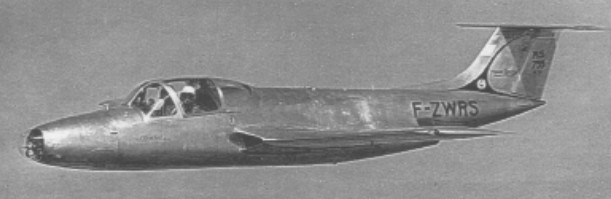
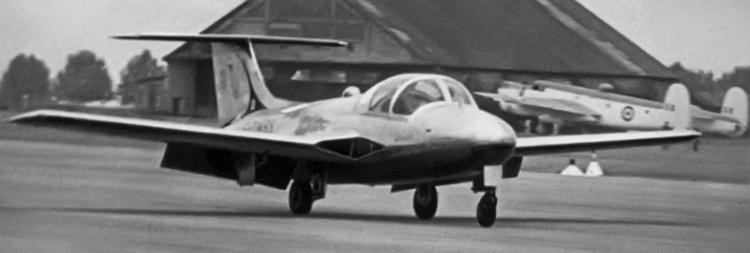
In January 1953 Morane-Saulnier flew the prototype M.S.755 Fleuret, a two-seat jet trainer which competed with the Fouga Magister for an air force order. The Fleuret lost the competition, but its design formed the basis of the Morane-Saulnier M.S.760 Paris which, designed primarily as a high-speed liaison aircraft, can be considered as a forerunner of the executive jet. Morane-Saulnier developed the Fleuret into a four seat light communications aircraft by enlarging the cabin, increasing the internal fuel capacity and strengthening the airframe.
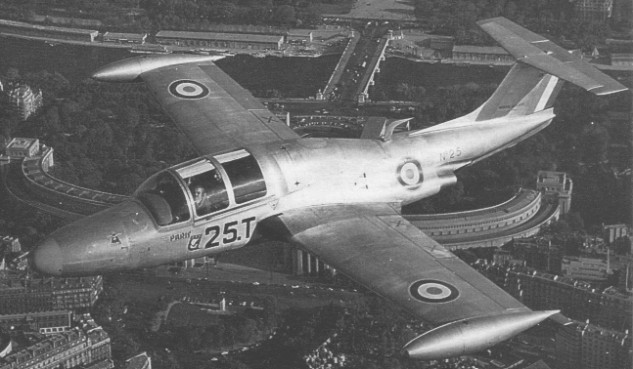
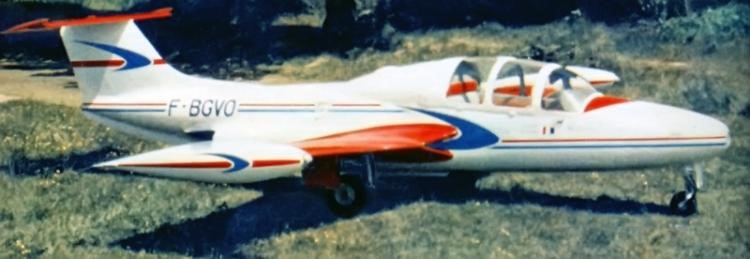
The Turboméca Mabore II powered first prototype, MS.760-01 F WGVO (then F-BGVO), was flown on 29 July 1954, and interest shown by the French military authorities resulted in orders for 50 for the air force and navy on 18 July 1956, the initial production example designated M.S.760A, flying on 27 February 1958. Fitted with tip tanks, this type was delivered as the Paris IR to the Armée de l’Air and the Aeronavale.
Two basic models will be manufactured in series. The MS 760A Paris I (one hundred and fifty built), and MS 760B Paris II (sixty-three built). The dates of the first flight respectively, February 27, 1958 and December 12, 1960.
Orders were received for 109 civil and military use, 12 MS.760A sets of components were supplied to Argentina for assembly at the Fabrica Militar de Aviones (FMA) factory in Cordoba, followed by production of 36 more. The 760 MS was purchased by Argentina in May 1957. Forty-eight Paris were operated by the Fabrica Militar de Aviones Cordoba. The first shipped to Argentina was Paris I No. 3, on 1 May 1958. By February 1959, twenty-six complete aircraft had crossed the Atlantic in separate shipments.
MS 760 of Argentina
Brazil acquired 30 for liaison, photographic survey and training. A first order of eight Paris II for Brazil was signed February 19, 1960 with twenty other options. In total, Brazil assembled forty-eight Paris II, mainly for the Air Force.
The first Paris was delivered to the Air Force as a training and liaison aircraft on 27 February 1958. The Naval Aviation were to receive a small number for the same missions as the Air Force. On a training mission, it can be armed with two 7.5mm machine guns plus four rockets or two bombs of 50 kg fixed under the wing.
At the end of 1958 the College of Aeronautics, Cranfield, received an MS.760 (No. 8) for practical demonstrations. Two were sold in the U.S., and one in Iran (delivered on 15 July.1958).
The initial production version was superseded in 1961 by the M.S.760B Paris II with 10581bst / 480kg thrust Marbore VI turbojets and various systems improvements and integral fuel tanks in wing leading edges.
When production ended in 1964 a total of 156 aircraft of the two series had been built, including 48 assembled in Argentina.
In 1969, four MS 760A were registered in France and many 760B, one registered in Italy and seven in Holland. Seven Paris II were purchased to train airline pilots at the Eelde school in Holland, the first being delivered September 14, 1962.
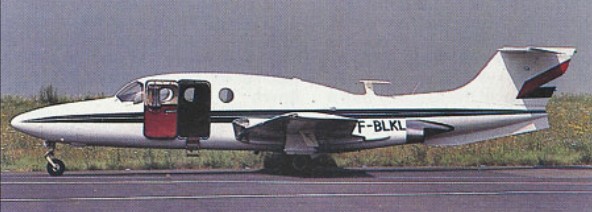
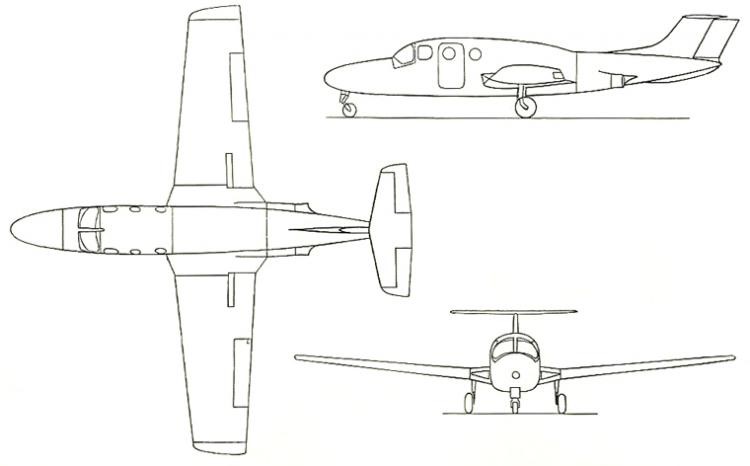
The final version was the 1963 Marbore VI-powered M.S.760C Paris III, with an enlarged wing but without tip tanks, plus increased fuel in a redesigned fully integral cabin fuselage accommodating five or six passengers, and a car-type door on port side instead of a sliding canopy. It was also fitted with an air system for cabin and pressurisation bled from the turbojet (SEMCA automatic air-conditionning system). The sole prototype, F WLKL, flew for the first time on 28 February 1964 but the variant did not find favour as a business jet and proceeded no further. Only one aircraft built, F-BLKL.
Paris III F-BLKL / 366 (cn 01)
A total of 109 MS.760A Paris I, 10 MS.760B Paris II and 1 MS.760C Paris III were built. For replacement, Argentina selected the FMA Pampa jet trainer, while France chose the TBM700 turboprop.
Two French companies, Fouga and Morane Saulnier, saw a market for such a basic jet trainer and realised the potential of the Turbomeca engines for this application. Fouga presented a proposal for a tandem two seat trainer to the French Air Ministry, the CM.130R, which was powered by two 353 lbst (160kgst) Palas engines. The design was refined and a contract for three of the resulting twin Marbore II powered CM.170R aircraft was placed with Fouga in December 1950. The Morane Saulnier company were working along similar lines at this time, and their drawing boards brought the MS.755 Fleuret. It was designed under the direction of engineer Paul-René Gauthier, who was then director of Morane-Saulnier engineering department.
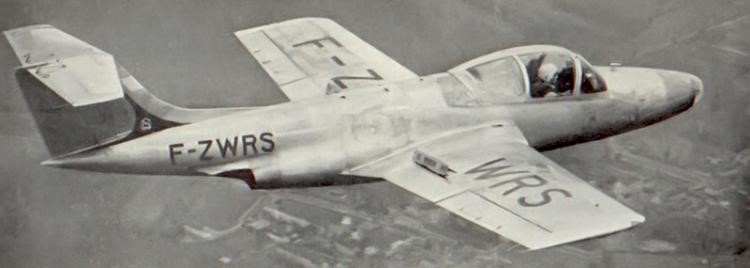
It was an all-metal mid-wing cantilever monoplane with a T-type tail. The MS.755 Fleuret featured side by side seating, the wing was set slightly lower on the fuselage and had a lower aspect ratio, the tail surfaces were conventional and the two Turbomeca Marbore II turbojet engines were faired more into the fuselage than the semi podded arrangement evident on the Magister. Air intakes were located in the wing roots. The two pilots seats were attached to an aerodynamically balanced trap in the fuselage, which operated following jettison of a hatch in the underbelly in an emergency and ejected the two occupants through the floor of the cockpit.
The construction of two prototypes was launched at the same time. Cn 01 (F-ZWRS) began its taxi tests in January 1953 (while its competitor, the Fouga Magister, made its first flight on July 23, 1952). The MS-755 made its maiden flight on 26 January 1953, with Morane-Saulnier chief test pilot Jean Cliquet at the controls, accompanied by flight engineer Ferdinand Naudy. Jean Cliquet took off from Melun-Villaroche for a 15 minute flight. The aircraft did not exceed the altitude of 800-900 m considered a limited ceiling. Two other flights were made the next day. On January 31, a flight was performed with the commander Grigaut (Head of Bretigny AB. *Flight Test Center (CEAM)). February 12 was the official flight presentation of the aircraft to President Robert Morane and the executive committee.
On 30 April 1953, the aircraft is delivred to Bretigny Flight Test Center for official qualifying tests. At that time 57 flights and almost 35 hours of flights have been made.
After stopping the program, Cn 02 was converted into four-seater as the MS-760 01.
After evaluating the merits of both aircraft, the French Air Force expressed a preference for tandem seating, and in 1953 placed an initial order for ten pre production and 95 production CM.170R Magister aircraft.
The initial success of the Magister was not lost on Morane¬Saulnier, who decided not to compete head on and thus developed the Fleuret into a four seat light communications aircraft by enlarging the cabin, increasing the internal fuel capacity and strengthening the airframe. This became the MS.760 Paris.
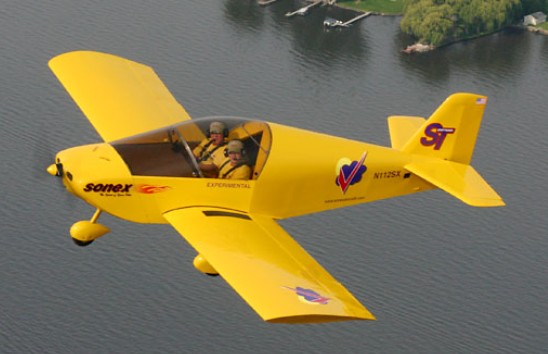
Sonex, Ltd. is a kit manufacturer in Oshkosh, Wisconsin. Their original design, the all-metal, two-seat Sonex single engine monoplane morphed into the V-tailed Waiex. Add a 45′ wingspan to that airplane, and a motorglider, the Xenos, is born. The company boasts the talents of John Monnett, creator of the Monerai sailplane and the Moni motorglider.
Designed by John Monnett as a simple airframe and power plant to create a fun VFR machine. A basic and economical all metal, two place monoplane with a hp range of 80-120. With all the metal except the main spar, pop-riveted, options include nose or tail wheel.
Designed to meet the needs of the European and Domestic sport aircraft markets, it can incorporate various light weight engines of 80 to 120 hp (engine package weight of less than 200 lbs.), and is perfectly suited to the new US Sport Pilot/LSA regulations. The three recommended powerplants include the 2180cc Volkswagon, 2200 Jabiru, and 3300 Jabiru.
Performance is achieved through its clean aerodynamic shape and simple, light weight construction. The Sonex plans contain many options, including a tailwheel or tricycle landing gear along with a center or dual stick. Motor mount drawings are supplied for all three recommended powerplants.
The Sonex features easily removable wings for transport and storage.
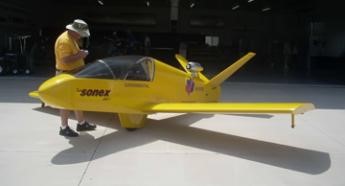
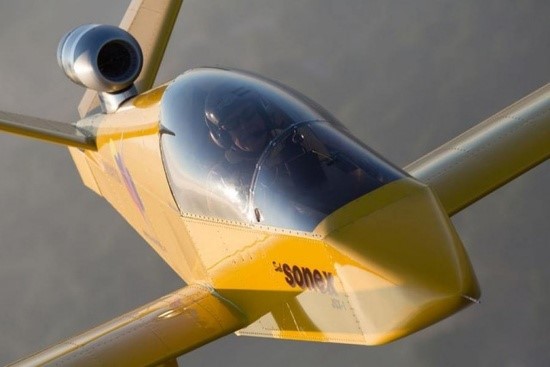
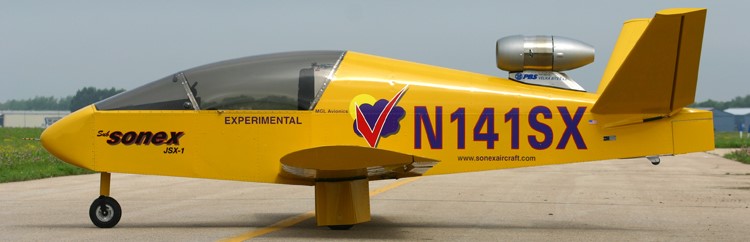
The SubSonex jet aircraft prototype, JSX-1, made its first flight on August 10, 2011 at Wittman Airport in Oshkosh, Wisconsin. Piloted by Bob Carlton, the flight lasted approximately 14 minutes and focused on low-end speed, including stalls and low approaches in the landing configuration. The engine selected for the SubSonex is the Czech-built PBS TJ-100 turbojet.
Through the course of a series of high-speed taxi tests, Sonex design team has identified some issues with controllability of the aircraft in the transition phase approaching takeoff speeds, and has decided to enter a thorough design review process aimed at making the aircraft easier to handle for the average recreational pilot.
The Subsonex originally sported a tandem landing gear with outrigger gear on each wing tip. Due to the increased power offered by the new PBS TJ-100 engine selected for the SubSonex, it was determined that a tricycle gear configuration would be needed to increase yaw stability on the ground in the transition phase approaching takeoff speeds.
SubSonex personal Jet aircraft
During Air Venture 2010, it was presented with the new fixed tricycle landing gear and the PBS TJ-100 turboJet engine.
JA21MJ Mitsubishi MRJ-90 at Nagoya Komaki on 15th September 2016
In 2003 the Japanese government started a five-year, ¥50 billion ($420 million) research program to study an indigenous regional jet for 30 to 90 passengers, led by Mitsubishi Heavy Industries (MHI). In 2004 MHI was focused on a 2m high by 2.8m-wide, four-seat abreast cabin, seating 30 to 50 passengers, and was hoping to fly a prototype in 2007 and deliver the first aircraft in 2010. In 2005 it switched to a larger 70-90 seat category. The Mitsubishi Regional Jet (Japanese: 三菱リージョナルジェット), or MRJ for short, is a twin-engine regional jet aircraft seating 70–90 passengers manufactured by Mitsubishi Aircraft Corporation, a partnership between majority owner Mitsubishi Heavy Industries and minority owner Toyota Motor Corporation with design assistance from Toyota affiliate Subaru Corporation, itself already an aerospace manufacturer.
MHI launched its concept at the 47th Paris Air Show in June 2007, showing a full-scale cabin mock-up and aiming to be the first regional jet all-composite airframe, with certification targeted for 2012. Mitsubishi formally offered the MRJ to airlines in October 2007 after being the first airframer to select the Pratt & Whitney PW1000G geared turbofan offering a 12% reduction in thrust specific fuel consumption, rated at 15,000 lbf (67 kN) thrust on the 70- to 80-seat MRJ70 and 17,000 lb thrust (75.7 kN) on the 86- to 96-seat MRJ90, projecting a ¥150 billion ($1275 million) development cost.
MHI officially launched the Mitsubishi Regional Jet Program on March 28, 2008 with an order for 25 aircraft (15 firm, 10 optional) from All Nippon Airways, targeting a 2013 introduction. Flight testing was scheduled for late 2011 and the $1.9-billion programme necessitates 300-400 sales to recoup its cost.
In September 2009 Mitsubishi unveiled extensive design changes, using aluminium instead of carbon fibre composites for the aircraft’s wings and wingbox; the remaining composite parts will make up 10-15% of the airframe: the empennage, horizontal tail and vertical tail. The cabin height is increased by 1.5 in (4 cm) to 80.5 in (204 cm) and the fuselage height is increased to 116.5 in (296 cm), giving a rounder cabin, wider and higher than its competition. The program was delayed six months with final design frozen in mid-2010, first flight delayed to the second quarter of 2012 and deliveries to early 2014.
As the MRJ90 MTOW of 39.6 t is above the US regional carriers scope clause of 39 t, SkyWest and Trans States Holdings could convert their MRJ90 orders for 100 and 50, respectively, to the 1.4 m shorter MRJ70: 67% of the 223 firm MRJ90 orders. But the MRJ70 seats only 69 in two classes and attain the 76 seats scope close limit only in all-economy: Mitsubishi wants to increase seating within its fuselage to compete with the currently compliant Embraer E-175 and Bombardier CRJ900.
On 15 September 2010, the Mitsubishi Aircraft Corporation announced that it had entered the production drawing phase and was proceeding with the manufacturing process. Assembly of the first aircraft began in April 2011 with construction of the emergency escape for the cockpit.
In early 2013, Pratt & Whitney delayed the PW1200G certification to the “latter half” of 2014, after the MRJ first flight scheduled for late 2013. On 22 August 2013, Mitsubishi announced a third delay to the program, and that the first flight would take place in the second quarter of 2015 instead of end-2013, while the first delivery to launch customer ANA would take place in the second quarter of 2017 instead of 2015, due to parts delivery problems including Pratt & Whitney engines. On 7 September 2013 were exhibited a prototype of the left wing and four aluminium sections: forward fuselage, front mid fuselage, aft mid fuselage and aft fuselage, to be assembled in October 2013. Mitsubishi has hired foreign experts to help with relations with suppliers, ground tests, flight tests, and certification.
Pictures of the first fully assembled MRJ90 were available on 26 June 2014. An official rollout occurred on 18 October 2014.
The maiden flight of the MRJ90 took place on 11 November 2015. On 24 December 2015, Mitsubishi announced a one-year delay for the first delivery of the MRJ, to mid-2018. The delay was attributed to insufficient wing strength and the redesign of the landing gear for better safety. Much of the flight testing for the MRJ90 will take place in Moses Lake, Washington, due to the crowded airspace in Japan causing scheduling difficulties. Static strength test were completed on November 1, 2016 and confirmed that the airframe could withstand 1.5 times the maximum load.
In January 2017, a further two-year delay was announced, pushing the expected first delivery to mid-2020. This resulted from moving the avionics bay and wiring looms and in March 2017 the flight certification program was extended from 2500 to 3000 flying hours. The development cost ballooned to 350 billion yen (US$3.17 billion) and the project might never able to fully recover its costs. Mitsubishi originally planned to use five flight test aircraft and two ground test aircraft.
In June 2017, 940 hours of flight tests have been done and the four prototypes have an above 98% availability. On 21 August, FTA-2 experienced a flameout 170 km (92 nmi) west of Portland International where it landed, partial damage was confirmed in the PW1200G and the test fleet was grounded until the cause is known. Flight testing resumed on 6 September.
By December 2017, the MRJ test campaign was half done with 1,500 flight hours and less than 1% cancelled due to technical issues.
In January 2018, the avionics bay rearrangement and rerouted wiring were almost complete to be adequate for extreme events such as bomb explosions or water ingress underfloor. Upgrades and ground tests were performed on four flight test aircraft from February to March 2018 at Moses Lake, preceding flight testing for natural icing, avionics and autopilot, performance, stability and control.
In April 2018, the test fleet had logged 1,900 flight hours as Mitsubishi plans displaying it at the July 2018 Farnborough air show. In May 2018, the flight-test fleet is attaining 2,000 hours and as most of the flight envelope is explored.
On 26 April 2017, the fifth MRJ was complete in ANA livery, lacking only engines and nose cone, aircraft number six and seven had their fuselage and wings joined without the tails and the eighth, the first MRJ70, was at the assembly line start; Mitsubishi could manufacture 12 aircraft concurrently: in station one are joined fuselage sections, in station two the landing gear, wings and horizontal stabilisers are attached, in section three the major components are assembled, in outfitting takes place in section four and ground tests in station five, then the completed aircraft moves to painting.
All Nippon Airways was the first customer, with an order for 15 MRJ 90s and an option for 10 more. In March 2008, and again in October 2008, Sankei Shimbun and Fuji Sankei Business I reported that the government of Japan would buy ten MRJs to serve as short-haul and small-field VIP transports, supplementing the existing Japanese Air Force One Boeing 747 aircraft.
At the July 2012 Farnborough Airshow, SkyWest agreed to buy 100 MRJ90s, to be delivered between 2017 and 2020. The deal is worth $4.2bn at list prices. During the 2013 Regional Airlines Association conference, held in Montreal, Quebec, Canada, Mitsubishi announced that ANI Group Holdings, which firmed a MoU for 5 MRJ aircraft in June 2011, cancelled the deal, without giving further details.
The MRJ future was fragile after six years of delays, with 70% of the backlog shared by two US regional carriers bounded by scope clauses: the MRJ90 is too heavy and the smaller MRJ70 accommodates seven seats less than the 76 permitted.
MRJ70 Engines: 2 x Pratt & Whitney PW1215G, 69.3 kN (15,600 lbf) Fan diameter: 56 in (142 cm) Wing span: 29.2m / 95 ft 10in Length: 33.4m / 109 ft 8in Tail height: 10.4m / 34 ft 2in Max takeoff weight: 40,200 kg (88,626 lb) Max landing weight: 36,200 kg (79,807 lb) Max zero fuel weight: 34,000 kg (74,957 lb) Typical cruise speed: Mach 0.78 (447 kn; 829 km/h) Range: 3,740 km (2,020 nmi) Operating ceiling: 11,900 m (39,000 ft) Takeoff field length (MTOW, SL, ISA): 1,720 m (5,650 ft) Landing field length (MLW, Dry): 1,430 m (4,700 ft) Passengers: 69 to 80 Seat pitch: 74–79 cm (29–31 in) – 91 cm (36 in) Cabin Height: 2.03 m / 6 ft 8in Cabin Width: 2.76 m / 9 ft 1in Cabin length: 33.4m / 109 ft 8in
MRJ90 Engines: 2 x Pratt & Whitney PW1217G, 78.2 kN (17,600 lbf) Fan diameter: 56 in (142 cm) Wing span: 29.2m / 95 ft 10in Length: 35.8m / 117 ft 5in Tail height: 10.4m / 34 ft 2in Max takeoff weight: 42,800 kg (94,358 lb) Max landing weight: 38,000 kg (83,776 lb) Max zero fuel weight: 36,150 kg (79,697 lb) Operating empty weight: 26,000 kg (57,320 lb) Fuel Capacity: 12,100 L (3,200 US gal) Typical cruise speed: Mach 0.78 (447 kn; 829 km/h) Range: 3,770 km (2,040 nmi) Operating ceiling: 11,900 m (39,000 ft) Takeoff field length (MTOW, SL, ISA): 1,740 m (5,710 ft) Landing field length (MLW, Dry): 1,480 m (4,860 ft) Passengers: 81 to 92 Seat pitch: 74–79 cm (29–31 in) – 91 cm (36 in) Cabin Height: 2.03 m / 6 ft 8in Cabin Width: 2.76 m / 9 ft 1in
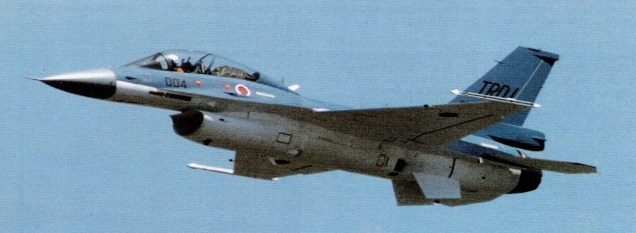
The Japanese-developed F-2 fighter support aircraft, intended to replace F-1 and based on F-16 but incorporating new technologies was developed jointly with Lockheed. The fighter uses an all-composite wing. The Japanese Defense Agency approved a 55 aircraft purchase for 2000-1.
Early in October 1987, Japan announced that the FS-X would be a derivative of an existing US aircraft, the choice of the basic airframe being either the F-16 of the F-15. The F-16 derivative was selected by the Japanese Self-Defense Agency with formal endorsement of the Japanese National Security Council in October 1987.
The first prototype flew on 7 October 1995, and the first squadron to be equipped with the F-2 was formed in 2000.
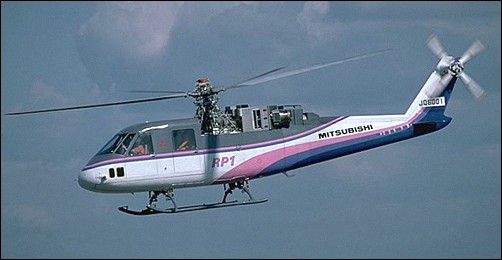
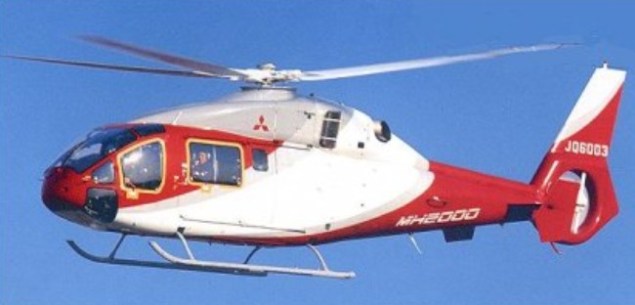
The 1994 Mitsubishi-originated helicopter programme is the MH.2000. Launched in second half of 1995, this 7/12 seat commercial helicopter was first known as the Mitsubishi RP-1. Four development MH.2000 aircraft (two flying, two for ground test), the first flew on 29 July 1996(JQ6003), followed by a second machine (JQ6004, later JA001M) in late 1996.
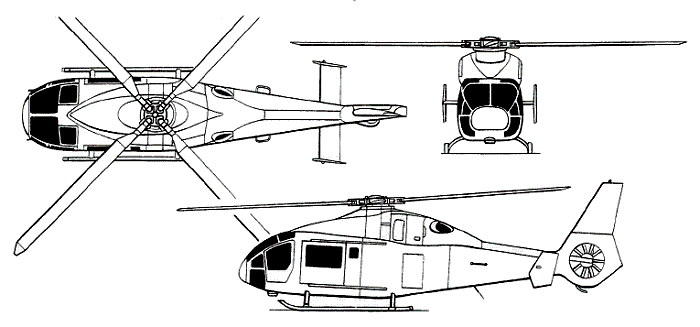
Of single main rotor configuration (four blades with tapered tips) and Fenestron-type tail rotor, the main gearbox and other drive mechanisms are in an overhead fairing located aft of the passenger cabin. There is a mid-mounted tailplane with angular endplate fins. The landing gear is a cnventional twin-skid type, and all-composites main and tail rotor blades.
Power is from two 800shp / 653kW Mitsubishi MG5-110 turboshafts, with digital electronic control permitting one-touch changeovers between high-speed and low-noise modes. Crash-resistant fuel tanks are aft of the passenger cabin, wit a maximum usable capacity of 1,132 litres.
The main cabin has forward-facing, impact-absorbing seats for eight (standard) or six persons, and a crew of two. A crew door is on each side at the front, and a; large sliding door to the main cabin on each side. A baggage compartment is aft of the fuel tanks, with external access. An avionics bay is in the rear fuselage aft of the baggage compartment.
JCAB limited certification was awarded in June 1997 and full VFR certification on 24 September 1999. First and second prototypes had flown approximately 800 hours (500 + 300) by April 1998 and the initial production rate then planned for three per year.
The first production MH2000A (JQ 6005) was handed over to customer (Excel Air Service of Japan) on 1 October 1999. Two others were sold by October 1999, to the National Aerospace Laboratory (delivered March 1999 as JA21ME) and a Japanese private customer.
By July 2000, only three production aircraft had been registered in Japan. In 2003, Mitsubishi anticipated sales of 10 per year. The fifth production aircraft was registered in April 2003.
Four of first five (three customer aircraft and one demonstrator) was recalled in August 2000 when flaws were discovered in the metal engine covers. The sixth MH2000 was on the production line at that time. Loss of one prototype due to tail rotor blade separation led to suspension of the type certificate and redesign of the tail rotor. The aircraft was re-certified with new rotor and resumed flight testing in 2002.
Mitsubishi MH2000 Crew: 1 Passengers: 6-12 Engine: 2 x Mitsubishi MG5-100 turboshaft, 597kW Main rotor diameter: 12.2m Length with rotors turning: 14.0m Fuselage length: 12.2m Height: 4.1m Fuselage width: 3.1m Max take-off weight: 4500kg Empty weight: 2500kg Max speed: 280km/h Economic cruising speed: 250km/h Range: 700km
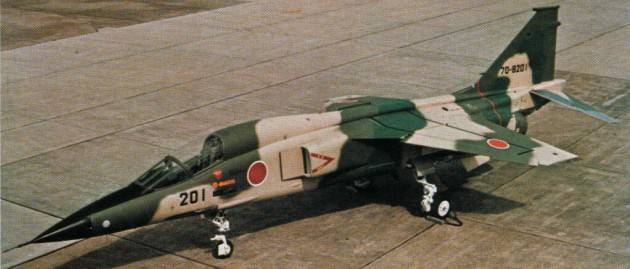
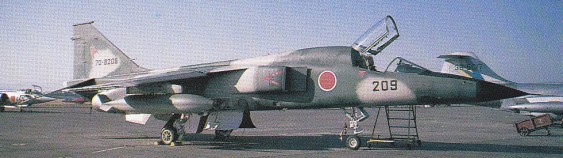
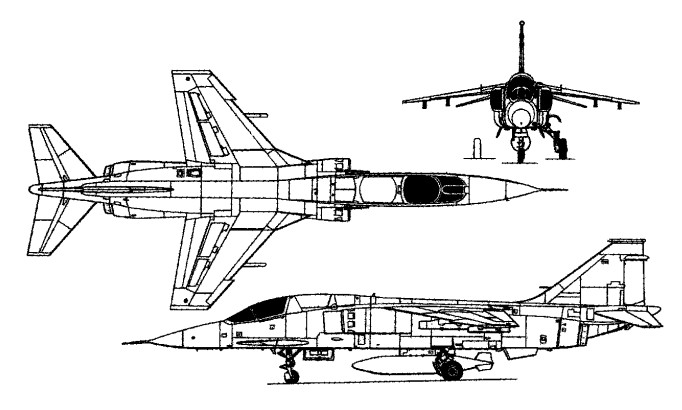
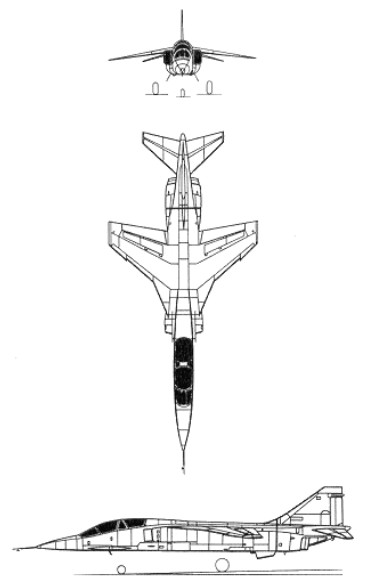
Japan’s first indigenous combat aircraft produced since the end of World War II, the F-1 originated from a 1972 decision to develop a single-seat close air support fighter from the Mitsubishi T-2 supersonic trainer. The overall performance of the latter was such that virtually no aerodynamic modifica¬tions had to be made, the principal change from the T-2 to the F-1 being the fairing over the rear cockpit for a bombing computer, inertial navigation and radar warning systems, without changing the contours. Two T-2s were converted to a single-seat fighter variant and redesignated FST-2 Kai. The first flight of this prototype (59 5107) took place on 3 June 1975, a conversion of the third production T 2 trainer.
The two prototypes were modified T-2s with weapons systems equipment and test instrumentation in the rear cockpits. Powered by two 7,070 lb st / 3207kg with afterburning Ishikawajima-Harima TF40-IHI-801A (licence-built Rolls-Royce/Turbomeca Adour) turbofans, the F-1 was armed with a single 20mm JM61 multi-barrel cannon in the lower front fuselage and had provision for up to 2721kg of bombs or rockets on the fuselage centreline and four wing hardpoints. Normal armament comprised two ASM-1 air-to-surface missiles and two or four AIM-9 Sidewinder AAMs.
Its primary task in the Japanese Self Defense Force was anti-shipping with the 50km range ASM-1 anti-ship missile as its primary weapon. It is equipped with the J/AWG-12 radar which has two operating modes, air-to-air and air-to-surface, and is compatible with the ASM-1 missile. It has an air-to-air capability using the AIM-9 IR seeking missile, but because of its short range this capability is only limited.
The Air Self-Defence Force purchased 77 F-1s, and the first production example (70¬8201) of the Mitsubishi F 1 was flown on 16 June 1977. First deliveries of the initial 59 aircraft ordered began in 1977 to the 3rd Squadron of the JASDF’s 81st Air Wing were made on 26 September 1977, and in April 1978 the first F-1 entered JASDF (Japanese Self Defense Force) service. All were delivered by 1987.
70 were retrofitted during 1991-93 to enable them to remain in Air Self-Defence Force service until 1999-2000. The retrofit included installation of an advanced fire control system, provision of a stronger cockpit canopy and compatibility with the ASM-2 anti-shipping missile and XGCS homing bomb.
The F-1 was scheduled to be replaced by the F-2.
Mitsubishi F-1 Engines: two 32.49 kN (7,305 lb st) Ishikawajima-Harisma TF40-IHI-801 (license built Rolls-Royce/Turbomeca Adour Mk 801A) afterburning turbofans Wing span 7.88m (25 ft 10¼ in) Length 17.86m (58 ft 7 in) Height 4.39m (14 ft 5 in) Wing area, 228 sq ft (21,18 sq.m) Empty weight, 14,017 lb (6 358 kg) Max loaded weight, 30,146 lb (13 674 kg) Max speed, 1,056mph (Mach 1.6 / 1700 km/h) at 40,000 ft (12 190 m) Service ceiling 15240m (50,000 ft) Initial climb, 35,000 ft/ min (177,8 m/sec) Combat radius, 346 mls (556 km) Max range: 1100 km / 684 miles Armament: one JM61 Vulcan 20mm multi-barrel cannon with 750 rounds Hardpoints: 5 Bombload: 2721 kg (6,000 lb)
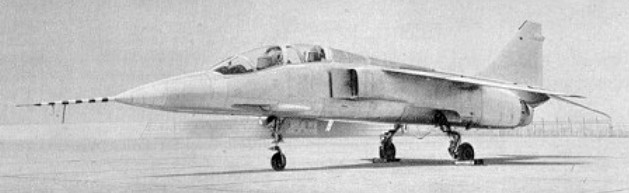
The T-2 was the first supersonic aircraft developed by the Japanese aircraft industry. It is a twin-engined two-seat jet trainer designed to meet the requirements of the JASDF. The first XT-2 prototype took to the air on 20 July 1971 and flew supersonically for the first time in level flight (Mach 1.03) during its 30th flight on 19 November 1971.
Armed with the 20mm Vulcan rotary cannon, production orders were placed for 92 T-2s: 28 T-2 advanced trainers, 62 T-2A combat trainers, and two as prototypes for the F-1 close-support fighter version. All of them retired from service by 1988.
Two T-2s were converted to a single-seat fighter variant and redesignated FS-T-2 Kai. The Mitsubishi FS-T2 Kai single seat close support fighter prototype (59 5107) was the first to fly on 3 June 1975, a conversion of the third production T 2 trainer. Designated F 1 in production form.
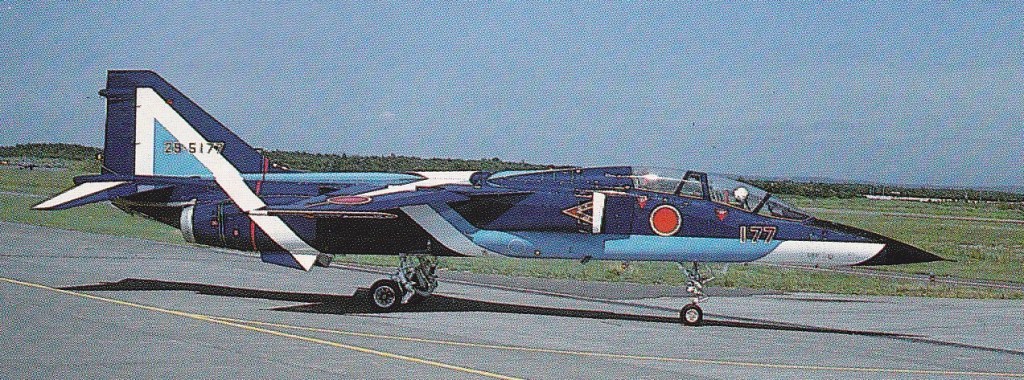
Mitsubishi T-2 29-5177 of JASDF ‘Blue Impulse’ team, Chitose, August 1982
A T-2 supersonic twin-turbofan advanced trainer modified to serve as a Control Configured Vehicle (CCV) testbed and distinguished by new horizontal canard and vertical control surfaces flew in August 1983. An extensive test programme undertaken by the JASDF/TRDI had achieved a total of 138 flights by March 1986, exploring all flight regimes including relaxed-stability and direct side force control.
Engines: 2 x Rolls Royce Turbomecca Adour turbofan, 22.8kN / 70 lb Wingspan: 7.9 m / 25 ft 11 in Length: 17.9 m / 58 ft 9 in Height: 4.5 m / 14 ft 9 in Wing area: 21.2 sq.m / 228.19 sq ft Max take-off weight: 9650 kg / 21275 lb Empty weight: 6200 kg / 13669 lb Max. speed: M1.6 Ceiling: 15250 m / 50050 ft Range w/max.fuel: 2870 km / 1783 miles Armament: 1 x 20mm cannon, 8-12 bombs, 2-4 missiles Crew: 2
Single seat single engined high wing mono¬plane with conventional three axis control. Wing has swept back leading and trailing edges, and tapering chord; no tall. Pitch/roll control by stabilators; yaw control by tip rudders; control inputs through stick for pitch/roll and pedals for yaw. Cantilever wing: wing profile NACA 23015; double surface. Undercarriage has three wheels in tricycle formation; suspension on all wheels. Push right go right nosewheel steering con¬nected to yaw control. Optional brake on nosewheel.
Aluminium tube/wood/steel tube framework, with optional pod. Engine mounted below wing driving pusher propeller.
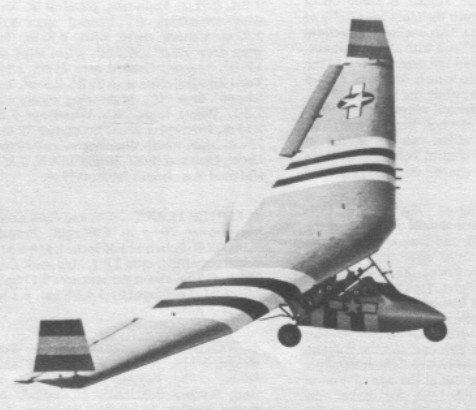
A hang gliding fanatic, Dr H Long, gave Don Mitchell control of a high performance wing. By 1975 this same wing had become the B 10. The first powered version now carries the designation of B40F (F for foot launch). The aircraft is in effect a wing, supporting beneath its lower surface a rigid frame formed by two sets of struts in the shape of an N, at the back of which is mounted a McCulloch Mc101 12hp engine with direct drive to a two blade pusher propeller.
Very quickly Don Mitchell fitted the framework with a tricycle undercarriage with a nosewheel steered by the rudder bar, while a more elaborate version of the B 10 was shown at Oshkosh in August 1981, fitted with a glass fibre fairing and main wheel spats. By 1980, more than 500 sets of plans or kits for the B 10 had been sold. Previously only sold as sets of plans or as a kit, the B 10 Mitchell Wing has been offered factory built, since September 1982.
The structure of each wing has five central ribs in a wooden lattice with six ribs on either side, all of quite conventional construction. The thick plywood spar has D shaped pieces of polyurethene foam resting on it every 4.3 inch (11 cm), which are then covered in 0.04 inch (l mm) thick sheets of plywood to form the leading edge. The control surfaces are made in the same way except for the rudders which have a tubular metallic spar. The covering is of Dacron or aviation quality Ceconite.
Due to the absence of a tail, roll and pitch control are both provided by stabilators, which span most of each half wing. Controlled from the stick, these stabilators act differentially like ailerons and together as elevators, while the rudders can also act as air brakes. The B 10 Mitchell Wing has dropped the Mc101 engine in favour of the Zenoah G25B. According to Mitchell Aircraft, con¬struction requires 250h of work. The 1983 prices are $6995 ready built, economy kit $1995 (without engine, instru¬ments and undercarriage), homebuilder’s kit $1295 (including raw materials and all hard¬ware but without engine, undercarriage, paint or glue), power pack $1595, tricycle undercarriage $495 and plans $125.
Units and plans delivered by June 1981 1,200 + kits.
Basically a strengthened B 10, the 1981 prototype of the XF 10 was originally shown by Mitchell Aircraft under the name of SR 10 and is a modified version of the B 10 Mitchell Wing, intended for the military market. This machine is today offered as a kit for an extra $1100 on top of the price of a B 10, compared with which the XF 10 is structurally reinforced and has a faired cockpit as standard. Like the standard B 10, the XF 10 uses the single cylinder Zenoah G2513 1.
Plans for the Mitchell wing B-10 became available from Richard Avalon at US Pacific, 892 Jenevein Ave., San Bruno, CA 94066. The B-10 has held world records by George Worthington. Richard worked with Don just before Don’s death and was not able to carry forward with some planned designs, but Richard is offering Don’s plans.
The Mitchell B-10J is a package available from Jim Gordon’s Micro Aviation. The US$5200 package includes a Garrett JFS100-13 originally used as a starter for the TF-41 engine in the A-7 Corsair. Including throttle package, lubrication and tailpipe assembly, the engine weight is 53 lb, and replaces the Zenoah. First flights were in February 1996, with 80 lb thrust.
Variation: Bremner Mitchell B10 Wing Special
B-10 Engine: Zenoah G2SB 1, 23 hp at 6500 rpm Propeller diameter 44 inch, 1.11 m Toothed belt reduction, ratio 3.0/1 Max static thrust 165 lb, 75 kg Power per unit area 0.17hp/sq.ft, 1.8hp/sq.m Fuel capacity 3.0 US gal, 2.5 Imp gal, 11.4 litre Length overall 6.0ft, 1.83 m Height overall 4.0ft, 1.21m Wing span 34.0ft, 10.36m Chord at root 6.0ft, 1.83 m Chord at tip 2.0 ft, 0.61 m Dihedral (On outboard part of wing) 6 deg Sweepback 12 deg Total wing area 136 sq.ft, 12.6 sq.m Wing aspect ratio 8.5/1 Nosewheel diameter overall 10 inch, 25 cm Main wheels diameter overall 10 inch, 25cm Empty weight 185 lb, 84kg Max take off weight 525 lb, 238kg Payload 340 lb, 154kg Max wing loading 3.86 lb/sq.ft, 18.8kg/sq.m Max power loading 22.8 lb/hp, 10.3kg/hp Load factors; +4.2 ultimate Max level speed 55 mph, 88 kph Max cruising speed 45 mph, 72kph Stalling speed 25mph, 40kph Max climb rate at sea level 300 ft/min, 1.5 m/s Min sink rate 225ft/min at 35mph, 1.1m/s at 56 kph Best glide ratio with power off 16/1 Take off distance 175ft, 53m Landing distance 175 ft, 53 m Service ceiling 12,000 ft, 3648 m Range at average cruising speed 135 mile, 217 km
XF 10 Engine: Zenoah G2SB 1, 23 hp at 6500 rpm Propeller diameter 44 inch, 1.11 m Toothed belt reduction, ratio 3.0/1 Max static thrust 165 lb, 75 kg Power per unit area 0.17hp/sq.ft, 1.8hp/sq.m Fuel capacity 6.0 US gal, 5.0 Imp gal, 22.7 litre Length overall 6.0ft, 1.83 m Height overall 4.0ft, 1.21m Wing span 34.0ft, 10.36m Chord at root 6.0ft, 1.83 m Chord at tip 2.0 ft, 0.61 m Dihedral (On outboard part of wing) 6 deg Sweepback 12 deg Total wing area 136 sq.ft, 12.6 sq.m Wing aspect ratio 8.5/1 Nosewheel diameter overall 10 inch, 25 cm Main wheels diameter overall 10 inch, 25cm Empty weight 200 lb, 91kg Max take off weight 600 lb, 272kg Payload 400 lb, 181kg Max wing loading 4.41 lb/sq.ft, 21.5 kg/sq.m Max power loading 26.1 lb/hp, 11.8kg/hp Never exceed speed 50mph, 80kph Stalling speed 25mph. 40 kph




 All Aero