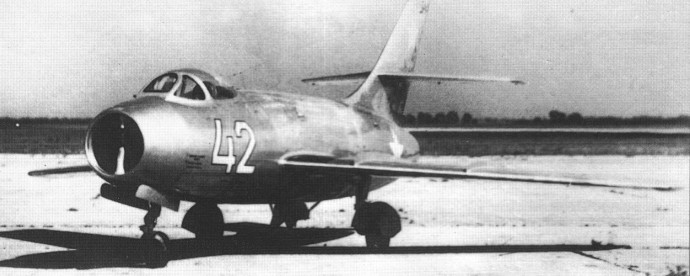
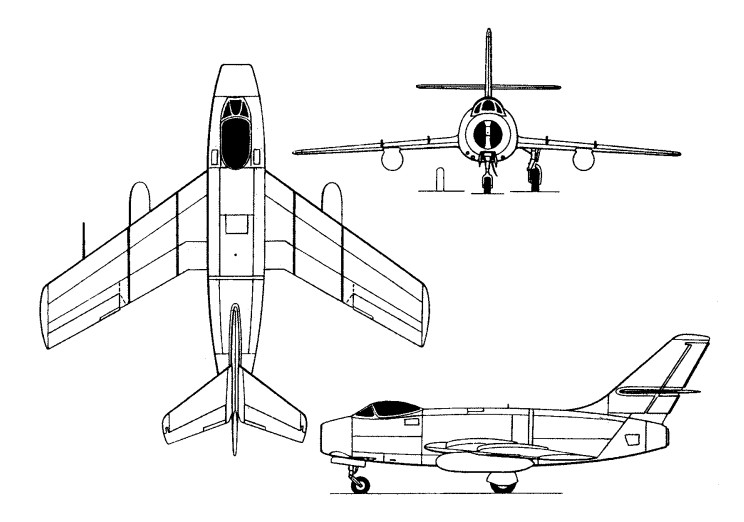
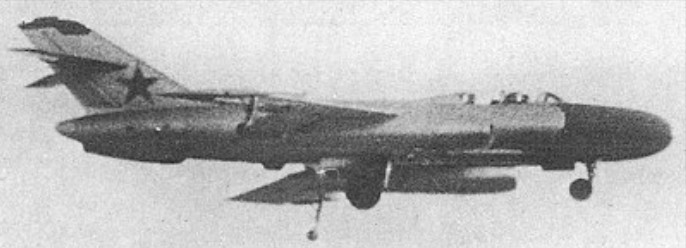
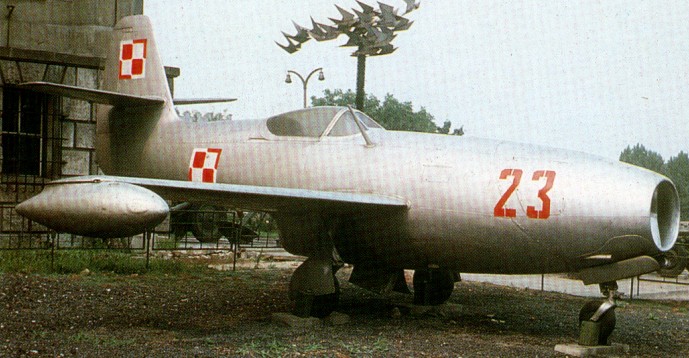
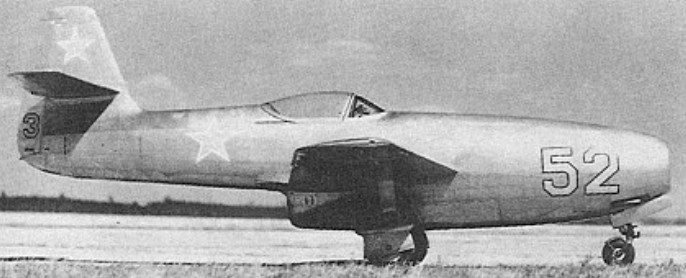
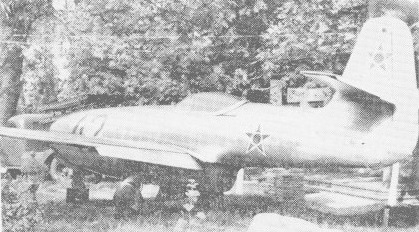
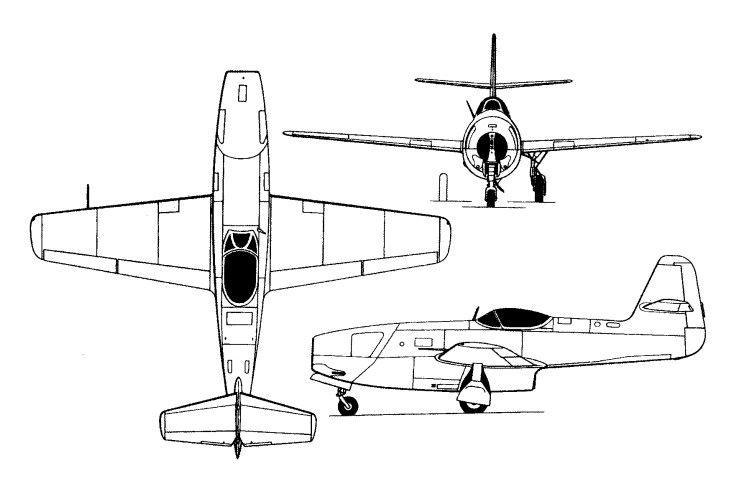
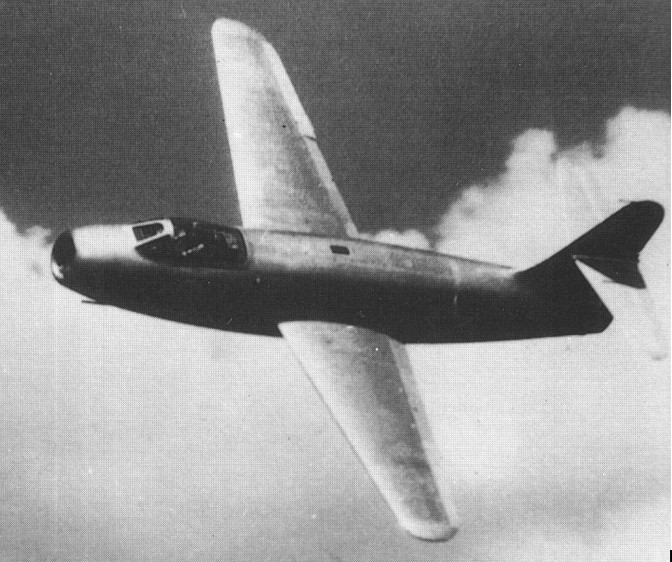
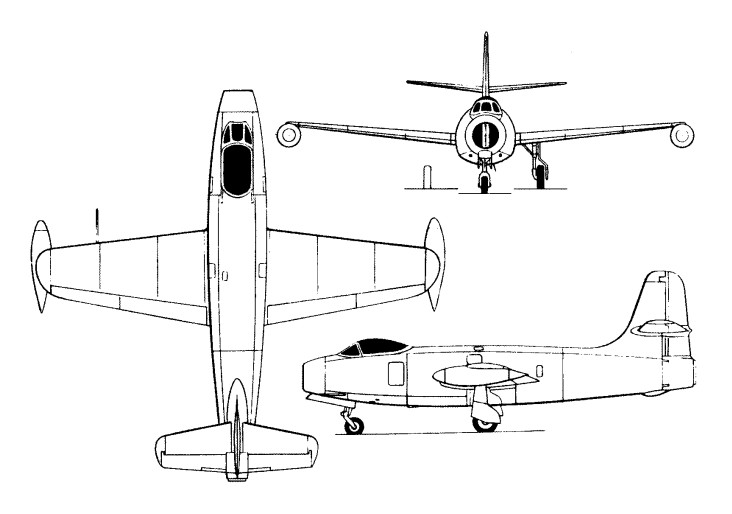
The Yakolev OKB’s response to the March 1946 requirement for a Rolls-Royce Derwent-powered Mach=0.9 “frontal” or general-purpose tactical fighter suitable for use from existing unpaved airfields was the Yak-30. Derived from the Yak-25 from which it differed primarily in having wings sweptback 35 degrees at quarter chord, the Yak-30 retained the fuselage, tail surfaces and undercarriage of the earlier fighter fundamentally unchanged, together with the three-NR-23 cannon armament. Powered by a 1590kg RD-500 turbojet, the first of two Yak-30 prototypes was flown on 4 September 1948. The second prototype, the Yak-30D, which joined the flight test programme early in 1949, had a 38cm section inserted in the aft fuselage, revised mainwheel doors forming a large section of the fuselage skinning, Fowler-type flaps in place of split flaps, increased fuel and ammunition capacity, and changes to the oxygen system and radio equipment. The Yak-30D was also fitted with air brakes on the aft fuselage. Normal loaded weight (without external fuel) was increased by 110kg. Although the modifications introduced by the Yak-30D eradicated several shortcomings displayed by the first prototype, the first production deliveries of the superior MiG-15 were already taking place by the time that the improved version of the Yakolev fighter entered flight test, and the results of NIl V-VS trials were, therefore, little more than academic.
Yak-30 Max take-off weight: 3330 kg / 7341 lb Empty weight: 2415 kg / 5324 lb Wingspan: 8.65 m / 28 ft 5 in Length: 8.58 m / 28 ft 2 in Wing area: 15.10 sq.m / 162.53 sq ft Max. speed: 1010 km/h / 628 mph Ceiling: 15000 m / 49200 ft Range w/max.fuel: 1720 km / 1069 miles Crew: 1
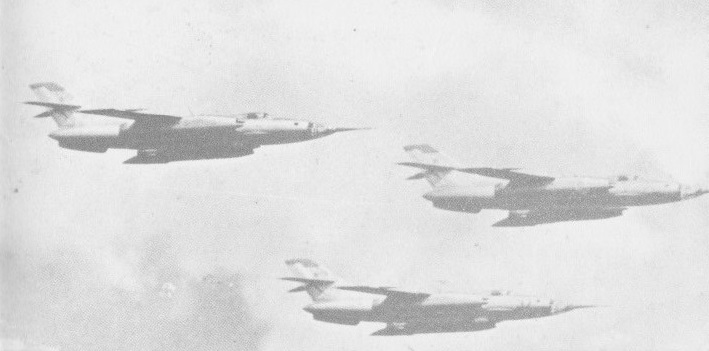
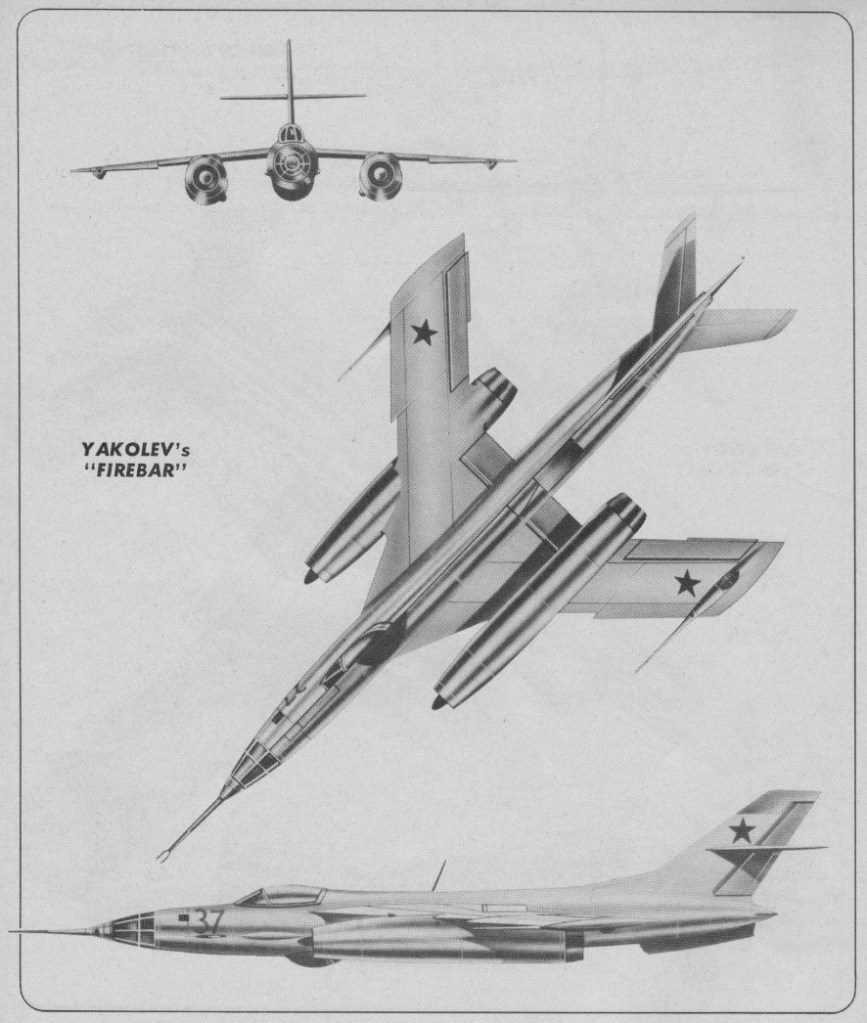
A light bomber and reconnaissance aircraft (NATO code name ‘Brewer’), and all weather fighter (NATO code name ‘Firebar’) and trainer (NATO code name ‘Maestro’). The Yakolev Yak-28P Firebar was a two-seater transonic all-weather twin-jet interceptor with a maximum speed of Mach 1.1 at 35,000 feet and a service ceiling of 55,000 feet. The Yak-28 first flew on 5 March 1958.
Possessing no more than a configurational similarity to preceding twin-engined Yakolev combat aircraft, the Yak-129 multi-role aircraft was first flown on 5 March 1958 in tactical attack bomber form. Powered by two Tumansky R-11AF-300 turbojets each rated at 5750kg with afterburning and 3880kg maximum military power, the Yak-129 had a shoulder-mounted wing swept back 63 degrees inboard of the engine nacelles and 44 degrees outboard. Although of zero-track arrangement as on the Yak-25 and -27, the undercarriage of the Yak-129 consisted of long-base twin-wheel units sharing aircraft weight almost equally.
Assigned the service designation Yak-28 and first shown publicly during the 1961 Aviation Day Display in Moscow, the first series version of the aircraft was the Yak-28B with an RBR-3 radar bombing system. This was followed by the Yak-28I and -28L tactical attack aircraft, differing in avionic equipment, which were joined under test during 1960 by the Yak-28P dedicated all-weather interceptor fighter. This featured tandem cockpits for the two crew members and was intended for low- and medium-altitude operation with an Orel-D radar and one beam-riding and one radar-homing R-30 (K-8M) AAM. The Yak-28P entered IA-PVO service during the winter of 1961-62.
The Yak 28 series, comprising the Brewer bomber in addition to the Firebar intercepter, was substantially larger and more powerful than its predecessor. Area ruling was adopted for the fuselage and the wing, of increased area, carried 50 degrees of sweepback on the inboard leading edge. Firebar is powered by a pair of Tumansky R 11 turbojets, the power of which has progressively been uprated since the aircraft entered service. Late production versions are powered by variants rated at an estimated 4600 kg (10140 lb) of dry thrust each, or 6200 kg (13670 lb) with afterburning.
The major differences from the Brewer, which was developed in parallel, lay in the forward fuselage. A radome replaced Brewer’s glazed nose, and the windscreen of the two crew cockpit was, along with the forward undercarriage leg, mounted some 76.2 cm (2.5 ft) further forward in the intercepter version. The internal weapons bay fitted to Brewer was deleted from the intercepter, and Firebar’s lengthened fuselage was later also adopted for the strike variant. A longer and more pointed radome was fitted to later production Firebars. Firebar is fitted with an X band Skip Spin search and fire control radar operated by the rear crew member.
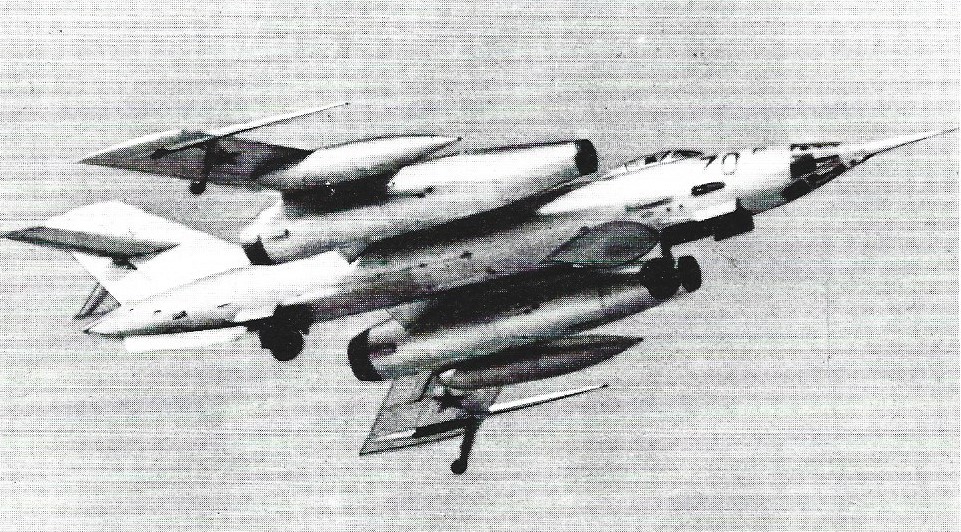
Standard armament comprises four AA 3 Anab air to air missiles, two of which use infrared guidance while the other pair employ semi active radar homing. A Yak 28P has been displayed with one Anab and one AA 2 Atoll under each wing, but this is thought to have been only an experimental installation. Firebar had by 1978 been mainly replaced by the Flagon E variant of the Sukhoi Su 15.
Brewer
Progressive upgrading resulted in R-11AF-2-300 engines uprated to 3950kg and 6120kg with afterburning, and enclosed by forward-lengthened nacelles, a longer, sharply-pointed radome housing an upgraded radar and affording lower supersonic drag and reduced erosion, and an additional stores station beneath each wing permitting two short-range dogfight IR missiles to be carried. With all these changes incorporated the designation was changed to Yak-28PM. With further upgrading, the fighter was evaluated as the Yak-28PD, but this suffered high-speed aileron reversal during trials, and by the time that this problem had been overcome production of the Yak-28P was phasing out, terminating in 1967 with limited production of the Yak-28PP electronic warfare version. Production of the fighter totalled 437 aircraft.
Yak-28P Span: 12.5 m (41 ft) Length: 22 m (72 ft 2.25 in) Gross weight: 18500 kg (40785 lb) Maximum speed: Mach 1.15 (all figures estimated)
Yak-28PM Max take-off weight: 15700 kg / 34613 lb Wingspan: 11.64 m / 38 ft 2 in Length: 20.65 m / 68 ft 9 in Max. speed: 1890 km/h / 1174 mph Ceiling: 16000 m / 52500 ft Range: 2630 km / 1634 miles
In 1955, the Yakolev OKB flew the prototype of a light tactical bomber, the Yak-26, which, evolved from the Yak-25, embodied aerodynamic refinement and was powered by two Tumansky RD-9AK turbojets each rated at 3250kg with afterburning. During test, the Yak-26 achieved 1235km/h at 3000m, or Mach = 1.05, but suffered from serious instability at high attack angles, development consequently being discontinued in favour of a tandem two-seat all-weather fighter, the Yak-27, as a potential successor to the Yak-25. Similarly powered to the Yak-26 and flown in 1956, the Yak-27 featured extended wing root leading edges increasing sweepback inboard of the engine nacelles to 62 degrees, and a sharply pointed nose radome to reduce drag and lessen rain erosion. Armament remained paired 37mm N-37L cannon, but provision was made to supplement this with two RS-2U beam-riding AAMs. Parallel development was undertaken of a tactical reconnaissance aircraft, the Yak-27R, which accommodated the navigator in a pointed, glazed nose. Recurrence of the instability problems that had afflicted the Yak-26 led to major redesign of the wing, broader-chord outer panels being introduced and the tips were extended beyond the outriggers which were enclosed by streamlined under-wing blisters. The Yak 27P was dubbed Flashlight C on its appearance at the Tushino Soviet Aviation Day in 1956.
Series production of the Yak-27 fighter was not undertaken – although 180 examples of the Yak-27R were built – but a single-seat mixed-power development, the Yak-27V, underwent extensive evaluation. Intended as a high-altitude interceptor and first flown in May 1957, the Yak-27V was powered by two RD-9Ye turbojets with an afterburning thrust of 3800kg each and a tail-mounted Dushkin S-155 bi-fuel rocket motor of 1300kg. Basic armament remained two 37mm cannon. The Yak-27V attained zoom altitudes of up to 25000m during a test programme that continued for two years, but the disbandment of the Dushkin OKB and a loss of interest in rocket propulsion resulted in termination of the programme.
Max take-off weight: 11340 kg / 25001 lb Wingspan: 11.90 m / 39 ft 1 in Length: 16.76 m / 55 ft 0 in Height: 4.05 m / 13 ft 3 in Max. speed: 1150 km/h / 715 mph Ceiling: 15250 m / 50050 ft Range: 3000 km / 1864 miles
In 1955, the Yakolev OKB flew the prototype of a light tactical bomber, the Yak-26, which, evolved from the Yak-25, embodied aerodynamic refinement and was powered by two Tumansky RD-9AK turbojets each rated at 3250kg with afterburning. During test, the Yak-26 achieved 1235km/h at 3000m, or Mach = 1.05, but suffered from serious instability at high attack angles, development consequently being discontinued in favour of a tandem two-seat all-weather fighter, the Yak-27
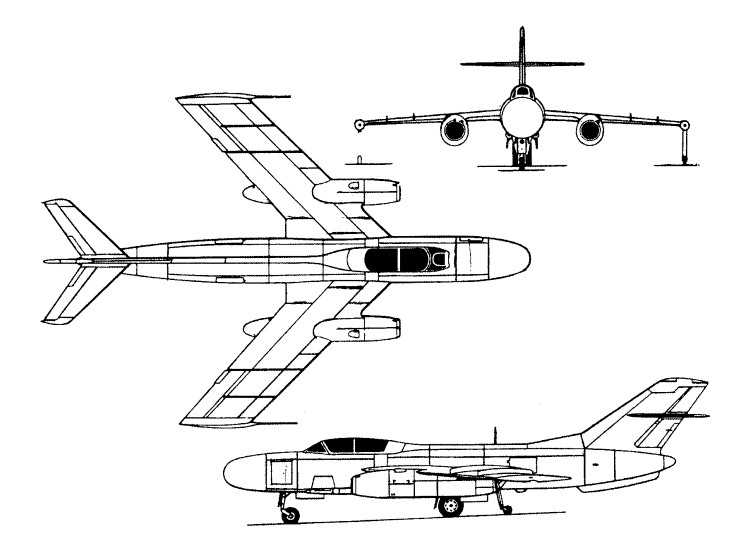
In the summer of 1951, the NKAP issued a requirement for an all-weather interceptor fighter possessing sufficient internal fuel capacity to mount standing patrols of up to 2.5 hours duration and capable of accommodating a large, new radar. This supplanted an earlier requirement to which the Mikoyan-Gurevich I-320 and Lavochkin La-200 had been evolved. The new radar, known as the Sokol (Falcon), had a 80cm diameter dish, three different scan modes and an installed mass weight of almost 500kg. To meet this new requirement, the Lavochkin and Yakolev OKBs respectively developed the La-200B and Yak-120. The latter, an all-metal stressed-skin tandem two-seater, was powered by a pair of small-diameter Mikulin AM-5A turbojets each rated at 2200kg / 4850-lb and hung beneath a wing swept back 45 degrees at quarter chord and carrying some 3 degrees of anhedral, and mounted in full-mid position. The undercarriage was of zero-track type, with wingtip-housed outrigger stabilisers, and armament comprised two 37mm N-37L cannon with their barrels accommodated in external fairings beneath the fuselage.
From 1957 the Mikulin AM 5 turbojets were replaced in the definitive Yak 25F by Tumansky RD 9s of 2600 kg (5730 lb) thrust, increasing the maximum speed.
The first of three Yak-120 prototypes was flown on 19 June 1952, State acceptance testing paralleling construction of a pre-series of 20 aircraft for avionics development and, commencing late 1953, service evaluation. With ballast equivalent in weight to the Sokol radar – which did not attain service status until late 1955 – the Yak-120 had a loaded weight of 9220kg, series production commencing late 1953 as the Yak-25 with RD-9 turbojets each rated at 2630kg. Confusing repetition of the “Yak-25” designation resulted from its initial use as an OKB appellation and subsequent use by the NKAP as an official and sequential designation, the previous Yakolev service fighter having been the Yak-23. The Yak-25 was assigned primarily to defence sectors in the Far North of the USSR, production being completed in 1958 after the delivery of 480 aircraft and service phase-out taking place in the mid ‘sixties.
The production programme took the type right through toward the end of the 1960s in role-differentiated models designated Yak-25, Yak-26 and Yak-27 with swept wings and on the Yak-25RD high-altitude reconnaisance version with straight wings.
The intercepter was codenamed Flashlight-A by NATO’s Air Standards Coordinating Committee, Flashlight B being a reconnaissance variant developed concurrently for service with the Soviet air force’s frontal aviation or tactical air arm.
A tactical reconnaissance derivative with the navigator accommodated in a glazed nose was built in 1953 as the Yak-125, but was not produced in series owing to prior adoption of the IL-28R. Other derivatives of the basic design were the Yak-25L ejection-seat test bed with individual cockpits, and the Yak-25RV long-range high-altitude strategic reconnaissance aircraft.
The Yak 25R carried the second crew member in a pointed glazed nose instead of behind the pilot, and armament was reduced from the intercepter’s pair of 37 mm (1.46 in) NR 37 cannon to a single 23 mm (0.90 in) weapon in the right-hand side of the forward fuselage.
Engines: 2 x Klimov VK-5, 8820 lb thrust Max take-off weight: 10900 kg / 24031 lb Wingspan: 11.00 m / 36 ft 1 in Length: 15.67 m / 51 ft 5 in Height: 4.32 m / 14 ft 2 in Wing area: 28.94 sq.m / 311.51 sq ft Max speed: 1090 km/h / 677 mph Cruise speed: 820 km/h / 510 mph Ceiling: 13900 m / 45600 ft Range: 2730 km / 1696 miles Armament: 2 x 37m cannon
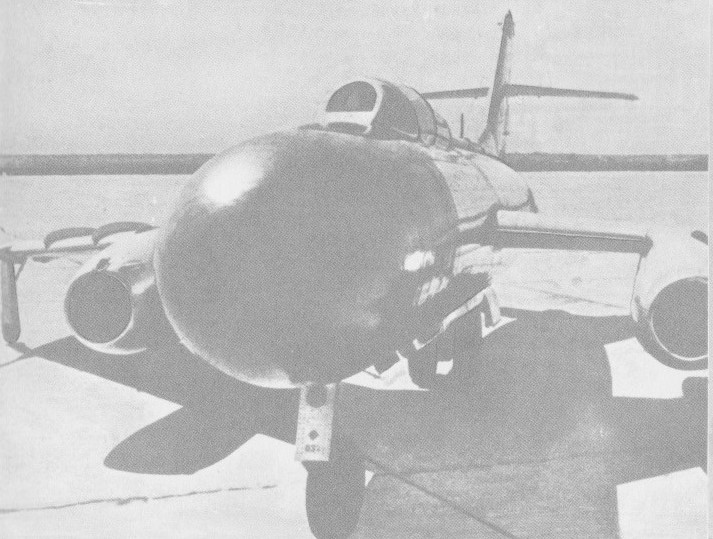
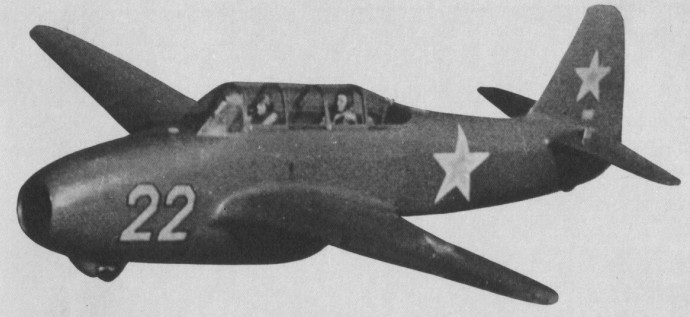
This type resulted from an October 1946 requirement, and as one of the bureau’s first all-metal stressed-skin designs was based on a “stepped” fuselage with the RD-500 engine (in essence a British unit, the Rolls-Royce Derwent V centrifugal-flow turbojet, built in the USSR) located in the forward fuselage and ex¬hausting below the fuselage in line with the cockpit and trailing edges of the unswept wing. This kept the engine installation as short as possible, and so avoided the efficiency losses associated with a long jetpipe. The Yak-23 possessed wing and horizontal tail surfaces similar to those of the Yak-19, and was intended to fulfil a requirement for a lightweight day interceptor capable of operating from existing fields. The first of three prototypes of the Yak-23, which were of all-metal stressed-skin construction and powered by imported Rolls-Royce Derwent turbojets, was flown on 17 June 1947. Seen as something of a back-up for the very much more advanced Nene-engined fighters with wing sweep-back then under development, the Yak-23 proved itself an outstandingly agile warplane. NATO code name Flora. Manufacturer’s trials were completed on 12 September 1947. State Acceptance testing had been successfully completed before the year’s end and series production began in the late spring of 1948. The series Yak-23 was powered by a Soviet copy of the Derwent known as the RD-500 – a designation derived from GAZ-500, the factory in which the engine was produced – and rated at 1590kg. Its armament consisted of two 23mm NS-23 (later NR-23) cannon. Deliveries to the V-VS began early in 1949, by which time the first production examples of the MiG-15 had already flown. In consequence, only two V-VS regiments reportedly re-equipped (from the Yak-17) with the Yak-23, which was quickly released for export. Twelve were delivered to Czechoslovakia during 1950 (and there assigned the designation S101) and the supply of some 95 to Poland began late that year, while, in 1951, 12 each were delivered to Romania and Bulgaria. Both Czechoslovakia and Poland were to have licence-built the Yak-23 but, in the event, manufactured the MiG-15, and Soviet production of the Yakolev type terminated in 1950 with 310 built.
One example was converted by the OKB as a tandem two-seat conversion trainer (Yak-23UTI), this first being flown in the spring of 1949. One Yak-23 was rebuilt as a tandem two-seater in Romania, but the type had given place to the MiG-15 in all Warsaw Pact air forces by the mid ’50s.
Bulgarian Yak-23
Principal versions – Yak-23 (basic fighter model) and Yak-23UTI (two seat conversion trainer whose production is unconfirmed). Principal users – Czechoslovakia, Poland, Romania, USSR, and possibly other Warsaw Pact countries.
Engine: one 3,505-lb (1,590-kg) thrust RD-500 turbojet Wing span 28 ft 7.75 in (8.37 m) Length 26 ft 7.75 in (8.12 m) Wing area 145.32 sq ft (13.50 sq.m) Height: 10.827 ft / 3.31 m Empty weight 4,409 lb (2,000 kg) Maximum take-off weight 7,460 lb (3,384 kg) Maximum speed 606 mph (975 kph) Initial climb rate 9,252 ft (2,820 m) per minute Service ceiling 48,555 ft (14,800 m) Range 746 miles (1,200 km) Armament: two 23-mm cannon Bombload two 132-lb (60-kg) Crew: 1
Virtually simultaneously with redesign of the Yak-15 to produce the Yak-17, the Yakolev OKB embarked upon the design of a more advanced single-seat fighter, the Yak-19. Utilising a straight-through airflow arrangement, the Yak-19 employed a 12% thickness straight wing. The Yak-19 accommodated all fuel within the fuselage. Of all-metal stressed-skin construction with a semi-monocoque fuselage, the Yak-19 had a laminar-flow wing of TsAGI S-l-12 section, and armament of two 23mm cannon. Equipped with an ejection seat, it was the first Soviet fighter to be fitted with an afterburner, this boosting the thrust of its RD-10F turbojet to 1100kg. The design was tailored round the 2425-lb (1100-kg) afterburning thrust RD-10F located in a straight-through design with a nose inlet and tail exhaust. Two prototypes were built, the first of these entering flight test in January 1947. The second prototype differed in having revised vertical tail surfaces, several degrees of anhedral applied to the horizontal tail and provision for a 200-litre drop tank beneath each wingtip. Difficulties were experienced with the afterburner, and as more powerful turbojets (eg, the RD-500) were by now available, the Yak-19 test programme was terminated on 21 August 1947.
Yak-19 Max take-off weight: 3050 kg / 6724 lb Empty weight: 2200 kg / 4850 lb Wingspan: 8.7 m / 29 ft 7 in Length: 8.36 m / 27 ft 5 in Wing area: 13.5 sq.m / 145.31 sq ft Max. speed: 904 km/h / 562 mph Ceiling: 15000 m / 49200 ft Range: 550 km / 342 miles
In 1945 the Soviet authorities instructed four bureaux to design fighters Mikoyan/Gurevich and Sukhoi were allocated respon¬sibility for twin engined types, with Lavoch¬kin and Yakolev concentrating on single jet aircraft. The powerplant was to be the Kolesov RD 10, an adaptation of the Junkers Jumo 004B developing 850 kg (1874 lb) of thrust. Primarily the responsibility of Yevgenii Adler and Leon Shekhter, development of the Yak-15 began in May 1945 around the captured German jet engines which were becoming available. The all-metal second-generation Yak-3 airframe was used as a basis and enabling the first of three prototypes to be completed in the following October. Taxying trials and short “hops” were performed, but flight testing was delayed while the possibility of the jet efflux attaching to the fuselage at high incidences was explored in the TsAGI T-101 full-scale wind tunnel. The Yak-15 retained most of the wing, rear fuselage, tail and undercarriage of the Yak-3, a new fuselage nose housing a Junkers Jumo 004B turbojet being introduced, and the main-spar being arched over the jetpipe. Main longerons were strengthened to take the increased load. A stainless steel sheet was attached beneath the rear fuselage to protect it from the hot exhaust gases, and a roller replaced the tail wheel, with protection against the jet blast being given by a shield. The first prototype was ready in October 1945, but the first flight was delayed to 24 April 1946, just three hours after the Mikoyan-Gurevich OKB’s I-300 (MiG-9). The Yak-15 was demonstrated over Tushino during Aviation Day on 18 August 1946, and two days later, on 20 August, the NKAP (People’s Commissariat for the Aircraft Industry) issued a directive that 12 additional aircraft be built to participate in the October Revolution Parade to be held on the following 7 November, 80 days later. Produced by hand, the first of these flew on 5 October and the last in time to participate in the Parade, which, in the event, was cancelled because of inclement weather. State Acceptance testing was completed in May 1947, and, despite being structurally limited to Mach=0.68 below 3200m, 280 were ordered into production at GAZ 153 as an interim type single-¬seat jet conversion trainers. Flutter problems with an airframe which had been designed to accept a piston engine resulted in the Yak 15’s top speed being limited to Mach 0.68, thus preventing full power being used below 3200 m (10500 ft). One of the pre-series Yak-15s had meanwhile been adapted as a tandem two-seat conversion trainer under the designation Yak-21. The initial pro¬duction batch used the tailwheel undercar¬riage, but this proved unsatisfactory and the type was redesigned as the Yak 15U (Usover shenstvovanny, or improved) with a tricycle layout. The nose wheel could not retract fully, since it was mounted beneath the air intake, so it was housed in a bulged fairing when in the up position. The change to a nose wheel layout altered the Yak 15’s balance, so the main undercarriage was mod¬ified to retract between the main spars instead of in front of the forward member. The series Yak-15 carried an armament of two 23mm NS-23 cannon and was powered by a Jumo 004B turbojet which had been adapted by I F Koliesov of the Lyulka bureau for manufacture at Kazan as the RD-10 with a rating of 892kg. Production gave place late in 1947 to the Yak-17 after completion of 280 Yak-15s.
The Yak-15 was to achieve the distinction of being one of only two service jet fighters in aviation’s annals to have been derived from a piston-engined service fighter (the other being the Swedish Saab 21R).
Span, 30 ft 2.25in (9,20m) Length, 28 ft 6.5 in (8,70 m) Height, 7 ft 5.5 in (2,27m) Wing area, 159.85 (14,85sq.m) Max speed, 435 mph (700km/h) at 8,200 ft (2 500 m), 500 mph (805km/h) at 16,405 ft (5 000 m) Time to 16,405 ft (5000 m), 4.8 min Max range, 317mls (510 km) Empty weight, 5,1811b (2350 kg) Loaded weight, 6,0291b (2735kg)
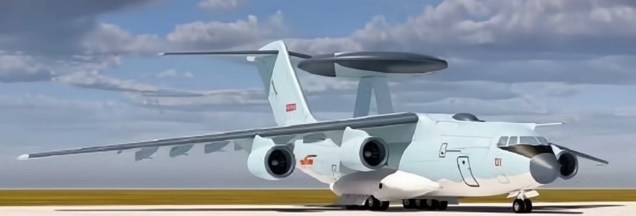
China has not officially confirmed the first flight of the KJ-3000 aircraft, which will significantly enhance its early warning capabilities. The KJ-3000 is based on the People’s Liberation Army Air Force (PLAAF) Y-20 transport aircraft and is the latest addition to China’s “eye in the sky” arsenal of early warning aircraft.
The rotodome is a discus-shaped rotating radome that allows the detection and tracking of targets by providing 360-degree coverage. Some experts speculate that the bulge on the tail may be related to the integration of some advanced communication systems.
The aircraft is powered by the domestically-produced WS-20 high-bypass turbofan engine, like the Y-20B transport aircraft that it is based on. It is anticipated to generate approximately 31,000 pounds of thrust. As per some unconfirmed claims, the aircraft would have a detection range exceeding 360-500 km.
The KJ-3000 can carry more payload—up to 66 tons— 16 tons more than the KJ-2000. Moreover, the WS-20 engines provide more thrust and fuel efficiency, enabling longer flight operations.
The aircraft could operate as a complete command center since it integrates C4ISR (Command, Control, Communications, Computers, Intelligence, Surveillance, and Reconnaissance) technologies, allowing for better coordination between the land, sea, and air domains.
Two major Chinese aviation companies, Shaanxi Aircraft Corporation and Xi’an Aircraft Corporation, expressed interest to develop the Y-20 aircraft, but Xi’an was announced as the manufacturer of Y-20 in 2007.
Developed by Xi’an Aircraft Industrial Corporation and was officially launched in 2006 the Xi’an Y-20 (Chinese: 运-20; pinyin: Yùn-20; literally: “transport-20”) is a large military transport aircraft. The official codename of the aircraft is Kunpeng (Chinese: 鲲鹏), after the mythical bird that can fly for thousands of miles described in the ancient Chinese Taoist classic Zhuangzi. However, within the Chinese aviation industry itself, the aircraft is more commonly known by its nickname Chubby Girl (Chinese: 胖妞), because its wide fuselage in comparison to other Chinese aircraft previously developed in China.
The aircraft was primarily designed and developed in China by Xi’an Aircraft Industrial Corporation under Tang Changhong. Certain parts of the wing such as the triple-slotted trailing-edge flaps were developed by the Ukrainian Antonov Design Bureau. The Y-20 uses components made of composite materials. The composites are produced in China, whereas in the past they had to be imported. The Y-20’s cabin incorporates flame-retardant composites developed by the 703 Institute of the China Aerospace Science and Technology Corporation (CASC). The 703 Institute was created in March 2009 with development taking three years. The performance of the composites is reportedly comparable to those that fulfill FAR Part 25.835. The 703 Institute achieved another milestone by establishing a comprehensive Chinese evaluation and certification system for aircraft composite materials based on international standards.
The Y-20 is the first cargo aircraft to use 3D printing technology to speed up its development and to lower its manufacturing cost. Model-based definition (MBD) is also used, and it’s the third aircraft to utilize MBD technology in the world, after Airbus A380 (2000) and Boeing 787 (2005). A project team to implement MBD for Y-20 program was formally formed in October 2009, and after the initial success in application on the main landing gear, MBD application was expanded to the entire aircraft and became mandatory for all contractors and sub contractors of the Y-20 program. The implementation of MBD was initially met with strong resistance, with only a third of suppliers agreeing to implement MBD. However, the general designer of Y-20 declared that those who refused to implement MBD will be banned from participating in the Y-20 program, thus forcing everyone to comply, resulting in increases in productivity. The implementation of MBD greatly shortened the time required, for example, without MBD, installation of wings takes a month or two, but with MBD adopted, the time is drastically shortened to just a few hours, and in general, the design work reduced by 40%, preparation for production reduced by 75%, and manufacturing cycle reduced by 30%. In addition to 3D printing, Y-20 is also the first aircraft in China adopting associative design technology (ADT) in its development. Headed by the deputy general designer of structural design, Mr. Feng Jun (冯军), the initial attempt to implement ADT actually failed after two months spent on application on the nose section. It was only after the second attempt that took another three months on the application on wings did ADT became successful. The adaptation of ADT greatly shortened the development time by at least eight months, and modification of wing design that previously took a week is shortened to half a day.
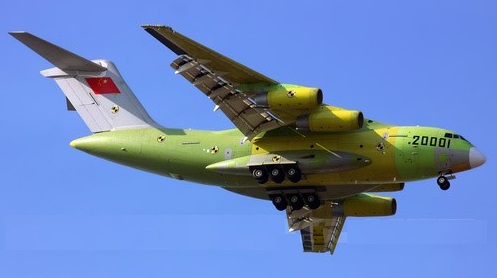
The Y-20 airlifter has a glass cockpit, which accommodates three crew members. Cargo is loaded through a large aft ramp that accommodates rolling stock. The Y-20 incorporates a shoulder wing, T-tail, rear cargo-loading assembly and heavy-duty retractable landing gear, consists of three rows, with a pair of wheels for each row, totalling six wheels for each side. The structural test was completed in 194 days as opposed to the 300 days originally planned, thanks to the successful development and application of an automated structural strength analysis system. According to the deputy general designer, the shortest take-off distance of Y-20 is 600 to 700 meters. Y-20 incorporates a total of four LCD EFIS, and the development of EFIS for Y-20 utilizes virtual reality via helmet mounted display. Eight types of different relays used on Y-20 are developed by Guilin Aerospace Co., Ltd. a wholly own subsidiary of China Tri-River Aerospace Group Co., Ltd.(中国三江航天集团), which is also known as the 9th Academy of China Aerospace Science and Industry Corporation (CASIC).
It was reported that the Y-20 started ground testing from December 2012, including runway taxi tests. The aircraft made its maiden flight lasting one hour on January 26, 2013 at Shaanxi Yanliang Aviation Base. During landing in first flight, it was reported that the Y-20 prototype bounced once before finally settling on runway due to high landing speed. In December 2013, a new Y-20 prototype took to the sky.
The Y-20 is powered by four 12-ton thrust Soloviev D-30KP-2 engines, and all early production units are likely to be similarly powered. The Chinese intend to replace the D-30 with the 14-ton thrust WS-20, which is required for the Y-20 to achieve its maximum cargo capacity of 66 tons. The Shenyang WS-20 is derived from the core of the Shenyang WS-10A, an indigenous Chinese turbofan engine for fighter aircraft.
In 2013, Shenyang Engine Design and Research Institute was reportedly developing the SF-A, a 28700-pound thrust engine, for the Y-20 and the Comac C919. The SF-A is derived from the core of the WS-15. Compared to the WS-20, the SF-A is a conservative design that does not seek to match the technology of more modern engines.
In late 2017, it is revealed that domestic Chinese turbofan WS-18 has begun flight test on Y-20. Compared with Russian Soloviev D-30, WS-18 is 300 kg lighter, weighing at 2000 kg; with thrust increased from 12.5 ton of D-30 to 13.2 ton; and fuel consumption of WS-18 is also reduced in comparison to D-30, and the mean time between overhaul of WS-18 is 3000 hours. However, because the increase in thrust is not significant in comparison to D-30, WS-18 is like to be a stopgap measure before WS-20 is ready. The production aircraft are equipped with WS-20 engines.
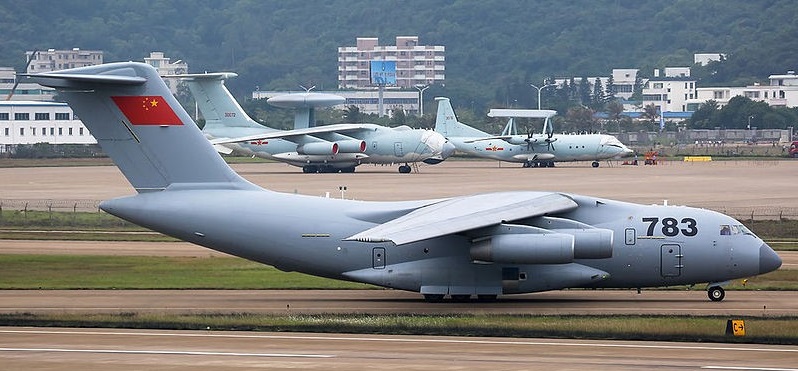
The aircraft is equipped with a retractable landing gear comprising two main landing gear units and a nose unit. Each of the two main units on either side of under-fuselage features six wheels, which are arranged in a two-two-two layout from front-to back. The steerable nose gear includes a standard twin-wheel leg unit. The landing gear allows take-offs and landings on rough airfields or unpaved runways.
In 2014 the PLA National Defence University’s Center for Economic Research recommended the purchase of up to 400 Y-20s, comparing the PLAAF’s needs with the existing airlifter fleets of the United States and Russia. In June 2016 Jane’s reported that up to 1,000 Y-20s are being requested by the Chinese military.
On 6 February 2016 the Y-20 was flown for the first time and pictures of the fifth prototype (serial number 788) in flight appeared on Chinese military webpages. Other known prototypes carry identification numbers 781, 783 and 785. On 27 January 2016, former Chinese test pilot Xu Yongling had reported in a Xinhua article that Chinese aviation industry officials had stated that the Y-20 “completed development” at the end of 2015. In June 2016, the first two Xian Y-20 aircraft were delivered to the People’s Liberation Army Air Force (PLAAF).
On 6 July 2016 the first serial Y-20 (serial number 11051) was handed over to the PLAAF in a ceremony. The second aircraft serialed 11052 followed soon after – it is assigned to the 12th Regiment of the 4th Transport Division at Qionglai, Chengdu. On 8 May 2018, it was announced by PLAAF’s spokeperson Shen Jinke that Y-20 had “recently conducted its first joint airdrop training with the country’s airborne troops”.
At least two aircraft stationed at Qionglai Air Base since July 2016. Commercial satellite imagery captured on 9 December 2017 suggests that at least three more Xian Aircraft Corporation Y-20 Kunpeng transport aircraft have entered service with China’s People’s Liberation Army Air Force (PLAAF). In these images there are a total of 5 Xi’an Y-20’s lined up at Qionglai Airbase near Chengdu in China’s southwestern Sichuan Province.
The YY-20A tanker, bearing the serial number 20646, was spotted in February 2025.
YY-20A
Derived from the Xi’an Y-20 strategic transport, the YY-20A tanker variant can haul up to 90 tons of fuel, tripling the capacity of the aging H-6U tankers it’s replacing.
2023 analysis pointed to the YY-20B’s “hot and high” takeoff capability—enabled by the WS-20 engines—as a game-changer, allowing operations from rugged, high-altitude bases that could support a Taiwan contingency.
The base Y-20A transport, powered initially by Russian D-30KP-2 engines, boasts a 66-ton payload and a range of up to 7,800 kilometers when fully loaded, capable of carrying everything from ZTZ-99 tanks to medical supplies.
The YY-20A tanker variant, introduced in 2022, swaps cargo for fuel pallets, featuring two underwing refueling pods and a centerline drogue for large aircraft like the H-6N bomber or KJ-500A AEW&C platform, monitored by IIR/TV cameras for precision.
The Y-20B, rolled out by 2023, upgrades to four Shenyang WS-20 high-bypass turbofans, boosting thrust to 31,000 pounds per engine and enhancing the range and short-field performance. A YY-20B tanker sub-variant, spotted in late 2023, likely builds on this, though some speculate the Y-20B’s modular design allows any unit to double as a tanker with minimal reconfiguration.
Advanced avionics, a glass cockpit with heads-up displays, and composite materials round out a platform that’s as modern as it is massive, with a 50-meter wingspan and 47-meter length.
Analysts see a niche for the Y-20E export variant, powered by WS-20s.
In 2025 production capacity was ramping up and a civilian Y-20F-100 variant pitched for commercial use.
Specifications (estimated) Engines: 4 × Soloviev D-30KP-2 turbofans Wingspan: 45 m (147 ft ~ 164 ft) Wing area: 330 m² (3550 ft²) Length: 47 m (154.2 ft) Height: 15 m (49.2 ft) Empty weight: 100,000 kg (220,400 lb) Max takeoff weight: 220,000 kg (485,000 lb) Payload: 66 tonnes (145,505 lb) Max wing loading: 710 kg/m² (145 lb/ft²) Cruise speed: Mach 0.75 Range max payload: 4,500 km Range 40 ton payload: 7,800 km Service ceiling: 13,000 m (42,700 ft) Crew: 3: pilot, copilot & load master









 All Aero