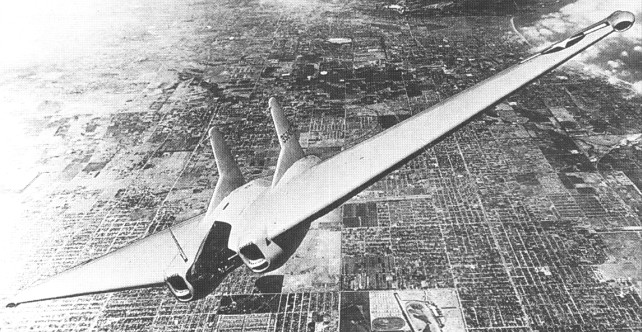
In January 1943, Northrop was awarded a USAAF contract for the design and construction of three prototypes of a highly original rocket-propelled interceptor fighter of all-wing configuration and designated XP-79. By 1944 Northrop had a range of projects stemming from the MX 324, including Ram Wing. This was a true flying wing with tip duct bellows spoilers, and a pilot lying prone to fit within the wing pro¬file and withstand violent combat manoeuvres. To be powered by a single 907kg Aerojet rocket motor, the XP-79 was to have accommodated its pilot in the prone position, but, in the event, development problems with the rocket led to cancellation of the project. However, a contract was placed for the redesign of the fighter for turbojet power, one prototype being ordered as the XP-79B.
It was schemed in various forms but the basic concept was that the wing should have a leading edge of thick magnesium endowing it with exceptional impact strength. Unlike almost every other flying machine in history the XP 79 was planned with mid air collision as a basic design case. Its four 0.50in guns were officially called “secondary”. There were still no powerful rocket motors and Northrop built the XP 79B with two of the new turbojets.
The engines chosen were the 19 inch Westinghouse Navy axials, which as the pre production J30 (model 19B) were each rated at about 1,150 1b / 619kg. This was judged enough to make the 8,670 lb XP 79B a practical proposition, and technically it was a design of exceptional interest. The pilot was accommodated in a modified cradle, stressed for sustained 12g manoeuvres, with an engine close on each side. To overcome the nose gear problem there was “a wheel at each corner”, each leg folding into the wing. After testing with no fin or with a central fin it was decided to fly with a fin above each jet. The aircraft that bore AAF serial 43 52437. It was delivered to Muroc in June 1945 to start testing with Harry Crosby as a test pilot.
Flown for the first time on September 12, 1945, after several days of preliminary tests, an incident marked the beginning of the flight when an Army Air Force fire truck crossed runway. Crosby had time to cut the power to avoid the collision, then he climbed to 10,000 feet. Crosby seemed quite at home, and flew confidently for 15 minutes. He returned to his take-off area by describing a large circle with a particularly high speed (estimated at more than 400 mph). On his second pass over the salt lake, Crosby started a climbing turn, then the Ram Wing went into an agonizingly slow roll and went straight into the ground in “a steep vertical spin”. Crosby was seen jumping at the last moment but was struck by a portion of the plane. His parachute never opened. The cause was attributed to a hard over runaway by the electric trim tab in the lateral control system. As the war was over ramming was dropped.
XP-79B Wingspan: 11.58 m / 37 ft 12 in Length: 4.27 m / 14 ft 0 in Height: 2.13 m / 7 ft 0 in Wing area: 25.83 sq.m / 278.03 sq ft Max take-off weight: 3932 kg / 8669 lb Empty weight: 2649 kg / 5840 lb Max. speed: 880 km/h / 547 mph Range: 1600 km / 994 miles Service ceiling: 40,000 ft / 12 000 m Rate of climb: 4,000 ft/mn / 1 220 m/mn Crew: 1
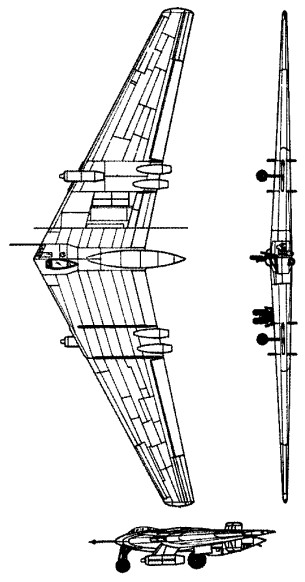
The second and third YB-35 pre-production prototypes were converted into YB-35B aircraft. Their four 3250-hp (242 3-kW) Pratt & Whitney R4360 piston engines were replaced by eight 4000-lb (1814-kg) thrust Allison J35-A-5 turbojets, four jets being grouped in each trailing edge and aspirated through the same arrangement of leading-edge inlets used to supply carburation and cooling air for the piston engines of the original aircraft.
The YB-35B was redesignated YB-49 while it was being rebuilt, and the first aeroplane flew on 21 October 1947. The second had six 2540kg thrust Allison engines, four buried in the wings and two in underslung pods to increase the volume available for fuel.
Speed was increased dramatically from 393 to 520 mph (632 to 837 kph), but such was the thirst of the turbojets that range was halved. There were also several control problems that made the type unsuitable for use as a free-fall bomber, and it was decided to transform the type into a strategic reconnaissance aeroplane.
In June 1948 the second YB-49 was destroyed with the loss of its five man crew in a crash attributed to structural failure.
Confi¬dence ran high, and the USAF ordered 30 YRB 49s for the long-range reconnaissance role, one of which was to be built by Northrop and, because of that company’s other commitments, 29 by Consolidated Vultee. Even the fatal in flight breakup of the second prototype in March 1950 failed to dampen spirits. The RB-49 offered no real advantages over the B-47 and the new B-52, production was cancelled before the single YRB-49 flew on May 4, 1950.
The YB-35 programme continued for a while with various test airframes, but in October 1949 the whole programme was cancelled and the aircraft were scrapped. The YB 49 made a flag waving trip from Edwards Air Force Base in California to Washington, D.C. at 823 kph (511.2 mph), 160 kph (100 mph) faster than the favoured B 36, but it was too late.
Sole survivor was the six-jet YB-49A, but just four years later this was broken up.
YB-49 Engines: 8 x Allison J35-A-2, 1814 kg (4000 lb) thrust. Engines: 8 x Allison J35-A-15, 1800kg Max take-off weight: 96800 kg / 213409 lb Wingspan: 52.4 m / 171 ft 11 in Length: 16.2 m / 53 ft 2 in Wing area: 372 sq.m / 4004.17 sq ft Max. speed: 930 km/h / 578 mph Range: 8700 km / 5406 miles Range: 2800 mi / 4506 km wit 10,000 lb / 4536 kg bombload Max bombload: 37,400 lb / 16,965 kg Crew: 6
YRB-49 Engines: 6 x Allison J35 turbojets, 1870kg Wingspan: 52.4 m / 171 ft 11 in Length: 16.2 m / 53 ft 2 in Wing area: 372 sq.m / 4004.17 sq ft
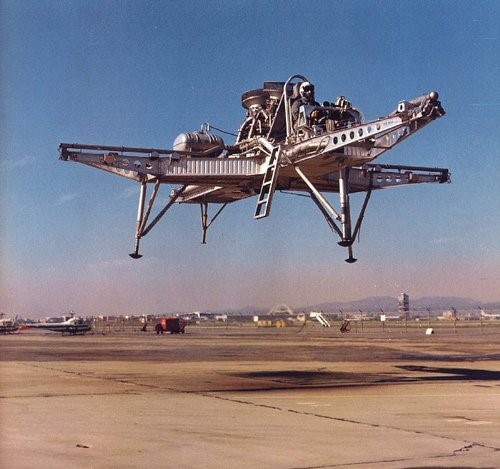
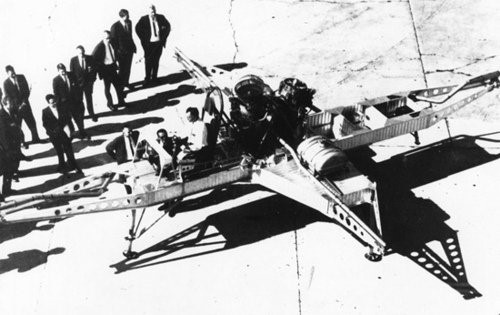
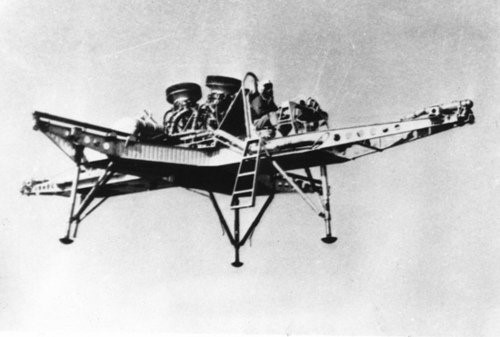
The North American FS-1 (Flight Simulator Number 1) Hoverbuggy was a 1965 open framework VTOL research vehicle with two 2200 lb GE YJ85 turbojets for lift, and four engine bleed-air nozzles on outriggers for control.
The craft had made 15 tethered and 185 free flights at altitudes up to 100ft when the program was shut down in 1967.
Engines: two x GE YJ85, 2200 lb Span: 23’0″ Length: 36’0″ Useful load: 1550 lb Max speed: 58 mph Range 10 mi
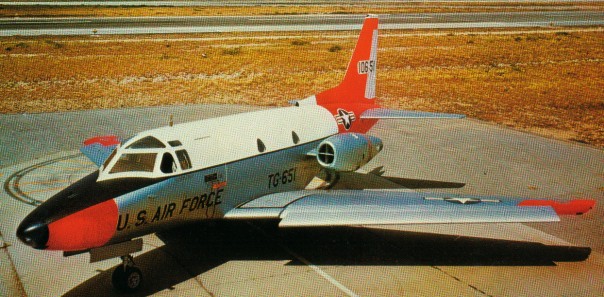
The NA-246 Sabreliner started its life as a private venture in the mid 1950s to meet the USAF’s UTX requirements for a combat readiness trainer and utility aircraft. Announced on 27 August 1956, It was laid out with a six-seat interior and to be flown by a two-man crew, the civil-registered prototype was completed in May 1958, although the lack of suitable engines delayed the first flight, which took place at Los Angeles, until 16 September, under the designation T 39. The initial powerplant comprised two 1134kg thrust General Electric YJ85 turbojets and, thus powered, the prototype completed its military evaluation programme at Edwards Air Force Base in December 1958.
In October 1958 the Sabreliner won its first order, for seven NA-265 or T-39A aircraft with 1361kg thrust Pratt & Whitney J60 engines. Production of the highly successful T 39 series commenced in 1958, and 213 were purchased by the Air Force and the Navy. All military models of the T-39 series were certificated to civil airworthiness standards, beginning with the T-39A on 23 March 1962.
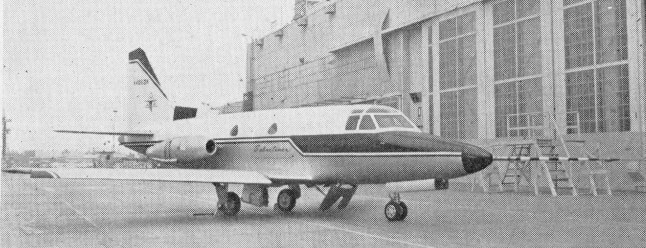
The commercial version of the T 39, known as the NA-265-40 Sabreliner / Sabre 40, was type certificated on 17 April 1963 and was one of the first jets available to business aviation. It is larger and more rugged and powerful than jets that have been designed solely for civilian use. Its speed by jet standards is modest with a cruise of 489 knots. The aircraft maintained its popularity throughout the 1960s and 1970s as improvements were made to the airframe and powerplants.
In 1965 North American increased the Sabreliner’s gross weight by beefing up landing gear and re-qualifying wheels. The modification allows the twin-jet to carry full fuel with nine people and baggage aboard totalling 18,650 lb. The previous max was 17,760 lb. Changes were offered free to Sabreliner owners.
One of the unusual features that the Sabreliner was automatic leading edge slats. The slats added impressive low speed handling qualities to the bizjet.
Gone are the slats, however, from a Sabreliner 60. The stretched Sabre 60, introduced in 1969, is powered by two 3,300 pound thrust P&W JT12A 8 turbojets, the same engine that was used in the Dash 8 JetStar.
The Rockwell Sabreliner 65 is essentially a fanjet, supercritical wing version of the Sabre 60. Its engines are Garrett AiResearch TFE 731-3s, which the factory may also retrofit to Model 60s and the even earlier Sabre 40s. Its IFR range was just under 2,500 nautical miles. The first production lot of Sabre 65s was sold at an average equipped price of $3,250,000.
Both the 74 and 60 models were fitted with thrust reversers to aid in shorter landings and assist in braking on icy or wet runways.
75A
The Sabre 75A, with its expanded cabin height and higher gross weight, uses two General Elec¬tric CF700 2D2 turbofans identical to the 4,315 pound thrust powerplants employed on the Falcon 20. The 75A model features square windows, a ‘stand-up’ cabin and a long span tailplane.
In 1978 Rockwell International’s Sabreliner 80A made a first flight from St. Louis. The new business jet is a modified version of the Model 75A, with a supercritical wing.
Civil production of all models, including the final model, the Sabreliner 65A, totalled well over 600 aircraft when the last aircraft came off the line in 1981.
Rockewell International’s Sabreliner Division was acquired in 1983 by the specially formed Sabreliner Corporation of St Louis, Missouri to continue product support. Type Certificate A2WE was reissued to Saberliner Corp in 1983 to cover active Model 265s. At the end of 1990 the company completed the design of a new version of the Sabreliner designated the Model 85. This has a supercritical wing incorporating winglets, a fuselage stretch of 1.5m, and more powerful TFE731-5 turbofan engines, but further development would require a risk-sharing partner.
NA-246 Sabreliner / T-39 Engines: 2 x General Electric YJ85 turbojets 1134kg thrust
T-39 Engines: 2 x P&W Wing span: 44 ft 5 in (13.54 m) Length: 43 ft 9 in (13.34 m) Height: 16 ft 0 in (4.88 m) Max TO wt: 17,760 lb (8055 kg) Max level speed: 595 mph (958 kph)
NA 265-65 Sabreliner 65 Engines: 2 x Garrett TFE 731-3R-1D, 3700 lbs / 1678kg thrust Seats: 10 Length: 14.30 m / 46 ft 11 in Height: 4.88 m / 16 ft Wingspan: 15.37 m / 50.5 ft Wing area: 380 sq.ft Wing aspect ratio: 6.7 Maximum ramp weight: 24,000 lbs Maximum takeoff weight: 10886 kg / 24,000 lbs Standard empty weight: 13,350 lbs Maximum useful load: 10,650 lbs Zero-fuel weight: 16,250 lbs Maximum landing weight: 21,755 lbs Wing loading: 63.2 lbs/sq.ft Power loading: 3.2 lbs/lb Maximum usable fuel: 8644 lbs Best rate of climb: 3540 fpm Certificated ceiling: 13715 m / 45,000 ft Max pressurisation differential: 8.8 psi 8000 ft cabin alt @: 45,000 ft Maximum single-engine rate of climb: 950 fpm @ 127 kts Single-engine climb gradient: 452 ft/nm Single-engine ceiling: 25,000 ft Maximum speed: 513 kts Normal cruise @ 43,000ft: 430 kts Fuel flow @ normal cruise: 1090 pph Stalling speed clean: 117 kts Stalling speed gear/flaps down: 81 kts Turbulent-air penetration speed: 225 kts
Sabreliner 65A
Sabreliner 75A Engines: 2 x General Elec¬tric CF700-2D2, 4315 lb Seats: 8/10 Wing loading: 68.11 lb/sq.ft Pwr loading: 2.53 lb/lb Max TO wt: 22,800 lb Operating wt: 13,600 lb Equipped useful load: 9200 lb Payload max fuel: 1820 lb Zero fuel wt: 15,620 lb Range max fuel/cruise: 1985 nm/4.0 hr Range max fuel / range: 1897 nm/ 4.6 hr Service ceiling: 45,000 ft Max cruise: 489 kt Max range cruise: 417 kt Vmc: 92 kt Stall: 105-113 kt 1.3 Vso: 137 kt ROC: 4500 fpm SE ROC: 1050 fpm @ 190 kt SE Service ceiling: 24,000 ft Cabin press: 8.8 psi Fuel cap: 7380 lb Takeoff run (balanced) 4,420 ft Landing roll 2,525 ft
Developed to USAF General Operational Requirement 38 for an intercontinental bomber to replace the Boeing B-52.
At one time the order was cut back to a single prototype containing no military equipment. In 1960 the US Government decided to order 12 fully operational B-70s. In March 1961, the contract awarded on 4 October 1961 was again cut back to three aeroplanes, intended mainly for research, although the third was later cancelled.
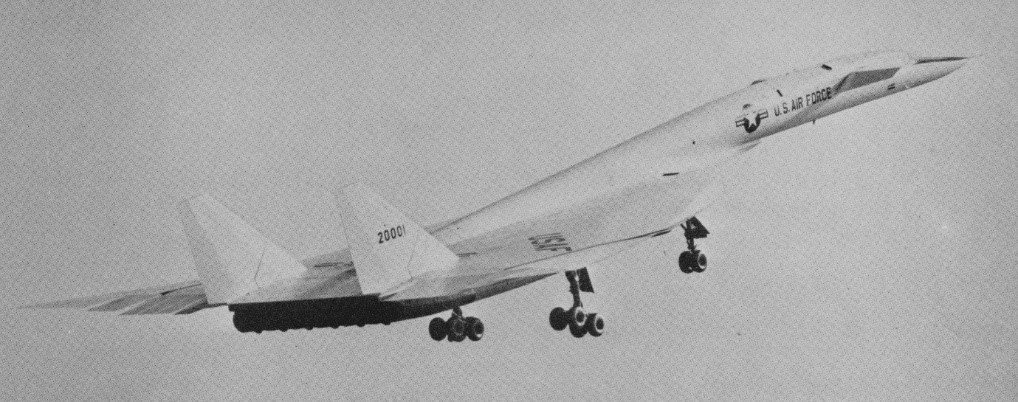
The North American XB-70 Valkyrie first flew in prototype form on 21 September 1964. When the first prototype flew it was simultaneously the longest (56.4 m/185 ft), fastest (Mach 3+), most powerful and costliest aircraft ever built, US$2000 million, and weighing 305 tonne (300 ton). Piloted by North American test pilot Alvin S. White and USAF Col. Joseph F. Cotton the first take-off took a 5000 ft ground roll and 30 seconds to get airborne. During the 65 min flight from Palmdale to Edwards Air Force Base the main wheels failed to retract and number three J93 GE engine over-revved. The aircraft flew to 16,000 ft and 375 mph. Locked rear wheels on the left main gear ground themselves down to metal on touch-down.
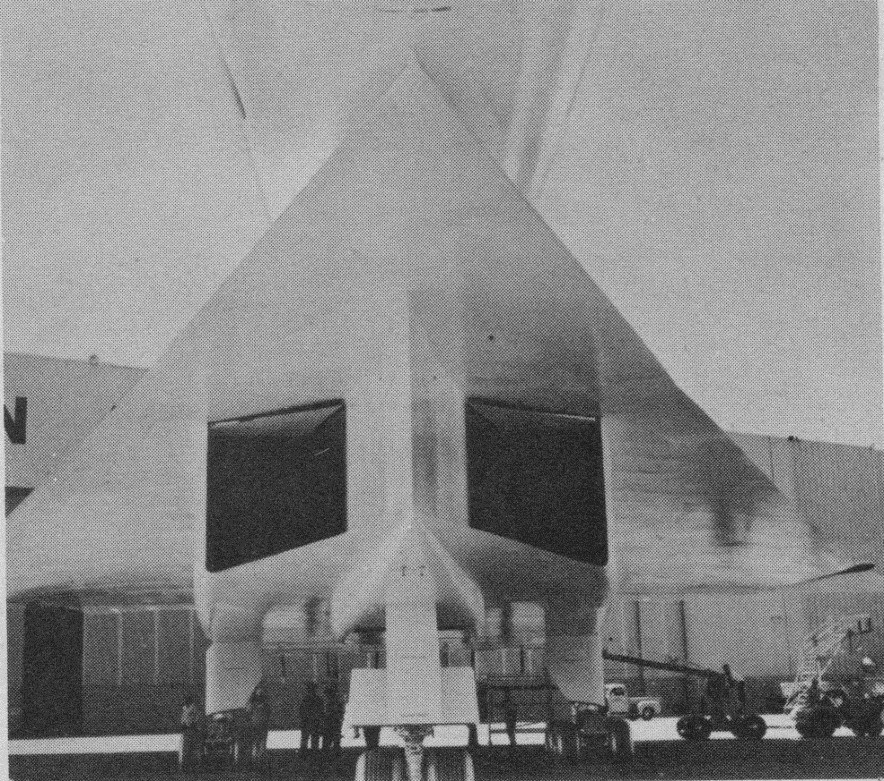
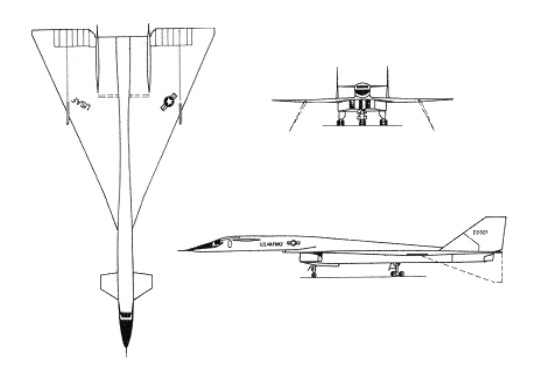
A delta-winged canard design, the airframe made extensive use of contemporary ‘exotic’ alloys to overcome the problems associated with kinetic heating. The wings were swept back at 65 degrees 34 minutes on the leading edge, and were covered with brazed stainless steel honeycomb panels welded together to produce an extremely strong yet heat-resistant whole. Similar construction was used for the huge rectangular moveable engine duct under the centreline, the twin vertical tail surfaces (30 ft high) and part of the fuselage. The advanced aerodynamics of this elegant yet menacing warplane were based on a large delta wing from whose centre grew a slim forward fuselage complete with canard foreplanes.
The powerplant comprised six 31,000-lb (14.062-kg) thrust General Electric YJ93-GE-3 afterburning turbojets in a 30 ft long ducted arrangement under virtually the full chord of the delta wing. To slow entering airstream from Mach 3 to less than Mach 1 the designers created a series of shock patterns which employ the vertical splitter, then additional breaks within the splitter duct. Finally hydraulically operated panels vary final throat area to meet varying conditions.
The wings outer portions were arranged to hinge downward in flight under hydraulic power to improve stability and maneuverability. An anhedral angle of 25 degrees was used for low-altitude supersonic flight, increasing to 65 degrees for high-altitude flight at Mach 3. Six power hinge actuators on each lower outer surfaces during high speed flight. Each hinge has hundreds of closely meshed gears of hard H-11 steel.
Control was provided by a combination of flaps on the canard foreplanes, no fewer than 12 wide-chord elevons across much of the trailing edge of the wings outboard of the variable-geometry engine exhausts, and large rudders on each of the vertical surfaces. The canard slab surfaces provide trim control while keeping drag low, their rear section deflecting down as flaps. Control of so complex an aerodynamic platform moving at high supersonic speeds was effected with the aid of a three-axis stability-augmentation system.
The landing gear consists of 2 tons of wheels, tires and brakes. A brake control device employs a fifth wheel on the main gear, comparing the amount of slippage between braked wheels and the fifth wheel with coefficient of friction between tires and runway surface, predicts skid point, and automatically regulates
The windshield moves along with a variable-position nose ramp. During subsonic operation the forward edge of the windshield can be lowered for better visibility. Dark spots above the cockpit area and on the canard surfaces are crane lift points.
The first prototype was flown by Alvin S. White and Colonel Joseph F. Cotton on 21 September 1964. The take-off from Palmdale runway required 5000 ft and less than 30 sec roll. During the flight the undercarriage failed to retract, one of the six engines failed, and a brake locked which burned out half of the left main gear supports. The flight was held to a maximum of 375 mph and 16,000 ft for the flight of just over one hour.
The first flight had been so long postponed and the entire project downgraded to only two prototypes. By the flight, the first US had spent $1.34 billion on its development. $92 million was then allocated to see the two prototypes through the flight program. Both XB-70’s were programmed for a 180 hr flight test schedule, including experiments for NASA. It first achieved its design speed of Mach 3 on 14 October 1965.
NASA’s Flight Research Center spent $2,000,000 on instrumentation on the No.1 aircraft. Areas of study included flutter of skin panels and internal noise levels; heating of structures in such areas as windshield, fuel tanks and crew compartment.
The improved second prototype flew on 17 July 1965, but was lost in a mid-air collision on 8 June 1966. The surviving aircraft carried out a number of test programmes, including work in connection with the US supersonic transport programme, but on 4 February 1969 it was flown to retirement at the US Air Force Museum, Wright Patterson AFB, Dayton, Ohio.
Even before the first prototype flew, however, technological developments in air defence had made the XB-70 obsolete. In 1963 the U.S. government ended the XB 70 development programme and turned the prototypes over for research purposes although one of the XB 70s was lost on 8 June 1966. The surviving XB 70 is now a museum piece.
Engines: 6 x General Electric YJ93-GE-3 afterburning turbojets, 31,000-lb (14.062-kg) Wing span: 105 ft 0 in (32 m) Length: 196 ft 0 in (59.74 m) Max TO wt: 530,000 lb (240,400 kg) Max level speed: M3 / 3218 km/h / 2000 mph Height: 9.1 m / 29 ft 10 in Wing area: 565.0 sq.m / 6081.60 sq ft Ceiling: 21336 m / 70000 ft Range w/max.fuel: 12000 km / 7457 miles Crew: 2
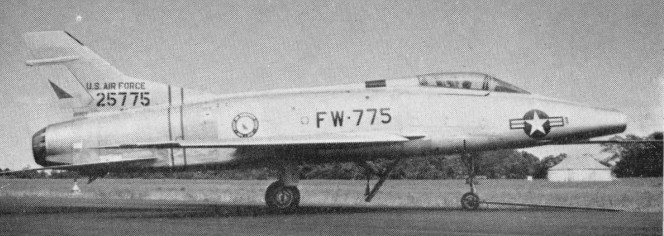
First of the “Century fighters”, the prototype F-100 flew on 25 May 1953 piloted by George Welch. Powered by a Pratt & WhitneyJ57 turbojet and augmented by an after¬burner, it flew faster than sound on its maiden flight.
Originally known as the “Sabre 45”, because of its 45-degree swept wing, the F-100 is a completely new design and was the first U.S.A.F. operational aircraft to fly supersonic in level flight. In very large-scale production as standard U.S.A.F. day fighter in 1955. Established World Speed Record of 755.15 mph on 29 October 1953.
The whole F-100 structure is immensely strong and rigid; so much so that assembly jigs are rendered unnecessary, the parts being simply put together. The wing interior is largely taken up by huge forgings, machined into honeycombs or grids; some of the outer skins are machined from sheet of no less than 3in original thickness. There was talk of the aircraft being made by Commonwealth (Australia) and Canadair.
The F-100 has an all-moving tailplane and inset ailerons, each in two sections, and automatic leading-edge slats. Ailerons were located inboard and flaps were omitted. Flaps were on the F-100D and F only. An air-brake is under the centre fuselage. The tricycle undercarriage has single wheels on each main unit ad twin wheels on the nose unit. The mains retract inward into the fuselage and nose wheels retract rearward.
The initial production version was the F-100A, a single-seat day fighter powered by a 43.15kN J57-P-7 or P-39 engine. Armament comprised four 20mm M-39E cannon plus external stores on six under-wing hardpoints.
F-100A Super Sabre
By May 1954, the U.S.A.F. had accepted delivery of a fair number of F-100As, but some had already been damaged or written-off in accidents. The F-100A was grounded in November 1954 because of transonic control problems. The height of the rudder had been reduced by some 18in and a corresponding amount added to the fin. The F-100 lands at nearly 180 mph. There are no landing flaps, but the ventral airbrake can be used on the approach.
North American F-100A Super Sabre
The F-100A production model first flew on 29 October 1951. 203 of the F-100A and RF-100A were built, the last 35 having an 11,700 lb thrust J57-P. The RF-100A was a photo-reconnaissance conversion of the F-100A with a deeper camera-carrying front fuselage.
RF-100A 53-2600
The 1956 F-100B designation was not applied as it was extensively redesigned as the F-107.
The F-100C (NA-214, -217, -222) appeared as a single-seat fighter bomber with strengthened wings, up to 3,402kg of bombs on eight underwing hardpoints, in-flight refuelling capability and 75.62kN (with afterburning) Pratt & Whitney J57-P-21A turbojet engine. First flown on 17 Jnuary 1955, 476 were built. An F-100C set the first world speed record to exceed Mach 1 on 20 August 1955 at 822.135mph.
The TF-100C of 1956 was a planned two-place trainer version modified from F-100C 54-1960, which instead became a prototype for the F-100F. Only the one was built.
TF-100C 54-1960
The similar F-100D (NA-223, -224, -235, -245) introduced design refinements, including a taller fin, landing flaps; supersonic autopilot, low-level bombing system, and could be armed with four Sidewinder or two Bullpup missiles, or 3,402kg of external weapons in addition to its standard four 20mm cannon.
F-100D 55-2851
First flown on 24 January 1956, 1274 F-100D were built.
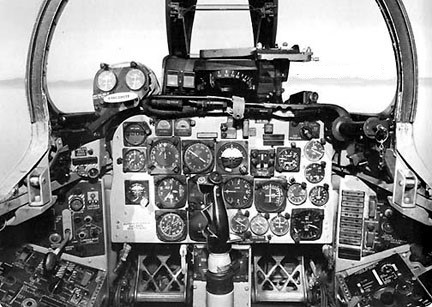
F-100D cockpit
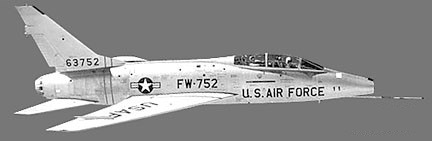
The final version built was the F-100F (NA-234, -255, -261, -262), first flown on 1 March 1957. It was a lengthened tandem two-seat operational trainer and tactical attack aircraft, armed with two 20mm cannon and capable of carrying 2,722kg of external stores. A total of 339 were built.
F-100F 56-3752
Operation Julius Caesar, involving the first flight by jet fighter aircraft over the North Pole, was conducted on 7 August 1959 with the landing of two USAF F-100F fighters at Eielson, Alaska AFB, southeast of Fairbanks, Alaska. The flight from Wethersfield, Essex, was completed in 9 hr 37 min.
Total production was 2294 aircraft when the line closed in October 1959.
After cancelling all airshows for two big summer months the Airforce Thunderbirds reverted back into F-100s in August 1965 to complete the season. They had started in Republic F-105s but a series of accidents throughout the Air Force grounded all Thunderchiefs.
F-100 Engine: 1 x P+W J-57-P-21 turbo-jet, 66.7kN Max take-off weight: 12700 kg / 27999 lb Empty weight: 9500 kg / 20944 lb Wingspan: 11.6 m / 38 ft 1 in Length: 14.3 m / 46 ft 11 in Height: 4.9 m / 16 ft 1 in Wing area: 35.8 sq.m / 385.35 sq ft Max. speed: 1216 km/h / 756 mph Ceiling: 15250 m / 50050 ft Range: 920 km / 572 miles Armament: 4 x 20mm machine-guns, 2720kg of bombs and missiles Crew: 1
North American F 100 Super Sabre Engine: Pratt & Whitney J-57-P-21A, 75645 N Length: 46.982 ft / 14.32 m Height: 14.665 ft / 4.47 m Wingspan: 38.747 ft / 11.81 m Max take off weight: 34839.0 lb / 15800.0 kg Max. speed: 751 kt / 1390 km/h Service ceiling: 45013 ft / 13720 m Range: 1304 nm / 2415 km Crew: 1 Armament: 4 mg. 3402 kg bombs
F-100A Super Sabre Engine: 10,000 lb. thrust Pratt & Whitney J57-P-7 turbojet, with afterburner. Wingspan: 36 ft. 7 in Length: 45 ft. 3 in Loaded weight: approx. 27,000 lb. Max. speed: over 760 m.p.h. Ceiling: over 50,000 ft. Range: over 1,000 miles. Armament: 4×20 mm cannon, Crew: 1.
F-100C Engine: Pratt & Whitney J57-P-21A, 16,950 lb w/afterburner Wingspan: 38 ft 9.25 in Wing area: 385.2 sq.ft Length: 54 ft 3 in Height: 16 ft 2.25 in Wheel track: 12 ft Fuel capacity: 987 Imp.Gal External fuel: 2 x 208 Imp.Gal + 2 x 187 Imp.Gal Armament: 4 x 20mm cannon Hardpoints: 6 External load: 6000 lb
F-100D Engine: Pratt & Whitney J57-P-21A afterburning turbojet, 17,000 lb / 7711 kg Wingspan: 38’10” / 11.82 m Wing area: 385.0 sq.ft / 35.77 sq.m Length: 47’2″ / 14.36 m Height: 16 ft 3 in / 4.95 m Wheel track: 12 ft Empty weight: 21,000 lb / 9525 kg MTOW: 34,832 lb / 15,800 kg Fuel capacity: 987 Imp.Gal External fuel: 2 x 208 Imp.Gal + 2 x 187 Imp.Gal Max speed: 864 mph / 1390 kph / M1.3 at 35,000 ft / 10,670 m Cruise speed: 565 mph Initial ROC: 16,000 fpm / 4877 m/min Range: 600 mi / 966 km Service ceiling: 46,000 ft / 14,020 m Armament: 4 x 20 mm cannon Hardpoints: 6 Bombload: 7500 lb / 3402 kg
F-100F Engine: Pratt & Whitney J57-P-21A, 16,950 lb w/afterburner Wingspan: 38 ft 9.25 in Wing area: 385.2 sq.ft Length: 57 ft 3 in Height: 16 ft 2.25 in Wheel track: 12 ft Fuel capacity: 987 Imp.Gal External fuel: 2 x 208 Imp.Gal + 2 x 187 Imp.Gal Armament: 2 x 20mm cannon Hardpoints: 6 External load: 7500 lb Seats: 2
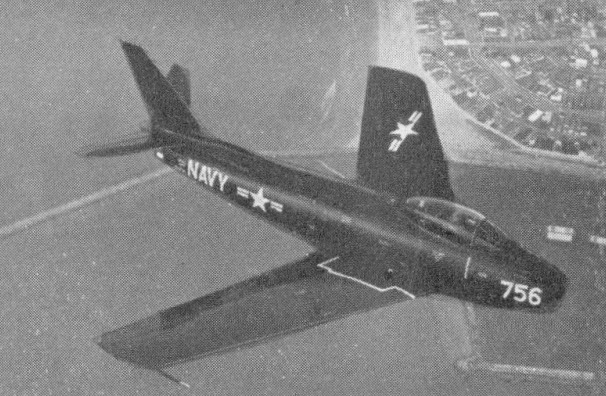
In the summer of 1944, North American Aviation completed the project design for a jet fighter using a wing based on that of the P 51 but with a completely new fuselage with a straight through jet duct from a nose inlet. Two designs were prepared, the second being a longer and heavier aircraft for the USAAF (this was later delayed and finally emerged as the XP 86, the first of the sweptwing Sabre family). The original proposal became the NA 134, ordered by the US Navy as the three XFJ-1 prototypes with the name Fury on January 1, 1945. The Navy became aware of German swept-wing data in the summer of 1945 but, unlike the USAAF, decided not to incorporate it in the new jet fighter.
A US Navy contract for the building of three XFJ-1 prototypes was awarded on 1 January 1945. Designed around the General Electric J35 axial flow turbojet, NAA chose a simple configuration with a nose intake and straight through airflow to the engine in the rear fuselage. This necessitated putting the cockpit above the intake ducting and resulted in a short and stumpy looking fuselage. The armament of six 12.7mm machine guns was installed on the sides of the nose. Fuel was housed in the fuselage and in tip tanks on production aircraft.
Like the same company’s XB 45 four jet bomber, the XFJ 1 was little more than jet propulsion applied to an advanced traditional airframe, with a laminar wing similar in profile to the P 51. The first flight was made at Inglewood on November 27, 1946, the engine being the 1733 kg (3820 lb) thrust General Electric J35 2 (TGA80) axial. By this time Inglewood was building 100 production FJ 1 Furies, with the Allison J3-A 5 2, virtually the same engine but rerated at 1814 kg (4000 lb) thrust, and with full carrier equipment and six 0.3 in (12.7 mm) guns. Features included small dive brakes above and below the non¬-folding wings, tip tanks, a primitive ejection seat and a ‘kneeling’ nose gear for stacking in a tight nose to tail line below decks. Desig¬nated NA 141, this batch was cut to 30 in 1948. Deliveries of these aircraft began in March 1948 with Allison-built engines and served only with VF 5A, soon restyled VF 51, between November 1947 and May 1949. In 1948 VF-5A (later VF-51) became the first jet unit to complete a seagoing tour of duty, aboard USS Boxer, the first carrier landing having been on March 10, 1948.
The Fury was quickly overtaken by the rapid pace of jet fighter development and remained in front line USN service for only 14 months before being relegated to Naval Reserve units. VF-5A / VF-51 was only operational squadron to fly the aircraft.
FJ-1 Fury 1948
One of the prototype FJ-1s achieved a speed of Mach 0.87 in 1947 when, the fastest by any US fighter to that point.
FJ-2
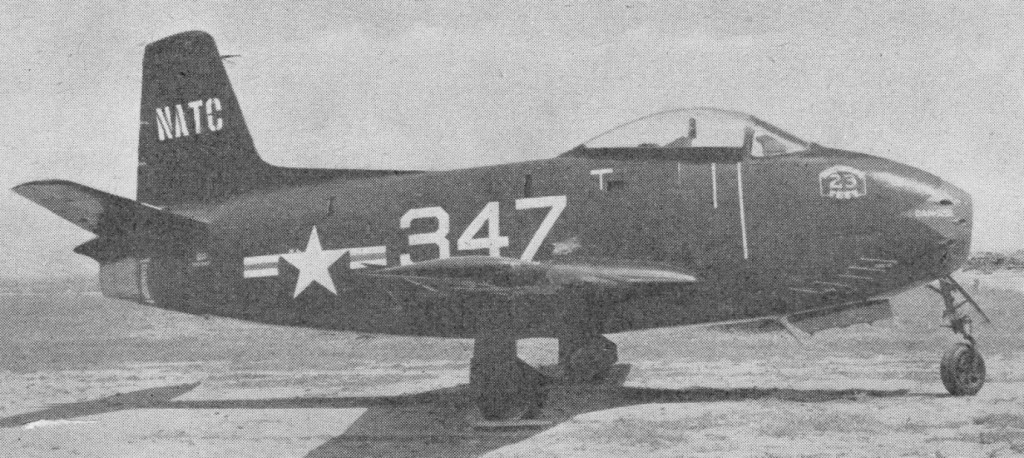
Though the original Fury was no better than several other fighters of the day, the Air Force clearly had made a major advance with the F 86 Sabre, and despite the Cutlass, Skyray and even the later McDonnell Demon the Navy decided to order a naval version of the Sabre in 1950. Confusingly, it decided to designate this FJ 2, instead of F2J, and to perpetuate the name Fury, thereby funds easier to obtain by suggesting that the type was a mere improved FJ 1 instead of a totally new aircraft. The first of the new NA 179 / XFJ-2 Fury prototypes flew on December 27, 1951 (piloted by Bob Hoover). It was essentially an F 86E with four 20 mm (0.79¬in) M 2 guns, an A frame arrester hook, catapult hooks and a lengthened nose leg, the General Electric J47 13 engine remaining.
With successful conclusion of initial carrier qualification trials aboard the USS Midway, this type was ordered into quantity production. Deliveries began in 1954, but only 200 had been completed by 1954 when production switched to the FJ-3.
North American FJ-3 Fury
Carrier qualification was outstanding, and the Columbus, Ohio, factory (previously a Curtiss Wright facility) constructed 300 of the much refined FJ 2 production type, with 2722 kg (6000 1b) thrust J47 2 engine, modified power folding wings, wider track landing gear and APG 30 radar gunsight. Production was assigned lower priority than the F 86F, and when the Korean war ended orders were cut to 200; all were delivered in the first nine months of 1954. All served with shore based Marine fighter squadrons, with bomb racks and, from 1955, the new Sidewinder AAM.
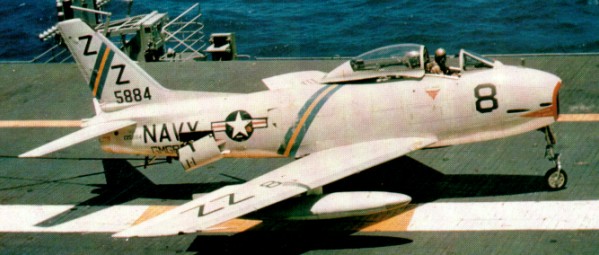
On 3 March 1952, the design of a new Fury shipboard fighter began around the newly-available Sapphire engine, built by Wright and Buick as the J65 2 at 3538 kg (7800 1b) thrust, fed by an enlarged duct which made the fuselage deeper. Assigned the designation FJ-3, the new fighter differed from the FJ-2 primarily in having a redesigned fuselage with a deeper air intake to accommodate the Wright J65 engine, as the US-built version of the Sapphire was known. The fifth FJ-2 was adapted to take the new engine as the NA 196 XFJ-3 and flew on 3 July 1953, and the first of 389 production FJ-3 (NA 194), powered by a J65-W-4 engine rated at 7,650 lb st (3 470 kgp) and carrying an armament of four 20-mm cannon, followed on 11 December 1953. De¬liveries to the US Navy began in September 1954, and, in the following year, the wing slats were discarded in favour of extended leading edges, while, with the 345th aircraft, additional wing stores stations were introduced for 500- or 1,000-lb (227- or 454-kg) bombs or rocket packs. The navy later added 214 NA 215 models with the W 4D engine, but cut this back to an extra 149 only, for a total of 538. In August 1956, as the 538th and last FJ-3 was delivered, a new weapon capability was introduced in the form of the Sidewinder AAM. 80 aircraft subsequently being modified as EJ-3Ms which augmented cannon armament with a pair of the AAMs.
FJ-3 Fury
This fighter/bomber equipped 17 navy and four marine squadrons, and VF 21 in January 1956 became the first combat unit to embark aboard the super carrier Forrestal. (The first FJ 3 unit at sea was VF 173, aboard Bennington, in May 1955.)
From August 1956 a total of 80 FJ 3s were converted to fire Sidewinders as the FJ 3M, while later others were rebuilt as drone targets and as drone (RPY) directors. The FJ¬3D controlled the Regulus 1 ship launched cruise missile, while the FJ 3D2 was parent aircraft to F9F 6K and KDA target aircraft. By 1959 surviving FJ 3s were being rebuilt with a long chord wing, without slats, with integral wing fuel tanks and either three or four weapon pylons. In 1962 the new designations became DF 1C, DF 1D and MF 1C.
In 1953 Columbus, which from the start had a competent and aggressive design and project staff, proposed a completely re-egineered Fury with much enhanced capability. This was soon accepted, and a rebuilt FJ 3 styled NA 208 and with the Navy designation XFJ-4, flew on October 16, 1953. Hardly any part was common to earlier Furies. The wing was much broader and thinner, with mid span ailerons and full integ-ral tankage, inboard high lift flaps and small fences on a fixed leading edge. The sweep was 35 degrees. The very deep reprofiled fuselage combined with the wing to increase internal fuel capacity by M, and with the four underwing pylons all loaded the gross weight was increased by the same proportion compared with the original FJ 2. The tail was thinner, and the vertical surface taller, and much of the engineering was that of the F 100C then in production at the Ohio factory. Main gears had levered suspension and further widened track, and the result was a superior carrier based attack aircraft.
Production FJ 4 (NA 209) Furys flowed from February 1955, the engine being the 3493 kg (7700 1b) thrust J65 16A. The first batch of 150, completed in March 1957, were followed by 222 FJ 4B (71 followed by 151 improved NA 244) which finally closed out production of Sabres and Furys in the United States in May 1958. The FJ 4B had a stiffer wing with six pylons, LABS (Low Altitude Bombing System) for nuclear toss¬-delivery, extra air brakes on the rear fuselage and other changes. It was entirely configured as an attack bomber, and cleared to fire the ASM N 7 Bullpup air to surface guided missile in January 1957.
North American FJ-4B Fury
Five Bullpups could be carried, with the radio command guidance pod on the sixth pylon. In the revised Department of Defense numbering scheme the FJ 4 became the F 1E, and the FJ4B the AF 1E. The AF equipped nine navy and three marine corps attack squadrons, before being progressively transferred to the reserve in 1962 65. A little-¬known research programme involved mixed-power trials using two FJ 4 Furys with North American hydrogen peroxide rockets mounted in a fuselage extension above the normal jetpipe, and with nose extensions housing instrumentation.
Introduced to service in 1957, the FJ-4B was finally retired from the front-line inventory in late 1962 although it continued to fly with second-line squadrons and Reserve units for several more years, the post-1962 designations being F-1C (FJ-3), MF-1C (FJ-3M), F-1E (FJ-4) and AF-1E (FJ-4B). Lesser-used variants were the FJ-3D and FJ-3D2 (DF-1C and DF-1D) drone-director conversions.
FJ-1 Fury Engine: one 4.000-lb (1,814-kg) thrust Allison J35-A-2 turbojet Maximum speed 547 mph (800 km/h) at 9000 ft (2,745 m) Initial climb rate 3,300 ft (1,006 m) per minute Service ceiling 32,000 ft (9,755 m) Range w/max.fuel 1500 miles (2,414 km) Empty weight 8,843 lb (4,011 kg) Maximum take-off weight 15,600 lb (7,076 kg) Wing span 38 ft 2 in (11.63 m) without tip tanks Length 34 ft 5 in (10.49 m) Height 14 ft 10 in (4.52 m) Wing area 221.0 sq ft (20.53 sq.m) Armament: six 0.5-in (12.7-mm) machine guns Crew: 1
FJ-2 Fury Engine: GE J47
FJ-3 Fury Engine: 1 x Wright J-65-W-16A, 3470kW Max speed at sea level, 681 mph (1 096 km/h) Max speed at 35,000 ft (10 670 m) 623 mph (1 002 km/h) Initial climb, 8.450 ft/min (42,93 m/see) Range (clean), 990 mls (1 593 km) Empty weight, 12,205 lb (5536 kg) Loaded weight (clean), 17,189 1b(7 797kg) Span, 37 ft 1 ½ in(11,31 m) Length, 37ft7in(11.45m) Height, l3ft 8 in(4,16 m) Wing area, 302.3 sq ft (28,08 sq.m)
FJ-4 Engine: 1 x Wright J-65-W-16A, 3470kW Max take-off weight: 9131 kg / 20131 lb Empty weight: 5 992 kg Wingspan: 11.91 m / 39 ft 1 in Length: 11.07 m / 36 ft 4 in Height: 4.24 m / 13 ft 11 in Wing area: 31.46 sq.m / 338.63 sq ft Max. speed: 1094 km/h Range: 2390 km / 1485 miles Armament: 4 x 20mm cannon Crew: 1
FJ-4 Engine: 1 x Wright J-65-W-16A, 7700 lb Wingspan: 11.91 m / 39 ft 1 in Length: 37 ft 6 in Height: 12 ft 8 in Wing area: 31.46 sq.m / 338.63 sq ft Max take-off weight: 9131 kg / 20131 lb Empty weight: 5 992 kg Fuel capacity external: 583 Imp.Gal. Max. speed: 687 mph at SL Max ROC: 7500 fpm Range: 2390 km / 1485 miles Max range: 2700 mi Armament: 4 x 20mm cannon Crew: 1 Wheel track: 11 ft 7 in Wheelbase: 16 ft 9.5 in Underwing hard points: 6
FJ-4B/AF 1E Fury Powerplant: one 3493-kg (7,700-lb) thrust Wright J65-W-16A turbojet Maximum speed 1094 km/h (680 mph) at sea level Service ceiling 14265 m (46800 ft) Range 4458 km (2,770 miles) with maximum external fuel. Empty weight 6250 kg (13,778 lb) Maximum take-off weight 12701 kg (28,000 lb) Wing span 11.91 m(39 ft 1 in) Length 11.07 m(36 ft 4 in) Height 4.24 m (13ft 11 in) Wing area 3l.46 sq.m (338.66 sq ft) Armament: four 20-mm cannon External ordnance 2722 kg (6,000 lb)
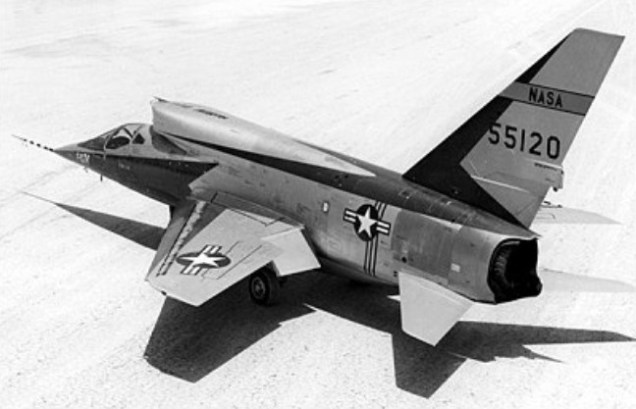
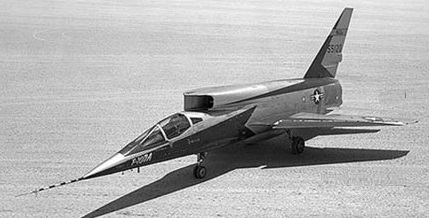
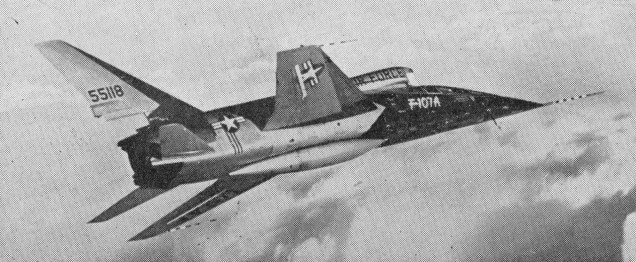
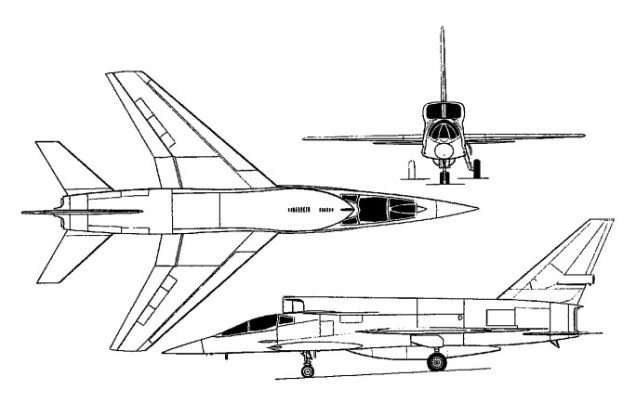
A derivative of the Super Sabre and originally designated the YF-100B, the North American F-107, or company NA-212, was an all-weather fighter-bomber version of the F-100 powered by a 10660kg thrust Pratt & Whitney YJ75-P-9 turbojet.
North American YF-107A 55-5120
A large dorsal arrangement with bifurcated VAID (Variable Area Inlet Duct) inlets inlet was above and behind the cockpit, so positioned to create space in the nose for radar. The F-107 was equipped with a sidestick flight control system.
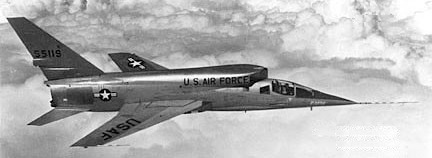
North American YF-107A 55-5119
Design work began in June 1953 and a year later the USAF ordered nine aircraft (55-5118 to 55-5126), although only three were actually completed (55-5118 to 55-5120). In 1955, the F-107 lost out to the Republic F-105 in a paper competition even though it had not yet flown and its competitor did not, then, have all-weather capability. Thus, the future of the F-107 was already clouded on 10 September 1956 when Robert Baker made the first flight at Edwards AFB, California, in the first of three service-test YF-107As.
The YF-107A was relatively trouble free but despite good performance, the three YF-107As were soon relegated to permanent test status. Features of the aircraft warranting further evaluation included a flush centre-line fuel tank mounted in the indented fuselage bottom, spoilers on the wing surface instead of ailerons, and a one-piece all-moving rudder, later adopted on the A-5 Vigilante attack bomber.
The first YF-107A eventually found itself in a scrap heap, the second is now on display at the Air Force Museum in Dayton, Ohio, and the third was lost in a crash landing while on loan to NACA. F-107 (Tail number 55-5118) was on display at Pima Air and Space Museum in Tucson.
YF-107A Engine: 1 x Pratt & Whitney J-75-P-9, 24,500-lb (11,115-kg) Max take-off weight: 22204 kg / 48952 lb Empty weight: 16852 kg / 37152 lb Wingspan: 11.2 m / 36 ft 9 in Length: 18.5 m / 60 ft 8 in Height: 6.0 m / 19 ft 8 in Wing area: 39.7 sq.m / 427.33 sq ft Max speed: 2200 km/h / 1367 mph Cruise speed: 700 mph Range: 1900 km / 1181 miles Ceiling: 50,000 ft Armament: 4 x 20mm cannons, 4540kg of weapons Seats: 1
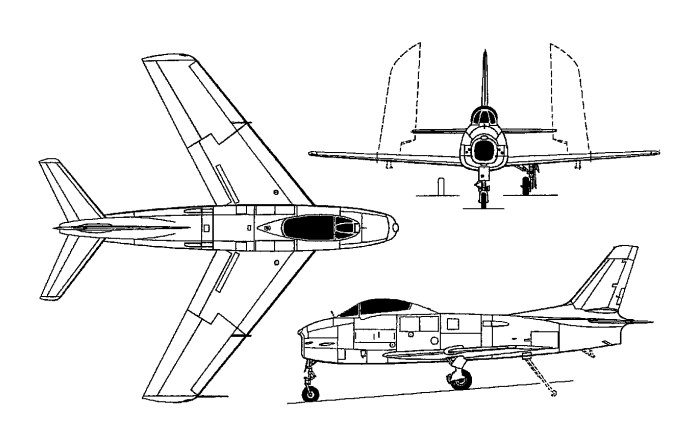
The North American F-86C developed into the YF-93A and eventually became the third design in the penetration fighter competition with the McDonnell XF-88 and Lockheed XF-90. The YF-93A was a bigger, and bulkier than the Sabre. The nose inlet of the F-86 design was replaced with side-mounted inlets and the fuselage was widened to house a 12835kg thrust Pratt & Whitney turbojet. The result was a larger, heavier machine with longer range and greater load-carrying capacity than the Sabre.
On 9 June 1948, the USAF ordered 118 F-93s, but the order was cancelled a year later. The YF-93A lost its second chance to attain production status when it emerged a poor third in the penetration fighter contest which, as it turned out, did not result in any production contract anyway.
The first of the two YF-93As, also known as the company NA-157, was first flown on 24 January 1950. The two machines underwent various modifications during evaluation, including changes in the shape of their lateral air inlets.
After the USAF was no longer a potential buyer, the two airframes were turned over to the National Advisory Committee for Aeronautics (NACA), where they were employed in various tests until eventually being retired and scrapped.
YF-93A Engine: 12835kg thrust Pratt & Whitney turbojet Max take-off weight: 12025 kg / 26511 lb Empty weight: 16360 kg / 36068 lb Wingspan: 11.81 m / 38 ft 9 in Length: 13.44 m / 44 ft 1 in Height: 4.78 m / 15 ft 8 in Wing area: 28.43 sq.m / 306.02 sq ft Max. speed: 1140 km/h / 708 mph Ceiling: 14265 m / 46800 ft
To meet a US Army Air Force requirement for a day fighter that could be used also as an escort fighter or dive-bomber, North American submitted a design known as the NA-140.
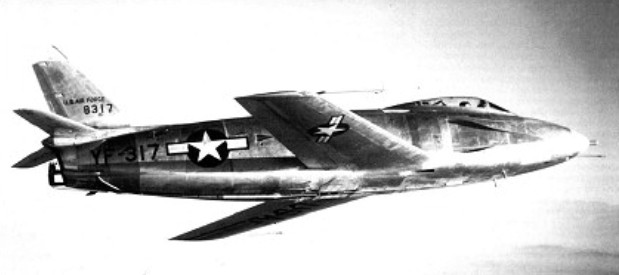
Two XP-86 prototypes of the NA-140 design were contracted in late 1944, but when German research data on the characteristics of swept wings became available soon after the end of the war, North American sought USAAF agreement to redesign the XP-86 to incorporate swept wings and tail surfaces. This cost a year’s delay, and it was not until 1 October 1947 that the first prototype was flown with flying surfaces swept at 35 degrees, then powered by a Chevrolet-built General Electric TG-180 (or J35-C-3) turbojet of 1701kg thrust; on 25 April 1948, by then re-engined with a General Electric J47 turbojet as the YP-86A, this aircraft exceeded a speed of Mach 1 in a shallow dive.
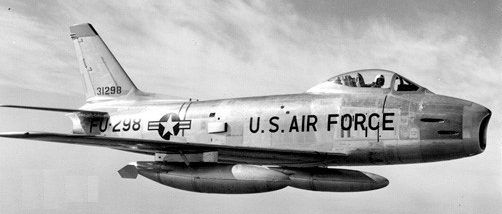
The first production version was the P-86A, powered initially by a 2200kg thrust General Electric J47-GE-1 turbojet and flown first on 20 May 1948. A month later USAF redesignation resulted in the P-86A becoming the F-86A and in 1949, by which time it had gained the name Sabre. The new fighter began to enter service with the USAF’s 1st, 4th and 81st Fighter Groups, the 94th Squadron of the 1st Fighter Group receiving the first in February 1949.
On 5 September 1948 at Cleveland, Ohio, an F-86 made an attempt on the world absolute speed record. As a result of faulty timing this flight, estimated to have averaged 669 mph, cannot be claimed as an official record.
F-86A 5 September 1948
F-86A production totalled 554, the majority having 2359kg thrust J47-GE-3, -7, -9, or -13 turbo-jets.
Just six months after it was assigned to duty, the F-86 set a world speed record of 670.9 mph. Later the Sabre beat its own record, upping the bar to 715 mph.
The F-86B (deeper fuselage and larger tyres) and F-86C (redesigned fuselage) did not enter production. The F-86C developed into the YF-93A.
The most extensively built was the F-86D (2,054), a redesigned all-weather/night fighter with a nose radome for all weather fighter duties and rocket armament instead of machine guns. The F-95 designation was assigned initially to the radar-equipped, all-weather interceptor version of the North American F-86 Sabre. The first two YF-95A airframes (50-577/ 578) were hastily assembled in 1949 with the nose configuration but not the radar of production aircraft. The two YF-95As also lacked the missile armament and afterburner of the production machine, being equipped instead with an extremely crude external reheat device at the exhaust for the 2460kg thrust General Electric J47-GE-17 turbojet engine. By the time the first of these machines had been completed and made its first flight on 22 December 1949 with company test pilot Joseph Lynch at the controls, it had been redesignated F-86D.
F-86D / YF-95 Dog Sabre
The F-86D, -K, and -L had a 35 degree sweepback wing with leading edge slats (slots I the F-86L) and trailing edge flaps. The F-86D and -L had a retractable pack of twenty-four 2.75in air-to-air rockets in the bottom of their forward fuselage, the -K having four 20mm cannon.
Subsequent production included the 1950 F-86E (NA-170, -172) with an all-moving tailplane and power-boost controls, and the F-86F (1,539) with a new wing and J47-GE-27 engine. 336 F-86E were built, plus 60 built by Canadair as Sabre Mk.III/IV.
The F-86F was the last day fighter version to be produced by North American and served with many, including Argentina, Nationalist China, Ethiopia, South Korea, Pakistan, Peru, Philippines, Portugal, Saudi Arabia, Spain, Thailand, and Venezuela. Mitsubishi assembled 300 F-86F in Japan for the Japanese Air Self-Defence Force.
The F-86F had the 35 degrees sweptback wings, with tailplane and elevators linked for co-ordinated movements. Fuel tanks are in the fuselage and two or four underwing jettison able tanks were available.
F-86E 51-2721
The sole 1951 F-86G was a provisional designation for an engine test-bed with a modified J47. Production of 406 were completed as F-86D.
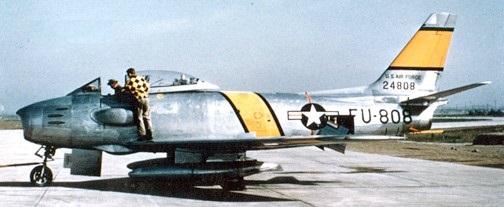
The F-86F, QF-86F, RF-86F, and TF-86F (NA-172, -176, -191, -193, -202, -204, -206, -210, -227, -231, -238, -256) of 1952 had new leading edge and boundary layer fences, and six nose guns. First flying on 19 March 1952 (p: George Smith). 2,540 were built, of which one was converted as RF-86F photo-recon and two as two-seat TF-86F (NA-204, -216) trainer (first flying on 5 January 1954). Many were later used as QF-86F targets and drones. The NA-231, 238, and -256 were 300 exports to Japan.
RF-86F 52-4808
TF-86F 52-5016
Destined to be the final production version of the Sabre (477) for the USAF, the F-86H featured a deeper fuselage to accommodate the larger air intake required by an 8,920 lb st (4 046 kgp) General Electric J73-GE-3 engine and permitting a substantial increase in internal fuel capacity. The first F-86H was flown on 30 April 1953 piloted by Joe Lynch, this retaining the slatted wing of the F-86E. Two prototypes were built, 52-1975 and 52-1976. Subsequent aircraft omitted the slats and adopted the extended wing leading edge introduced during F-86F production the final 10 aircraft having both slats and extended wing. Intended for the fighter-bomber role, the F-86H had four underwing stores stations, and could carry a pair of 1,000-lb (463,6-kg) GP bombs or 750-lb (340-kg) napalm bombs in addition to drop tanks, or a 1,200-lb (544-kg) 100-kT nuclear store under the port wing.
F-86H 53-1298
First flying on 4 September 1953, deliveries of the F-86H (NA-187, -203) to the USAF commenced in January 1954, the first 113 having an armament of six 05-in (12,7-mm) machine guns which gave place to four 20-mm cannon in subsequent aircraft, and a total of 473 (plus two pre-series) F-86H Sabres was built with the last being accepted on 11 April 1956.
The F-86K (120) was a simplified version of the F-86D. Evolved from the F-86D specifically for supply to NATO forces under the MDAP, the F-86K differed from its predecessor primarily in having a simpler fire control system and cannon armament which could be supplemented by a pair of AIM-9B Sidewinder AAMs, and was 8’; longer. Development began on 14 May 1953, two F-86D-40s being modified as YF-86K(NA-205) prototypes (52-3630, -3804) and the first of these flying on 15 July 1954. These were subsequently sent to Italy to serve as pattern aircraft for similar aircraft assembled under licence by Fiat. The parent company built 120 F-86Ks, deliveries commencing in May 1955, these being powered by a 147-GE-17B engine rated at 5,425 lb st (2460 kgp) and boosted to 7,500 lb st (3402 kgp) with afterburning, built in armament comprising four 20-mm cannon.
North American F-86K 54-1231
Of the NAA-built F-86Ks (NA-213, -221, -232, -242), 60 were supplied to Norway and 59 to the Netherlands. The first Fiat-assembled F-86K was flown on 23 May 1955, a total of 221 (from North American-built kits of components) being delivered of which 63 were supplied to the Italian air arm, 60 to France, 88 to Germany, six to the Netherlands and four to Norway. The last 45 Fiat-assembled aircraft had the extended wing of the F-86F-40, others being retroactively modified. The Dutch F-86Ks were passed on to Turkey in 1963-64, and, in 1967-68, 47 ex-German aircraft were passed to Venezuela, four of the latter being sold to Honduras in 1969.
In total, 341 were built, plus those license-built by Fiat in Italy, with four 20mm nose cannon.
Production from North American-built kits of components began in Japan, with Mitsubishi leading a group of Japanese companies which first assembled, then increasingly constructed, a total of 300 similar to the F-86F and RF-86F.
The designation F-86L was applied in 1956 to rebuilds (981) from F-86Ds, which introduced a 2’ increased span wing, leading edge slats and electronic equipment integrating them into the American SAGE air defence system.
North American F-86L 52-10143
In 1952 North American installed a 6000lb Avro-Canada Orenda in one F-86A-5 pulled from their own production line as an experimental prototype F-86J (NA-167).
Canadair built a single Sabre Mk.I, based on the original F-86A was followed by 60 F-86Es for the USAF refitted with GE J47, followed by 290 generally similar Sabre Mk 2 fighters, comprising 230 for the RCAF and 60 for the Mutual Defense Assistance Program. These were similar to the F-86E and were fitted with imported J-47-GE-13 engines, rated at 5200 lb.
Canadian production continued with 438 Sabre Mk 4 for the RAF with General Electric engines. Many Mk.2s were brought up to Mk.4 standard.
With the selection in 1948 by the RCAF of the F-86A Sabre as its next-generation fighter it was envisaged from the outset that the indigenous Orenda engine would replace the J47. In the event, this intention was to be frustrated by delays in power plant availability, and it was not until 30 July 1953 that a pre-¬series aircraft was flown with the Canadian engine as the CL-13A Sabre 5.
Almost three years prior to this event, North American had re-engined an F-86A-5 with an Orenda 3 as the F-86A/O, this having flown in October 1950, and the 100th F-86E licence-built airframe completed by Canadair had been similarly powered as the CL- 13 Sabre 3 (alias F-86J) and flown on 4 June 1952.
The Canadair SabreMk.3 was a North American-built F-86E converted for the Avro Orenda engine.
This gave considerably improved performance so the RCAF ordered 470 Sabre Mk.5s based on the F-86F and powered by a 6355 lb Orenda 10.
Twenty-four Canadair Sabre 5 were ordered by Israel and some were completed before the order was cancelled.
Israeli Sabre 5
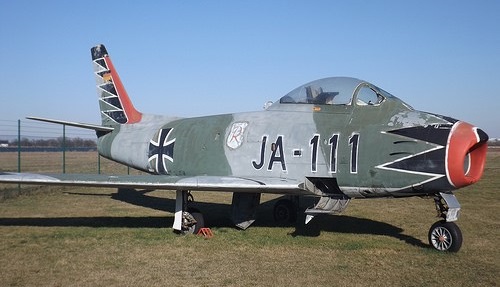
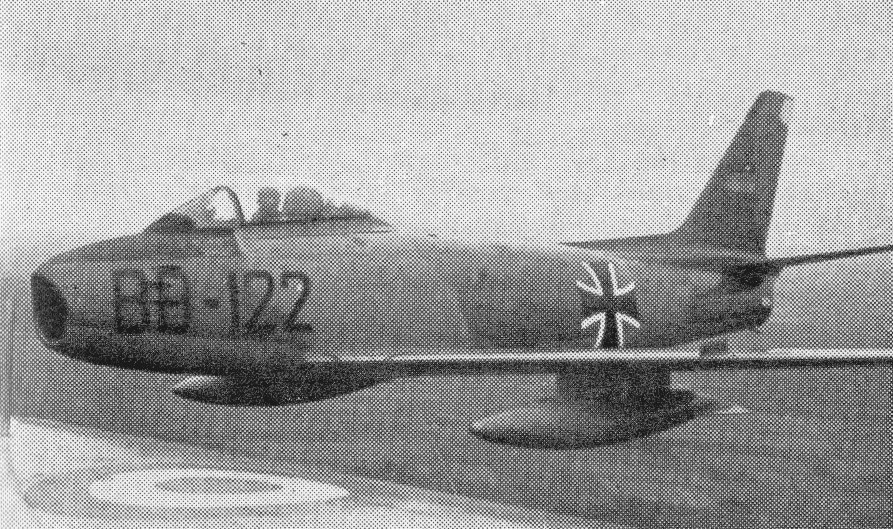
Powered by a 6,355 lb st (2 883 kgp) Avro Orenda 10 turbojet, the Sabre 5 retained the armament of six 05-in (12,7-mm) machine guns and had the slatless extended wing leading edge introduced by the F-86F. A total of 370 Sabre 5s was built, of which 75 were presented to the Federal German Luftwaffe, before production deliveries commenced of what was to prove the definitive Canadair-built model, the CL-13B Sabre 6 first flown on 2 November 1954. This differed essentially from the Sabre 5 in having the two-stage Orenda 14 of 7,275 lb st (3 300 kgp) and initial aircraft had a similar wing to that of the Sabre 5, but later Sabre 6s reinstated wing slats. Of the 655 Sabre 6s built, six were supplied to Colombia, 34 to South Africa and 225 to Federal Germany.
The CL-13C was a Sabre 5 with an area ruled fuselage and the CL-13E was a Sabre 6 fitted with an afterburner.
JA+111 Canadair CL-13B Sabre Mk.6 1625
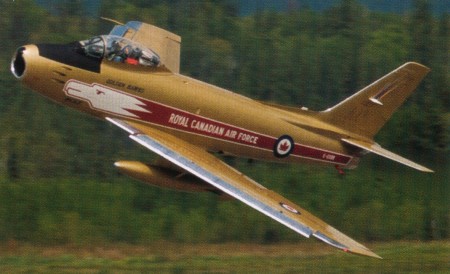
The Sabre 6 served the RCAF from 1950-68. The Sabre 6 with its extra power and slatted wings served in many air forces around the world into the 1970’s, though it stood down in Canada in 1968.
Canadair CL-13 Sabre 6
The Commonwealth Aircraft Corporation in Australia also became involved in Sabre production, modifying the F-86F airframe for two 30mm Adens and the 3402kg thrust Rolls-Royce Avon 26 engine. The more powerful engine involved extensive redesign of the fuselage, including a larger intake.
The prototype, first flying on 3 August 1953, and the first 22 production Avon-Sabres had imported Avon RA.7 turbojets and retained the Sabre’s leading-edge slats. These were designated Mk.30, first flying on 13 July 1954.
CA-27 Avon-Sabre
They were followed by 20 Sabre Mk 31s with Commonwealth-built Avon 20 and with the slats replaced by extended wing leading-edges.
Subsequently 69 Sabre Mk32 fighters with Australian-built engines were produced.
The wings had a 35 degree sweepback and the tailplane had 10 degrees dihedral. Slotted trailing-edge flaps and tricycle undercarriage were fitted. The main wheels retract inward into the fuselage and the nosewheel retracts rearward. Airbrakes are on each side of the rear fuselage. Fuel tanks are in the fuselage.
Commonwealth Aircraft Corporation Sabre Mk.32
The RAAF received its aircraft 1956, based at Williamstown, NSW.
More than 9,000 Sabres were built; 1,815 of them in Canada.
The German Luftwaffe purchased 225 Sabres from Canadair and in addition received 75 under MDAP arrangements.
This fighter was the prime contender against the North Korean MiG-15, typically flown by Russian and Chinese pilots. The tally at the end of the war was telling, both about American technology and pilot skills. By the end of hostilities, it had shot down 729 MiGs, loosing only 76 Sabres—a victory ration of 10:1. During the Korean War, approximately 22 Canadian pilots were attached to the USAF (United States Air Force) and flew Sabres in combat.
The Royal Thai Air Force received 45 F-86F-30/40 Sabres. Designated ‘Fighter Type 17’, they served from 1961 to 1973.
A radical development of the F-86 Sabre was the FJ Fury naval fighter.
Bob Hoover tested an F-86D that had the horizontal tail located at the bottom of the fuselage. This was a testbed for the future F-100, which would feature a similar configuration. One of the design characteristics of the test bed was that the dive brakes were located on the top of the fuselage instead of the lower section. When the brakes were extended, the plane pitched down and not up as would be the case with the conventional F-86s.
F-86A Sabre Engine: 1 x General Electric J47-GE-3, -7, -9, or -13 Span: 37ft 1in Length: 37ft 6in Height: 14ft 9in Empty Weight: 10,854lbs Max Take-off Weight: 15,800lbs Max Speed: 679mph at sea level Cruising Speed: 533mph Service Ceiling: 48,000ft Range: 660miles Time to 40,000ft: 10.4 mins Fuel Capacity is 436 gallons internal – external two 100 gallon drop tanks
F-86A/O An F-86A-5 re-engined to serve as the prototype of the Canadair CL-13 Sabre
F-86D Engine: General Electric J47-GE-33, 7650 lb with re-heat Wingspan: 11.30 m / 37 ft 1 in Length: 12.29 m / 40 ft 4 in Height: 4.57 m / 15 ft 0 in Wing area: 287.9 sq ft Max take-off weight: 20,550 lb Empty weight: 11,905 lb Max. speed: 1138 km/h / 707 mph Ceiling: 16640 m / 54600 ft Max ROC: 15,600 fpm Range: 1344 km / 835 miles Armament: 24 x 69.9mm missiles Crew: 1
F-86F Engine: 1 x General Electric J47-GE-27, 5970 lb / 26.3 kN Wing span: 39 ft 1 in (11.91 m) Wing area: 287.9 sq.ft Length: 37 ft 6 in (11.43 m) Height: 14 ft 8 in (4.47m) Empty weight: 10,950 lb Max TO wt: 20.195 lb Wheel track: 8 ft 3 in Max level speed: 655 mph at SL Cruise speed: 603 mph Service Ceiling: 49,600 ft / 15,100 m Range: 1270 mi Ceiling: 50,000 ft Armament: 6 x 0.5in mg Bombload: 2 x 1000 lb bombs
YF-86H Engine: GE YJ73, 9300 lb Wingspan: 39’1″ Length: 38’8″ Useful load: 8016 lb Max speed: 692 mph Range: 1040 mi Ceiling: 49,000 ft
F-86H Engine: G.E.C. J73, 8920 lb Max speed at sea level, 692 mph (1114 km/h) Max speed at 35,000 ft (10 670 m) 617 mph (993 km/h) Initial climb, 12,900 ft/min (65,53 m/sec) Range (two 200-US gal/757-lt drop tanks), 1,040 mls (1674 km) Empty weight, 13,836 lb (6 276 kg) Loaded weight (with two drop tanks), 21,852 lb (9912kg) Span, 39ft 1½ in(l1,92m) Length, 38ft l0in(11,84 m) Wing area, 313.37 sq ft (29,11 sq.m)
F-86K Engine: General Electric J47-GE-17B, 7450 lb with re-heat Span, 37 ft 1.5 in (11,31 m) Length. 40 ft 11 1/8 in (12,47 m) Height, 15 ft0 in (4.57 m) Wing area. 287.9 sq ft (26,7 5 sq.m) Empty weight. 13,367 lb (6063 kg) Loaded weight (clean), 18,379 lb (8337kg) Max speed at sea level, 692 mph (1114km/h) Max speed at 40,000 ft (12 190 m), 612 mph (985 km/h) Initial climb, 12.000 ft/min (60,96 m/sec) Range (with two 120-US gal/454-lt drop tanks), 744 mls (1197 km)
F-86L Engine: General Electric J47-GE-33, 7650 lb with re-heat Wingspan: 39’1″ Length: 40’3″
Canadair Sabre Mk.I
Canadair Sabre Mk.2 Engine: GE J47-GE-13, 5200 lb
Canadair Sabre Mk.3 Engine: Avro Orenda
Canadair Sabre Mk.4 Engine: GE J47-GE-27, 5800 lb
Canadair Sabre Mk.5 Engine: Orenda 10, 6500 lb
Canadair F-86 Sabre 6 Engine: Avro Canada Orenda 14 turbojet, 7275 lb Dimensions as for F-86A Wing Span: 37 ft 11.5 in Empty weight; 10,618 lb / 4816 kg Loaded weight (clean): 14,613 lb / 6628 kg MTOW: 17,560 lb / 7965 kg Engine: Orenenda 14, 7275 lb / 3300 kg Max speed at sea level, 710 mph (1143 km/h) Max speed at 36,000 ft (10 975 m) 620 mph (998 km/h) Range: 363 miles / 584 km Ferry range: 1486 miles / 2391 km Service ceiling: 54,700 ft / 16,460 m Initial climb, 11,800 ft/ min (59,94m/sec) Rate of Climb: 35,000 ft / 10,670m in 4 min 42 sec Armament: 6 x 0.50in (12.7mm) mg , 1602 rounds total (267 rounds per gun)
CA-27 Avon-Sabre Engine: Commonwealth Rolls-Royce Avon 26, 7500 lb.s.t Wingspan: 37 ft 1 in Wing area: 312 sq.ft Length: 37 ft 6 in Height: 14 ft 5 in Wheel track: 8 ft 4 in Empty weight: 12,000 lb MTOW: 17,300 lb Max speed: 700 mph at SL Max ROC: 12,000 fpm Service ceiling: 50,000 ft Max range: 1150 mi Armament: 2 x 30mm Aden cannon Bombload: 2 x 1000 lb

























 All Aero