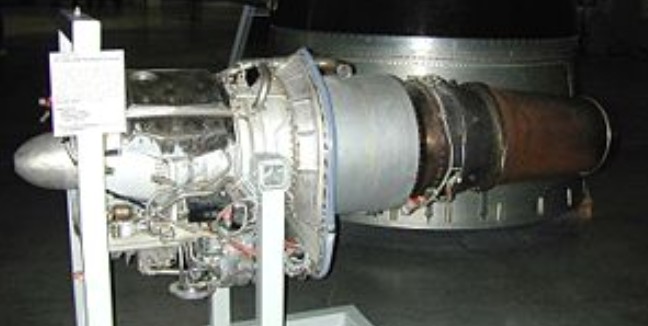
The Pratt & Whitney JT12, (US military designation J60) is a small turbojet engine. The J60 conception and project design began in July 1957 at United Aircraft of Canada (later Pratt & Whitney Canada) in Montreal. The project design details were transferred to the main P&W company in East Hartford and in May 1958, the first prototype, with military designation YJ60-P-1 commenced testing.
Flight tests were completed in early 1959; followed by the delivery of the new JT12A-5 engines in July 1959. These were for the two Canadair CL-41 prototype trainers with a rating of 12.9 kN (2,900 lb st).
The modified JT12A-3 turbojets with a basic rating of 14.69 kN (3,300 lb st) were tested in the two Lockheed XV-4A Hummingbird VTOL research aircraft. The next version, JT12A-21, had an afterburner which delivered a maximum thrust of 17.91 kN (4,025 lb st).
A total of 2621 were built.
The Pratt & Whitney T73 (Pratt & Whitney JFTD12) is a related turboshaft engine.
Variants: YJ60-P-1—prototype
J60-P-3
J60-P-4
J60-P-5
J60-P-6
T73 Military designation of the Pratt & Whitney JFTD12 free power turbine turboshaft version of the J60.
JT12A-3LH
JT12A-5 (J60-P-3/-5/-6) Take-off ratings from 2,900 lbf (12.9 kN) to 3,001 lbf (13.35 kN).
JT12A-6 Essentially similar to the –5
JT12A-7 (J60-P-4) up-rated to 3,300 lbf (15 kN)
JT12A-8
JT12A-21 An after-burning version developing 4,024 lbf (17.9 kN) thrust wet.
FT12 Turboshaft versions for marine use.
JFTD12 Comapny designation of the Pratt & Whitney T73 free power turbine turbo-shaft version of the J60.
Applications: Civilian (JT12) Lockheed JetStar North American Sabreliner
Military (J60) T-2B Buckeye T-39 Sabreliner Sikorsky XH-59/S-69 XV-4 Hummingbird
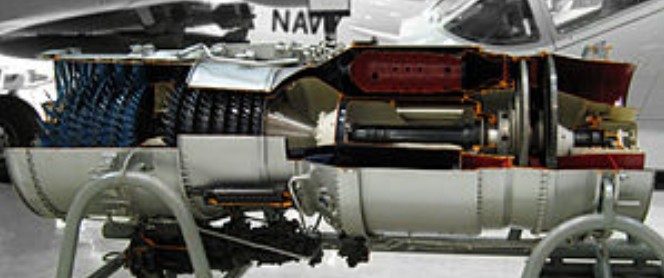
The Pratt & Whitney J52 (company designation JT8A) is an axial-flow turbojet engine originally designed for the United States Navy, in the 9,000 lbf-class as a scaled-down derivative of the J57/JT3A.
First run in 1955, it was initially intended to power the A4D-3 Skyhawk, an advanced avionics model that was canceled in 1957. After being canceled, the U.S. Air Force selected the J52 to power the AGM-28 Hound Dog cruise missile. The engine was designed with several unique features for this application, including a “conical centerbody mounted in the intake” and a “variable central plug … in the nozzle”.Then, in 1958, the US Navy selected the engine to power what became the A-6 Intruder.
The J52-P-6 model, designed for the YA2F-1 (YA-6A) Intruder, had a unique nozzle that could be angled downward at 23 degrees for STOL takeoffs; this was not used on production A-6s. The J52 was selected to power the A4D-5, another model of the A-4 Skyhawk, remaining in all subsequent new-built models.
The twin-spool J52 employs a split 12-stage axial compressor consisting of a five-stage low pressure unit and a seven-stage high pressure unit. Behind the compressor is a nine-unit can-annular combustion chamber and a two-stage split turbine.
A total of 4,567 were built.
The engine also provided the basis for the Pratt & Whitney JT8D, a civilian low-bypass turbofan engine.
JT8D
The P&W JT8D was first tested in 1961 resulting in nine basic models.
Variants: J52-P-3 Flown in: AGM-28 Hound Dog. This variant produced 7,500 lbf (33,000 N) of thrust. The design of the P-3 model included a variable inlet duct to improve engine efficiency at the various altitudes the cruise missile was designed to fly at.
J52-P-6 Flown in: A-6A. This variant produced 8,500 lbf (38,000 N) of thrust and included the 23-degree downward swiveling nozzle.
J52-P6A Flown in: A-4E, TA-4J, EA-6B (the first few). This variant produced 8,500 lbf (38,000 N) of thrust.
J52-P-8A/B Flown in: A-4F/G/H/K, TA-4E/F/G/H, A-6E, EA-6B. This variant produced 9,300 lbf (41,000 N) of thrust.
J52-P-408 Flown in: A-4M/N, TA-4KU, EA-6B. This variant included variable inlet guide vanes (VIGV) in the LPC, air-cooled turbine blades, and produced 11,200 lbf (50,000 N) of thrust.
J52-P-409 Also known as PW1212. 12,000 lbf (53 kN) thrust version of the J52-P-408 with an improved low pressure turbine (LPT) and faster acceleration. Designed for the EA-6B and was additionally marketed as an upgrade for the A-4. The J52-P-409 was also proposed as a cost-effective upgrade to the A-6E as an alternative to the A-6F Intruder II, but was not purchased. The P-409 engine was also proposed for use in the EA-6B ADVCAP, but that program was canceled after three prototypes were built and flown. The P-409 would have been available as a new engine or as an upgrade kit for P-408 engines, but was never ordered in significant quantities.
PW1216 An afterburning derivative of the J52-P409 engine proposed for the Grumman Sabre II concept (the project later evolved into the JF-17 Thunder). The afterburner, designed in China, would have increased thrust to 16,000 lbf (71 kN).
JT8A Company designation for initial versions of the J52
JT8B-1 (J52-P-6)
Applications: AGM-28 Hound Dog Dassault Super Mystere Douglas A-4 Skyhawk Grumman A-6 Intruder Lockheed Martin A-4AR Fightinghawk Northrop Grumman EA-6B Prowler
The J57 was a turbojet development of the XT45 (PT4) turboprop engine intended for the XB-52. As the B-52 power requirements grew, the design evolved into a turbojet, the JT3. The Collier Trophy for 1952 was awarded to Leonard S. Hobbs, Chief Engineer of United Aircraft Corporation, for “designing and producing the P&W J57 turbojet engine”.On May 25, 1953, a J57-powered YF-100A exceeded Mach 1 on its maiden flight. First run in 1952, the engine was produced from 1951 to 1965 with a total of 21,170 built. One XT57 was installed in the nose of a C-124 (BuNo 52-1069), and tested in 1956.
The Pratt & Whitney J57 (company designation: JT3C). The J57 was the first 10,000 lbf (45 kN) thrust class engine in the United States. The J57/JT3C was developed into the J75/JT4A turbojet, JT3D/TF33 turbofan and the PT5/T57 turboprop.
Variants: J57-P-1W 11,400 lbf (51 kN) s.t with water injection (B-52B)
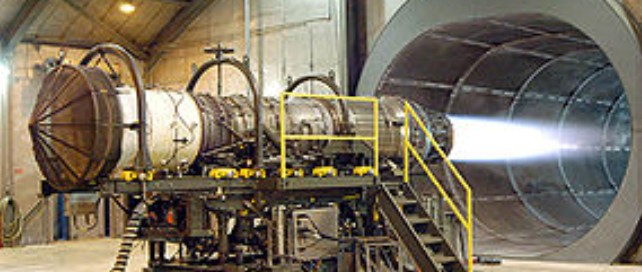
The origins of the F135 afterburning turbofan lie with the Lockheed Corporation Skunk Works’s efforts to develop a stealthy STOVL strike fighter for the U.S. Marine Corps under a 1986 DARPA program. Lockheed employee Paul Bevilaqua developed and patented a concept aircraft and propulsion system, and then turned to Pratt & Whitney (P&W) to build a demonstrator engine. The demonstrator used the first stage fan from a F119 engine for the lift fan, the engine fan and core from the F100-220 for the core, and the larger low pressure turbine from the F100-229 for the low pressure turbine of the demonstrator engine. The larger turbine was used to provide the additional power required to operate the lift fan. Finally, a variable thrust deflecting nozzle was added to complete the “F100-229-Plus” demonstrator engine. This engine proved the lift-fan concept and led to the development of the current F135 engine.
P&W developed the F135 from their F119 turbofan, which powers the F-22 Raptor, as the “F119-JSF”. The F135 integrates the F119 core with new components optimized for the JSF. The F135 is assembled at a plant in Middletown, Connecticut. Some parts of the engine are made in Longueuil, Quebec, Canada, and in Poland.
The first production propulsion system for operational service was scheduled for delivery in 2007 for the F-35 Lightning II single-engine strike fighter. The F-35 will serve the U.S., UK, and other international customers. The initial F-35s will be powered by the F135, but the GE/Rolls-Royce team was developing the F136 turbofan as an alternate engine for the F-35 as of July 2009. Initial Pentagon planning required that after 2010, for the Lot 6 aircraft, the engine contracts will be competitively tendered. However since 2006 the Defense Department has not requested funding for the alternate F136 engine program, but Congress has maintained program funding.
The F135 team is made up of Pratt & Whitney, Rolls-Royce and Hamilton Sundstrand. Pratt & Whitney is the prime contractor for the main engine, and systems integration. Rolls-Royce is responsible for the vertical lift system for the STOVL aircraft. Hamilton Sundstrand is responsible for the electronic engine control system, actuation system, PMAG, gearbox, and health monitoring systems. Woodward is responsible for the fuel system.
The F135 family has several distinct variants, including a conventional, forward thrust variant and a multi-cycle STOVL variant that includes a forward lift fan.
The F135 is a two-shaft engine featuring a three-stage fan (low pressure) and a six-stage high pressure (HP) compressor. The hot section features an annular combustor with a single-stage HP turbine unit and a two-stage LP turbine. The afterburner features a variable converging-diverging nozzle.
The conventional and carrier aviation engines, the F135-PW-100 and F135-PW-400, have a maximum (wet) thrust of approximately 43,000 lbf (191 kN) and a dry thrust of approximately 28,000 lbf (125 kN). The major difference between the -100 and -400 models is the use of salt-corrosion resistant materials.
The STOVL variant, F135-PW-600, delivers the same 43,000 lbf (191 kN) of wet thrust as the other types in its conventional configuration. In STOVL configuration, the engine produces 18,000 lbf (80.1 kN) of lift thrust. Combined with thrust from the LiftFan (20,000 lbf or 89.0 kN) and two roll posts (1,950 lbf or 8.67 kN each), the Rolls-Royce LiftSystem produces a total of 41,900 lbf (186 kN) of thrust, almost the same vertical lifting force for slow speed flight as the same engine produces at maximum afterburner, without the extreme fuel use or exhaust heat as wet thrust.
The STOVL variant engages a clutch to extract around 35,000 shp (26,000 kW) from the LP turbine to turn the forward lift fans, while switching power cycle from mixed (turbofan) to unmixed (turboshaft). Power is transferred forward through shaft to a bevel gearbox, to drive two vertically mounted contra-rotating fans. The uppermost fan is fitted with variable inlet guide vanes and the fan discharges efflux (low-velocity unheated air) through a nozzle on the underside of the aircraft. This cool air from the lift fan has the added benefit of preventing hot exhaust gases from the core section from being reingested into the engine while hovering. Finally, bypass duct air is sent to a pair of roll post nozzles and the core stream discharges downwards via a thrust vectoring nozzle at the rear of the engine. Measured by lift thrust in full vertical lift mode, the engine operates as 43% turbojet, 48% turboshaft, and 9% turbofan. Improving engine reliability and ease of maintenance is a major objective of the F135. The engine has fewer parts than similar engines which should help improve reliability. All line-replaceable components (LRCs) can be removed and replaced with a set of six common hand tools. Additionally, the F135’s health management system is designed to provide real time data to maintainers on the ground, allowing them to troubleshoot problems and prepare replacement parts before the aircraft returns to base. According to Pratt & Whitney, this data may help drastically reduce troubleshooting and replacement time, as much as 94% over legacy engines.
The F-35 with F135/F136 engines are not designed to supercruise, but the F-35 can achieve a limited supercruise of Mach 1.2 for 150 miles.
Because the F135 is designed for a fifth generation jet fighter, it is the second afterburning jet engine to use special “low-observable coatings”.
As of 2009, P&W was developing a more durable version of the F135 engine to increase the service life of key parts. These parts are primarily in the hot sections of the engine (the combustor and high pressure turbine blades specifically) where current versions of the engine are running hotter than expected, reducing life expectancy. The test engine is designated XTE68/LF1. This redesign has caused “substantial cost growth.”
In 2013, Pratt found that the latest F135 issue to ground the fleet was not a design problem but likely poor workmanship, and was caused by using the afterburner during testing at four times the stress of normal operation.
The 100th engine was delivered in 2013. LRIP-6 was agreed in 2013 for $1.1 billion for 38 engines of various types, continuing the unit cost decreases.
Variants: F135-PW-100 : Used in the F-35A Conventional Take-Off and Landing variant F135-PW-400 : Used in the F-35C carrier variant F135-PW-600 : Used in the F-35B Short Take-Off Vertical Landing variant
Specifications: F135-PW-100 Type: Afterburning Turbofan. F-35B: also partially turboshaft Length: 220 in (5.59 m) Diameter: 51 in (1.29 m) Dry weight: 1,701 kg / 3,750 lbs Compressor: Axial 3 stage low-pressure compressor, 6 stage high-pressure compressor Combustors: Short, annular combustor Turbine: Single stage high pressure turbine, two stage low pressure turbine Maximum thrust: 43,000 lbf (191.35 kN) max, 28,000 lbf (124.6 kN) intermediate Specific fuel consumption: 0.886 lb/(hr·lbf) or 25,0 g/kN·s (w/o afterburner) Thrust-to-weight ratio: 11.467
In 1967, the United States Navy and United States Air Force issued a joint engine Request for Proposals (RFP) for the F-14 Tomcat and F-15 Eagle fighters. The combined program was called Advanced Turbine Engine Gas Generator (ATEGG) with goals to improve thrust and reduce weight to achieve a thrust-to-weight ratio of 9. The program requested proposals and would award Pratt & Whitney a contract in 1970 to produce F100-PW-100 (USAF) and F401-PW-400 (USN) afterburning turbofan engines (company designation JTF22). The Navy would cut back and later cancel its order, choosing to continue to use the Pratt & Whitney TF30 engine from the F-111 in its F-14.
Variants: F100-PW-100 The F100-100 first flew in an F-15 Eagle in 1972 with a thrust of 106.4 kN (23,930 lbf). Due to the advanced nature of engine and aircraft, numerous problems were encountered in its early days of service including high wear, stalling and “hard” afterburner starts. These “hard” starts could be caused by failure of the afterburner to start or by extinguishing after start, in either case the large jets of jet fuel were lit by the engine exhaust resulting in high pressure waves causing the engine to stall. Early problems were solved.
F100-PW-200 The F-16 Fighting Falcon entered service with the F100-200, with only slight differences from the -100. Seeking a way to drive unit costs down, the USAF implemented the Alternative Fighter Engine (AFE) program in 1984, under which the engine contract would be awarded through competition. The F-16C/D Block 30/32s were the first to be built with the common engine bay, able to accept the existing engine or the General Electric F110.
F100-PW-220/220E The F100-PW-220 incorporated the most advanced technology available, including the precision control and advanced maintenance features of digital electronic controls and the extended durability and reliability of metallurgical and heat-transfer advances. The F100-220 was introduced in 1986 and could be installed on either an F-15 or F-16. A non-afterburning variant, the F100-PW-220U powers the Northrop Grumman X-47B UCAV. The “E” abbreviation from 220E is for equivalent. The abbreviation is given to engines which have been upgraded from series 200 to 220, thus becoming equivalent to 220 specifications.
F100-PW-229 Using technology developed from the F119 and F135 engine programs for the F-22 Raptor and F-35 Lightning II, the production F100-PW-229 incorporates modern turbine materials, cooling management techniques, compressor aerodynamics, and electronic controls. The first -229 was flown in 1989 and has a thrust of 79 kN (17,800 lbf) (dry thrust) and 129.7 kN (29,160 lbf) with afterburner. It powers late model F-16s and the F-15E Strike Eagle.
Applications: F100 McDonnell Douglas F-15 Eagle McDonnell Douglas F-15E Strike Eagle General Dynamics F-16 Fighting Falcon Northrop Grumman X-47B
F401 Grumman F-14B Tomcat (planned; test aircraft only) Rockwell XFV-12 Vought Model 1600 (proposed)
Specifications: F100-PW-229 Type: Afterburning turbofan Length: 4,900 millimetres (191 in) Diameter: 880 millimetres (34.8 in) inlet, 1,180 millimetres (46.5 in) maximum external Dry weight: 1,700 kilograms (3,740 lb) Compressor: Dual Spool Axial compressor with 3 fan and 10 compressor stages Bypass ratio: 0.36:1 Combustors: annular Turbine: 2 low-pressure and 2 high-pressure stages Maximum thrust: 79 kilonewtons (17,800 lbf) military thrust, 129.7 kilonewtons (29,160 lbf) with afterburner Overall pressure ratio: 32:1 Turbine inlet temperature: 1,350 °C (2,460 °F) Specific fuel consumption: Military thrust: 77.5 kg/(kN·h) (0.76 lb/(lbf·h)) Full afterburner: 197.8 kg/(kN·h) (1.94 lb/(lbf·h)) Thrust-to-weight ratio: 7.8:1
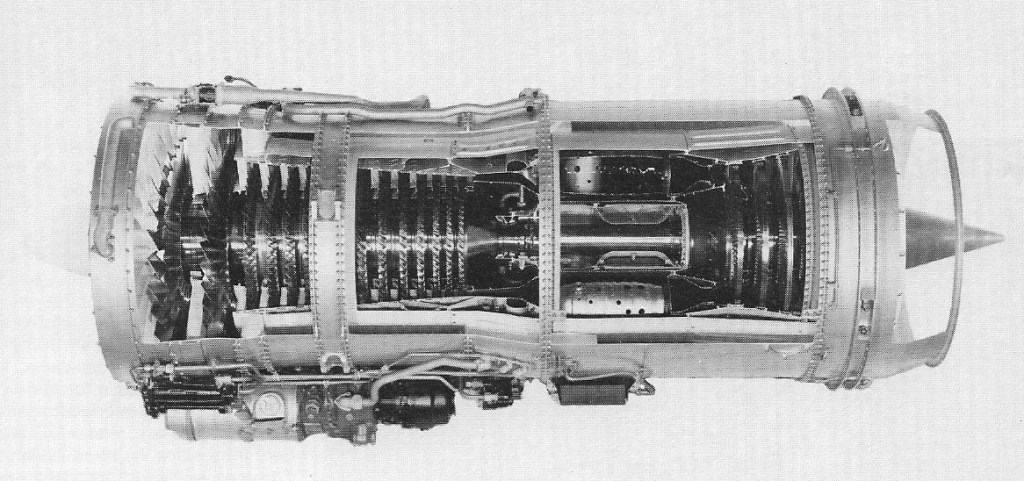
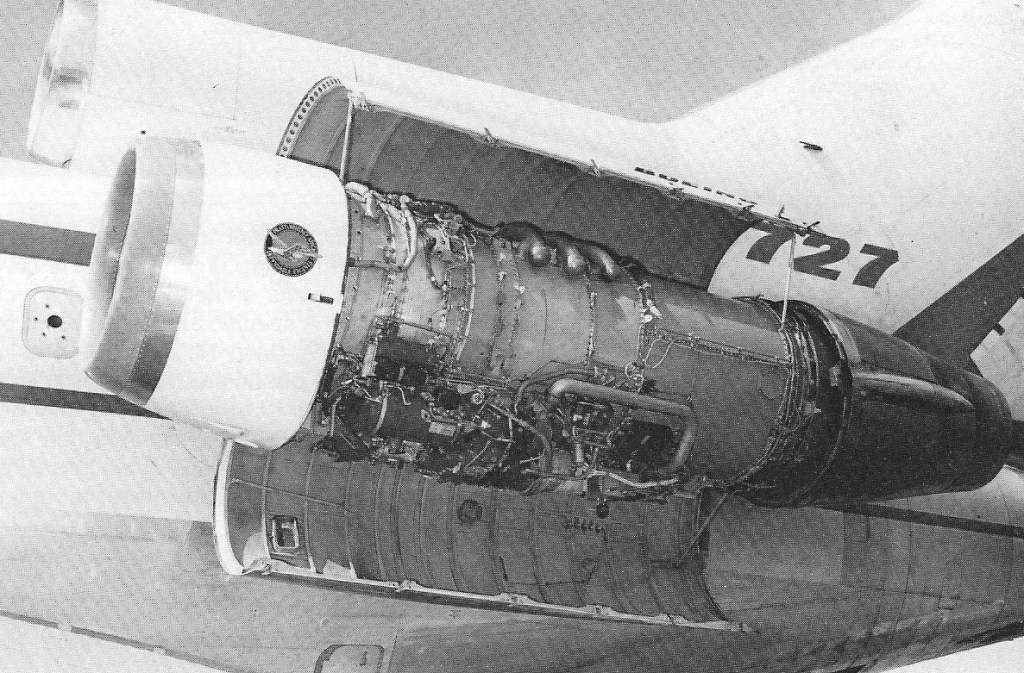
Aware of the competition from the Rolls-Royce Conway turbofan, Pratt&Whitney decided to develop the JT3D turbofan from the JT3C turbojet for later deliveries of the Boeing 707 and the Douglas DC-8, then nearing entry into service. A 2-stage fan, based on work done on the J91 nuclear turbojet, replaced the first 3 stages of the 8-stage JT3C LP compressor. On the LP turbine, the second stage was enlarged and a third stage added. On the Boeing 707 the fan nacelle was relatively short, whereas the Douglas DC-8 installation had a full length fan cowl. First run in 1958 and flown in 1959 (under a B-45 Tornado test aircraft), Pratt & Whitney provided a kit whereby JT3C’s could be converted to the JT3D standard in an overhaul shop.
In 1959, important orders for the engine were the Boeing 707-120B and Boeing 720B when American Airlines ordered one 707 powered by JT3D turbofans and KLM ordered a JT3D powered Douglas DC-8. The earlier 707s had been powered by the turbojet JT3C and the improved efficiency of the turbofan soon attracted the airlines. A JT3D powered 707-123B and 720-023B (the suffix B was to indicate a turbofan powered aircraft) entered service with American Airlines on the same day, March 12, 1961.
The Boeing KC-135 Stratotankers were all originally powered by turbojet engines. With the demise of many airline 707s the United States Air Force took the opportunity to buy the surplus airframes and use the engines to re-engine the KC-135As used by the Air National Guard and reserve squadrons with the civilian JT3D (designated TF33-PW-102). Over 150 aircraft were modified and the former KC-135A were re-designated the KC-135E.
135 KC-135s use the JT3D while 354 were fitted with CFM International CFM56 engines which provide greater thrust and increased operational flexibility due to their lower noise footprint. The noise of the JT3D is one of the reasons NATO has debated re-engining their E-3 Sentry AWACS fleet, with the aircraft subject to restrictions that modern-engined aircraft are not. Operational flexibility would be further increased due to the ability of higher power engines to increase the ceiling of the aircraft, extending the horizon for radar surveillance; for instance, RAF, French and Saudi E-3s routinely fly higher than NATO/USAF counterparts.
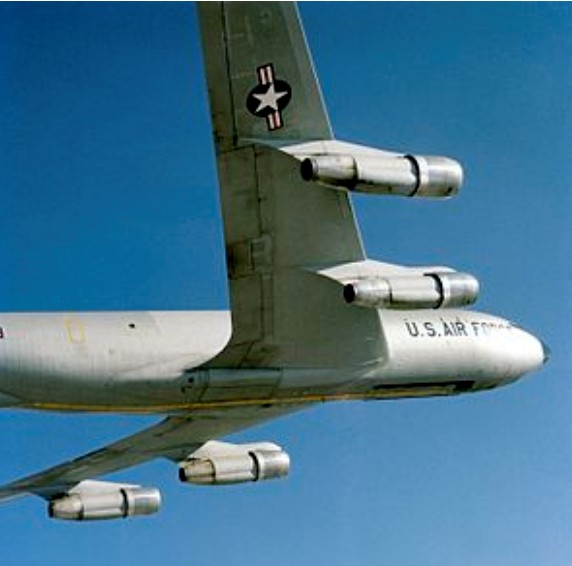
the Boeing B-52H Stratofortress is fitted with the JT3D (in TF33 form). The ‘H’ model of the B-52 was the only production variant of the bomber to be fitted with turbofan engines.
About 8,600 JT3Ds were produced between 1959 and 1985.
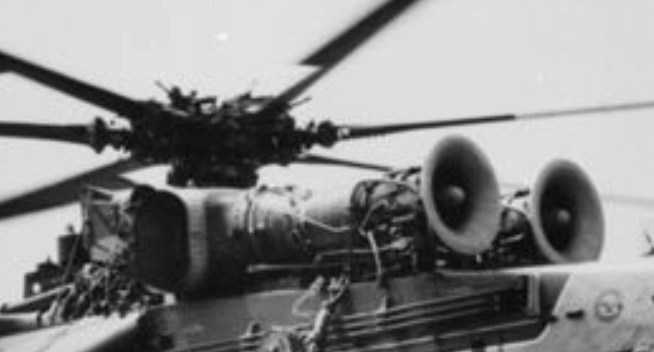
The Pratt & Whitney T73 (company designation JFTD12) is a turboshaft engine developed from the Pratt & Whitney JT12. Based on the JT12A, the T73 powered the CH-54 Tarhe/Sikorsky S-64 flying crane heavy-lift helicopter. Turboshaft versions for naval use are known as the FT12. 352 were built.
The Pratt & Whitney PT1 (US military designation T32) was a Free-piston gas turbine project first run in 1943. The project never progressed beyond ground test units, and was cancelled in 1945 in favor of developing the PT2 (T34) turboprop. The development of the PT1 gave Pratt & Whitney engineers valuable experience in designing gas turbines that it would later apply to projects that resulted in the Pratt & Whitney JT3 turbojet engine.
After a period of indifference, in June 1939 a demonstration of the Power Jets WU was made before a delegation of the Air Ministry, notably Dr Pye, Director of Scientific Research. The demonstration was so successful that the Ministry quickly arranged to buy the engine to give Power Jets working capital, lending it back to them for testing.
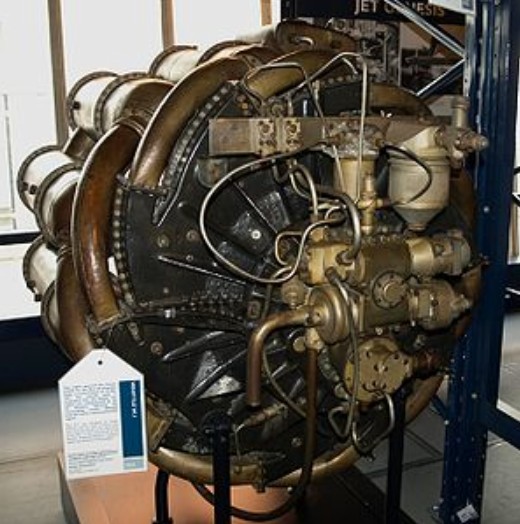
At the same time, a contract was placed for a “flight engine”, the W.1 (sometimes called the Whittle W.1). Designed by Frank Whittle and Power Jets, the W.1 was built under contract by British Thomson-Houston (BTH). Unlike the Whittle WU, that began bench testing in 1937, the W.1 was a symmetrical engine designed to facilitate, after development, installation in an aircraft. The W.1 used a double-sided centrifugal compressor of Hiduminium RR.59 alloy, reverse-flow combustion chambers and a water-cooled axial-flow turbine section; this was later modified to use air-cooling. The turbine blades were of Firth-Vickers Rex 78, a stainless steel developed under Dr. W. H Hatfield.
As development of the new design dragged on, it was decided to build a test unit “early engine” using any components that were deemed unairworthy along with test items. This was assembled to become the one-off W.1X.This officially unairworthy unit powered the Gloster E.28/39 on a short ‘hop’ during taxiing trials in April 1941, with flight trials taking place on 15 May 1941 at RAF Cranwell with a definitive W.1 engine.
After a visit to England in 1941, General Henry H. Arnold arranged for the W.1X to be shipped to the U.S, along with drawings for the more powerful W.2B engine. The former became the prototype of the General Electric I-16 and by April 1943 had been developed to produce 1,650 pounds force (750 kgf).
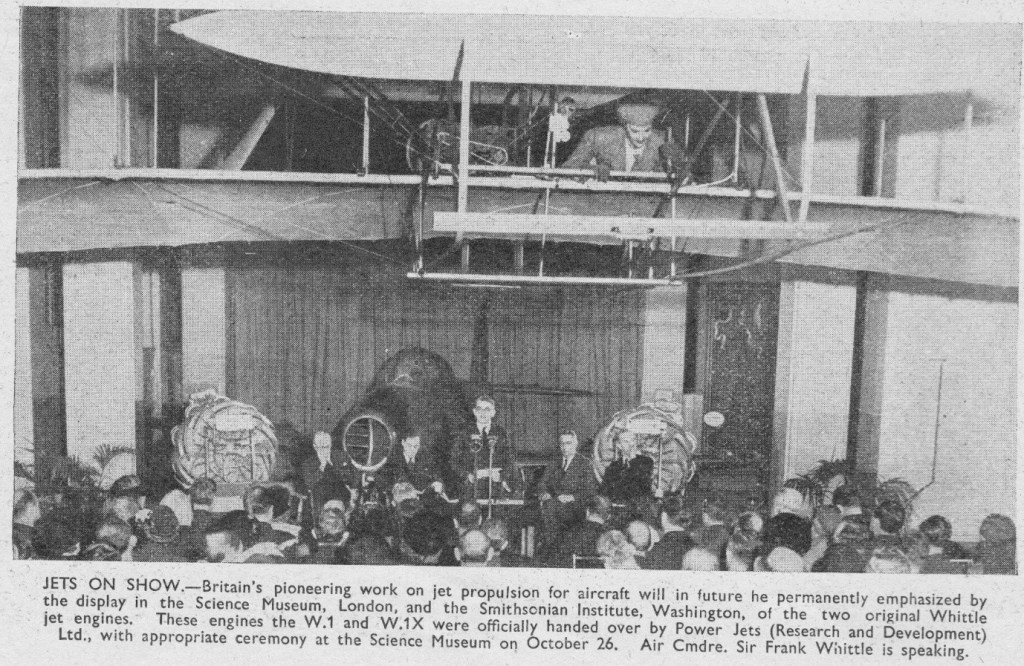
The Gloster E.28/39 and the Power Jets W.1 engine that powered it are both on public display at the Science Museum (London).
November 1949
The W.1A is preserved at the RAF College Cranwell, and the W.1X is at the Smithsonian Institution, Washington DC.
Variants: W.1(T) Bench-testing only.
W.1(3)
W.1X Intended for ground use only (aircraft taxi tests).
W.1A 1,450 lbf (6.45KN) air-cooled turbine disc
Variation: General Electric I-16 American-built version of W.1A. This is the only version of the W.1 to go into mass production.
Specifications: W.1 early development engine Type: Centrifugal flow turbojet Dry weight: 700 lb (320 kg) Compressor: Single-stage double-sided centrifugal flow Combustors: 10 reverse-flow can Turbine: Single stage axial flow Fuel type: Kerosene Maximum thrust: 850 lbf (3.8 kN) at 16,500 rpm Fuel consumption: 1,170 lb/hr (531 kg/h) Specific fuel consumption: 1.376 lb/hr/lb (38.98 g/s·kN) Thrust-to-weight ratio: 1.214:1
W.1 later development engine Type: Centrifugal flow turbojet Dry weight: 700 lb (320 kg) Compressor: Single-stage double-sided centrifugal flow Combustors: 10 reverse-flow can Turbine: Single stage axial flow Fuel type: Kerosene Maximum thrust: ~1,032 lbf (4.59 kN) Overall pressure ratio: ~3.8:1 Turbine inlet temperature: ~1,430 °C (2,610 °F) Fuel consumption: ~1401 lb/hr (~636 kg/h) Specific fuel consumption: ~1.358 lb/hr/lb (~38.47 g/s·kN) Thrust-to-weight ratio: ~1.474:1




 All Aero