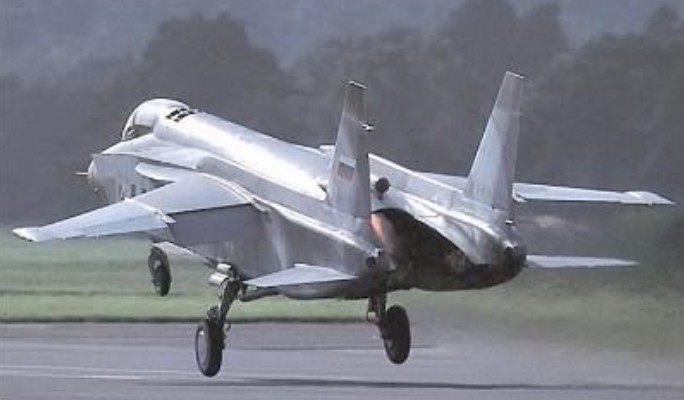
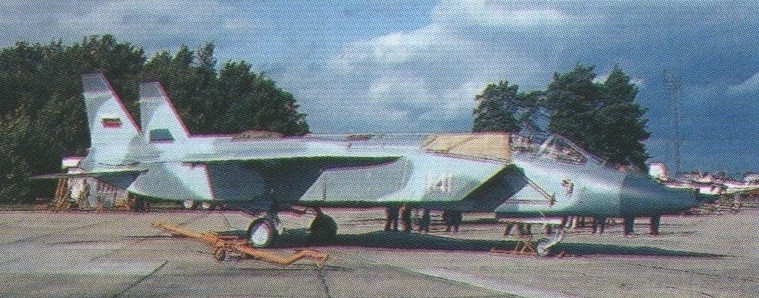
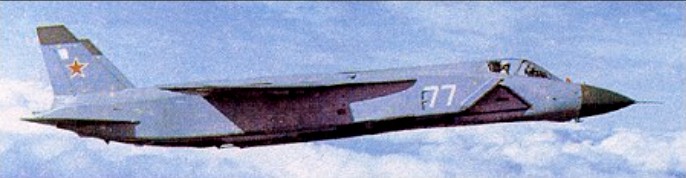
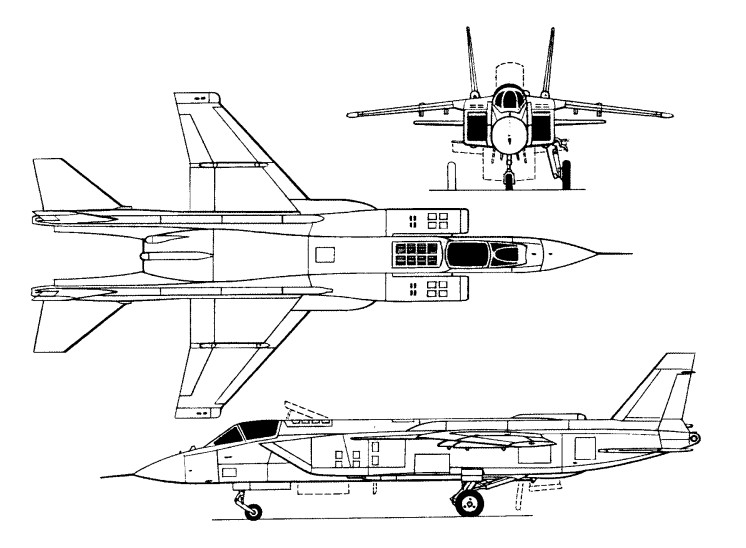
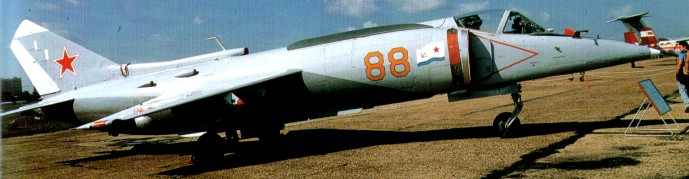
The Yak-141, being the world’s first supersonic STOVL (short take-off/vertical landing) aircraft, has three engines: one lift-cruise R-79 with a thrust of 15500kg and two small-sized RD-41 of 4100kg each. The powerplant allows the plane to lift off vertically with a weight of up to 15,800kg. Alternatively, the Yak-141 can perform short take-offs (60-120m) with a weight of up to 19,500kg. In the latter case the combat radius increases by 1.5-2 times and patrol time in the combat zone by two times. The pilot can use afterburner even when the nozzles are deflected. The Yak-141’s integral flight-control system sets power and deflection of the nozzles so as to optimise making vertical/short take-offs and landings.
The Yak-141 first flew in March 1989, piloted by Andrei Sinitsin.
The Yak-141M was meant primarily for ground-basing. Introduction of new flight regimes, as well as new take-off/landing techniques, has entailed changes in the airframe, leading to a new design, the Yak-141M.
Engine: 1 x R-79V-300, 152.0 kN , 2 x RD-41, 41.8 kN Max take-off weight: 19500 kg / 42990 lb Empty weight: 11650 kg / 25684 lb Wingspan: 10.1 m / 33 ft 2 in Length: 18.3 m / 60 ft 0 in Height: 5.0 m / 16 ft 5 in Wing area: 31.7 sq.m / 341.22 sq ft Max. speed: 1850 km/h / 1150 mph Ceiling: 15500 m / 50850 ft Range w/max.fuel: 2100 km / 1305 miles Range w/max.payload: 1400 km / 870 miles Crew: 1 Armament: 1 x 30mm cannon, 1000kg (VTOL) or 2650kg (STOL) Hardpoints: six
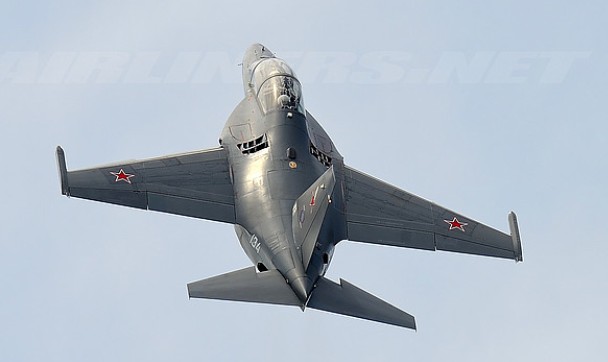
Through a joint programme with Yakolev of Russia, Aermacchi is assisting in developing the Yak/AEM-130 to meet the Russian Air Force’s requirement to replace the L-29 and L-39. The aircraft is equipped with a quadruplex fly-by-wire flight control system and will be required to fulfil a broad range of tasks: from basic flying training to weapons training and aircraft carrier deck training. The aircraft are equipped with wingtip- and pylon mounted AAMs with a roulette and sensor pod also fitted.
The joint Italian/Russian Yak 130 technology development programme ran from April 1996 to December 1999, accumulating some 300hr flying. The two seat Yak-130 fighter/trainer was exported as the AEM-130.
The Yak-130 became all Italian in 1998 and served as a basis for the Aermacchi M-346.
Engine: 2 x Klimov RD-35, 22kN Max take-off weight: 5400-6200 kg / 11905 – 13669 lb Wingspan: 10.6 m / 35 ft 9 in Length: 11.3 m / 37 ft 1 in Height: 4.8 m / 16 ft 9 in Wing area: 17.6 sq.m / 189.44 sq ft Max. speed: 1000 km/h / 621 mph Ceiling: 12500 m / 41000 ft Range: 1850 km / 1150 miles Crew: 2
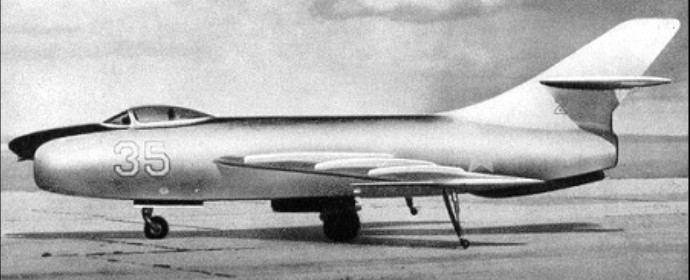
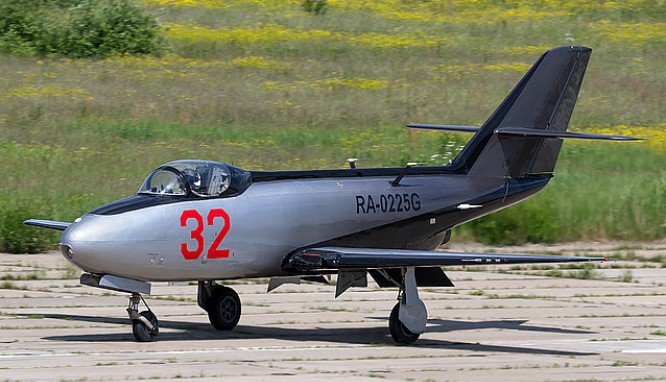
With V-VS formulation of a requirement for a single-seat limited all-weather fighter, the Yakolev OKB developed the Yak-50 in competition with the MiG-15Pbis. The wing, mounted in full mid position, was a two-spar structure of constant 12% thickness sweptback 45 degree at quarter chord. The OKB used magnesium alloys in the structure for the first time to any great extent as a contribution to weight reduction, a further weight-saving measure being the adoption of a velosipedno tipa, or “bicycle type” undercarriage. This zero-track arrangement, earlier tested by the Yak-25, comprised a single nosewheel member and a twin-wheel main unit, the latter taking 85% of the total aircraft weight; in addition, small outrigger stabilising wheels retracted into wingtip fairings. Power was provided by a single 2700kg Klimov VK-1 turbojet, armament consisted of two 23mm NR-23 cannon and provision was made for the installation of a single-antenna, fixed-scan, manually-tracked Korshun (Kite) AI radar in a housing above the nose air intake splitter. The first of three Yak-50 prototypes was flown on 15 July 1949, several months before the first radar-equipped MiG-15Pbis (SP-1), and demonstrated an outstanding speed performance, exceeding Mach=1.01 in a shallow dive on several occasions during manufacturer’s trials and Mach=1.048 during State Acceptance testing. It could take-off within 578m and land within 965m, but in more than a 18km/h crosswind, the Yak-50 tended to swerve from the runway, and it was barely controllable on a wet surface. In level flight at speeds between Mach=0.92 and 0.97, the Yak-50 suffered lateral oscillation preventing gun aiming. These shortcomings, coupled with the fact that the Mikoyan-Gurevich OKB was offering the potentially superior Izumrud radar-equipped MiG-17P, led to termination on 30 May 1950.
Max take-off weight: 4155 kg / 9160 lb Empty weight: 3125 kg / 6889 lb Wingspan: 7.98 m / 26 ft 2 in Length: 11.20 m / 37 ft 9 in Wing area: 16.00 sq.m / 172.22 sq ft Max. speed: 1170 km/h / 727 mph Range: 1100 km / 684 miles
In the Soviet Union the prototype (SSSR 1974) of a new short range civil transport accommodating a maximum 120 passengers, the Yakolev Yak 42, made its maiden flight on 7 March 1975. This was powered by three Lotarev D 36 turbofans, in a similar rear engine layout to the Yak 40. Three prototypes ordered initially; first prototype (SSSR-1974) flew 7 March 1975, with 11 degree wing sweepback and furnished in 100-seat local service form, with carry-on baggage and coat stowage fore and aft of cabin; second prototype (SSSR-1975, later SSSR-42304) had 23 degree sweepback and more cabin windows, representative of 120-seat version with three more rows of seats and no carry-on baggage areas; third prototype (SSSR-1976, later SSSR-42303) introduced small refinements; flight testing proved a 23 degree wing superior.
The second Yak-42 flew in April 1976 and the third, which was exhibited at the Paris Air Show earlier this year and is representative of the production version, flew in February 1977. By May, these three aircraft had totalled some 320 hrs of testing.
The Yak-42 is designed to have a fatigue life of at least 30,000 hrs and 30,000 landings, and the life of the turbofans that power the new aircraft is said to be 18,000 hrs, subject to major overhaul and revision at 6,000 and 12,000 hrs. Glassfibre and carbon fibre composites are used to a considerable degree in the construction of the Yak-42, and it is claimed that the noise levels meet the newest requirements.
The maximum take off weight of the Yak 42 was increased in 1981 to 117,945 lb (53 500 kg), maximum and normal useful loads remaining unchanged. Cruising speeds have been reduced marginally to 466 503 mph (750-810 km/h), and range with max payload has been reduced to 559 mls (900 km) at 478 mph (770 km/h) at 29,530 ft (9000 m). Ranges with 23,148 lb/10500 kg and 14,330 lb/6500 kg payloads are quoted as 1,243 mls (2000 km) and 1,864 mls (3000 km) respectively. The practical life of the Yak 42 is claimed to be 30,000 hours or 30,000 flight cycles over a 15 year period and the service life of its Lotarev D 36 turbofan is 18,000 hours with two major overhauls.
The first series of production aircraft, built to replace some Aeroflot Tu-134, generally similar to SSSR-42303 as exhibited 1977 Paris Air Show. Changes for production included substitution of four-wheel main landing gear bogies for twin-wheel units on prototypes.
The Yak-42 and Il-86 entered regular service with Aeroflot at the end of 1980, after production examples had made proving flights on typical routes from Moscow. The 120 seat Yak-42 operated on the Moscow-Krasnodar route.
An accident in June 1982 caused the type to be grounded until October 1984, the aircraft being drastically redesigned during its temporary withdrawal from service. In 1990 the Yak-42D was introduced, this version having been stretched to include seating for 120 passengers. First exports of the Yak-42 were achieved in 1990, aircraft being sold to Cubana and CAAC.
Yak-42D introduced from second quarter of 1989 and manufactured by Saratov Aviation Plant (SAZ). The Yak-142 transport is a new variant of Yak-42D, featuring mostly US digital avionics and other improvements. Yak-42A and other versions have been produced in small numbers or been proposed.
Power Plant: Three Lotarev D-36 turbofans, 14,320 lb st (6500 kgp) for take-off, with a nominal static rating of 11,015 lb (5000 kg) and a thrust of 3,525 lb (1 600 kg) cruising at Mach 0.75 at 26,245 ft (8000 m) Max fuel load, 27,090 lb (12 300 kg). Max. speed: 870 km/h / 541 mph Typical cruising speed, 510 mph (820 km/h) at 25,000 ft (7600 m) Take-off distance, 4,920 ft (1 500 m) at ISA and 5,900 ft (1 800 m) at ISA plus 15 deg C Landing distance r, 5,900 ft (1 800 m) Range with max fuel, 1,520 mls (2450 km) Range with max payload, 620 mls (1000 km) Range with 26,430-lb (12 000-kg) payload, 1,150 mls (1 850 km). Typical empty weight, 63,788 lb (28 960 kg) Max payload, 31,938 lb (14500 kg) Max fuel, 27,090 lb (12 300 kg) Max take-off, 114,540 lb (52000 kg) Wing span, 112 ft 2.5 in (34,20 m) Length, 119 ft 4 in (36,38 m) Height, 32 ft 3 in (9,83 m) Wing area, 1,615 sq ft (150 sq.m) Undercarriage track, 18 ft 6 in (5,63 m) Wheelbase, 48 ft 5.5 in (14.776 m) Accommodation: max high density, 120 six abreast at 32-in (81-cm) seat pitch. Crew: 2-4
The Yak-38 was followed by a new VTOL prototype known as the Yak-41 (first flown March 1987) which was subsequently abandoned, as was the projected next-generation STOVL Yak-43 and the Yak- 44 shipborne AEW&C aircraft.
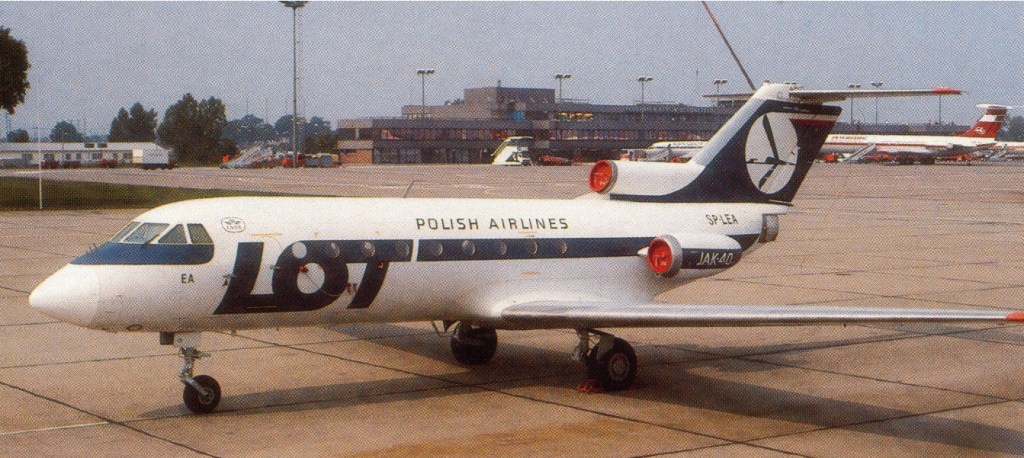
Development the Yak-40 as a replacement of the ageing LI-2, Il-12 and Il-14’s, started in 1965 by the Yakolev Design Bureau. The Yak-40 was required to operate from Class 5 grass airfields or semi-prepared strips. The resulting aircraft has high-lift lightly-loaded wings and, for added safety, three Ivchenko AI-25 turbojets. All three engines are operated on take-off, but the central engine may be throttled back to idle for fuel economy during cruise. In configuration, the Yak-40 is a cantilever low-wing monoplane with retractable tricycle landing gear, rear-mounted engines and with accommodation for a flight crew of two or three and up to 32 passengers. The provision of a ventral rear door with airstair makes it possible to operate the Yak-40 from airfields with minimum facilities, and an onboard auxiliary power unit makes the type independent of ground equipment for engine starting and the maintenance of cabin heating and air-conditioning.
The first prototype tri-jet was flown on 21 October 1966, the Yak bureau eventually building five pre-production test airframes. The type entering revenue service with Aeroflot on 30 September 1968 with 2 crew and 27-31 passengers (NATO reporting name ‘Codling’).
The Yak-40 is cleared for Class Five grass airfield operations, and to improve its short landing performance a single clamshell thrust reverser has been fitted to the centre engine on later production models. The rear mounted turbofan engines enable it to take off and land within 1500 ft (500 m), and it can operate from grass fields.
The Yak-40K cargo version is configured purely for the carriage of freight, the aircraft being cleared to carry a load of up to 5070 lbs in weight.
When production ended in 1980, 1011 Yak-40 airliners were built in Saratov in the former USSR. The majority of these are still in service in 1993, with both military and civilian operators.
Yak40 Engines, Ivehenko Al-25 (3 x 3300 lb thrust) Max take-off weight, 27,500 lb Payload. 5500 1h Cruising speed, 405 kt Range. 620-1240 st. miles Take-off distance to 50 ft, 1950 ft No. of passengers, 24
Engines: 3 x 3,306 lb (1,500 kg) st Ivehenko AI 25 turbofans Wing span: 82 ft 0.25 in (25.00 m) Length: 66 ft 9.5 in (20.36 m) Wing area: 735 sq ft (70.0sq.m) Gross weight: 30,200 lb (13,700 kg) Max cruising speed: 342 mph (550 kph) Typical range: 620 miles (1,000 km) with normal payload of 5,070 lb (2,300 kg) Crew: 2 Passengers: 24 40 T/O run: 700m Ldg run: 360m Cargo: 5070 lbs
Engines: 3 x turbo-jet AI-25, 14.7kN Max take-off weight: 12400 kg / 27337 lb Empty weight: 8500 kg / 18739 lb Wingspan: 25.0 m / 82 ft 0 in Length: 20.2 m / 66 ft 3 in Height: 6.5 m / 21 ft 4 in Wing area: 70.0 sq.m / 753.47 sq ft Cruise speed: 550 km/h / 342 mph Range w/max.fuel: 1600 km / 994 miles Range w/max.payload: 600 km / 373 miles Crew: 2 Passengers: 24-33
Flown in prototype form in 1971, the Yak-38 was developed under the design leadership of S Mordovin for the primary tasks of fleet air defence against shadowing maritime surveillance aircraft, reconnaissance and anti-ship strike. Power plant combined a Yu Gusev-developed Tumansky R-27V thrust-vectoring turbojet with two Rybinsk (Koliesov) RD-36-35 vertical-lift turbojets designed by a team led by A Dynkin. Hydraulic drives synchronised by a transverse shaft rotated the thrust-vectoring nozzles aft of the wing, their output in vertical take-off and landing operations being balanced during hover and transition by the paired lift engines mounted in tandem immediately aft of the cockpit and inclined forward 13 degrees from the vertical.
Shipboard trials with the Yak-38 began aboard the Moskva half-deck anti-submarine cruiser in 1972, and, in the following year, the decision was taken to build a pre-series of Yak-38 fighters for service evaluation, the first two of these landing aboard the carrier-cruiser Kiev in 1975. An evaluation squadron comprising 12 single-seat Yak-38s and two two-seat Yak-36Us embarked aboard the Kiev in the summer of 1976, the aircraft being confined to vertical take-off with conversion following at 5-6m above the deck. During 1976, production was initiated of a much improved version of the basic design as the Yak-38.
Yak-38 aboard Kiev
Externally similar to the Yak-36M, apart from substantial strakes either side of the intake for the lift engines, the Yak-38 possessed a full weapons system and an automatic control system permitting a short roll leading into vertical take-off as distinct from an orthodox short take-off benefiting from wing-induced lift. Although intended only for vertical take-offs and landings, the ‘Forger’ had double-slotted flaps and a braking parachute. The Yak-38 entered service with the Soviet Navy in 1978, and, during 1980, was evaluated under operational conditions in Afghanistan. Progressive development resulted in the Yak-38M, which, with 1000kg more engine thrust, a steerable nosewheel and provision for paired 600-litre underwing auxiliary tanks, entered production in succession to the Yak-38. The Yak-38M had a 6940kg R-27V-300 thrust-vectoring turbojet and two vertical-lift RD-38 turbojets each rated at 3250kg. Two wing stations immediately inboard of vertically-folding panels provided for two gun pods each containing a twin-barrel 23mm GSh-23 cannon, rocket packs or bombs weighing up to 500kg each, two R-60 IR-homing AAMs or short-range ASMs. The tuitional version, the Yak-38UM, had vertically-staggered tandem seats, a plug being inserted in the aft fuselage to compensate for a lengthened nose. Each of the four Soviet Navy Kiev-class carrier cruisers received a 14-aircraft squadron of Yak-38s or -38Ms (each including two two-seaters), and production was completed by 1987 with a total of 231 Yak-38s (all versions) built. The ‘Forger’ had a system to automaticaliy eject the pilot if the engine stopped while the thrust was angled below the horizontal. On one occasion this occurred in full view of a British carrier, who rescued the pilot. Production of the Yak-38 Forger subsonic V/Stol shipborne fighter continued in 1987, to equip four Kiev-Class aircraft carriers. Each vessel carries 12 Forger As and two two-seat Forger Bs, which lack the ranging radar of the single-seat aircraft. Some 70 Yak-38s had been built by mid-1986. Photographs of Forger As executing rolling take-offs from the deck of a carrier appeared in 1984, ending all speculation that the aircraft was only capable of Vtol operations. Short take-off techniques will improve the Forger’s payload/range performance. The Yak-38 has no internal armament, but carries gun and rocket pods on four underwing hardpoints to a maximum load of approximately 3,600kg.
Yak-38 aboard Minsk
Yak-38 Forger A Engine: 1 x Lyuika AL-21F, 8160 kg / 17,989 lb thrust Lift engines: 2 x Koliesov ZM, 3750 kg / 7870 lb thrust Installed thrust (dry): 80 kN Span: 7.32 m / 24 ft 8.25 in Length: 15.50 m / 50 ft 10.5 in Height: 4.37 m / 14 ft 4 in Wing area: 18.50 sq.m / 199.14 sq ft Empty wt: 7385 kg / 16,281 lb MTOW VTOL: 11,700 kg / 25,794 lb MTOL STOL: 13,000 kg / 28,660 lb Warload: 1350 kg Max speed: Mach 0.95 / 1110 kph / 627 mph Initial ROC: 4500 m / min Ceiling: 12,000 m / 39,370 ft T/O run: VTOL Ldg run: VTOL Range: 740 km / 460 mi Combat radius: 370 km Fuel internal: 2900 lt Air refuel: No Hard points: 4 Bombload: 3600 kg / 7937 lb Seats: 1
Yak-38M Max take-off weight: 11700 kg / 25794 lb Wingspan: 7.32 m / 24 ft 0 in Length: 15.5 m / 51 ft 10 in Height: 4.37 m / 14 ft 4 in Wing area: 18.50 sq.m / 199.13 sq ft Max. speed: 1010 km/h / 628 mph
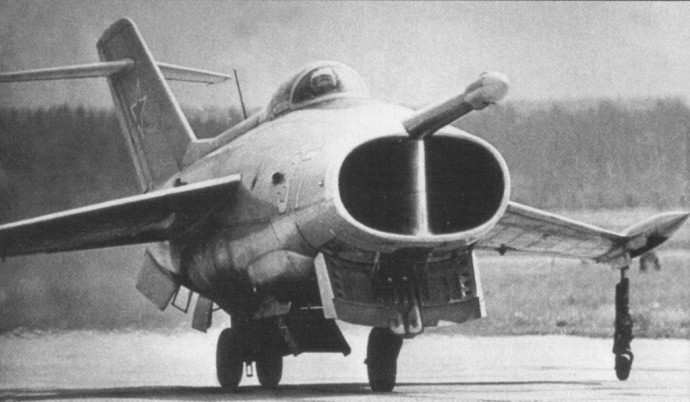
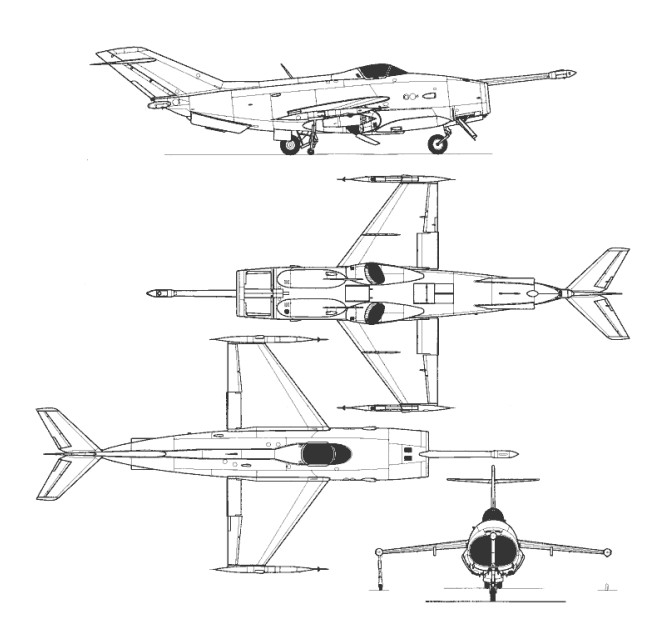
In 1962 the Yakolev bureau was chosen to produce the first Soviet vertical take-off and landing aeroplane for the Soviet navy’s new ‘Kiev’ class of aircraft-carriers. Initial consideration was given to a composite arrangement of lift jets and a cruise engine, but it was finally decided to use two 36.78kN Koliesov engines with vectoring nozzles on the centre of gravity to provide direct lift or forward thrust as required. The airframe designed for the new Yak-36 was necessarily broad to accommodate the side-by-side engines, used the now-standard arrangement of tandem main units on the centreline together with stabilizing outriggers at the wingtips, and was completely conventional as only high subsonic speeds were envisaged. Hovering control was provided by reaction jets in the wingtip pods, the tail and the long nose boom. The type first flew in the mid-1960s, and trials with at least 12 such prototypes paved the way for the Yak-38 VTOL naval aeroplane, which has a composite powerplant with one vectored thrust turbojet in the rear fuselage, and two lift turbojets in the forward fuselage. Displayed publicly at the Domodedovo, Moscow, flying display in July 1967, this single seater appeared to be powered by two turbojets installed side by side in the belly, each discharging through a louvred and gridded swivelling nozzle. The nose was occupied by large lateral air ducts from a bifurcated pitot inlet. Freehand had no lift jets, and pipes from the main engine served reaction control nozzles at the tips of the wing, at the tail and on the end of an outsize nose boom. The wing was mounted in the mid position directly above the engine nozzles. The vertical tail was sharply swept, and two ventral fins were fitted under the rear fuselage. A large surface under the nose, double hinged to function as an airbrake, was also hinged at the rear, and was judged to reduce reingestion of hot gas in the low level hovering mode. Two Freehands took part at Domodedovo, one No 37 and the other No 38, the latter carrying two UV 16 57 rocket pods. Fitting the latter was considered chiefly a public relations exercise. There is no evidence to suggest that it was ever an operational type, though at least eight were built, and one went aboard the helicopter ASW cruiser Moskva where it conducted flying trials from an elevated platform not quite the same as those often used by Ka 25 helicopters.
Engines: 2 x RD-27-300, 53.0kN Max take-off weight: 8900 kg / 19621 lb Wingspan: 10.5 m / 34 ft 5 in Length: 17.0 m / 56 ft 9 in Height: 4.5 m / 15 ft 9 in Max. speed: 1010 km/h / 628 mph Ceiling: 12000 m / 39350 ft Hardpoints: 2 Crew: 1
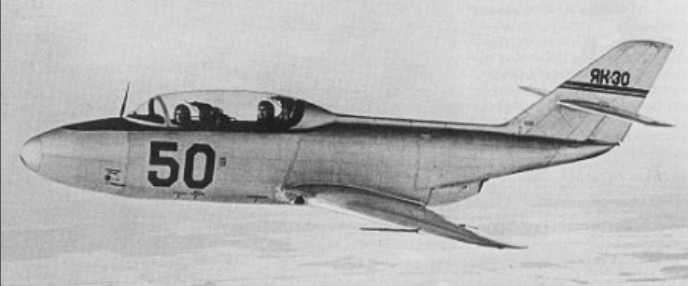
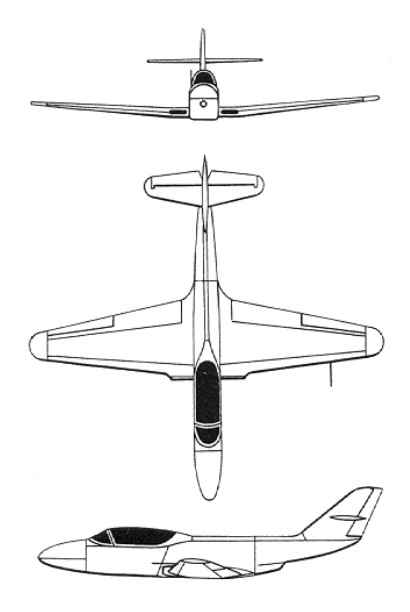
In 1959 the VVS held a competition for a light jet trainer, able to be used for ab initio instruction. Such aircraft had never been developed in the Soviet Union, the only jet trainers being conversions of powerful military types. Yakolev produced a prototype, with the Service designation Yak-30. In parallel, funded by DOSAAF, the OKB produced a single-seat version, the Yak-32. Surprisingly, the only competitors came from outside the Soviet Union.
The contest for a jet trainer resolved itself in 1960 into a three-pronged evaluation, the rivals being the Czechoslovak L-29 Delfin and the Polish TS-11 Iskra. The TS-11 was soon eliminated and sent back to Poland, and a head-to- head developed in which the Yak-30 showed an edge in performance, but was marred by detail problems. In any case Czechoslovakia needed the work, and so the L-29 was chosen in August 1961 as the trainer for all Warsaw Pact air forces except Poland’s.
NATO code MANTIS.
Engine: 1 x Tumanskii TRD 29 turbojet, 1,764 2,315 lbs.t. (800 1050kgp) Cruise, 350 mph (563 kph) Service ceiling, 40,000 ft (12192 m)
Engine: 1 x turbo-jet RU-19, 8.8kN Max take-off weight: 2250 kg / 4960 lb Empty weight: 1555 kg / 3428 lb Wingspan: 9.38 m / 31 ft 9 in Length: 10.14 m / 33 ft 3 in Wing area: 14.3 sq.m / 153.92 sq ft Max. speed: 767 km/h / 477 mph Ceiling: 16100 m / 52800 ft Range: 965 km / 600 miles Crew: 2












 All Aero