The ARES, Scaled Model 151, was designed initially in response to a U.S. Army request for a Low Cost Battlefield Attack Aircraft. A design study was performed by Rutan Aircraft Factory in 1981 for such an aircraft. The original LCBAA design was for a pusher turboprop aircraft, of generally the same aerodynamic configuration you see here. It also was designed around a 30mm chain gun. Its mission goals were low-altitude, close air support, with long endurance, and with adequate field performance to operate from roads. Its structure and systems were simple enough to be maintained and repaired in the field.
Scaled followed up with the concept, and ultimately decided to build a demonstrator aircraft with internal funds. By the time construction started in 1986, the design had evolved to the current configuration: a single Pratt and Whitney Canada JT15D-5 turbofan engine (same as in the Beechjet / T-1A Jayhawk), and a GAU-12/U 25mm gatling gun.
The ARES first flew on February 19, 1990, with Scaled test pilot Doug Shane at the controls. Since that first flight, the ARES has flown more than 250 hours, and demonstrated all of its design performance and handling qualities goals, including departure-free handling at full aft stick. During November of 1991, under a contract from the U.S. Air Force, initial ground and flight (air-air and air-ground) tests of the GAU-12/U gun system installed in ARES were performed, with outstanding results.
Movie buffs may also remember the ARES villainously portraying the secret ME-263 jet in the screen classic Iron Eagle III.
In November 1957 when Saunders-Roe Ltd. began its design of a private venture for a Skeeter development and replacement. Two prototypes of the aircraft, then known as the Saro P.531, were begun early in 1958, the first (G-APNU) flying on 20 July and the second (G-APNV) on 30 September 1958. Several Skeeter components were used in their construction, including the tailboom, short-legged tricycle undercarriage and rotor blades (the P.531 having a 4-blade assembly). Both prototypes were powered by Blackburn-built 400shp Turmo 603 shaft turbines, derated to 325shp.
Saunders-Roe P.531 G-APNU
Westland, after acquiring Saunders-Roe in 1959, took development an important stage further by completing two more prototypes with double the power and various other changes including a skid undercarriage. The first with a 1050shp Bristol Siddeley Nimbus engine derated to 635shp, and the other with a de Havilland Gnome H.1000 turbine derated to 685shp. Subsequently developing the P.531 as the Scout AH.Mk 1 for the British Army and Wasp HAS.Mk 1 for the Royal Navy.
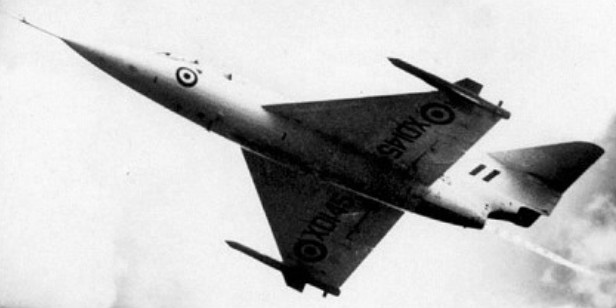
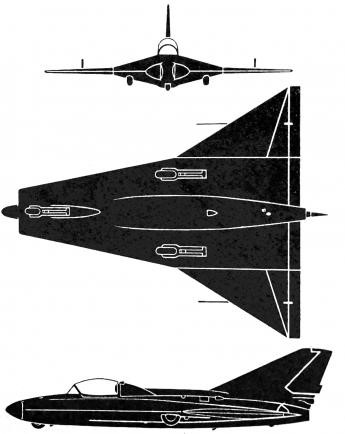
By 1952 Saunders-Roe produced the SR.53 design for a single-seat target defence interceptor combining a liquid-fuel rocket motor with an auxiliary turbojet. Submitted to the Ministry of Supply (MoS) the design based on the pairing of the de Havilland Engines DGJ.1OR Gyron junior turbojet and Spectre rocket motor, to meet the requirements of Specification F.124T. This was accepted with high regard, and Specification F.177D was written around it to meet Operational Requirement (OR) 337. Furthermore, naval requirement NR/AA7 was combined in the specification, the designation SR.177R being applied to the RAF aircraft and SR. 177N to those for the Fleet Air Arm (FAA). The SR.53 was recipient of a three-prototype contract in October 1952. Armament proposed was a Red Top missile on each wingtip.
On September 4, 1956, Saro received an initial order for nine aircraft, and West Germany expressed enough interest for the eventual figure of 600 production aircraft to be mooted. Production was to be shared among Saro and other companies, and German companies were to manufacture that nation’s variant, so the whole programme would benefit a large European workforce.
With one 8,0001b-thrust de Havilland Spectre rocket engine and one 1,6401b-thrust Armstrong Siddeley Viper turbojet. Of clipped delta wing configuration with a specified armament of two wingtip-mounted Blue Jay (de Havilland Firestreak) AAMs, the SR.53 was powered by an 3629kg de Havilland Spectre HTP rocket and a 744kg Armstrong Siddeley Viper turbojet superimposed one above the other in the rear fuselage.
In the event, only two of the SR.53s were to be completed (XD145 and XD151), these making their initial flights on 16 May and 8 December 1957, prior to which, in April 1957, all rocket-powered fighter development in the UK had been cancelled.
Duncan Sandys’ Defence the White Paper of 1957 resulted in the cancellation of the whole project. When a British request to the USA for funding under the Mutual Weapons Development Program (MWDP) was turned down, West Germany dropped out and turned to the Lockheed F-104 Starfighter.
Nonetheless, the two SR.53s performed 42 test flights before, on 15 June 1958, the second aircraft crashed, the surviving aircraft then being permanently grounded.
SR.53 Max take-off weight: 8618 kg / 19000 lb Empty weight: 3357 kg / 7401 lb Wingspan: 7.65 m / 25 ft 1 in Length: 13.72 m / 45 ft 0 in Height: 3.29 m / 11 ft 10 in Wing area: 25.45 sq.m / 273.94 sq ft Max. speed: 2135 km/h / 1327 mph
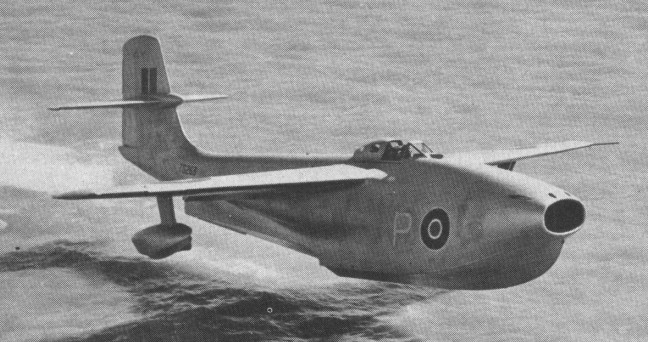
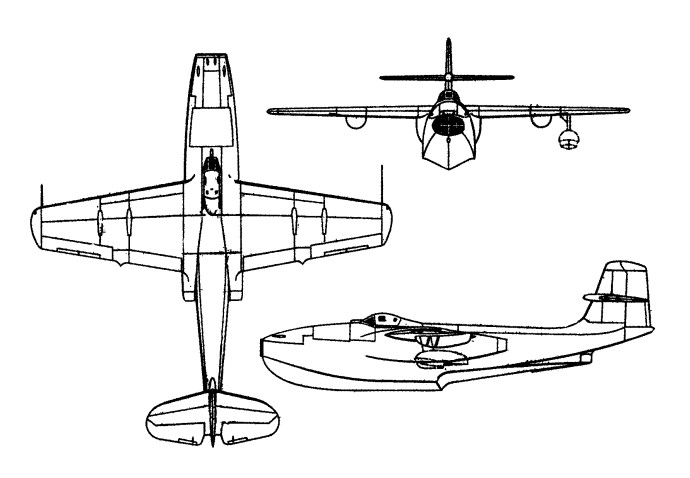
Following discussions between Hugh Francis of the Marine Aircraft Experimental Establishment (MAEE) and Henry Knowler, chief designer of Saunders Roe, the idea of a flying boat fighter was generated. It was then schemed and serious work was started at the beginning of 1944 in Beaumaris, Anglesey, where Saunders Roe had their Design Office. The official specification was E.6/44 and the aircraft’s designation SR A/1 followed the then new nomenclature of the SBAC for the drawing system for each company, A/1 signifying the first aircraft of Saunders Roe under that system.
The new aircraft was designed around two Metropolitan Vickers F2/4 Beryl turbojets designed under the direction of Dr D. M. Smith, chief engineer of that company’s Gas Turbine Department. These engines, the first British axial flow engines, delivered 3,3001b thrust initially, raised later to 3,8501b following successful type tests. They were small in diameter by comparison with the centrifugal type compressors favoured at that time by other engine makers. Two could therefore be installed side by side without making the hull’s beam unduly great. The intake was provided with an extendable lip which was intended to overcome water ingestion troubles, should they occur. In the event, they did not and, although the lip was used on test, it was pot normally needed, as the SR A/1 was intended for operation from sheltered or inland waters. Both engines shared the oval shaped intake. The hull shape was of faired vee form, entirely of metal construction, made up of strong keel members, closely spaced frames, light upper longitudinals and carefully filled skin rivetting. The engine exhausts were toed out five degrees each side of the centre line. The pilot’s cockpit was pressurised and air conditioned by air tapped from both power unit compressors. Provision was also made for a “G” suit.
Another “first” was the Martin Baker ejector seat, which was the first to be delivered to an aircraft manufacturer from the works. The pilot had four 20mm Hispano cannon mounted immediately ahead of him in the nose, each gun having 240 rounds. In addition, two 1,000 lb bombs or eight rockets could be carried.
The wing was a single spar structure, fitted with dive brakes and dive recovery flaps, as well as ailerons and landing flaps. The tail unit was of similar construction to the wing. The aircraft had a Mach Number of 0.81. The uniqueness of the controls lay in the, combined use of geared and spring tabs, allowing a simple and neat type of manual control without fine balance or trailing edge troubles.
Control on the water was by means of a small rudder integral with the rear step. It could be locked centrally when in flight or, when on the water, linked to the rudder pedals. Lateral support was by means of hydraulically retractable floats which were rotated mechanically as they retracted inwards so as to lie inverted in the under surface of the wing, thus creating minimum drag. The four main wing fuel tanks together with two overload drop tanks gave an endurance of around 212 hours.
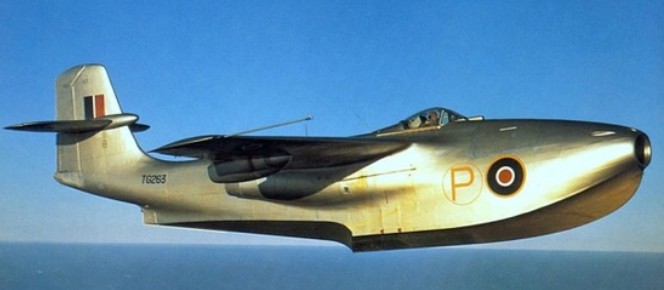
When it was agreed that construction of the SR A/1 should proceed, three prototypes were authorised. These were allocated the serials TG263, TG267 and TG271. The design was completed at the Beaumaris Works and the components were made there. They were transported to Cowes for assembly and test flying.
Geoffrey Tyson undertook the flight testing of the new flying boat. He first taxied TG263 on July 16, 1947 and, finding everything in order, took it off.
The SRA/1 was improved later by the fitting of an “acorn” at the intersection of the fin and tailplane to cure a slight buffet. The first take off had taken only twelve seconds and the rate of climb was exceptional. Apart from this, the only other visible alteration was the fitting of a metal cockpit canopy following the loss of a transparent hood in the course of a test flight. This was one of the earliest sliding hoods to be pressurised as high as 6.75 lb/sq ft.
So well did the flight testing go that Tyson was able to demonstrate the prototype at the SBAC Show at Farnborough two months after its first flight. Testing continued steadily through 1948 and the prototype was joined by TG267 and TG271. The second flew on 30 April 1948 with 1587kg Beryls and the third followed on 17 August 1948 with fully rated Beryls of 1746kg. The second to be built, TG267, was lost with its pilot at the Marine Aircraft Experimental Establishment at Felixstowe on 17 September 1949. He had been practising for a local air display in conditions of poor visibility and crashed into the sea. Squadron Leader ‘Pete’ Major took TG267 up that morning to prepare for the aerobatic routine he planned to perform for the public that afternoon. During a slow roll, he let the nose slip down while inverted, then instinctively pulled on the stick rather than pushing out from his upside-down position. The aircraft broke up on impact, and no trace of Major was found; much of the aircraft was salvaged over the next ten days.
Engine development continued on the other two with simulated failures (and one or two genuine ones), re-lighting sometimes being a problem. On one occasion Tyson suffered a double flame out at about 20,000ft and was unable to relight either engine. He had been some 20 miles South of the Isle of Wight and managed to glide home.
Chief Naval Test Pilot Lt Cmdr Eric “Winkle” Brown flew the third SR A/1, TG271, for the first and only time on 12 Aug 1949 at the behest of Saunders-Roe. He wrung out the tubby little ‘boat, reaching Mach .82, pretty much the top speed of the SR A/1, in a dive. approaching to land at Cowes and, at the very last moment when he was committed to the touch down, he saw a half submerged baulk of timber. The log tore a 4 5ft gash in the starboard front hull and ripped off the starboard stabilizing float. Despite his best efforts, Brown could not keep the starboard wing from digging in and cartwheeling TG271 onto its back. Struggling free underwater, Brown almost succumbed, but was held up by Geoffrey Tyson, the Saro test pilot responsible for the majority of the SR A/1 testing, who had leapt off the supporting launch when he saw Brown in trouble. Despite extensive searching, the sunken third SR A/1 prototype was never located, such are the peculiarities of the Solent tides.
Although the design of the SR A/1 was begun before the end of World War 2, its construction was authorised after hostilities ended. Export orders were hoped for. It became clear that exports were unlikely and this, together with the loss of the two aircraft brought the development programme to a halt.
Tests were resumed for a short period beginning in November, 1950, after a brief revival of interest during the Korean War.
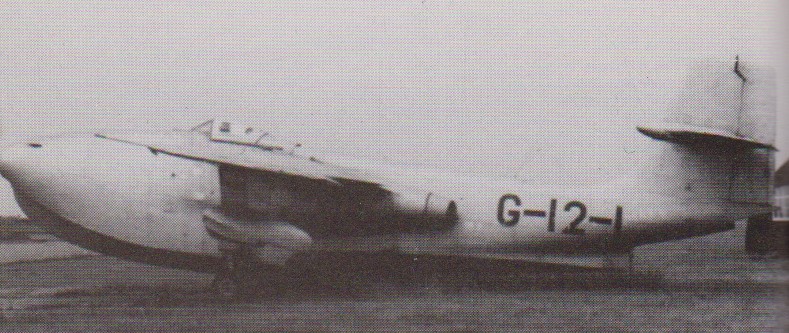
The last public appearance of a SR A/1 was in June, 1951, when Geoffrey Tyson took the remaining prototype to London for display at the Festival of Britain. He landed on the Thames in Woolwich Reach and was towed to a mooring opposite where the Royal Festival Hall now stands. The aircraft, TG263, then bearing the registration G 12 1, remained for three days and was then towed back to Woolwich Reach.
The last remaining SR A/1 came to the end of its working life in June 1951 and it was presented to the College of Aeronautics at Cranfield. Its engines were removed and given elsewhere for a speed record attempt. Some time later, it passed to the Skyfame Museum at Staverton, near Cheltenham, and into the care of Mr Peter Thomas, its founder.
The completely restored first prototype, TG263, resides today at the Southampton Hall of Aviation, along with an example of its ejection seat (the first delivered by Martin-Baker to an aircraft manufacturer) and a MetroVick Beryl powerplant, both exhibited outside the airframe.
SR.A/1 Engines: 2 x Metropolitan-Vickers F2/4 Beryl turbojets, 1474-1746kg Wingspan: 14.02 m / 46 ft 0 in Length: 15.24 m / 50 ft 0 in Height: 5.11 m / 17 ft 9 in Wing area: 38.60 sq.m / 415.49 sq ft Max take-off weight: 8633 kg / 19033 lb Empty weight: 5108 kg / 11261 lb Max. speed: 824 km/h / 512 mph Crew: 1
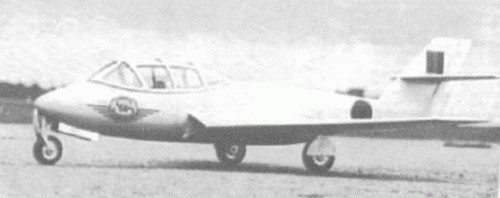
The SABCA S.60 was a two-seat low-wing transition jet trainer project of 1951.
Sabca S 60 Engines: 2 x Turbomeca, 400Kg Wing area: 13.26 sq,m Load: 630Kg Max take-off weight: 1750Kg Estimated performances: Take off speed: 130Km/h Cruising speed: 560Km/h Max speed: 650Km/h
Not long after it had given a go-ahead for development and production of the Saab-32, the Swedish air force began to draw up its specification for a new single-seat fighter that would be able to intercept bombers flying in the transonic speed range. The new type was going to need supersonic speed capability, an unprecedented rate of climb, above, average range and endurance, and a considerable weapon load. It was required to have STOL (short take-off and landing) characteristics to allow for its deployment from a variety of dispersed sites.
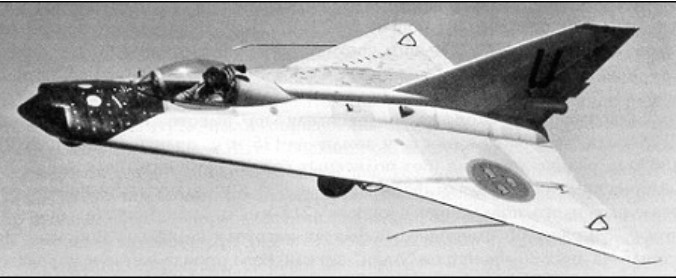
Saab began work on this requirement in August 1949, selecting a wing of double-delta configuration that promised great structural integrity with low weight and which, if it performed satisfactorily, would provide the volume needed for the equipment, fuel and weapons demanded by its primary role. The capability of such a wing was confirmed by wind tunnel testing of models and by the Saab-210 small-scale research aircraft, powered by a 476kg thrust Armstrong Siddeley Adder turbojet. First flown on 21 February 1952, the Saab-210 confirmed that there were no particular problems in the handling of the double-delta wing.
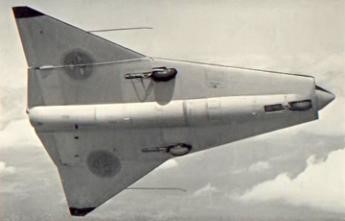
A double delta model, with wing sweep at 80o for the inner and 60o for the outer sections was demonstrated and led to a 1:7 scale aircraft being built. The project was launched in November 1950 and on December 7, 1951, the SAAB 210 began its taxi tests. Tests were carried out with ground contact speeds between 250 and 150 km / h.
The ‘Mini-Draken’ (otherwise the Saab 210) was completed and first flown on 21 January 1952, with Bengt Olow at the controls, nine months and SKr 1.7 million later. The landing gear was raised hydraulicly, the descent was by gravity.
Following a successful test flight, the Swedish Air Force ordered three full-scale J35 prototypes. The 210 flew a total of 887 flights and 286 flying hours.
210 Engine: Armstrong Siddley Adder ASA1, 475 kg Wingspan: 6.35 m Length: 8.80 m Height: 2.78 m Wing area: 24.20 m² Aspect ratio: 1.67 Sweepback: 60 – 77 ° Take-off Weight: 1775 Kg Wing loading: 77 kg / m² Rate of climb: 11 m/s Climb to 2000m: 4 min. Climb to 4000m: 8 min. Max speed 4000m: 540 km / h Landing roll: 300 m Landing roll with parachute: 200 m Take-off dist: 900 m Range: 280 km Takeoff speed: 180 km / h Landing Speed: 190 km / h
210A Engine: Armstrong Siddley Adder ASA1, 475 kg Wingspan: 6.35 m Length: 8.80 m Height: 2.78 m Wing area: 24.20 m² Aspect ratio: 1.67 Sweepback: 60 – 77 ° Wing loading: 77 kg / m² Maximum speed: 555 km / h Max speed 2000 m: 545 km / h Max speed 4000 m: 540 km / h Range: 280 km Takeoff speed: 180 km / h Landing Speed: 190 km / h Take-off dist: 900 m Climb to 2000m: 4 min. Climb to 4000m: 8 min.
210B Engine: Armstrong Siddley Adder ASA1, 475 kg Wingspan: 6.35 m Length: 9.12 m Height: 2.78 m Wing area: 23.00 m² Aspect ratio: 1.67 Sweepback: 60 – 77 ° Wing loading: 77 kg / m² Range: 280 km Takeoff speed: 180 km / h Landing Speed: 190 km / h Climb to 2000m: 4 min. Climb to 4000m: 8 min. Take-off dist: 900 m
Developed by Saab as a private venture, to add to its product line a lightweight turbojet-powered aircraft able to fulfil a number of civil and military roles, the Saab-105 entered the design stage in 1959. SAAB launched the Saab-105-project in April 1960. This shoulder-wing aircraft was originally engined by two French Turbomeca Aubisque turbofans. The project was company-funded and conducted by a design team under Ragnar Haerdmark.
On 16 December 1961, the Swedish government awarded SAAB a contract for a prototype of the SAAB 105 side-by-side two-seater and signed a letter of intent for at least a hundred production machines. In 1962, the Flygvapnet ordered 150 SAAB 105, designated Sk 60 (was to be Sk 55, but SAAB asked for number 60).
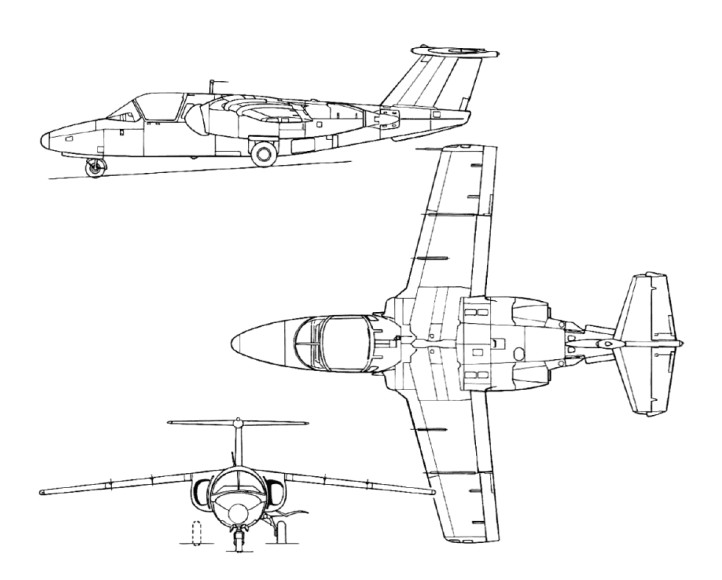
A cantilever-shoulder-wing monoplane with marked wing anhedral and high T-tail, it has retractable tricycle landing gear, is powered by two turbofans nacelle-mounted one on each side of the fuselage, and has an enclosed cockpit that accommodates two side-by-side on ejection seats. Alternative seating for four can be provided on fixed seats.
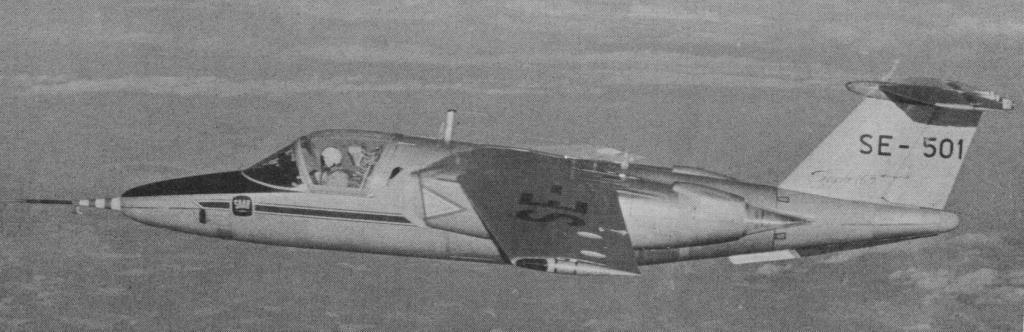
The initial test flight was delayed to find an appropriate engine, eventually found in the 745kg thrust Turbomeca Aubisque. The first SAAB 105 prototype, registered SE-501, was flown on 29 June 1963. A second prototype, SE-502, flew on 17 June 1964.
Following extensive testing of the prototypes the Flygvapen placed an initial order in early 1964 for 130 production aircraft, a figure that was amended later to 150. The first of them was the Sk 60A trainer/liaison aircraft, flown initially on 27 August 1965 with deliveries for optional deployment in an attack role. The first Sk 60A, Swedish Air Force 60001, was delivered to the F 5 at Ljungbyhed in 1966. By 1969, 149 Saab Sk 60A, were delivered to the Swedish Air Force and placed in service.
Next to the SAAB 105 for the Swedish Air Force, SAAB worked on a military export model, the SAAB 105XT, with “XT” standing for “Export Tropic”. This variant had more powerful General Electric J85-GE-17B turbojets and an improved wing structure. The second SAAB 105 prototype was modified and was flown first as Saab 105XT on 29 April 1967. It was registered SE-XBZ for use as a flying demonstrator. Austria ordered 40 SAAB 105XT machines with the designation of SAAB 105OE (“OE” for “Oesterreich”). Deliveries started in 1970 and the order was completed in 1972. The Saab 105OE is used in Austrian service for reconnaissance, support and air defence tasks.
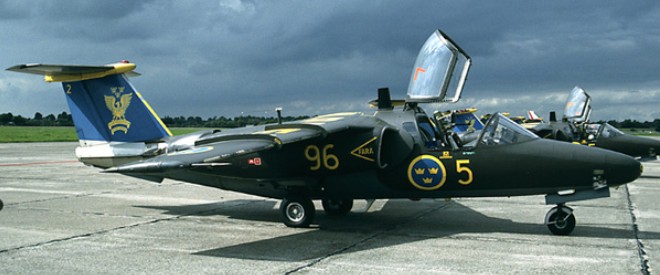
The Saab 105 delivered to the Swedish Air Force as Sk 60A was an unarmed trainer. Starting in 1970, 46 Sk 60As were converted into Sk 60B standard, with three hardpoints beneath each wing enabling them to operate as a light ground attack aircraft.
Another 28 Sk 60A aircraft were modified to Sk 60C. The Sk 60C has a reconnaissance camera in the nose. The nose is longer and angular compared with the other versions of the aircraft. The Sk 60C prototype was the only new-build Sk 60C, when delivered to the Flygvapnet, making it the 150th and last new-build Sk 60 for the Swedish Air Force service.
In the mid-1970s, ten Sk 60A planes were configured as transports and given the designation of Sk 60D. A further development is the Sk 60E, which is equipped commercial-type instruments, including an instrument landing system. This variant has four seats, and consequently no rocket chairs. The Sk 60D and Sk 60E variants were also used for training of civil pilots. The Sk 60 has now gone trough a modernisation programme. The most important alteration was replacement of the Turbomeccas by the stronger William Rolls FJ 44 turbofans. The first Williams-powered Sk 60(W) was flown in August 1995. A total of about 115 conversions of Sk 60A, Sk 60B, and Sk 60C machines were performed in the late 1990s. In addition to its primary duty as a trainer, the Sk 60 is used as target aircraft, weather flying and liaison aircraft. A new variant, the Sk 60M, was developed to replace the Mitsubishi MU-2 target aircraft / target tug of Nyge Aero.
Surviving Swedish air force Sk 60s, of which there are four squadrons, have undergone a life extension programme at Saab.
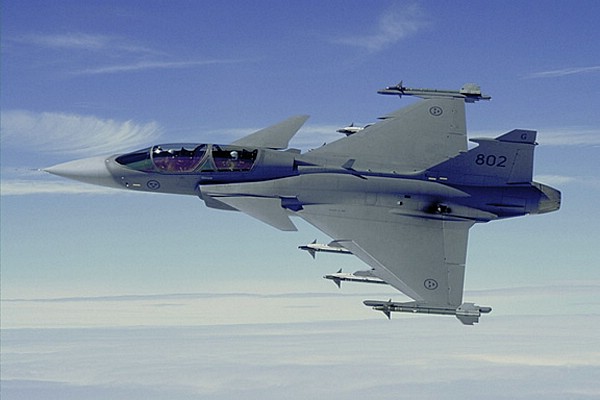
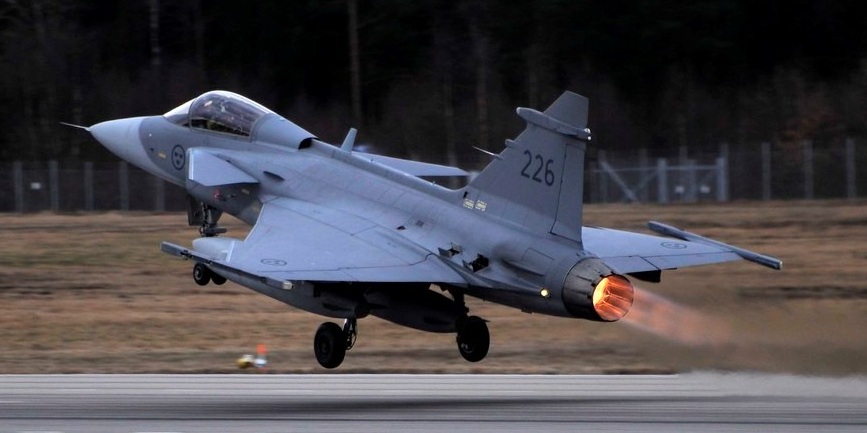
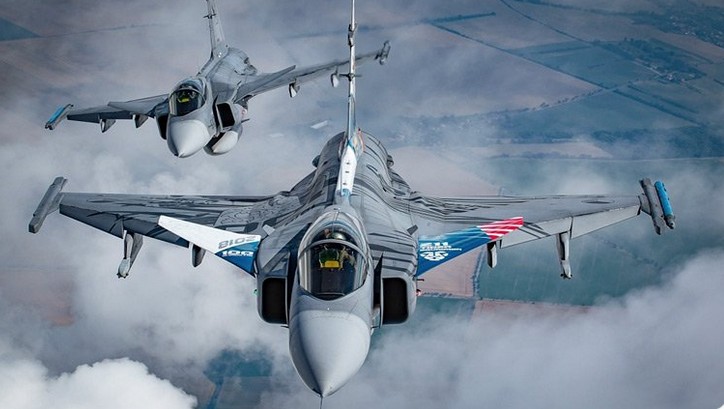
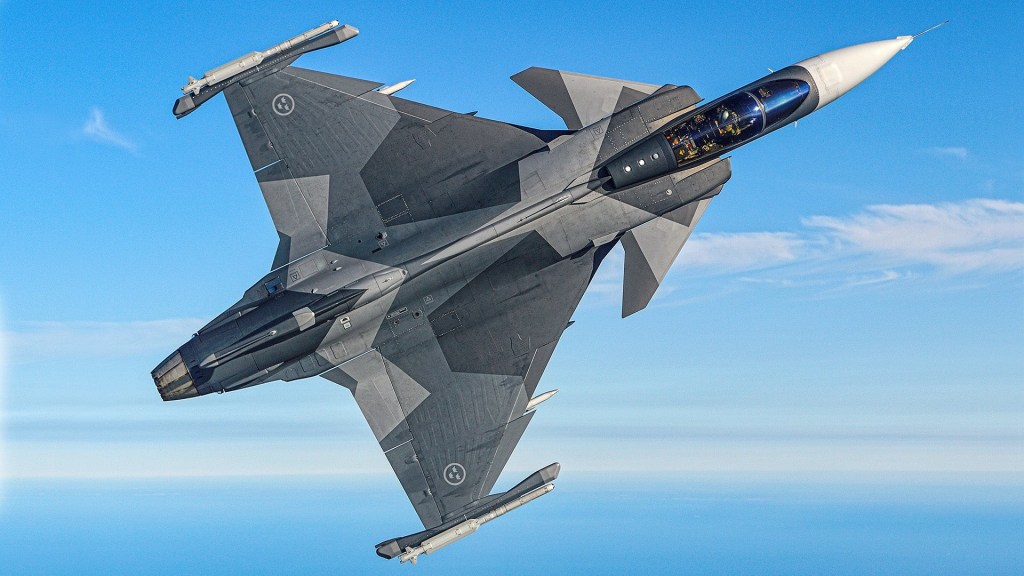
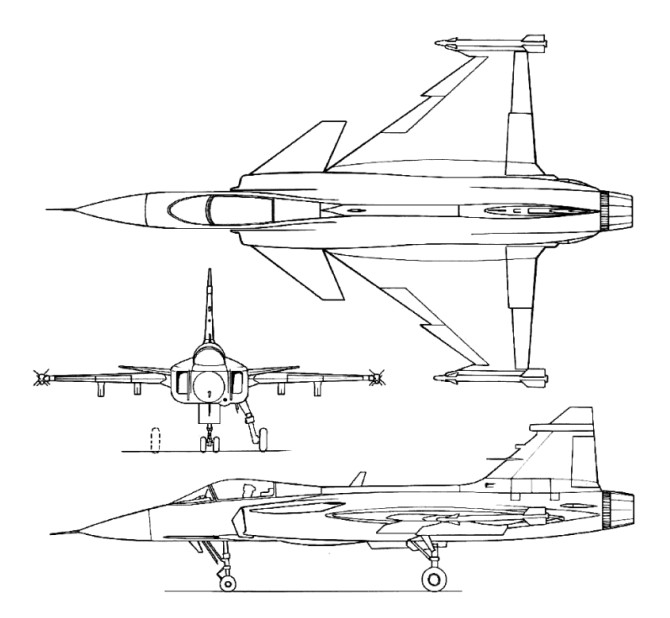
The JAS 39 Gripen is a small, agile and lightweight fighter design for multiple roles in the Royal Swedish Air Force. JAS stands for Jagt-Attack-Spaning which means Fighter-Attack-Reconnaissance. The Gripen (Griffon) design features canards positioned close in front of the delta wing. It is powered by a single 80kN reheated Volvo RM12 licensed built General Electric F404-GE-400 engine.
The JAS 39 Gripen is a Swedish fourth-generation multi-role fighter developed by Saab. Its name comes from the mythical griffin, symbolizing divine power. The design work began in 1979, the first flight took place in 1988, and in 1997 the Gripen entered service with the Swedish Air Force. Costs range from $30 million to $60 million depending on the modification.
The fighter features a canard aerodynamic layout: control surfaces generate lift at any speed, while the delta wing compensates for negative lift at supersonic speeds. This design provides high maneuverability, stability during supersonic flight, and excellent takeoff and landing performance. To reduce landing distance, the aircraft is equipped with powerful air brakes. Key systems, including the RM12 engine and PS-05/A radar, are modular, simplifying maintenance and upgrades. A powerful turbofan engine with high bypass allows a top speed of 2,130 km/h and takeoff acceleration in 18 seconds. Initially, the aircraft had a limited weapons set, but it later gained the ability to use most European and American air-launched weapons: bombs, unguided rockets, and precision missiles for ground and naval targets.
It is a canard delta design with a triplex digital fly-by-wire flight control system, a multimode Ericsson PS-05A pulse-Doppler radar, a Honeywell INS, a Hughes wide-angle headup display, an external Flir pod, and an advanced cockpit with three CRT displays. British Aerospace designed and developed the carbonfibre wing, and produced them for the first three prototypes.
It has a modern glass cockpit with three multi function displays and a wide-angle HUD. Its easily programmable software and associated systems make the aircraft suitable to configure it for all kinds of mission profiles.
Armament includes a 27mm Mauser BK27 cannon internally, and six hardpoints.
The first prototype of the JAS 39 was rolled out on April 26, 1987, and first flown in 1988.
Five Gripen prototypes were to be followed by an initial batch of 30 production aircraft. Options were held on another 110, although the total Swedish Air Force requirement exceeded 300 aircraft to replace Drakens and Viggens.
The JAS 39A single-seater and the JAS 39B two-seater were the first production aircraft to enter service in the Swedish Air Force in 1997. The improved JAS 39C and two-seat version JAS 39D were a later production batch. Improvements include air-to-air refuelling capability, NATO weapon pylons, and NATO compatible systems. The export versions are also based on the C/D variants.
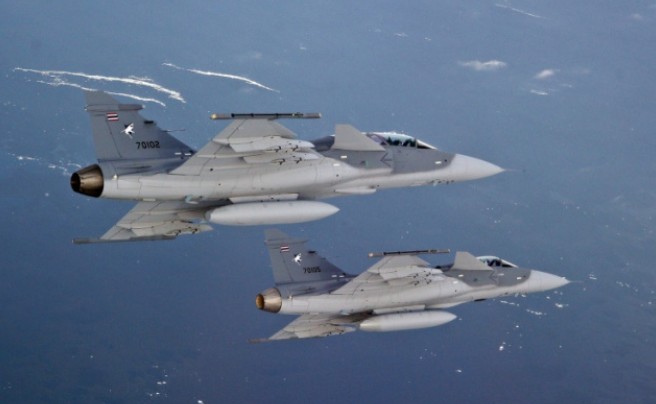
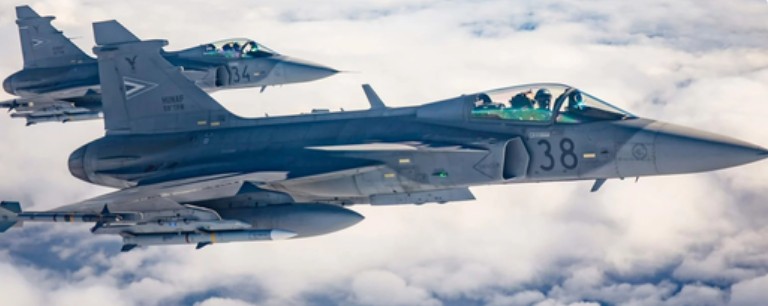
After 2004 Swedish A/B variants were to be updated to Batch 3 (C/D) standard. Export customers include South Africa, Czech Republic and Hungary. South Africa was the first foreign customer for the Gripen, ordering 19 single-seat and 9 twin-seat aircraft in 1999. The aircraft were to be delivered between 2007 and 2011 and replace the Cheetah C/D aircraft in service.
In 2003 Hungary signed a lease-and-purchase contract for 12 single-seat and 2 twin-seat aircraft to be delivered in 2006 and 2007. The contract consisted of a 10 year lease after which the aircraft will be property of the Hungarian government. The Gripen will be fully NATO compliant and represent the main fighting force of the Hungarian air force.
In 2004 the Czech Republic signed a lease contract for twelve single-seat and two twin-seat Gripen aircraft for a period of 10 years. The aircraft are diverted from the production line destined for the Swedish Air Force for reduced delivery times. The first Czech Gripen made its first flight in November 2004 and were to be delivered to the Czech Air Force in April 2005, making the Czech Republic the first NATO operator of the type. The last aircraft is to be delivered in August 2005. The JAS 39 C/D is fully NATO compliant and will fill the gap in the Czech air defense left by the MiG-23/29 disposal and MiG-21 retirement.
The Gripen was also offered to Poland to fill its requirement for 48 fourth generation fighter aircraft, but Lockheed Martin’s F-16C/D Block 52 fighter was the winner. Austria preferred the Eurofighter Typhoon over the Gripen. The Saab-BAE SYSTEMS consortium also lost potential export sales to customers the Joint Strike Fighter, such as the Netherlands and Australia.
The Gripen boasts a top speed of Mach 2 and a combat radius of about 500 miles.
Its delta-wing design and fly-by-wire controls make it highly agile, while its PS-05/A pulse-Doppler radar, upgraded in the MS20 configuration, allows it to track multiple targets and deploy a wide array of weapons, from AIM-120 AMRAAM missiles to precision-guided bombs like the GBU-39.
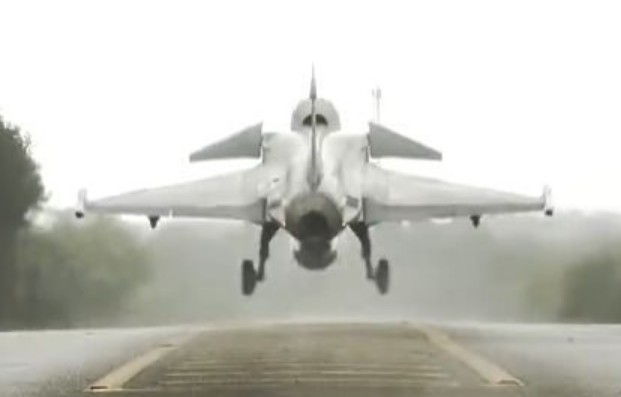
The jet’s versatility shines in its ability to operate from short, unprepared airstrips—a feature rooted in Sweden’s Cold War strategy of dispersed basing—which gives it an edge in flexibility over heavier platforms like the F-35.
At roughly 18,000 pounds empty, it’s a fraction of the F-35’s 29,000-pound weight, and its operating costs, estimated at $4,700 per flight hour, are significantly lower than the F-35’s $44,000, according to a 2021 Pentagon report (2025).
The first prototype Gripen E made its maiden flight from Saab’s Linköping facility on June 15, 2017. The aircraft is slightly larger than the C-model at just under 50 feet and includes a beefed-up fuselage that accommodates approximately 30 percent more fuel. The aircraft also features larger air intakes, the more powerful General Electric F414-GE-39E engine, and a total of 10 hardpoints. A two-seat F-model is now in development for Brazil, which currently has 36 E/F variants on order as the first export customer for the latest versions.
December 2020 saw the first of a planned 60 Gripen Es being handed over to the Swedish Air Force to commence the joint test program for verification and validation between Saab, the Swedish Armed Forces, and FMV, the Swedish procurement agency.
JAS 39 Gripen E
Key specifications of the Gripen E: Engine Turbofan engine General Electric F414-GE-39E, providing up to 22,000 pounds of thrust with afterburner. This engine delivers 25% more thrust compared to previous models, enhancing the aircraft’s maneuverability and efficiency. Radar Active electronically scanned array (AESA) Raven ES-05, offering high accuracy and long-range target detection. Weapons systems The Gripen E has 10 hardpoints, allowing it to carry a wide range of weapons, including Meteor and IRIS-T missiles, as well as various air-to-ground and air-to-air bombs and missiles. Avionics Modern flight control and sensor systems provide a high degree of integration and automation. The cockpit features multifunction displays and voice-command control capabilities. Mobility and support The Gripen E is designed for efficient combat operations in various climates and can operate from airfields with limited infrastructure, making it highly versatile for diverse operational environments. The Gripen E is already in service with the Swedish Air Force and is used by other countries, including Brazil and Czechia.
Studies aimed at developing a successor to the Draken were carried out between 1952 and 1957. The Saab 37 Viggen (Thunderbolt) multi-role combat aircraft configuration and engine were specified in 1960 from the requirement for STOL performance to permit operation from short roadway dispersal airfields, and the navigation system was selected the next year.
Prolonged research led to adoption of a then-unique canard configuration for the interceptor that was to form the airborne component of the weapon system. The configuration comprises a large rear-mounted delta wing combined with a delta foreplane incorporating trailing-edge flaps. This was adopted to provide improved STOL performance so that the Saab-37 would be able to operate from short runways and sections of roadway about 500m in length, greatly increasing the flexibility of dispersed operations. This configuration, in combination with a high-power turbofan engine, has provided the essential short take-off capability. The engine also complements short landing capability by introducing thrust reversal, its first use in a combat aircraft. The Saab-37 has been designed for a ‘no-flare’ approach to landing with a rate of sink of 5m per second, and this has meant the design of special landing gear able to absorb such a high rate of descent. Once on the ground, thrust reversal plus anti-skid brakes ensure the achievement of a minimum landing run. The pilot is accommodated on a zero-zero ejection seat in an air-conditioned, heated and pressurised cockpit, protected by a bird-proof windscreen. Much of the capability of this aircraft results from the incorporation of the latest avionics, including for attack a head-up display linked via an air-data computer to a digital fire-control system; for its own protection ECM (electronic countermeasures) and radar warning equipment; for navigating Doppler radar and radar altimeter; and for landing in all weathers a tactical instrument landing system plus a blind-landing guidance system.
The first JA37 Viggen was delivered to the Swedish airforce in 1979. This aircraft was made especially in mind for Swedish air force specifications about STOL. The Swedish airforce needed a high quality all weather fighter, able to take off and land on short strips. The system builds on using regular roads as landing/take off strips spread out around the country, making it harder for an enemy to defeat the fighters on the ground during reloading, service and refuelling. The first delivery to the Swedish airforce was the year 1979 and the last one 1990. JA37 is the fifth member of the Viggen family. Viggen is built out of aluminium, honeycomb-elements and titanium-reinforcements. JA37 Viggen is the only aircraft in the Viggen family equipped with a head-down-display from Smiths Industries. It makes it possible for the pilot to fly in any kind of weather. Totally 329 Viggen were built, 149 of then are JA37´s.
Many of the functions in Viggen are automated. Examples of this are the automatic cannon. Once the pilot has his target locked on radar, the aircraft will steer itself so that every round will hit its target. The cockpit in Viggen is a relaxed environment; automatic throttle helps the pilot to keep an optimum speed, altitude and angel at short and steep landings. It can land at speeds between 195-249km/h (121-154 mph) with an aoa (Angel of attack) 16, 5 degrees.
Once the landing gear hits the ground and presses together, the reversing function sets in. This is optional, the pilot may choose to use the reversing system manually is he so wishes. The Viggen has a unique reversing system built in, which helps it to keep the landings under 500 meters. It also results in that the pilot can go backwards with his aircraft without any external help.
Construction commenced in 1964, the first of seven prototypes making its maiden flight on February 8, 1967.
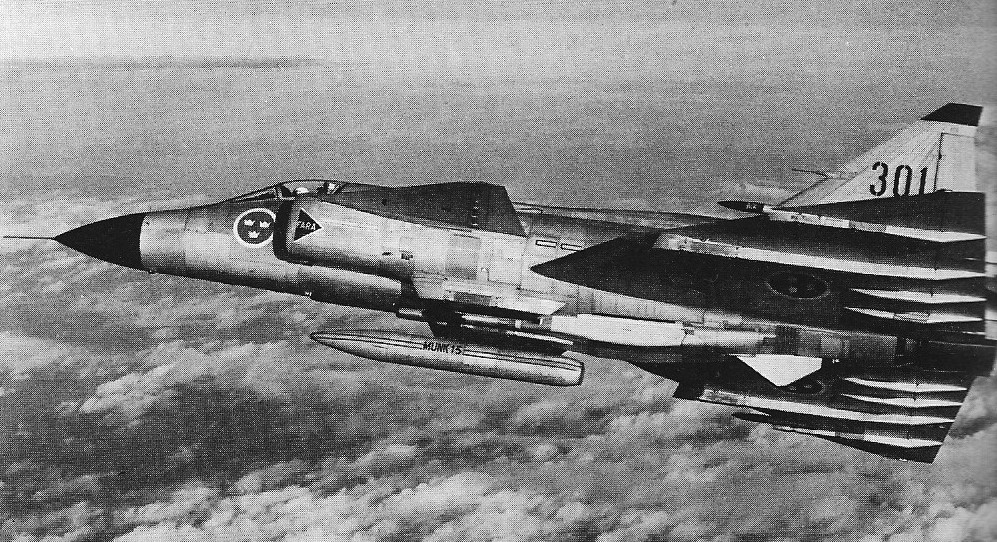
Saab received the initial order for 149 production aircraft in 1968 and first production Saab JA37 Viggen (301) made its initial flight on 4 November 1977. The first of them were delivered during 1979 to a squadron of F13 Wing based at Norrkfiping. It is powered by a US-designed JT8D turbofan engine which has a Swedish-produced afterburner. Short-field ability is enhanced by an automatic speed control and a thrust reverser, so that with its numerous aerodynamic aids the Viggen can take off in 400 m (1,310 ft) and land in 500 m (1,640 ft), coming ‘over the fence’ at a remarkably docile 220km/h (137mph) for such a high-performance aircraft.
The first operational squadron was established at F7 Wing in Sâtenäs from June 1971 onwards. Equipped with uprated turbofan, cannon, BAe Sky Flash missiles and I/J band pulse Doppler radar.
The 100th JA 37 was delivered on 20 August 1985.
Production of the AJ37 totalled 110 aircraft, but three basically similar models were produced in parallel, conforming to the Swedish practice of producing a single airframe capable of adaptation to specialist roles.
The next versions to be developed were dedicated reconnaissance Viggens. R&D funding was allocated for a nominal ‘S-37’ (Spanning, or reconnaissance) aircraft programme in 1971, resulting in the SF 37 Viggen (Spanning Foto, or photo-reconnaissance) which was intended to replace the S 35E Drakens and surviving Lansens in their overland mission. The first prototype flew on 21 May 1973. The 26 SF 37 are fitted with a varied array of cameras in a chisel nose, which dispenses with radar of any kind. An array of cameras (totalling seven in all) is provided, comprising four vertical or oblique units for low-level photography, two vertical cameras for medium to high-altitude tasks, and a solitary infra-red camera, Additional capability is provided by pod-mounted systems as and when required, such facilities enhancing both day and night reconnaissance potential and including additional specialized cameras and Red Baron infra-red linescan equipment. These systems can also be supplemented by pods, particularly night recon-naissance units, on the Viggen’s shoulder pylons.
Ordered into production early in 1973, the SF37 variant flew for the first time on 21 May of the same year, with deliveries to the first operational unit, F21 at Lulea, beginning during April 1977. This model replaced the same company’s S35E Draken in Swedish air force service.
The second dedicated reconnaissance version is the SH 37 Viggen (Spanning Havsovervakning, or sea surveillance) aircraft. The third production Viggen served as the SH 37 prototype, first flying in that configuration on 10 December 1973. Fitted with a long-range Ericsson PS-371/A surveillance and attack radar, optimised for over-water operations, contained in a fairing located beneath and slightly aft of the starboard engine air inlet, the 26 SH 37 also boasts an RKA 40 camera which records radar imagery for analysis. Outwardly, the SH 37 Viggen resembles the AJ 37 aircraft, and if any additional reconnaissance systems are carried they are externally mounted on the shoulder pylons. The usual fit is a night photography pod to port and a LOROP pod to starboard. The SH37 retains a nose-mounted radar for surveillance purposes and it can also operate with additional sensors or weaponry. Production models were delivered from June 1975. Air-to-air missiles can be carried by both reconnaissance derivatives for self-defence purposes.
With a need for a two-seat trainer version, the Sk 37 Viggen (Skol, or school), has two separate cockpits for pilot and instructor. The 18 Sk 37s have an extended fin and retain the standard Viggen nose, but carry no radar, instead relying on Doppler equipment and DME to find their way around. Based on the AJ, the Sk 37 has reduced fuel capacity as a result of its extra cockpit, and aircraft often operate with external tanks. Deliveries of the Sk37 2-seater trainer commenced in 1972. This aircraft was also designed for a limited strike role.
The first 27 Viggens were built with weakened spars and early in its career the type gained an unfortunate reputation as a result. The basic integrity of Saab’s design was never in doubt, as borne out by the long service of all its post-war military aircraft, so it came as no surprise when the decision was made to proceed with the final and perhaps most radical development of System-37. To replace the J 35 Draken in the air defence role the JA 37 Viggen (Jakt, or fighter) was conceived, externally identical to the AJ 37 but underneath a very different aircraft. Design work had been underway at a low rate since 1968, and the first contracts were awarded in 1972.
A total of five prototypes were required, the first flying on 4 June 1974. The fuselage was subtly stretched by 7cm and the fin gained a distinctive extension (a la Sk 37), and additional elevon activators. The other obvious external difference is a blade VHF aerial, behind the rudder. The JA 37 has an uprated 125kN Volvo RM8B afterburning engine, (licence-built Pratt & Whitney JT-8D-22, featuring an additional fan stage, while the on-board equipment was supplemented by an all-weather long-range Ericsson UAP 1023 pulse-Doppler radar. The JA37 also possesses strike capability. Armament includes a permanent 30mm cannon pack and Skyflash and AIM-9L Sidewinder AAMs.
An extensive test programme was undertaken to integrate the new Volvo-Flygmotor RM8B engine, Ericsson PS-46 multi-mode radar, BVR missile system, and all-new cockpit avionics and displays. While still a relatively small, single-engined aircraft, the JA 37 conforms to Sweden’s exacting operational requirement for short missions but high sortie rates. Its wing has been restressed to cope with a higher load factor and the aircraft’s weight has increased. The first of 149 production JA 37s flew on 4 November 1977, with deliveries commencing in 1980. The final aircraft was handed over to the Flygvapen on 29 June 1990, bringing to an end the Viggen’s production run of 329 aircraft.
The JA 37 at full throttle and full afterburner will empty the fuel tanks in 9 minutes, and 0-315 km/h (take off speed) takes 7 seconds.
Attempts were made to export the aircraft, first as a Starfighter replacement to NATO nations and Japan, a Mirage III replacement for Australia and, later, as a deep penetration strike aircraft to India. All these efforts came to nothing, partly because of restrictions imposed on Saab by the national legislature.
The 149th and last JA 37 fighter was handed over to the Flygvapnet at Linkoping on 29 June 1990.
A proposal to fund attrition replacements for the Swedish air force was also defeated, and first-generation aircraft were withdrawn before the JAS 39 Gripen became fully operational. To bridge that gap Saab is undertaking an extensive upgrade programme to modify 115 AJ, SF and SH 37s to AJS 37 standard. This involves fitting a new digital databus giving each aircraft a true multi-role capability, a terrain-following radar system, and compatibility with some of the armaments being developed for the Saab Gripen (such as the DWS 39 stand-off dispenser weapon).
Not long after it had given a go-ahead for development and production of the Saab-32, the Swedish air force began to draw up its specification for a new single-seat fighter that would be able to intercept bombers flying in the transonic speed range. The new type was going to need supersonic speed capability, an unprecedented rate of climb, above, average range and endurance, and a considerable weapon load. It was required to have STOL (short take-off and landing) characteristics to allow for its deployment from a variety of dispersed sites.
Saab began work on this requirement in August 1949, selecting a wing of double-delta configuration that promised great structural integrity with low weight and which, if it performed satisfactorily, would provide the volume needed for the equipment, fuel and weapons demanded by its primary role. The capability of such a wing was confirmed by wind tunnel testing of models and by the Saab-210 small-scale research aircraft, powered by a 476kg thrust Armstrong Siddeley Adder turbojet. First flown on 21 February 1952, the Saab-210 confirmed that there were no particular problems in the handling of the double-delta wing, and following inspection of a wooden mock-up the company received an order for three Saab-35 prototypes. Features of the design included fully-powered controls, a combination of bag and integral fuel tanks, and retractable tricycle landing gear complemented by two retractable tail wheels, an arrangement permitting a tail-down landing to gain the full aerodynamic braking effect of the wing. Such a landing, combined with the use of a braking parachute, makes possible a landing run as short as 610m.
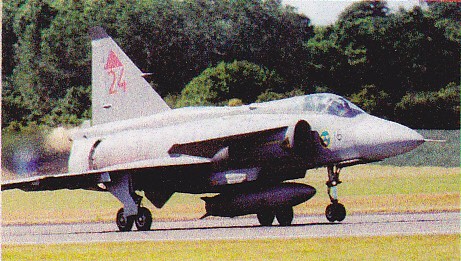
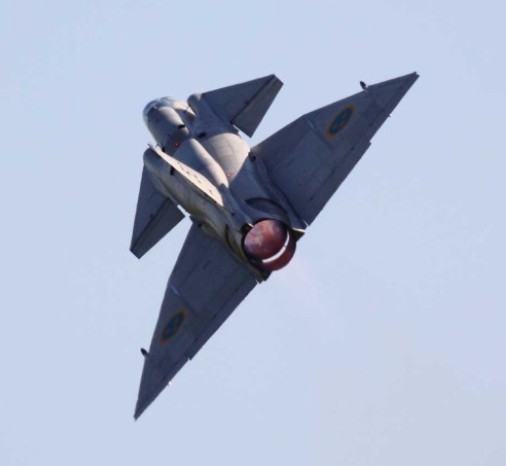
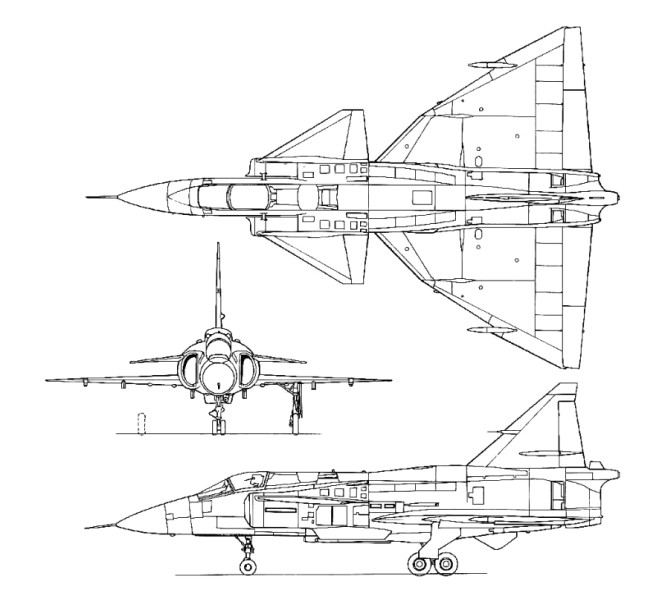
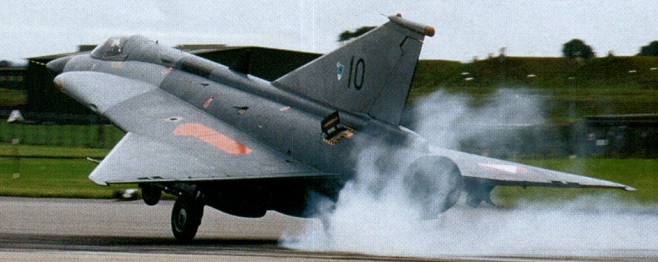
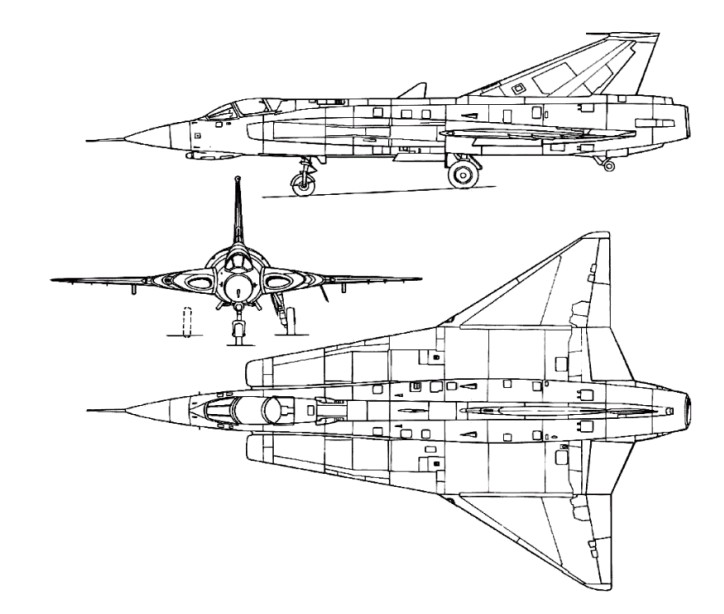
Erik Bratt achieved fame as the designer of the Saab Draken. The first batch of final drawings was issued by the design team (which finally numbered 200) in 1953 and the plane began to take shape towards the end of 1954. The mid-set wigs are a double delta with 80 degrees sweepback on the inner wings and 57 degrees on the outer wings. Elevons on the wing trailing-edges are made up of two inboard and two outboard surfaces. The main wheels retract outward into the wings and the nosewheel retracts forward.
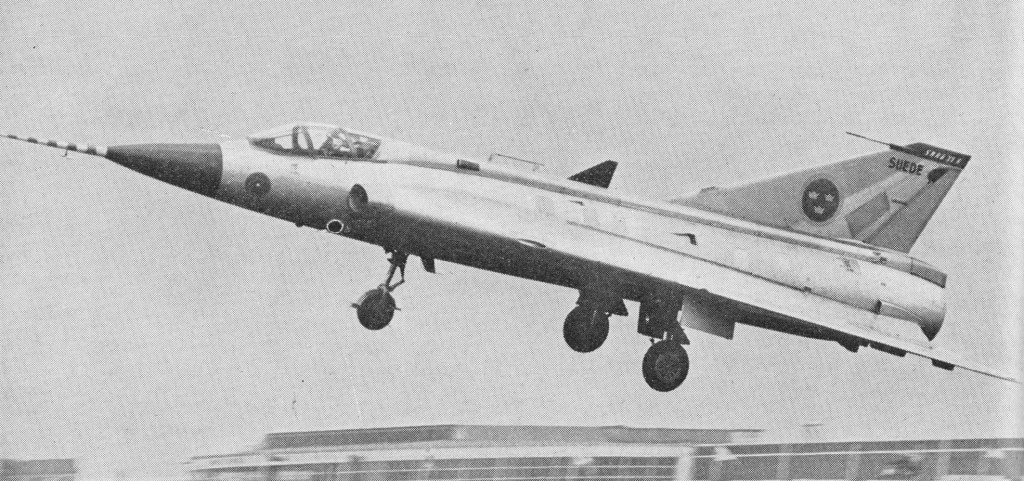
The J35 finally made its first flight on 25 October 1955, piloted by Bengt Olow. The other two in early 1956. The first prototype was not equipped with an afterburner. The three prototypes were powered by Rolls Royce Avon engines of the Series 200 model, but Svenska Flygmotor acquired a licence to build the engine in Sweden and it was these units which powered production aircraft, the first of which flew in February 1958. The Svenska produced engines, with a Swedish developed afterburner, were given the designation RM6, and the B model, which powered the first production Draken, the J35A, was rated at 6890 kg (15 190 lb) of static thrust with augmentation. The first to feature the RM6B unintentionally broke the sound barrier (while climbing) during its maiden flight.
SAAB 35A Draken
Relatively minor changes were made as a result of flight development, the most noticeable being the addition of a cockpit transparency to give the pilot a better view, and the extension of the extreme aft fuselage and jetpipe to reduce drag. The type was ordered into production during 1956, and the first series-built J 35A Draken (dragon) was flown on 15 February 1958, and the first J35As joined Flygflottilj 13 operational squadron at Norrkoping in March 1960. Before they were armed and equipped with radar they were used as single seat trainer. The usual basic armament of these interceptors was four Sidewinder infrared seeking missiles, designated Rb324 in Sweden, although provision was made for three under fuselage hardpoints and four more under each wing. A 30mm (1.18 in) Aden cannon was mounted in each wing.
By the time the J35A entered service, the first J35B had already flown. The 35B prototype was flown for the first time on 29 November 1959 and was being used to test the new Saab S7 collision course fire control radar. The production model was equipped with sophisticated fire-control equipment for mounting collision-course offensives in coordination with the Swedish-built STRIL 60 air-defense system. In January 1960, what had started as a low supersonic aircraft with simple engine intakes reached Mach 2 for the first time. Some J35Bs were built from new, others converted from J35As.
The J 35B had improved ejection seat and control systems, and was equipped with the longer afterburner, like the final J 35As.
The training version (35C) a modified 35A with the radar equipment and armament removed to make it a twin-seater, made its inaugural flight on 30 December 1959. The 35C had an entirely new forward fuselage with dual seating, twin ejection seats, and full instrument panels for instructor and student and designated Sk-35C with the Swedish Air Force (Sk stands for Skol or Trainer). Many more As were also converted later to tandem two seat and unarmed trainers. The 35C variant was based on the J 35A with the short afterburner.
Equipped with the completely new Rolls-Royce RB Series 300 Avon engine with an afterburner, the 35D became the first Draken to reach Mach 2. The combined D/E prototype made its first flight on 27 December 1960. In most respects similar to the B, but was powered by a Series 300 Avon with the Swedish designation RM6C. The thrust was now 5801 kg (12 790 lb) dry and 8006 kg (17 650 lb) with afterburner, and maximum gross weight of the aircraft rose accordingly, most of it being taken up with additional internal fuel. The RM6C engine required the engine intakes to be extended forward.
Flying for the first time on 27 June 1963, the Saab S35E is a variant optimized for the tactical reconnaissance role and able to perform low-, medium- or high-altitude reconnaissance by day or night. Essentially similar to the J35D fighter, the S35E features a battery of forward-facing, vertical and oblique cameras in a redesigned nose section, the entire outer shell of which slides forward to permit rapid access and thus facilitate removal and replacement of camera magazines. These were replaced by British external pods in 1973. The two forward looking cameras in the wings replacing the internal guns.
Entering service with the Swedish air force’s Flygflottilj 11 in the mid1960s, the S3SE served as the Flygvapen reconnaissance workhorse although it was largely supplanted by a version of the Viggen. Some 60 examples of the S35E were produced, this figure being fairly evenly split between new-build airframes and reconfigured J35Ds, whilst a further 20 reconnaissance Drakens were produced for the Royal Danish air force (forming part of the total of 52 Drakens acquired by Denmark in the early 1970s) and being known by the designation RF35 in that country’s service with a full camera nose with provision for up to five 0MERA cameras. In company parlance, the machines are known as the S35SD, the basic Saab 35X being a derivative of the definitive J35F interceptor earmarked for the export market.
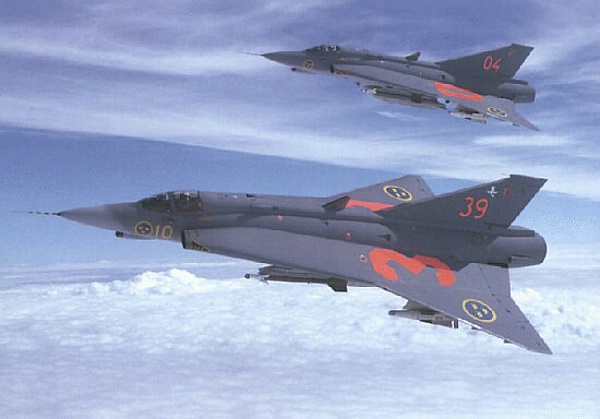
The most numerous variant ordered was the J35F, a prototype converted from a D model which made its first flight in late 1965. It was a considerable step up in weapon system performance, introducing an Ericsson produced Hughes pulse Doppler radar, completely automatic fire control and Hughes Falcon air to air missiles in both infrared and radar seeking versions and revised canopy.
The first two Drakens modified to J35J standard were handed over to the Swedish Air Force on March 3, 1987. The update programme was designed to maintain the Draken’s effectiveness until the mid-1990s, and up to 64 aircraft were to be converted. Based on the J35F version, the J35J modification and life extension programme includes an extensive system update with a modified radar, an improved infrared seeker, and IFF equipment. Two additional stores pylons are fitted, allowing additional weapons or auxiliary fuel tanks to be carried. The conversion programme was due to be completed by 1989.
Saab also developed the Draken for export, under the designation Saab-35X, with increased fuel capacity, up to a normal 4000 litres (880 gal), and a higher gross weight to allow the carriage of heavier external loads of 4500 kg (9920 lb). The maximum overload takeoff weight is nearly double the gross weight of the early model Drakens.
The first customer was Denmark, receiving 20 aircraft known as the A 35XD (similar to the Swedish J 35F), but becoming the F-35 once in service with the Kongelige Danske Flyvevabnet (Danish air force). Based on the J 35F but was upgraded with more internal fuel, stronger gear, arrester hook, improved avionics and cockpit layout, new weapon pylons which resulted in redesigned outer wings. Later F-35s were equipped with IR sensor in the nose. The 20 RF 35 (Saab S 35XD) is a variant of the Swedish S 35E photo-reconnaissance Draken, no longer in service. Eventually 11 Sk 35XD (TF-35) two-seat trainers were also delivered. Denmark’s last Draken squadron, operating all three versions of the aircraft. Delivered in 1970 and remaining in service until 1993.
The second export customer was Finland which received 12 J 35XS (Swedish J 35F-2) fighters, five J 35CS (Swedish Sk 35C) trainers and finally 24 J 35FS zero-timed ex-Flygvapnet J 35F single-seaters, more or less upgraded to J 35J standard with a better countermeasures suite. A single unit, ‘Lapland Wing’, flew the aircraft in the 1980s. In 1985 Austria ordered 24 Drakens (ex-Swedish J35Ds rebuilt 1964-65) designated J35ÖE equipped with bulged canopies, RWR, and chaff-flare dispensers. Austria became the fourth Draken operator with the delivery of its aircraft in the mid-1980s. Twenty-three J 35 ÖE s (reworked Swedish J 35Ds) serve as the nation’s primary air defence fighter. Austria acquired 24 aircraft in 1985, with deliveries in 1987-1989.
After having operated the Draken for 17 years, Austria finally retired the last nine Drakens from operational service in November 2005. Just prior to the retirement, the Draken celebrated its 50 year anniversary. Sixty J 35J and 12 Sk 35C two-seat trainers remained in service with F10’s four squadrons at Angelholm, in southern Sweden. Serving as pure interceptors, the J 35J ‘Johanns’ were to be retained until 1995 at least.
Replaced in Swedish service by the Saab 37 Viggen, a total of 644 Drakens were built, including 12 at the Valmet plant in Finland.
35A Engine: RM6B Svenska Flygmotor/Rolls-Royce Avon 200 (10472-13977 lbs) Span: 9.42 m (30 ft l0.75 in) Wing area: 538.2 sq.ft Length: 15.2 m (49 ft 10.5 in) Wheel track: 8 ft 10.5 in Take-off weight: 9000 kg (19841 lb) Max speed: 1.8 Mach / 1190 mph at 36,000 ft Cruising speed: 0.9 Mach Landing speed: 300 kph (186 mph) ROC: 39,360 fpm Range: 1375-2750 km (850-1710 sm) Max altitude: 13000-15000 m (42650-49210 ft)
35B Engine: RM6B Svenska Flygmotor/Rolls-Royce Avon 200 (10472-13977 lbs) Span: 9.42 m (30 ft10.75 in) Length: 15.34 m (50 ft 4 in) Take-off weight: 9000 kg (19841 lb) Max speed: 1.5 Mach Cruising speed: 0.9 Mach Landing speed: 300 kph (186 mph) Range: 1375-2750 km (850-1710 sm) Max altitude: 13000-15000 m (42650-49210 ft)
35C Engine: RM6B Svenska Flygmotor/Rolls-Royce Avon 200 (10472-13977 lbs) Span: 9.42 m (30 ft l0.75 in) Length: 15.2 m (49 ft 10.5 in) Take-off weight: 9000 kg (19841 lb) Max speed: 1.5 Mach Cruising speed: 0.9 Mach Landing speed: 300 kph (186 mph) Range: 1375-2750 km (850-1710 sm) Max altitude: 13000-15000 m (42650-49210 ft)
35D Engine: RM6C Svenska Flygmotor/Rolls-Royce Avon 300 (12787-17637 lbs) Span: 9.42 m (30 ft 10¾ in) Length: 15.34 m (50 ft 4 in) Take-off weight: 12500 kg (27557 lb) Max speed: 2+ Mach Cruising speed: 0.9 Mach Landing speed: 300 kph (186 mph) Range: 1375-2750 km (850-1710 sm) Max altitude: 13000-15000 m (42650-49210 ft)
35E Engine: RM6C Svenska Flygmotor/Rolls-Royce Avon 300 (12787-17637 lbs) Span: 9.42 m (30 ft 10.75 in) Length: 15.34 m (50 ft 4 in) Take-off weight: 12500 kg (27557 lb) Max speed: 2+ Mach Cruising speed: 0.9 Mach Landing speed: 300 kph (186 mph) Range: 1375-2750 km (850-1710 sm) Max altitude: 13000-15000 m (42650-49210 ft)
35F Engine: RM6C Svenska Flygmotor/Rolls-Royce Avon 300 (12787-17637 lbs) Span: 9.42 m (30 ft 10¾ in) Length: 15.34 m (50 ft 4 in) Height: 12.762 ft / 3.89 m Wing area: 529.589 sqft / 49.2 sq.m Take-off weight: 12500 kg (27557 lb) Weight empty: 16817.5 lb / 7627.0 kg Max speed: 2+ Mach / 1147 kts / 2125 km/h Cruising speed: 0.9 Mach Landing speed: 300 kph (186 mph) Range: 1375-2750 km (850-1710 sm) Range (max. weight): 1188 nm / 2200 km Max altitude: 13000-15000 m (42650-49210 ft) Armament: 1 MG 30mm ADEN/90rds, 2x AAM RB27, 2x AAM RB28 Falcon Crew: 1
J 35J Powerplant: 1 x Volvo Flygmotor RM6C afterburning turbojet, 79.51 kN (17,650 lb st) Length: 15.35m (50 ft 4 in) Height: 3.89m (12 ft 9 in) Wing span: 9.40m (30 ft 10 in) Empty, equipped weight: 8,250 kg (18,188 lb) Max Take-Off Weight 12.270 kg (27,050 lb) Max level speed clean at 10.975 m (36,000 ft): Mach 2.0+ / 2.126 km/h / 1,321 mph Armament: one 30mm Aden M/55 cannon with 150 rounds per gun External load: up to 2,900 kg (6,393 lb) ordnance, up to four auxiliary fuel tanks.
S35E Powerplant: 1 x Svenska Flygmotor RM6C turbojet, 7760-kg (17,108 lb) afterburning thrust. Wing span: 9.40 m (30 ft 10 in) Wing area: 49.20 sq.m (529.6 sq ft) Length: 15.85 m (52 ft 0 in) Height: 3.89 m (12 ft 9 in) Max speed: 2125 kph /1,320 mph / Mach 2. 0 Range int. fuel: 1290 km /800 sm Max range: 3250 km (2,020 sm) Empty wt: 8245 kg (18,180 lb) Max TOW: 16000 kg (35,275 lb)
RF35 / S35SD Powerplant: 1 x Svenska Flygmotor RM6C turbojet, 7760-kg (17,1081b) afterburning thrust. Wing span: 9.40 m (30 ft 10 in) Wing area: 49.20 sq.m (529.6 sq ft) Length: 15.85 m (52 ft 0 in) Height: 3.89 m (12 ft 9 in) Empty wt: 8245 kg (18,180 lb) MTOW: 16000 kg (35,275 lb) Max speed: 2125 kph / 1,320 mph / Mach 2. 0 Range int. fuel: 1290 km (800 sm) Max range: 3250 km (2,020 sm)
35X Engine: Volvo Flygmotor, 12,790 lb Wing span: 39 ft 10 in (9.4 m) Length: 50 ft 4 in (15.35 m) Height: 12 ft 9 in (3.89 m) Max TO wt: 33,070 lb (16,000 kg) Max level speed: M0.2.







 All Aero