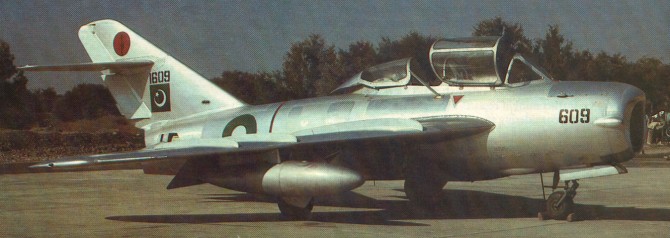
The Chinese developed two seat version of the MiG-17, built at Shenyang and designated the FT 5, emerged from complete obscurity. The FT 5 appears uniquely Chinese, in that no similar two seat conversion of the MiG 17 ever appeared in the Soviet Union.
The FT 5 is based on the two seat MiG-15UTI, or FT-2, built in very large numbers in both the USSR and the People’s Republic of China, and as a modification of the early MiG 17, with a non afterburning Klimov VK 1 centrifugal turbojet derived from the Rolls Royce Nene (designated TJ 5D by the Chinese), and developing only 5,952 lb (2700 kg) thrust for take off, offers little more in the way of performance. It remains firmly subsonic, with no transonic capability limiting speed is around Mach 0.92 and has a fixed rather than all moving tailplane.
Although the forward and centre (ie, forward of the rear frame of the engine plenum chamber) fuselage of the FT 5 remains essentially similar to that of the MiG 15UTI, the rear fuselage of the MiG 17 is lengthened 35.4 in (90 cm), the tailplane sweep is increased and the wing is substantially different, with a consequent major improvement in handling.
The thinner and almost crescent wing of the MiG 17, with inner leading edge sweep of 45 deg reducing to 42 deg on the outer panels, plus three large and strategically placed fences appears to result in much “softer” and less critical handling characteristics.
Cockpit arrangement, both internally and externally, seems basically similar to that of the MiG 15UTI alias FT 2, a few of which remain in PAF service for instrument training. In Pakistan, the FT 5 began replacing the Lockheed T 33 and F¬-86F Sabre for advanced training in early 1975.
The FT 5 is equipped with a single 23 mm Nudelman Rikhter cannon under the starboard nose for air to ground gunnery, apparently in conjunction with a radar ranging sight through a di electric antenna in a small radome above the intake.
Although so far identified in foreign service outside China only in Pakistan, the FT 5 has been built in substantial numbers. The JJ-5 is the export derivative.
Wing span: 31 ft in (9,63 m) Length: 37 ft 7.2 in (11,46 m) Height: 12 ft 5.5 in (3,8 m) Max level speed: 486 kts (902 km/h) at 32,000 ft (9753 m) Service ceiling: 45,000 ft (13715 m) Max endurance @45,000ft: 2 hr 38 min with two 88 Imp gal (400 lt) drop tanks
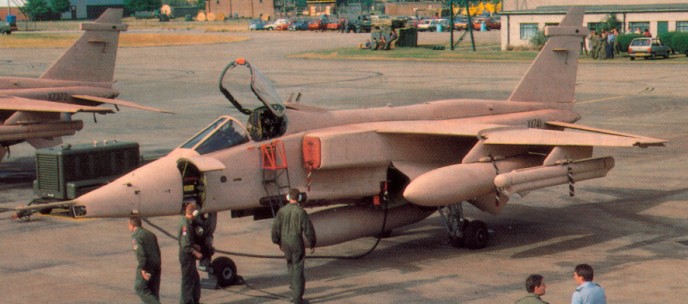
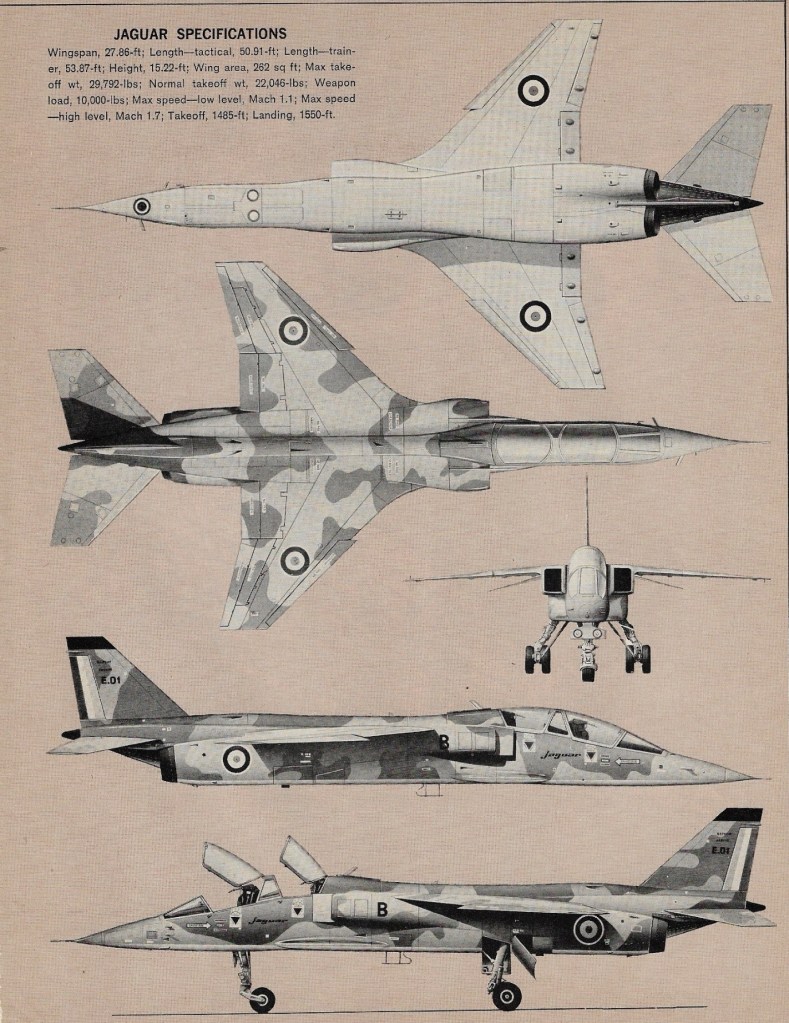
Bréguet 121 is the prototype, on which the SEPECAT (acronym for Société Européenne de Production de l’Avion d’Ecole de Combat et d’Appui Tactique) Jaguar is based. The Sepecat Jaguar, an Anglo-French joint venture by the British Aircraft Corporation and Breguet Aviation for a supersonic strike-attack and reconnaissance aircraft, plus a two-seat operational trainer, first flew on 12 October 1969.
Developed cooperatively by the United Kingdom and France, the Jaguar. The Jaguar is a light but capable strike aircraft, having two afterburning turbofan engines. It is used in the reconnaissance, advanced training, close air support, maritime attack as well as in the strike and interdiction role. Powered by two Rolls-Royce Turbomeca Adour turbofan engines of, according to engine mark, these aircraft have a maximum speed of Mach 1.5 at optimum altitude, and Mach 1.1 at sea level. A maximum external load of 10,000 lb (4,500 kg) of stores which can include nuclear and conventional weapons can be carried.
There followed a production of some 203 examples for the Royal Air Force, which included 38 two-seat variants, and 200 for the French Air Force. The Armee de l’Air’s first SEPECAT Jaguars became operational in January 1975. They had been modified to carry the French AN 52 tactical nuclear weapon.
Jaguar A is the original prototype and the French single-seat attack version. Jaguar E is the French tandem two-seat trainer variant with dual controls. Both were equipped with Adour Mk 101 engines of 7,305 lb thrust (with afterburning), although they were quickly replaced by the Adour Mk 102 of 8,600 lb thrust (with afterburning). The French Jaguars saw combat in Africa and the Balkans, before the last squadron (EC.01.007) retired its final examples from operational use on July 1, 2005.
Jaguar S designated GR.Mk1 (GR.1) by the Royal Air Force is the British equivalent of the Jaguar A with a laser in the nose. The Jaguar B is the RAF’s advanced trainer designated T.Mk2 (T.2) and has a more advanced full suite nav/attack system. Although originally delivered with the Adour Mk 102 engines, they were quickly retrofitted with the more powerful Rolls-Royce/Turbomeca Adour Mk 104 turbofans. GR.1A is an upgraded GR.1 aircraft with the nav/attack system from the T.2 and self defense systems, which were also added to the T.2A upgrade. Reconnainssance aircraft are equipped with a centre-line pod housing five cameras and an IR linescan.
Armament of the A and S versions consists of two 30 mm cannon, and, rockets and missiles. Jaguar A and S production aircraft entered service with the Armee de l’Air and the RAF respectively in 1973.
Entering RAF service with No 226 Operational Conversion Unit on 13 September 1973, and front-line service with No 54 Squadron since 29 March 1974, the Jaguar has at one stage equipped eight RAF front-line squadrons based in the UK and, the then, West Germany.
Only the Royal Air Force employed the type in the reconnaissance role, equipped with the Jaguar GR.Mk 1 carrying a large pod on the centreline stores station, containing cameras and infra-red linescan equipment. Reconnaissance cameras are located in a pair of rotating drums within the pod, swivelling to expose the camera ports during photography. Two side-mounted and one forward-looking camera are positioned in the forward drum whilst the second can contain a pair of oblique cameras for low-level work or a solitary vertical camera best suited for photography from medium altitudes. This combination offers quite comprehensive coverage, one particularly useful facility being a data conversion unit which automatically annotates the aircraft’s position on the film, details of this being obtained from the onboard navigation computer. IR-linescan film is similarly marked.The type is being continually upgraded into variants as the GR. 1A and lB. These upgrades, known as Jaguar ‘96 and ‘97, include the ability to carry the TIALD pod (thermal imaging and laser designator), new-generation reconnaissance equipment, an improved cockpit lay-out and an enhanced mission planning system and terrain reference navigation equipment.
The GR.3 and T.4 are the last RAF standards of RAF GR.1s and T.2s respectively. The upgrade program included new cockpit displays, helmet-mounted sights, the ability to carry the new Advanced Short Range Air-to-Air Missile (ASRAAM) and other system improvements to further extend the life of the aircraft into the 21st century. Finally, in the twilight of their career with the RAF, 60 GR.3/T.4 aircraft were fitted with the Adour Mk 106 engine, a rebuild and enhanced version of the Mk 104 offering better reliability, maintainability and slightly more thrust.
Despite the upgrades, it was decided the Jaguar would ultimately leave RAF service in 2007. The last RAF Jaguar squadron, 6 Sqn, was planned to disband in October 2007, retiring its aircraft. However the date was brought forward by some six months to 30 April 2007, a decision which had been announced only six days earlier by the UK MOD. Only one GR.3A and one T.4 aircraft remained active for trials with QinetiQ at Boscombe Down, Wiltshire, UK.
The Jaguar had somewhat limited export success, but the international variant was sold to the Ecuadorean Air Force (12), India, Nigeria, and the Royal Air Force Oman (24), as well as the Nigerian Air Force (18 these are currently (1999) stored and have not been operational for many years). The first of 10 SEPECAT Jaguar International fighters (the export version) was delivered to the Sultan of Oman’s air force in March 1977. All export Jaguar Internationals are based on the RAF’s Jaguar B/S airframe.
In March 1969, the Indian Minister of Defence Production stated in Parliament that BAC had proposed collaboration in the manufacture of the Jaguar in India, but did not elaborate. Ten days earlier, the first strike Jaguar prototype (A-03) had flown. By the autumn of 1971, eight development Jaguars in France and Britain were going flight tests and armament trials.
Although the Jaguar flew well, the dry thrust of its Adour Mk 101s was considered inadequate. Also at this stage of development, the part-throttle reheat system for the engine was being developed to provide for smooth augmentation and making it possible to select any thrust from minimum dry to maximum reheat. Subsequently, BAC offered the Adour Mk 102 with the PTR system, the engine now developing a dry thrust of 5,165 lb / 2343 kgp, increasing to 7379 lb / 3347 kgp with reheat, a 50% increase over the Mk 101.
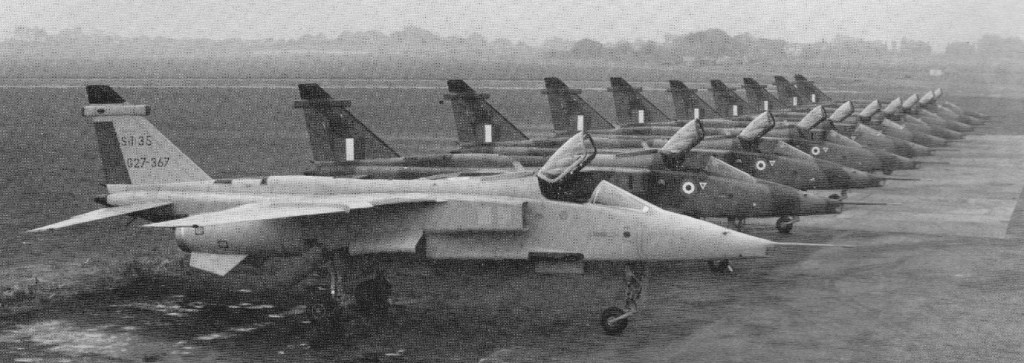
The 18 Jaguars from RAF reserve stocks were from various units, but largely ex-No 6 Sqn, and BAe Warton prepared the aircraft to the “interim” standard. The first two aircraft were two-seaters XX138(RAF)=B 3(BAe)=J1001I(IAF) and XX720(RAF)=B 8(BAe)=J1002(IAF), followed by the single-seaters including ex-No 6 Sqn RAF Nos XX738, XX729 and XX734. The “interim” Jaguars were painted in the standard RAF camouflage scheme but with IAF roundels and fin flashes. The first two were formally handed over at Warton on 19 July 1979.
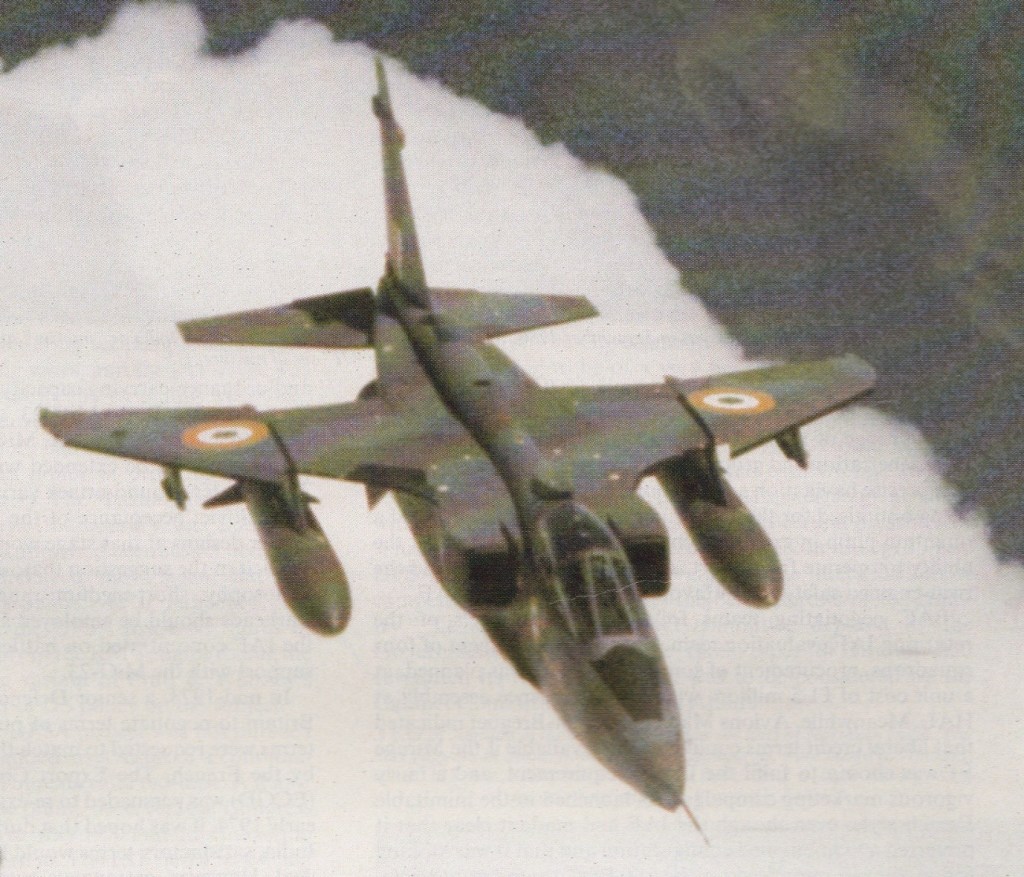
The Indian Air Force received 40, where the type is known as the Shamsher (assault sword). An additional 45 were supplied and assembled in India and a further 46 followed, being produced in India by Hindustan Aeronautics. The first of 45 HAL-assembled Jaguars flew in March 1982, and production ended in 1998. India was the biggest Jaguar operator today, with Jaguar IS strike , IT trainer and IM maritime strike aircraft. The latter have the Agave radar in a reprofiled nose and are armed with BAe Sea Eagle anti-ship missiles. While the original manufacturing countries of the Jaguar, France and the United Kingdom, had retired the Jaguar from air force service, India was still producing new aircraft of the type for the Indian Air Force (IAF). HAL’s Bangalore production line assembled the last batch of 20 single-seat Jaguars complete with the DARIN (Display Attack Ranging Inertial Navigation) II upgrade, including HOTAS, MFD, and new INS/GPS nagivation system. At Aero India 2007, February 2007, it was revealed that five of the 20 new Jaguars were ready for delivery with another three in final assembly. The eight were scheduled for delivery to the IAF before March 31, 2007, with the remaining 12 aircraft to be delivered within a year.
Latest versions have uprated Adour Mk.811 engines and overwing air-to-air missiles, while optional equipment includes multipurpose radar, Sea Eagle, Harpoon, Exocet, or Kormoran anti-shipping missiles, and a system such as low-light TV for enhanced night oper¬ations.
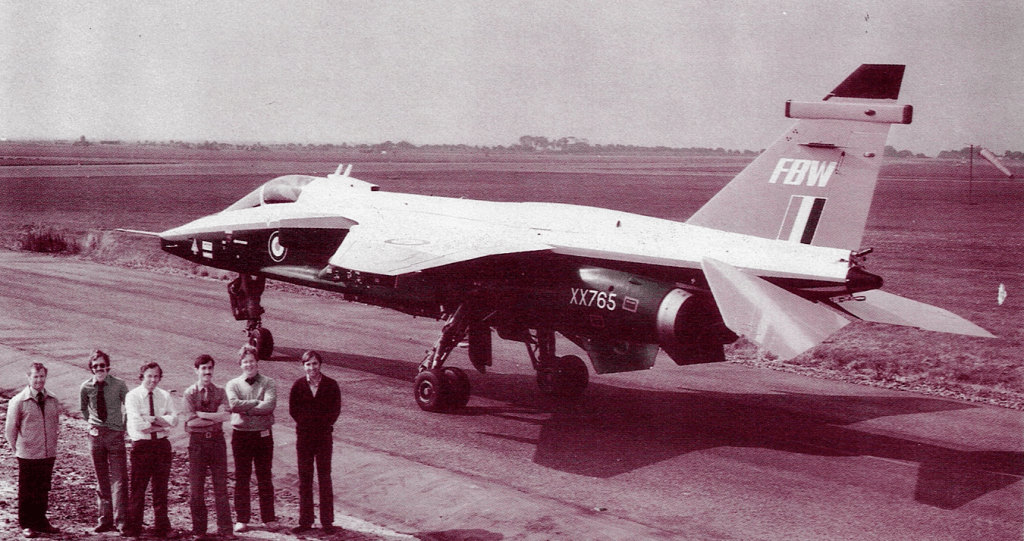
During the 1970s and early 1980s considerable research was undertaken into a host of aeronautical fields but this was generally performed with conversions of existing aircraft such as the SEPECAT Jaguar converted by British Aerospace for fly-by- wire control development.
Jaguar Engine: 2 x R-R / Turbomeca Adour. Installed thrust (dry / reheat): 50 / 75 kN Span: 8.7 m Length: 15.5 m Wing area: 24.2 sq.m Empty wt: 7700 kg MTOW: 15,430 kg Warload: 4760 kg Max speed: 1350 kph, M1.4 Initial ROC: 1.5 min to 9150 m Ceiling: 14,000 m T/O run: 880 m Ldg run: 470 m Combat radius lo-lo-lo: 535 km Fuel internal: 4200 lt Air refuel: Yes Armament: 2 x 30 mm Hard points: 5
Jaguar GR.Mk.1 Powerplant: two Rolls-Royce/ Turbomeca Adour Mk 104 turbofans, 3647-kg (8,040-1b) afterburning Maximum speed at 10.975m (36,000 ft) 1700 km/h (1,055 mph) or Mach 1.6 Service ceiling 14,020m (46,000 ft) Ferry range 4205 km (2,614 miles) Weight empty about 7000 kg (15,432 lb) Maximum take-off 15700 kg (34,612 lb) Span 8.69 m (28 ft 6 in) Length 15.52 m (50 ft 11 in) Height 4.89 m (16 ft ½ in) Wing area 24.18 sq.m (260.27 sq.ft) Armament: two 30mm Aden Mk.4 cannons / 150 rounds per gun External load: 4763 kg (10,500 lb) Hardpoints: five + wingtips
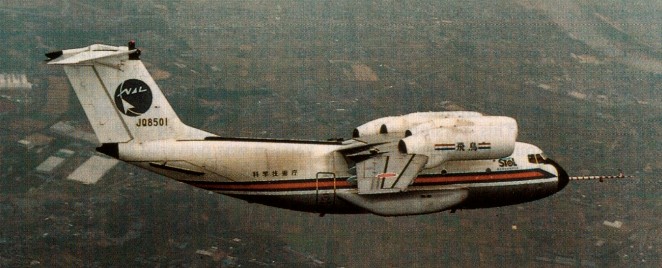
The Asuka, which first flew in October 1985, is a derivative of the Kawasaki C-1 tactical transport. The original P&W JT8D engines have been replaced by four Ishikawajima-Harima Heavy Industries FJR710/600S high bypass ratio turbofans.
The engines are mounted above and ahead of the wing leading edges. The exhaust airflow is directed across the wing extrados and attaches to the trailing edge flaps in whathas been termed “Upper Surface Blowing”. The resulting depression caused by the Coanda effect produces the desired lift force.
The STOL conversion takeoff run to 15m on the first flight was 509m, including a 394m ground run. Takeoff speed was 72 kts. The landing run from 15 m was 439 m, including 320 m on the ground.
STA claims the plane is only experimental and that there are no immediate development prospects.
The Schweizer turbine 330 is powered by an Allison 225 C10A engine. The new 350 shp Allison engine has been derated to 200 shp in the 330, which the company claims will provide a full 200 shp under standard day conditions up to 18,000 feet or to 16,000 feet on a 95oF day.
The piston powered 300 and the turbine powered 330 have virtually identical dynamic components main and tail rotor blades, transmissions and drive shafts with the exception of the powerplants.
In training configuration the 330 features three abreast seating, with the middle seat raised and slightly aft to give the instructor an overview. Another variant, for the civil utility market, has four seats in two by two configuration.
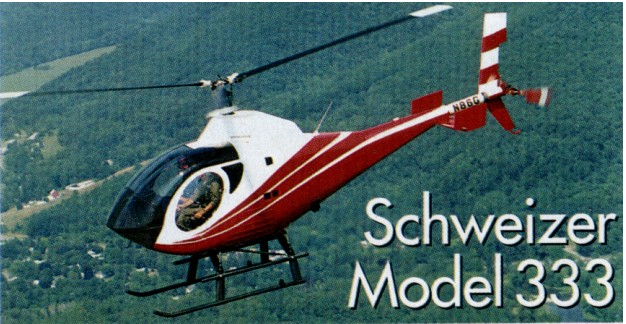
In September 2000 Schweizer Aircraft received type certification for the 333. This upgraded version of the 330SP features a new rotor system composed of cambered airfoil blades combined with an increase in maximum and continuous takeoff power. This gives 290 lbs more useful load and a cruise 20 kts higher than the 330SP. The 330SP may be upgraded to the 333.
Schweizer 330 Sky Knight Engine: Allison 250-C10A, 148 shp Length: 30.84 ft / 9.4 m Height: 8.53 ft / 2.6 m Rotor diameter: 26.903 ft / 8.2 m Max take off weight: 2050.7 lb / 930.0 kg Weight empty: 1049.6 lb / 476.0 kg Max. speed: 100 kt / 185 km/h Cruising speed: 91 kt / 169 km/h Initial climb rate: 1574.8 ft/min / 8.0 m/s Service ceiling: 20997 ft / 6400 m Range: 241 nm / 446 km Fuel capacity: 60 gal / 227 lt Crew: 1 Payload: 2-3 pax
330 / TH-330 Engine: 1 x Allison 250-C20W Instant pwr: 175 kW Rotor dia: 8.17 m / 27’6″ MTOW: 1000 kg Useful load: 475 kg Max speed: 230 mph Max cruise: 108 kts Max range: 495 km Ceiling: 11,200′ HIGE: 13,900 ft HOGE: 11,200 ft Crew: 1 Pax: 3 Seats: 3-4
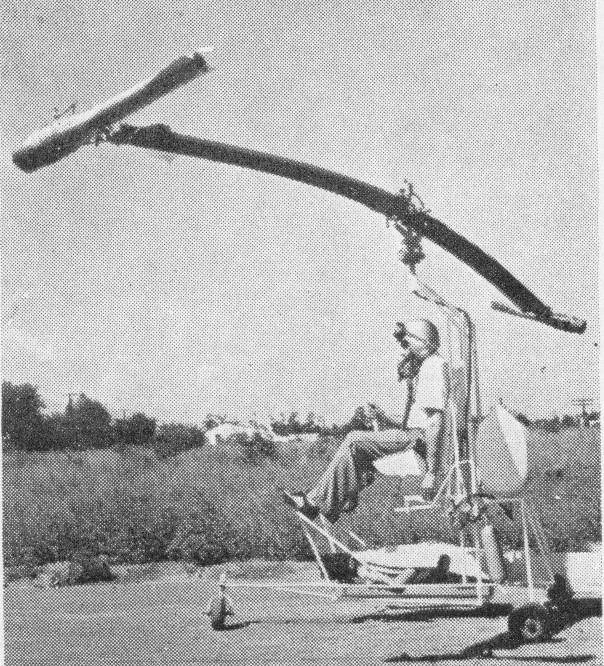
A prototype built circa 1958 by George Schmidt, an engineer who was formerly with Focke-Achgelis in Germany. Designed primarily to rescue wounded from front-line areas: one stretcher can be carried beneath the pilot’s seat.
Power: 2 x 10⁵ lb Schmidt pulse-jets Rotors: 2-blade tip-powered main Rotor diameter: 17 ft 5 in Loaded weight: 775 lb Max. speed: 132 mph Ceiling: 12,300 ft Seats: 2
Allen first announced the Stratolaunch in 2011. Being the largest aeroplane in the world, it’s intended to fly into low Earth orbit and launch an Orbital ATK’s Pegasus XL rocket into space. The rocket is designed to carry small satellites that weigh up to 454kg into orbit. Once the Stratolaunch hits an altitude of 10,668m, the rocket that’s tethered to its belly will finish out the journey. If Allen’s full ambitions are realised, the company will be able to send crewed missions into space at a lower price than Russia is charging NASA.
Stratolaunch is designed to carry up to three Pegasus XL air launch vehicles, each capable of hauling a 1,000-pound satellite into low Earth orbit. The company says it’s looking into medium and large, solid and liquid fueled launch vehicles, which would boost the size of satellites they could carry.
Test flights were supposed to begin in 2016, but that deadline came and went. Aerospace engineer Burt Rutan and his team were at work on the massive aeroplane all this time.
This is a first-of-its-kind aircraft, so the aircraft was to start testing at the Mojave Air and Space Port with plans for a launch demonstration in 2019. The plane is the largest in the world based on wingspan, measuring 385 feet.
The Scaled Composites Model 351 Stratolaunch is an aircraft built for Stratolaunch Systems by Scaled Composites to carry air-launch-to-orbit rockets. In early 2011, Dynetics began studying the project and had approximately 40 employees working on it at the December 2011 public announcement.
In May 2012, its specially constructed hangar was being built at the Mojave Air and Space Port in Mojave, California. In October 2012, the first of two manufacturing buildings, a 88,000 sq ft (8,200 m2) facility for construction of the composite sections of the wing and fuselage, was opened for production.
By June 2016 Scaled Composites had 300 people working on the project. By May 1, 2017, Stratolaunch had already spent hundreds of millions of dollars on the project. On May 31, 2017, the aircraft was rolled out for fueling tests, and to be prepared for ground testing, engine runs, taxi tests, and ultimately first flight.
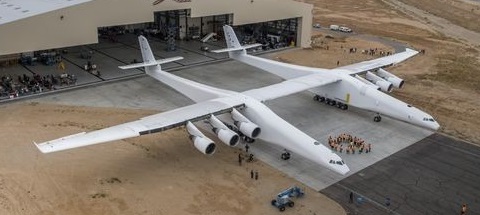
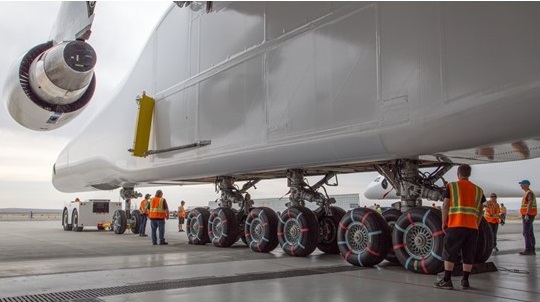
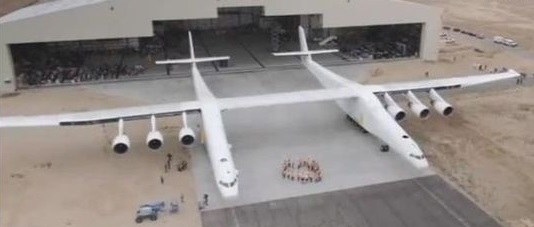
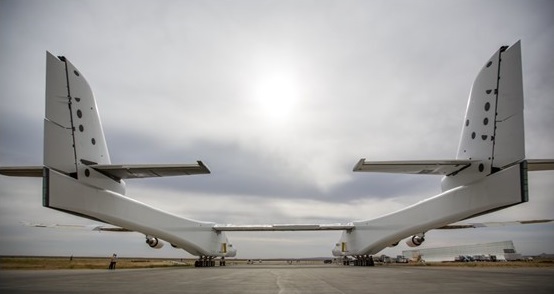
Stratolaunch has a twin-fuselage configuration, each 238 ft (73 m) long and supported by 12 main landing gear wheels and two nose gear wheels, for a total of 28 wheels. Each fuselage has its own empennage and the twin fuselages are 95 feet apart.
The pilot, co-pilot and flight engineer are accommodated in the right fuselage cockpit. The flight data systems are in the left fuselage. The unpressurized left fuselage cockpit is unmanned with storage space for up to 2,500lb of mission specific support equipment. Both fuselage cockpits are pressurized and separated by a composite pressure bulkhead from the remainder of the unpressurized vehicle.
At 385 ft (117 m), it is the largest plane by wingspan, surpassing the Hughes H-4 Hercules flying boat of 321 feet (98 m). The main center section is made up of four primary composite spars supported by four secondary spars. The center section of the high-mounted, high aspect ratio wing is fitted with a Mating and Integration System (MIS), developed by Dynetics and capable of handling a 490,000 lb (220 t) load. The wing houses six main and two auxiliary fuel tanks, with the main tanks located inboard adjacent to an engine. The auxiliary tanks are located in the inboard wing where the load-carrying structure joins the fuselage.
Stratolaunch is powered by six Pratt & Whitney PW4056 engines positioned on pylons outboard of each fuselage, providing 56,750 lbf (252.4 kN) of thrust per engine. Many of the aircraft systems have been adopted from the Boeing 747-400, including the engines, avionics, flight deck, landing gear and other systems, reducing development costs.
The flight controls include 12 cable-driven ailerons powered by hydraulic actuators, split rudders, and horizontal stabilizers on twin tail units. The wing has 14 electrically signaled, hydraulically actuated trailing-edge split flaps that also act as speed brakes. The hydraulic system and actuators, electrical system, avionics, pilot controls, and flight deck are from donor B747-400s. Approximately 250,000 lb of the aircraft’s takeoff weight of 1,300,000 lb is from B747-400 components. Much of the design is based on the Boeing 747-400, replicating much of the avionics, engineering, power plants, and more to reduce the $400 million cost of the project.
Within Scaled Composites, its model number is M351. It is nicknamed “Roc” after Sinbad’s Roc, the mythical bird so big it could carry an elephant.
Initially, flights will be under an experimental certification from the FAA.
The Stratolaunch has a wingspan of 117m, it uses six 747 jet engines, sits on 28 wheels, can carry 113,400kg of fuel, and weighs 226,800kg without fuel. In order to take off, it needs about 3660m of runway.
The Stratolaunch is intended to carry a 550,000-pound (250 t) payload and has a 1,300,000-pound (590 t) maximum takeoff weight.
In December 2017, registration N351SL first low-speed taxi test took it to 25 knots (46 km/h) on the runway powered by its six turbofans to test its steering, braking, and telemetry. Higher-speed taxi tests began in 2018, reaching 40 knots (74 km/h) in February, and 78 kn (140 km/h) in October. On January 9, 2019, Stratolaunch completed a 110 knot (219 km/h) taxi test, and released a photograph of the nose landing gear lifted off the ground during the test.
In January 2019, three months after the death of Stratolaunch founder and Microsoft co-founder Paul Allen, Stratolaunch abandoned the development of its PGA rocket engines and dedicated launchers. Stratolaunch was then reported to be aiming for a first flight within a few weeks and a first launch from the carrier in 2020.
The aircraft first flew on April 13, 2019 at 06:58, at the Mojave Air and Space Port, reaching 17,000 ft (5,200 m) and 165 kn (305 km/h) in a 2 h 29 min flight. Tests included various flight control manoeuvres to calibrate speed and evaluate flight-control systems, including roll doublets, yawing manoeuvres, pushovers and pull-ups, and steady heading sideslips. Test crew Evan Thomas and Chris Guarente also flew simulated landing approach exercises at an altitude of 15,000ft.
The company ceased operations the next month, and placed all company assets, including the aircraft, for sale for US$400 million by June 2019. Cerberus Capital Management acquired Stratolaunch Systems including the Stratolaunch aircraft in October 2019. Stratolaunch announced in December 2019 that it would now be focusing on offering high-speed flight test services.
So far, only one flight has been carried out.
Model 351 Stratolaunch Powerplant: 6 × Pratt & Whitney PW4056 turbofan, 56,750 lbf (252.4 kN) thrust each Wingspan: 385 ft (117 m) Length: 238 ft (73 m) Height: 50 ft (15 m) Empty weight: 500,000 lb (226,796 kg) Gross weight: 750,000 lb (340,194 kg) with no external payload Max takeoff weight: 1,300,000 lb (589,670 kg) External payload: 550,000 lb (250,000 kg) Maximum speed: 460 kn (530 mph, 850 km/h) Range: 1,000 nmi (1,200 mi, 1,900 km) radius Ferry range: 2,500 nmi (2,900 mi, 4,600 km)
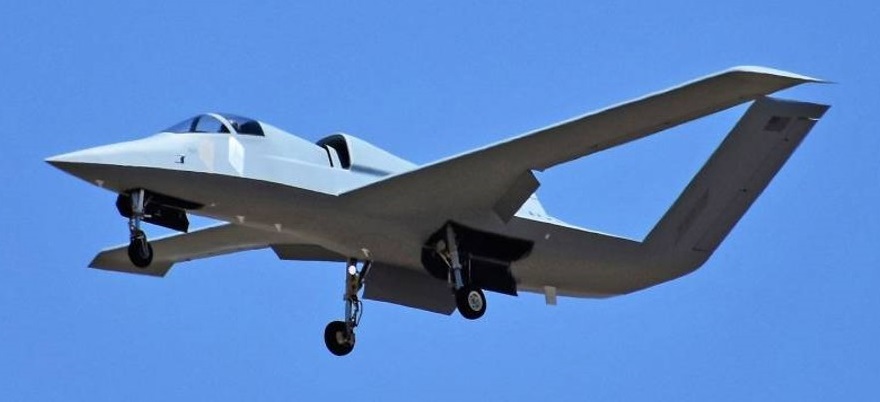
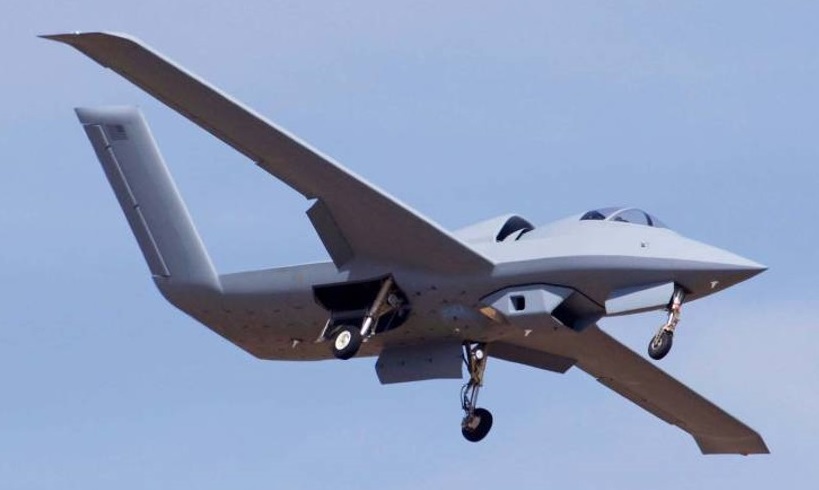
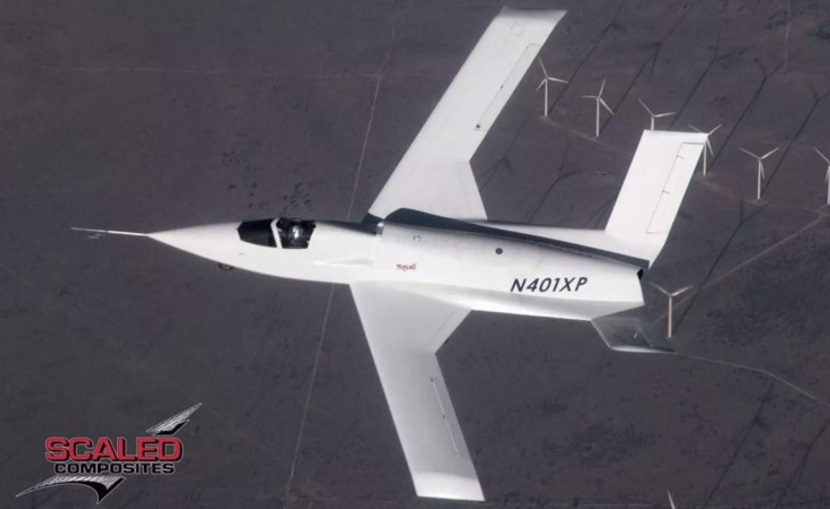
The Scaled Composites 401 Son of Ares single-seat aircraft empty mass is 1814 kilograms and the maximum take-off weight is 3629 kilograms. The wingspan and length are 11 meters. The power plant is a Pratt & Whitney JTD-15D-5D bypass turbojet engine with a maximum thrust of 1381 kilograms. The Model 401 is slow-moving: Mach 0,6 at an altitude of over 9 kilometers. In cruise mode, the Son of Ares can stay in the air for about 3 hours.
The plane took off for the first time on October 11, 2017.
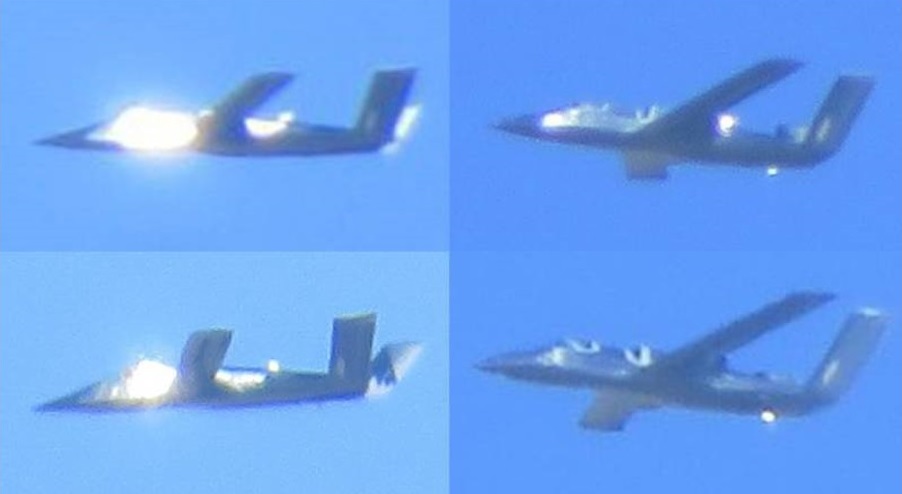
The aircraft only occasionally appeared in the skies over the Mojave Desert in California. Son of Ares does not have installed weapon and even a place for it is not provided.
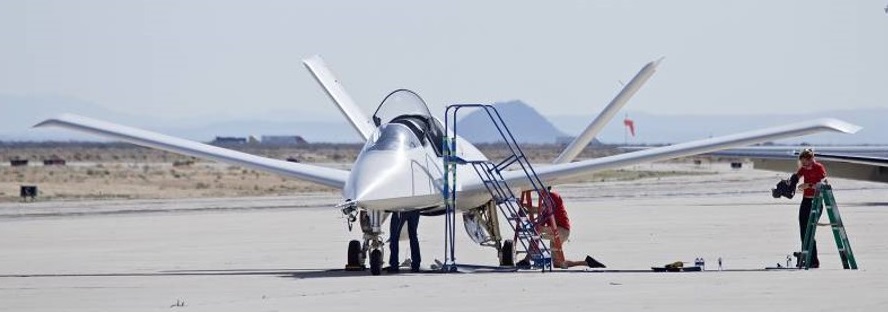
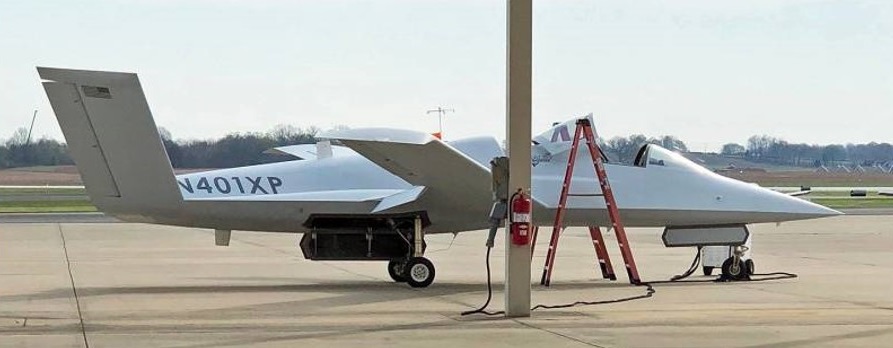
A couple of prototypes built by 2017 were named “Deimos” and “Phobos” (tail numbers: N401XD Deimos and N401XP Phobos). According to mythology, Deimos with Phobos were the sons of the god Ares. There is speculation that option D is a drone with an opaque dome instead of the cockpit.
On the second flight model of the Model 401, a matte gray finish could be seen. Given the prevalence and development of infrared guidance systems that can partially devalue stealth technology, it can be assumed that Scaled Composites were testing a new cloaking system.
The first time the Model 401 seriously attracted attention was in the middle of 2020, when it took to the air, completely covered with mirror film. The flight of the mirror plane over the China Lake airbase was accompanied by the Proteus aircraft. The Proteus was carrying a container under the fuselage with signs of optical systems. The logic of those observing this couple was very simple: the specular coating of the experimental Son of Ares is necessary to reflect the rays, and they are clearly not solar. The working hypothesis was testing a secret coating designed to reflect combat lasers. Proteus in this story acts as the carrier of the container with laser weapons. Of course, the power of the emitter was artificially lowered: after all, a manned aircraft acted as a training target.
The use of a similar gray coating on aircraft is to scatter laser beams of guidance and destruction systems. On some flights of the mirrored and matt Model 401 aircraft, an F-15D Eagle acted as an escort. And under its fuselage was also seen a container with optical equipment. All indications are that the Son of Ares program is being considered by the military as a testing ground for technological innovations for the Air Force and Navy.
Son of Ares N401XP at the end of October 2020 had a mysterious hardware unit under the cockpit. The flights took place in the Mojave Desert and were accompanied by a completely traditional training T-39 Sabreliner. No specific equipment was seen on the escort plane. In this case, the Model 401 acted as a carrier of laser weapons, in flights they worked out the tactics of its use. The characteristic shape of the block probably indicates the need to cool the equipment hidden inside.
An unknown container under the fuselage of the Son of Ares believed to be a solid-state combat laser.
The uniqueness of the Model 401 program lies in its ambiguous secrecy. On the one hand, on the official website of Scaled Composites there is not a word about the experimental aircraft, and on the other hand, the aircraft is photographed by everyone who is not lazy. The reason for the creation of such an expensive aircraft with a carbon fiber fuselage, assembled according to the precepts of the Stealth technology, is not fully understood. It is too expensive to develop such an aircraft solely as a platform for testing new technologies – after all, you can use a lot of other aircraft. The double nature of the use of the experimental aircraft cannot be disregarded. Such “secret” PR can serve to attract the attention of potential investors to the Model 401 civilian use program.
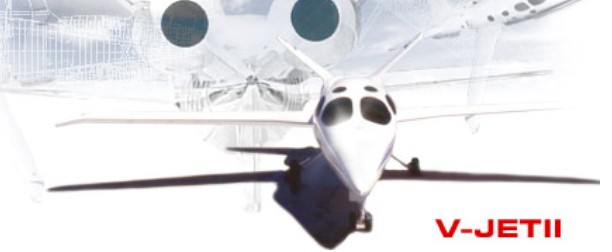
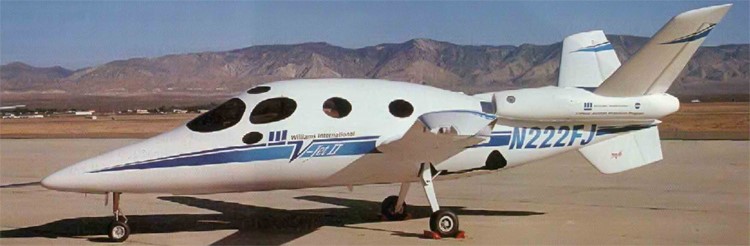
On June 23, 1997, Williams International announced that its all-composite, turbofan- powered “V-JET II” light aircraft is on schedule for its July 31 fly-in and follow-on demonstration flights and exhibition at the Experimental Aircraft Association (EAA) convention at Oshkosh, July 30 to August 5, 1997. Williams also announced that, although the aircraft is early in its program of gradually expanding its flight envelope, the twin-engine “V-JET II” has already demonstrated docile stall characteristics for beginning pilots, and it has flown at 30,000 feet and at 295 knots true air speed. The Oshkosh show will be the first unveiling of the aircraft to the media and public.
Last fall under a competitive procurement program among jet engine companies, NASA selected Williams International to join NASA in a $100 million cooperative effort to revitalize the once-flourishing light aircraft industry in the United States through small turbofan engine technology. Under the program, Williams and its industry team members, which include Williams suppliers and future aircraft company customers, provide 60 percent of the resources and NASA provides 40 percent for the initial engine demonstration phase.
In 2010, Williams was in the component design phase of the engine technology program, is emphasizing low cost manufacturing processes suitable for high quantity production, and is active with key suppliers to minimize material and purchase parts costs. The new Williams engine has been named the “FJX-2.”
Dr. Sam Williams, Chairman of Williams International, said, “Our objective is to replace aging, piston-powered light aircraft with all new, four-place single and six-place twin, turbofan-powered modern aircraft. This means we must develop a turbofan in the 700 lb thrust category that is very low in cost at a high production rate, is extremely quiet, is light in weight, and is very reliable.”
Not intended for production, the “V-JET II” was designed by Dr. Sam Williams to demonstrate the new Williams FJX-2 high bypass ratio engine characteristics in flight over the anticipated speed and altitude range for the future “turbofan-powered, light aircraft era.”
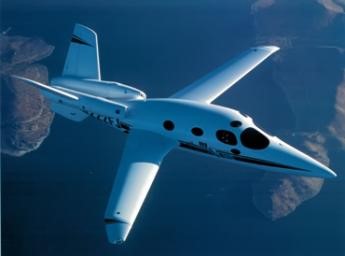
Several Williams “V-JETs” have been designed in past years by Dr. Williams with three full-scale mockups and at least a dozen small models studied to arrive at the present “V-JET II” configuration. The name, “V-JET”, started with the forward-swept or V-shaped wing that continues from the early Williams designs.
The “V-JET” has the appearance of an advanced fighter with forward-swept wings. The sleek appearance is not only for marketing appeal but is for sound aerodynamic and structural reasons. The Williams design emphasized, and has now achieved for beginning pilots, very docile stall characteristics (because of the forward-swept wing) and minimum pilot action required in the event of a single engine-out condition (because of the close spacing of the engines in the unique Williams V-tail design).
Williams also revealed it contracted with Burt Rutan’s Scaled Composites organization to start with the Williams preliminary design, to conduct the V-JET II” detailed design and analysis, and to manufacture the prototype “V-JET II” (that will fly in to the Oshkosh show). According to Dr. Williams, “Burt Rutan and his team have made major improvements to this design and have introduced into this prototype many new, exciting manufacturing processes.” Flight testing is being done by Scaled Composites’; Doug Shane, acting as Chief Pilot of the program; Matt Gionta, Project Engineer; and Burt Rutan.
The aircraft at Oshkosh this year will be powered by two existing low bypass ratio, 550 lb thrust, FJX-1 turbofan engines developed previously by Williams, These interim engines are being used to check out the aircraft’s performance and systems prior to installation of the new high bypass ratio, FJX-2 engines being developed in cooperation with NASA. The new engines are to be installed during the fourth year of the NASA/Williams program and demonstrated at Oshkosh during the year 2000.
According to Williams, the “V-JET II” will be used primarily to demonstrate the new turbofan engines over a range of flight speeds and altitudes that are expected to be required in future turbofan-powered light aircraft. Installation characteristics, engine performance data, noise levels, exhaust emissions, and flight parameters will be reviewed with the aircraft companies that are participating in the program as members of the NASA/Williams General Aviation Propulsion (GAP) team.
Another purpose of the “V-JET II” flight demonstrations will be to stimulate interest on the part of aircraft companies in designing and developing production aircraft utilizing this new propulsion technology. Williams said, “When the public views the 3800 lb “V-JET II” powered with the existing small turbofan engines, the interest will begin to build. However, later in the program when they view this sleek aircraft powered with extremely quiet, very low cost, light weight, high bypass ration turbofans, the potential for a revival of the light aircraft industry through turbofan power should certainly be underway. I believe every light aircraft pilot dreams of being a jet pilot. This low cost turbofan technology can make this a reality.”
NASA partnered with the general aviation industry in introducing the V-JET II, a turbofan-powered jet. NASA awarded Williams International a 37 million dollar developmental grant to design and build such a small jet engine.
Burt Rutan and his Scaled Composites were contracted to build the V-JET II. While the overall configuration had been created by Sam Williams, it was up to Burt and his staff to do the detail design work and then execute it in the new, composite construction method Scaled Composites had developed.
A the time of its first flight on April 13,1997, as a five seat jet, the VJET II was powered by two Williams International FJX-1 turbofan engines.
Engines: two Williams International FJX-1 turbofan Span: 35.3 ft Length 31.1 ft Height: 9.8 ft Max TO Weight: 3,800 lb Empty Weight: 2,200 lb Take off Distance 5000 ft / IS A (25°C): 3,000 ft Take off Distance SL / std day: 2,300 ft Climb rate (SL): 3,200 ft/min Time to climb: 8 min to 18,000 ft High speed cruise: 370 knts Range – max fuel: 2600 miles Range loaded: 1800 miles Seating: 6
The all-composite Triumph, an 8500-lb, 41,000-ft capable, pressurized 8-seat corporate aircraft, was designed around the then-unflown Williams FJ-44 turbofan engine. In 1988, Scaled performed the first flight of the Triumph, which was also the first flight tests of the FJ-44. The subsequent test program, which consisted of over 100 hours of flight tests, confirmed the performance and operating characteristics of both the engines and the airplane. The Triumph was tested to over 41,000 ft, at speeds up to .69 Mach. Pressurization systems were developed, installed, and tested, basic handling qualities and performance tests were conducted, and a significant body of engine tests were performed.








 All Aero