The Caravelle was the outcome of a specification issued in November 1951 by the French Secretariat General of Commercial and Civil Aviation for a 1600 to 2000km range airliner with a 6000 to 7000kg payload requirement at a speed of 620km/h. Six major French aircraft constructors submitted design proposals. The S.N.C.A. du Sud-Est responded with two projects: one a triple Atar-design with three rear mounted SNECMA Atar turbojets, designated the X120 and the other based on the use of two as yet undeveloped by-pass engines, designated the X210. This design then matured to feature two rear mounted Rolls-Royce Avon R.A.26 engines. In January 1953 the French government ordered two flying and two static prototypes of the twinjet.
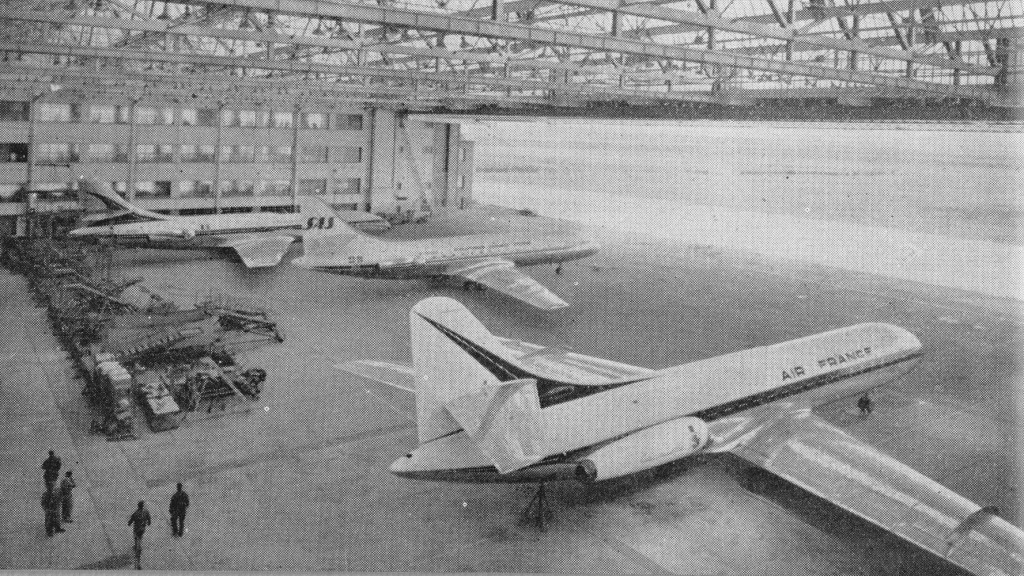
In Toulouse, Sud Aviation was building the SE 210, destined to be known as the Caravelle, and the most successful of European civil aircraft of its generation. The prototype, F-WHHH, made its maiden flight on 27 May 1955, followed by the second prototype, F-WHHI, on 16 May 1956 and four more were ordered in July 1953. To speed construction the first Caravelles used DH Comet nose sections purchased from de Havilland. The Caravelle was the first jet to be built in France, and its design, with rear-mounted engines, was revolutionary. Originally it was intended to have three French-made SNECMA turbojets, but it was soon decided that two Rolls-Royce Avons would be more economical. On 3 February 1956, after extensive trials, Air France placed an order for 12, with an option for 12 more.
First production and two prototypes – 1958
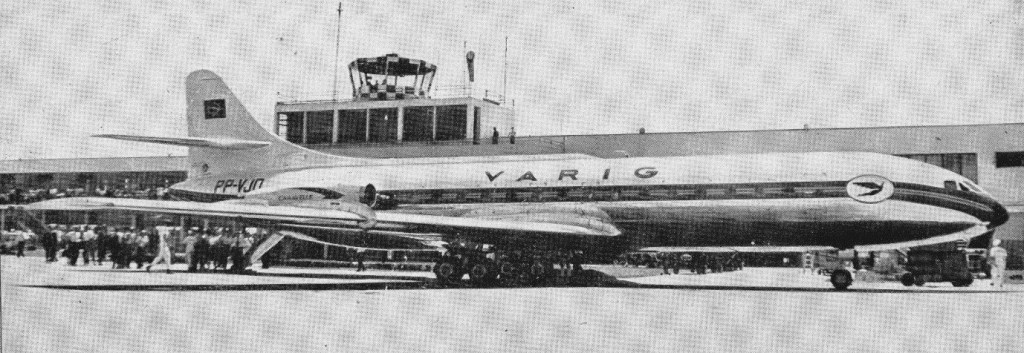
The first production machine, the Sud-Aviation SE-210 Caravelle I F-WHRA, was flown on 18 May 1958, and the initial production series, the Caravelle I and IA with Rolls-Royce Avon 522 and 526 engines respectively, entered service with Air France and S.A.S. in mid-1959. The first series, Caravelle I, was delivered to Air France from 18 May1958, and after one year’s proving they inaugurated the company’s regular service Paris-Rome-Istanbul. Other airlines – SAS, VARIG, Air Algérie – soon followed Air France’s lead. These Caravelle I and IA have been converted to Caravelle III standards with the Rolls-Royce Avon RA.29 mk527’s, and a maiden flight on 11 February 1960.
The Caravelle proved a great success, despite the competition from American manufacturers, and the aircraft then went through a series of modified types. The first production Caravelle III, being the 24th Caravelle whose maiden flight took place on 30 December 1959, was provided with more powerful engines, Avon 527s, and had a greater capacity. The first operational aircraft went into service with Alitalia on 23 May 1960. This model offers standard accommodation for 64-80 passengers, and was supplanted in production by the Caravelle VI-N and VI-R with the Avon 531s and Avon 533Rs respectively. The first Caravelle VI-N flew on September 10, 1960, followed by the VI-R on February 6, 1961. The VIN had a heavier payload and longer range; the VIR, of which 20 were ordered by the American United Air Lines for the New York-Chicago service, had numerous other modifications.
Orders for the Caravelle totalled nearly 100 by the autumn of 1960.
On 4 September 1963 a Swissair Caravelle had brakes overheat from extensive taxiing ad parts of a tire and melted wheel rim were found on the runway. When retracted, the overheated landing gear ruptured hydraulic and fuel lines starting a hot fire in the wing. Losing control, it crashed shortly after take-off from Zurich, Switzerland, killing 80 persons on board.
The Caravelle 10B introduced more fuel efficient Pratt & Whitney JT8D turbofans, while the 11R was a convertible passenger/freighter based on the 10. The Caravelle IIR, which first flew in 1967, had a three foot fuselage extension, forward of the wing, incorporating a large cargo door in the left side of the fuselage, for mixed passenger freight, and Pratt and Whitney turbofan engines.
Caravelle IIR
Then, in 1964, came the Super Caravelle12, a slightly stretched version powered by Pratt & Whitney JT8D-1 turbojets, which was flown in service for the first time by Finnair on 16 August 1964. It was stretched 3.21 m over the Caravelle 10 and could seat up to 128 single class passengers.
When production ended in 1973, a total of 282 SE-210 Caravelles were built, including 20 Caravelle I; 12 Caravelle 1A; 78 Caravelle 3 (including 31 upgraded from 1/1A); 53 Caravelle 6N; 56 Caravelle 6R; 20 Caravelle 10B1R; 22 Caravelle 10B3; 1 Caravelle 10R; 6 Caravelle 11R and 12 Caravelle 12.
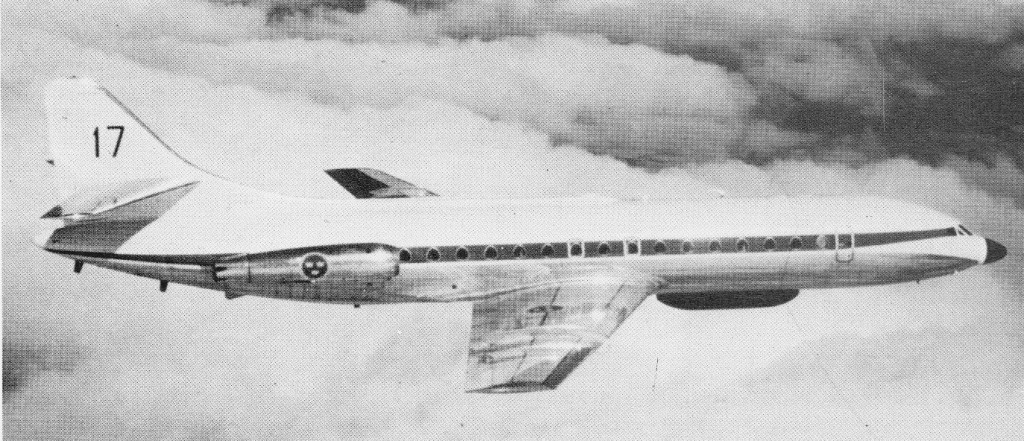
Two Caravelles were purchased by the Swedish Air Force from SAS airline in 1971 (formerly SE-DAG and SE-DAI) and equipped with a long black ventral pod and the insignia of the Flygvapnet. The Caravelles actually served as flying spies for National Defence Research Institute with batteries of multi-track recorders installed in the cabin.
Swedish electronic reconnaissance Caravelle
Air France flew its last Caravelle service on 28 March 1981, from Amsterdam to Paris. The event came just short of 22 years after the Caravelle went into service, on 5 May 1959, and in all Air France purchased 46 Caravelles of various types, out of total production of 280. The fleet world-wide had logged about 7 million flight hours by the end of 1980, and according to Aerospatiale 174 examples are still in service.
Caravelle I Engines: 2 x 12,600 lb. (5,725 kg.) thrust Rolls Royce Avon turbojet Length 105 ft. (32.01 m) Wing span 112.5 ft. (34.30 m.) Weight empty 57,935 lb. (26,280 kg.) Max. accommodation: 99 Max cruise 525 m.p.h. (845 km.p.h.) Range 1,430 miles (2,300 km.) with max. payload
Caravelle IIR Engines: 2 x Pratt & Whitney JT8D-7B
Caravelle III Engines: 2 x RR Avon 527, 11,400 lb Wing span: 112 ft 6 in (34.3 m) Length: 105 ft 0 in (32.01 m) Height: 28 ft 7 in (8.72 m) Max TO wt: 101,413 lb (46,000 kg) Max level speed: 500 mph ( 805 kph)
Caravelle VIN Engines: 2 x RR Avon 531
Caravelle VIR
Super Caravelle Engines: 2 x Pratt & Whitney JT8D-1 turbojet
Caravelle 12 Engines: 2 x Pratt & Whitney JT8D-9, 64.5kN Max take-off weight: 58000 kg / 127869 lb Empty weight: 29500 kg / 65037 lb Wingspan: 34.29 m / 113 ft 6 in Length: 36.23 m / 119 ft 10 in Height: 9.02 m / 30 ft 7 in Wing area: 146.70 sq.m / 1579.06 sq ft Cruise speed: 825 km/h / 513 mph Ceiling: 7620 m / 25000 ft Range w/max.fuel: 11240 km / 6984 miles Range w/max.payload: 3465 km / 2153 miles Crew: 2 Passengers: 128-140
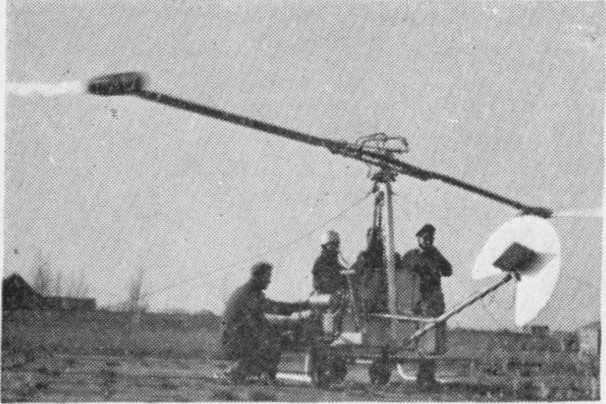
The first post-War Dutch-built helicopter the Sobeh-l, was developed into the Sobeh H-2. Its all-metal, all-bonded rotor had automatic stability and transfers automatically into auto-rotative pitch in case of engine failure. The rotor was turned initially by a separate 1 hp bicycle engine.
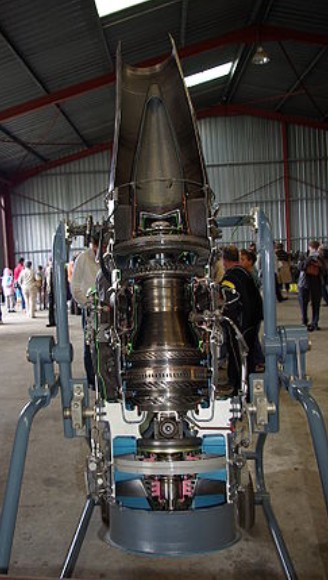
The Snecma M88 is a French afterburning turbofan engine developed by Snecma for the Dassault Rafale fighter.
The M88 Pack CGP (for “total cost of ownership”) or M88-4E is based on a study contract, development and production reported in 2008 by the General Delegation for Armament and was to introduce technical improvements to reduce maintenance costs. The purpose of this release was to reduce cost of ownership of the M88 and longer inspection intervals of the main modules by increasing the lifetime of the hot and rotating parts. It was tested in flight for the first time March 22, 2010 at Istres, the Rafale’s M02 CEV.
Qualification of the M88-2 engine was completed during 1996 while the first production engine was delivered by the end of that year. It is of a modular design for ease of construction and maintenance, as well as to enable older engines to be retrofitted with improved subsections upon availability, such as existing M88-2s being upgraded to M88-4E standard. In May 2010, a Rafale flew for the first time with the M88-4E engine, an upgraded variant with greater thrust and lower maintenance requirements than the preceding M88-2.
M88 Type: Twin-shaft, turbofan engine Length: 3538 mm (139.3 in) Diameter: 696 mm (27.5 in) max Dry weight: 897 kg (1,977 lb) Compressor: 3 stage low pressure, 6 stage high pressure Combustors: Annular Turbine: single stage high pressure, single stage low pressure Maximum thrust: 50 kN (11,250 lbf) dry, 75 kN (16,900 lbf) wet (afterburning) Overall pressure ratio: 24.5:1 Bypass ratio: 0.3 Turbine inlet temperature: 1,850K (1,577 °C) Fuel consumption: 0.80 kg/(daNh) (0.78 lbm/(lbfh)) (dry), 1.75 kg/(daNh) (1.72 lbm/(lbfhr)) (wet/afterburning) Thrust-to-weight ratio: 5.7:1 (dry), 8.5:1 (wet/afterburning)
Herman Östrich’s team in charge of the development of the BMW 003 engine had moved to the town of Stassfurt, near Magdeburg, in February 1945. An underground production factory was being set up in a salt mine outside town by C.G. Rheinhardt in a desperate attempt to continue engine production in face of the now overwhelming Allied air campaign. This mine is well known historically as it was also being used for the storage of uranium compounds as part of the Nazi atomic bomb program.
The town of Stassfurt surrendered to US forces on 12 April 1945, and Östrich hid much of the technical data in a local cemetery. The next day a ten-man team made up primarily of engineers from Pratt & Whitney arrived, and he handed the data over to them. Production restarted for US use while the war ground to a close, and the US forces cleared out the factory while they waited to turn the area over to the Soviets.
Östrich had by this time moved to Munich for further interrogation, and from there to England at the request of Roy Fedden. He had them work on the design of a turboprop engine for a proposed C-54 Skymaster-class four-engine transport. While working on this design, Őstrich was secretly approached by French DGER agents with an offer to take up further design of the 003 in France. The French forces had found a number of 003 engines in their occupation zone after the war, and were interested in setting up a production line. These discussions had not progressed very far when Őstrich was allowed to return to Munich, only to be brought back to England in late August, then returned to Munich again where the US offered him and a hand-selected team jobs in the US, but without their families.
The French made contact with Herman Oestrich, the chief designer of the German BMW factory, and smuggled him out of the American occupation zone into the French zone and then into France itself, giving him every technical support in return for his skills. By 1948 Oestrich had produced his first jet engine; the Atar
Östrich instead accepted the French invitation, and by September had been set up at the former Dornier factories in Rickenbach in the French Zone. Here they were soon joined by other former BMW engineers, as well as those from a number of other German firms, bringing the team to about 200 members. The group was named the Atelier Technique Aéronautique Rickenbach, or ATAR. They worked on a new design that was based on the BMW layout, but considerably larger and more powerful. They completed the preliminary design of the ATAR 101 (model R.101) in October, and granted a production contract on the proviso that actual production would be carried out in France. In January a further five-year contract was offered to the entire team, including protected wages, provisions for their families, few travel restrictions, and the possibility of French citizenship. The contract was signed on 25 April 1946, and the drawings for the ATAR 101 were sent to SNECMA for production.
Communications between the ATAR group and SNECMA, the newly formed Nationalised engine manufacturer, proved to be difficult and the design team soon moved to Decize on the River Loire, to improve communications with SNECMA and was re-named Aeroplanes G.Voisin, Groupe ‘O’ . Manufacture of components for the ATAR 101 V1 commenced at SNECMA plants in May 1946.
The first engine took some time to assemble. The first parts were available as early as May 1946, but a complete compressor or turbine was not ready until the middle of the next year. The first complete engine finally ran on 26 March 1948. By April 5 it had been brought up to 3,700 lbf (16,000 N) thrust and was continually improved until it reached 4,850 lbf (21,600 N) by October. During this time a new turbine made of solid high-temperature steels replaced the earlier air-cooled models, allowing for better aerodynamic shaping and an improved compression ratio. By January 1950 several additional engines had joined the program, bringing the total running time to over 1,000 hours, and a thrust of 5,955 lbf (26,490 N), making it among the most powerful engines of the era. The BMW 003 that it was developed from provided only 1,760 lbf (7,800 N), less than half of the Atar.
The ATAR 101 was steadily developed with improvements to materials, aerodynamic design, compressors, combustion chambers and turbines resulting in the first commercially viable engine, the ATAR 101B, which, along with later marques, powered the SNCASO S.O.4050 Vautour fighter / bomber/ reconnaissance aircraft.
The ATAR 101B introduced more stator blades as well as a number of changes to fix minor problems seen in the earlier experimental models. The first B model passed a 150 hour endurance test in February 1951 at 5,290 lbf (23,500 N). A flight test followed on 5 December 1951 in the Dassault Ouragan, and starting on 27 March 1952, under the wings of a Gloster Meteor F.4. After delivering the initial production run of B models, the Atar 101C used an improved compressor and combustion chamber, raising the power to 6,170 lbf (27,400 N). The Atar 101D featured a slightly larger turbine with new high-temperature alloys that allowed the exit temperature to rise to 1,000 C and the thrust to 6,615 lbf (29,420 N). The D model also included a new exhaust consisting of a long pipe ending in two “eyelid” shutters on the outside of the engine in place of the earlier moving cone on the inside. The Atar 101E added a “zeroth” compressor stage, raising the overall pressure ratio to 4.8:1 and the thrust to 8,160 lbf (36,300 N). Various models were tested on a wide variety of aircraft.
An afterburner was incorporated into the D model to produce the Atar 101F of 8,380 lbf (37,300 N), while the same addition to the E model produced the 10,365 lbf (46,110 N) ATAR 101G. These were flight tested on the Mystère II in August 1954, but they did not see production on this aircraft. Their first success was on the Super Mystère, a Mystère in name only, which first flew under Rolls-Royce Avon power on 2 March 1955, and followed by the 101G powered version on 15 May 1956.
Production started in 1957 with a contract for 370 aircraft, but this was later cut back to 180 in light of the performance of the Dassault Mirage III which was then undergoing testing.
The early engines were constructed from ordinary commercial steels and suffered from very short running lives, not achieving a 150 hour endurance test until 1951. As more exotic materials were introduced the durability and reliability of test engines improved dramatically and on 10 November 1950 the first flight-ready ATAR 101A flew in the fuselage of a Martin B-26G Marauder (F-WBXM). Steady progress was made by Groupe O, but they were soon absorbed into SNECMA during a massive re-organisation of the nationalised giant in June 1950. Other aircraft joined the flight test program, including two SNCASE S.E.161 Languedoc airliners, a SNCASO S.O.30P Bretagne (F-WAYD), SNCASE S.E.2060 Armagnac and a Gloster Meteor F.4 (RA491).
With the Atar 101 now sitting at the low end of the power scale, in 1954 SNECMA started the design of a more radical upgrade, the Atar 08. Overall design and dimensions were similar to the 101, but the new engine included a nine-stage compressor in place of the earlier seven-stage one, and a smaller two-stage turbine to power it. There were many detail improvements as well, including the replacement of the original compressor rotor with a new one made of magnesium alloy. The first Atar 08 B-3 produced 9,500 lbf (42,000 N) and had a slightly improved overall pressure ratio of 5.5:1.
A new and much improved afterburner was designed for the engine, resulting in the Atar 09. It was first tested in January 1957 at 12,350 lbf (54,900 N), and was soon improved to 13,230 lbf (58,800 N). A further improved afterburner with eighteen flaps in place of the two-flap system of the earlier designs was introduced on the 09C model in December 1959. This version also featured a new starter from Microturbo that provided compressed air directly into the engine allowing it to start without the compressor running at full speed. The Atar 9D replaced the exhaust and afterburner area with one made of titanium that allowed continual operation at Mach 2, up from the C’s 1.4. Air cooling was re-introduced for the Atar 9K models, further improving overall performance, and especially fuel economy.
With the Atar 8 and 9 series, the long ten years of development had finally resulted in a successful commercial design. Thousands were produced for a variety of aircraft, including the Étendard and Super Étendard strike aircraft, Mirage III, Mirage 5 and Mirage F1 fighters, the Mirage IV bomber, and a variety of test aircraft.
In 1955 the French government started a project to explore flight speeds up to Mach 3.0. SNECMA began studies on an engine to power it, initially consisting of the compressor design of the existing Atar 101, but replacing all of the light alloys with steels in order to handle the increased operating temperatures. This also demanded the use of an air-cooled turbine, similar to the ones from the earliest prototypes. Such an engine, the M.26, ran in May 1957, giving 47 kN (10,364 lbf) without an afterburner. Further improvements led to the M.28, which ran in September 1958 at 52 kN (11,466 lbf).
This work led to the Super Atar design of 85 kN with afterburning. This version also included variable stators, which were in the process of being widely introduced in the industry. However, the project to build the test aircraft, the Griffon III, never went ahead and SNECMA ended development of the Super Atar in 1960.
The Atar design was also used for a variety of larger, smaller, and experimental developments. Of particular note are the R.104 Vulcain, a scaled-up Atar, and the much smaller R.105 Vesta. Both engines were developed in parallel to the Atar in the early 1950s in order to fill particular performance niches, the Vulcain for the Mystère IV D, and the Vesta for a variety of designs. None of these entered production, however; the Mystère IV D was cancelled, and the Vesta lost out to the Turboméca Gabizo, which was also abandoned.
The original Atar 101 featured a seven-stage axial compressor using aluminum alloy blades attached to an aluminum rotor. The front bearing was held in place by four vanes, with the “left” one as seen from the front containing a power takeoff shaft. One unique feature of the Atar designs was the separate Atar 5000 accessories section, which could be mounted in front of the engine, driven by an extension shaft. The combustion area consisted of twenty steel flame cans arranged in a “canular” layout, exiting into the single-stage turbine. Early models were 2.85 m long, 0.9 m in diameter, and weighed 850 kg, while The C models and on were 3.68 m lone including the long extension, 0.89 m in diameter, and weighed 940 kg. Later versions were generally similar to the C model, although the inclusion of the afterburner increased lengths to 5.23 m, and weights varied from 925 to 1,240 kg depending on the model.
Improved marques continued to be developed throughout the 1950s culminating in the 101G with after-burning laying the ground work for the later ATAR 8 and ATAR 9.
The Atar 8 and 9 used a 9-stage compressor similar to the 101, but including a steel first stage in order to improve damage resistance. The turbine included two stages. Length and width remained the same as the 101 models, deliberately, but weights further increased up to 1,350 kg for the 9B.
Variants: 101V Early test engines used to develop the engine.
101A Flight test engines flown on flying test-beds.
101B Initial production engine built in limited numbers for prototypes and test installations on contemporary aircraft. First flown in a Dassault MD.450-11/12 Ouragan on 5 December 1951, 101Bs also flew in a Gloster Meteor F.4 and the S.O.4050-01, first prototype of the Vautour
101C Improved compressor and combustion as well as an increase in maximum rpm from 8,050 to 8,400 rpm gave a thrust of 27.45 kN (6,170 lbf)
101D The D introduced a variable area eyelid nozzle, replacing the translating bullet used in earlier Marks.
101E By 1954 the I0IE3 was developing 34.32 kN (7,715 lbf) largely due to a new compressor with 15% higher pressure ratio.
101F The 101D fitted with an afterburner to produce the 101F
101G The 101E fitted with an afterburner to produce the 101G
Atar 08 Two-stage turbine and improved compressor, non-afterburning, developed in 1954-1956.
Atar 08B Used in Dassault Étendard IV
Atar 08K-50 Simplified non-afterburning version of Atar 9K-50 for Dassault Super Étendard
Atar 09C Used in Dassault Mirage III and 5 fighters
Atar09K-10 Improved combustion chamber, turbine blade cooling; used in Dassault Mirage IV bombers
Atar09K-50 Improved Atar 9C with a redesigned turbine and upgraded compressor resulting in improved fuel consumption and thrust; used in Dassault Mirage F1 and Mirage 50.
Atar Plus Joint development with ITP and Denel, new compressor, new turbine, new electronics.
Applications: Martin B-26 Marauder Dassault Étendard IVM Dassault Étendard IVP Dassault Mirage F1 Dassault Mirage III Dassault Mirage IV Dassault Mirage 5 Dassault Mirage 50 Dassault Super Étendard Dassault Mystère B prototypes Dassault Mystere C production aircraft Dassault Mystère IVB prototype only Dassault Super Mystère Dassault MD.450-11/12 Ouragan Gloster Meteor F.4 Leduc 0.22 Nord Gerfaut SNCASE S.E.161 Languedoc SNCASE SE-212 Durandal SNCASE S.E.2060 Armagnac SNCASE S.E.5000 Baroudeur Sud-Est Baroudeur
Specifications: Atar 101C Type: Turbojet Length: 3,680 mm (145 in) Diameter: 890 mm (35 in) Dry weight: 940 kg (2,072 lb) Compressor: 7-stage Axial flow Combustors: Annular Turbine: Single stage Axial Fuel type: Aviation kerosene Oil system: Pressure spray / splash system Maximum thrust: 2,800 kgf (27.46 kN; 6,172.94 lbf) Specific fuel consumption: 1.05 (107.03 kg/kN/hr) Thrust-to-weight ratio: 2.98 (0.0292 kN/kg)
Atar 9C Type: Afterburning turbojet Length: 5,900 mm (232 in) Diameter: 1,000 mm (39 in) Dry weight: 1,456 kg (3,210 lb) Compressor: 9-stage axial compressor Combustors: annular Turbine: Two-stage Maximum thrust: 42.0 kN (9,440 lbf) military power 58.9 kN (13,240 lbf) with afterburner Overall pressure ratio: 5.2:1 Specific fuel consumption: 103 kg/(kN·h) (1.01 lb/(lbf·h)) military power 207 kg/(kN·h) (2.03 lb/(lbf·h)) with afterburner Thrust-to-weight ratio: 40.5 N/kg (4.1:1)
The SNECMA Turbomeca Larzac is a military turbofan manufactured by GRTS (Groupement Turbomeca-SNECMA), a consortium between the two French companies, SNECMA and Turbomeca. Its main application was on the Dassault/Dornier Alpha Jet.
Variants: 04-C6 04-C20 04-H-20
Applications: Dassault/Dornier Alpha Jet HAL HJT-36
SNECMA began work on pulse jets in1943, when the first studies were carried out by an engineer named Bertin. They lead in 1948 to a first stable operation and in March 1950 the definite version of the “Escopette”.
The Escopette 3340 develops a thrust of 10 kgf with a specific fuel consumption of 1.8 kg / kgf / h. (At the time, turbojets consumption is about 1.3 kg / kgf / h.) The total length of 2800 mm and a nozzle diameter of 157 mm.
For flight testing, a Kestrel flying testbed was made available to SNECMA. The SA.104 kestrel glider was transformed by SEVIMIA under the direction of engineer Jarlaud. Each group of thrusters is fixed to the wing at the front by a mast secured to the rail and mounted on a bracket mounts, and secondly by a false spar. Before the mast is a passage to fuel and ignition lines.
First flight towed occurred at the end of November 1950 at the SNECMA field in Melun-Villaroche, piloted by Chief Pilot Leon Gouel. The first autonomous flight was conducted on December 19, 1950, and a camera is always equipped for the first four tests.
The Kestrel takes off with this 40 kgf thrust for a total take-off weight of 320 kg. Many flights are made until the end of 1951 in this configuration. At that time, an Emouchet SA. No. 224 104 glider has two groups of three pulsos (60 kgp total thrust).
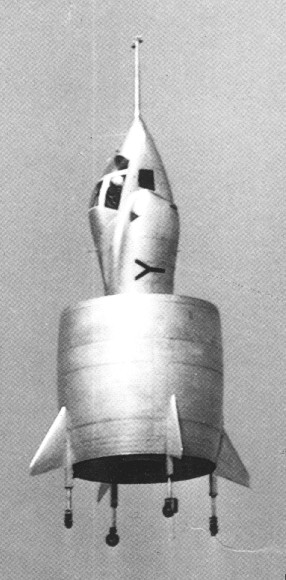
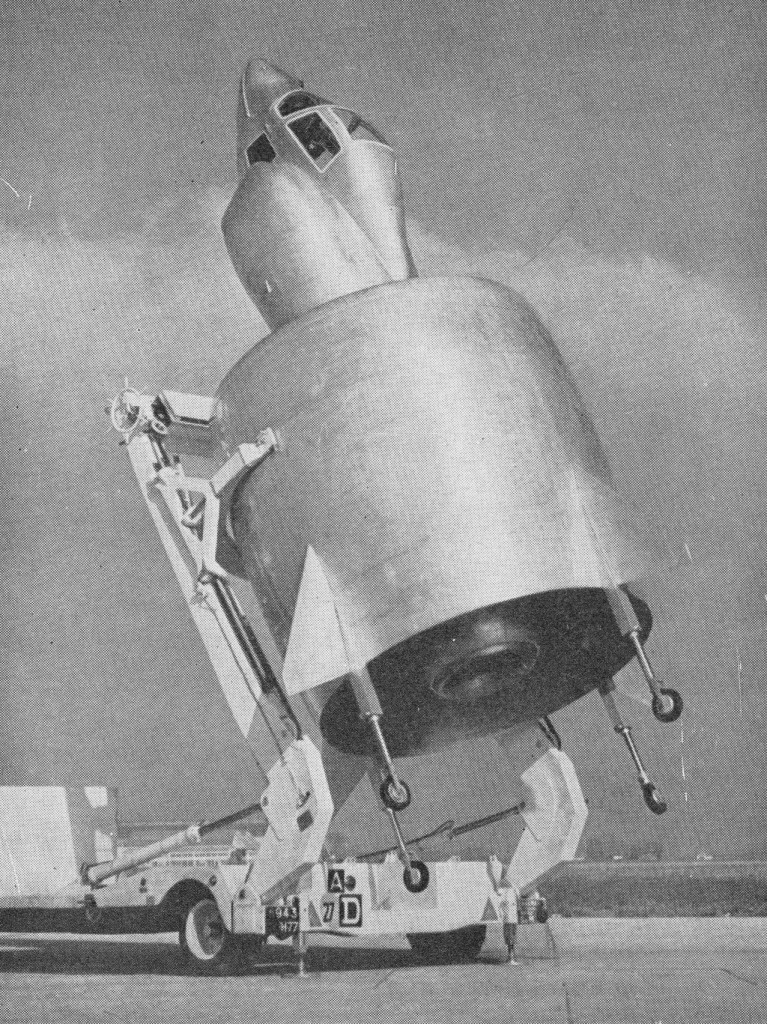
The C.450 Coleoptere was a VTOL research aeroplane, designed by von Zborowski,,that rose vertically on the power of its SNECMA Atar 101 turbojet before translating into forward flight supported by its annular wing.
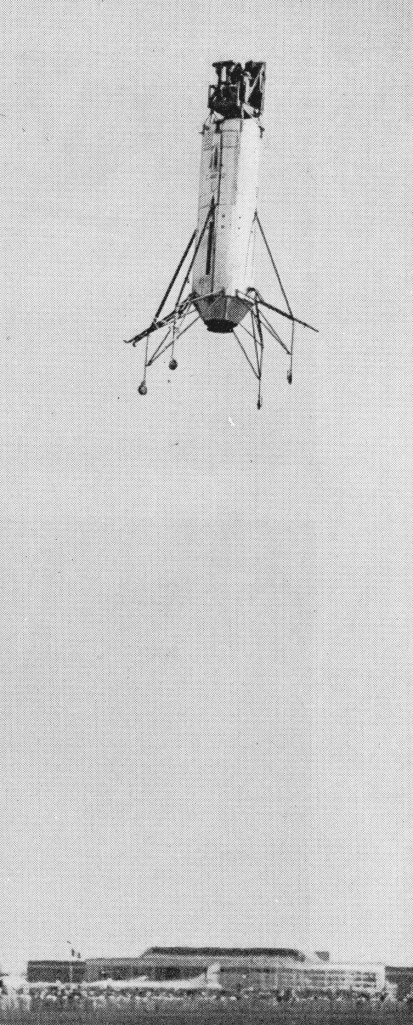
The C.450 Coleoptere was derived from the Atar Volant test vehicle, and combined the concept of tail-sitting vertical take-off and an annular wing. Powered by an 8157-lb (3700-kg) thrust SNECMA Atar 101EX, the Coleoptere first flew in May 1959 and completed a limited test programme before the aeroplane was lost in an accident.
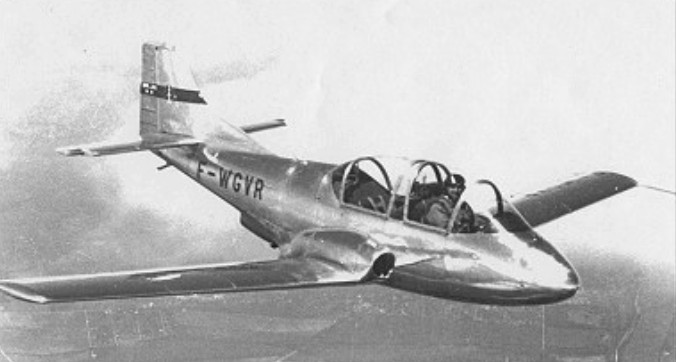
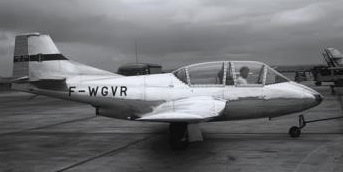
In 1954 Yves Gardan designed the SIPA 300 single jet engine tandem two seater ab-initio jet trainer. The construction of the prototype was launched on the basis of a contract awarded by the SALS.
First flown on September 4, 1954, by Max Fischl, it was powered by a 0.712kN Turbomeca Palas.
After thirty hours of flight testing by the manufacturer, the Sipa-300R entered the CEV Brétigny sur Orge April 4, 1955. On July 28 of the same year, it had accumulated 75 hours of flight and 99 landings.
This prototype was destroyed during a test spin on Sept. 26, 1955. No serial production was considered.
Fuel was in two tanks, one of 70 lt in the central wing and the other, 150 lt, housed in the fuselage.
Engine: Turboméca Palas I, 160 kg Wingspan: 8.02 m / 26 ft 4 in Length: 6.71 m Height: 2.50 m Wing area: 9.8 m² Empty weight: 524 Kg Max weight: 880 Kg Max. speed: 360 km/h / 224 mph Cruise speed: 312 Km / h ROC: 4,6 m / s Ceiling: 5000 m Range: 400 – 700 miles
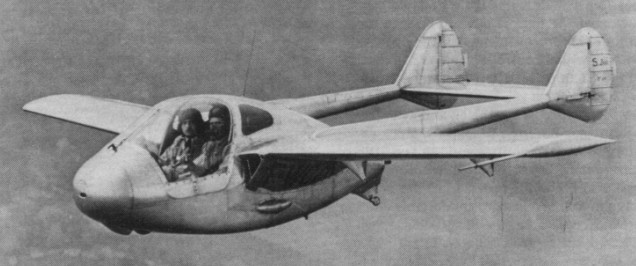
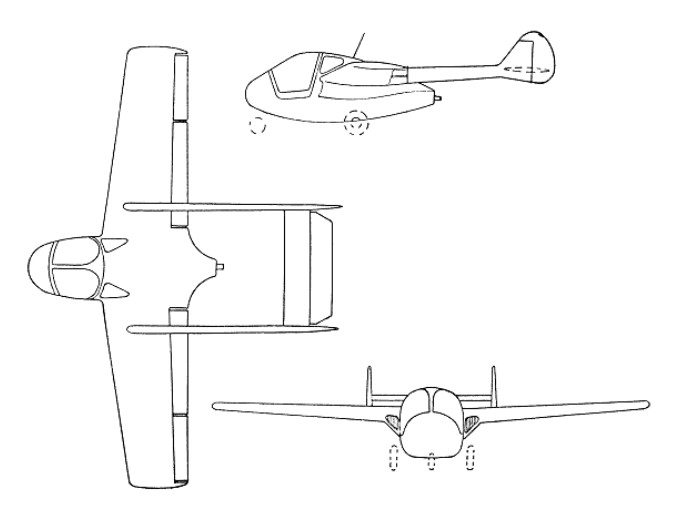
In 1949 Yves Gardan created the SIPA 200 Minijet, a single jet engine light two seater capable of 250 mph (400 kph) maximum level speed with 358 lb (160 kg) static thrust. It was distinctive in its twin-boom configuration and short, tubby nacelle housing the engine and cockpit.
The SIPA 200 was built at the request of the French government, which was evaluating new aviation concepts as part of the progressive build-up of France’s postwar aircraft industry.
The monoplane cantilever wing has a laminar profile. The undercarriage is of tricycle. It has been designed and manufactured by ERAM. The main gear retracts completely into the body. The front landing gear remains slightly out, providing protection to the cockpit in case of landing gear retracted. There is a retractable rear stand that protects when landing.
Kerosene fuel is held in 2 x 60 lt tanks in each wing, and one central reservoir of 120 lt in the fuselage. A total capacity of about 240 lt.
Although its extreme height is given as 6ft, the wings are at waist level, the cabin roof very little higher, and the underside of the fuselage just a few inches clear of the ground. The second prototype fins and rudders are very slightly modified; the original Y control-column was replaced by two separate sticks, and a full blind-flying panel was now installed, and five-point seat harness. All instruments are on a vertical panel, and flap, undercarriage, fuel and trim controls and indicators are on a console down the centre of the cockpit, between the two pilots.
To climb in, one ducks under the open roof panel and then wriggles down and back into the seat. Once in, there is just enough room for elbows and plenty for the legs. The view is reasonable over the instrument panel, good to the sides and poor everywhere behind the three to nine o’clock sectors.
To started up; select petrol on, oil on, pressed the starter for two seconds, then further pressed the igniter button and at 10,000 revs released these two buttons, switched to kerosine, and opened the throttle. Taxi is about 25,000 revs, using toe-operated hydraulic brakes for steering. The noise is distinctive but neither loud nor penetrating.
Takeoff uses 15 deg of flap and 35,000 revs against the brakes and the take-off is about 400 yd. By the time the undercarriage is pumped up, the speed has gone from 70 to 100 kt and climb is between 200 and 300 m/min (990 ft/min).
The S.200 made its first flight on 14 January 1952 at the hands of Roger Launay. Early test flights revealed that it was underpowered and performance fell short of expectations, and it was unable to compete with contemporary types such as the Fouga Magister.
The second prototype Minijet, unlike the first prototype, is fully aerobatic at its take-off weight of 1,675 lb.
The flaps are double slotted but so arranged that, when retracted, both slots are shrouded by the wing under-skin. The approach is about 80 kt. The flap selector was left “down” and one full stroke of the pump lowered 5 deg of flap to some 30 deg. More than this is available but is never required.
It stalls at about 50 kt, cruises at 150 kt at 1,500 ft at 31,500 r.p.m., and climbs at almost 1,500 ft/min. Although there is nothing “hot” about it, it does behave like a jet aircraft.
Besides the two prototypes, a pre-production batch of five has been ordered by the French Government Secretariat for Light and Sporting Aviation. Furthermore, NATO training authorities have shown interest in the Minijet as a possible basic trainer. Seven prototypes were built. All except one (No.5) were assigned to the Training Service Aviation and based in Saint Yan.
Prototype N ° 1 Engine: Turbomeca Palas I, 150kg / 330 lb thrust. Wingspan: 7.20 m / 24 ft 7 in Length: 5.12 m / 17 ft 10 in Height: 1.78 m / 6 ft 10 in Wing area: 7.90 m² Empty weight: 488 kg Max weigh: 824 kg Wing loading: 85 kg / m² Max speed: 185 kt / 400 km/h / 249 mph Cruise: 195 kt Stall speed: 55 kt Ceiling: 8000 m / 26250 ft Range: 500 km / 311 miles Seats: 2
Prototypes N ° 2 of 7 Engine: Turbomeca Palas I, 160kg Wingspan: 8.00 m Length: 5.12 m Height: 1.75 m Wing area: 9.62 m² Empty weight: 488 kg Max weight: 825 kg Max speed: 240 kt Stall speed: 70 kt











 All Aero