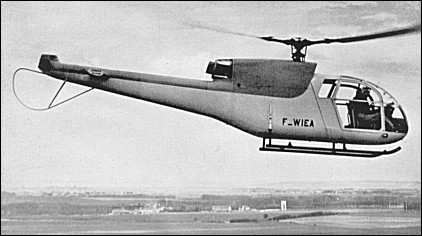
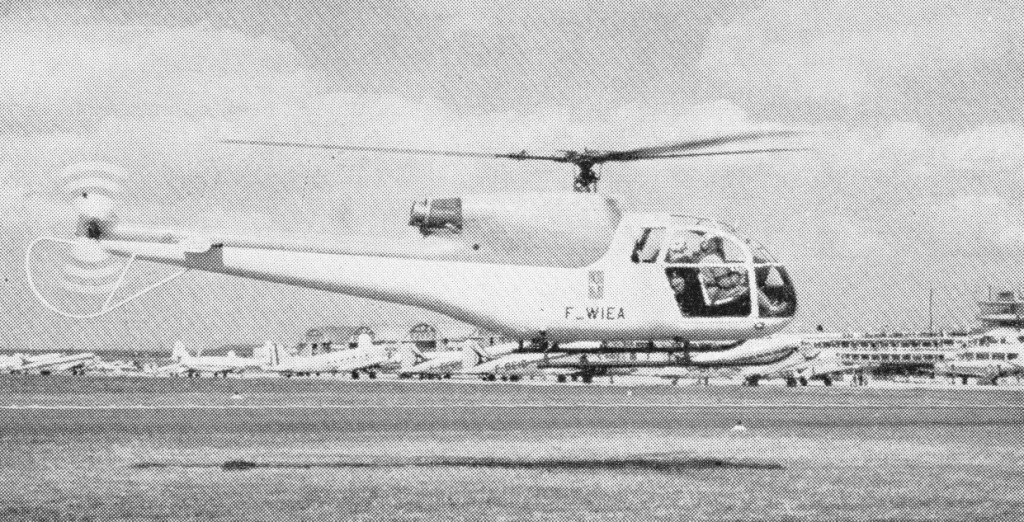
This new helicopter, which was brought out as a product of Sud Aviation, first flew on 10 May 1957 (F-WIEA). It was introduced to the public during the French International Air Show at le Bourget soon afterwards. It basically an Alouette II with an Artouste engine, covered fuselage and executive cabin seating 5 occupants including the pilot, by the well-known expert Loewy.
Streamlining gave the Gouverneur improved cruising speed.
Both the main and the anti-torque rotor are taken from the Alouette, but to protect the latter, a bow-shaped tail skid is provided. Much thought has been given to making the Gouverneur’s cabin as comfortable as possible, particularly by means of sound-proofing.
The existence of the Stratos 714 project was announced on 16 July 2008 by Stratos Aircraft of Redmond, Oregon and a cabin mock-up was shown at AirVenture in July 2009. At that time the company predicted the jet would sell for about US$2M. The company was seeking US$12M to build two prototypes and a further US$100M to complete certification and commence production. In November 2016 the company indicated it had no firm schedule for certification.
The company was accepting refundable customer deposits of US$50,000 to be held in interest-bearing escrow in 2009. The first deposit was made by Cascade Air Charter, of Bend, Oregon in October 2009.
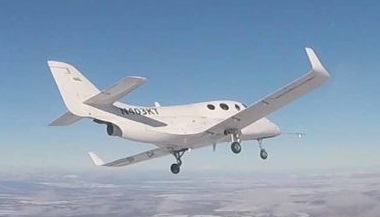
The aircraft features a cantilever low-wing with winglets, a cruciform tail, a four-seat cabin pressurized to 10.0 psi (69 kPa), retractable tricycle landing gear and a single Pratt & Whitney Canada JT15D-5 jet engine. The airframe is made predominately from carbon fiber reinforced polymer. Initial design goals included a 400 kn (741 km/h) cruise speed and 1,500 nmi (2,778 km) range, with NBAA IFR reserves.
First flight of a proof of concept aircraft, registered N403KT, was achieved on 21 November 2016. The initial flight of the 714 was limited to 128 knots and 3,700 feet agl with the gear extended and flaps at 24 degrees.
The company intended to make a public introduction of this aircraft at AirVenture in July 2017. The test pilots logged 52 hours on 33 flights. The aircraft topped out at 320 ktas and 17,000 feet, with a max test weight of 8,300 pounds.
In February 2017 prototype flight testing continued. The company did not have the funding to complete certification, and was no longer accepting deposits from customers. Stratos CEO Michael Lemaire indicated at that time, “we are privately funded for the prototype phase, during which we are planning to explore the full flight envelope and draw conclusions for the certification stage. We are not yet funded for the certification phase. At present, we have no plan to take deposits towards deliveries, which are still many years away.”
Stratos 714 Engine: 1 × Pratt & Whitney Canada JT15D-5, 2,900 lbf (13 kN) thrust Wingspan: 40.5 ft (12.3 m) Length: 35.8 ft (10.9 m) Height: 9.8 ft (3.0 m) Empty weight: 4,367 lb (1,981 kg) Gross weight: 7,213 lb (3,272 kg) maximum take-off weight Fuel capacity: 2,605 lb (1,182 kg) Maximum speed: Mach 0.7 Cruise speed: 415 kn (478 mph; 769 km/h) Stall speed: 63 kn (72 mph; 117 km/h) Range: 1,500 nmi (1,726 mi; 2,778 km) with NBAA IFR reserves Service ceiling: 41,000 ft (12,000 m) Time to altitude: 17 minutes to FL370 Crew: one Capacity: three passengers
The 1962 Jet-Packet 3400 was a Steward-Davis Jet-Packet 1600 Fairchild C-82A with a single 3250 lb Westinghouse J34-WE-34 or 3400 lb WE-36 jet-pak. At least four were converted.
The Jet-Packet II involved airframe weight reduction to increase cargo weights. With two P&W R-2800CB-16 engines, the application was applied to Jet-Packet 1600 or 3400. At least three were converted, including TWA C-82A Ontos N9701F.
In 1967 Stewart-Davis completed a new version of its C-119 STOLmaster with a Jet-Pak 3402 detachable jet engine under each wing and provision for a third above the fuselage, supplementing the two R-3350-89a piston engines. Each Jet-Pak contains a 3400 lb thrust Westinghouse J34 engine.
The 1957 Jet-Packet 3200 was a Steward-Davis Jet-Packet 1600 Fairchild C-82A converted with two 3200 lb J30-W in a single upper fuselage jet-pak. Registered N5095V, the MTOW was 54,000 lb.
The 1956 Steward-Davis Jet-Packet 1600 was a civil conversion of Fairchild C-82A with a jet-pod added to upper fuselage. At least three were converted including N6887C and N6985C,
The Jet-Packet II involved airframe weight reduction to increase cargo weights. With two P&W R-2800CB-16 engines, the application was applied to Jet-Packet 1600 or 3400. At least three were converted, including TWA C-82A Ontos N9701F.
Engines: 2 x 2100hp P&W R-2800-85 and 1 x 1600 lb Westinghouse J30-W jet-pak Max take-off wt: 54,000 lb
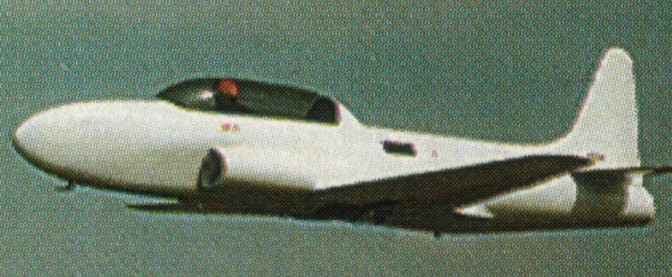
First flown in 1995 and presented at Oshkosh 1995, the Stargate YT-33 was built by Bo Case McMinnville (OR) on behalf of Sid Hendricks Mille Valley (CA). It is a fairly faithfully 2/3 scale reproduction of a Lockheed T-33.
Of composite construction, it is equipped with a Turbomeca Marbore IIA turbojet of 400 Kp. The tricycle undercarriage is electrically retractable and steerable through 40°.
Engine: Marbore IIA Turbojet, 880 lbs thrust Length: 25.83 ft Wing span: 26.67 ft / 7.80 m Wing area: 110 sq.ft Weight empty: 1750 lbs Gross: 3600 lbs Fuel cap: 200 USG VNE: 500 mph Speed max: 320 mph Cruise: 300 mph Range: 1200 sm Stall: 75 mph ROC: 1500 fpm Take-off dist: 2500 ft / 600 m Takeoff speed: 130 km / h Landing dist: 3000 ft Service ceiling: 30,000 ft Seats: 2 Landing gear: nose wheel
Earlier, in August 1978, P.Z.L. Swidnik concluded an agreement with the Spitfire Helicopter Company of Media, Pennsylvania, US allowing them to market a modified version of the Kania (itself an Mil Mi-2 verion) in Western countries under the name Spitfire Taurus. This differed primarily from the standard Polish version by introducing uprated Allison 250-C28 turboshaft engines, each with a take-off rating of 373kW fed by a large common intake; revised nose contours and sporting a ventral fin. However, the company has since gone out of business, and it is not known if any conversions were completed.
Taurus Engine: 2 x Isotov 350P, 400 shp TBO: 3500 hr Main rotor: 48.3 ft Seats: 9 Length: 39.2 ft Height: 12.3 ft Max ramp weight: 7400 lb Max takeoff weight: 7400 lb Standard empty weight: 5166 lb Max useful load: 2234 lb Max landing weight: 7400 lb Max sling load: 1763 lb Disc loading: 4 lbs/sq.ft Power loading: 9.3 lbs/hp Max usable fuel: 1472 lb Max rate of climb: 900 fpm Service ceiling: 13,300 ft Hover in ground effect: 6,900 ft Hover out of ground effect: 7900 ft Max speed: 147 kt Normal cruise @ 3000 ft: 128 kt Fuel flow @ normal cruise: 435 pph Endurance @ normal cruise: 2.8 hr
The Spitfire Mark I was a utility helicopter built in the United States in the late 1970s and intended for series production. In essence, the Mark I was an Enstrom F-28 that was modified to use an Allison 250 turboshaft engine and geared transmission in place of the original piston engine and system of vee belts. The resulting powerplant installation was lighter and more compact, which allowed for additional cargo or fuel.
Spitfire Helicopters’ parent company, Fetsko Aviation Sales and Transportation began work on the prototype in January 1976, and on a number of pre-production aircraft in February 1977. Fetsko displayed a mockup of the concept at the National Maintenance and Operations Meeting at Reading, Pennsylvania in June 1976.
The prototype (registered N4890) first flew in December 1978. By May 1979, Spitfire had supplemental approval for the turbine conversion and by July, the company reported that it had sold 42 examples of the Mark I and Mark II and expected to build 60 aircraft during 1980. The engine installation on production models was to be slightly further forward than on the prototype.
The Spitfire II derivative of the Enstrom uses a new four seat front fuselage and the Allison engine with Enstrom rotor and rear fuselage.
Other projects included Spitfire Mark IV with auxiliary propulsion engines at tips of stub wings.
However, Spitfire remained dependent on Enstrom to supply airframes for remanufacture, and Enstrom distanced itself from the project somewhat. Competing plans by Enstrom and Spitfire to market Polish-built Mil Mi-2 helicopters in the United States might have contributed to the friction. In Spitfire’s version of the deal, Polish manufacturer PZL-Świdnik would also contribute to the Spitfire manufacturing efforts. By November 1979, Enstrom refused to supply airframes to Spitfire.
The situation improved somewhat in the 1980s, and Spitfire president Jack Fetsko reported in May 1983 that relations with Enstrom had improved to the point where the two companies could “talk programs”. By that time, costs had increased from $US 165,000 expected in 1979 to $US 285,000 but Spitfire had taken deposits for 50 Mark Is, and had a firm sale for the first production aircraft. Together with companies Sodian and Soprea, Spitfire formed a new venture, Spitfire Helicopters International, to manufacture the Mark I and Mark II in Málaga, Spain.
Nothing came of the joint venture, and Spitfire’s attempts to market F-28 derivatives came to an end. In the 1990s, Enstrom marketed its own turbine-powered version of the F-28 as the Enstrom 480.
Mark 1 Engine: Allison 250-C20B, 420 shp TBO: 3500 hr Main rotor: 32 ft Seats: 3 Length: 29.4 ft Height: 9.2 ft Max ramp weight: 2350 lb Max takeoff weight: 2350 lb Standard empty weight: 1292 lb Max useful load: 1058 lb Max landing weight: 2350 lb Disc loading: 2.9 lbs/sq.ft Power loading: 5.6 lbs/hp Max usable fuel: 469 lb Max rate of climb: 1550 fpm Service ceiling: 15,000 ft Hover in ground effect: 13,400 ft Hover out of ground effect: 8000 ft Max speed: 112 kt Normal cruise @ 3000 ft: 96 kt Fuel flow @ normal cruise: 180 pph Endurance @ normal cruise: 2.4 hr Range: 308 mi
Mark II Tigershark Engine: 420hp Allison 250-C20B Rotor: 31’11” Useful load: 1175 lb Max speed: 135 mph Cruise: 120 mph Seats: 4
Mark IV Engine: 420hp Allison 250-C20B Rotor dia: 33’4″ Length: 30’0″ Useful load: 2100 lb Max speed: 215 mph Cruise: 201 mph Range: 482 mi Seats: 4-5
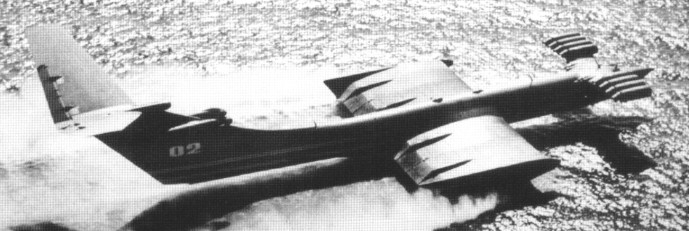
The Monster (its Russian designation was KM, derived from the words Korabl’ Maket or “ship model”) was nothing less than a juggernaut, one of the largest heavier-than-air flying machines ever built. At 500 tonnes it had a 100-tonne MAUW advantage over its fellow winged heavyweight the Boeing 747. No less than ten jet turbines constituted its propulsion system, an array of power used for take-off rather than cruise. Eight turbines were arranged in a shoulder-mounted stub-wing battery just aft of the cockpit. Capable of being deflected under the mainplane where a full-span trailing edge flap would trap their thrust, their combined power could generate an immense lifting force via a hovercraft-like static air cushion to cruise 4 metres above the water
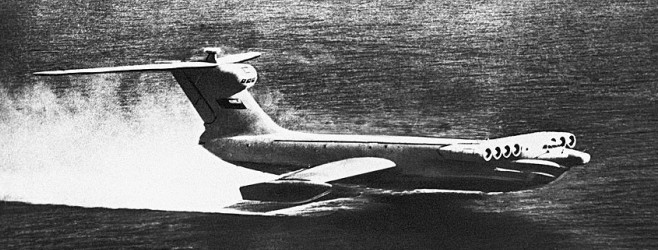
The Lun-class ground effect vehicle (GEV), or sea skimmer, was developed by Russian engineers at the Alexeyev Hydrofoil Design Bureau.
During the Cold War, ekranoplans were sighted for years on the Caspian Sea as huge, fast-moving objects. The name Caspian Sea Monster was given by U.S. intelligence operatives who had discovered the huge vehicle, which looked like an airplane with the outer halves of the wings removed. After the end of the Cold War, the “monster” was revealed to be one of several Russian military designs meant to fly only a few meters above water, saving energy and staying below enemy radar.
The KM, as the Caspian Sea Monster was known in the top secret Soviet military development program, was over 100 m long (330 ft), weighed 540 tonnes fully loaded, and could travel over 400 km/h (250 mi/h), mere meters above the surface of the water.
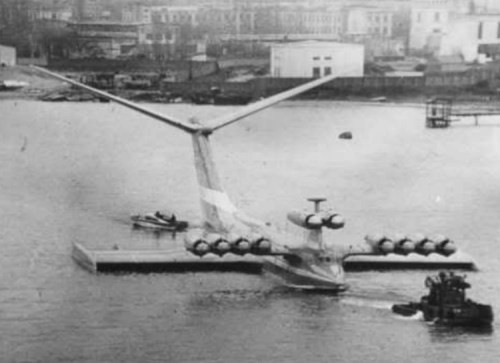
These craft were originally developed by the Soviet Union as very high-speed (several hundred km/hour) military transports, and were mostly based on the shores of the Caspian Sea and Black Sea. The largest could transport over 100 tonnes of cargo. The only three operational A-90 Orlyonok ekranoplans built (with renewed hull design) and one Lun-class ekranoplan remained at a naval base near Kaspiysk.
The Lun-class (“Harrier”) Ekranoplan MD-160, dubbed the “Caspian Sea Monster” by US Intelligence services, was one of a kind. It was capable of carrying up to 124 tonnes of troops and equipment, including as many as six nuclear missiles, at speeds up to 560km/h as far as 2000km. Eight Kuznetsov 128.9kN NK-87 turbofans mounted on the front cannards provided the thrust to get the seaplane’s hull up and out of the water and engage the ground effect.
While ground-effect vehicles are a highly efficient way to transport cargo over long distances, the MD-160 had significant drawbacks in its military applications. For one thing, manoeuvrability. Anything resembling a sharp turn was right out, and allowing a wing tip to even sniff the water could result in 500 tonnes of seaplane cartwheeling along the surface of the Caspian. And since the ground effect didn’t actually take effect until the plane was out of the water, the MD-160 had to always take off into the wind.
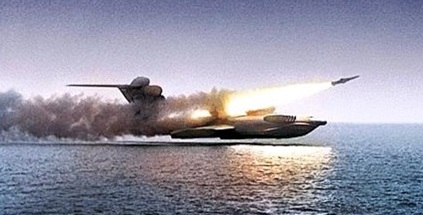
In 1987, the first flight was made by Lun, an ekranoplan-rocket carrier. It was armed with six guided anti-ship missiles “3M-80 Mosquito”.
After the successful completion of state tests “Lun” was in 1990 transferred to trial operation. However, the collapse of the Soviet Union led to the cessation of work in this area and the disbanding of the 11th Air Group of the Black Sea Fleet E-Wing.
So while the MD-160 was thoroughly impervious to subsurface mines and torpedoes, its size and complete lack of manoeuvrability made the planes sitting ducks against Western air forces (hence its NATO designation: Duck), often requiring armed escort and forward scouting boats to avoid obstacles. The Ekranoplan carried anti-ship P-270 Moskit guided missiles in six pairs mounted onto its fuselage as well as a pair of 23mm Pl-23 cannons in a tail turret and forward-facing pair under the forward missile tubes.
Despite the the MD-160’s shortcomings, Soviet high command continued to move forward with the program right up until the Soviet Union fell. A second MD-160, destined to be a mobile field hospital, was 90 per cent complete and another 30 A-90 Orlyonok GEVs, meant to strengthen the Black Sea Fleet, were on order when the program’s funding was cut. The MD-160 currently resides at a naval station in Kaspiysk.
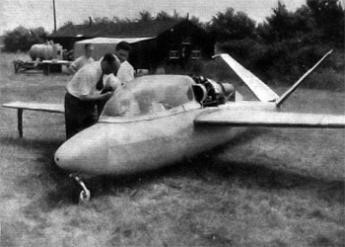
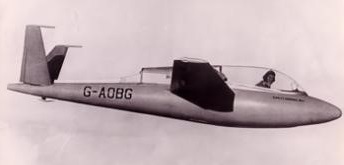
Funded by Nat Somers and designed by Hugh Kendall the Somers Kendal SK-1 was planned to win a Royal Aero Club prize for the design of a light aircraft, and to race, all with acrobatic abilities.
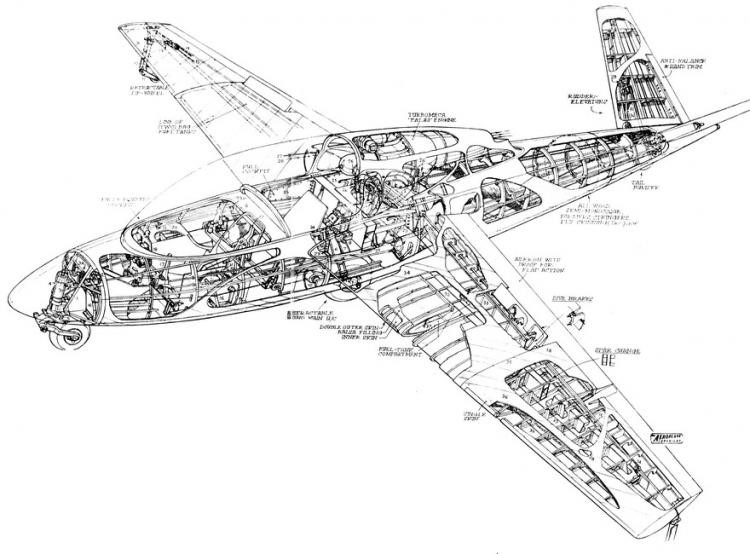
The tandem two-seat SK-1 is made of wood. The wings each hold a structural tank. Both tanks have a total capacity of 227 liters. The leading edge and wing tips are made of synthetic fiber impregnated fiberglass. The laminar wing has an aspect ratio of 8. The flaps extend over the entire span and contribute to the high lift by simultaneously operating down.
The only metal parts of the aircraft are the engine mounts, the landing gear and butterfly tail. The undercarriage front wheel was a Miles Gemini tail wheel, with a singe main wheel. Side outriggers fully retracted into the wing.
The butterfly tail is full flying and smaller trailing edge flaps act as servo trim tabs.
Built at Woodley, the first flight of the SK-1 was flown by Hugh Woodley Kendall, its designer, on Oct. 8, 1955, registered G-AOBC. It suffered a mid-air turbine failure on 11 July 1957.
The lack of market opportunity (either as aircraft race or as training aircraft for the RAF) terminated the project.
It went to the College of Aeronautics, Cranfield for use as a design example but departed in the mid-1960s.
It was found in 1974 under re-build at a farm near Dunstable.
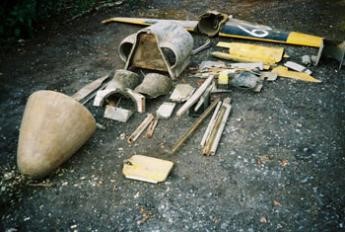
Circa 2010, the Somers-Kendall SK-1 was bought by Peter Bishop of Hamburg, Germany. The body is in good condition and it was transferred to Classic Aero Services in France for restoration.
Some other elements exist, but the wings and canopy were missing.
Engine: Turbomeca Palas, 160 Kp Span 22 ft 9 in / 6.93 m Wing area: 6.25 m² Length 20 ft 10 in / 6.35 m Height: 1.62 m Fuselage weight: 217 Kg Engine and accessories weight: 90 Kg Equipment and oil weight; 35 Kg Empty weight: 343 Kg Aerobatic mauw 1300 lb Fuel capacity: 228 lt Vne: 645 km / h Max speed: 332 mph / 535 Km / h (at sea level) Max cruise: 450 km / h Initial climb rate: 1850 ft / min Range: 1160 km at 20,000 ft at 190 kts Take-off (50 feet, 750 Kg): 685m Landing dist (50 feet to 650 Kg): 595m Load factor: + / – 6 g








 All Aero