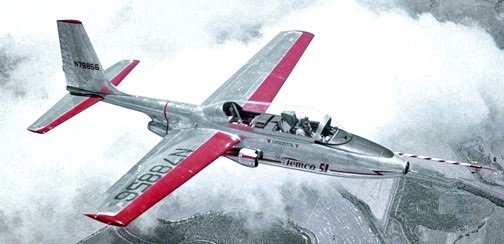
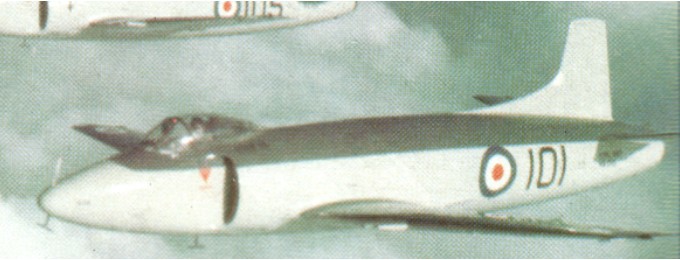
The United States Air Force issued a requirement in 1952 for a jet-powered primary trainer, and Texas Engineering and Manufacturing Company (Temco) responded with the Model 51 Pinto. Powered by a Continental J69-T-9 turbojet, the Pinto was a tricycle-geared mid-wing cantilever monoplane, with tandem seating for the instructor and student in an enclosed cockpit.
First flown on 26 March of 1956, the prototype, N78856, was tested by the U. S. Navy, which subsequently ordered 14 of the aircraft under the designation TT-1 (144223-144236), to study the feasibility of using jet aircraft for primary training. No additional TT-1 Pinto aircraft were manufactured.
Temco TT-1 N78856
The United States Air Force issued a requirement was met by the Cessna T-37
In June 1968 American Jet Industries Inc first flew the Super Pinto, a jet primary trainer or light strike aircraft developed from TT-1 Pinto built by Temco.
Temco TT-1 Super Pinto
One original surplus Temco TT-1 Pinto became the Super Pinto when modified with the J-85-17 engine by Frank Guzman. Registered N7753A, it first flew on 15 January 1972.
On November 8, 1976 the Philippine government bought the Super Pinto (Cali) prototype, including design and manufacturing rights.
Developed for such UAVs as the YBQM-145A, aerial targets, and standoff and cruise missiles in the 4.45 kN (1,000 lb) thrust class. Teledyne Continental Model number is 382-10.
This single pilot manned test-bed was built by Jim Kern’s TASK Research Inc. of Santa Paula, California in 1982, which supplied many composite structures/components for the Rutan designed Long-EZ, Defiant, and Voyager aircraft during the early to mid-1980’s under contract to Northrop’s Electric Mechanical Division in the late 1980s to test early avionics/electronic equipment for remotely piloted vehicles.
The Vantage was a single-seat pusher canard which resembled a Rutan Long-EZ, but was slightly larger with more rounded fuselage sides, a large bulbous two piece canopy. The craft also incorporated an extra long pitot tube in the front. Power was supplied by a single Lycoming O-360 (180 HP) engine turning a variable pitch wood or composite propeller. The aircraft incorporated a retractable nose gear which was powered by an electric motor. The wing root to fuselage joint was blended/contoured and flowed seamlessly into the cockpit. Nicknamed “Sneeky Pete” by its pilots, the undesignated aircraft was outfitted with various special avionics depending on the specific mission requirement. The exterior was painted white, with the name “Sneeky Pete” written along the side of the fuselage, though this is not apparent in the one picture that was released.
Although the maiden flight of “Sneeky Pete” took place at Mojave Airport on July 18th, 1982 with Dick Rutan at the controls (Mike Melvill, along with many others served as test pilots for this aircraft), Rutan Aircraft Factory or Scaled Composites apparently were not involved in the elaboration and building process of the aircraft. It is believed that the flight test program for “Sneeky Pete” first took place at the remote Groom Lake test site in Nevada widely known as “Area 51” (AFFTC DET. 3) in late 1982. The aircraft was periodically tested over the years with various equipment, put into seclusion at various times, but has never been officially retired. During its “down time”, “Sneeky Pete” was most likely stored in a top-secret facility known as “Dyson’s Dock” at Groom Lake which was also the location of the Northrop “Tacit Blue” technology demonstrator after it was retired in 1985.
In 1993, “Sneeky Pete” was acquired and rebuilt by Scaled Composites and experimentally fitted with a Williams FJ107 jet engine, a small turbofan engine designed to power cruise missiles and developed by the Williams International company from their WR19.The FJ107 was notably the powerplant for the AGM-86 ALCM, BGM-109 Tomahawk, and AGM-129 ACM, as well as the experimental Williams X-Jet flying platform. In its jet-powered form, the aircraft was first tested in August 1993 and was known at Scaled Composites as the Jet LEZ Vantage or Model 61-B. A striking feature of the revised aircraft was a square, flat section, as seen from below, added at the back of the aircraft. The section wasn’t as wide as the strakes at the front wing roots but was longer along the fuselage, in comparison.
Jet LEZ Vantage
Only one airframe was ever constructed. The data gathered throughout the “Sneeky Pete” program contributed to today’s advanced UAVs such as the Northrop/Grumman Global Hawk, General Atomics Predator, Boeing X-45, Northrop/Grumman X-47 Pegasus. The aircraft was returned to a more conventional configuration and still appears on the civil register as being owned by Scaled Composites, but its current whereabouts are unknown, and, like many experimental variants of the Long-EZ, it is not properly documented, due to its classified use by the military.
N3142B c/n 1 Powerplant:1 x Lycoming O-360 (180 hp) / 1 x Williams FJ107 / 1 x Lycoming IO-320 (150 hp) Wingspan: 28 ft. Overall length: 17ft. (approximate) Weight: up to 12,499 lb. (with Lycoming engine) Crew/passengers: 2
Swearingen announced the official formation of Sino-Swearingen to complete development and construct the eight place SJ30 business jet. The company is a joint venture between Swearingen and Sino Aerospace Investment Corporation, a grouping of Taiwanese investors, including Taiwan Aerospace Corporation. With the formation of the new company construction will start on a new 18, 600sq.m (200,000 sq ft) assembly plant in Martinsburg, West Virginia (major components will be manufactured in Taiwan and shipped to the US), while the original SJ30 prototype has returned to full test and certification flying duties.
Originally the SA-30, renamed SJ30, first flew on 13 February 1991.
Sino Swearingen Aircraft Corporation has flown their SJ30-2 business jet (first flown 1996) at an altitude of 49,000 ft. This cruise level of the aircraft exceeds that of most of the business twinjets or commercial airliners in production. The SJ30-2 is a seven-place twin jet aircraft with an IFR range of 2,500 nm. The aircraft will cruise at speeds in excess of Mach 0.80 and will maintain a “sea level cabin” to 41,000 ft (owing to its pressurization differ¬ential being 12.0 psi).
SA-30 / SJ30 Engines: 2 x 1900 lb Williams Intl FJ44 turbofan Wingspan: 36’4″ Length: 42’4″ Useful load: 4150 lb Max speed: 541 mph Cruise: 512 mph Range: 2390 mi Ceiling: 41,000′ Seats: 8
SJ30-2 Engines: (2) FJ44-2A Williams Rolls Overall Length: 46.80 ft (14.26 m) Overall Height: 14.19 ft (4.33 m) Wing: Span: 42.33 ft (12.90 m) Sweep (@ 1/4 Chord): 30.1 deg Dihedral: 2.3 deg Area: 190.69 sq ft (17.71 sq m) Aspect Ratio: 9.40 Mean Aerodynamic Chord (MAC): 5.12 ft (1.56 m) High Speed Cruise: Mach 0.83 / 560 MPH / 486 KTAS / 901 Km/H Long Range Cruise 2,875 sm (2500 nm): 0.76Mach / 502MPH / 436KTAS / 807Km/H Stall Speed: 91 KCAS FAA Take-Off Balanced Field Length GW: 3,939 ft (1200 m) FAA Landing Distance: 2,941 ft (896 m) Seats: Seven Place w/Pilot Take-Off Thrust: 4,600 lbs total (2,300 lbs ea) Pressurization: 12.0 psi Max. Certified Altitude: 49,000 ft Cabin Altitude is Sea Level Up To: 41,000 ft Mmo Above 29,500 ft: Mach 0.83 Vmo Up To 29,500 ft: 320 KCAS (593 km/h) Vref: 105 KCAS Speed Brake Operation: No Speed Limit Max. Ramp Wt: 14,050 lbs (6373 kgs) Max. Take-Off Wt: 13,950 lbs (6327 kgs) Max. Landing Wt: 12,725 lbs (5772 kgs) Max. Zero Fuel Wt: 10,500 lbs (4763 kgs) Basic Operating Wt: 8,650 lbs (3923 kgs) Max. Fuel Quantity: 4,850 lbs (2199 kgs) Max. Baggage Compartment Wt: 500 lbs (227 kgs) Horizontal Tail: Span: 14.56 ft (4.44 m) Sweep (@ 1/4 Chord): 33 deg Dihedral: 0 deg Area: 36.72 sq ft (3.41 sq m) Aspect Ratio: 5.77 Mean Aerodynamic Chord (MAC): 2.72 ft (0.83 m) Vertical Tail: Span: 7.21 ft (2.20 m) Sweep (@ 1/4 Chord): 55.5 deg Dihedral: 46.80 sq ft (4.35 sq m) Area: 11.56 sq ft (1.07 sq m) Aspect Ratio: 1.11 Mean Aerodynamic Chord (MAC): 7.10 ft (2.17 m) Ventral Fin: Total Area: 11.56 sq ft (1.07 sq m) Ventral Rudder Area: 1.95 sq ft (0.18 sq m) Landing Gear: Width Between Main Gear: 6.85 ft (2.09 m) Wheelbase: 18.84 ft (5.74 m) Tire Size: 16 in x 4.4 in
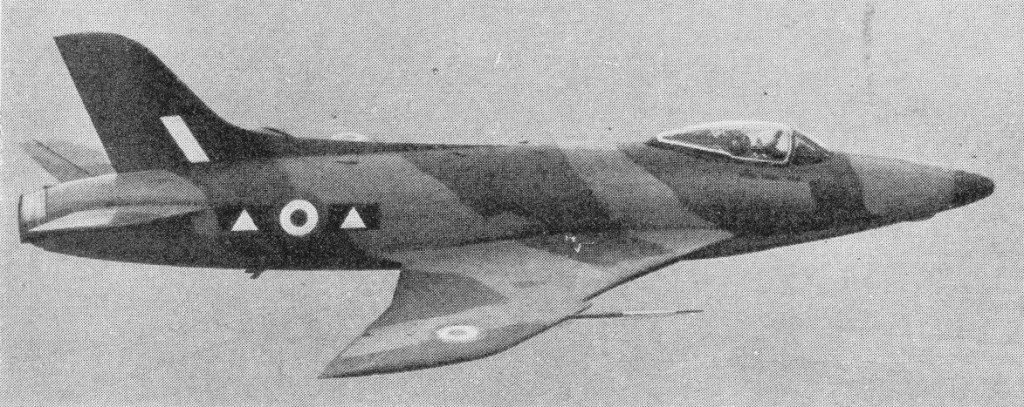
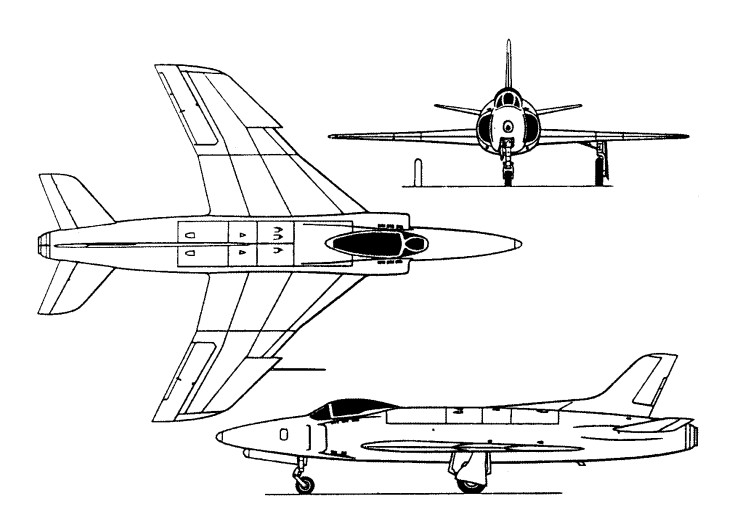
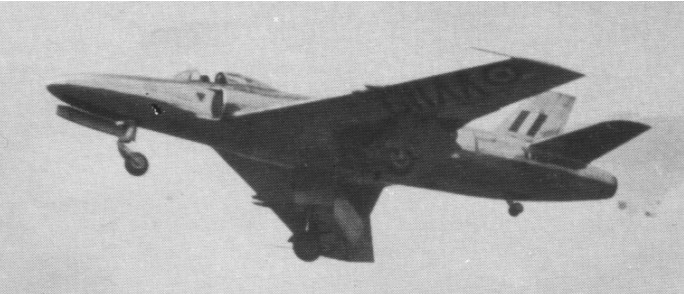
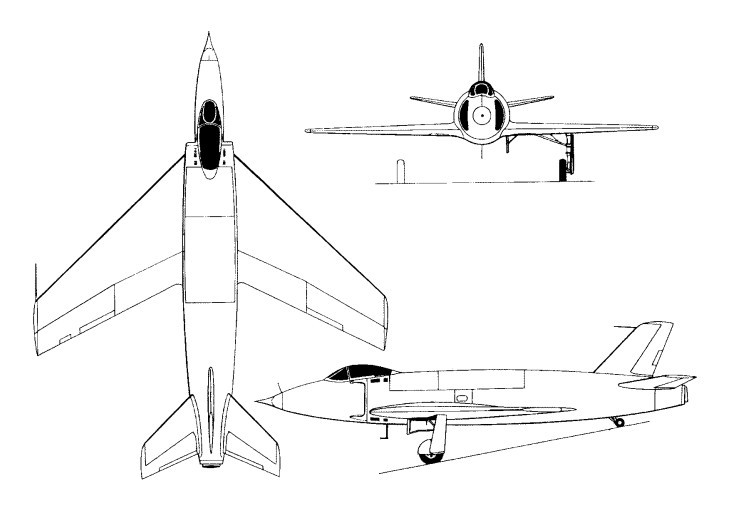
The Swift was a single-seat swept-wing fighter powered by a Rolls-Royce Avon axial-flow turbojet engine. During development the engine was changed from the Rolls-Royce Nene to the slimmer Avon. It was too late to change the fuselage, which was fatter than necessary. Flown for the first time in prototype form on 1 August 1951, the Swift appears to have proceeded fairly smoothly through its development period.
On 10 July 1952 the prototype established an international point-to-point record between London and Brussels, covering 320km in 18 minutes 3.3 seconds, representing a speed of 1,071.7km/h. Mike Lithgow piloted the prototype Swift F.Mk 4 to 1183.5 km/h (735,4 mph) over a 3 km course at Idris, Libya, of 24 September 1953. Subsequent runs were spoilt by a failed afterburner. This accomplishment was extremely short-lived, the record standing for just three days before it succumbed to a US Navy Douglas F4D-1 Skyray.
WK198 in Libya
Record holding Swift WK198 was the third production Swift F.Mk 1 and was converted as the prototype F.Mk 4. This introduced a variable-incidence tailplane to counter pitch-up problems encountered with earlier machines.
WK198 F.Mk 4
Deliveries to the Royal Air Force got under way during February 1954, the first examples of the Swift F.Mk.1 being assigned to the Air Fighting Development Squadron for operational trials. Shortly after this the type began to enter operational service with No. 56 Squadron, but the pure fighter variant was destined to enjoy only a very brief career, those examples of the Swift F.Mk 1 and Swift F.Mk 2 which equipped No. 56 being retired in March of the following year, largely as a result of the type’s poor all-round qualities. Subsequently, most of the remaining Swift F.Mk 2 and Swift F.Mk 3 production examples were passed directly from storage to technical schools, where they served as instructional airframes.
The RAF received a total of about 60 Swift F.1s, F.2s and F.3s, with an Avon RA.7 turbojet engine and two 30mm Aden cannon; four Aden cannon and a new wing planform with compound leading-edge taper; and with an Avon RA.7R engine with afterburner and changes to the rear fuselage respectively. These versions were not used operationally.
The Swift F.4 had an all-moving tail of increased area which finally cured the Swift’s pitch-up problems, and an afterburning Rolls-Royce Avon.
Only the FR.5 was used for any length of time and was a fighter-reconnaissance aircraft with a longer nose to accommodate 3 F95 camera- 1 facing forward & 2 facing sideways. AG45 gun camera was also fitted.
Swift FR.5
Deliveries began in 1956. Sixty were flown by the RAF; one further aircraft ordered crashed on delivery and several others were not completed.
All production was stopped in February 1955 after the 176th production machine had been completed. The final 35 aircraft were converted to the tactical reconnaissance FR Mk.5, this serving with Nos 2 and 79 Squadrons from Gütersloh, West Germany. Introduced by No.2 Squadron during February 1956, the Swift FR.Mk 5 remained operational until early in 1961 when re-equipment with the Hunter FR.Mk 10 was completed. The only other noteworthy Swift derivative was the Swift F.Mk 7 which equipped the Guided Weapons Development Squadron at Valley during the late 1950s, being employed on trials work in connection with the Fairey Fireflash guided missile. Following a single prototype, 12 examples of the Swift F.Mk 7 were completed from F Mk 4s, and one of these remained in an airworthy state until about the mid-1960s, at one time taking part in a series of trials relating to braking efficiency on wet runways.
Despite more and more modifications, it was all too late. The performance of the aircraft had been so degraded by the constant increase in weight that its intended role as an interceptor could not be fulfilled. Reheat had to be employed for take off, climb and combat, which resulted in an endurance of but 25min and a combat radius of barely 50 miles, or virtually nil if a bad weather recovery was needed. Having been plagued with problems and incidents and being clearly unsuited for its intended role as a day fighter, the aircraft was withdrawn from use by 56 Sqn during March 1955, after barely a year of service. The squadron was re-equipped with the Hunter during the following May.
Only a relatively small number of the 175 or so that were eventually completed actually attaining operational service with the Royal Air Force.
Swift F.Mk.1 Engine: 1 x Avon RA.7 turbojet Armament: two 30mm Aden cannon
Swift F.Mk 2 Engine: 1 x Avon RA.7 turbojet Armament: four 30mm Aden cannon
Swift F.Mk 3 Engine: 1 x Avon RA.7 turbojet Armament: four 30mm Aden cannon
Swift F.4 Engine: 1 x Rolls-Royce Avon RA.7R with afterburner.
Swift FR.5 Engine: 1 x 4287-kg (9,450-lb) afterburning thrust Rolls-Royce Avon Mk 114 turbojet Maximum speed 1102 km/h (685 mph) at sea level Initial climb rate 4468 m (14,660 ft) per minute Service ceiling 13960 m (45,800 ft) Range 1014 km (630 miles) Empty weight 6094 kg (13,435 lb) Maximum take-off 9831 kg (21,673 lb) Wingspan 9.85 m (32 ft 4 in) Length 12.90 m (42 ft 3.5 in) Height 4.00 m (13 ft 2 in) Wing area 30.44 sq.m (327.7 sq ft) Armament: two 30-mm Aden cannon Crew: 1
Swift F.Mk 7 Engine: 1 x Rolls-Royce Avon RA.7R with afterburner.
Three aircraft were ordered to Specification N.9/47 for a naval fighter, and, configurationally similar to the Type 505 apart from the undercarriage. In February 1950, the contract covering the third prototype was amended to introduce sweptback wings, and this, as the Type 525, became, in effect, the prototype of the Scimitar.
The Type 525 has an all moving tail with narrow chord elevators and a tail braking parachute in the streamlined fairing of the tailplane and fin. A V type arrester hook is housed in clamshell doors below the rear fuselage, and there is a fuel tank of 58 gal. capacity in the fuselage between the two jet pipes. The 525 has slotted ailerons, of a similar type to those of the Swift.
Very large flap area is provided for deck landing, wing flaps being of the chord increasing type with a slot effect, and extra area is gained by two additional hinged surfaces below the fuselage. The wing also has full span slats which are extended for slow speed control. Since the long stroke undercarriage with its large diameter wheels retracts into the fuselage forward of the flaps, fairing doors for the wheel wells are provided and close to preserve the airflow after the undercarriage is extended. The 525 also has fuselage -mounted air brake flaps hingeing forward just below the leading edge of the wing on the fuselage.
During 1946, in response to a contract to build two prototypes of a single-seat high-speed fighter to Specification E.41/46, Supermarine combined sweptback wing and tail surfaces with what was essentially an Attacker fuselage to create the Type 510. This retained the Rolls-Royce Nene 2 engine and tailwheel undercarriage of the Attacker.
The first prototype was flown on 29 December 1948. No armament was fitted, but provision was made for four wing-mounted 20mm cannon. The second prototype, designated Type 528, flew in similar configuration on 27 March 1950, and, on 8 November of that year, the Type 510, fitted with an Attacker-style A-frame arrester hook, made a series of landings and take-offs from the carrier HMS Illustrious.
Later, the first aircraft (now redesignated Type 517) was fitted with a movable rear fuselage permitting the incidence of the integral tailplane to be varied. Meanwhile, the Type 528 was fitted with an afterburning version of the Nene, a lengthened nose and a tricycle undercarriage as the Type 535, flying in this form for the first time on 23 August 1950, and providing the basis for the development of the Swift. Four wing cannon were carried by the 535, but such positioning found no official favour.
The Type 535 proved sufficiently impressive for a 100-aircraft order to be planned if the same company’s Type 541 proved a failure.
Type 510 Max take-off weight: 5534 kg / 12200 lb Wingspan: 9.66 m / 32 ft 8 in Length: 11.61 m / 38 ft 1 in Height: 2.68 m / 9 ft 10 in Wing area: 25.36 sq.m / 272.97 sq ft Max. speed: 1014 km/h / 630 mph
The Superrnarme Attacker prototype had been built to a 1944 specification. The single-seat jet fighter flew for the first time on July 27, 1946. The machine was flown by Supermarine’s test pilot, Mr Jeffrey Quill, from the A&AEE at Boscombe Down, where, as there is not at the firm’s aerodrome at High Post, there is a runway.
The prototype, T5409, was seen at the SBAC show at Radlett the following month.
Named Attacker, the aircraft uses a Rolls-Royce RB.41 (later Nene) centrifugal flow turbojet, a new fuselage and tail mounted on the laminar flow wings of the Spiteful with radiators removed.
The undercarriage was also taken from the Spiteful. The wing retained the Spiteful’s four cannon armament but the radiators for its Griffon piston engine were removed and replaced by fuel tanks.
The result was the Attacker F.Mk.1, a mediocre fighter whose main advantages were cheapness and easy handling at low level. This was put to use by adding bombs in the Attacker FB.Mk.1 version, and the Attacker FB.Mk.2 had powered ailerons and a stronger met¬al-framed canopy. The last of 145 of the three marks was delivered in 1953, also exported to Pakistan, and served until 1957.
Three prototypes were ordered in August 1944 but development was slower than anticipated due to delays in laminar flow wing research, with low speed handling problems proving difficult to solve. As the RAF had begun to lose interest in the aircraft, it was decided that the last two prototypes would be navalised.
The first prototype flew on 27 July 1946 and the second on 17 June 1947 (the name “Attacker” applied on the same day), this differing in having longer stroke undercarriage, smaller fin, enlarged tailplane, increased fuel capacity, arrester hook and an ejection seat. Folding wings would not appear until the production versions were built. By then, the RAF was no longer a prospective customer and the aircraft was ordered only tor the Royal Navy Fleet Air Arm.
The first production Attacker F.1 flew on 5 May 1950 and operational service began in August 1951 with No 800 Squadron FAA. Subsequent versions were the FB.1 fighter-bomber with provision for underwing ordnance and the FB.2 which differed mainly in its Nene Mk.102 engine with a throttle acceleration control unit to prevent flameout if the throttle was opened quickly, such as when performing a go-around. The Attacker served with only two FAA front line squadrons and had been relegated to Volunteer Reserve units by 1954 and retired two years later.
The only export was to the Pakistan Air Force, which received 36 ‘denavalised’ aircraft between 1951 and 1953 for operation from land. These lacked the folding wings and arrester gear of the Royal Navy’s aircraft but were otherwise similar to the Attacker F.1.
Attacker F.Mk.1 Engine: 1 x Rolls-Royce “Nene 3”, 22.24kN Max take-off weight: 5339 kg / 11771 lb Empty weight: 3826 kg / 8435 lb Wingspan: 11.25 m / 37 ft 11 in Length: 11.43 m / 38 ft 6 in Height: 3.02 m / 10 ft 11 in Max. speed: 950 km/h / 590 mph Ceiling: 13700 m / 44950 ft Range: 950 km / 590 miles Armament: 4 x 20mm cannon Crew: 1
Attacker FB.Mk 2 Engine: one 2313-kg (5, 100-lb) thrust Rolls-Royce Nene Mk 102 turbojet Maximum speed 950 km/h (590 mph) at sea level Initial climb (light weight 5216 kg/1,500 lb) 1935 m (6,350 ft) per minute Service ceiling (maximum weight) 11890 m (39,000 ft) Range (with 1 137-litre/250-Imp gal belly tank) 1700 km (1,060 miles) Empty weight 4495 kg (9,910 lb) Maximum take-off 7938 kg (17,500 lb) Span 11.26 m (36 ft 11 in) Length 11.43 m (37 ft 6 in) Height 3.03 m (9 ft 11 in) Wing area 21 sq.m (226 sq ft) Armament: four 20-mm Hispano Mk 5 cannon Bombload: two 454-kg (1,000-lb) bombs or eight rockets
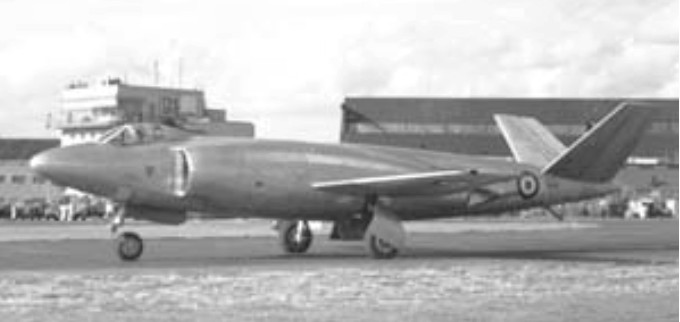
Responding to Admiralty interest in “undercarriage-less” aircraft suitable for operation from flexible decks on aircraft carriers, Supermarine designed the Type 505 single-seat fighter in 1945. Two Rolls-Royce AJ65 (later to be named Avon) turbojets were located side-by-side in a broad centre fuselage to provide a stable base for alighting on the “carpet” and a Vee configuration kept the tail surfaces clear of the jet efflux. An armament of twin 20mm cannon was planned and provision was made to provide for a fixed tricycle undercarriage for flight development and operation from shore bases. It was thus relatively simple to incorporate a retractable undercarriage in the design when Admiralty interest in the flexible deck concept waned in late 1947 and the fighter was modified as the more conventional Type 508.
Three aircraft were ordered to Specification N.9/47 for a naval fighter, and, configurationally similar to the Type 505 apart from the undercarriage, the first of these flew on 31 August 1951. The second (as the essentially similar Type 529) followed a year later, on 29 August 1952.
In February 1950, the contract covering the third prototype was amended to introduce sweptback wings, and this, as the Type 525, became, in effect, the prototype of the Scimitar. The Types 508 and 529 were each powered by a pair of 2948kg Avon RA3 engines and had provision for an armament of four 20mm cannon.
To be broken up February 1956
Type 529 Engines: 2 x 2948kg Avon RA3 Empty weight: 8373 kg / 18459 lb Wingspan: 12.50 m / 41 ft 0 in Length: 15.24 m / 50 ft 0 in Height: 3.54 m / 12 ft 7 in Wing area: 31.59 sq.m / 340.03 sq ft Max. speed: 977 km/h / 607 mph











 All Aero