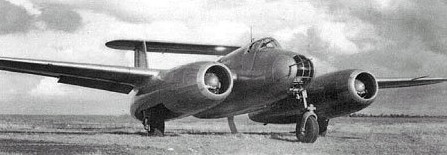
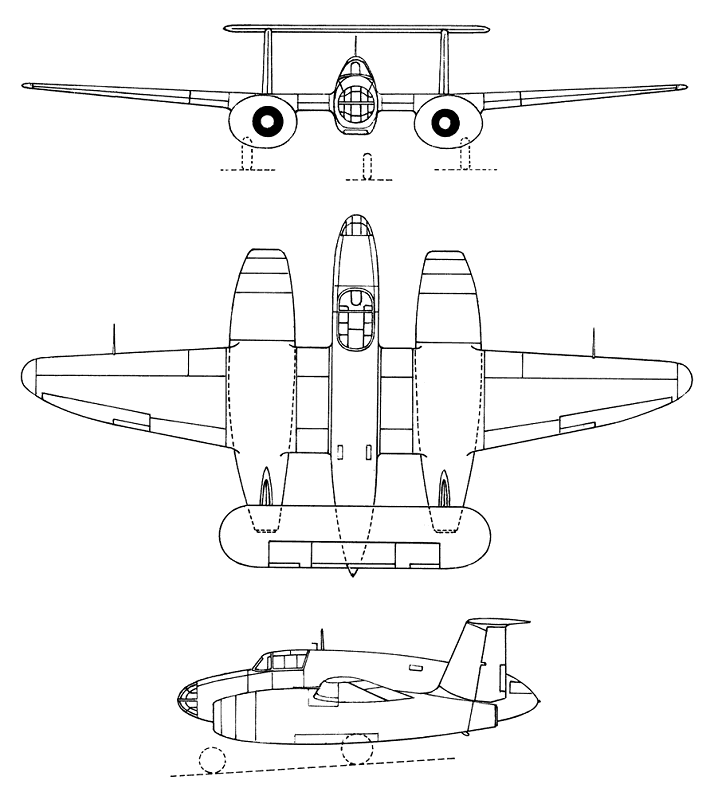
A turbojet-powered derivative of the NC.1070, the NC.1071 had underwing engine nacelles, which also carried the tailfins, connected by a tailplane on top. The first prototype flew on 12 October 1948 but the second prototype was abandoned after suffering structural damage in a flight to Mach 0.7. Aerocentre went into liquidation during 1949 and the project was cancelled in 1951.
Engine: 2 x 2350kg Hispano-Suiza (Rolls Royce) Nene 101 Take-off weight: 13750 kg / 30314 lb Empty weight: 7980 kg / 17593 lb Wingspan: 20.0 m / 66 ft 7 in Length: 10.75 m / 35 ft 3 in Height: 4.6 m / 15 ft 1 in Wing area: 50.0 sq.m / 538.20 sq ft Max. Speed: 800 km/h / 497 mph Cruise speed: 724 km/h / 450 mph Ceiling: 13000 m / 42650 ft Range: 1000 km / 621 miles Armament: 2 x 20mm cannon, 800kg of weapons
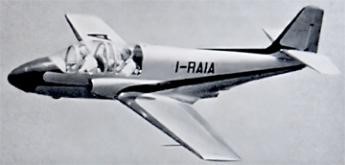
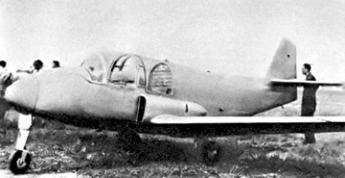
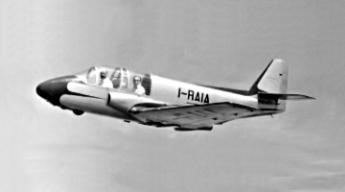
Postwar Caproni released the F5 in its new identity”Aero Caproni Trento”. It is a small low-wing monoplane, tandem two-seater.
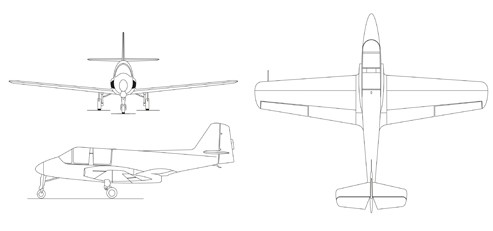
An all wood, simple structure, the air inlets have been designed so they do not interfere with the wing. The Caproni F-5 is a cantilever monoplane, with the lower surface flush with the ventral surface of the fuselage.
The fuselage shell is oval section and single box, covered with birch plywood. The fuselage is in two parts; the first comprises the cockpit (two seats in tandem) and supports the front leg of the undercarriage; the second contains the engine and the empennage. The two sections are joined by bolts. The tail is cantilever.
The landing gear is a retractable tricycle. The front has oleo-pneumatic damping, with steering controlled by the rudder. This wheel retracting rearward. The main gear has oleo- pneumatic damping, with hydraulic brake swingarm (the hinge rotates around the wing spar). The landing gear retraction is mechanical ; it is effected by means of a crank attached to the right front position.
The first flight was performed by test pilot Ernesto Zanlucchi on 17 May 1952 on the Milan Malpensa airport.
The same day as the first flight, Zanlucci and Vico Rosaspina, flew a range of acrobatics including looping and incipient spin.
The first tests made it possible to record the maximum ground speed at 360 kph, and at 3,000 m the F5 reached 315 km.h.
During the test dive conducted at 3,000 m, having two people on board, 520 km / h were reached without showing any vibration
Engine: Turbomeca Palas, 150 Kgp Wingspan: 7.65 m Length total: 6.625 m Height: 6.2 m Wing area: 10 m² Empty weight: 490 Kg Max weight: 750 Kg Max speed: 360 km Range: 300 km Ceiling: 8000 m Time to 3,000 m: 11 min Landing distance clean: 241 m Landing distance flaps & brakes: 154 m
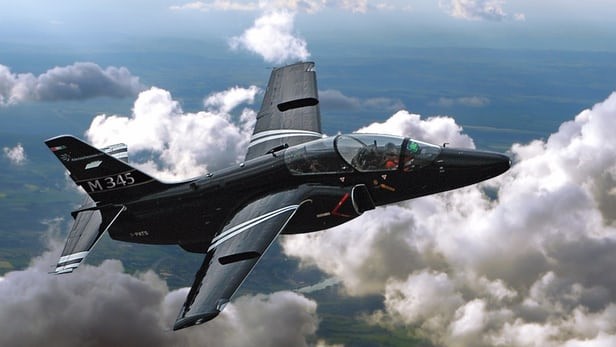
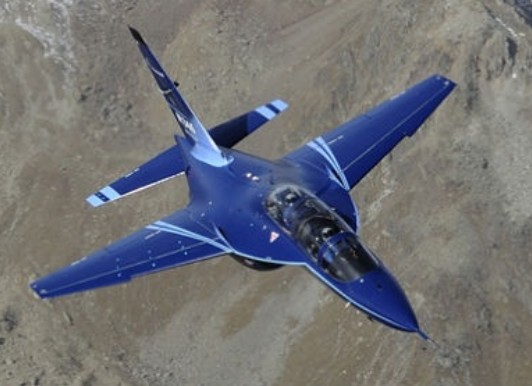
Italian aerospace company Leonardo’s military trainer aircraft, the M-345 was intended for the international market as both a trainer and an operational aircraft, and is designed for low price, and also low maintenance and operational costs. This is due in part to the airplane’s advanced avionics that includes the Health and Usage Monitoring System (HUMS), which monitors the state of the aircraft and reduces the need of general overhauls.
The M-345 also has an avionics suite that the company says is up to combat jet standards and includes Hands On Throttle And Stick (HOTAS) controls, Head up Display (HUD), and real-time Multi-Function Displays (MFD). The aircraft has pressure refuelling systems and an On-Board Oxygen Generation System (OBOGS) for greater efficiency and less need for ground crews.
On 29 December 2016, the prototype M-345HET (High Efficiency Trainer) tandem-seat basic jet trainer took to the skies over the Venegono Superiore airfield in Varese, Italy, under the command of test pilots Quirino Bucci and Giacomo Iannelli. According to the company, the 30-minute flight went off without incident.
Engine: 1 x Williams FJ44-4M-34 turbofan, 1,540 kg / 3,450 lb thrust Wingspan: 8.47 m / 27.78 ft Weight: 3,300 kg / 7,275 lb Cruising speed: 400 kt / 460 mph / 740 km/h Service ceiling: 40,000 ft / 12,000 m Ferry range: 760 nm / 824 mi / 1,410 km
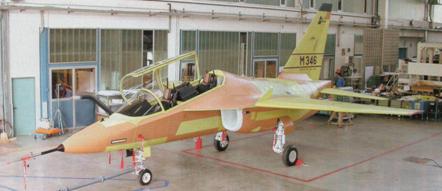
Powered by two 7,0001b thrust Honeywell F124 turbofans, the fly by wire M 346 advanced jet trainer was launched in January 2000 following cessation of the joint Italian/Russian Yak 130 technology development programme which ran from April 1996 to December 1999, accumulating some 300hr flying. The prototype M-346 first flew in July 2004.
Textron will offer a US-made version of the Italian light jet under the designation Beechcraft M-346N.
In 2025 Textron Aviation Defense started a nationwide demonstration tour to promote its Beechcraft M-346N advanced jet trainer for the U.S. Navy. The M-346N took off from Beech Factory Airport in Wichita, Kansas, where it was assembled. The aircraft is part of a broader integrated training system originally developed by Leonardo and adapted for U.S. Navy needs by Textron under the Beechcraft name.
Assembled in the United States by Beechcraft, the M-346N is a tandem-seat, twin-engine jet equipped with digital flight controls, advanced avionics, and a modern cockpit layout. Features include a quadruple-redundant fly-by-wire system, Head-Up Displays (HUD), Large Area Displays (LAD), and hands-on throttle and stick controls in both cockpits. It also incorporates safety systems such as Automatic Ground Collision Avoidance (Auto-GCAS).
Powered by two Honeywell F124-GA-200 turbofan engines, the M-346N has a maximum cruise speed of over 590 knots and a service ceiling of 45,000 feet. Its features an elevated rear cockpit provides instructors with a clear field of view.
Textron says more than 100 M-346 aircraft built by Leonardo are already in service worldwide, logging over 150,000 flight hours by 2025. These numbers reflect a platform that has been tested and adopted by air forces in at least 20 countries.
The 1972 designed Viper 632 powered Aermacchi MB339 produced in Varese, Italy, became the successor to the MB-326 and the Fiat G91. Sharing much of the MB-326K airframe structure, the MB-339 has a redesigned forward fuselage to allow the tandem seating to be staggered vertically, for the instructor to see over the pupil, the vertical tail enlarged, raised fin, a revised nose gear, stronger wings, Martin-Baker Mk.10 zero-zero seats, nose wheel steering and modern avionics. Six hardpoints (up to 1815 kg/4,000 lb) al¬low a combined trainer/light strike role. The wing is NACA 64A212 at the root and NACA 64A114 at the tip.
The first prototype MB-339X (I NOVE) made the type’s maiden flight on 12 August 1976, the second prototype was registered I NINE. Beginning production in 1976 was the MB.339A, of which the first of 100 for the Aeronautica Militare were handed over for pre service trials on 8 August 1979. Customers have included Argentina, Dubai, Ghana, Malaysia, Nigeria, and Peru.
MB.339As were the only operational jet aircraft deployed to the Falklands by the Argentineans during the hostilities, the Port Stanley runway being unable to accommodate Mirages or A 4s. An Argentine Navy MB.339 attacked a Royal Navy frigate, causing damage with 30 mm DEFA cannon fire and four Zuni 5 inch rockets. The trainer also has provision to carry the AGM65 Maverick ASM, the AIM 9 Sidewinder and the Sistel Marte II fire and forget sea skimming anti ship missile.
The MB.339B is basically a standard MB.339A advanced trainer with an uprated Viper 680 engine, enlarged tip tanks, and increased weapons carrying capability, enhanced for the ground attack role.
The MB.339C is designed to train pilots to use modern front-line mission management systems and powered by an uprated Viper 680-43 turbojet. Envisaged as a close support/maritime attack aircraft, the MB.339C first flew on December 17, 1985, equipped with a digital navigation/attack system including a GEC navigation computer, two Kaiser Sabre headup displays, a Litton inertial platform, CRT multifunction displays, a Fiat P-0702 laser rangefinder, an ELT-156 radar warning receiver, and a GEC AD-660 Doppler radar. Armament options included AIM-9L Sidewinder, AGM-65 Maverick ASMs, and Marte Mk.II anti-shipping missiles.
The MB-339CB with the Rolls-Royce Viper 680-43 jet engine experienced a number of engine problems. Flameouts on wet runways, compressor stalls during rapid acceleration/deceleration, defective fuel supply components, and turbine blade cracks. The subsequent repairs reduced the maximum thrust of the Viper to 4,280 lbs.
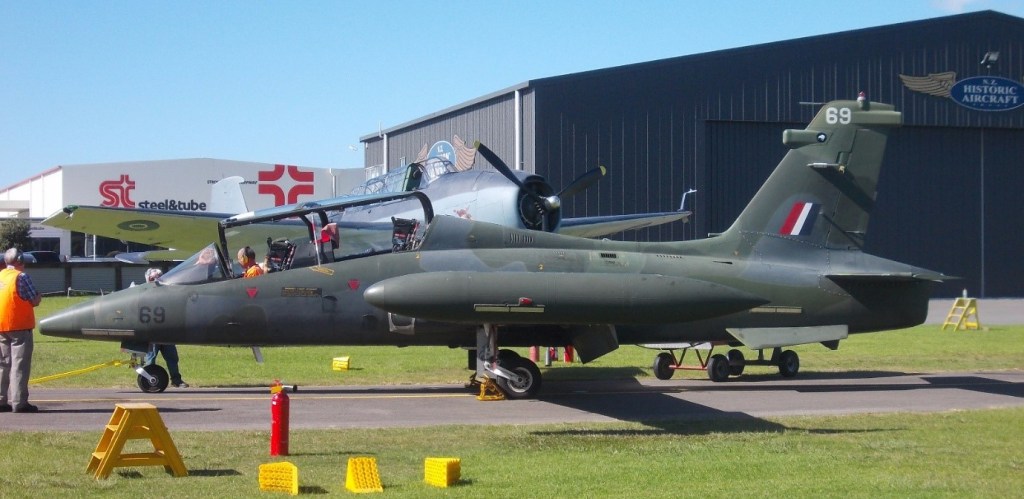
In 1991 the RNZAF purchased 18 of the model MB-339CB for use an advanced pilot trainer and weapons trainer with 14 Squadron based at Ohakea.
MB-339CB
The “CD” model was offered with HOTAS (Hands on Throttle and Stick), HUDs display and three LCD screens.
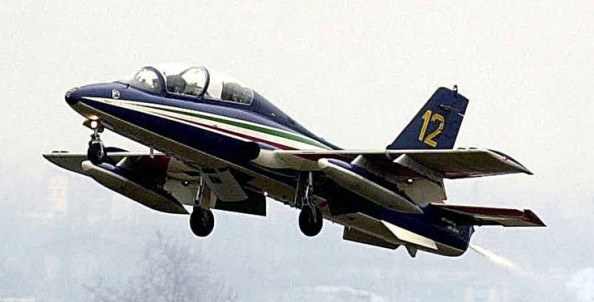
Development of the MB-339 has included the MB-339RM calibration model and 15 MB-339PAN delivered in 1982 for the Italian “Frecce Tricolori” aerobatic team.
The Viper 680 engined MB-339K, also known as the Veltro II, was a single-seat attack version. This aircraft first flew on 30 May 1980. In production form, the single-seat MB.339K Veltro 2, which flew in May 1980, was avail¬able with the digital navigation/attack system from the MB.339C.
Prototype Wing span: 35 ft 7.5 in (10.86 m). Max speed: 558 mph (898 km/h).
MB-339A Engine: 1x R-R Viper 632-43. Installed thrust: 17.8 kN. Span: 10.9 m. Length: 11 m. Wing area: 19.3 sq.m. Empty wt: 3125 kg. MTOW: 5900 kg. Warload: 1815 kg. Max speed: 925 kph. Initial ROC: 2010 m / min. Ceiling: 14,600+ m. T/O run: 465 m. Ldg run: 415 m. Fuel internal: 1410 lt. Endurance: 2hr 50min. Combat radius hi-lo-hi: 590 km. Hardpoints: 6.
MB-339C Engine: Viper 680, 1995-kg (4,400 lb) thrust. Max speed SL: 480 knots Max speed 25,000 ft: 460 knots ROC SL: 6500 fpm. Time to 30,000 ft: 7 min 6 sec. TO wt clean: 10,000 lbs. Endurance: 2 hr 50 min. Fuel Burn: 2500 lb/hr. Max extenal load: 4000 lb on six pylons.
MB-339CB Engine: Rolls-Royce Viper Mk.680-43, 4000 lb thrust. Span: 11.22m. Wing area: 19.3 sq.m. Length: 11.24m. MTOW: 6350 kg. Internal fuel: 1430 kg. (+2 x 400 kg tip tanks). Empty wt: 3414 kg. Height: 3.9 m. Max speed: M0.8, 575 mph. T/o run: 550m. ROC: 8500 fpm. Service ceiling: 46,000ft. Limits: +7.33 & -4g. Ferry range: 1190 miles (2200 km)
MB-339K Veltro 2 Engine: 1 x Piaggio RR Viper 680-43 turbojet, 4,450lbs / 19.8 kN thrust. Length: 36.88ft (11.24m) Wingspan: 36.81ft (11.22m) Height: 13.09ft (3.99m) Wing area: 19.3 sq.m Empty Weight: 6,889lbs (3,125kg) Maximum Take-Off Weight: 13,999lbs (6,350kg) Fuel internal: 2030 lt Maximum Speed: 506mph (815kmh; 440kts) Maximum Range: 231miles (371km) Rate-of-Climb: 6,595ft/min (2,010m/min) Service Ceiling: 46,719ft (14,240m) T/O run: 580 m Ldg run: 450 m Armament: 2 x 30mm DEFA cannons / 1935 kg external Seats: 2 Hardpoints: 6 Air refuel: No.
Single-seat version of the MB.326, the Aermacchi MB.336 made its first flight on Saturday, August 22, 1970. The pilot was Cdte Guido Careftiato, Aermacchi chief test pilot.
The new type, developed in response to an increasing world demand for a simple, high-performance and low-cost operational trainer and close-support aircraft, differs chiefly from the two-seat version in its more powerful engine (Rolls-Royce Viper 632-Y3 of 4,0001b thrust), internal gun installation and additional fuselage tank.
The two prototypes I-AMKK and I-KMAK, were converted from MB-326G to this new model.
The MB.326 developed into the MB 326K as the latest generation model, equipped with Mk 600 Viper engine, able to push 1,814 kg to give an even better performance.
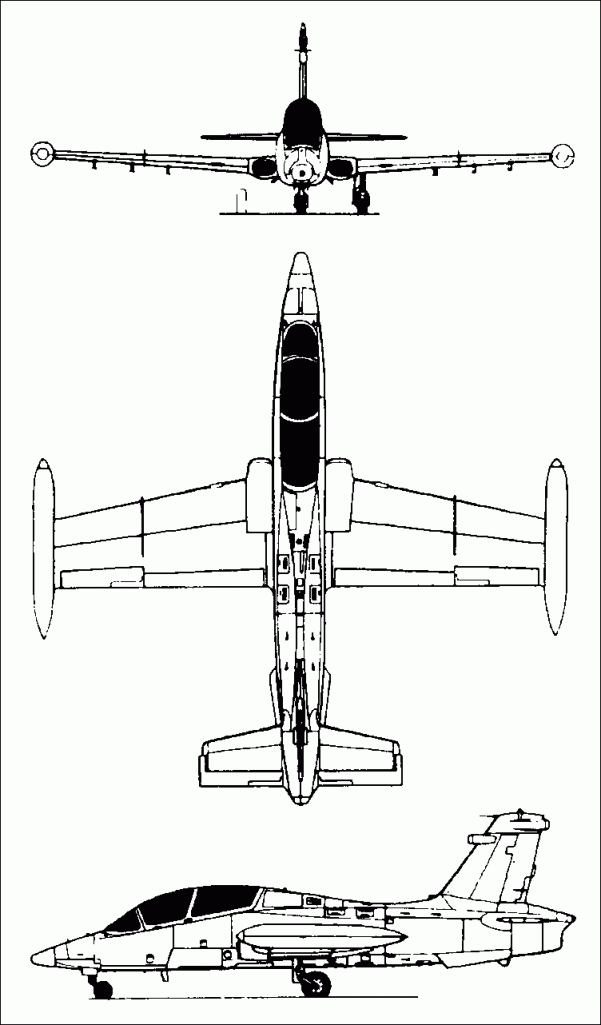
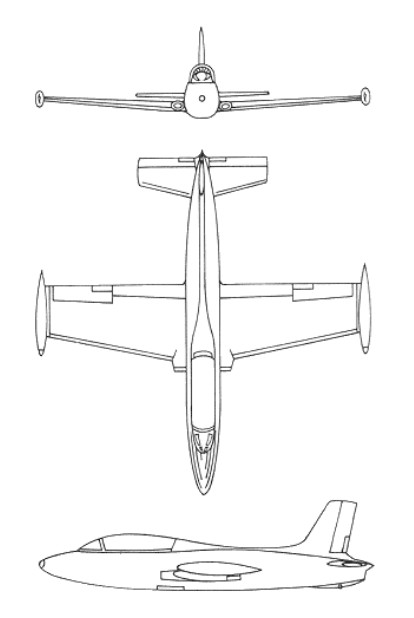
The design (by Ermanno Bazzocchi) of the MB-326 began in 1954. There were some modifications to the project: horizontal tail surfaces had reduced dihedral, and the airbrakes (two in wings) became one under the fuselage. In 1956 AMI approved the project and asked for two prototypes (MM.571 and 572) and one airframe for static tests. No weapons or pressuriisation needed, but Bazzocchi introduced them.
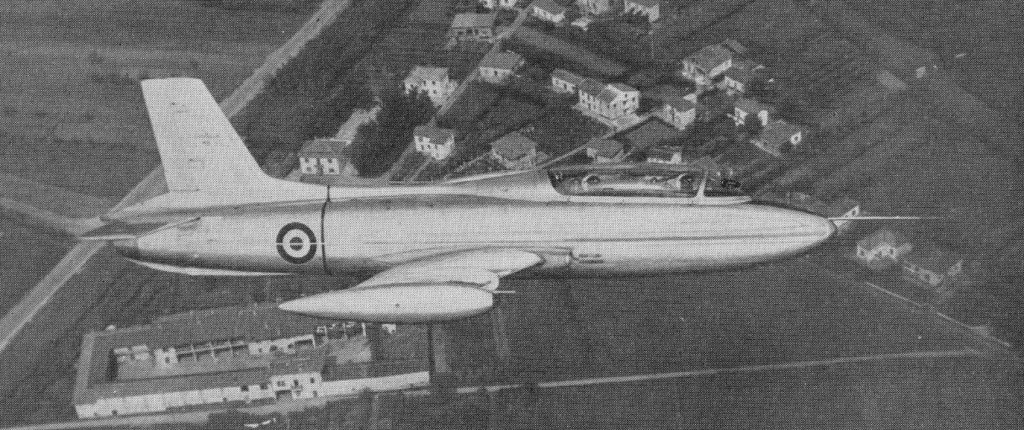
The first prototype, I-MAKI, first flew on 10 December 1957, powered by a Bristol-Siddeley Viper 8 turbojet, flown by test pilot Guido Carestiato. The wing is NACA 64A114 at the root and NACA 64A212 at the tip. Each wing has 22 ribs and two spars. The fuel system has a tank in the center of the plane and two at the wingtips. The aircraft was 400 kg (880 lb) more than initial estimates. The original Viper 8 engine producing 7.8 kN (1,750 lbf) of thrust, was replaced by the Viper 9 which was 0.7 kN (147 lbf) extra thrust. The first prototype was lost in Egypt on 22 April 1959.
The second prototype first flew on 22 September 1958 and a new Viper engine, the model 11, was updated to produce a thrust of 11.1 kN (1,134 kg, 2,500 lb).
On December 15, 1958, AMI placed an order for 15 pre-series examples. In 1960, orders for 100 aircraft were placed.
The first production model flew on 5 October 1960.
Guido Carestiano set C1D 1 group records for an altitude of 15 489 m during of August 1961 in an MB-326.
The machines eventually arriving at 214 ° Lecce-Galatina school Group; while deployed in Brindisi. The type entered service with 43 ° N Flyer on March 22, 1962. This engine replaces the T-6 Texan, and there is a “fully-jet” training course for AMI pilots.
Eight MB-326Bs were ordered by Tunisia in 1965. They were developed from the basic MB-326s with weapons capability, with the 37th AMI series aircraft converted (I-MAKC). The key innovation is the ability of the ground offensive, with six underwing pylons, holding a maximum of 907 kg. In the same year, Ghana ordered nine of the same MB-326Fs.
“C” and “A” models never materialized. “A” is intended as a light attack aircraft, with two 7.62 mm machine-guns in the nose, but never built. Then, a few MB-326s called “A”, but this only means that they are equipped with Marconi ADF-370 AD. “C” version is to have NASARR radar in the nose, to train F-104 pilot, but only appeared as a mock-up.
Alitalia ordered four aircraft as a coach in the D “version”; demilitarization and equipped with special instruments to train pilots in preparation for the new jet liners.
Pilot also provided publicity for the MB 326: Riccardo Peracchi, working for AMI, displayed the MB-326 in many airshows, while Massimo Ralli set many records: February 8, 1966, climb records: 2 min 2 sec to 3000 m, 3 minutes 56 seconds for 6,000 m, 6 minutes 39 seconds for 9,000 m and 12,000 m 10 minutes 53 seconds. March 18, 1966, a record of 15 690 m altitude in horizontal flight, and 17 315 m absolute. July 18, 1966, endurance record, with 970 km August 2, 1966, a record speed of more than 3 km straight: 871 km / h December 1966: the speed of 880.586 km / h over 15-25 km, 831.007 km / h over 100 km, 777.667 km / h over 500 km, and the endurance record at 777.557 km
Other MB-326G s using a Viper Mk 20 engine that provides 1,524 kg of thrust, and consequently much faster and has a payload increase of 1814 kg max. Argentina ordered eight, initially as-MB 326K, then called-MB 326GB.
Other MB-326G s using a Viper Mk 20 engine that provides 1,524 kg of thrust, and consequently much faster and has a payload increase of 1814 kg max. Argentina ordered eight, initially as-MB 326K, then called-MB 326GB.
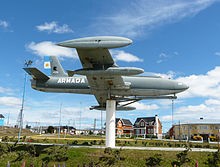
Argentine Navy MB-326 preserved in Río Grande, Tierra del Fuego
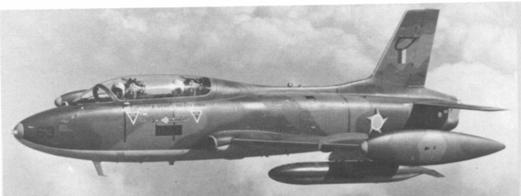
Since that time MB 326 B/F/ GC/K and M versions with attack/COIN capability were supplied to the armed forces of the Argentine, Bolivia, Brazil (where it is known as the AT 26 Xavante), Dubai, and South Africa (known as the Impala Mk 1). Some also served with Alitalia as the MB.326D.
Dubai bought three in 1974, and a further three in 1978 (MB-326KD), Tunisia eight (MB-326KT), Ghana nine (MB-326KB) and Zaire eight (MB-326KB). The MB-326L is essentially MB-326K with two seats. Two MB-326LD supplied to Dubai and four MB-326LD to Tunisia.
The engine is typically one 3,410 lb thrust Rolls Royce Bristol Viper 20 Mk 540 turbojet, and armament of up to 4,000 lb (1,814 kg) total can be carried on six underwing stations: this can include bombs, gun packs, rockets, and missiles. The MB.326G variant was fitted with a more powerful Viper 20 engine. An improved version was in production for the Italian Air Force under the designation M.B.339A.
The type was developed for the light strike role in the 326A, which was fitted with underwing hardpoints, culminating in the MB-326K single-seat close support version, which first flew on 22 August 1970. The additional of twin 30mm DEFA cannon was also introduced with the K model to compliment the already existing 6-hardpoints.
Engine upgrades moved from the 794-kg Rolls-Royce Viper 8 to the 1814-kg RR Viper 632. Variants of the MB-326 were used by Italy, Ghana, and Tunisia.
Seventeen were built in Italy for Zaire (Forces Arienne Zairoise) and 23 for the Air Force Zambia.
The MB 326K (originally known as MB-336) is a single seat model.
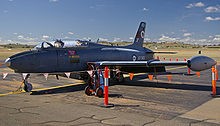
The aircraft were licence-built in Australia as the MB-326H, in Brazil as the AT-26 Xavante, and in South Africa as the Impala.
Brazil is the main customer for the 326-MB, in 1970 ordered two prototypes and 166-326GC s MB, called AT-26 Xavante.
The Forca Aerea Brasileira took delivery of its last 12 MB-326E, consisting of six MB-326 updated to MB-326G, and six newly produced (MM.54384 / 389). They had provision for weaponry and powered by 11 Viper 200 engine, not the Viper Mk 20 Mk 540 in 1981, bringing the Xavante line to a close, the final half dozen aircraft being replacements for export aircraft relinquished by the FAB from earlier contracts. They had provision for weaponry and powered by 11 Viper 200 engine, not the Viper Mk 20 Mk 540.
It was produced under license by Embraer with a further six for Togo (as the AT 26 Xavante) and 10 for Paraguay. Deliveries commenced in January 1983 of 12 ex-Forca Aerea Brasileira EMB-326GB Xavantes ordered for the 4a Escuadra Aeronaval at BAN Punta del Indio, Argentina. They were to make up attrition for two MB 326GB lost in accidents and three MB 339AA lost in the Falklands.
In Italian service the MB-326 was replaced by MB 339 between 1981 and 1984, after which they acted as liaison aircraft, replacing Lockheed T-33s. Excluding the prototype, 33 Italian Air Force MB-326s were lost in accidents between 1963 and 1992.
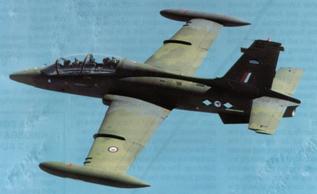
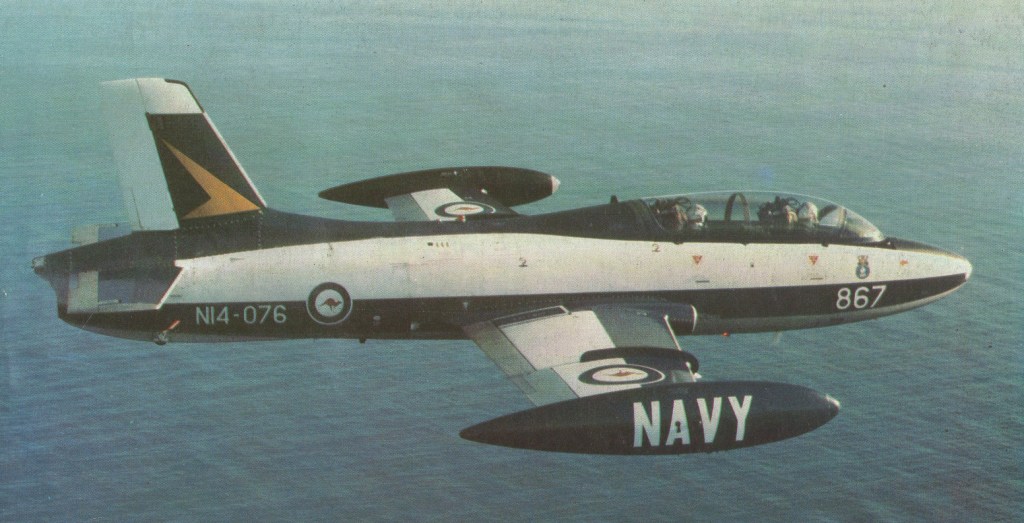
The MB326 was selected by the RAAF in the advanced training role in 1964 and by the RAN (10 RAN, 87 RAAF) in 1969. 12 were delivered by Macchi, 18 are assembled from kits in Australia, and another 67 built by the Commonwealth Aircraft Corporation and Hawker aircraft with the designation CA-30. Manufacturered by Commonwealth Aircraft Corporation, Melbourne, Victoria, Australia, under licence to Aermacchi, the first was delivered in October 1967 and the last in September 1972.
South Africa received a license to produce MB-326M (similar to G ‘model’), as Impala Mk I in 1964 with production beginning in 1966. They received 40 Italian-built aircraft followed by about 125 built locally by Atlas Aircraft Corporation, use them both as a trainer and in the armed configuration. Seven examples of the MB-326K also purchased as a light attack aircraft, with a further 15 assembled from a kit, while about 78 were license-produced and is known as the Impala Mk II. Production licenses of the single-seat version began in 1974.
South African Impalas were used in the battle against Angola, the Cuban and some militias, usually flying at 550-650 km / h at an altitude of 15 m. One was shot down by SA-7 and another returned with an unexploded missiles (SA-7, 8 or 9) in the flue gas. Six squadrons were equipped with Impala Mk. II in the SAAF during the 1970s and 1980s. During 1987 and 1988 Impalas were withdrawn from the front line, leaving Mirage and Buccaneers. Impala Mk. IIs also shot down a total of six Mi-8 and Mi-24 helicopters.
The Silver Falcons, the SAAF aerobatic team, were equipped with Impala Mk Is and on October 2, 1993, an Impala Mark I (Aermacchi MB-326) (no. 489) from the SAAF Silver Falcons aerobatic team fell after a separation of the right wing during a performance at the Airshow Lanseria. Pilot, Captain Charlie Rudnick was injured as the ejection was started outside the design envelope ejection seat.
Flying school for Impalas were Flying Training School in Langebaanweg while operational squadron 4, 5, 6, 7 and 8 squadrons while 85 Advanced Flying School also has a small number Impalas to supplement their Mirages.
AL Argentina – The Naval Argentina Flights received eight MB-326GB plus eleven MB-326GC ex-Brazilian Air Force
Royal Australian Air Force operated 87 MB-326Hs (RAAF serial A7-001 to -072, -079 to -083) 1967-2001. No. 25 Squadron RAAF No 76 Squadron RAAF No. 77 Squadron RAAF No 79 Squadron RAAF No. 2 Flying Training School RAAF RAAF No. 2 Operational Conversion Unit No. 5 Operational Training Unit RAAF Fitness RAAF Flying School Roulettes Telstars Aircraft Research and Development Unit Fleet Air Arm (RAN operated ten MB-326Hs 1970-1983. No. 724 Squadron RAN
Brazilian Air Force received 182 MB-326GCs (known as AT-26 Xavante) and 12 Atlas Impala former South African Air Force.
Cameroon Air Force has five in service.
Air Force Democratic Republic of the Congo
Dubai Air Wing
Ghana Air Force received 15 MB.326s.
Alitalia Italian Air Force operated 106 MB-326s, including 15 pre-production version.
Paraguay Air Arm ten operated EMB-326GBs / AT-26 Xavante, all retired in 2003.
South African Air Force received a 62 MB-326s plus 125 Impala Mk.1s and 73 Mk.2s
Togo Air Force received six MB-326GCs.
Tunisian Air Force received 16 MB-326s.
United Arab Emirates Air Force purchased six aircraft.
United States of America National Test Pilot School
Zaire Air Force received 25 MB-326GBs.
Zambia Air Force receives 23 MB-326GB.
Variants: MB-326: Two prototypes and 125 production of training aircraft for the Italian Air Force. MB-326A: Proposed armed version for weapons training, not built. MB-326B: Two-seat trainer jets, light aircraft attacks to Tunisia. (Eight built). MB-326D: Two-seat jet trainer armed for Alitalia. (Four built). MB-326E: Two-seat jet trainer armed to the Italian Air Force. (Six built). MB-326F: Two-seat trainer jets, light aircraft attack for Ghana. (Nine built). MB-326G: Two-seat trainer jets, ground-attack aircraft. (Two built). MB-326GB: Two-seat trainer jets, ground-attack aircraft. Eight sold to the Argentine Navy. 17 aircraft were exported to Zaire, and another 23 aircraft to Zambia. MB-326GC: Two-seat trainer jets, ground-attack aircraft for the Brazilian Air Force. Built under license in Brazil as the Embraer EMB-326. 167 aircraft were built for the Brazilian Air Force. Eleven of the Brazilian aircraft transferred to AL Argentina after the Falklands War. Six aircraft were exported to Togo, and another ten aircraft Paraguay. Total production, 182. AT-26 Xavante: Brazilian Air Force designation MB-326GC. RT-26 Xavante: Some AT-26 Xavantes converted into reconnaissance aircraft. MB-326H: seat jet trainer-Two, 87 aircraft were built for the Royal Australian Air Force, and 10 to the Royal Australian Navy. Built twelve Italian aircraft and 85 built under license in Australia by the Commonwealth Aircraft Corporation with the designation CA-30. MB-326K: Single-seat ground-attack aircraft for the South African Air Force. Built under license in South Africa by the Atlas Aircraft Corporation. Impala II: South African Air Force designation MB 326K. MB-326KB: Single-seat ground-attack aircraft for Zaire. (Six built). MB-326KD: Single-seat ground-attack aircraft to Dubai. (Three built). MB-326KG: Single-seat ground-attack aircraft for Ghana. (Four Built). MB-326KT: Single-seat ground-attack aircraft for Tunisia. (Seven built). MB-326L: Two-seat advanced jet trainer. MB-326LD: further training Two-seat jet plane to Dubai. (Two built). MB-326LT: further training Two-seat jet aircraft for Tunisia. Four built. MB-326M: Two-seat trainer jets, ground-attack aircraft for the South African Air Force. Built under license in South Africa by the Atlas Aircraft Corporation. Impala I: South African Air Force designation MB-326M. MB-326RM: Five Italian Air Force MB-326s aircraft converted into ECM.
Specifications:
MB.326 Engine: 2 x Bristol Siddeley Viper 22 1 turbojet, 2500 lbs.t. (1134 kgp) Span: 32 ft 10.75 in (10.04 m) Length: 35 ft 1 in (10.66 m) Wing area: 204.52 sq.ft (19sq.m). Height: 3.5 m / 11 ft 6 in Never exceed speed: Mach 0.8 Max speed: 501 mph / 806 kph / 436 kt at 4,575 m (15,000 ft) Cruise: 348 mph (560 kph) Stall speed: 146 km / h (79 knots, 91 mph) Initial climb: 4,420 fpm. (22.5 m/sec) Service ceiling: 41,000ft (12,500 m) Range w/tip tank 11,500 m (38,000 ft): 1,665 km (900 nautical miles, 1,035 miles) Empty weight: 4,930 lb (2 237 kg) Loaded weight: 7,320 lb (3 320 kg). Armament: 3 machine-guns, 4 missiles Hardpoints: 6 Bombload: Up to 2000 lb (900 kg) Crew: 2
MB-326H Engine: 1 x Rolls-Royce Viper 11 Mk.22-11 turbojet, 2,500 lb Wing span: 35 ft 11 in (10.8m). Length: 34 ft 5 in Height: 11 ft 4 in Empty weight: 5,027 lb Loaded weight: 7,340 lb Crew: 2 Initial Rate of Climb: 4,420 ft/min Ceiling: 40,000 ft Speed: 506 mph Range: 940 miles Armament: 2 x 7.62 mm Miniguns and bombs
MB-326K Engine: 1 x Rolls-Royce Viper 632-42 turbojet, 4,000lbs thrust. Length: 35.01 ft (10.67m) Width: 35.60 ft (10.85m) Height: 12.20 ft (3.72m) Empty Weight: 6,535lbs (2,964kg) Maximum Take-Off Weight: 12,996lbs (5,895kg) Maximum Speed: 553mph (890kmh; 481kts) Maximum Range: 677miles (1,090km) Rate-of-Climb: 6,500ft/min (1,981m/min) Service Ceiling: 41,010ft (12,500m) Armament: 2 x 30mm DEFA cannon Max external ordnance: 4,000lbs Seats: 1 Hardpoints: 6
In 1977 the Italian Air Force (AMI) issued a requirement for a multi-role strike/recce aircraft to replace its Fiat G-91R/Ys and F-104G/Ss.
Mid-1978 Aeronautica Macchi concluded an agreement with Aeritalia for the joint design, development and production of what became the AMX (Aeritalia-Macchi-eXperimental). This agreement provided for assembly lines in both countries and single-sourced sub-assemblies.
Alenia and Aermacchi started development of the AMX and in 1980 Embraer joined the project, the Brazilian Air Force (FAB) also having issued a requirement for a similar aircraft to replace its AT-26 Xavantes. The consortium was based in Rome, Alenia 46.5%, Aermacchi 23.8%, and Embraer 29.7%.
The basic single-seat aircraft is designed for daytime low-level attack and tactical reconnaissance. Work was split 70:30 between Italy and Brazil, and 70:30 between Aeritalia and Aermacchi in Italy. Embraer was responsible for the wings, flaps, intakes, and tailplane, Aermacchi for the forward and rear fuselage sections, and Aeri¬talia for the centre fuselage and fin. Italy built four prototypes and Brazil two. Final-assembly lines were located in both countries.
In May 1984 the AMX made its first flight, and in February 1987 Embraer’s first prototype flew with the purpose-designed reconnaissance pallet, and by May the aircraft was undertaking static test firing of the Brazilian versions twin 30mm DEFA cannon. A second Brazilian prototype joined the test programme in December 1986.
The AMX International AMX has high-mounted monoplane wings, twin intakes and a single engine exhaust under the single tail rudder. Crew accommodations vary with model and can either be a single pilot or pilot and rear-cockpit operator in tandem. Standard armament varies between the Italian and the Brazilian models, with the Italian version receiving a single 20mm General Electric cannon and the Brazilian version being fielded with twin 30mm DEFA cannons. Four underwing hardpoints, a centerline hardpoint and wingtip hardpoints are fitted. Wingtip mounts are reserved for short-range air-to-air missiles.
Final assembly of the first Italian production AMX began on schedule in January 1987 and was delivered to the Italian Air Force in January 1989 and to the Brazilian Air Force in 1990.
The AMX were assembled in both Italy as Brazil. Planed build was for 317 aircraft of both types (238 for Italy and 65 for Brazil). The initial order was later cut to 136 due to budgetary constraints to defences in both countries. Production continued with little in the way of developmental setbacks. Production of the AMX series broke down with Alenia (Aeritalia) handling up to 46.7% whilst Embraer took 29.7% and Aermacchi 23.6%. Final production would be handled in their respective countries.
A single-seat multi-role strike fighter aircraft, designed to fly low-altitude missions at high-subsonic speeds in day or night and in poor visibility, it is capable of operating from damaged or unprepared runways. It has a limited air-to-air capability and integrated ECM for self defense.
AMX-T is the twin-seat variant of the AMX and is used as advanced trainer. The AMX-T retains the operational capabilities of the single-seat version.
The aircraft for the Brazilian Air Force (FAB) are designated A-1 (single-seat) and TA-1 (two-seat), and are equipped with two DEFA 544 30mm cannons, while the Italian variant is fitted with one M61A1 multi-barrel 20 mm canon.
The Brazilian A-1/TA-1 fleet underwent an upgrade, the aircraft designated A-1M in FAB service, The A-1M upgrade is based on the Brazilian AT-29 and the F-5M upgrade program, giving the aircraft many simularities in avionics and capabilities. The new cockpit includes three colored MFDs, HOTAS, new multimode radar (the Italian Grifo F) and the capability to use smart weapons.
The Italian AMX and AMX-Ts went through the ACOL upgrade program. Alenia Aerospace upgraded 43 single-seat and 12 two-seat AMX aircraft as the AMX-ATA extending the operational life to 2015 and giving the AMX improved combat capabilities. It includes a new inertial navigation system/GPS, GPS-guided weapons integration, new colour MFDs, updated communications and IFF, and a new computer symbol generator with digital map functions.
The AMX aircraft under the Italian banner saw extensive service in the war against Serbia in Operation Allied Force, accounting for over 250 sorties all its own. The system was fielded with advanced Israeli Elbit Opher imaging infra-red guided bombs, Mk 82, Mk 83 and Mk 84 conventional bombs and Paveway II laser-guided bombs.
Variants: AMX A-1 TA-1 AMX-T AMX-ATA
AMX International AMX (Ghibli) Engine: 1 x R-R Spey 807 non-afterburning turbofan, 49.1 kN (11,030 lb st) Length: 44.521 ft / 13.57 m Height: 15.026 ft / 4.58 m Wingspan: 29.101 ft / 8.87 m Wing area: 226.044 sqft / 21.0 sqm Max take off weight: 28665.0 lb / 13000.0 kg Weight empty: 14773.5 lb / 6700.0 kg Wing load: 126.9 lb/sq.ft / 619.0 kg/sq.m Max. speed: 493 kts / 913 km/h Initial ROC: 10236.22 ft/min / 52.0 m/s Service Ceiling: 13,000 m / 42,650 ft Maximum Range int. fuel: 345miles (556km) Max range: 1801 nm / 3336 km T/O run: 950 m Ldg run: 1525 m. Crew: 1 / 2 Hard points: 5 + 2 wing tips. Armament: 1 x 20mm General Electric GE M61A1 Vulcan cannon (Italian AMX) with 350 rounds 2 x 30mm DEFA cannons (Brazilian AMX) Bombload: 3800 kg (8,377 lb)
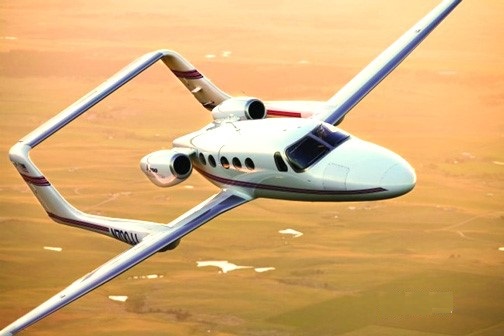
Derived from the A500, the A700 twin-jet (two Williams FJ33, 1700 lb) began testing on 27 July 2003. The Adam 700 flew into AirVenture on a Thursday in 2003 after only a few test flights. The pilot never retracted the gear in flight from Denver to Oshkosh. The airfoil is the NASA LS(1)-0417 from root to tip.



 All Aero