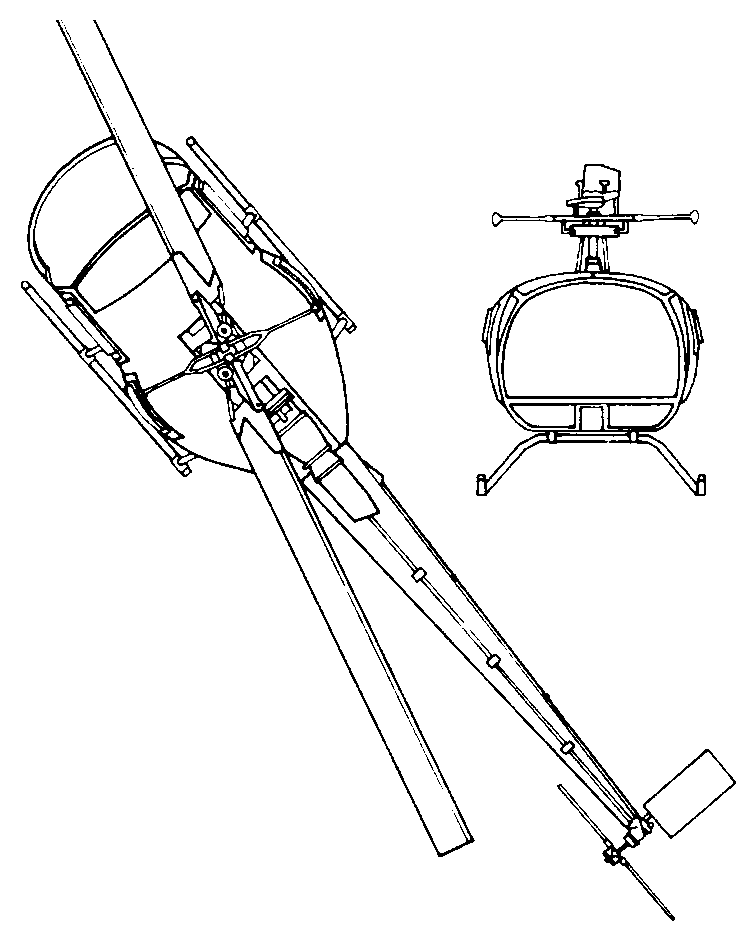
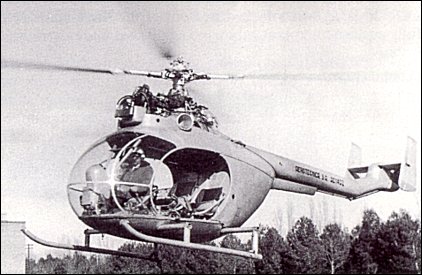
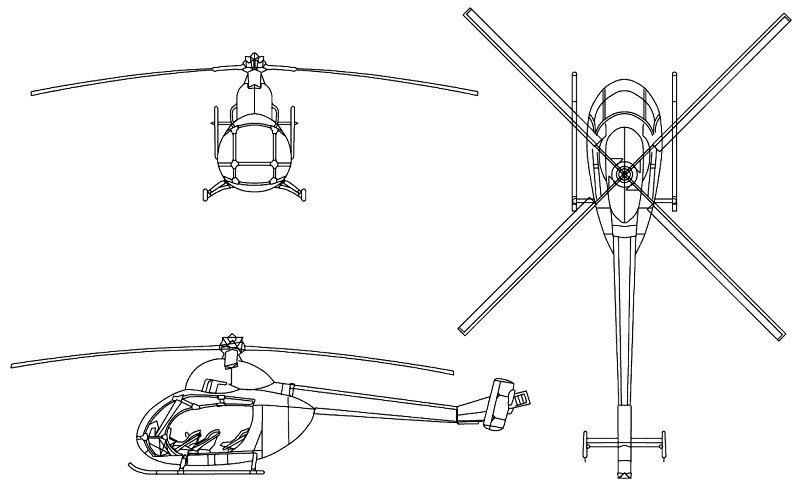
Flown in prototype form early in November 1965, the Agusta A.106 is a small lightweight armed helicopter designed initially in an antisubmarine role. The single-seater had a Turbomeca-Agusta TAA-230 turbine behind the cockpit, and the 2-blade main rotor, and the tail section including the 2-blade tail rotor, can be folded for stowage on board ship. With a standard skid landing gear, an auxiliary fuel tank may be carried externally. Systems included an autostabilizing device, an acoustic submarine detector and armament of two Mk.44 torpedoes. The Ferranti company developed an electronic three-axis stability augmentation system for the A 106, providing a stable firing platform and damping out external disturbances. The Italian Navy ordered two prototypes and five production aircraft, but construction of the production aircraft was suspended in 1973.
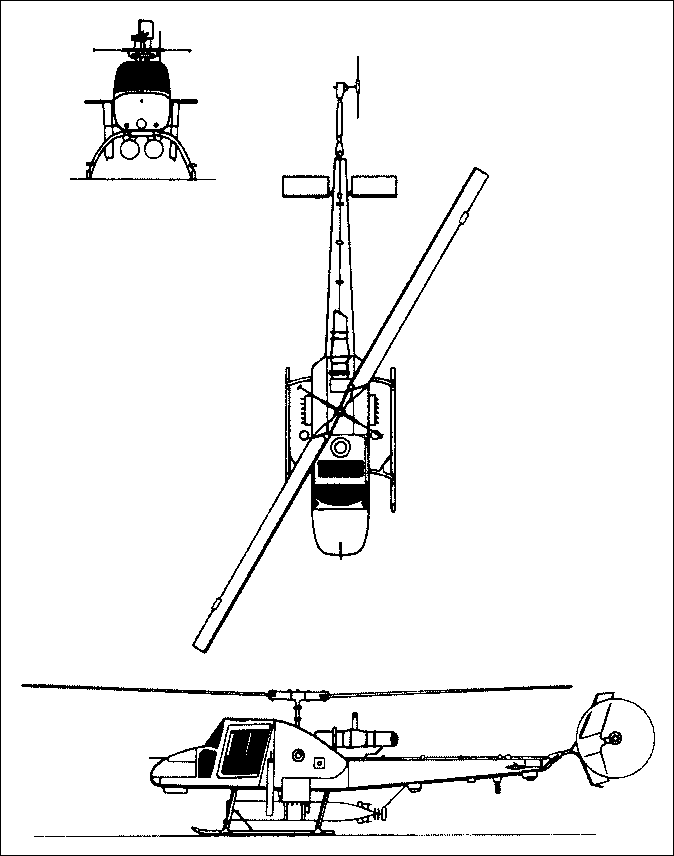
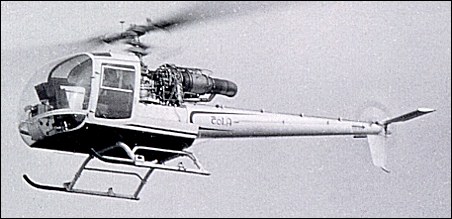
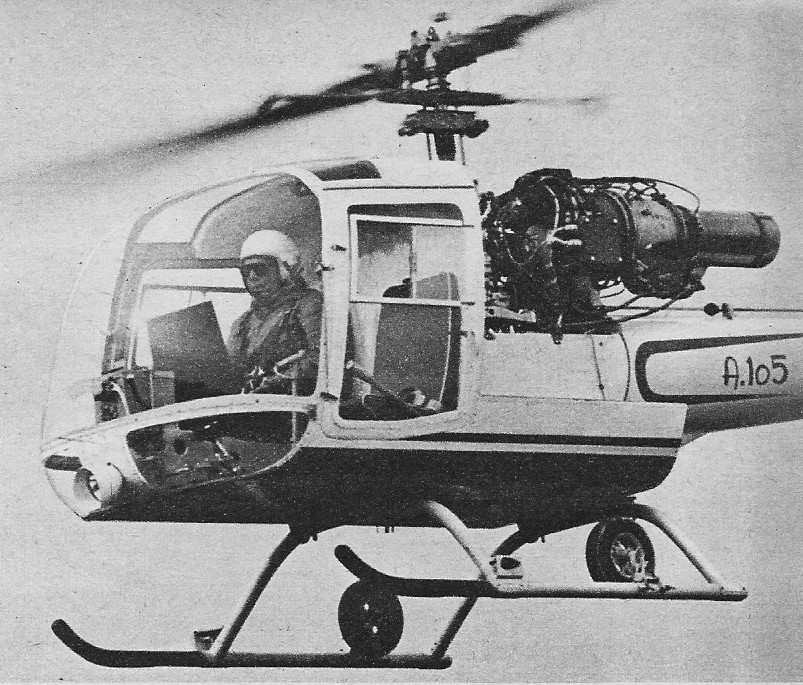
The A.105 small helicopter was designed from the start to simplify the manufacturing process and was powered by a Turbomeca-Agusta TA-230 turbine engine developing 350shp. The design also incorporated an Agusta-designed transmission.
First flown in April 1964 the A.105 was built in two models – the A.105 two-seater and the A.105B four-seat variant. Cruising speed was around 210kph with a range of 320km. The four-seat variant, the A.105B, was displayed at the 1965 Paris Air Show. It had the same mechanical and structural parts as the two-seater, but a bigger cabin. Both helicopters never progressed beyond the prototype stage.
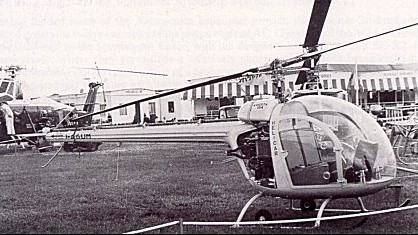
The all-metal two-seat A.104 developed from the A.103 was produced by the Cascina Costa works. With a single stabilised rotor, skid udercarriage and powered by one 140hp Agusta MV-A120 piston engine, the first of two prototype, I-AGUM, first flew in December 1960. One A.104BT was built; an A.104 with a 270shp Agusta A.270 turboshaft engine.
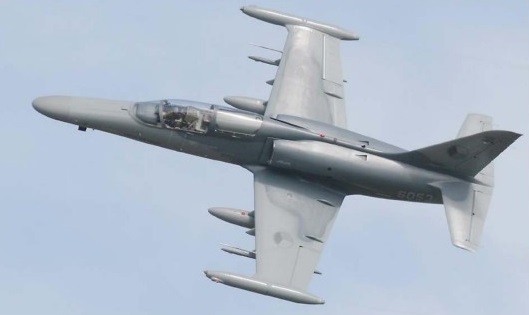
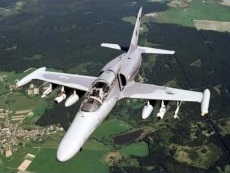
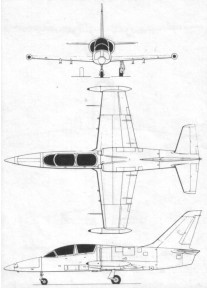
The L-159 ‘Albatross II’ was developed from the L-39 Albatross family for a Czech Air Force’s requirement in the early 1990s. Based on the L-59, the tandem canopy was retained, the back seat of the single-seat L-159A being occupied by an additional fuel tank. This enabled Aero to offer a two-seat combat capable version, designated L-159B, for training and operational conversion. Compared to the L-59, a number of changes were made although the aerodynamic configuration was retained. The airframe was strengthened and the cockpit area was reinforced with composite and ceramic ballistic armour to offer the pilot better protection. The aircraft’s nose was enlarged to accomodate the radar, and the fuselage was extended behind the cockpit, making the L-159 0.52m (1ft 8in) longer than the L-59. One centre-line weapon pylon was added and the number of underwing pylons was increased from four to six.
The engine was replaced with the US Honeywell/ITEC F124-GA-100 non-afterburning turbofan, of 6,300 lb of thrust (28,58 kN), providing about 66% more thrust than the L-39’s AI-25TL turbofan, and almost 30% more than the L-59’s Slovak ZMK DV-2 turbofan. Providing a better thrust-to-weight ratio and the ability to carry full weapon loads, the new engine makes the aircraft faster and more capable in the combat role. The L-159A is fitted with the Italian FIAR Grifo-L multimode pulse Doppler radar. The radar has five air-to-air modes including track-while-scan with four air combat submodes, and is able to track up to eight targets simultaneously. For ground and maritime attack it has nine air-to-surface modes. The L-159B it features a full cockpit including HUD repeater panel. Both versions are fitted with lightweight fully automatic VS-2C zero-zero ejection seats and a canopy jettison system.
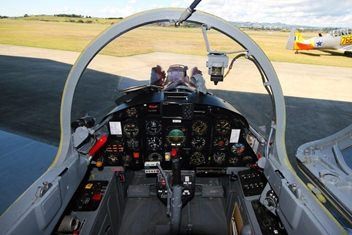
The L-159 has the digital MIL-STD-1553 integrated avionics system with two multi-function colour displays and analogue instruments for backup. The cockpit is NVG-compatible and has NATO-compatible radios for secure communication. For navigation it uses a Honeywell GPS navigation system, with Ring Laser Gyro INS as backup. The Head-Up Display is the FV-3000 by Flight Vision, and the L-159 provides Hands On Throttle And Stick (HOTAS) functionality. The L-159 is capable of carrying a wide range of NATO-compatible weapons. The short-range air-to-air AIM-9M Sidewinder and the air-to-ground AGM-65 Maverick air-to-surface missiles have been integrated. Unguided weapons include Mk.82 bombs, CBU-87 cluster bombs and LAU-5002 rocket launchers. The aircraft is also capable of carrying a podded 20mm cannon.
The Czech government signed a contract with Aero on April 11, 1995, to fund 25% of the development cost and stated a requirement for 72 single-seat L-159A, but this many aircraft far exceeded the requirement, and there were no orders for the L-159B.
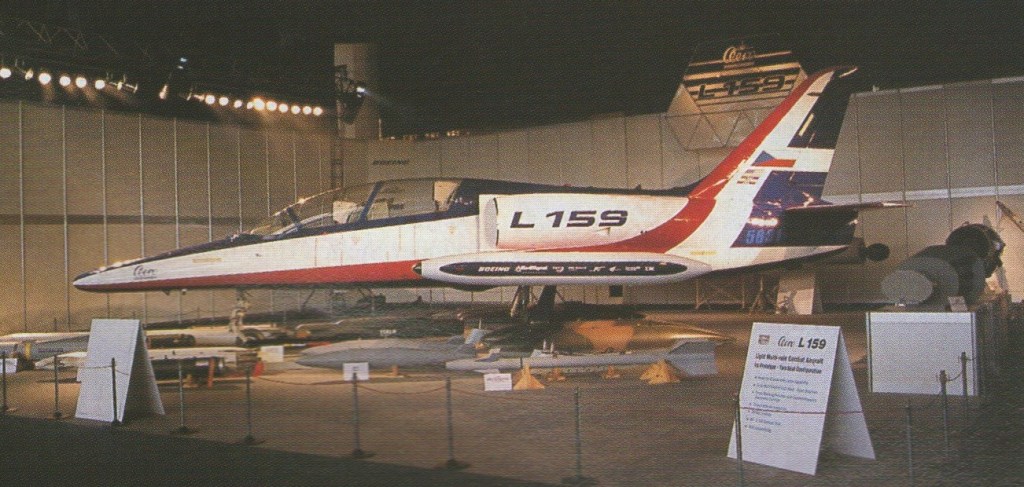
prototype L-159, 5831
The prototype L-159, 5831, was unveiled at Aero Vodochody near Prague on 12 June 1997.
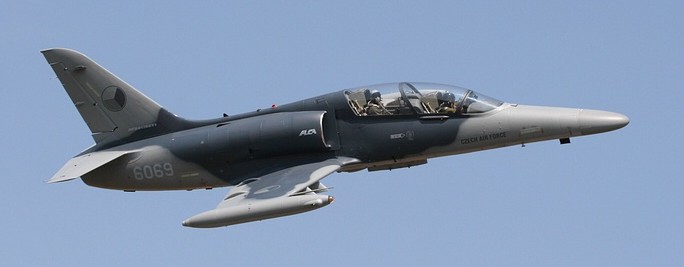
The first prototype (L-159T serial 5831) was rolled out on June 12, 1997, and first flew on August 2, 1997, flown by Aero’s chief test pilot Miroslav Schutzner. The second prototype (L-159A serial 5832) made its first flight on August 18, 1998. Again flow by Schutzner, it was the first single-seat aircraft to fly with the space of the rear cockpit being occupied by test equipment. In 2002, the third L-159 protype performed its maiden flight on June 1. Designated L-159B, ‘6073’ was a two-seat version designed for advanced training and operational conversion. The first L-159A arrived at Çáslav AB on December 27, 2000, joining the 42 Fighter Squadron. Economic conditions resulted in defence cutbacks, putting the L-159As into storage. 212 FS remained as the sole L-159 unit with just 18 L-159A ALCA and six aircraft as reserve. The Czech Air Force ordered the conversion of a number of L-159A single-seat aircraft into L-159T1 two-seaters. The Czech MoD signed a contract for four conversions of surplus L-159A aircraft to two-seat L-159T1 trainers on June 26, 2006. Two days later the first L-159A arrived at Aero’s plant, serialled 6069 it is one from the 24 at Çáslav AB. It was completed in early 2007 and made its first flight on March 8, 2007. The three others converted to L-159T1 are 6067, 6071 and 6072. All four L-159T1 were officially accepted back into service on November 23, 2007. L-159T1 is the designation introduced by the Czech Air Force, Aero Vodochody also referred to the conversion as L-159BAT (“B from A for Training”). The L-159T1 conversion replaces the front fuselage with a new one providing the second cockpit. The new version lacks cockpit protective armour, but closely resembles the L-159A on all other areas to provide a good conversion trainer. Aero Vodochody has failed to attract any customers and the Czech MoD also failed to find any takers for its surplus of 47 L-159A ALCAs. Despite this, Aero Vodochody continued to develop the L-159 offering new capabilities including aerial refueling capability.
Aero L 159 ALCA Engine: Allied Signal / ITEC F 124 GA-100, 28.58 kN / 6,300 lb turbofan Length: 41.765 ft / 12.73 m Height: 15.682 ft / 4.78 m Wingspan: 31.299 ft / 9.54 m Wing area: 202.363 sqft / 18.8 sqm MTOW: 17640.0 lb / 8000.0 kg Weight empty: 9172.8 lb / 4160.0 kg Internal fuel: 1596 kg / 5,159 lb Max fuel: 2973 kg / 6,554 lb Max. speed: 505 kts / 936 km/h / 582 mph Initial climb rate: 9251.97 ft/min / 47.0 m/s Service ceiling: 43307 ft / 13200 m Wing load: 87.33 lb/sq.ft / 426.0 kg/sq.m Range int. fuel: 1570km / 850 nm Max range: 2250km / 1,215 nm Crew: 1-2 Armament: 7x ext. Max. stores: 2340kg / 5,159 lb Design load: +8/-4 G
Similar externally to earlier versions, the L 59 (previously designated L 39MS) has a more powerful DV 2 engine of 4,850 lb st (21,57 kN) giving a 20 per cent improvement in climb-rate, a VS 2 zero/zero ejection seat, and upgraded avionics including a HUD. First flight was made on 30 September 1986.
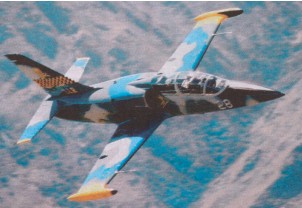
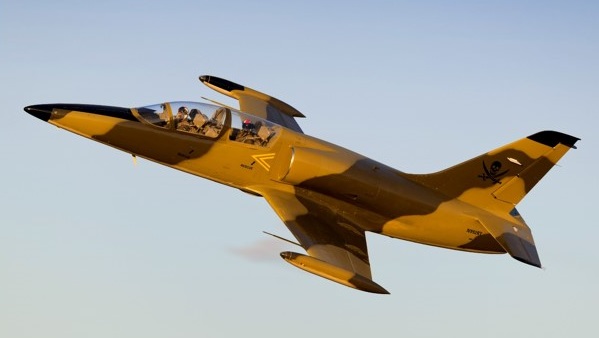
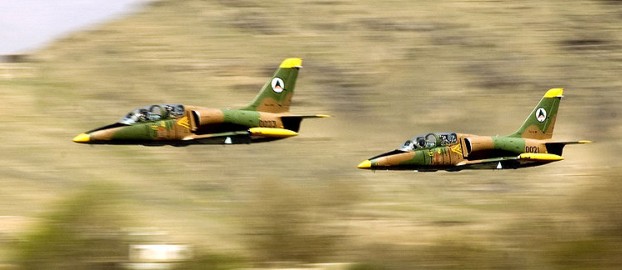
The Albatros, first flown on November 4, 1968, is the L 29’s successor as the standard trainer of all Warsaw Pact countries except Poland, and was in production in a light attack version, mainly for export. Designed three years after the L-29, the L-39 went through a series of prototype and development models before seeing production begin in 1972. The L-39 was designed with simplified and a more modular approach to engineering allowing the L-39 to be produced more efficiently and quicker than the L-28. The base powerplant allowed for a thrust upgrade when compared to the L-29 and avionics coupled with reinforced subsystems put the L-39 ahead.
A tandem seater, with the instructor in the raised rear ejection seat, it is powered by the 1720 kg (3792 ¬lb) thrust Walter Titan, the Czech built Ivchenko Al 25TL turbofan also used in the Yak 40 STOL trijet. The name Albatros is used only for L 39 aircraft in service with the Czech air force, to which deliveries began in April 1974.
The basic aircraft is equipped with a camera gun and electrically controlled gunsight, but has no internal gun. Gun pods, bombs, rockets and missiles can be carried on two or four wing pylons along with a centerline-mounted 23mm GSh-23L twin-barrel cannon for close quarters work.
With production of 2,600 by 1990 it proved to be a very successful aircraft, with more than 2,900 built by 2005 with about 300 in civilian ownership around the world.
The aircraft is fully aerobatic stressed for +8G and 4G and can climb at the rate of about 3500 feet per minute. Export numbers for the L-39 Albatross were roughly the same as the L-29. Thailand went on to purchase an export model designated with L-39 ZA/ART that featured Israeli-produced Elbit avionics. The most numerous in terms of production was the L-39 “C” model, which helped drive total production total past 3,000.
L-39C
Earlier variants of the aircraft are the L.39ZO weapons trainer, the L.39ZA ground attack and reconnaissance aircraft, which has an under-fuselage gun pod and four wing hardpoints, and the L.39V target tug. The L.39MS version of the Albatros was rolled out in mid-1986, but later designated the L-59.
Aero L 39 Albatros Engine: Ivtshenko AI 25 TL turbofan, 3,792 lb / 16873 N Wingspan: 31.037 ft / 9.46 m Length: 40.42 ft / 12.32 m Height: 15.486 ft 4.72 m Wing area: 202.363 sqft / 18.8 sqm Aspect ratio: 4.4 Area of elevons: 18.299 sqft / 1.7 sqm Area of flaps: 28.848 sqft / 2.68 sq.m Empty weight: 7,340 lb MTOW: 11,618 lb Max. speed: 405 kts / 750 km/h Landing speed: 92 kts / 170 km/h TO distance: 1476 ft / 450 m Landing dist: 2034 ft / 620 m Initial climb rate: 4330.71 ft/min / 22.00 m/s Service ceiling: 37730 ft / 11500 m Wing load: 49.41 lb/sq.ft / 241.00 kg/sq.m Range: 589 nm / 1090 km Crew: 2 Armament: 1100kg ext. 4 pods., 23mm MK
L.39A Engine: 1 x Walter Titan, 1720 kg / 3792 lb thrust. Span: 9.4 m / 31 ft 0.5 in Length: 12.25 m / 40 ft 5 in Gross weight: 4535 kg / 9998 lb Max speed: 750 km/h / 466 mph
L-39C Engine: 3,800 lbs thrust turbofan. Max wt: 4500 kg. Speed: M 0.8 / 500mph / 600kph / 490 KIAS Ceiling: 36,000 ft. G-Limits: +8 / -4 Payload: 550 lb per pylon (2) Endurance: 1.5+
L.39Z Engine: 1 x Ivchenko AI-25TL, 16.9 kN. Span: 9.5 m. Length: 12.1 m. Wing area: 18.8 sq.m Empty wt: 3650 kg. MTOW: 5600 kg. Warload: 1100 kg. Max speed: 755 kph. Initial ROC: 1260 m / min. Ceiling: 11,000 m. T/O run: 480 m. Ldg run: 600 m. Fuel internal: 1255 lt. Range: 1750 km. Combat radius: 600 km. Armament: 1 x 23 mm. Hardpoints: 4.
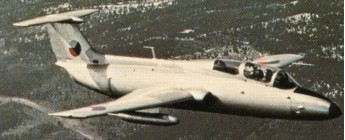
The Czech designed and produced Aero L-29 Delfin (translating to “Dolphin”; NATO designation of “Maya”) series was a highly utilized Cold War jet trainer aircraft for the Soviet Union and its satellite states. The twin-seat aircraft was capable of speeds over 400 miles per hour and a ceiling of over 36,000 feet.
Early design studies for a two-seat jet trainer were conducted by K Tomas and Z Rubic in 1955. The L-29 features a T tail and can operate from grass, waterlogged, and dirt strips.
The single engine L-29 was built from two XL-29-designated prototypes – one fitted with a British Bristol Siddeley Viper turbojet engine and another fitted with an indigenous 1,960 lb thrust M 701c 500 turbojet, first flown on 5 April 1959. The XL-29 powered by an M 701 turbojet flew for the first time on April 5, 1960.
Further development saw a three-way competitive fly-off occur against the Yak-30 design and the PZL Mielec TS-11 Iskra with the L-29 coming out ahead (Poland would go on to utilize the TS-11 trainer however). Placed in production in 1963, it subsequently became a standard trainer with many Warsaw Pact and other countries.
The last of over 3,600 rolled off the production line in 1974. Almost all production was of the basic aircraft variant (codename Maya), although two other variants did appear.
The Soviet Union alone took over 2,000 Delfins, while significant numbers also served in Czechoslovakia, East Germany, and Hungary. In these countries the Delfin was used in all-through training from ab iniito to advanced stages.
Small numbers of a single seat L-29A Delfin Akrobats were built for aerobatics while a prototype L-29R dedicated attack aircraft was also built.
With two available underwing hardpoints, a light attack strike aircraft was designed that could carry gun pods, drop bombs and rockets. Specialized aerobatic performers were also devised from the existing base L-29 airframe. 3665 were built until production ceased in 1974, superceded by the L-39. NATO name Maya.
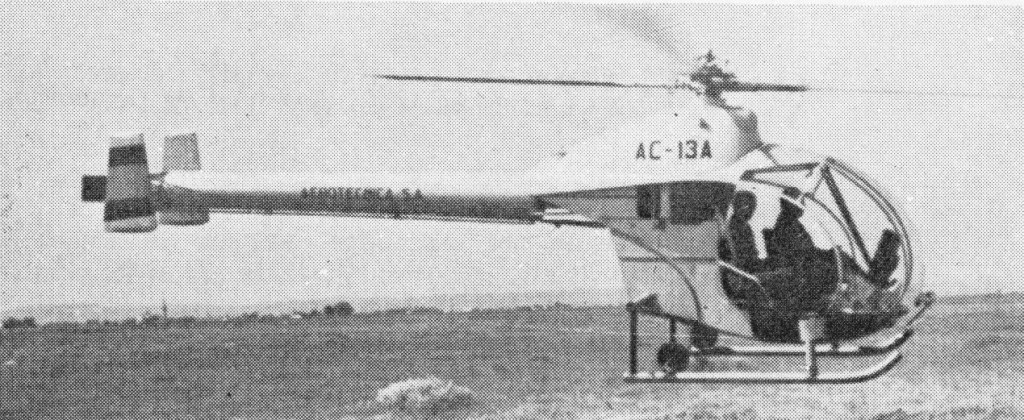
An improved version of the AC-13 was designed, known as the AC-14. A larger version of the AC-13, powered by a Turbomeca Artouste II shaft turbine and with accommodation for five. The prototype AC.14 used part of the structure of one of the AC.13s but had a lengthened cabin section with a rear seating area and a larger 400shp Turbomeca Artouste IIB turboshaft engine. The engine is mounted above the cabin, which is extensively sound-proofed. Residual thrust is used to increase forward speed, and anti-torque control by gas deflection in helicopter flight and by vertical rudders in gyrodyne flight (high speed cruising). The single, four-blade rotor has double-articulated blades with an area each 0.84sq.m, and total disc area of 72.35sq.m. The landing gear of of skid type with a 2.0m track. The enclosed cabin seats a pilot at the front and four passengers in two side-by-side pairs behind. Entrance doors are on each side of cabin. An initial series of six was completed in Madrid by ENHASA and the first flew on July 16, 1957. Having provided funds for the Aerotecnica helicopter project, the Spanish Government ordered ten examples. These were delivered to the Spanish Air Force, with the designation EC-XZ-4, where they served for a relatively short period before being retired.
Aerotecnica AC-14 Engine: 1 x Turbomeca Artouste IIB shaft-turbine, 400hp. Oil capacity: 9.4 lt Main rotor diameter: 9.60m Overall length: 11.22m Fuselage length: 8.25m Height: 3.10m Weight empty: 700kg Weight loaded: 1300kg Max speed: 180km/h Cruising speed: 150km/h Best rate of climb SL: 300m/min HIGE: 2700m Service ceiling: 6350m Range: 260km Fuel capacity: 74 lt ag version Fuel capacity: 244 lt passenger version.
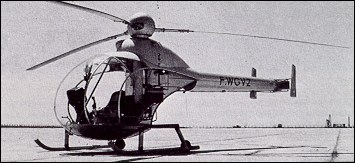
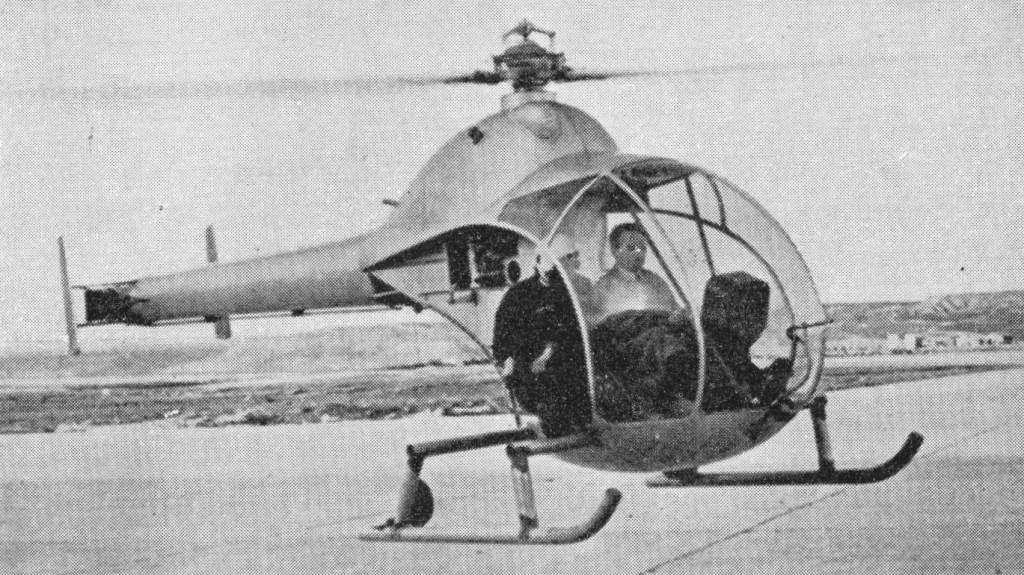
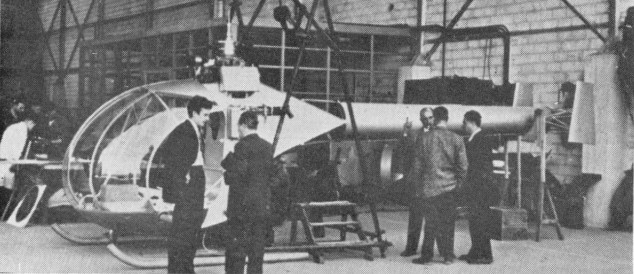
Jean Cantinieau had been working on a three-seat turbine-powered helicopter, the designs for which he had sold to Societe Nationale de Constructions Aeronautiques du Nord (S.N.C.A.N.). Very similiar to the AC.12, SNCAN built two prototypes as the Nord N.1750 Norelfe with a large bubble canopy and a Turbomeca Artouste I turbine mounted above and behind the cockpit.
The three-blade rotor was positioned directly above the engine and had a rotorhead enclosed in a large spherical fairing. The tail rotor was replaced by a ducted exhaust gas controlled by the pilot through pedals.
The first Noreife prototype, F-WGVZ, was flown on 28 December 1954 but SNCAN sold both the aircraft and the rights to Aerotecnica who designated them AC.13A. After further testing in Spain, Aerotecnica moved to a larger five-seat version known as the AC.14.
The two prototypes were acquired by the Spanish Government.



 All Aero