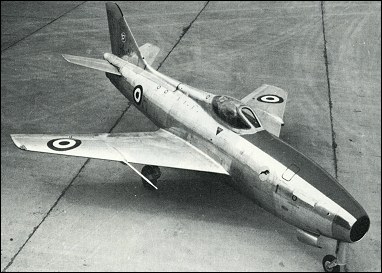
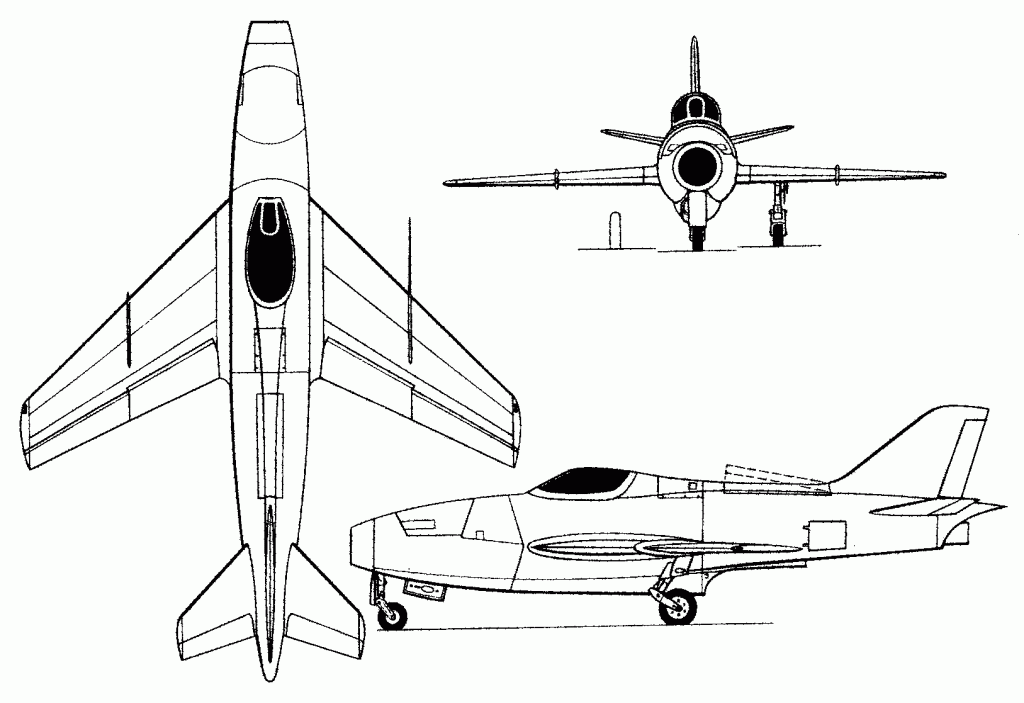
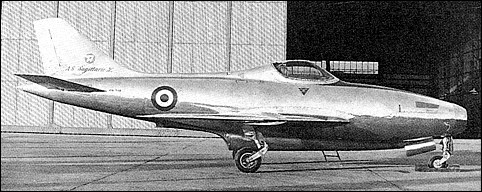
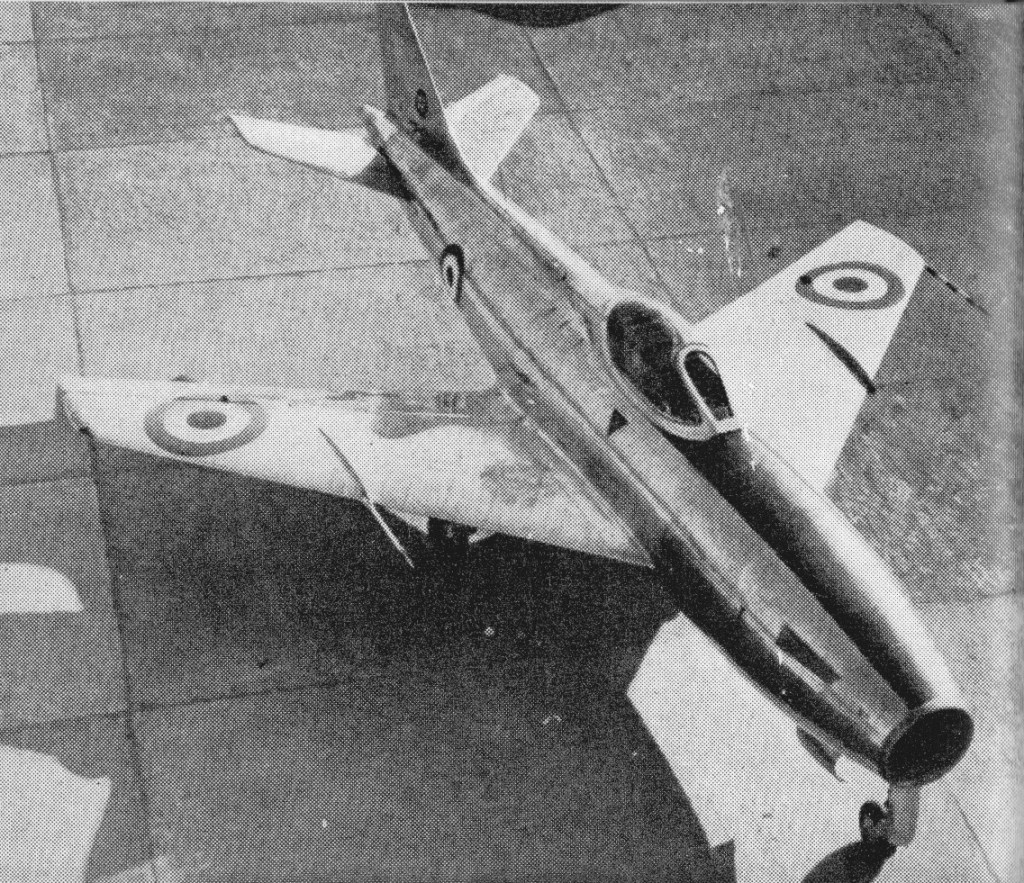
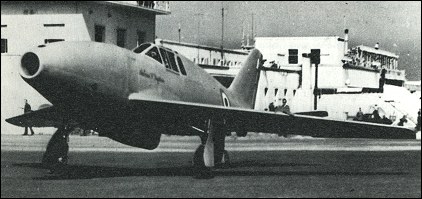
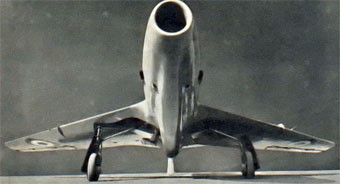
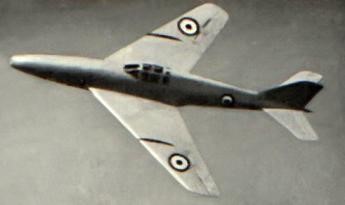
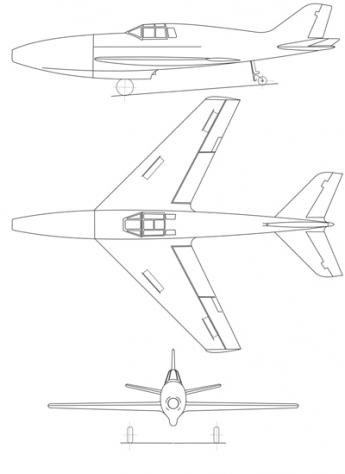
Basically similar to the Sagittario II, the Aerfer Ariete (Battering Ram) was built by Industrie Aeronautiche Meridionali (Aerfer), and represented the next step towards the development of the Leone (Lion) mixed-power light interceptor fighter, which was being worked upon with the financial support of the US government. The Ariete had a deeper rear fuselage and, in addition to the Derwent 9, had an 821kg thrust Rolls-Royce Soar R.Sr 2 auxiliary turbojet, which improved overall performance. The Ariete prototype (MM 568) flew for the first time on 27 March 1958, but the entire project was later abandoned.
Engine: 1 x Rolls-Royce Derwent 9 turbojet, 1633kg and 1 x Rolls-Royce Soar R.Sr 2 auxiliary turbojet, 821 kg Wingspan: 7.50 m / 24 ft 7 in Length: 9.60 m / 31 ft 6 in Wing area: 14.50 sq.m / 156.08 sq ft Loaded weight: 3535 kg / 7793 lb Empty weight: 2400 kg / 5291 lb Max. speed: 1080 km/h / 671 mph
From the initial Sagittario prototype, Sergio Stefanutti subsequently developed the Sagittario II, which made its maiden flight on 19 May 1956. Powered by a Rolls-Royce Derwent 9 turbojet, this more advanced aircraft was virtually a new design and of all-metal construction and built by Aerfer. The Sagittario II was the first aircraft of Italian design to exceed Mach unity when it reached Mach 1.1 in a dive on 4 December 1956.
Engine: 1 x Rolls-Royce Derwent 9 turbojet, 1633kg Wingspan: 7.5 m / 24 ft 7 in Length: 9.5 m / 31 ft 2 in Height: 6.627 ft / 2.02 m Wing area: 14.50 sq.m / 156.08 sq ft Loaded weight: 3300 kg / 7275 lb Empty weight: 2300 kg / 5071 lb Max. speed: 1020 km/h / 634 mph Service Ceiling: 14000 m / 45950 ft Range: 413 nm / 765 km / 475 miles Armament: 2 x 30mm cannon Crew: 1
After tests with a 45° sweptback wing fitted to an otherwise standard Ambrosini S.7, thus nicknamed Freccia (Arrow), the designer Sergio Stefanutti designed the Sagittario (Archer) while he was director of SAI Ambrosini in Passignano sul Trasimeno in 1951.
Early studies for the new project, named Turbofreccia, instaled two Turbomeca Palas, positioned in the fuselage just behind the pilot’s seat, with air intakes n the wing roots. This arrangement was finally abandoned by Stefanutti who preferred the new Marboré II of 380 kg thrust. The engine is located in the front part of the fuselage, with a nose air inlet. The exhaust nozzle opens behind the trailing edge of the wing.
The construction is entirely of wood. The aircraft retained the basic fuselage of the Super S.7 married at a new 45 degree swept wing and swept tail surfaces. The retractable main landing gear comprises two front wheels and one rear wheel.
Intended mainly for aerodynamic research into transonic compressibility, the Sagittario flew for the first time on 5 January 1953. From this initial prototype Stefanutti subsequently developed the Sagittario II, which made its maiden flight on 19 May 1956, piloted by Guidantonio Ferrari, at Aviano.
Engines: 2 x Turbomeca Marboré II, 380 kg thrust Wingspan: 7.50 m / 24 ft 7 in Length: 9.32 m / 30 ft 7 in Wing area: 16.60 m² / 157.15 sq.ft Normal weight: 1750 kg Loaded weight: 5070 lb Maximum level speed: 560 Km / h / 349 mph at 13,123 ft Time to 6000 m: 16 min 30 sec Range: 354 mi Endurance: 1h.35
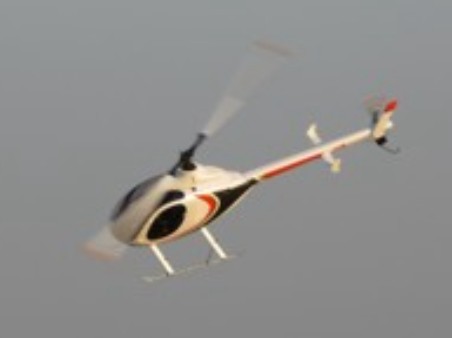
A new helicopter ULM produced by Alps Aviation, the Syton AH130 is an ultralight helicopter built with the precision and the technology of the certified helicopters, from a kit.
The Syton AH130 has side by side seating (equipped of dual controls). The fuselage structure is of aluminium alloys and steel. The fuselage has a lattice of steel tube.
The tail boom uses aluminium sheet, with composite material. Fairings of aerodynamic form and cockpit linings are composite material. The main rotor is two blade semi-rigid. The blades are completely composite in material, with an aluminium alloy rotor head.
Engine: Turbina Turboalbero turboshaft, 130 SHP Max continuous Max Length: 8.84 m (29.00 ft) Max Width: 1.60 m (5.25 ft) Max Height: 2.40 m (7.87 ft) Fuselage Width: 1.12 m (3.67 ft) Fuselage Height: 1.82 m (5.97 ft) Main rotor diameter: 7.63 m (25.00 ft) Tail rotor diameter: 1.28 m (4.20 ft) Empty weight: 290 Kg (693.3 lb) Normal take off weight: 450 Kg (992.0 lb) Maximum take off weight: 580 Kg (1278.7 lb) Max Cruise speed: 190 km/h (103.0 kts) Normal Cruise Speed: 160 km/h (86.0 kts) VNE: 210 km/h (113.5 kts) Max Rate of climb: 8.5 m/s (1670 ft/min) Hovering ceiling IGE: 2800 m (9200 ft) Hovering ceiling OGE: 1800 m (5900 ft) Maximum ceiling: 3800 m (12450 ft) Max endurance: 2 hr
MD-80 first flight, 13 April 1989, powered by one Allison 578-DX Propfan
The Pratt & Whitney/Allison 578-DX was an experimental aircraft engine, a hybrid between a turbofan and a turboprop known as a propfan. The 578-DX was developed as a joint venture between Pratt & Whitney and Allison. Unlike the competing General Electric GE-36 UDF, the 578-DX was fairly conventional, having a reduction gearbox between the LP turbine and the propfan blades. First run in 1986, noise considerations, plus a significant reduction in the real cost of aviation fuel, brought the NASA funded program to a halt
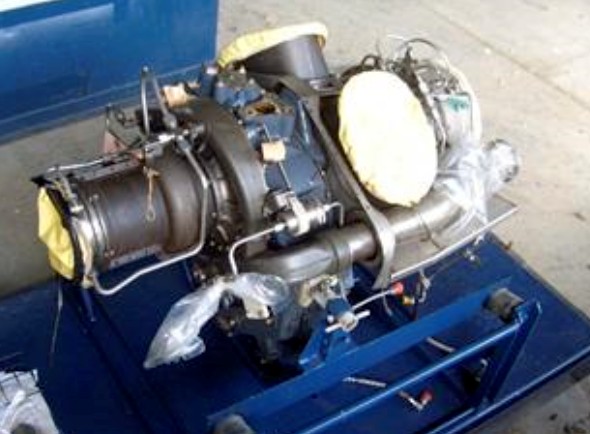
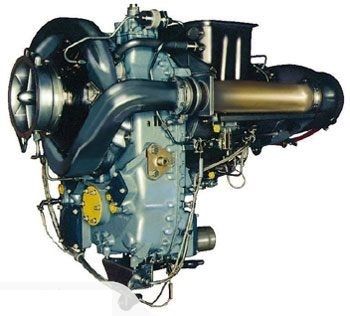
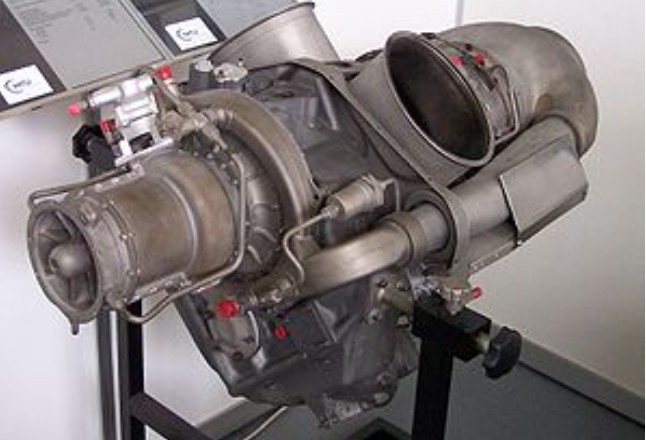
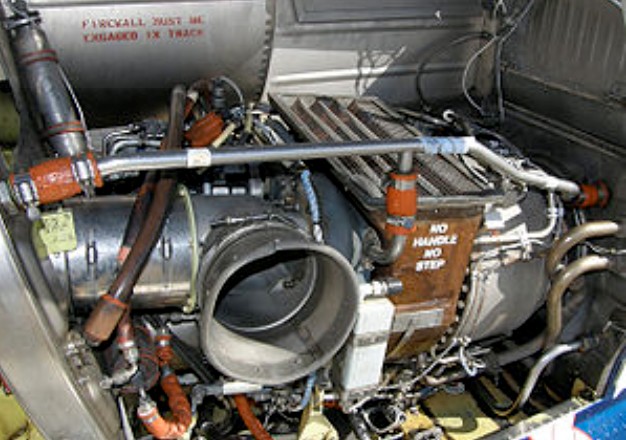
The Allison Model 250, known as the Rolls-Royce M250, (US military designations T63 and T703) is a successful turboshaft engine family, originally developed by the Allison Engine Company in the early 1960s. The Model 250 has been produced by Rolls-Royce since it acquired Allison in 1995.
Allison adopted a reverse airflow engine configuration for the Model 250: although air enters the intake/compression system in the conventional fashion, the compressed air leaving the centrifugal compressor diffuser is ducted rearwards around the turbine system, before being turned through 180 degrees at entry to the combustor; the combustion products expand through the two stage HP turbine, which is connected, via the HP shaft, to the compression system, before expanding through the two stage power turbine; the exhaust gases then turn through 90 degrees to exit the engine in a radial direction; a stub shaft connects the power turbine to a compact reduction gearbox, located inboard, between the centrifugal compressor and the exhaust/power turbine system.
Allison / Rolls Royce A250
One of the latest versions of the Model 250 is the -C40, which has a centrifugal compressor pulling a pressure ratio of 9.2:1, at an airflow of 6.1 lb/s (2.8 kg/s), and developing, at the shaft, 715 hp (533 kW). Some of the earlier versions have axial compressor stages mounted on the HP shaft to supercharge a relatively low pressure ratio centrifugal compressor. The -C20R is typical, pulling an overall pressure ratio of 8.0:1, at an airflow of 4.0 lb/s (1.8 kg/s), with a power output, at the shaft, of 450 hp (340 kW). The Model 250 powers a large number of helicopters, small aircraft and even a motorcycle (MTT Turbine Superbike). As a result, nearly 30,000 Model 250 engines have been produced, making the Model 250 one of the highest-selling engines made by Rolls-Royce.
The Allison TF41 (Company designations RB. 168-62 and Model 912) is a low-bypass turbofan engine jointly developed by Allison Engine Company and Rolls-Royce from the latter’s RB.168-25R Spey. First run in 1967, Allison manufactured the TF41 under license, while Rolls-Royce supplied parts common to existing Speys. The TF41 was developed for use in the LTV A-7D Corsair II for the USAF, and the US Navy’s A-7E. Between 1968 and 1983, a total of 1,440 TF41s were delivered.
TF41 of a U.S. Navy A-7E-4-CV
Applications LTV A-7 Corsair II (USAF -D and US Navy -E models)
Specifications: TF41-A-1 Type: Turbofan Compressor: Three-stage LP compressor, two-stage IP compressor (both driven by LP turbine),11-stage HP compressor Combustors: Cannular combustor with ten flame tubes Turbine: Two-stage LP, Two-stage HP Maximum thrust: 14,250 lb Overall pressure ratio: 20:1 Bypass ratio: 0.77:1
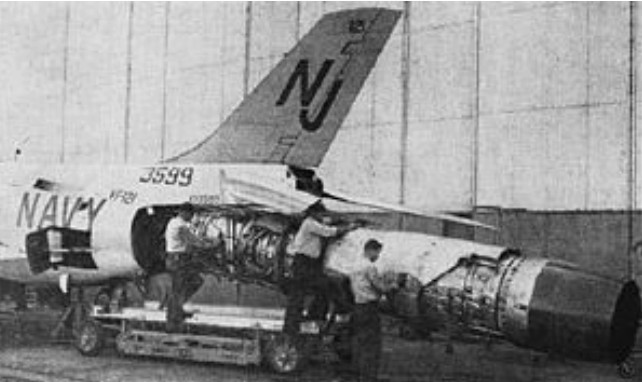
The Allison J71 was a turbojet engine, designed and built in the United States. It began development in 1948 as a modified J35 and was originally designated the J35-A-23.
The Allison J71 turbojet powered the Douglas B-66 Destroyer and the McDonnell F3H-2 Demon after the failed Westinghouse J40 proved unworkable. The prototype P6M SeaMasters were also fitted with the engine.
Allis-Chalmers was a U.S. manufacturer of machinery for various industries. Its business lines included agricultural equipment, construction equipment, power generation and power transmission equipment, and machinery for use in industrial settings such as factories, flour mills, sawmills, textile mills, steel mills, refineries, mines, and ore mills. The first Allis-Chalmers Company was formed in 1901 as an amalgamation of the Edward P. Allis Company (steam engines and mill equipment), Fraser & Chalmers (mining and ore milling equipment), the Gates Iron Works (rock and cement milling equipment), and the industrial business line of the Dickson Manufacturing Company (engines and compressors). It was reorganized in 1912 as the Allis-Chalmers Manufacturing Company.
Immediately at the war’s end, in 1945–1946, Allis-Chalmers endured a crippling 11-month labor strike.
During the next 70 years its industrial machinery filled countless mills, mines, and factories around the world, and its brand gained fame among consumers mostly from its farm equipment business’s orange tractors. In the 1980s and 1990s a series of divestitures transformed the firm and eventually dissolved it. Its successors today are Allis-Chalmers Energy and AGCO.
First run in 1960, the Lycoming (now Honeywell) LTS101 is a turboshaft engine family ranging from 650 to 850 shaft horsepower, used in a number of popular helicopters, and, as the LTP101 turboprop, light aircraft. Both models carry the US military designation T702. The engine was originally designed at the Lycoming Turbine Engine Division in Stratford, Connecticut, but is now produced by Honeywell Aerospace.
Applications: Bell 222A, B and UT Eurocopter AS350 AStar HH-65A/B Dolphin MBB/Kawasaki BK 117 Air Tractor AT-302 Piaggio P166 EcoJet concept car built under the direction of General Motors and Jay Leno



 All Aero