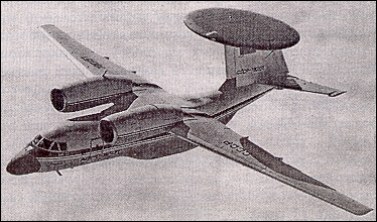
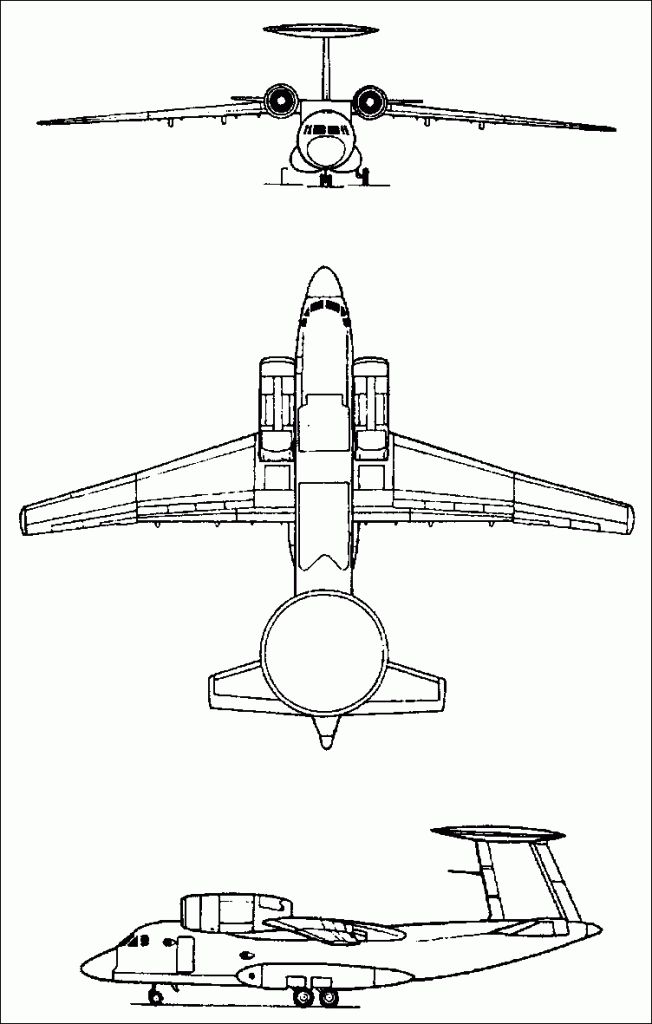
An AEW plane based on An-72 transport plane, the first prototype flew on July 12, 1985. A small tactical airborne early warning and control aircraft with rotating radome above tailfin, the program was canceled with no production orders. NATO reporting name ‘Madcap’.
An-71 Engine: 2 x D-436K turbofans, 7500kg + 1 x RD-38A, 2900kg Wingspan: 31.89 m / 104 ft 8 in Length: 23.50 m / 77 ft 1 in Height: 9.20 m / 30 ft 2 in Max. Speed: 650 km/h / 404 mph Cruise Speed: 530 km/h / 329 mph Ceiling: 10800 m / 35450 ft Crew: 6
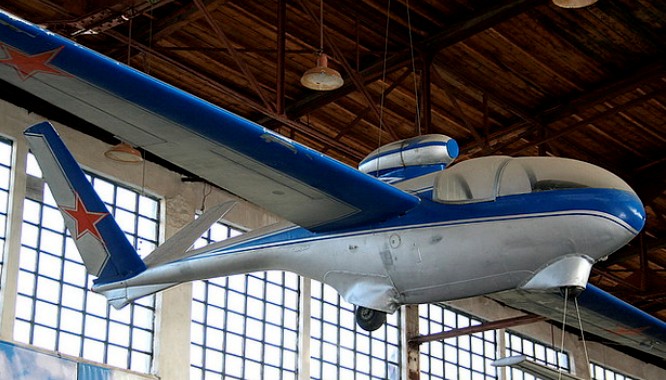
Developed in parallel with the Antonov A-11, and making its first flight exactly a week before the latter, the A-13 utilises the same fuselage, undercarriage and tail unit as the A-11 married to a shorter span (39 ft 8.5 in) wing of lower aspect ratio for aerobatic training. This wing is very similar in construction to the A-11’s, with a single spar in the root and two spars in the outer wings, and fabric covering aft of the main spar, but flaps are not fitted and the fabriccovered ailerons are not slotted. There are lift spoilers in the upper surfaces. The shorter span wing results in a higher wing loading of 7.07lb/sq ft and a much higher minimum sinking speed of 3.74ft/sec.
Altogether about 350 examples of the A-11 and A-13 were built.
Lyulka has produced the small TS-31M turbojet, which weighing only 51 lb (23 kg) and affording a thrust of 121 lb (55 kgp), is used by the Antonov A13 powered glider.
A-13 Span: 39 ft 8.5 in Length: 19 ft 8.5 in Wing area: 112.4 sq.ft Aspect ratio: 13.8 Empty weight: 560 lb Max take-off weight: 794 lb Max speed: 217 mph (in smooth air) Max aero-tow speed: 124 mph Min sinking speed: 3.74 ft/sec at 60 mph Best glide ratio: 25:1 at 70 mph
A13-M Crew: one pilot Length: 6.4 m (21 ft 0 in) Wingspan: 12.1 m (39 ft 8 in) Height: 1.6 m (5 ft 3 in) Wing area: 10.4 sq.m (112 sq.ft) Aspect ratio: 14:1 Empty weight: 270 kg (600 lb) Gross weight: 360 kg (800 lb) Maximum speed: 400 km/h (250 mph) Maximum glide ratio: 25:1 Rate of sink: 1.1 m/s (220 ft/min)
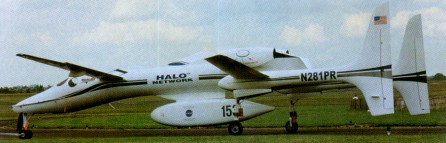
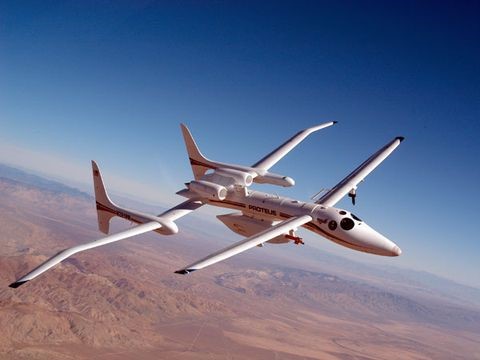
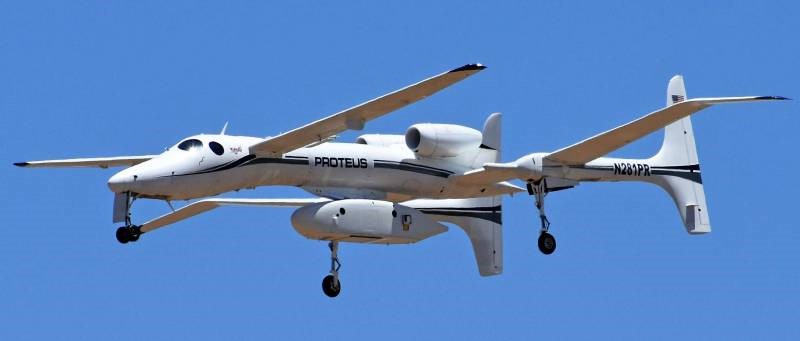
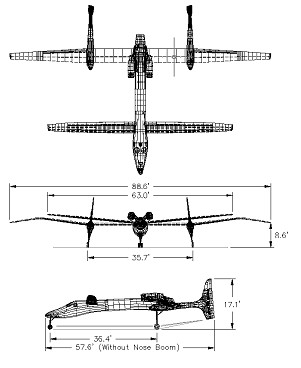
Proteus is a twin turbofan high altitude multi mission aircraft powered by Williams International FJ44-2E engines first flown in July 1998. It is designed by Burt Rutan to carry payloads in the 2000-pound class to altitudes above 60,000 feet and remain on station up to 14 hours. Heavier payloads can be carried for shorter missions. It is intended for piloted as well as for UAV missions. Missions for Proteus include telecommunications, reconnaissance, atmospheric research, commercial imaging, and space launch.
The Proteus is designed with long wings and a low wing loading needed for efficient high altitude loiter. It excels in stability and low noise. It is capable of dynamic maneuvers, needed to operate in adverse conditions. The crisp, short takeoff and landing uses the unique “three-mains” landing gear design intended to increase crosswind and wet runway capability without the use of spoilers.
Engines: 2 x Williams/RR FJ44-2E turbofan, 2293 lb thrust. Op alt: 60,000 ft.
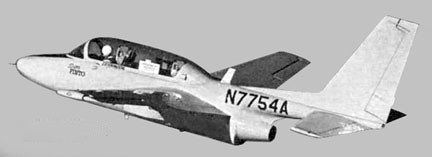
In June 1968 American Jet Industries Inc first flew the Super Pinto, a jet primary trainer or light strike aircraft developed from TT-1 Pinto built by Temco. Towards the end of the 1960s Aeronca undertook, in conjunction with American Jet Industries Inc., development of a light strike version of the Super Pinto, built originally as a jet primary trainer. Work was also done on five-seat executive version.
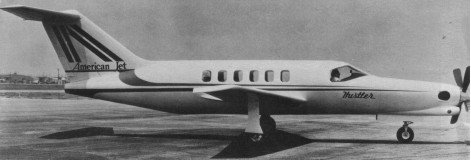
Unveiled at American Jet Industries plant in Van Nuys, California, in October, 1975, the seven place Hustler 400 turboprop/ turbojet has been modified since announcement was made. A major change was the redesign of the tail to a “T” tail configuration, and other changes include an increase of 52 inches in the wing span and installation of double slotted Fowler flaps on the supercritical wing. Sixteen inches have also been added to the fuselage. An 850 shp United Aircraft of Canada turboprop PT6A 41 in the nose provides power for the Hustler while the Teledyne turbojet engine will be used for standby’ power in the event of an engine failure. According to American Jet’s data the standby engine will enable the aircraft to maintain an airspeed of 170 mph at 13,500 feet with the nose turboprop engine feathered. A top speed of 380 mph for the Hustler is predicted with a maximum range of 2970 miles. Three prototypes were under construction at the American Jet California facility; two were to be used for flight testing and the third for ground structural testing. The Hustler faces some serious hurdles; for instance, no certificated jet engine of the size required by the design existed. Only various engines used for APUs, missiles or drones. If, on the other hand, a “single engine” classification were sought, the jet engine being viewed merely as a JATO unit, then the Hustler would face the challenge of making the FAA’s 70 mph landing speed requirement with a wing loading of at least 36 pounds per square foot. The Hustler was powered by a Pratt & Whitney PT6A-41 turboprop in the nose and a standby turbojet in the tail and made its first flight on January 12, 1978. Gulfstream American decided to replace the 850 shaft horsepower Pratt & Whitney PT6 turboprop engine in the nose of the Hustler with a 900 shp Garrett TPE331. The Pratt & Whitney JT15D remains Gulfstream’s choice for the Hustler’s rear mounted turbofan. Maximum takeoff weight was been increased to 10,000 from 9,500. Flight testing of the Gulfstream American Hustler 500 began late in January 1981 at Van Nuys, California, and continued at Mojave. This second Hustler prototype was powered by a 900 shp Garrett AiResearch TPE 331 10 501 turboprop in the nose and a 2,200 lb st (1000 kgp) Pratt & Whitney JT15D 1 turbofan in the tail.
Hustler 400 A Engine: Pratt&Whitney PT6A-41, 838 shp & Teledyne turbojet Length: 37.795 ft / 11.52 m Height: 10.761 ft / 3.28 m Wing span: 32.644 ft / 9.95 m Wing area: 185.141 sq.ft / 17.2 sq.m Max take off weight: 7497.0 lb / 3400.0 kg Weight empty: 3999.9 lb / 1814.0 kg Cruising speed: 343 kts / 636 kph Wing load: 40.59 lb/sq.ft / 198.0 kg/sq.m Range: 1303 nm / 2414 km Crew: 1 Payload: 6 Pax
Hustler 500 Engine: 1 x Garrett AiResearch TPE 331 10 501, 900 shp turboprop & 1 x Pratt & Whitney JT15D 1 turbofan 2,200 lb st (1000 kgp)
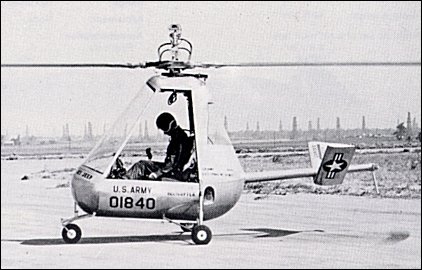
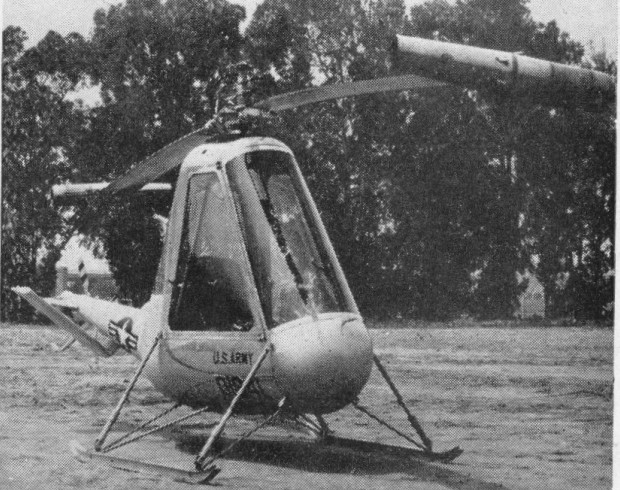
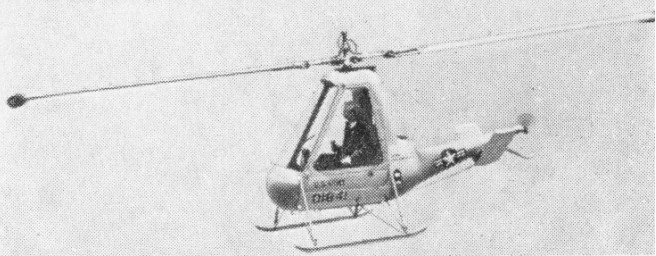
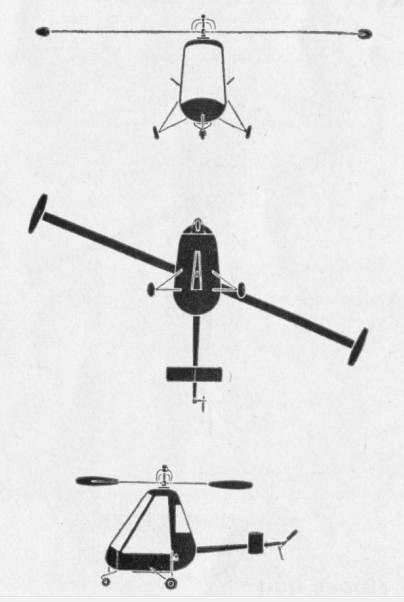
A 1950 Army specification called for a light, collapsible machine which could be used as both a light observation craft and as an air-droppable rescue vehicle for downed aircrew. American Helicopter responded with the Model XA-8 single-seat lightweight helicopter, design of which began in 1951 with the sponsorship of both the Army Transportation Corps and the USAF. American Helicopter was awarded a development contract in June 1951, and the first of a total of five XH-26s flew for the first time in June 1952.
The XH-26 was designed from the beginning to be both collapsible and air-droppable and its construction and size reflected both requirements. Twelve feet long and six feet tall, the helicopter could be transported in a five foot by five foot by fourteen foot container and could be unpacked and assembled by two men in less than thirty minutes. The machine’s fuselage was built primarily of aluminum and fiberglass and featured a glazed, pyramid-shaped cockpit. The XH-26 was powered by two pulse-jet engines, one fixed to the tip of each main rotor blade, and could burn virtually any type of fuel. The Army and Air Force jointly evaluated the five XH-26 prototypes from 1952 to 1954 but neither service procured the type in quantity.
American Helicopter H-26 Engine: 2 x American Helicopter XPJ49-AH-3 7.5 in pulse-jets, 16.2kg Main rotor diameter: 8.23m / 27 ft Rotors: 2-blade, tip-powered main; 2-blade tail. Fuselage length: 3.73m Height: 1.88m Empty weight: 135kg MAUW: 1,040 lb. Max speed: 130km/h / 80 mph Cruising speed: 110km/h Service ceiling: 2280m Range: 160km / 105 miles at 70 mph with normal load Crew: 1
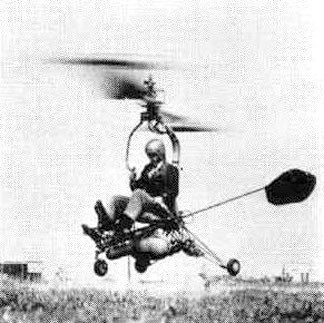
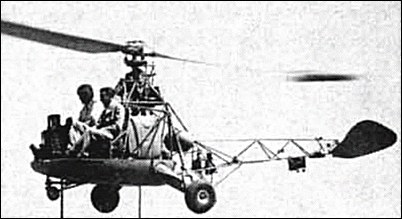
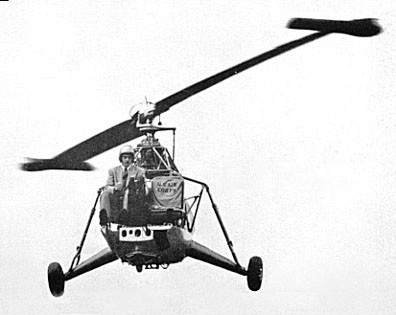
The first project of the American Helicopter company was the two-seat open-cockpit XA-5 “Top Sergeant”, which was based on the lower fuselage and undercarriage of a Sikorsky R-6 with an open rear boom and small rudder. It was driven by two tip-mounted 43kg AJ 8.75 pulse-jet engines driven by a fuselage-mounted compressor, and made its first flight in January 1949.
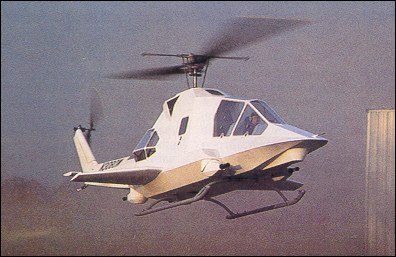
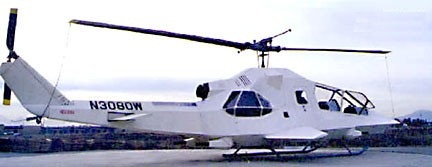
Bell UH-1B “Hueys” were stripped down to engine and transmission mounts, controls modified to tandem arrangement and re-covered with armored composite structure, containing troop-carrier compartment for six soldiers, two aft facing gunner turrets on either side of the engine and two forward facing turrets. The aircraft, named the “Penetrator”, was also outfitted with stub wings, which unloaded the main rotor in high-speed flight, increasing airspeed, and the aircraft’s aerodynamic fuselage minimizes profile drag. The basic model is an all-composite compounded helicopter with a gross take-off weight of 4280kg. To reduce the Penetrator’s drag, all the machine guns, cannons and some rocket launchers are carried internally. The “Penetrator” offers the feature of a two-seat in tandem cockpit with the pilot positioned in the first seat for unobstructed vision and two forward-firing weapons operator is in the second seat, with the third and fourth weapons operators in seats aft of the main cabin to control rear-facing weapons. This firepower allows the “Penetrator” to perform as an excellent shock assault troop lift gunship with air-to-air, air-to-ground and ground-to-ground capability. The Penetrator is fitted with a skid undercarriage (or optional retractable tricycle gear), a lower fuselage rear-facing gun turret and two forward-firing cannon. The “Penetrator” has 360 degrees of perimeter firepower and it’s composite construction of Kevlar reinforced by Nomex and the angular shape of its design afford the “Penetrator” ballistic resistance to small arms fire and low observability.
AAI Penetrator N3080W
Designed by William F Moody, the prototype (N3080W ex U.S.Army 63-8508) is powered by a 1300shp Avco Lycoming T52-L-13 turboshaft, and first flew in October 1991.
In 1990 American Aircraft fell into insolvency.
Engine: 1300shp Avco Lycoming T52-L-13 Rotor diameter: 48 ft 0 in Length: 48 ft 0 in Loaded weight: 4631 lb Max speed: 195 mph Cruise: 140 mph
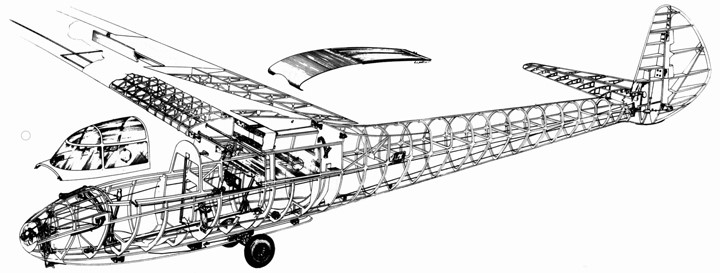
Originally, The Kangaroo is a wooden glider, two-seater, high-wing, and about 20m wingspan. It was designed in 1939 by the Gliding Institute Polytechnic of Milan (Centro Volo a Vela del Politecnico Di Milano) under the direction of the Engineer Ermenegildo Preti. In addition to the prototype, the Italian air force has ordered 32 copies. The first flew in 1940, only two copies will be built during the duration of the war. Others, built in 2 lots by two different companies were produced between 1953 and 1955. It was at this time, a significant number of aircraft.
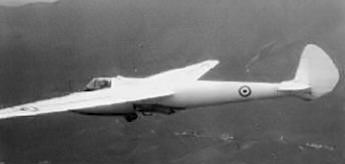
The “Palas” version corresponds to a transformation seater glider with a Turbomeca Palas jet engine.
The jet version was created by Adrianno Mantelli, from one that had crashed. It was rebuilt with a shortened wing, and with the addition of a Turbomeca Palas engine of 150kg thrust. This came from the prototype Caproni Trento F-5 jet. The air inlet is a removable scoop on the top of the fuselage.
In this configuration, Adrianno broke the world record for altitude jet less than 800 kg, with a flight to 9366 m, 24 September 1964.
A high-wing cantilever monoplane built completely in wood, the CVV6 had a fixed, single wheel undercarriage.
Wingspan: 19.20 m (63 ft 3 in) Length: 8.00 m (26 ft 2 in) Wing area: 21.60 m² (235.5 sq.ft) Empty weight: 280 kg (616 lb) Payload: 180 kg (396 lb) MTOW: 460 kg (1012 lb)
 All Aero