An improved search-and-rescue variant of the Be-40 became the Be-42 (sometimes referred to in the West as A-45).
Jet
Beriev A-40 / Be-40 Albatross
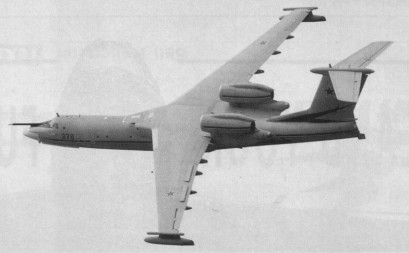
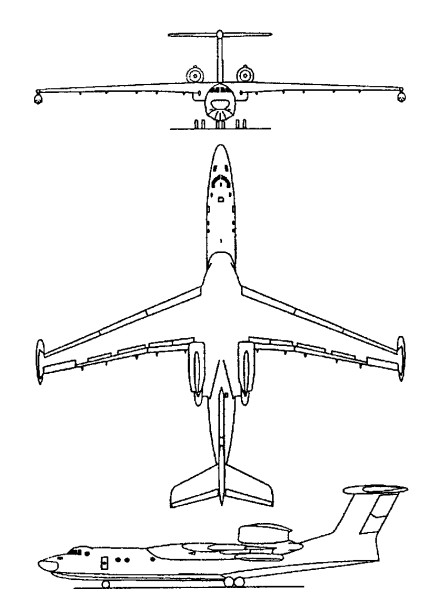
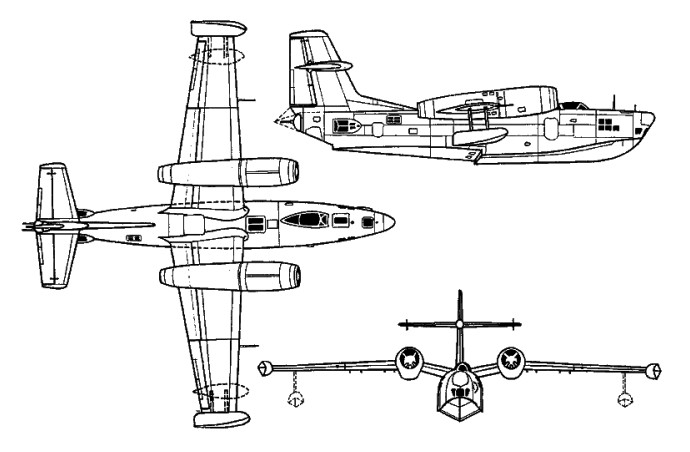
The A-40/Be-40 Albatross Mermaid turbofan-powered intermediate-range antisubmarine, search-and-rescue and patrol amphibian, first flown December 1986 and ordered for the Russian Navy in 1992 but not funded.
The A-40 amphibian aircraft is intended for antisubmarine warfare in the near coastal zone at any time of the day and year, in VFR and IFR weather conditions.
The aircraft is provided with an inflight refueling system.
Its onboard equipment provides for automatic solution of flight/navigation problems, search, detection, tracking and destruction of hostile submarines both in surface and submerged positions and on the sea bottom.
The equipment comprises a search/sighting system, a flight control and navigation complex, communications facilities, and other equipment. The search/sighting system consists of radar, sonar and magnetometric subsystems.
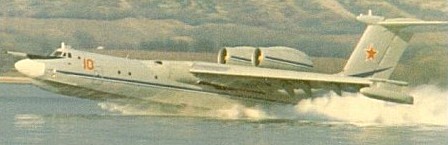
The engines are started by an auxiliary power unit and the cruise turbofans are equipped with a thrust reverser, thereby reducing the landing roll and the abortive takeoff distance.
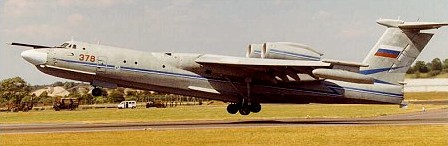
The type first showed up in US reconnaissance photographs during 1988 satellite passes over Taganrog but the first “closeups” came with the amphibian’s surprise debut at an air show in August 1989. NATO dubbed the aircraft, christened Albatross by the G M Beriev Taganrog Aviation Scientific Engineering Complex, “Mermaid”.

A requirement for the two large 26,455 lb static thrust PERM Soloviev D 30KPV engines to be placed away from ingesting water saw an over wing configuration incorporated in the design. The rear part of the pylon ac¬commodates RD 60 booster engines providing an increase in thrust by 6065 lbs st apiece. In the SAR role the A 40 can cover 1240 nm (2000km) from its base and take on board up to 54 survivors. The crew usually totals five plus a rescue team of around four to six.
An improved search-and-rescue variant became the Be-42 (sometimes referred to in the West as A-45).
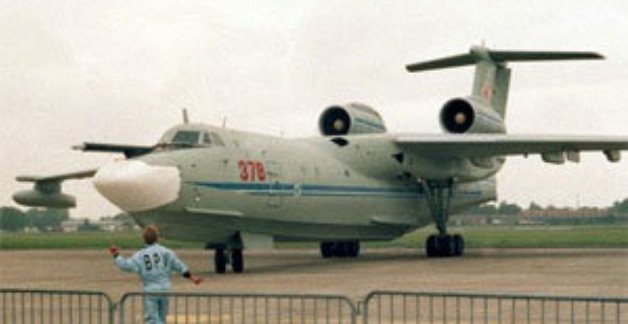
Engines: 2 x PERM Soloviev D-30KPV turbofan, 117.7 kN (26,455 lb) and 2 x Klimov RD-36-35AFV, 24.5 kN
Take-off weight: 86000 kg / 189599 lb
Wingspan: 41.6 m / 136 ft 6 in
Length: 43.8 m / 143 ft 8 in
Height: 11.1 m / 36 ft 5 in
Wing area: 200.0 sqm / 2152.78 sq ft
Max. speed: 760 km/h / 472 mph
Cruise speed: 720 km/h / 447 mph
Ceiling: 9700 m / 31800 ft
Range w/max.fuel: 5500 km / 3418 miles
Range w/max.payload: 4100 km / 2548 miles
Armament: 6500kg
Crew: 8
Beriev Be-10 / M-10
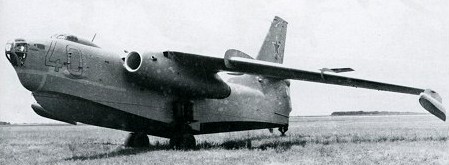
Developed from the R-1, the Be-10 flew for the first time on 20 July 1956 and was first seen in public on the 1961 Soviet Aviation Day, when four of the type flew past in formation.
The Beriev Be-10 ‘Mallow’ has the distinction of being the only turbojet-powered flying-boat in the world to have attained true production status. During 1961, and under the designation M-10, the type established 12 world class records. Among them were a speed record over a 15/25km course of 912km/h, piloted by Nikolai Andrievskii, and a speed of 875.86km/h over a 1000km closed circuit with a payload of 5000kg and an altitude record of 12733m with a 10000kg payload, with Georgi Buryanov at the controls.

The all-metal Be-10 was a high-wing monoplane with sharply sweptback wings; these had considerable anhedral, and incorporated two wing fences and a fixed wing-tip stabilising float on each wing. Armament comprised two 23mm NS-23 cannon in the nose, plus two more operated under radar control in a tail barbette.

Engines: 2 x Lyulka AL-7PB turbojets, 6500kg each.
Take-off weight: 46500 kg / 102515 lb
Empty weight: 24100 kg / 53132 lb
Wingspan: 22.3 m / 73 ft 2 in
Length: 31.1 m / 102 ft 0 in
Wing area: 111.8 sqm / 1203.40 sq ft
Max. speed: 912 km/h / 567 mph
Ceiling: 14962 m / 49100 ft
Range: 4800 km / 2983 miles
Armament: 4 x 23mm cannon, 2000kg of weapons

Beriev R-1
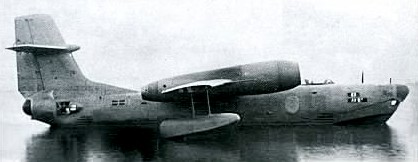
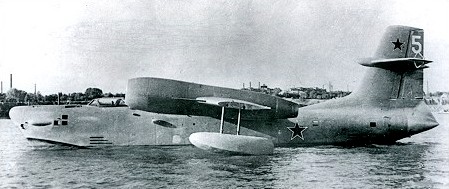
The first jet-propelled flying boat built in the USSR. The R-1 was first flown on 30 May 1952 by I M Sukhomlin. Only one prototype built.
Engine: 2 x VK-1, 2700kg each
Take-off weight: 20000 kg / 44093 lb
Wingspan: 20.0 m / 65 ft 7 in
Length: 19.8 m / 64 ft 12 in
Height: 7.1 m / 23 ft 4 in
Wing area: 58.0 sqm / 624.31 sq ft
Max. speed: 800 km/h / 497 mph
Ceiling: 11500 m / 37750 ft
Bensen Midget
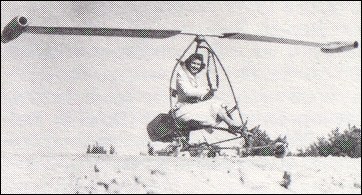
This miniature single-seater helicopter, designed as a private venture mainly for use in the United States Navy, has been simplified to such a degree that its components can be reassembled with hand tools. At each tip of the two-bladed rotor is a ram-jet engine, weighing 2.5 kilos and running on either ordinary petrol or fuel oil.
The “Midget” is reported to be able to lift four times its own weight. The initial tests were carried out in 1954.
Engines: 2 x ram-jets equivalent to 40hp
Number of seats: 1
Rotor diameter: 4.57m
Weight fully loaded: 227kg
Empty weight: 45kg
Cruising speed: 120km/h
Bell 216
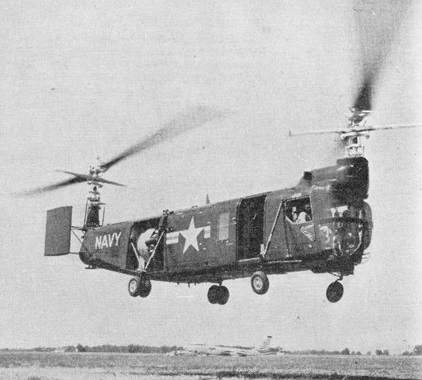
From the tandem rotor HSL-1 Bell developed the model 216 for commercial use with three Lycoming T-53 free shaft gas turbines.
Bell 505 JetRanger X
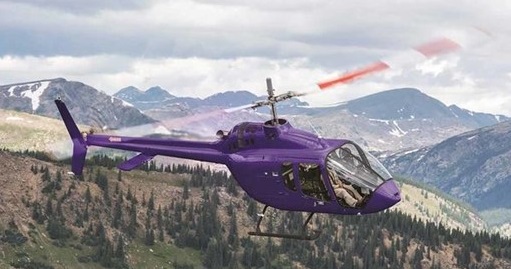
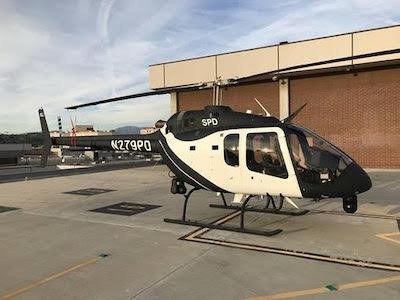
The Bell 505 features the Safran Helicopter Engines Arrius 2R engine incorporating dual-channel fadec that delivers good performance and reduces pilot workload and Garmin G1000H avionics. Top speed is 125 knots and useful load 1,500 pounds. When announced in 2013, the price was set at $1.07 million.
The five-seat Bell 505 Jet Ranger X received FAA certification six months after notching Canadian approval of the light single, Bell Helicopter announced in June 2017. Deliveries of the five-seat light single to U.S. customers were to begin immediately.
Bell was continuing to work with other certification authorities around the world to bring the 505 to more markets. The Bell Helicopter Training Academy was also prepared for entry into service with customer training and flight training device and coursework on track.
The first delivery of the Bell 505 occurred in March 2017 to Pylon Aviation. Bell confirmed delivery of the 200th Bell 505 Jet Ranger X to Austria-based operator Hubi-fly Helikopter GmbH in August 2019 with the global fleet of 200 aircraft flying across six continents.
Bell 525 Relentless
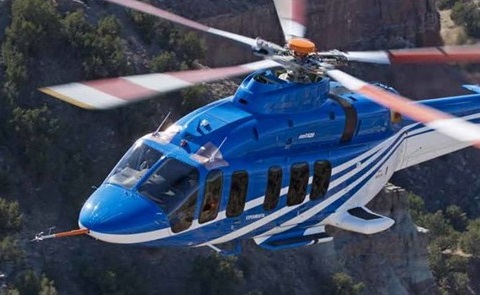
Designed to seat up to 20 passengers, the 525 is the first commercial helicopter with a fly-by-wire system, featuring BAE Systems’ flight control computers. The ARC Horizon flight deck is built around the Garmin G5000H integrated touch screen enabled avionics suite, incorporating four LCD screens and two touchscreen controllers into the wide instrument panel.
Powered by two electronically controlled GE CT7-4F1 engines putting out 1,979 shp on takeoff, the 525 is designed to cruise at speeds up to 160 knots with a max range of 560 nm and a useful load of 8,200 pounds.
“Bell Helicopter has worked with the NTSB and FAA since the accident and we are confident in the resumption of flight test activity,” said Bell’s president and CEO Mitch Snyder.
While the final report from the NTSB regarding the accident has not yet been released, the preliminary report said the helicopter broke up in flight. Both test pilots died as a result of the ensuing crash. Before the crash, the flight test program had accumulated more than 260 flight hours for the 525 and Bell hopes to finalize its certification next year.
The FAA has awarded experimental certificate renewal to the Bell 525 Relentless, allowing Bell Helicopter to resume the flight test program after a 2016 crash. Bell Helicopter was to resume testing the 525 Relentless following the FAA’s awarding of experimental certificate renewal. Certification for 20-passenger fly-by-wire helicopter is expected in 2018.
Bell Lunar Landing Research Vehicle / LLRV
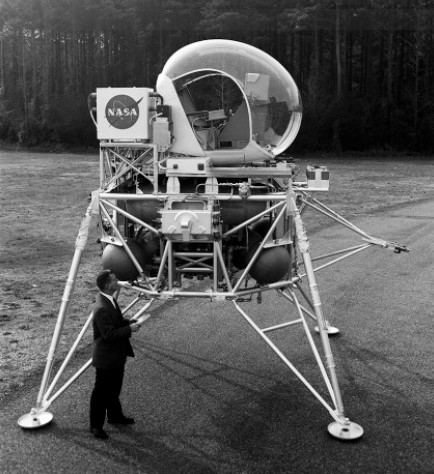
Lunar Landing Research Vehicle (LLRV) built in 1963 as part of the Apollo Project to land on the moon. It was a vertical take-off and landing vehicle powered by a single jet engine. The vehicle allowed Apollo astronauts to train for real moon landings.
Bell LLTV (Lunar Landing Training Vehicle)
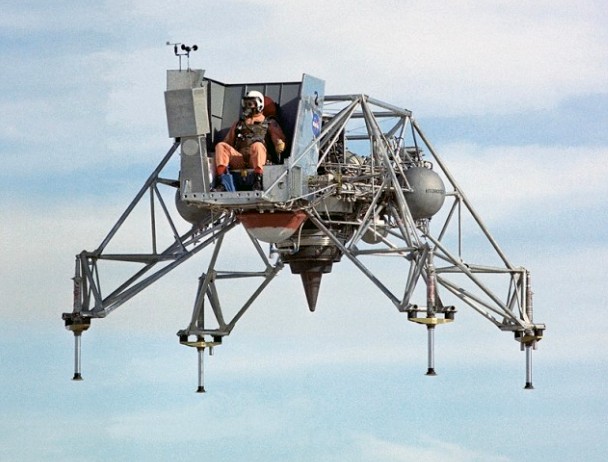
The Lunar Landing Training Vehicle (LLTV) was built by Bell Aerosystems in 1964 as part of the Apollo Project to land on the moon, it was a vertical take-off and landing vehicle powered by a single jet engine. The Lunar Landing Research Vehicle (LLRV) was built by Bell Aerosystems in 1964 as part of the Apollo Project to land on the moon, it was a vertical take-off and landing vehicle powered by a single jet engine.
By always offsetting five-sixths of earth’s gravity, the vertically mounted turbofan engine enabled the LLTV to reproduce the characteristics of landing a lunar module on the moon’s surface. The LLTV was used to train America’s Apollo astronauts.
 All Aero