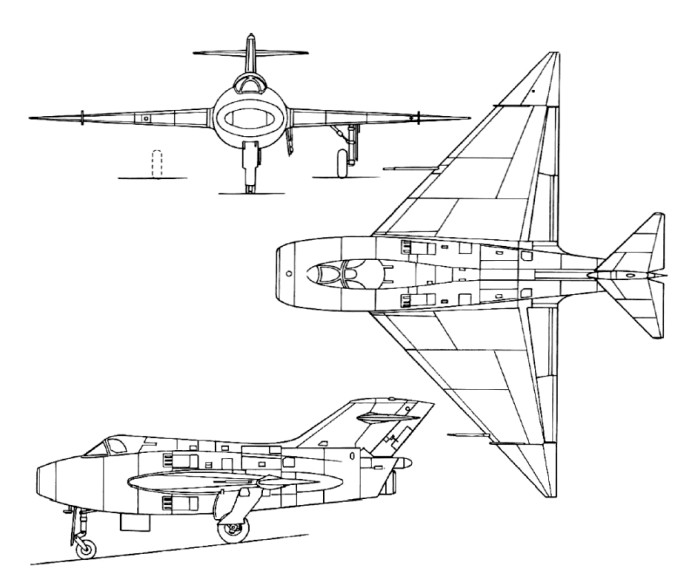
Bréguet 121 is the prototype, on which the SEPECAT (acronym for Société Européenne de Production de l’Avion d’Ecole de Combat et d’Appui Tactique) Jaguar is based.
Jet
Bratukhin SBIZ M-1
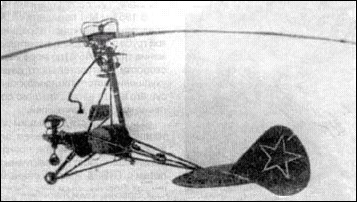
An experimental tip-jet helicopter designed by engineers of the Bratukhin design bureau. Only few tethered flights were made before the project was abandoned in 1951.
Brandner E-300 / Egyptian General Aero OrganisationE-300
The Austrian engineer, Ferdinand Brandner, who had previously worked as a prisoner of the Soviet Union on the development of the Kuznetsov NK-12 turboprop that was the powerplant of the Tupolev Tu-95 bomber, moved to Egypt to lead a team to design an engine to power the Helwan HA-300 jet fighter that was simultaneously being designed by a team of Germans led by Willy Messerschmitt.
The new turbojet engine underwent bench testing in 1963, and was flight tested under the wing of an Antonov An-12, before being installed in a HAL HF-24 Marut for high speed testing, in which form it flew on 29 March 1967. The E-300 was installed in the third prototype HA-300 (the first two powered by Bristol Siddeley Orpheus engines), it flew at least one time and successfully, but the programme of HA-300 being abandoned in May 1969.
Variants:
E-300-A
Military version for HA-300
E-300-C1
Civil version of E-300-A, proposed for Project 206 three-engined airliner.
E-300-C2
Proposed growth version of E-300-C1.
E-300-AF
Projected turbofan development.
Specifications:
Type: Afterburning turbojet
Length: 4,300 mm (169.3 in)
Diameter: 840 mm (33 in)
Dry weight: 860 kg (1,896 lb)
Compressor: nine-stage axial compressor
Combustors: can-annular combustion chamber
Turbine: two-stage axial turbine
Maximum thrust: 32.4kN (6,275 lbf) dry, 47.2 kN (10,582 lbf) with reheat
Overall pressure ratio: 6:1
Boulton Paul P120
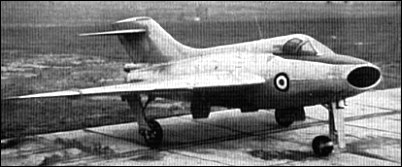
The Boulton Paul P.120 delta wing research aircraft, built to Air Ministry Specification E.27/49, was used to investigate high speed characteristics of the delta wing.
The P.120, flown on 6 August 1952, was similar in general layout to the P.111 but had an all-moving tailplane mounted on a squat fin. The aircraft was lost on 29 August, in an accident thought to have been caused by tail flutter.
Engine: 1 x 2315kg Rolls-Royce RN.2 Nene
Wingspan: 10.19 m / 33 ft 5 in
Length: 9.02 m / 29 ft 7 in
Height: 2.90 m / 9 ft 6 in
Wing area: 26.95 sq.m / 290.09 sq ft
Take-off weight: 5711 kg / 12591 lb
Empty weight: 4838 kg / 10666 lb
Boulton Paul P111
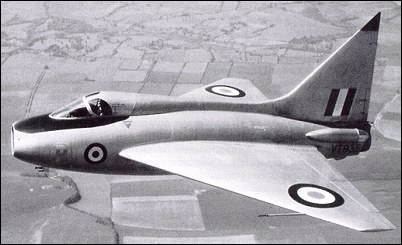
The Boulton and Paul P.111 research aircraft was built to specification E.27/46, to further investigation into delta wing characteristics at transonic speeds.
The only example, VT935, first flew on October 6, 1950, and was powered by a Rolls Royce Nene turbojet of 5,100 lb st. It featured a 45 degree delta wing with detachable tips to enable comparative tests of blunt and pointed wings to be made. The fin tip was also removeable. Data recording equipment, including a fin mounted camera, was fitted. It originally flew in natural metal finish and was supplemented from August 1952 by the P.120.
A critical feature, that of total hydraulic, irreversible, powered flying controls allowed artificial feel for the pilot was by way of built in springs which could not be fully trimmed to take into account the very fine degree of control necessary, particularly with the minimal input demanded at high IAS. The design work was carried out at Farnborough, and all of the early flying was by Aero Flight pilots including Bob Smythe CO, Jim Harrison, and Jock Elliot. Jock carried out most of the flying with 52 flights totalling some 26 hours. He commented on the sensitivy of the controls at IAS, stating that, at 500 kts IAS, 1/4″ stick movement gave 1″g” of acceleration, and observed that the possibility of a strong reflex input was very real and would have catastrophic results. Following a belly landing by Jim Harrison the design was near to being shelved, when Jock came up with the idea for variable gearing between stick and surfaces; this facility would be available to the pilot in flight and would allow a choice ranging between 1:1 to 4:1. Jock pointed out that the idea was not new and that some of the Schneider Trophy aircraft had incorporated the idea.
The idea was discussed at a meeting with Dennis Higton, aerodynamicist at RAE, JD North of BP, and Jock, and the outcome was that it was incorporated into the design, as the BP P111A.
The point has been made that Jock’s concept of variable gearing was an crital break through for the aviation industry and virtually paved the way for Concorde and all high speed aircraft that followed.
In 1953 the aircraft underwent internal modification, and also had four rectangular air brakes fitted around the fuselage behind the cockpit a nose probe. Redesignated P.111A, it made its first flight in this form on July 2, 1953. Ben Gunn flew the aircraft in it’s P111A form. Its research programme at RAE Bedford ended on June 20, 1958, by which time it had attained Mach. 0.93 in level flight.
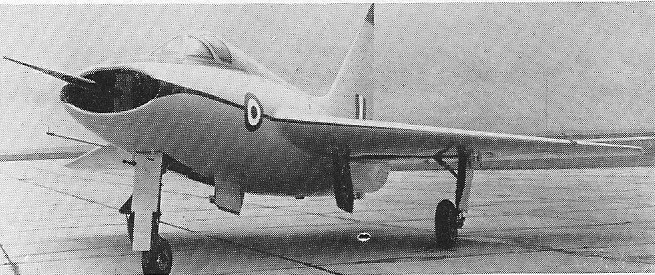
In April 1959 it was purchased from the Ministry of Aviation by the College of Aeronautics at Cranfield, Beds. It was then used in their Department of Aircraft Design to demonstrate variable gearing power flying control systems and general hydraulic services, and also for basic research on the ground resonance of a low aspect ratio wing.
The P.111A survives in the Midland Air Museum at Coventry’s Baginton Airport.
P.111A
Engine: 1 x Rolls Royce “Nene”, 2313kg
Wingspan: 10.21 m / 33 ft 6 in
Length: 7.95 m / 26 ft 1 in
Height: 3.82 m / 12 ft 6 in
Wing area: 18.58 sq.m / 199.99 sq ft
Take-off weight: 4354 kg / 9599 lb
Empty weight: 2948 kg / 6499 lb
Climb rate: 9,400ft/min
Max. speed: 0.98M, 650 m.p.h
Crew: 1
Borovkov-Florov I-207/6 / Object 11
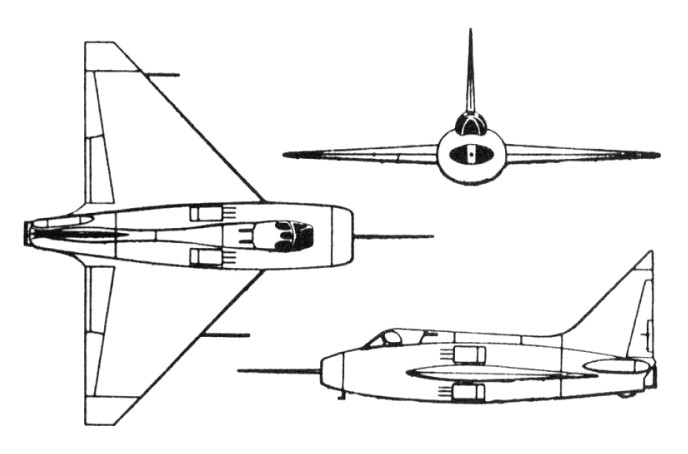
After the “Object 10” project, the Borovkov and Florov working group got to work on a new version known as “Object 11” or simply No.11. In some literature it has also been called I-207/6. This new project owed its origin to the intention to comply with the requirements issued by BN Yuriev during the review of the “Object 10” project as a way to achieve its serial production.
This new project returns to the conception of pure fighter with high manoeuvrability and to the conventional type landing gear. The armament included two 12.7 mm machine guns and two 7.62 mm ShKAS, but the possibility of carrying two FAB-250 250 kg bombs or instead two detachable containers with PTB-23 23 mm cannons remained.
It was smaller and lighter derivative of the “10”. Maintaining the same wing configuration of gull and inverted gull, the new model included two Merkulov DM ramjets in its metallic tail section, located side by side and with side gates for the air intakes. Instead of one large DM ramjet, it has two smaller ones placed side-by-side. This arrangement made it possible to install the tail wheel between them.
The project kept the Shvietsov M-71 engine, but in this case a variant with an elongated shaft was used, which made it possible to improve the aerodynamics of the forward section of the fuselage.
All efforts in the design of this new version were directed to obtain the lowest possible weight. The calculated speed of the project in fighter configuration at 5830 meters and without the auxiliary engines gave 654 km / h. With the bomb load the speed decreased to 611 km / h. The ascent time to 5000 meters was 3.7 and 4.5 minutes respectively.
The conceptual project for “Object 11” was presented in the fall of 1940. The evaluation commission considered that the calculated speed was a bit high and recalculated it to 630 km / h, leaving the speed with bombs at 585 km / h. The commission proposed to include the model in the plan of experimental works for the next year, obtaining the approval of AS Yakovlev.
In October 1940 the project was presented at the NII VVS and the conclusions of its evaluation were signed by PV Rychagov on December 9 1940. In general, the evaluation was positive and it was again recommended to include the fighter in the experimental construction plan for 1941 with the condition of increasing its range to 1000 km in normal version and 1400 km with auxiliary fuel (taking into account that “Object 11” it was not foreseen as an escort fighter, such range value was exaggerated and forced to considerably increase the weight of the aircraft in fuel).
The position of the GUAP, together with the negative perception of the industry and the air forces towards the biplane wing structure, resulted in the work on the project being closed. The deputy commissioner for experimental aviation AS Yakovlev, in a meeting informed the constructors of the decision not to include new proposals for two-plane configurations in the future work plans of the Narkomat.
Borovkov-Florov Object 11
Powerplant: One Shvietsov M-71 (1700/2000 hp) and two Merkulov DM ramjet
Wingspan: 8.5 m
Wing area: 22.0 m²
Length: 7.85 m
Flying weight: 3250 kg
Wing loading: 148 kg / m²
Maximum speed: 790 – 800 km / h
Ascent time at 8000 m: 6 – 7 min
Range: 800 km
Accommodation: 1
Florov-Borovkov I-207/5 Object 10
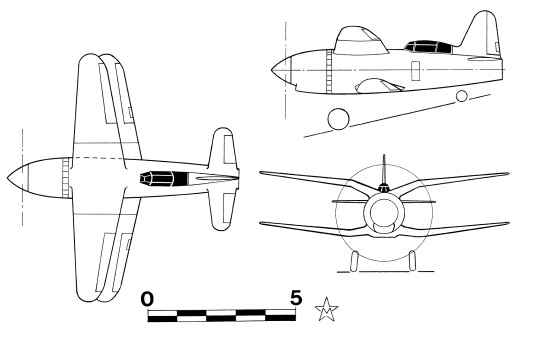
Florov and Borovkov continued with the “Object 10” project airplane that had a clear influence of the I-207 fighter, which is why the literature has sometimes named it I-207/5.
The project for this aircraft was ready for 1940 and envisaged the use of a Shvietsov M-71 engine. The fundamental objective of this new project was to achieve a design capable of eliminating all the difficulties encountered during the I-207 tests.
The aim was to demonstrate the possibility of creating a highly maneuverable biplane fighter with minimal resistance to advance, capable of competing with the best monoplane fighters of the time. The selection of a biplane wing box, according to its creators, should guarantee a more compact aircraft with better visibility for the pilot.
On this occasion and in order to achieve a wing as thin as possible, the builders decided to use a gull-type wing configuration for the upper wing and inverted gull for the lower wing. As in the I-207, the use of any type of bracing or upright was not foreseen. According to calculations the “Object 10” should reach a speed of 650 km / h with a turn time of 14 – 16 seconds.
In an attempt to achieve the highest possible speed, the builders designed from the beginning of the design stage, the use of reactive engines.
As early as July 1939 the engine manufacturer Merkulov had proposed the use of auxiliary ramjets in piston-engined aircraft. These ramjets were characterized by using the same jet fuel as the main power plant. These motors were called DM, acronym for Dopolnitielni Motor or auxiliary motor.
DM motors were designed as short-term supports for those moments in combat when additional speed was required. The first tests of these auxiliary engines were developed on a Polikarpov I-15bis in late 1939. The results were promising and for this reason in 1940 the constructors Borovkov and Florov installed these engines on the I-207/3. The test pilot of Factory No.207, LM Maximov, carried out about twenty flights without difficulties on this plane.
In the “Object 10” project the DM was installed inside the rear fuselage, behind the cockpit. In this way, its installation did not affect performance during the flight under normal conditions. The DM could be switched on by the pilot. For this, some side doors were opened that allowed air access to the engine and it was turned on. An increase in speed was calculated to about 840 km / h.
Unlike the previous models, the tail section was designed as a monocoque duralumin structure with a structure similar to that used in the wing. This was due to the need to reinforce the tail for the installation of the DM engine and to the need to avoid possible fires caused by the hot exhaust gases from the ramjet.
The armament was designed in such a way that it could be added or removed depending on the mission. The initial version was armed with two ShKAS 7.62 mm machine guns and a BS 12.7 mm machine gun, which could be replaced in field conditions by two 23 mm guns in the ground attack version. The armament had to include the possibility of transporting 250 – 500 kg bombs and dropping them accurately during dive on the target.
In the design, 350 – 400 kg were estimated for the armor and the installation of the guns. The cockpit and vital organs of the plane had to be protected. In the fighter version, the pilot’s back was protected by 8.5 mm thick concrete armor capable of defending the pilot from the firing of normal caliber weapons. The frontal armor was provided by the radial motor. This, together with the small dimensions of the plane, guaranteed an important level of safety to the pilot. The fuselage fuel tank was also protected.
A feature was the retractable type tricycle undercarriage. This configuration had been successfully tested by the TsAGI on an SB bomber. As early as 1940, several Soviet models included this type of landing gear in their design. In the case of “Object 10” this decision was forced by the fact that the tail was occupied by Merkulov’s engine.
The “Object 10” project was handed over to the NKAP in the summer of 1940. This project envisaged the use of a Shvietsov M-71 engine and a maximum armament capacity of 1000 kilograms. The armament could be made up of 250 or 100 kilogram bombs, although the possibility of using eight RS-82 reactive rockets under the wings was envisaged. The armament was also composed of two 12.7 mm and two 7.62 mm machine guns.
The cockpit armor comprised a 4 – 4.5mm armored seat plus an 8.5mm cement plate at the rear of the seat.
The project data showed a speed of 658 km / h without the auxiliary engine in the fighter version. The ground attack model had to fly at a speed of 550 km / h.
The project was reviewed by a directed commission for academic BN Yuriev on 3 August 1940, which considered objective the construction of the aircraft in its hunting version high manoeuvrability and in its version with two FAB-250 or four FAB- 100. The commission noted that the actual speed to be reached without the auxiliary engine would be only 605 km / h.
With these results, this variant in general could become an excellent ground attack aircraft. The possibility of using the M-82 engine was also evaluated.
With the start of the war, neither this model nor its development known as “Object 11” were built.
Object 10
Engine: 1x Shvetsov M-71 (1700/2000 hp); 1x Merkulov DM ramjet
Wing span: 9.5 m
Wing area: 24.0 sq.m
Length: 8.35 m
Takeoff weight: 3500 kg
Wing loading: 146 kg/sq.m
Max speed w/out ramjet: 650 km/h
Max speed with ramjet: 750-800 km/h
Climb to 8000 m (with ramjet active): 8.0 min
Flight range: 800 km
Armament: 1x 12.7 mm Berezin BS, 2x 7.62 mm ShKAS or 2x 23 mm cannons.
Crew: 1
Bombardier CSeries / Airbus A220
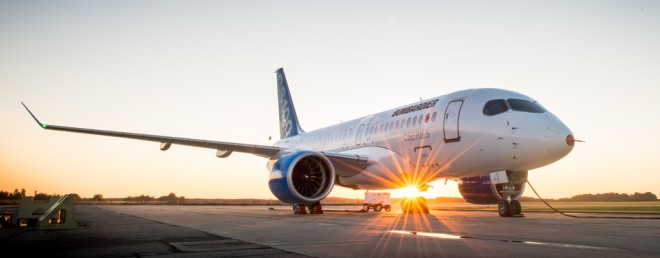
On September 1, 2013 4 Bombardier Aerospace announced that the first CSeries aircraft, Flight Test Vehicle 1 (FTV1), has successfully obtained Transport Canada’s Flight Test Permit, thereby clearing the way for its maiden flight. This follows a series of pre-flight tests including low-speed taxi runs.
“Five years in the making and today, following receipt of Transport Canada’s flight test permit, we are very close to the CSeries airliner’s first flight ” said Mike Arcamone, President, Bombardier Commercial Aircraft.
Designed for the growing 100 to 149 seat market, the 100% new CSeries aircraft family combines advanced materials, leading-edge technology and proven methods to meet commercial airline requirements. Powered by Pratt & Whitney PurePower PW1500G engines, the CSeries aircraft family will offer an extra capacity seating option.
As of June 30, 2013, Bombardier had booked orders and commitments for 388 CSeries aircraft that included firm orders for 177 CSeries airliners.
Bombardier sold the CSeries aircraft to Airbus. The CSeries became known as the A220, the single-aisle jet became a huge success for Airbus.
Bombardier Global 5000
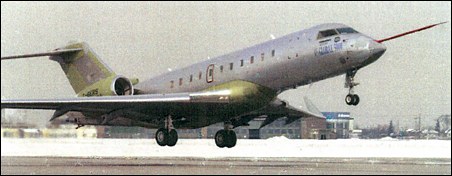
Market and design studies began 1999, announced on 25 October 2001 as the Global 5000. Based on the Global Express, with a 1.83m reduction in fuselage length, and a 2,222km reduction in maximum range, the first flight took place on 7 March 2003
Two aircraft were utilised in the flight test programme.
Bombardier Global 5000
Engines: 2 x 64354 N / 6560 kp
Length: 96.752 ft / 29.49 m
Height: 24.836 ft / 7.57 m
Cabin height: 6.266 ft / 1.91 m
Cabin width: 8.169 ft / 2.49 m
Cabin length: 42.487 ft / 12.95 m
Wingspan: 225.230 ft / 68.65 m
Max take off weight: 87714.9 lb / 39780.0 kg
Cruising speed (mach): 0.89 mach
Range: 4800 nm / 8889 km
Passengers: 19
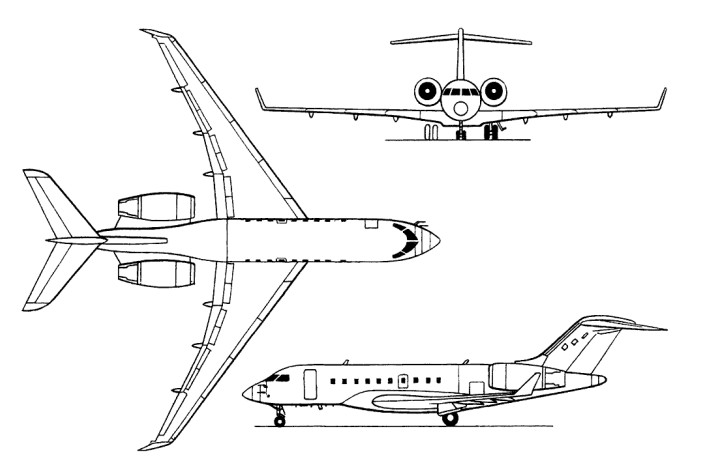
Bombardier BD-700 Global Express / Sentinel
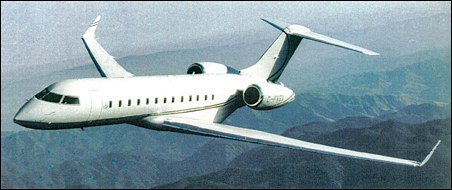
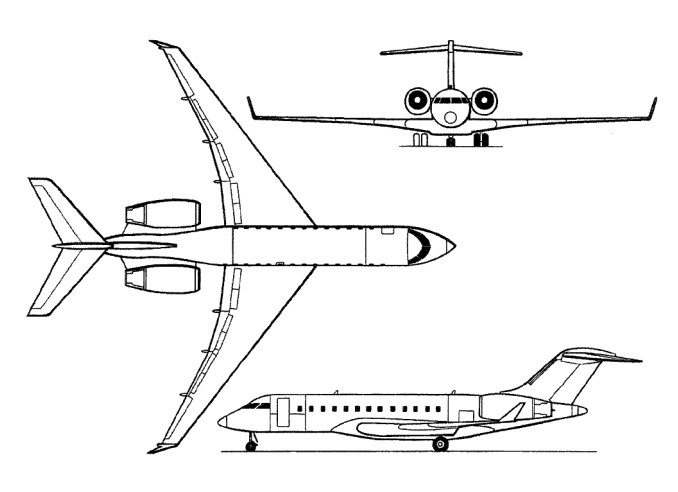
The Bombardier BD-700 Global Express is a twin-engine ultra long range executive jet aircraft with two crew members and up to 19 passengers and 2 flight attendants. Development of the BD-700 started late 1991 and the programme launched on 20 December 1993, the dsign goal was the longest possible range at highest speed from a short runway. A wide-body fuselage, combining the Challenger cabin cross-section with cabin length of the Regional Jet, the prototype rolled out 26 August 1996. Bombardier had 60 firm orders by February 1997.
Bombardier BD-700 Global Express Article
The first prototype flew on 13 October 1996. On 31 July 1998, the Canadian certification was granted and the first customer delivery was completed on 8 July 1999 to AirFlite Inc of Long Beach, California.
The Bombardier Global Express business jet was certified by the European Joint Aviation Authorities on May 7, 1999. The approval was issued under JAR Part 25, through Change 14. Bombardier reported having 80 orders for the twin-engine jet. Transport Canada and the FAA certified the airplane in 1998.
The range of the Global Express is 11,390 km at a cruise speed of 904 km/h.
On 3 August 2001 the first Global Express fitted with the ASTO long range airborne surveillance system flew.
The Bombardier BD-700 Global Express is powered by two Rolls-Royce Deutschland BR-710A2-20 turbofans.
Total of 91 aircraft were in customer service by 30 September 2002.
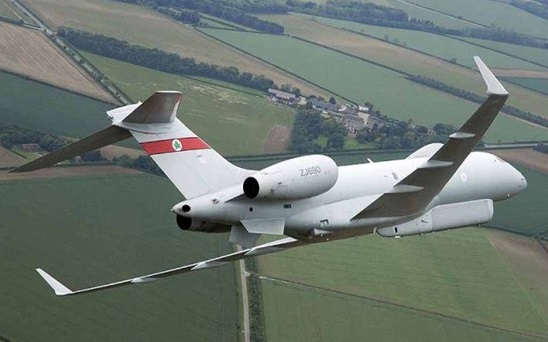
Engines: 2 x BMW / Rolls Royce BR 710-48-C2, 66119 N / 6740 kp
Wingspan: 91.896 ft / 28.01 m
Wing area: 1021.934 sq.ft / 94.94 sq.m
Length: 98.983 ft / 30.17 m
Height: 25.0 ft / 7.62 m
Max take off weight: 93395.0 lb / 42356.0 kg
Weight empty: 48510.0 lb / 22000.0 kg
Max. speed: 505 kts / 935 km/h
Cruising speed: 475 kts / 880 km/h
Service ceiling: 51001 ft / 15545 m
Wing load: 91.43 lb/sq.ft / 446.0 kg/sq.m
Maximum range: 6500 nm / 12038 km
Range: 6318 nm / 11700 km
Crew: 2
Payload: 8-19 pax (max. 3266kg)
 All Aero