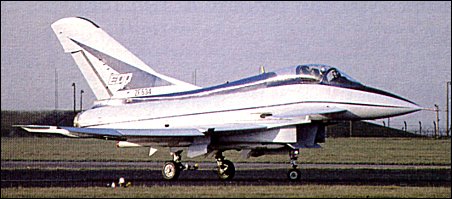
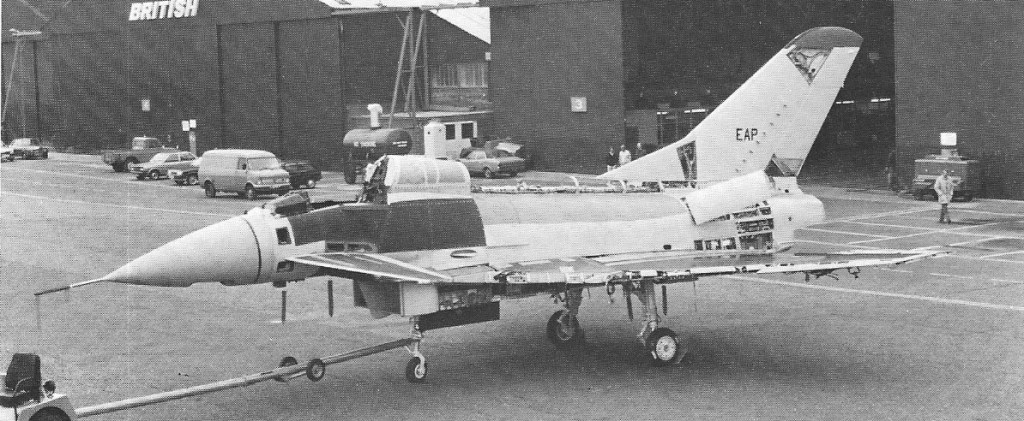
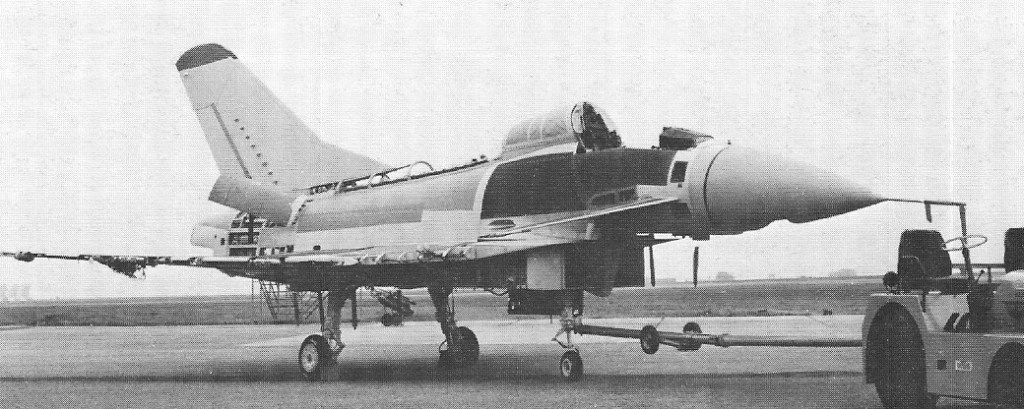
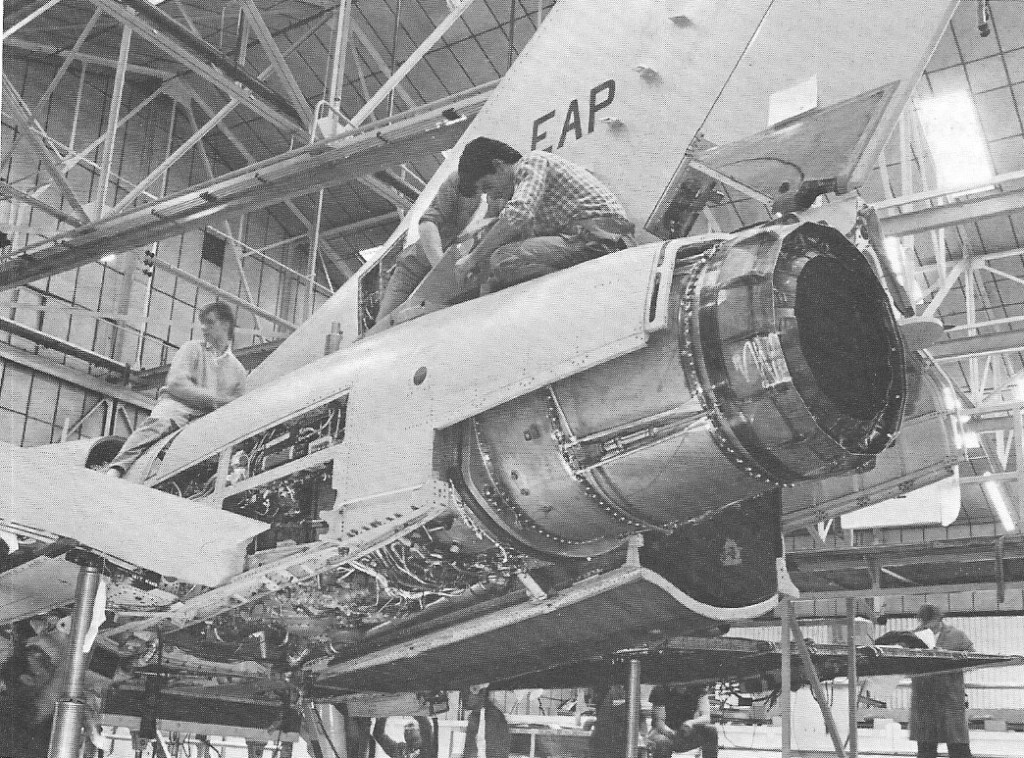
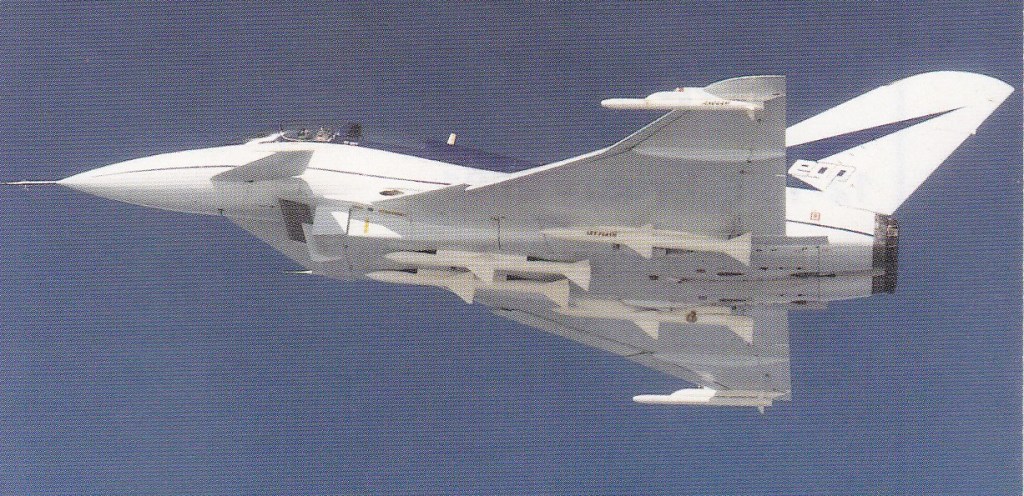
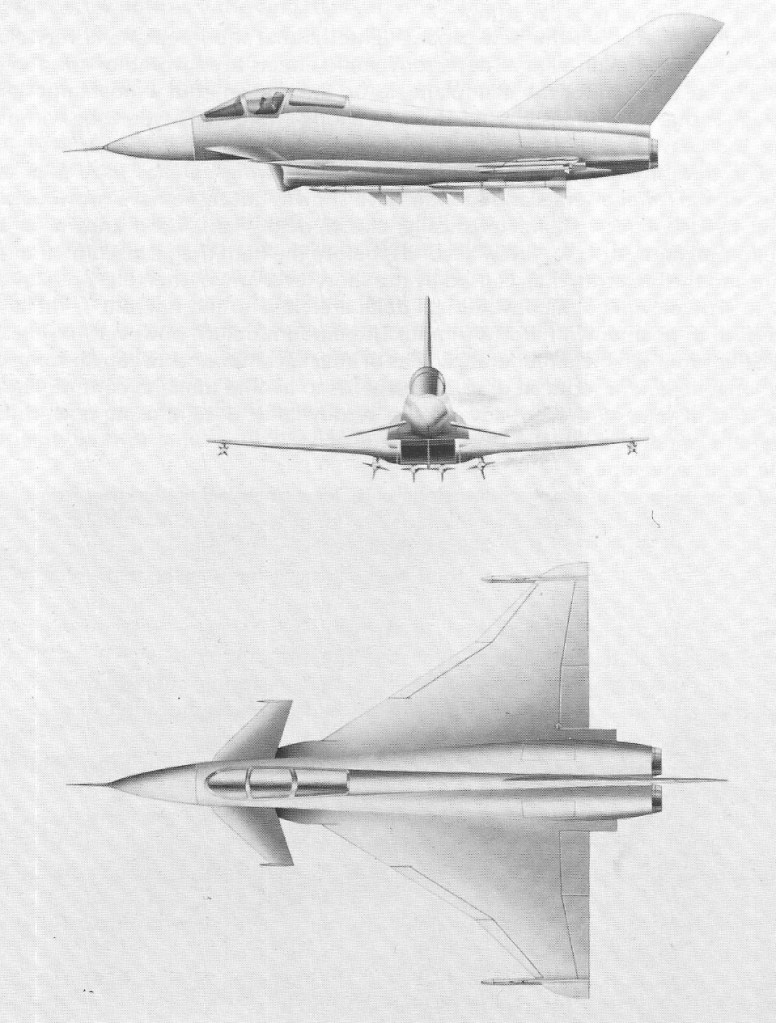
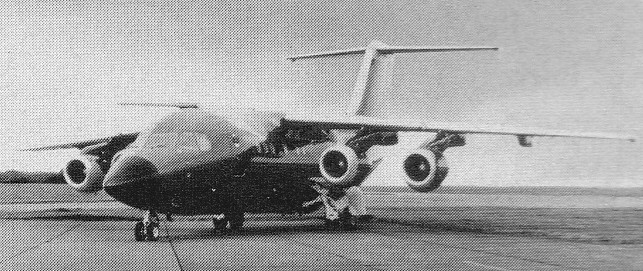
EAP is a single-seat aircraft with a compound-sweep delta wing and an all-moving canard. Power is provided by twin reheated RB.199 turbofans fed by chin intakes. The contract for the design, development, and construction of the demonstrator was signed in May 1983.
Prototype EAP October 1985
Prototype EAP October 1985
The EAP technology demonstrator aircraft exceeded Mach 1.1 on its first flight on August 8, 1986. Produced by British Aerospace in collaboration with several industrial partners, including Aeritalia, MBB, Rolls-Royce, Dowty, Ferranti, and GEC, the EAP has received financial support from the UK Government. Intended to demonstrate a complete weapons system for the 1990s, the EAP incorporates many advanced-technology features, including the extensive use of carbon-fibre structures, advanced aerodynamics, digital fly-by-wire with relaxed stability, a digital databus, and an integrated electronic cockpit.
EAP Engines: 2 x Turbo-Union RB 199-34R Mk, 40.0-75.7kN Take-off weight: 14515 kg / 32000 lb Empty weight: 10000 kg / 22046 lb Wingspan: 11.77 m / 38 ft 7 in Length: 17.72 m / 58 ft 2 in Height: 5.70 m / 18 ft 8 in Wing area: 51.66 sq.m / 556.06 sq ft Max. speed: 2M Crew: 1
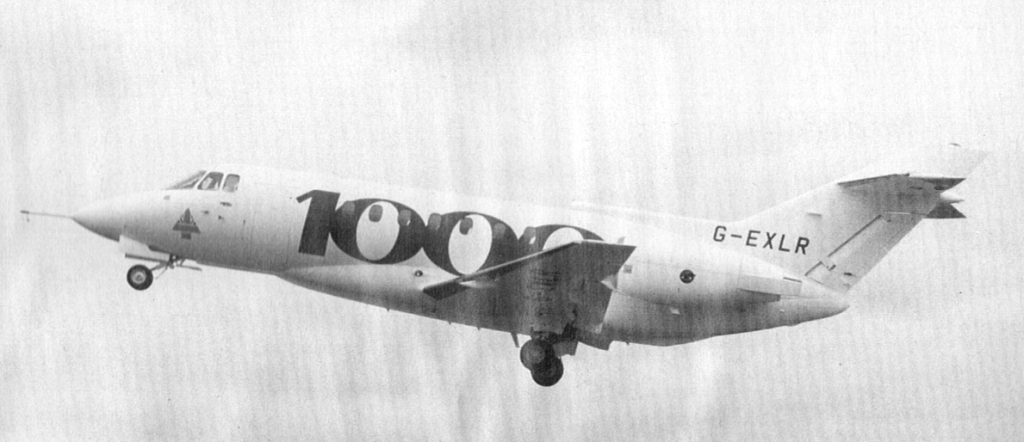
British Aerospace’s new BAe 1000, derived from the BAe 125 800, made its first flight in June 1990 from Chester. The BAe 1000 is billed as an intercontinental range, mid sized, corporate jet. The most obvious visual difference compared with the 125 Srs 800 is the lengthened fuselage with a more prominent external ventral fairing containing more fuel, stretched in size (84cm) as well as range (by 21 percent to 3635 nm). The cabin is deeper and there is space for a maximum of 15 in high density seating.
Engines: 2 x Pratt & Whitney Canada PW305 turbofans, 5,200 lb st (23,13 kN).
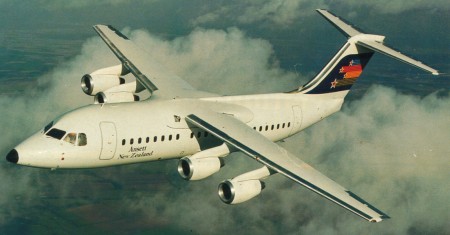
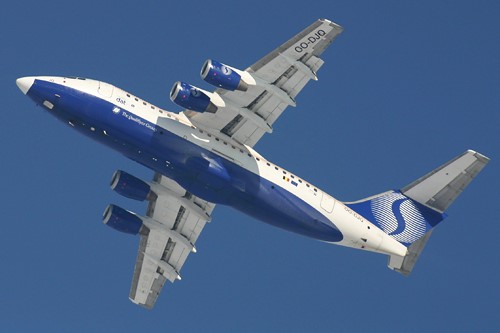
Hawker Siddeley announced their plans for a short-range, quiet airliner powered by four small turbo-fans in August 1973, the 146. But, with the economic recession in Britain that fol¬lowed shortly after, the HS. 146 project became “unjusti¬fiable” and was dropped. It was re-launched five years later when Hawker Siddley became British Aerospace (BAe).
Design of the BAe-146 included 15 rows of five-abreast seating, and it was powered by four Textron Lycoming ALF502R-5 high bypass turbofan engines of 6,970 lbs of thrust. The British Aerospace 146 first flew at Hatfield on 3 September 1981, flown by chief test pilot Michael Goodfellow and Peter Sedgwick, and two flight test observers. At the time of the first flight, which lasted 95 minutes, BAe reported that it had 35 aircraft “earmarked for customers”.
BAe 146-100 VH-NJA – the fourth built
The -200 development production model flew on 1 August 1982. The main point of difference between the -200 and the-100 was the increased fuselage length of the -200 by 2.40m to 28.60m. The type was granted certification on 4 February 1983, and production went ahead, with assembly of the BAe-146 beginning at Hartford and later expanding to Woodford. Annual production of the airliner reached 40 aircraft, and one of the first operators of the type was Dan-Air in Britain, which began operations with it in May 1983. QT Quiet Trader and QC convertible versions with side-opening freight doors were also available. The QT suffix under¬lines a marketing ploy; “Quiet Trader”. The 200QT combines the wide door introduced on the freighter versions with interior trim appropriate to the passenger role and has a within one hour turnaround between roles; providing either 94 seats or room for six freight pallets. The prototype QC had made its debut at the 1989 Paris Air Show. With a strengthened floor that enable pallets of up to 4000 lbs (1.815 tonnes) providing a possible gross payload of 10.05 tonnes to be shifted, with a 42.184 tonne MAUW permitted. The name Statesman refers to VIP-furnished variants for military or civil customers. The 146STA was the first dedicated military variant to reach demonstrator status, in the form of the original Srs 100 No 2 modified, by Hayes International, to incorporate a 131in/3.33m by 76in / 1.93m side-loading cargo door. The 146STA made its first flight in the USA on 8 August 1988 and featured a single air-openable (outwards and forward) parachuting door immediately behind the main freight door. A strengthened floor can take up to 7000 lb / 3175 kg single pallets and a total load of 22,300 lb / 10,115 kg.
BAe-146STA
A further development, the BAe 146-300, made its first flight on 1 May 1987 and certification was granted on 6 September 1988. This had its fuselage lengthened again to 30.99m, seating around 90 passengers five abreast, and an upgraded “glass” cockpit, but the power plant remained the same.
The -300 prototype was a modification of the original -100 prototype, then followed by a development aircraft, G-OASF, that first flew on 22 June 1988. Flight testing led to the development of a flap/trim compensation unit to cater for the increased tail arm of the -300, and an increase in max operating speed to M 0.72, but M 0.73 in the USA. Limiting airspeed remained at 295 kt / 546 kph IAS. It was certified at 93,000 lb / 42, 185 kg, like the Srs 200, but was likely to increase.
Late in 1990, BAe offered the first of an improved series called the RJ70, and this was followed over the next two years with the RJ80, the RJ85 and, in May 1992, the RJ100. The RJ-100 (G-IRJX) first flying on 23 Sept 2001. However, the RJX programme was eventually closed, marking the end of commercial jet airliner production in Britain. In all, a total of 380 BAe-146s were produced and the type has been in worldwide service.
BAe 146-100 Engines: Four Avco Lycoming ALF 502R-3 turbofans, 6,700 lb st (3 040 kgp) for take-off. Fuel capacity: 2,540 Imp gal (11540 lt) Optional fuel: 300 Imp gal (1364 lt) Design Vmo/Mmo, 310 kts (574 km/h) CAS, M0.70 above 22,000 ft (6 705 in) Typical high cruise speed, 419 kts (775 km/h) Still air range with basic 82-pax payload, 730 nm (1352 km) Range with max payload and std fuel, 510 nm (946 km) Range with max payload and increased gross weight 1,100 nm (2037 km) Range with optional increased tankage, 1,550 nm (2871 km) with 13,000 lb (5 900 kg) payload Balanced take-off field length, 3,600 ft (1097 m), ISA at sea level. Typical operating weight empty, 45,570 lb (20 670 kg) Max take-off weight, 74,600 lb (33840 kg) Optional (-00RR) increased gross weight version, 80,750 lb (36628 kg) Max landing weight, 71,850 lb (32590 kg) Max zero fuel weight, 63,250 lb (28 690 kg). Span, 86 ft 5 in (26,34 m) Length, 85 ft 10 in (26,16 m) Height, 28 ft 3 in (8,61 m) Gross wing area, 832 sq ft (77,3 sq.m) Aspect ratio, 8.97:1 Sweepback, 15 deg at quarter chord Undercarriage track, 15 ft 6 in (4,72 m) Wheelbase, 33 ft 11 in (10,1 m) Flight crew: two Max seating, one-class, 93 pax six abreast at 29-in (74-cm) pitch Standard seating, 82 at 33-in (84-cm) pitch Underfloor baggage/cargo compartments volumes 258 cu ft (7,30 cu.m) front / 242 cu ft (6,85 cu.m) rear
BAe 146-200 Engines: Four Avco Lycoming ALF 502R-3 turbofans, 6,700 lb st (3 040 kgp) for take-off. Fuel capacity, 2,540 Imp gal (11540 lt) Optional fuel 300 Imp gal (1364 lt) Design VMO/MMO, 300 kts (557 km/h) CAS, 100M = 0. 70 above 23,750 ft (7 240 m) Typical high cruise speed, 419 kts (775 km/h) Sill-air range with basic pax payload, 1200 nm (2 223 km) Range with max payload and std fuel, 1,080 nm (2 000 km) Range optional fuel and 19,000-1b (8 618-k.g) payload, 1380 nm (2 556 km) Balanced take-off field length, ISA at sea level, 5,000 ft (1520 m) Typical operating weight empty, 45,570 lb (20 670 kg) Max take-off, 88,250 lb (40030 kg) Max landing weight, 77,000 lb (34927 kg) Max zero fuel weight, 69,250 lb (31411 kg) Span, 86 ft 5 in (26,34 m) Length, 93 ft 8 in (28,55 m) Height, 28 ft 3 in (8,61 m) Gross wing area, 832 sq ft (77,3 cu.m) Aspect ratio, 8.97:1 Sweepback, 15 deg at quarter chord Undercarriage track, 15 ft 6 in (4,72 m) Wheelbase, 36 ft 9 in (11,20 m) Flight crew: two Max seating, one-class, 109 pax six abreast at 29-in (74-cm) pitch Standard seating, 100 at 33-in (84cm) pitch. Underfloor baggage/cargo capacity, 660 cu ft (18,69 cu.m).
BAe 146 200 II QC Engines: 4 x Avco Lycoming ALF502R-5, 6970 lb thrust. MAUW: 42.184 tonne.
BAe 146 III Engines: 4 x Textron Lycoming LF507, 7000 lb thrust.
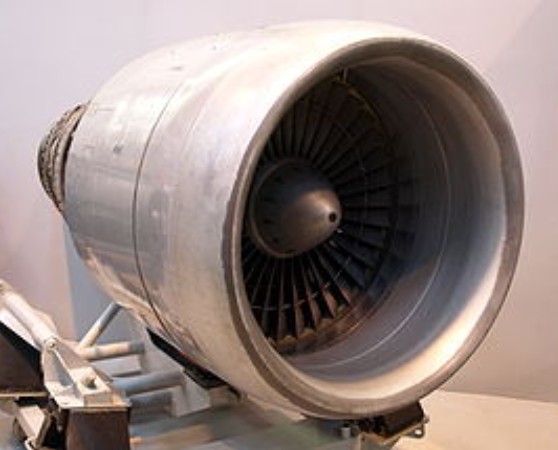
The Rolls-Royce/SNECMA M45H was a medium bypass ratio turbofan produced specifically for the twin-engined VFW-Fokker 614 aircraft in the early 1970s. The design was started as a collaborative effort between Bristol Siddeley and SNECMA.
The single-stage fan, together with a five-stage LP compressor, was driven by a three-stage LP turbine, whilst the seven-stage HP compressor was driven by a single-stage, air-cooled, HP turbine. An annular combustor and an unmixed exhaust, with a plug-type primary nozzle, were other design features. The engine was developed at the time of the Rolls-Royce bankruptcy which resulted in delays in developing the engine.
The M45SD-02 or RB.410 was a derivative of the M45H-01 turbofan, designed to demonstrate ultra-quiet engine technologies, needed for STOL aircraft operating from city centre airports.
A geared, variable pitch, fan replaced the first stage of the low pressure (LP) compressor. A modest fan pressure ratio, consistent with the high bypass ratio, meant a low fan tip speed could be employed. A low hot jet velocity was another major design feature.
In reverse thrust, intake air entered the bypass duct, via a gap in the cold nozzle outer wall, and went through the fan, to be expelled through the intake. A small proportion of the bypass duct air entered the IP compressor, via a special diverter valve, to sustain the gas generator. Reverse thrust was obtained by the fan going through fine (rather than feather) pitch. Engine testing took place in the mid 1970s.
Specifications:
M45H Mk.501 Type: Turbofan Length: 2,600 mm (102.4in) Diameter: 909 mm (35.8 in) Dry weight: 673 kg (1,483 lb) Compressor: 5-stage intermediate pressure and 7-stage high-pressure axial compressor with a single-stage fan Bypass ratio: 3:1 Combustors: Annular Turbine: 3-stage low pressure and single-stage high pressure turbines Maximum thrust: 7,300 lbf (32.4 kN) Overall pressure ratio: 16.5:1 Thrust-to-weight ratio: 4.9:1
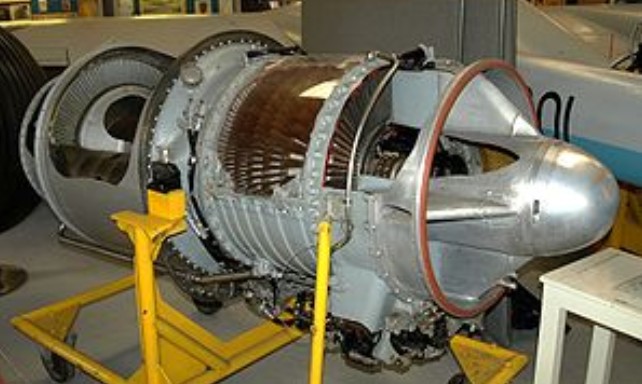
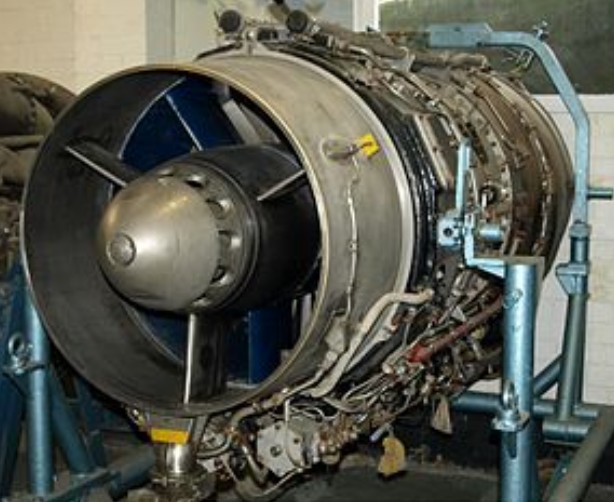
The engine had its genesis in a 1952 request by Folland for an engine in the 5,000 pounds (22 kN) class to power a new trainer and lightweight fighter-bomber they were developing. Stanley Hooker, relatively new to the company after an earlier career at Rolls-Royce, took the project under his wing. He delivered a relatively simple and easy to maintain engine, which was put into use in the Folland Gnat, flying in 1955. Developing a Sea Level Static thrust of 4,520 lbf (20.1 kN), the Orpheus 701 had a 7 stage axial compressor driven by a single stage turbine.
Other users, mostly trainers, soon followed, including the Fuji T-1, Hindustan Marut, HA-300,and the experimental Hunting H.126 and Short SB5. In 1957 NATO ran a competition for a light fighter design, asking for entries in both engine and airframe categories. The Orpheus was the unanimous winner of the engine contest, and was thus selected to power the Fiat G.91R and G.91T using Fiat-built versions of the engine.
Many companies in the 1950s were looking at ways of producing a vertical take off and landing aircraft. Michel Wibault had the idea of using a turboshaft engine to drive four large centrifugal blowers which could be swivelled to vector the thrust. Hooker’s engineers decided on using the Orpheus to drive a single large fan that would supply air to a pair of rotating nozzles, while the exhaust flow from the Orpheus was split into two and would supply another pair of nozzles at the rear of the engine. This experimental system developed into the Pegasus.
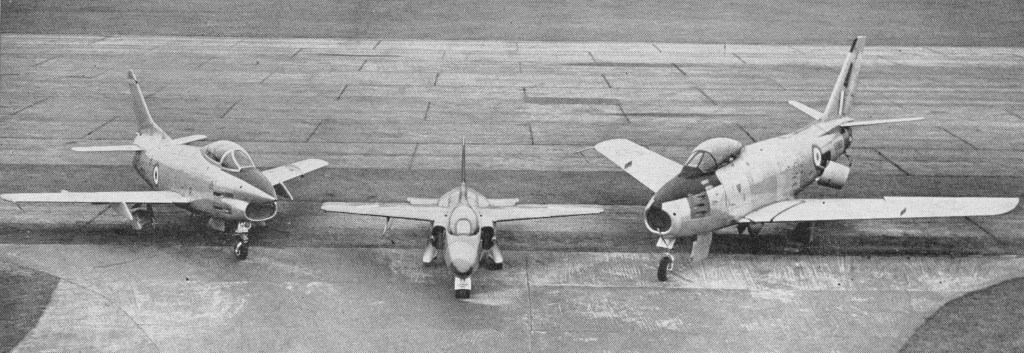
Fiat G.91, Folland Gnat, Canadair Sabre – all Bristol Siddeley Orpheus powered
Variants:
BOr.1 First run on 17 December 1954, rated at 3,285 lbf (14.61 kN) by Spring 1955, powered the prototype Folland Gnat.
BOr.2 (Mk.701 / Mk.703)
BOr.3 (Mk.801 / 803 / 805)
BOr.4 (Mk.100)
BOr.12 With a simplified reheat system the BOr.12 was rated at 68,100 lbf (302.92 kN) dry and 8,170 lbf (36.34 kN) with afterburning.
Mk.100 De-rated to improve reliability and fuel consumption and increased engine life, rated at 4,230 lbf (18.82 kN) for the Fiat G.91T and Hawker Siddeley Gnat T Mk.1.
Mk.701 Rated at 4,520 lbf (20.11 kN), the Mk.701 was used in the production Folland Gnat F Mk.1 for Finland and India.
Mk.703 The Mk.703 rated at 4,850 lbf (21.57 kN) powered the Hindustan HF-24 Marut Mk.1.
Mk.801 The Mk.801, rated at 4,520 lbf (20.11 kN), powering G.91s. The Mk.801 was identical to the BOr.2 engine except for accessories.
Mk.803 The Mk.803, with improvements to the compressor, rated at 5,000 lbf (22.24 kN), replaced earlier marks used in G.91s.
Mk.805 The Mk.805, de-rated to 4,000 lbf (17.79 kN), powered the Fuji T-1 trainers of the JASDF and the Hunting H.126 jet-flap research aircraft.
FIAT 4023 Mk.803 engines Licence built by FIAT.
FIAT 4023 Mk.803 engines Licence built by FIAT with added fire detection system.
Applications: Breguet Taon Fiat G.91 Folland Gnat Fuji T-1 HA-300 Hindustan Marut Hunting H.126 Short SB5
Specification:
Orpheus BOr.3 / Mk.803 Type: Turbojet Length: 75.45 in (1,916 mm) Diameter: 32.4 in (823 mm) Dry weight: 835 lb (379 kg) Compressor: 7 stage axial compressor Combustors: Can-annular with 7 flame tubes Turbine: Single stage turbine Fuel type: Aviation kerosene Oil system: Pressure spray and metered feed to gearbox and rear bearing. Oil from the rear bearing is lost overboard to the jet efflux. Maximum thrust: 5,000 lb (2 kN) Turbine inlet temperature: 1,184 °F (640 °C) maximum continuous Specific fuel consumption: 1.08 lb/lb/hr(110.1 kg/kN/hr) Thrust-to-weight ratio: 5.988 lbf/lb (0.0587 kN/kg)
The de Havilland Gyron Junior was a military turbojet, and a two-fifths output scaling down of the Gyron, starting as Project Study number 43 in 1954. The first prototype Junior ran in August 1955.
Only a little more widely used than the Gyron, it did at least enter serial production with Bristol for the Blackburn Buccaneer S.1 twin-engined Naval strike aircraft. However it was never a successful engine in service. The Buccaneer S.1 was criticised for being underpowered and the later and more numerous S.2 used the more powerful Rolls-Royce Spey instead.
Twin Gyron Juniors, with afterburners, were also used to power the Bristol 188 Mach 2 supersonic research aircraft. The Rolls-Royce Avon had been considered, but only the Gyron Junior was used in practice. The program was a disappointment, if not a failure, and was terminated early without achieving all of the high-speed high-temperature trials that had been intended. The limitation was the poor fuel consumption of the Gyron Junior and surging from the intakes. This could have been solved with Avons and the successful English Electric Lightning intake design, but the Avro 730 project that the 188 was a research aircraft for had been dropped as a result of the 1957 Defence White Paper which cancelled many manned aircraft designs under development as they were expected to be rendered obsolete by guided missiles. Only Mach 1.95 was achieved for a few minutes, endurance at any speed was so restricted by fuel limits that it was impossible to study the long-term “thermal soaking” of a supersonic airframe, as intended. In total 89 were built.
Variants: Gyron Junior DGJ.1 (or P.S.43)
Gyron Junior DGJ.2 (Mk.101) Interim production stage, used on Buccaneer S. Mk.1. Variable inlet and guide vane, annular manifold for flap blowing, 121 in (3.1 m) long overall
Gyron Junior DGJ.10 Exhibited in 1958 at Farnborough, longer than the DJG.1
Gyron Junior DGJ.10R (or P.S.50) highly augmentation afterburning version for the Bristol 188, dry thrust 10,000 lb, wet thrust 14,000 lb s.t. (62.3 kN). Added zero stage and two rows of variable stators. Variable nozzle for convergent, parallel and divergent/convergent configuration depending on reheat and aircraft speed. Overall length 191 in (4.9 m)
Gyron Junior DGJ.20
Applications: Blackburn Buccaneer S.1 40 aircraft built
Bristol 188 Only 2 built
Gloster Javelin Testing only, 1 production FAW Mk.1 modified
Saunders-Roe SR.177 Intended application, not built
Specifications:
Gyron Junior DGJ.10 Type: Single-spool after-burning turbojet Length: 102.9 in (2.61 m) Diameter: 41.1 in (1.04 m) Dry weight: Compressor: 7-stage axial flow with Variable Inlet GuideVanes (VIGV) Combustors: Annular compustion chamber with 13 spill-type burners Turbine: Two-stage axial flow Fuel type: Aviation kerosene Oil system: Pressure spray/splash with scavenging Maximum thrust: 10,000 lbf (44.48 kN) dry, 14,000 lbf (62.28 kN) wet at sea level, 20,000 lbf (88.96 kN)+ at M2.5+ at 36,000 ft (10,972.8 m) Overall pressure ratio: (DGJ.1)6.4:1 Turbine inlet temperature: (DGJ.1)1,200 °C (2,190 °F) Power-to-weight ratio:
The General Electric T58 is an American turboshaft engine developed for helicopter use. First run in 1955, it remained in production until 1984, by which time some 6,300 units had been built. On July 1, 1959, it became the first turbine engine to gain FAA certification for civil helicopter use.
Development commenced with a 1953 US Navy requirement for a helicopter turboshaft to weigh under 400 lb (180 kg) while delivering 800 hp (600 kW). The engine General Electric eventually built weighed only 250 lb (110 kg) and delivered 1,050 hp (780 kW) and was soon ordered into production. First flight was on a modified Sikorsky HSS-1 in 1957, and civil certification for the CT58-100 variant was obtained two years later.
The main production version of the engine was the T58-GE-10, developing 1,400 hp (1,044 kW). The most powerful version, the T58-GE-16, produces 1,870 hp (1,390 kW).
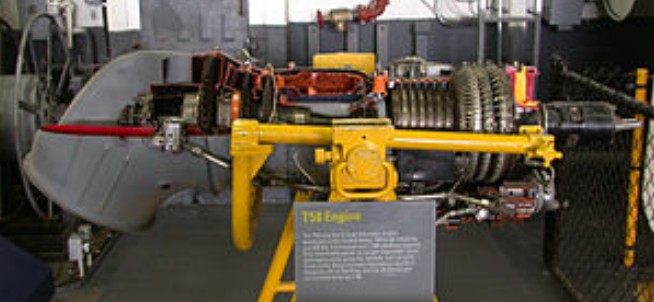
General Electric T58
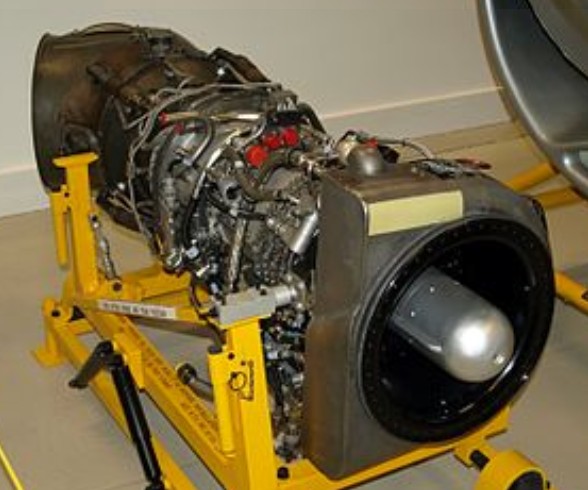
The Rolls-Royce Gnome is a single spool turboshaft engine originally developed by the de Havilland Engine Company as a licence-built General Electric T58—a mid-1950s design. The Gnome came to Rolls-Royce after their takeover of Bristol Siddeley in 1966, Bristol having absorbed de Havilland Engines Limited in 1961.
A licence to manufacture the T58 was purchased in 1958. The T58 had begun bench testing in 1955 and by 1958 had already been used in helicopters and de Havilland were able to test their first engines in a Westland Whirlwind and Wasp helicopters in August 1959.
A free-turbine turboshaft, it was used in helicopters such as the Westland Sea King and Westland Whirlwind. The design was sub-licensed to Alfa-Romeo and the IHI Corporation.
There were two series produced: the “H” turboshaft for helicopter use, and the “P” turboprop for fixed-wing aircraft.
A single-stage turbine drives the 10 stage all-axial compressor, whilst a two-stage free power turbine drives the load. The combustor is annular. The Gnome differed from the T-58 in having a British developed fuel control system (Lucas).
Because an all-axial design is employed, the final stage compressor rotor blades are amongst the smallest ever manufactured. Normally, a small engine such as this would feature an axial/centrifugal or even a double centrifugal compressor.
The engine was one of the first developed with an analogue computer, de Havilland’s own, as part of the fuel control system, specifically to control fuel flow during acceleration to prevent engine surge from occurring.
The General Electric T58 remained in production until 1984, by which time some 6,300 units had been built. On July 1, 1959, it became the first turbine engine to gain FAA certification for civil helicopter use.
T58s, have been converted to turbojet by the removal of the power turbines and were used as jet engines on: Maverick TwinJet 1200 Sipa 200 CozyJet BerkutJet VelocityJet Gross Panther Replica
T58 converted to turbojet by Les Shockley (2003). Named SHOCKWAVE 800+
The SHOCKWAVE 800+weighs just 300 pounds and is capable of producing up to 840 pounds of thrust.
The Carroll Shelby turbine cars entered in the 1968 Indianapolis 500 race were powered by T58s. The cars were found to be using variable inlets to get around the USAC regulations on the maximum allowable inlet size and were disqualified.
Turboshaft engines like the GE T58, Lycoming T53/T55 are also used to power high performance powerboats, such as aport and offshore vee, and catamaran hulls like the Skater “Jet Set” or Mystic Powerboats “My Way”, water jet river racers like Unatural Dissaster and hydroplanes. Some of these boats run in excess of 200 mph, despite them being open cockpit pleasure boats.
H.1000 (Mk.101) 1,050 shp, first production version for use on later marks of Westland Whirlwind
H.1200 1,250 shp, the Westland Wessex uses two H.1200, as the Coupled Gnome, with a coupled gearbox with a limited power of 1,550 shp at the rotor.
H.1400 1,400 shp for the Westland Sea King HAS.1
H.1400-1 1,535 shp, uprated from the 1400 by increasing the gas-generator speed and using improved blades that can operate at higher temperatures for the Westland Sea King HAS.2.
H.1400-1T For the Westland Commando HC.4
H.1400-2 1,660 shp for the Westland Sea King HAS.5.
H.1400-3 1,720 shp with new two-stage power turbine.
P.1000 Turboprop version of the H.1000
P.1200 Turboprop version of the H.1200
P.1400-3 Turboprop version of the H.1400-3 rated at 1,700 shp.
Gnome Mk.101
Gnome Mk.110 Handed H.1200 engines for Coupled Gnome units used in Westland Wessex helicopters.
Gnome Mk.111 Handed H.1200 engines for Coupled Gnome units used in Westland Wessex helicopters.
Mk.510 Civilianised Gnome engines.
Mk.610 Civilianised Gnome engines.
Gnome Mk 660 Used in the civilian Westland Wessex 60 helicopter
Coupled Gnome Twin engines driving through a common gearbox to a single output.
Application: General Electric T58 Aerospatiale SA 321K Super Frelon Agusta A.101 AgustaBell AB204B Bell UH-1F/TH-1F Bell X-22 (YT58) Boeing Vertol BV-107-II Boeing CH-46 Sea Knight Fairchild VZ-5 (YT58) Kaman SH-2 Seasprite Piasecki XH-21D Shawnee (Model 71) Sikorsky SH-3 Sea King Sikorsky HH-3B/C/E/F Sikorsky HH-52 Seaguard Sikorsky S-61L/N Sikorsky S-62 Sikorsky S-67 Sikorsky S-72
Applications: Rolls Royce Gnome Agusta A.101 AgustaBell AB204B Agusta-Bell 205BG Kawasaki KV-107 (Swedish Navy only) Saunders-Roe SR.N6 hovercraft Westland Sea King and Commando Westland Wessex Westland Whirlwind
Specifications:
T58-GE-8 Type: Free power turbine turboshaft Length: 55 in (1,397 mm) Diameter: 16 in (406 mm) Dry weight: 285 lb (129 kg) without reduction gearbox, 391 lb (177 kg) with reduction gearbox Compressor: 10 stage axial-flow compressor with variable inlet guide vanes + variable incidence stators in first three stages Combustors: Annular combustion chamber with 16 burner nozzles on two manifolds Turbine: 2x gas generator power turbine stages + 1x free power turbine stage Fuel type: Aviation kerosene Maximum power output: 1,250 hp (932.12 kW) Overall pressure ratio: 8.3:1 Specific fuel consumption: 0.64 lb/hp/hr (0.389 kg/kW/hr) at maximum continuous rating Power-to-weight ratio: 6.1 hp/lb (10.024 kW/kg) without reduction gearbox
Gnome H1400-1 Type: Turboshaft Length: 54.8 in (1392 mm) Diameter: 22.7 in (577 mm) Dry weight: 334 lb (151.5 kg) Compressor: Ten-stage axial flow Combustors: Annular Turbine: Single-stage compressor turbine, two-stage power turbine Maximum power output: 1,500 shp (1,119 kW) Overall pressure ratio: 8.4:1 Power-to-weight ratio: 4.5 shp/lb
The Rolls-Royce Gem is a turboshaft engine developed specifically for the Westland Lynx helicopter in the 1970s. The design started off at de Havilland (hence the name starting with “G”) and was passed to Bristol Siddeley as the BS.360. When Rolls-Royce bought out the latter in 1966, it became the RS.360.
The Gem is a three-shaft configuration turboshaft/turboprop engine. Basic arrangement is a four-stage axial compressor, driven by a single stage IP (Intermediate Pressure) turbine, supercharging a centrifugal HP (High Pressure) compressor, driven by a single stage HP turbine. Power is delivered to the load via a third shaft, connected to a two-stage free (power) turbine. A reverse flow combustor is featured.
The Gem 42 develops 1,000 shp (750 kW) at Take-off, Sea Level Static, ISA, but the Maximum Contingency Rating (MCR) is 1,120 shp (840 kW).
Applications: Agusta A129 Mangusta Westland Lynx
Specifications:
Gem 42 Type: Triple-shaft two-spool turboshaft Length: 43.4 in (1090 mm) Diameter: 23.5 in (590 mm) Dry weight: 414 lb (187 kg) Compressor: 4-stage axial LP, single-stage centrifugal HP Turbine: 2-stage power turbine, single-stage LP, single-stage HP Maximum power output: 1,000 shp (746 kW) Overall pressure ratio: 12:1
The Bristol Siddeley BS.100 was a British twin-spool, vectored thrust, turbofan aero engine that first ran in 1960, the engine was designed and built Bristol Siddeley Engines Limited. The BS.100 was similar in general arrangement to that of the company’s Pegasus design, but with the addition of plenum chamber burning (PCB), to enable the projected Hawker Siddeley P.1154 VSTOL fighter design to accelerate to supersonic speed. PCB is akin to reheat, but is only applied to the bypass stream (i.e. the front nozzles), as the flow turns from fan exit to the nozzle bearing plane. Variable area front nozzles were required, to maintain consistent fan matching regardless of whether the PCB was alight. The BS.100 was also intended for the Fokker Republic D-24. Six had been built when the project was cancelled in early 1965.
BS100 Type: Turbofan Length: Diameter: Dry weight: Compressor: Two-spool axial flow Bypass ratio: 0.9:1 Combustors: annular Maximum thrust: 26,200 lbf (116.54 kN) PCB off 35,900 lbf (159.69 kN) short lift thrust, PCB on Overall pressure ratio: 11.45:1 Specific fuel consumption: 0.615 lb/(hr·lbf) (62.73 kg/(kN·h)) at 19,200 lbf (85.41 kN) dry thrust 1.16 lb/(hr·lbf) (118.3 kg/(kN·h)) with PCB
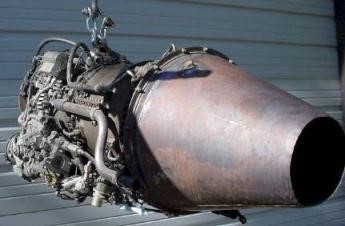
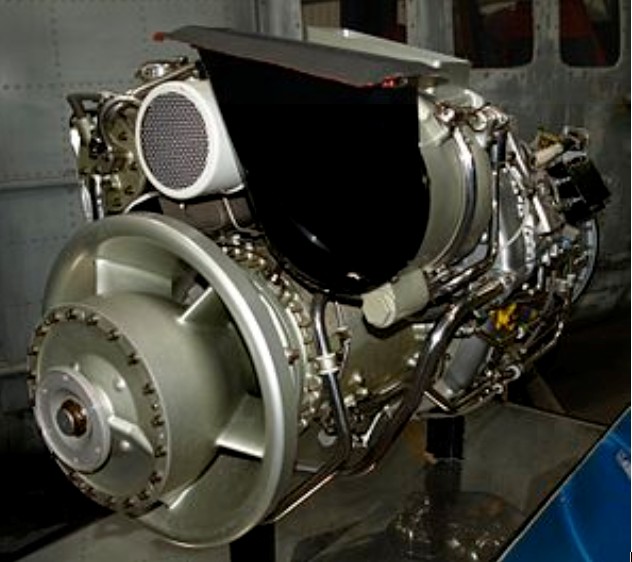
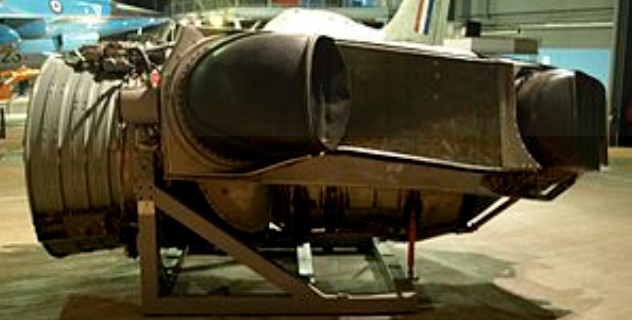
Turbojet early version of the Proteus used to test and develop the gas generator portion of the engine, flight tested in the bomb bay of an Avro Lincoln from May 1946.




 All Aero