CRJ-440
Engines: 2 x General Electric CF34-3B1 Turbofans, 9220 lb thrust.
Jet
Canadair CRJ / RJ 100 / RJ 200

The CRJ concept evolved from a stretched design of the Challenger business jet. Stretched versions of this aircraft go back to 1981 with the 24-seat CL-600. Bombardier then looked at a stretch of the CL-601 Challenger in 1987, which lead to the formation of the Regional Jet programme on 31 March 1989; the world’s first 50-seat jet airliner.
Canadair CRJ / RJ 100 / RJ 200 Article
The fuselage cross-section of the Challenger formed the basis and advanced design commenced in November 1987, the basic configuration frozen in June 1988, and the RJ (Regional Jet) Programme launched in March 1989.
The new airliner is based on the CL-601 3A version of the Challenger (first introduced in September 1986). The wing has been re configured to reduce drag at the Mach 0.8 max cruising speed, increased by span by 1.8 metres, but retains the CL601 winglets. The fuselage is stretched 6.1 metres by plugs both forward and aft of the wing, and additional emergency exits have been introduced. The 50 seat layout features 4 abreast seating, two each side of the aisle. The cockpit wind¬screen area is strengthened and the baggage compartment door enlarged. The undercarriage is beefed up and larger tyres are fitted. Simplified avionics and navigation systems have been introduced, reflecting the lesser requirements of short haul service. Power plants remain the same two General Electric CF34 3A turbo fans delivering 9220 lb thrust, although thrust reversers have been fitted to reduce stopping distance. While the original idea was to have maximum commonality with the Challenger, this has not quite worked out in practice. Because of the tougher environment the RJ will have to work in, most items in the structure have strengthened. Assembly takes place in Montreal alongside the Challenger.
An extended-range CRJ100ER announced September 1990. Three development CRJ Series 100 aircraft were built, plus a static test airframe and forward fuselage test article. The first aircraft rolled out on 6 May 1991 and first flew on 10 May 1991.
Transport Canada type approval (CRJ100 and CRJ100ER) was granted on 31 July 1992, and the Japanese Civil Aviation Bureau certification on 23 May 2000.
As at February 1993, the company had firm orders for 36 aircraft, condi¬tional orders for another two, and 34 options. In addition, Memorandums of Understanding for a further 74 aircraft were held. Production rate was two per month, and deliveries had been made of six aircraft (five to launch customer Lufthansa City Line and one to Xerox as a corporate shuttle). The first delivery aircraft flew on 4 July 1992, and was delivered to Lufthansa Cityline of Germany on 29 October 1992. Lufthansa operations commenced in November 1992.
European JAA and US FAA certification were received on 14 and 21 January 1993 respectively, with the long-range CRJ100LR certified on 29 April 1994.
The CRJ200 with CF34-TB1 engines was announced in 1995, replacing the CRJ 100 in production after 226 CRJ100had been delivered. The CRJ’s wing is an advanced airfoil that is manufactured as a single unit. Each wing has one fuel tank and, together with the centre tank, hold a total of 8230 lt. Atlantic Southeast Airlines ordered 30 in April 1997 (with options for 60 more), joining other Delta Connection operators Comair, SkyWest and Mesa.
The CRJ 200ER is an extended range derivative, customers for which include Atlantic Coast Airlines, which has ordered 12 aircraft and held options on 36 more.
Up to May 1999, Bombardier had delivered 306 of the 50-passenger CRJ-200 jets, having received 549 firm orders, as well as options for 254 of the aircraft.

200th aircraft delivered (to Lufthansa) 24 October 1997; 300th to Atlantic Coast Airlines in April 1999. 400th to Delta Connection/Sky West in July 2000. 500th to Atlantic Coast Airliners 26 April 2001, and 600th to Atlantic Southeast Airlines 29 January 2002, and 700th to Air Nostrum 30 October 2002. Production of CRJ200 running at 9.5 per month in 2000, rising to 12.5 per month by late 2001, and 14.5 per month by 2003.
Bombardier sought to sell the CRJ program to further reduce their debts and focus on their profitable side of aviation business – Business aircraft. In 2019 Mitsubishi Heavy Industries purchased Bombardier’s CRJ program for $550 million and was liable to pay Bombardier’s CRJ program debts, which stood at an approximate amount of $200 million. At the same time, Bombardier’s Learjet, Challenger and Global brands will be united under Bombardier Aviation.
VERSIONS
CRJ –100
Original standard aircraft.
Engineering designation CL-600-2B19.
Engines: 2 x General Electric CF34-3A1.
Seats: 50.
Cruising speed 424kts (786km/h).
Range with 50 passengers 1,815km (980nm).
Weight empty 13,236kg (29,180 lb).
Maximum take off weight 21,523kg (47,450 lb).
Span 21.21m (69ft 7in).
Length 26.77m (87ft 10in).
Wing area 54.0 sq.m (581.1 sq.ft).
CRJ-100ER
Replaced by CRJ200ER.
CRJ-100LR
Announced March 1994
Launch customer, Lauda Air of Austria
Replaced by CRJ200LR.
CRJ-200
Standard aircraft; designed to carry 50 passengers over 1,824km range; CF34-3B1 engines with 2.8 per cent lower specific fuel consumption than CF34-3A1 of CRJ100, increasing initial cruise altitude by 213m, cruising speed by 4.5km/h, and range typically by 1.5 per cent; Class C baggage compartment as standard.
First delivery to Tyrolean Airways, 15 January 1996.
CRJ-200B
With optional hot-and-high CF34-3B1 engines.
CRJ-200ER
Extended-range capability with optional increase in maximum TO weight to 23,133kg and optional additional fuel capacity, for range of 3,046km.
Engines: 2 x General Electric CF34-3B1 Turbofans, 9220 lb thrust.
Seats: 50.
Max cruise: 0.81M.
Range: 1645nm @ 0.74M.
Ceiling: 41,000 ft.
Length: 26.77m.
Height: 5.84m.
Width: 21.24m.
Max ramp wt: 23.24 tonne.
MTOW: 23.13 tonne.
CRJ-200B ER
With optional hot-and-high CF34-3B1 engines.
CRJ-200LR
Longer-range version of CRJ200ER (more than 3,713km; maximum T-O weght increased by 907kg to 24,040kg.
Engines: 2 x General Electric CF34-3A1.
Seats: 50.
CRJ-200B LR
With optional hot-and-high CF34-3B1 engines.
CRJ-440
Engineering designation CL-600-2B19.
Version seating 44 passengers in standard configuration.
Launch customer Northwest Airlines has ordered 75.
CRJ-700
Corporate Jetliner
Company shuttle version with more spacious cabin accommodation for 18 to 30 passengers. One delivered June 1993 to Xerox Corporation. Five ordered by the People’s Republic of China in January 1997. Supplanted from September 2002 by corporate version of Challenger 800.
Challenger 800
Corporate version developed in consultation with launch customer TAG Aeronautics Ltd to meet requirement for non-stop flights, London to Jeddah or equivalent, with three crew and five passengers; or between Middle East city pairs with 15 passengers.
First flown 26 May 1995 and formally announced at Paris Air Show in the following month; initially designated Canadair Special Edition; first delivery to TAG during Dubai International Aerospace Show in November 1995.
Accommodation for up to 19 passengers in customised cabin; additional 1,814kg of fuel carried in two auxiliary tanks behind main cabin, extending range to more than 5,556km and maximum T-O weight 24,040kg
First aircraft powered by standard CF34-3A1 turbofans, but subsequent examples are equipped with CF34-3B1s increasing range to 5,778km. Manufactured to special order only. Customers include Poly Technologies lnc, which ordered two on 16 August 2001 for operation by China Ocean Aviation Group.

Canadair Learstar 600 / CL-600 Challenger
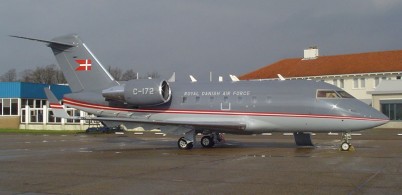
Lear’s brief collab¬oration with Canadair led to the LearStar 600, subsequently re¬named Challenger 600 after Canadair bought the manufacturing rights.
The initial Challenger 600, of which 83 were built, had Avco Lycoming ALF 502s and, on retro-fitted aircraft, winglets, and was flown for the first time on 8 November 1978, near Montreal. During the 50 minute first flight, the air¬plane climbed to 9,500 feet, the gear was cycled and various basic maneuvers were performed. The Challenger began certification flight testing in March 1979 with Lycoming ALF 502s of 7,500 pounds thrust (up from 6,700 pounds) and reduced elevator span to discourage flutter.
Canadair CL-600 Challenger Article
The second and third prototypes flew in March and July 1979.
On 3 April 1980, a test flight with the first prototype above the Mojave Desert ended in a disaster, with the airplane crashing due to a deep stall. In August 1980, certification was granted with temporary restrictions. Deliveries of the CL-600, powered by two Lycoming ALF-502L turbofans started on 30 December 1980, first flown on 21 September 1979.
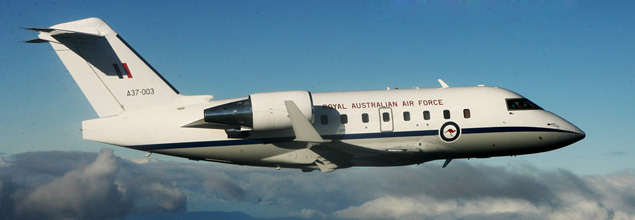
The design was developed further and on 10 April 1982 the Challenger 601, a refined version with the more powerful General Electric CF-34 engines and winglets, made its maiden flight. In 1983, the CL-601 replaced the CL-600 in production.
Sales to 1990 exceeded 140.
The first 601-1A delivered on 6 May 1983.
The first 601-3A flew on 6 May 1987 and the first 601-3A/ER on 19 May 1989.
The Canadair CL-601 Challenger 3A completed Canadian certifica¬tion on 21 April 1987, less than 10 months after its roll-out on 18 July 1986. FAA cer¬tification was confirmed on 30 April and the first delivery was made on 6 May, to TAG Aeronautics. The first production aircraft made its public debut at the Paris Air Show in June.
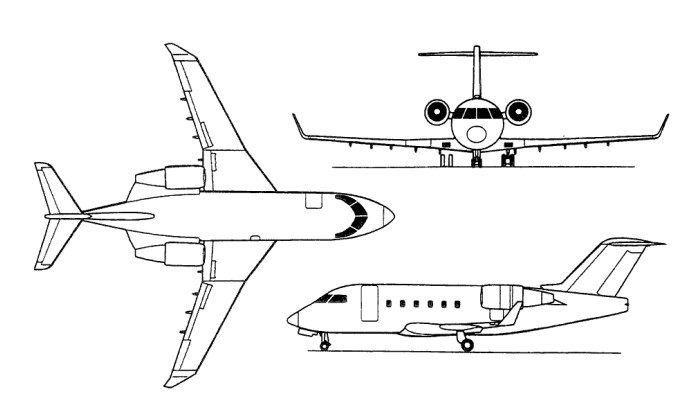
Based on the CL-601 — the version of the Challenger that introduced General Electric CF34 turbofans in the original CF-600 air¬frame — the Challenger 601-3A incorporates four significant developments. These are the improved CF34-3A engines to provide better climb and hot day take-off performance; a fully integrated digital avionics suite with higher reliability and improved diagnostics; a power-assisted passenger door and two land¬ing lights mounted in the nose. A “glass’ cockpit features dual Sperry flight guidance systems, a five-tube, four-colour Sperry FF15 with multi-functional display and four-colour digital weather radar; dual Sperry flight management systems; dual Honeywell laser IRS and a comprehensive Collins Pro Line II communications/navigation package.
In 1986, Bombardier Aerospace bought Canadair. The Bombardier Challenger became a family of business jets. A number of models entered production including in 1989 the CL-601-3R, an extended range version with an extra fuel tank added to the aircraft’s tail, a 2 crew and up to 19 passengers.
The number of models in 1989 included the CL-600-2B16 or Challenger 604 powered by CF-34-3B engines. First flight with these engines was on 17 March 1995, with Transport Canada certification granted that September. First delivery was in January 1996.
The first 601-3R flew on 14 July 1993, and the first 604 on 25 January 1996.
The Royal Australian Air Force Challenger CL-604 special purpose VIP transports are operated by the Royal Australian Air Force’s No 34 Squadron, based at Defence Establishment Fairbairn in Canberra. The Challenger has a crew of three (pilot, co-pilot and attendant) and carries up to nine passengers.
The Challenger CL-604 is fitted with a high-tech wing, high bypass CF34-3B engines, and a Collins ProLine 4 glass cockpit. The Challengers joined the RAAF VIP fleet in July 2002.
Challenger certified for operation in 40 countries by 1998. 500th Challenger rolled out 25 May 2000 and handed over 1 September 2000; 600th was undergoing interior outfitting in March 2003.
CL-600 Challenger
First built: 1978.
Engines: 2 x Lycoming ALF-502L, 7500 lbs thrust.
Seats: 11/28.
Length: 68.4 ft.
Height: 20.7 ft.
Wingspan: 61.8 ft.
Wing area: 450 sq.ft.
Wing aspect ratio: 8.5.
Maximum ramp weight: 40,550 lb
Maximum takeoff weight: 40,400 lb
Standard empty weight: 18,600 lb
Maximum useful load: 21,950 lb
Zero-fuel weight: 27,500 lb
Maximum landing weight: 36,000 lb
Wing loading: 89.7 lbs/sq.ft.
Power loading: 2.69 lbs/lb.
Maximum usable fuel: 16,725 lbs.
Best rate of climb: 3600fpm.
Certificated ceiling: 45,000 ft.
Max pressurisation differential: 9.3 psi. 8000 ft cabin alt @: 45,000 ft.
Maximum single-engine rate of climb: 1045 fpm @ 170 kts.
Single-engine climb gradient: 368 ft/nm.
Single-engine ceiling: 29,000 ft.
Maximum speed: 480 kts.
Normal cruise @ 43,000ft: 425 kts.
Fuel flow @ normal cruise: 2105 pph.
Stalling speed clean: 137 kts.
Stalling speed gear/flaps down: 113 kts.
Turbulent-air penetration speed: 280 kts.
Range : 4017 nm / 7440 km
Canadair CL-601 Challenger
light airliner, corporate jet, transport, Canada, 1986
Engine: 2 x CF 34 A1, 39829 N / 4060 kp
Length: 68.57 ft / 20.9 m
Height: 20.669 ft / 6.3 m
Wingspan: 64.304 ft / 19.6 m
Wing area: 519.901 sqft / 48.3 sq.m
Max take off weight: 43107.8 lb / 19550.0 kg
Weight empty: 19955.3 lb / 9050.0 kg
Payload: 23152.5 lb / 10500.0 kg
Max. speed: 460 kts / 851 km/h
Cruising speed: 442 kts / 819 km/h
Initial climb rate: 4527.56 ft/min / 23.00 m/s
Service ceiling: 41011 ft / 12500 m
Wing load: 83.03 lbs/sq.ft / 405.00 kg/sq.m
Range: 3440 nm / 6370 km
Crew: 2
Payload: 19 Pax
Challenger CL-601-3A
Power Plant: Two x General Electric CF34-3A turbofans each flat-rated at 9,140 lb St (4 146 kgp) including automatic power reserve (five-minute limit), up to 70 deg F at sea level.
Cascade-type fan air thrust reversers.
Fuel capacity, 2,451 US gal (9 278 1).
High speed cruise, 459 kts (850 km/h) or Mach = 080
Normal cruise, 442 kts (819 km/h) or M =077
Long-range cruise, 424 kts (786 km/h) or M = 074
Time to climb to initial cruise altitude, 23 mm
Max operating altitude, 41,000 ft (12 497 m)
Single-engine ceiling, 24,000 ft (7 315 m)
Take-off balanced field length, 5,400 ft (1 646 m)
Landing dis¬tance, 3,300 ft (1 006 m)
Max range, (NBAA IFR reserves, long-range cruise), 3,430 naut mls (6 352 kin) with five passengers.
Typical operating weight empty, 24,685 lb (11197 kg)
Max fuel load, 16,665 lb (7 559 kg)
Payload with max fuel, 1,900 lb (862 kg)
Max payload, 4,815 lb (2 184 kg)
Max take-off weight, 43,100 lb (19 550 kg)
Max zero fuel weight, 29,500 lb (13 381 kg)
Max landing weight, 36,000 lb (16 329 kg).
Wing span, 64 ft 4 in (19,61 m)
Overall length, 68 ft 5 in (20,85 m)
Overall height, 20 ft 8 in (6,30 m)
Wing area, 450 sq ft (41,81 sq.m)
Wing sweepback at quarter chord line, 25 deg
Undercarriage track, 10 ft 5 in (3,18 m)
Wheel¬base, 26 ft 2½ in (7,99 m).
Flight crew: two
Accommodation: 12 – 15.
Cabin length, 28 ft 3 in (8,61 m)
Max height, 6 ft 1 in (1,85 m)
Max width, 8 ft 2 in (2,49 m)
Cabin volume: 1,150 cu ft (32,56 cu.m)
Bombardier Challenger CL-604
Engines: Two General Electric CF34-3B turbofans (9,220 lbs thrust each)
Length: 20.86m
Height: 6.3m
Wingspan: 19.61m (including winglets)
Max takeoff: 21,863kg
Max landing: 17,236kg
Normal ops Speed: 870km/h
Range: 5,600km (with max fuel and reserves)
Ceiling: 41,000 feet
Crew: Two pilots and one crew attendant
Accommodation: 9 passengers
Canadair CL-41 Tutor / CT-114

Canadair started design of a jet trainer in 1958 as a private venture. Controls and systems of the Tutor are relatively simple with hydraulic power to the landing gear, flaps and nosewheel steering, and manual flying controls. The cabin is pressurized and zero-level ejection seats are fitted. It is fully equipped for navigation, instrument and night flying training. The Tutor has side-by-side seating and a single turbojet engine built by Orenda Engines in Canada.
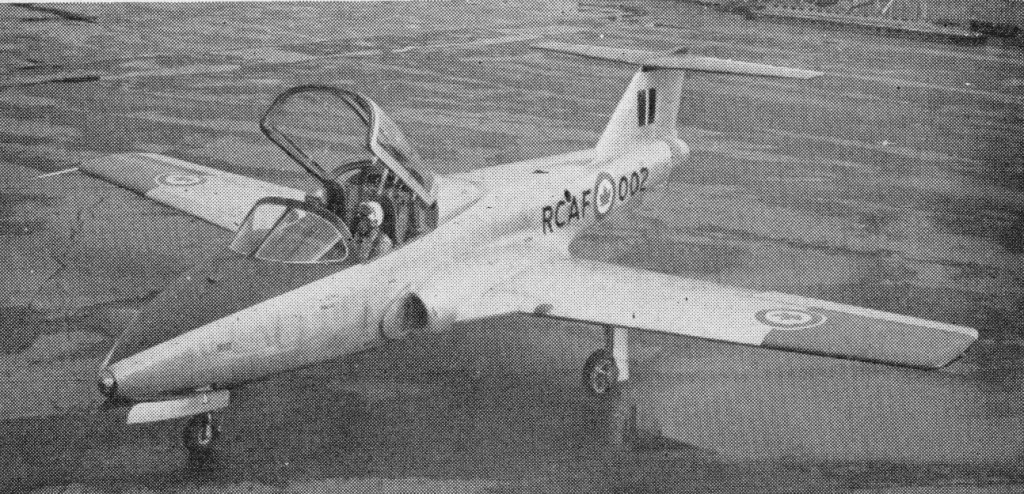
First flown on January 13, 1960, the 190 CL 41A aircraft were built for the Canadian air force as the CT 114 Tutor, ordered into production in 1961. It was used from 1963 until 2000 when it was replaced with the CT-156 Harvard II and the CT-155 Hawk as primary jet trainers.
The Tutor is best known in North America for the formation aerobatics of the Snowbird team who have performed from the Northwest Territories to Mexico. Officially known as 431 Air Demonstration Squadron, the team had fifteen Tutors, eleven of which travel with the team during the airshow season.

In 1965 Canadair was testing a prototype of a counter-insurgency version of the CL-41. The CL-41G was being tested by the USAF Air Commando Wing at Elgin AFB, Florida. Powered by a single Canadian built General Electric Orenda J85 turbojet rated at 3000 lb thrust, the -41G test version featured two 500 lb and two 250 lb bombs under wings, with pair of GE minigun pods under the fuselage.
Following the Canadian aircraft were 20 CL 41G Tebuan light attack derivative for Malaysia, production ending in 1967.
The CL-41R features an extended, pointed nose, as an NASARR (North American Search and Range Radar) electronics training version.
CL-41
Engine: Pratt & Whitney JT-12
CL-41A / CT-114 Tutor
Engine: 2,650 lbs.t. (1202 kgp) Orenda built J85 Can 40 turbojet.
Max speed, 486 mph (782 kph) at 27,500ft (8382m)
Cruise, 356 mph (560 kph)
Initial climb, 4,420 fpm (22.45 m/sec)
Service ceiling, 44,500ft (13564 m)
Range, 944 mls (1519 km)
Empty weight, 4,840 lb (2195 kg)
Loaded weight, 7348 lb (3333 kg)
Max TO weight: 11,288 lb (5131 kg)
Span, 36 ft 4in. (11 m)
Length, 32 ft (9.75 m)
Wing area, 220 sq.ft (20.44 sq.m)
Height: 9 ft 3.75 in (2.84 m).
CL-41G Tebuan
Engine: 1 x General Electric J85-J4 turbojet, 13.1kN
Max Take-off weight: 5120 kg / 11288 lb
Empty weight: 2402 kg / 5296 lb
Wingspan: 11.13 m / 37 ft 6 in
Length: 9.75 m / 32 ft 0 in
Height: 2.76 m / 9 ft 1 in
Wing area: 20.44 sq.m / 220.01 sq ft
Max. speed: 772 km/h / 480 mph
Ceiling: 12860 m / 42200 ft
Range: 2157 km / 1340 miles
Crew: 2
Hardpoints: 6
Armament: 1814kg load
CL-41R

B W Rotor Sky Cycle
A single-seat ultralight pressure jet helicopter.
British Aircraft Corp/Aerospatiale Concorde
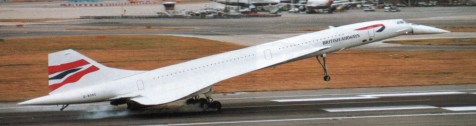
In the late 1950s, Sud Aviation in France (later represented by Aerospatiale) and Bristol Aircraft in the UK (lost in mergers that formed British Aerospace) were both working individually on the design of a supersonic civil transport aircraft. Both companies realized at an early date that the creation of such an aircraft was feasible, but beyond the economic capability of any individual company; thus came about the Anglo-French design and development agreement in November 1962, with the two companies backed by their individual governments.
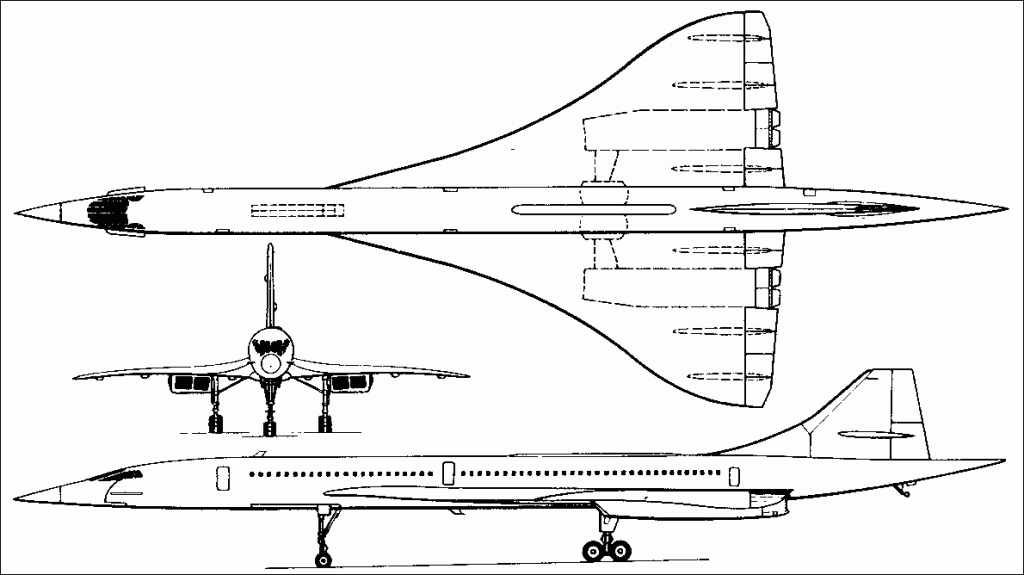
After the Anglo-French Supersonic Treaty was signed in 1962, years of intensive research and over 5,000 hours of wind-tunnel tests proved that the long, streamlined fuselage and slender ogival delta wing finally reconciled good control at speeds as low as 230 mph with low drag up to Mach 2.2 (around 1,300 mph).
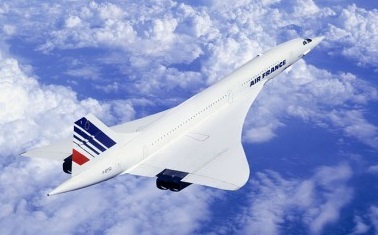
The wings, produced by Aéro¬spatiale, have elevons which work together as elevators and differen¬tially as ailerons. There are no flaps; control is built into the wings through camber, taper, droop and twist. Rolls-Royce designed the power-plant – so called because the four Olympus turbojet engines constitute just one part of a complex four-part system made up of air intakes adjustable for high and low speeds, engines with two independent compressors for low fuel consumption at sub- and supersonic speeds, the reheat system to give extra thrust for takeoff and transonic acceleration, and variable geometry exhaust nozzles that also serve as reverse thrust. The cruising speed was fixed at Mach 2.2, just below the “heat barrier”, so the airframe, designed for a life of 60,000 hours, could be constructed in an aluminium alloy resistant to variations in temperature from minus 35 to over 120 degrees Celsius (-310/2480F).
The first French built (F WTSS) and British built (G BSST) prototypes were flown for the first time on 2 March and 9 April 1969 respectively. The Anglo-French plane took off from Toulouse and was in the air for just 27 minutes before the pilot made the decision to land. The first pilot, Andre Turcat, said on his return to the airport: “Finally the big bird flies, and I can say now that it flies pretty well”. The French built F WTSS test flight reached 10,000ft (3,000m), but Concorde’s speed never rose above 300mph (480kph). Mr Turcat, his co-pilot and two engineers taxied to the end of the runway at about 1530GMT. Strong winds meant the test flight was in doubt for much of the day.
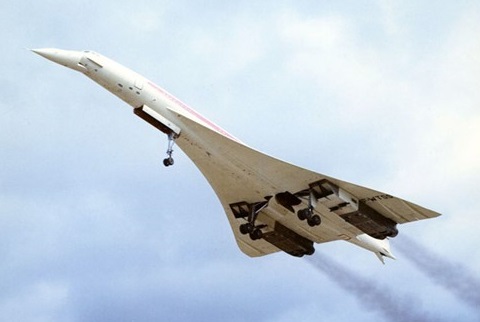
Two previous test flights had to be abandoned because of poor weather conditions. Concorde sped down the runway and there was a spontaneous burst of applause from watching reporters and cameramen as the wheels lifted off the ground. The noise from the four Olympus 593 engines, built jointly by the Bristol division of Rolls Royce and the French Snecma organisation, drowned out any noise from the crowd.
The first British test pilot, Brian Trubshaw, who watched the flight from the news stand, said, “I was terribly impressed by the way the whole flight was conducted. It was most professional and I would like to congratulate Andre on the way he handled this performance.”
Less than half-an-hour later, the aircraft was brought back down to earth using a braking parachute and reverse thrust. The crew emerged at the top of the steps, led by Mr Turcat, who gave the thumbs up signal with each hand.
On 9 April 1969, Brian Trubshaw made his first flight in the British-built prototype. The 22 minute flight left from a test runway at Filton near Bristol and landed at RAF Fairford in Gloucestershire. The British government had so far invested £155m in the project.
Key features of the design include the early decision to limit speed to Mach 2.2, making conventional construction possible; the development by Rolls Royce and SNECMA of the reliable Olympus 593 engines to power the type the evolution of the computer controlled variable area air intakes which ensure that each engine receives an optimum air flow under all flight conditions; and the design of a fuel system which serves not only to feed the powerplant, but also to act as a heat sink for the limiting of wing temperature in prolonged supersonic flight, and additionally to work as a system to maintain in flight the correct relationship between the aircraft’s centre of gravity and its aerodynamic centre of pressure. This last effect is achieved by trim tanks from which fuel is pumped rearward during acceleration and forward as the aircraft returns to subsonic flight speed.
The DST (the French counter-espionage service) and MI5 were collaborating on a case involving a double agent, Air Bubble. Air Bubble was an industrial chemist named Dr. Jean Paul Soupert. Soupert was an agent runner for East German intelligence and the KGB, but the Belgian Securite d’Etat doubled him. Soupert told the Belgians about an East German illegal named Herbert Steinbrecher, who was running agents inside the French Concorde assemble plants. They had acquired for the Russians every detail of the Anglo-French Concorde’s advanced electronic systems.
The Concorde first exceeded Mach 1 on 1 October 1969, and Mach 2 was passed during a test flight on 4 November 1970.
Despite the reactions of economists and the ecologists, Air France and British Airways began simultaneous inaugural Concorde services on 21 January 1976, from Paris via Dakar to Rio de Janeiro, and from London to Bahrain respectively, just over four months later, on 24 May, simultaneous services were launched from Paris and London to Washington’s Dulles International Airport.
In January 1976, 29 years after the first aircraft broke the sound barrier, two Concordes took off from Paris and London on the first supersonic passenger service. Concorde flies high at 50,000 feet or more, where air density is around one tenth that at sea level, temperatures are low and supersonic engines efficient. Sixty thousand feet is OK, because it can go supersonic there. Thirty thousand feet is OK because it can fly subsonic at that level. It is difficult to maintain a fixed altitude. It needs to follow the Mach number, which is dependant on air temperature. It operates at the block altitude of 50-60000 feet. Starting off at Mach 2 at 50000 feet, and gently climbing as fuel is burnt off.
Concorde were providing two daily return flights, with an average flying time of 3 hr 20 min, from London to JFK International, New York.
The fuel burn of the Paris-New York route is similar to that of a Boeing 747. But carrying 100 passengers, the jumbo 440 plus. The take-off speed is 220 knots, the typical take-off weight 186 tonnes (made up of 80 tonnes unladen weight, 96 tonnes of fuel and 10 tonnes of passengers and baggage). Twelve minutes after takeoff it can be at Mach 1, 26 minutes after take-off Mach 2. The complicated fuel manage¬ment systems to alter the centre of gravity as the centre of pressure shifts mean that a flight engineer is required. Landing speed is 163 knots. The skin temperature reaches 127 degrees C at Mach 2.02, and this was in fact the limiting factor in the original design with the airframe materials available at that time.
From a total of twenty originally built, fourteen were delivered to British Airways and Air France.

The aircraft were designed for working lives of 6700 cycles, with a possible 10,000 cycles seen as a desirable goal, through a life extension programme. Both airlines continue to co-operate closely in exchanging information on this work. There have been few incidents in service thus far, the well-publicized departure of bits of British Airways’ rudders being the exception. The aircraft continue to be expensive to maintain (about 2.5 times as labour intensive as the Boeing 747), but the prestige value is still considered to overide this.
Many airlines showed initial interest, but then cancelled their options and lost interest entirely.
With its massive development costs, Concorde was always struggling with profitability on the commercial routes. In more recent years, an upturn in charter business has helped defray Concorde’s high costs and utilisation – so much so that profitability had to some degree been achieved.
On 12 April 1989 a large section of rudder detached from Concorde G-BOAF as it climbed through 43,000 ft / 13,100 m on a flight from Christchurch, New Zealand to Sydney, Australia. The crew was unaware of the problem until landing.
Then came the accident to the Air France AF4590 aircraft, F-BTSC in Paris on 25 July 2000 where all one hundred passengers and nine crew, plus four people on the ground, lost their lives. After expensive and intricate modifications, British Airways put five aircraft back into service commencing on 7 November 2001. Air France put four back into service on the same day and both airlines operated to New York at the same time.
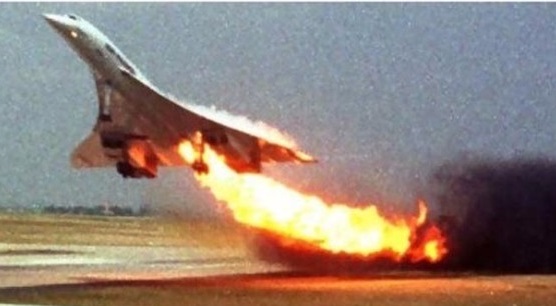
With the drop off in passenger numbers and the uncertainty of air travel in general, plus the ever-¬rising engineering costs to keep the fleet airworthy, British Airways took the decision on 10 April 2003 to terminate operations from the end of October. Air France had already ceased operations from the 6 of May 2003.
The last Concorde operation (a British Airways New York to Heathrow) was conducted on 24 October 2003.
British Airways operations saw Concorde make about 50,000 flights, travelling some 140 million miles and clocking up nearly 238,000 flying hours in the process, of which around 100,000 were supersonic (the prototype and development aircraft had collectively reached nearly 4,500 flying hours).
The remaining Air France aircraft were all retired to museums earlier in 2003: F BVFA (c/n 205, 17,824 hours) to Smithsonian’s Steven F Udvar Hazy centre at Dulles Airport, Washington Airport on 12 June 2003; F BVFB (c/n 207, 14,771 hours) to the Sinsheim Auto & Technik Museum in Germany on 24 June 2003; F BVFC (c/n 209, 14,332 hours) on 27 June 2003 to the Airbus factory at Toulouse; F BVFD (c/n 211, 5,821 hours) withdrawn in 1982 following a heavy landing and was finally scrapped in 1994; F BTSD (c/n 213, 12,974 hours) to Le Bourget Air and Space Museum on 14 June 2003 and F-BVFF (c/n 215, 12,420 flying hours), parked since July 2000 and officially withdrawn from use since 10 April 2003 and eventually to be dis¬played at Charles de Gaulle Airport, Paris.
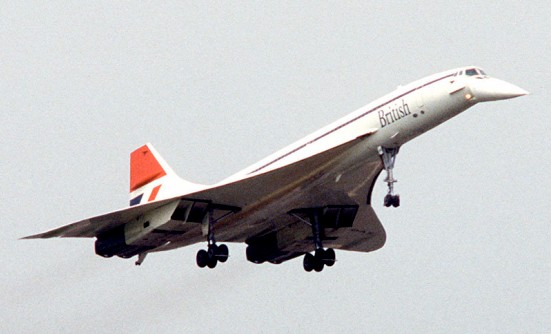
Recipients of the five airworthy British Airways aircraft are as follows: G BOAC (c/n 204, 22,260.11 hours/7,730 landings) flown from Heathrow to Manchester on 31 October for the Manchester Airport Aviation Park, where it will eventually be housed in a special glass hangar. G BOAD (c/n 210,23,397.25 hours/8,406 land¬ings) was flown from Heathrow to JFK New York on 10 November and on 24 November it was lifted onto a 260 ft former NASA barge (pre¬viously used to transport Apollo Saturn V moon rockets) and transported along the Hudson River to where it was moored to the quayside in Manhattan, at Pier 86, adjacent to the aircraft carrier USS Intrepid. It will ini¬tially be displayed as part of the Intrepid Sea Air Space Museum. G BOAE (c/n 212, 23,376.07 hours/8,383 land¬ings) was flown from Heathrow to Barbados (a Concorde route for 21 years) on 17 November and arrived just under 4 hours later with an Atlantic crossing altitude of 60,000 ft. It is to be displayed at the Grantley Adams Airport Bridgetown, where it will form the centre piece of a new aviation museum being set up in 2004 at Spencers Plantation close to the airport. G-¬BOAF (c/n 216 18,257.00 hours/6,045 landings) had the distinction of being the last Concorde built (first flown on 20 April 1979), the last to fly, and the last airliner to fly supersonic, leav¬ing Heathrow at 11.29 hours on 26 November for Filton. There it will come under Airbus UK charge, although still owned by BA but on indefinite loan, as a ground dis¬play aircraft. “Alpha Fox” will form the centre¬piece of a new aerospace heritage centre on the site, incorporating the Bristol Aero Collection at Kemble, and will be in place in an “interim” exhibition area which should be open to the public around Easter 2004. G BOAG (c/n 214,16,239.27 hours/5,633 landings) was flown from Heathrow to Seattle’s King County Airport, via New York on 3 November for the Museum of Flight to take its place amongst other airliners such as the prototype DC 2, Boeing’s 727, 737 and 747 prototypes, plus the only de Havilland Comet in North America. This flight outbound from New York to Seattle created its own achievement as the flight time of 3 hours, 55 min¬utes and 12 seconds, setting a new East to West coast record.
The airframe stored at Filton since 1982 as a spares source, G BBDG (c/n 202, 803 hours), is to be transported to the Brooklands Museum, Weybridge, Surrey. The UK prototype, G BSST (c/n 002, 835 hours), can be seen in the FAA Museum at Yeovilton, whilst G AXDN (c/ n 101, 632 hours), the first British production aircraft, which made its maiden flight on 13 February 1974, can be seen at Duxford Airfield as part of the Duxford Aviation Society collection. Similarly, in France can be seen F WTSS, (c/n 00 1,812 hours), the French prototype, in the Le Bourget Air and Space Museum; F WTSA (c/n 102, 656 hours), preserved and on display at Orly Airport, Paris; F WTSB (c/n 201, 754 hours), is on display outside the Aerospatiale (Airbus) Headquarters at Toulouse.
Two others, G BOAA (c/n 206, 22,768.56 hours/ 8,064 landings), and BOAB (c/n 208, 22,296.55 hours/7,810 landings), unmodified since the Paris crash and not flown since 12 August and 15 Au¬gust 2000 respectively, have also found new homes. G BOAA will be dismantled and trans¬ported to Scotland’s National Museum of Flight at East Fortune near Edinburgh, whilst G BOAB will stay at Heathrow as a ground display aircraft to be eventually installed within the Terminal 5 complex.
BAC-Sud Aviation Concorde prototype 001 F-WTSS
Engines: 4 x Bristol Siddeley / SNECMA Olympus 593 B Stage 1, 13,435 kg dry / 17,100 kg afterburn thrust
Wing span: 84 ft 0 in (25.56 m).
Length: 203 ft 11.5 in (62.17 m).
Height: 40 ft 0 in (12.11 m).
Wing area: 358.25 m²
Max TO wt: 343,500 lb (155,800 kg).
Max level speed: M2.2.
Ceiling: 18000 m
Range: 5200 km
Concorde (pre-production aircraft)
Powerplant: four Bristol Siddeley/SNECMA Olympus 593 turbojets of 35 000+1b thrust rated take-off power (ISA at sea level), low thrust boost afterburner on earlier engines.
Wingspan, 83 ft 10 in
Length, 191 ft 1 in
Height, 38 ft 0 in
Gross wing area, 3860 sq.ft
Max. usable floor area, 1000 sq.ft
Max. cabin length, 129 ft 0 in
Max. width, 103.4 in
Max. height, 77 in
Accommodation: max. high density seating, 138 at 34 in pitch
Volume of freight and baggage holds outside cabin, 530 cu.ft
Operating weight empty, 135 610 lb
Total fuel, 185 000 lb
Max. payload (volume limited), 28 000 lb
Max. take-off, 340 000 lb
Max. landing, 200 000 lb
Max. zero fuel, 165 000 lb
Wing loading (max. take-off weight), 88 lb/sq.ft
Wing loading (max. landing weight), 52 lb/sq.ft
Thrust loading, 2.62 1b/1b thrust
High-speed cruise, 1261 kt. TAS at 50 000-62 000 ft
Long range cruise, 1261 kt. TAS at 50 000-62 000 ft
Balanced field length at 330 000 lb take-off weight, at ISA at sea level, 9400 ft
Landing distance, max. landing weight, ISA at sea level, 7600 ft
Range max. payload, 3500 nm at 1200 kt. / 50 000-62 000 ft
Engine: 4 x Rolls-Royce/Snecma Olympus 593 Mk 602 afterburning turbojet (38,000 lb / 170.2kN) thrust.
Wing span: 84 ft 0 in (25,60 m).
Length: 203 ft 11.5 in (62.17 m).
Height : 37.073 ft / 11.3 m
Wing area: 3,856 sq ft (358.25 sq.m).
Wing load : 103.73 lb/sq.ft / 506.00 kg/sq.m
Max take off weight : 399987.0 lbs / 181400.0 kg
Weight empty : 174779.3 lbs / 79265.0 kg
Max cruising speed: 1,450 mph (2,333 km/h) at 54,500 ft (16,600 m).
Cruise speed: 2.2 mach @ 55,000 ft.
Range: 4,020 miles (6,470 km) at Mach 2.05 cruise/climb with payload of 28,000 lb (12,700 kg). Accommodation: Crew of 3 and 128¬-144 passengers
Cargo, nil.
Operating alt: 60,000 ft.
Engines: 4 x Rolls-Royce/Snecma Olympus 593 Mk.610 turbojet, 38,050lb / 169.2kN afterburning
Wingspan: 25.66m / 83 ft 10 in
Length: 62.17m / 203 ft 9 in
Height: 11.40m / 37 ft 5 in
Wing area: 358.25 sq.m / 3856 sq.ft
Operational empty weight: 78,700 kg / 173,500 lb
MTOW: 185,069 kg / 408,000 lb
Max payload: 13,381 kg / 29,500 lb
Fuel capacity: 119,786 lt
Max cruise: M2.04 / 1176 kt / 2178 kph at 51,000 ft / 15,545m
Take-off speed: 215 kt / 397 kph
Landing speed: 162 kt / 300 kph
Initial climb: 5000 fpm / 1524 m/min
Service ceiling: 60,000 ft / 18,288 m
Take-off dist to 35 ft: 3414m / 11,200 ft
Range max fuel & res: 3550 nm at M2.02
Accommodation: 100-128 passengers
BAe Harrier / Sea Harrier
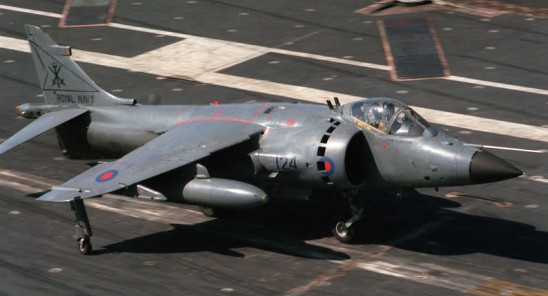
The Harrier family line consists of four major versions composed of the Hawker Siddeley Harrier, the British Aerospace (BAe) Sea Harrier, the Boeing/BAe AV-8B Harrier II and the BAe Systems/Boeing Harrier II.
The initial production model and beginning of the Harrier lineage was the Hawker Siddeley Harrier. The Sea Harrier became the dedicated navalized version of the base Harrier and utilized for air-defense as a primary role and ground strike as secondary. The Sea Harrier also made use of the powerful Blue Fox radar and was a direct development of the land-based RAF Harrier GR.3. The Boeing/BAe AV-8B Harrier II became a “second generation” Harrier and is a highly-modified version of the original Harrier for use by the USMC while the BAe Harrier II is a British-modified strike version of the USMC Harrier II.
Evolved from the Hawker P.1127 vertical take-off technology demonstrator, whose intended supersonic development (the P.1154), was cancelled, the BAe Harrier is powered by a vectored-thrust engine.
The first of six prototypes was flown in August 1966, and Harriers began to enter RAF service in 1969. The RAF’s first squadron was formed with Harrier GR.Mk.1 aircraft, the designation subsequently changing to Harrier GR.Mk.1A and then Harrier GR.Mk.3 as the Pegasus progressed from the 8709-kg (19,200-1b) Mk 101 through Mk 102 to the Mk 103.
The two-seat trainer, with longer fuselage and taller fin, was similarly designated Harrier T.Mk 2, Harrier T.Mk.2A and Harrier T.Mk.4.
Fourteen two-seat T Mk 10s, based on the USMC’s TAV-8B, are on order for the RAF. Powerplant is one 21,750 lb st (9675 kN) R-R Pegasus 11 turbofan.
Despite power increases, the Harrier is unable to take off vertically with a full weapon load, but can take off from a short length of road or semi-prepared strip in the STOVL, (short take-off. vertical landing) mode for tactical concealment. Equipped from the outset with a Ferranti FE541 inertial navigation system with head-up display, the RAF aircraft were fitted from 1976 with a Marconi LRMTS (laser ranger and marked-target seeker) resulting in a much extended profile to the nose. A Marconi ARI 18223 E-J band radar warning receiver was added to the fin and extreme rear fuselage at the same time. The Harrier carries a single oblique camera in the port side of the nose, but may be equipped with a sensor pod beneath the fuselage for more extensive reconnaissance, Following the production of six pre-production aircraft, the RAF received 114 single-seat Harriers and has ordered four more for replacement of Falklands losses. US Marine Corps contracts covered 102 AV-8A aircraft (now converted to AV8C standard), and the Spanish navy acquired 11 VA.1 Matador aircraft.
Two-seat trainer orders cover 23 for the RAF, T.Mk.4 (those not fitted with LRMTS being Harrier T.Mk.4A aircraft), fitted with laser nose and tall fin, eight TAV-8A aircraft with pointed nose, as TAV-8S by Spain, two VAE.1 Matador aircraft, a Harrier T. Mk.4 and three navalized Harrier T.Mk.4M aircraft for the Royal Navy, plus 4 company demonstrator. Developed as the GR.5 for the RAF and the AV-8B Harrier II for the USMC, the GR.5 features six underwing pylons, larger canopy, and outrigger wheels further inboard than the GR.3. A total of 300 (plus 28 two seat TAV-8B trainers) for the USM and 60 GR.5s for the RAF. Spain ordered 12 EAV-8Bs from 1987.
The improved GR Mk 7 is for RAF night attack use, with Smiths HUD and GEC FLIR.
After the first successful landing of a P.1127 XP831 trial Harrier on the deck of the HMS Ark Royal on February 8, 1967, the legacy of the Sea Harrier began. The suitability of Harriers for operation from ships at sea led to a decision, in 1975, to develop a special version of this aircraft to equip the Royal Navy’s new ‘Invincible’ class of anti submarine cruisers and the anti submarine carrier HMS Hermes.
Taking the GR.Mk 3 as the starting point, a new redesigned forward fuselage (with folding nose cone) was built to house a Ferranti Blue Fox radar. The cockpit was revised as more ergonomically friendly while the pilot’s seating position was raised ten inches to afford for better visibility out of the cockpit under a new “bubble” type canopy. The Martin-Baker Mk 9 series ejection seat was replaced by the newer and faster-reacting Mk 10 model.
The HUD (Heads-Up Display) was now be powered by a more powerful computer than that as found on the land-based Harrier. A Doppler pulse radar was fitted in place of the inertial-based unit of the GR.Mk 3 to compensate for air travel over the ocean. The Sea Harrier saw its radio system updated as well as the implementation of a simplistic autopilot. Vertical hovering controls were improved while the original landing gear undercarriage arrangement was retained. Though the Pegasus Mk 104 series turbofan engine received its new designation, it was nothing more than a “navalized” version of the land-based 21,500lb thrust Mk 103 series. All of the five underwing and centerline hardpoint pylons were revised for better efficiency and reaction while the outboard stations were now wired for compatibility with the AIM-9 Sidewinder short-range air-to-air missile. Much of the magnesium of the original Harrier construction was replayed by aluminum alloys to help retard corrosion of the metal at sea. Likewise, the folding nose cone helped keep the Sea Harrier’s footprint aboard the carriers as small as possible. The trainer T.Mk 4N did not feature the space-saving hinged folding nose cone and therefore could not be stored under the flight deck. Despite all of these internal changes, the Sea Harrier weight only 100lbs heavier than her land counterpart.
The first Sea Harrier (Hawker Siddeley designation of P.1184) achieved flight on August 20th, 1978 at Dunsford and later this same aircraft became the first Sea Harrier to land on the HMS Hermes on November 13th. No. 700A Flight squadron was formed to handle the intensive deck trials for the new aircraft and clear it for operational use. To expedite development even further, a pair of specially-modified Hawker Hunter T.Mk 8 trainer airframes were fitted with Sea Harrier equipment for critical in-flight testing of systems in action.
The first of 34 Sea Harriers for the Royal Navy entered service in June 1979. Three pre-production aircraft were on order followed by an order for 31 production units and a single two-seat T.Mk 4A trainer.
By the end of the first round, some 57 single-seat production Sea Harriers were ordered thanks to follow-up contracts and high expectations. The second production Sea Harrier (XZ451) completed her first flight on May 25th, 1979 and then came to the Royal Navy Intensive Flying Trials Unit (IFTU) at Yeovilton on June 18th of that same year. The squadron was then disbanded on March 31st, 1980 and reformed as No. 899 Squadron. The initial carrier-deployed Sea Harrier unit became No. 800 aboard HMS Invincible.
Overall the Sea Harrier looked every bit the part of her land-based sisters complete with her swept-back high-mounted monoplane wings, conventional single-finned tail unit and unique two-legged undercarriage complimented by two wingtip wheeled struts. The engine series remained the Rolls-Royce brand Pegasus type of which itself was a special navalized version of the Mk 103 – now marked as the Mk 104 – with an impressive rating of 21,500lb standard thrust output (Sea Harriers, like the base Harrier, were subsonic aircraft incapable of breaking Mach 1 or utilizing afterburner). The powerplant powered the four all-important thrust vectoring nozzles affixed as pairs to the either side of the fuselage body.
Since the Sea Harrier was branched off of the land-based Harrier GR.3 production models (and was only acquired in limited quantity), it maintains only a handful of variants to its name. The initial production version became the FRS1 and entered service in April of 1969. The FRS1 had a maximum speed of 1,185km per hour and a cruising speed equal to 850km per hour at 36,000 feet. High altitude combat radius was limited to 750km. Maximum take-off weight was 26,200lbs. The Sea Harrier made use of a pair of optional 30mm ADEN cannons mounted to the sides of the fuselage centerline with approximately 100 rounds per cannon. This could easily be complimented with an array of air-to-air and air-to-surface weaponry to fit the mission role up to 5,000lbs to include anti-ship missiles. Munitions were fielded on four underwing hardpoints at pylons in two inboard and two outboard positions. Outboard pylons were wired to fire the AIM-9 Sidewinder short-range air-to-air missile and eventually were made to field a double-launch rail for the missile.
The Sea Harrier also made use of various size conventional drop bombs and were cleared for use with the WE.177 nuclear bomb.
Sea Harriers were built with a basic F.95 oblique bomb camera installed along the starboard side of the aircraft nose assembly and featured an adjustable shutter speed of up to 1/3,000 seconds. The system was “basic” in that it was restricted to daytime use and was primarily utilized to help target enemy surface ships. During the Falklands conflict, this camera proved all but useless in assessing the damage post-strike of bombs dropped on Port Stanley.
The FRS51 was the export version of the FRS1 production model and delivered to the Indian Navy. These Sea Harriers featured compatibility with the French Matra R550 Magic air-to-air missiles. India bought 16 FRS.51 Sea Harriers and three Harrier T.60 trainers to 1987. India since maintained 30 Sea Harriers (designated as FRS51 and based on the FRS1) beginning in December 1983 with these beginning service the INS Vikrant and ultimately switching to the INS Viraat. Indian Sea Harriers make up the 300 Naval Squadron and represent the only foreign use of the Sea Harrier model.
The FA2 (formally using the FRS.2 and F/A.2 designations) appeared as a mid-life upgrade to the FRS1 and improved upon the airframe, avionics, armament capabilities, cockpit and radar and compatibility for the American-made AIM-120 medium-range air-to-air missile. Initial flight of the FRS.2 prototype was on September 19th, 1988 with the production contract coming on December 7th, 1988. Thirty-two FRS.1 models were tabbed for conversion to this new standard while others appeared as “new-build” systems. The designation of F/A.2 was used as a replacement for the initial designation of FRS.2. Wing leading edges were now kinked and a new navalized Pegasus Mk 106 engine of 21,500lbf (based on the USMC AV-8B powerplant) was fitted. Carrier testing was accomplished over a 9-day period in November of 1990 with AMRAAM clearance tests finished in 1991.Deliveries of this new Sea Harrier (conversions followed by new-builds) began in April of 1993 and lasted until 1998.
In the FA2, the Blue Fox AI radar of old was modernized to the more powerful Blue Vixen system fitting an all-new radome. Like the Blue Fox before it, the Blue Vixen was a multi-mode pulse Doppler radar unit but now applicable to operations in all-weather with tracking and targeting of multiple land- and air-based enemies through an improved suite. Additionally, the system allowed for a track-while-scan mode and “lookdown-shootdown” capability. HOTAS (Hands-On Throttle and Stick) and multifunction displays all greeted the new Sea Harrier model as did a slightly lengthened airframe.
The first flight of BAe’s up-graded Sea Harrier FRS.2, armed with AIM-120s took place on 30 March 1989.
AMRAAM capability was brought online with this FA2 and these aircraft were fielded in anger over Bosnia by No. 889 Squadron off of the deck of the HMS Invincible. Performance for the FA2 included a maximum speed of 735 miles per hour with a service ceiling of approximately 51,000 feet and a rate-of-climb equal to 50,000 feet per minute. The ferry range was listed at 2,000 miles with a combat radius of 620 miles. Maximum take-off weight was listed at 26,200lbs.
The final FA2 was delivered in January of 1999.
The Sea Harrier added a collection of two-seat trainers to its production. The T.4N was a navalized form of the land-based T.Mk 2 used by the Royal Air Force. These were delivered sans radar and minimal Sea Harrier instrumentation and were used to train would-be Sea Harrier pilots on the ins-and-outs encountered with the FRS1 production model. Four T.Mk 4Ns were delivered to the Royal Navy.
The T.Mk 8 was a similar two-seat trainer based on the FA2 production model and, again, delivered without the radar system. Seven such T.Mk 8’s were delivered to the Royal Navy and ultimately retired from service as of March of 2006. The T.Mk 60 was the export version of the Royal Navy T.Mk 4N and delivered to the Indian Navy. Four of these twin-seat Sea Harriers were sold to India and utilized as land-based trainers.
The Argentine dictatorship moved in to occupy the Falkland Islands group in 1982 and the British moved into action to protect their interest. Both the Harrier GR.Mk 3 and Blue Fox/Sidewinder-equipped FRS1 were the two Harrier types involved. The Falklands War was the first time that Harriers of any type were to see action.
The first Sea Harrier attack sortie occurred on May 1st, 1982. Two separate strikes involved low-level swipes using cannons and cluster bombs against Argentine targets at the Port Stanley airfield and the Goose Green airfield.
Further actions involved the Sea Harrier in the amphibious landing operation at San Carlos Bay. Sea Harriers covered some 2,000 sorties in the conflict from the available 28 airframes. Just six Sea Harriers were lost in the conflict with two of these related to Argentine ground fire and the other four to accident.
The Sea Harrier has already been retired by the Royal Navy as of March 2006, replaced by the Harrier GR.Mk 9 series.
The Italian Navy operated radar-equipped Harrier II Plus.
Harrier FA.2
Harrier GR.Mk.3
Armament: two 30-mm. Aden cannon (with 130 rpg)
Hardpoints: 4 up to 2268 kg (5,000 lb)
four wing pylons carrying of ordnance (or 455-litre/ 100-Imp gal tanks, inboard only
Powerplant: one 9752-kg (2 1, 500-1b) thrust Rolls-Royce Pegasus 103 vectored-thrust turbofan.
Maximum speed, clean 1159 km/h (720 mph) at 305 m (1,000 ft) or Mach 0.95
Tactical radius on a hi-lo-hi mission 418 km (260 miles).
Weight empty 5425 kg (11,960 lb)
Maximum weight vertical take-off 8165 kg (18,000 lb)
Maximum short-take-off 11340+ kg(25,000+ lb)
Span 7.09 m (23 ft 3 in)
Length 14.27 m (46 ft 10 in)
Height 3,45 m (11 ft 4 in)
Wing area 18,67 sq.m (201.0 sq ft)
Harrier GR.5
Wing span: 9.5 m (30 ft 6 in)
Harrier GR.7
T.10
Sea Harrier FRS.1
Engine: R-R Pegasus.
Installed thrust: 95.6 kN.
Wingspan: 25 ft 3.25 in (7.7 m)
Length: 14.5 m.
Wing area: 18.7 sq.m.
Empty wt: 5670 kg.
MTOW: 11,880 kg.
Warload: 2270+ kg.
Max speed: 1190+ kph.
Ceiling: 15,000+ m.
T/O / Ldg run: VSTOL.
Combat radius: 750 km.
Fuel internal: 2870 lt.
Air refuel: Yes.
Armament: 2 x 30 mm, 4 x AAM
Hard points: 5.
BAe Sea Harrier FA2
Engine: 1 x Rolls-Royce Pegasus Mk 104 turbofan engine generating 21,500lbs of thrust.
Length: 46.59ft (14.2m)
Width: 24.93ft (7.60m)
Height: 12.17ft (3.71m)
Maximum Speed: 734mph (1,182kmh; 638kts)
Maximum Range: 2,237miles (3,600km)
Rate-of-Climb: 50,000ft/min (15,240m/min)
Service Ceiling: 52,493ft (16,000m; 9.9miles)
Armament:
STANDARD:
2 x 30mm ADEN cannons in under-fuselage pod fairings.
OPTIONAL:
WE.177 Nuclear Bomb
2 x Fuel Drop Tanks
Up to 5,000lbs of external ordnance on four underwing pylons (two to a wing).
Accommodation: 1
Hardpoints: 4
Empty Weight:14,052lbs (6,374kg)
Maximum Take-Off Weight: 26,235lbs (11,900kg)
BAC HS.1182 Hawk
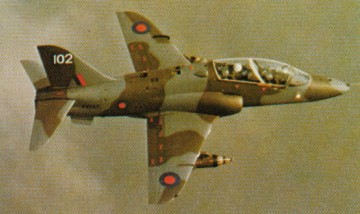
It is a tandem two seat low wing monoplane powered by a single Rolls Royce/Turbomeca Adour engine of 5,340 lb thrust.
The Hawker Siddeley P.1182 design was adopted by the RAF for its then new advanced trainer in 1970 and this type first flew in 1971. The single pre-production Hawker Siddeley Hawk (XX154) made the type’s maiden flight at Dunsfold, Surrey on 21 August 1974. A two-seat basic and advanced jet trainer with close support capability, in addition to service with the RAF it has been ordered by the air forces of Abu Dhabi, Dubai, Finland, Kenya, Kuwait, Indonesia and Zimbabwe, and in modified form as the US Navy’s T-45.
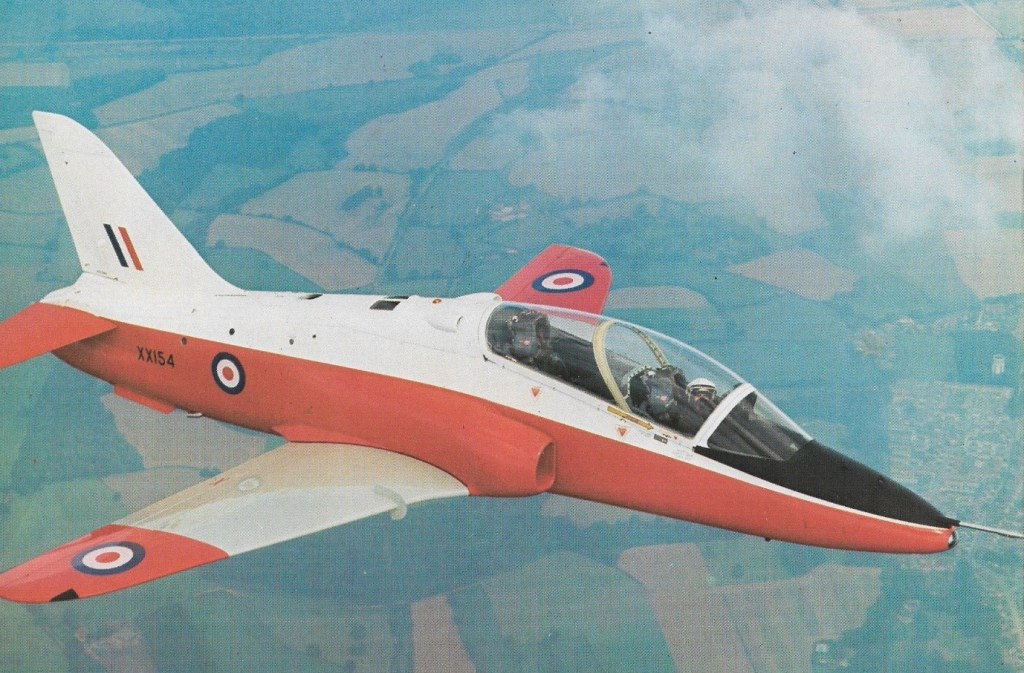
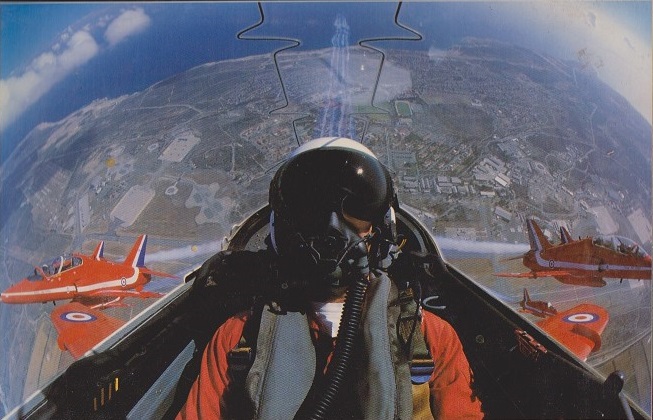
175 Adour 151 powered T.ls for the RAF were delivered for advanced and tactical training, beginning on 4 November 1976 with two aircraft for No. 4 FTS at RAF Valley, Anglesey. Subsequently 88 have been modified as Hawk T.lAs for secondary airfield defence duties, by the installation of AIM-9L Sidewinder missiles.
The initial export version was the Hawk 50 Series, sold to Finland (Mk.51, final assembly of 47 by Valmet), Kenya (Mk.52), and Indonesia (Mk.53), powered by the Adour 851 and an increased MTOW. Hawk 60 Series aircraft are equipped with uprated 25.35kN Adour 861 engines and other performance improving modifications. The Hawk 60 Series has been sold to five countries, Zimbabwe (Mk.60), Dubai (Mk.61), Kuwait (Mk.64), and Saudi Arabia (Mk.65).
Primarily for combat missions the two-seat the Hawk Mk.100 is a development of the earlier Hawk Mk.60 advanced jet trainer. A much improved version, with the Rolls-Royce Adour 871 engine of 5,845 lbs of thrust, a revised wing with fixed leading edge droop, full width flaps, optional wingtip missile rails for Sidewinder missiles, an extended nose to house the FLIR camera and a laser range finder, revised avionics and a HUD in the forward cockpit. Equipment includes Singer Kearfott SKN 2416 INS, an advanced Smiths Industries headup display/ aiming computer, optional laser or improved weapons management system, controls, and colour CRT displays in cockpits, all linked by a MIL 1553B digital databus. External load is increased to 3,265kg, and provision is made for carrying an ECM I pod.
By 1988, customers in¬clude Finland, Indonesia, Kenya, Abu Dhabi, Dubai, Kuwait, Saudi Arabia, Switzerland and Zimbabwe; a total of 352 Hawks.
Canada operated 17 Hawk Mk.115s as CT-155s.
The RAAF Mk. 127s are a further development the Hawk. Its three head-down colour CRT multifunction displays in both cockpits and the aircraft display and mission computers provide trainee aircrews and their instructors with a F/A- 18 Hornet style cockpit. Weapons delivery and navigation information is in colour on the displays and the cockpits are functionally considerably “common” to the Hornet, allowing for easy transition to the front-line aircraft later. The Hawk Mk. 127 also has an on board video camera that captures the head-up and head-down visuals, along with sound for subsequent debriefings. The test flight of the first Australian-assembled Hawk (s/n DT-10) took place on 12 May 2000.
The avionics system is integrated via a 1553 multiplex database. The principle components are two display and mission computers (DMCs), which coordinate, process and command the display of information from the communications, navigation and attack sub-systems. Each cockpit has hands-on-throttle-and-stick (HOTAS) controls.
The head-up display (HUD) in the front cockpit and three colour multi-function displays (MFD) in each cockpit present a range of flight information, ranging from aircraft performance and attitude through to equipment status reports. Mission-specific data can be pre-programmed by the pilot and downloaded into the system. Equipment performance, aircraft fatigue and engine life data is monitored and recorded by a health and usage monitoring system (HUMS).
The Hawk 127 armament system provides for the carriage, aiming and release or firing of practice and Mk 82 bombs, AIM-9M Sidewinder missiles and a 30mm cannon. The stores are carried on two wingtip missile stations or pylon-mounted on four underwing and one centreline hardpoints. A 30mm Aden cannon carried in a gunpod can be installed on the centreline station in place of the pylon. Stores are controlled by the integrated stores management system (SMS).
The Hawk through-life support programs have been designed for 25 years service. Its design allows for system upgrades to be incorporated, to reflect evolving training requirements.
The single-seat Hawk 200 series is a multi-role combat version has some 80 per cent airframe commonality with the trainer and uses the same uprated Adour 871 powerplant as the Hawk 100. In the lower fuselage can be fitted one or two 25mm Aden guns, leaving the centreline pylon free for weapons to complement the four underwing pylons. The Hawk 200 has been designed to incorporate a change of nose that can include FLIR, laser rangefinder or APG-66H radar for all-weather operation.
The first pre-production Hawk 200 flew on April 24, 1987, seven days ahead of the schedule set following the loss of the prototype in July 1986. The pre-production Hawk flew on August 21, 1974, and the aircraft has been produced in several versions. The Hawk 2 multirole combat aircraft, which first flew May 19, 1986, is powered by a 26kN Adour 871, and has an internal armament of two 25mm Aden I guns in a new front fuselage. The redesigned nose can also house sensors such as a rangefinder, forward looking infrared, or a multimode radar.
On 7 April 1989 U-1251 became the first BAe Hawk Mk.66 advanced trainer to be delivered to the Swiss Air Force.
Hawker Siddeley Hawk
Engine: Rolls-Royce/Turbomeca Adour Mk. 151, 5,340 lb.
Top speed: 535 kts.
Service ceiling: 44,000ft.
Landing speed: 100 kts.
Wingspan: 30ft 10in.
Length: 39ft 2in.
Height: 14ft 5in.
Crew: 2
Hawk 60
Engine: 1 x R-R/Turbomeca Adour 861.
Installed thrust: 25.4 kN.
Span: 9.4 m.
Length: 11.9 m.
Wing area: 16.7 sq.m.
Empty wt: 3635 kg.
MTOW: 8570 kg.
Warload: 3100 kg.
Max speed: 1065 kph.
Initial ROC: 2835 m / min.
Ceiling: 15,000+ m.
T/O run: 550 m.
Ldg run: 488 m.
Fuel internal: 1750 lt.
Range/Endurance: 2400 km / 4+ hr.
Combat radius: 500-1100 km.
Armament: 1 x 30 mm, 2 x AAM.
Hardpoints: 4/5.
Hawk T.Mk 1
Engine: one 5,340 lb thrust Rolls Royce/Turbomeca RT.172 06 11 Adour Mk 151 turbofan.
Wing span: 30 ft 9.75 in (9.39 m).
Length: 11.8 m / 38 ft 9 in
Height: 4.1 m / 13 ft 5 in
Wing area: 16.7 sq.m / 179.76 sq ft
Take-off weight: 5443 kg / 12000 lb
Empty weight: 3379 kg / 7449 lb
Max speed: 621 mph (1,000 km/h).
Ceiling: 12000 m / 39350 ft
Range w/max.fuel: 2780 km / 1727 miles
Payload: 5,660 lb (2,567 kg).
Armament: 1 x 30mm cannon
Crew: 2
Mk.100
Engine: Rolls-Royce Adour 871, 5,845 lbs thrust
Hawk 102D
Hawk 127
Crew: Pilot (instructor) and student
Engine: 1 x Rolls-Royce Turbomeca Adour Mk 871
Length: 11.95m
Height: 4.08m
Wingspan: 9.39m
Weight: 5443kg
Speed: 1207km/h
Range: 1207km
Ceiling: 50,000 feet
Hawk 200
Engine: 1 x R-R / Turbomeca Adour 871.
Installed thrust (dry): 26 kN.
Span: 9.39 m.
Length: 11.38 m.
Height : 13.451 ft / 4.1 m
Wing area : 179.759 sq.ft / 16.7 sq.m
Wing load : 105.78 lb/sq.ft / 516.0 kg/sq.m
Weight empty : 9100.0 lb / 4127.0 kg
MTOW: 9101 kg.
Max. payload weight : 7697.7 lb / 3491.0 kg
Max speed: Mach 1.2 / 560 kts / 1037 kph.
Initial ROC: 11417 ft/min / 58.00 m/s
Service ceiling : 50000 ft / 15240 m
T/O run: 1585 m.
Ldg run: 854 m.
Landing speed : 106 kts / 197 kph
Combat radius hi-lo-hi: 1072 km.
Fuel internal: 1704 lt.
Air refuel: No.
Armament: 2 x 25 mm Aden / 27mm Mauser
Hard points: 5

BAC 167 Strikemaster
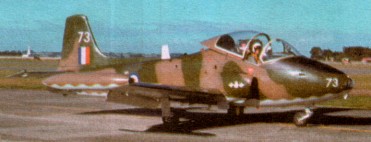
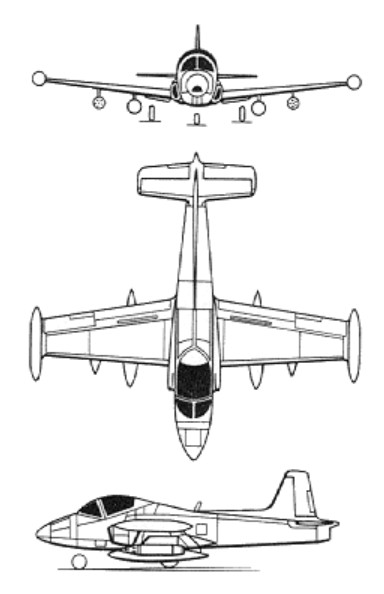
A development of the BAC 145 Provost and originally call the ‘Armed Jet Provost’, which differed from the trainer by having permanently attached wingtip fuel tanks, a more powerful Rolls Royce Bristol Viper Mk 535 turbojet engine of 3,410 lb / 15.2kN thrust, and provisions to carry a weapon load of 3,000 lb (1,360 kg) on eight underwing hardpoints. The wing being slightly longer and strengthened to carry the external stores. The Strikemaster had an original fatigue life of up to 7500 hr on the wings, 11,600 for the rear fuselage and tailplane and 12,500 hrs for the forward fuselage and cockpit.
The first Strikemaster was flown in 1967, and since that time they have been supplied to the air forces of Ecuador, Kenya, Kuwait, Muscat, New Zealand, Oman, Saudi Arabia, Singapore, Sudan and South Yemen.
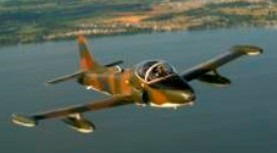
The RNZAF ordered their first Mk.88 Strikemasters in 1970, replacing DH Vampires in 1972, and serving until December 1992 when replaced by Aermacchi MB339s.
The first Strikemaster was flown on 26 October 1967 and 155 have been built (including a few for store against possible new orders).
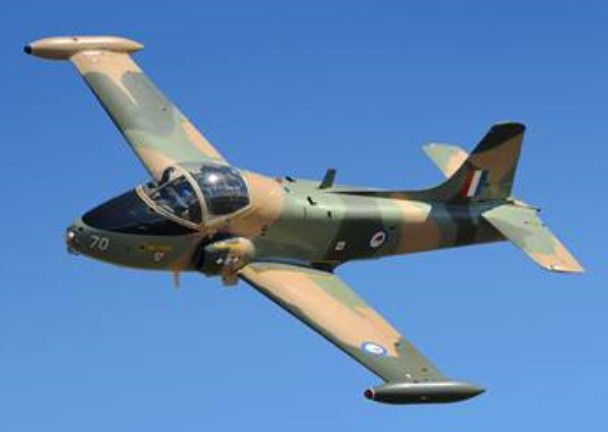
Engine: 1 x turbo-jet BS Viper 11, 11.1kN
Take-off weight: 4173 kg / 9200 lb
Wingspan: 10.8 m / 35 ft 5 in
Length: 10.3 m / 33 ft 10 in
Height: 3.1 m / 10 ft 2 in
Max. speed: 700 km/h / 435 mph
Ceiling: 11200 m / 36750 ft
Range: 1450 km / 901 miles
Seats: 2
Armament: 2 x 7.62 machine-guns or bombs
British Aircraft Corp. 167 Strikemaster
Engine : Rolls Royce Viper 535, 15176 N
Length : 33.99 ft / 10.36 m
Height : 10.171 ft / 3.1 m
Wingspan : 35.335 ft / 10.77 m
Max take off weight : 11501.3 lb / 5216.0 kg
Max. speed : 391 kt / 724 km/h
Service ceiling : 40026 ft / 12200 m
Range : 1201 nm / 2224 km
Crew : 2
Armament : 2x MG 7,62mm FN, 1360Kg ext 8 Pylons
Mk.88
Engine: 1 x Rolls Royce/Bristol Viper 535 3365 lbs thrust.
Max speed: 450 mph (418 kt) @ 18,000 ft, 391 kts @ SL.
Vmo: 425 kt (M0.75); with under wing stores: 375 kts (M0.68).
Range: 1500 km.
Ceiling: 40,000 ft.
Armament: 2 x 7.62 mg, 8 x underwing hard points max 2650 lbs.
Fuel cap: Main: 2150 lbs, Tip tanks: 768 lb total.
MTOW: 11,500 lb (5200 kg).
Design load: +5.5 / -3.5G.
Wing span: 11.2m (36 ft 9 in).
BAC 111
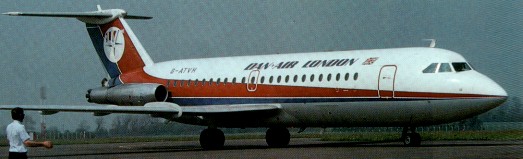
By 1957 the Hunting H.107 had been defined as a trim-looking project powered by two engines in the 6,000-lb class. But in 1960 Hunting became part of BAC (British Aircraft Corporation). By this time the design looked promising, and Vickers-Armstrongs collaborated (and eventually took over). The 107 grew into the One-Eleven, to match the thrust of the available Rolls-Royce Spey engine (10,000 lb). This made the aircraft at least a 65-seater, with 3+2 seating in a wider fuselage.
By 1961 the newly formed British Aircraft Corporation decided to proceed with the project and on the 9 May 1961 the public launch took place as the first order was announced by the company for 10 aircraft from British United Airways. On 23 October Braniff Airways placed a firm order for 6 aircraft. Other orders soon followed from Mohawk Airlines for 4 aircraft, Kuwait Airways for 3 aircraft and by Central African Airways for 2 aircraft. Braniff Airways subsequently doubled it’s order to 12 aircraft while Aer Lingus ordered 4 aircraft. Western Airways ordered 10 aircraft but later it was cancelled. The biggest breakthrough came when American Airlines ordered 15 aircraft on the 17 July 1963. 60 orders had been received by the time the first 1-11 was rolled out.
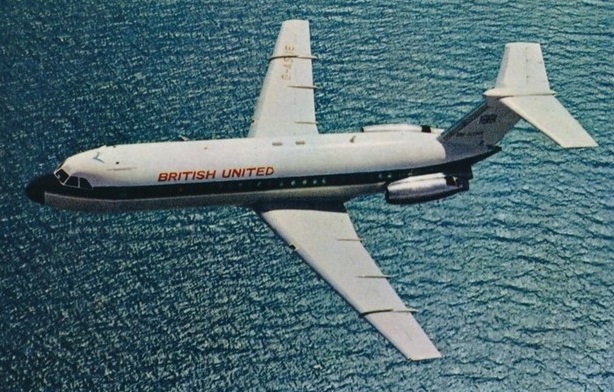
The finally revised aircraft incorporated a circular-section all-metal pressurised fuselage, low-set swept monoplane wings incorporating Fowler type trailing-edge flaps, and airbrakes/spoilers on the wing upper surface, forward of the flaps. The T-tail included a variable-incidence tailplane, and the landing gear, of hydraulically retractable tricycle type, had twin wheels on each unit. Accommodation was provided for a maximum of 79 passengers in five-abreast high-density seating, and in addition to a conventionally placed passenger door at the forward end of the cabin on the port side, the BAC.111 had also a ventral airstair below the tail unit, giving access to or from the aft end of the cabin. Powerplant of the prototype One-Eleven Series 200, which was intended as the basic production version, consisted of two 4722kg thrust Rolls-Royce Spey Mk 506 turbofans.

The prototype G-ASHG rolled off the Hurn production line on 28 July 1963 in the livery of first customer British United Airways. The first flight took place on 20 August 1963. G.R.Bryce, chief test pilot for BAC, conducted the 27 minute first flight from Bournemouth (Hurn) airport. Taking off in 3150 ft, and reaching 8000 ft and 220 mph, wheels and flaps were left down. The first BAC One Eleven totalled 30 hr. 30 min in the air in the 24 days following the maiden flight.
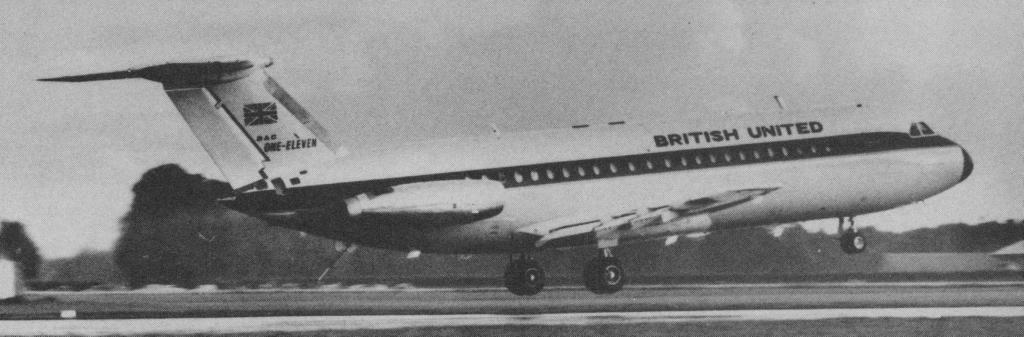
This aircraft crashed on 22 October during the flight development programme, together with a highly experienced crew of seven that included test pilot M. J. Lithgow. Investigation showed the cause to be a deep stall, resulting from the T-tail and rear-mounted engine configuration, and remedial action included the installation of powered elevators, a stick-pusher, and modification of the wing leading edges. These changes were adequate to prevent the aircraft from assuming an inadvertent and dangerous angle of attack, a condition peculiar to this configuration, in which the wing loses lift and the horizontal tail surfaces are unable to restore longitudinal stability. Despite this early setback the flight test program continued and customer confidence remained high. American Airlines and Braniff Airways placed more orders in February 1964. During this year further orders were received from Mohawk Airlines, Philippine Airlines and from Helmut Horten who ordered the first Executive aircraft.
After nearly 2 years of flight testing the aircraft was certified on 5 April 1965 and the first 1-11 delivery, G-ASJI to British United Airways, took place on 22 January 1965. After several weeks of route proving flights the first revenue service commenced on 9 April with G-ASJJ from Gatwick to Genoa. Braniff took delivery of their first aircraft N1543 on 11 March while Mohawk Airlines took their first aircraft on 15 May. Deliveries continued to take place and by the end of 1965 34 aircraft had been received by their customers. Such was the demand that a second production line was set up at Weybridge to cope. Total deliveries for 1966 stood at 46 aircraft. 1967 to 1971 saw another 120 aircraft delivered with the most significant order going to British European Airways.
In the period 1972 until the production line finally closed in 1982 only another 35 aircraft were built.
The first version, the Series 200, weighed 73,5001b and could seat 79. This sold to Braniff and Mohawk of the USA.
Long before certification, in May 1963, the British Aircraft Corporation (BAC) announced that it was intended to develop two other versions in addition to the basic Series 200. These were to include an increased payload/range One-Eleven Series 300, with 5171kg thrust Spey Mk 511 turbofans, and a generally similar One-Eleven Series 400 that would incorporate modifications to meet US requirements. As well as introducing more powerful engines, the Series 300 had increased fuel capacity, and strengthened wings and landing gear to cater for a 3856kg increase in gross weight. Interest in the One-Eleven was growing, following the initial order of 10 Series 200 aircraft from British United Airways (BUA), and market potential within the USA was demonstrated by an early order for six aircraft from Braniff International. When this was followed by orders from other US carriers, including American Airlines, the prospect for fairly large US sales seemed very good. However, by the time that FAA Type Approval was awarded, on 16 April 1965, there was a growing number of aircraft competing within the same payload/range category, and total sales to US carriers failed to reach the figures that had at one time seemed possible. Initial One-Eleven services were flown by British United, from Gatwick to Genoa, on 9 April 1965; in the USA, Braniff’s first Corpus Christi-Minneapolis revenue flight was made on 25 April. In January 1966, BUA inaugurated London-Scotland and London-Northern Ireland One-Eleven domestic routes. Production of the three initial versions of the One-Eleven totalled 134: 56 Series 200, nine Series 300, and 69 Series 400 aircraft.
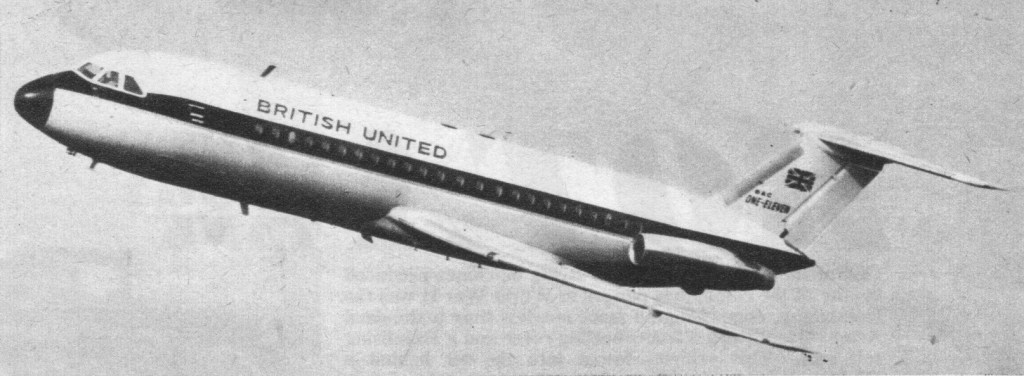
The Series 300, with 11,400-lb engines, weighed 85,000 lb, with more fuel and more powerful brakes. The Series 400 was a 300 tailored to the US market, with weight reduced for two-crew operation and many special US features. American bought 30.
Iit was not until British European Airways (BEA) began to show interest in an enlarged One-Eleven that design of what was to become the One-Eleven Series 500 was finalised. With a fuselage lengthened by 2.54m forward of the wing, and 1.57m aft of the wing, the Series 500 could accommodate a maximum of 119 passengers. More powerful Speys of up to 12,550-lb thrust with water injection engines were introduced, the wing span increased by 1.52m, and the structure of both landing gear and wings strengthened to make possible a significant increase in gross weight. This was originally 41277kg for takeoff, but has since been raised to a maximum of 47400kg. The prototype for the Series 500 was produced by conversion of the Series 400 development aircraft, and this flew for the first time in its new configuration on 30 June 1967. ARB certification of a production example was gained on 15 August 1968, and BEA’s first revenue flight was flown three months later, on 17 November.
The final variant to appear was the One-Eleven Series 475, intended for operation from and into smaller airports, or in higher temperature/altitude environments. This retains the standard fuselage/accommodation of the Series 400, and combines the powerplant and wings of the Series 500, plus a modified landing gear with low-pressure tyres, anti-slush protection and gravel deflectors to permit operation from lower-grade surfaces.
In addition to Series 475 and 500 aircraft which were available from BAe in standard configuration, two other special variants were available. These comprised executive or freighter configurations, and approximately 40 examples of the former are in service worldwide. The freighter conversion includes installation of a 3.05 by 1.85m hydraulically actuated cargo door in the port forward fuselage, and a quick-conversion freight handling system. New-technology options for new aircraft, and in some cases suitable for retrospective installation, include a fully certificated Category II automatic landing system, automatic throttle control, and engine ‘hush-kits’.
The One-Eleven continued in production after BAC was merged into British Aerospace, concluding at No. 230 in July 1980.
The largest order received during the last ten years came from Tarom.
The last aircraft to be built was G-BLDH construction number 262. The last aircraft to be delivered was G-BLHD “Last Hurn Delivery” construction number 260. This took place on 30 May 1984. A total of 235 aircraft had been delivered from Hurn and Weybridge.
In 1979 British Aerospace had concluded an agreement with CNIAR of Romania, providing for manufacture of the One-Eleven in Romania under licence. The prime contractor is IAv Bucuresti, and the deal provided for BAe to supply three complete aircraft plus 22 kits for Romanian assembly. Romania picked two variants, the 495, an upgraded 475, and the 560, an upgraded 500 with engines fitted as standard with noise suppressors. The first flight of a Rombac 1-11 YR-BRA took place on 18 September 1982. Production continued until the 9th and last ever new production 1-11 YR-BRI came off the line. It’s first flight took place in April 1989. It was delivered to Romavia in 1991. The demise of the Rombac project came about due to the unstable political situation in Romania. Total production of the BAC 1-11 therefore was 244 aircraft. 2 further airframes remained incomplete in Romania. These consisted of several models. The series 200, 300, 400, 475, 500, 670.
In February 1986 Dee Howard of the USA announced agreements with Rolls-Royce and British Aerospace for retrofitting One Elevens with the Tay 650 engine. Shown at Farnborough 1990 by Aeritalia was the first Dee Howard BAC One-Eleven conversion powered by two Rolls-Royce Tay 650 turbofans, each rated at 15,100 lb st (67,17 kN). Available for Series 400, 475 and 500 aircraft, the conversion involves replacing the original Speys with the new engine, new nacelles and Dee Howard-developed thrust reversers which will enable the aircraft to meet FAR Pt 36 Stage 3 noise requirements as well as other, more restrictive, local regulations. The first conversion, called the BAC-1-11/2400, first flew on 2 July 1989.
The only operational aircraft to survive in the UK in 2002 were the 3 aircraft operated by QinietQ, ZE432, ZE433 and ZH763, based at Boscombe Down.
prototype One-Eleven Series 200
Engines: 2 x 4722kg thrust Rolls-Royce Spey Mk 506 turbofans
Seats: 65
Srs 200
Total built: 58
Overall height: 24ft 6in
Span: 88ft 6in / 26.98m
Overall length: 93ft 6in
Max take-off weight: 79,000lb
Wing chord at root: 16ft 5in / 5.01m
Wing chord at tip: 5ft 3.5in / 1.61m
Wing aspect ratio: 8.0
Sweepback at quarter chord: 20 degrees
Overall length: 93ft 6in / 28.50m
Fuselage length: 83ft 10in / 25.55m
Max fuselage width/depth: 11ft 2in / 3.40m
Overall height: 24ft 6in / 7.47m
Tailplane span: 29ft 6in / 8.99m
Ground clearance to fuselage: 2ft 7.5in / 0.80m
Wheel track: 14ft 3in / 4.34m
Wheel base: 33ft 1in / 10.08m
Overall turn radius outer wing tip: 51ft 6in / 15.70m
Forward passenger door Height / Width / Height to sill: 5ft 8in / 1.73m – 2ft 8in / 0.82m – 7ft 0in / 2.13m
Ventral entrance:
Height: 6ft 0in / 1.83m
Width: 2ft 4in / 0.71m
Height to sill: 7ft 0in / 2.13m
Galley service door:
Height: 4ft 0in / 1.22m
Width: 2ft 3in / 0.69m
Height to sill: 7ft 0in / 2.13m
Overwing emergency exits:
Height: 3ft 0in / 0.91m
Width: 1ft 8in / 0.51m
Underfloor frt door (Fwd):
Height (projected): 2ft 7in / 0.79m
Width: 3ft 0in / 0.91m
Height to sill: 3ft 7in / 1.09m
Underfloor frt door (Rear):
Height (projected): 2ft 2in / 0.66m
Width: 3ft 0in / 0.91m
Height to sill: 4ft 3in / 1.30m
Cabin length (including flight deck): 56ft 10in / 17.31m
Max cabin width: 10ft 4in / 3.16m
Engines: Spey Mk.506-14 or 14AW, 10,410lb
BAC 111-200 Srs
Powerplant: two Rolls-Royce Spey Mk 506-14, 10,410 lb thrust take-off power
Wingspan, 88 ft 6 in
Length, 93 ft 6 in
Height, 24 ft 6 in
Gross wing area, 980 sq.ft
Max. usable floor area, 520 sq.ft approx
Max usable volume, 3542 cu.ft
Max. cabin length, 56 ft 10 in
Max. width, 124 in
Max. height, 78 in
Accommodation: 79 passengers at 33 in min. pitch
Baggage and freight hold volume: 534 cu.ft
Basic operational (gross less usable fuel and payload), 46,312 lb
Total fuel, 17,920 lb
Max. take-off, 78,500 lb
Max. landing, 69,000 lb
Max. payload (volume limited), 17,688 lb
Max. zero fuel, 64,000 lb
Power loading (max. take-off weight), 3.77 lb/lb thrust
Wing loading (max. take-off weight), 80.1 lb/sq.ft
Wing loading (max. landing weight), 70.4 lb/sq.ft
High-speed cruise, Mach 0.78 at 25,000 ft
Long-range cruise, Mach 0.70 at 35,000 ft
Approach speed, 119 kt
Take-off field length ISA at sea level, 7070 ft
Landing field length, ISA at sea level, 5300 ft
Range with allowances, max. fuel, 14,560 lb payload, 1570 nm
Type 207AJ
Overall height: 24ft 6in
Span: 88ft 6in / 26.98m
Overall length: 93ft 6in
Max take-off weight: 79,000lb
Wing chord at root: 16ft 5in / 5.01m
Wing chord at tip: 5ft 3.5in / 1.61m
Wing aspect ratio: 8.0
Sweepback at quarter chord: 20 degrees
Overall length: 93ft 6in / 28.50m
Fuselage length: 83ft 10in / 25.55m
Max fuselage width/depth: 11ft 2in / 3.40m
Overall height: 24ft 6in / 7.47m
Tailplane span: 29ft 6in / 8.99m
Ground clearance to fuselage: 2ft 7.5in / 0.80m
Wheel track: 14ft 3in / 4.34m
Wheel base: 33ft 1in / 10.08m
Overall turn radius outer wing tip: 51ft 6in / 15.70m
Forward passenger door Height / Width / Height to sill: 5ft 8in / 1.73m – 2ft 8in / 0.82m – 7ft 0in / 2.13m
Ventral entrance:
Height: 6ft 0in / 1.83m
Width: 2ft 4in / 0.71m
Height to sill: 7ft 0in / 2.13m
Galley service door:
Height: 4ft 0in / 1.22m
Width: 2ft 3in / 0.69m
Height to sill: 7ft 0in / 2.13m
Overwing emergency exits:
Height: 3ft 0in / 0.91m
Width: 1ft 8in / 0.51m
Underfloor frt door (Fwd):
Height (projected): 2ft 7in / 0.79m
Width: 3ft 0in / 0.91m
Height to sill: 3ft 7in / 1.09m
Underfloor frt door (Rear):
Height (projected): 2ft 2in / 0.66m
Width: 3ft 0in / 0.91m
Height to sill: 4ft 3in / 1.30m
Cabin length (including flight deck): 56ft 10in / 17.31m
Max cabin width: 10ft 4in / 3.16m
Engines: Spey Mk.511-14, 11,400lb
Type 217AU
Overall height: 24ft 6in
Span: 88ft 6in / 26.98m
Overall length: 93ft 6in
Max take-off weight: 79,000lb
Wing chord at root: 16ft 5in / 5.01m
Wing chord at tip: 5ft 3.5in / 1.61m
Wing aspect ratio: 8.0
Sweepback at quarter chord: 20 degrees
Overall length: 93ft 6in / 28.50m
Fuselage length: 83ft 10in / 25.55m
Max fuselage width/depth: 11ft 2in / 3.40m
Overall height: 24ft 6in / 7.47m
Tailplane span: 29ft 6in / 8.99m
Ground clearance to fuselage: 2ft 7.5in / 0.80m
Wheel track: 14ft 3in / 4.34m
Wheel base: 33ft 1in / 10.08m
Overall turn radius outer wing tip: 51ft 6in / 15.70m
Forward passenger door Height / Width / Height to sill: 5ft 8in / 1.73m – 2ft 8in / 0.82m – 7ft 0in / 2.13m
Ventral entrance:
Height: 6ft 0in / 1.83m
Width: 2ft 4in / 0.71m
Height to sill: 7ft 0in / 2.13m
Galley service door:
Height: 4ft 0in / 1.22m
Width: 2ft 3in / 0.69m
Height to sill: 7ft 0in / 2.13m
Overwing emergency exits:
Height: 3ft 0in / 0.91m
Width: 1ft 8in / 0.51m
Underfloor frt door (Fwd):
Height (projected): 2ft 7in / 0.79m
Width: 3ft 0in / 0.91m
Height to sill: 3ft 7in / 1.09m
Underfloor frt door (Rear):
Height (projected): 2ft 2in / 0.66m
Width: 3ft 0in / 0.91m
Height to sill: 4ft 3in / 1.30m
Cabin length (including flight deck): 56ft 10in / 17.31m
Max cabin width: 10ft 4in / 3.16m
Engines: Spey Mk.511-14, 11,400lb
Crew: 3
Srs 300
Total built: 9
Overall height: 24ft 6in
Span: 88ft 6in / 26.98m
Overall length: 93ft 6in
Max take-off weight: 88,500lb
Wing chord at root: 16ft 5in / 5.01m
Wing chord at tip: 5ft 3.5in / 1.61m
Wing aspect ratio: 8.0
Sweepback at quarter chord: 20 degrees
Overall length: 93ft 6in / 28.50m
Fuselage length: 83ft 10in / 25.55m
Max fuselage width/depth: 11ft 2in / 3.40m
Overall height: 24ft 6in / 7.47m
Tailplane span: 29ft 6in / 8.99m
Ground clearance to fuselage: 2ft 7.5in / 0.80m
Wheel track: 14ft 3in / 4.34m
Wheel base: 33ft 1in / 10.08m
Overall turn radius outer wing tip: 51ft 6in / 15.70m
Forward passenger door Height / Width / Height to sill: 5ft 8in / 1.73m – 2ft 8in / 0.82m – 7ft 0in / 2.13m
Ventral entrance:
Height: 6ft 0in / 1.83m
Width: 2ft 4in / 0.71m
Height to sill: 7ft 0in / 2.13m
Galley service door:
Height: 4ft 0in / 1.22m
Width: 2ft 3in / 0.69m
Height to sill: 7ft 0in / 2.13m
Overwing emergency exits:
Height: 3ft 0in / 0.91m
Width: 1ft 8in / 0.51m
Underfloor frt door (Fwd):
Height (projected): 2ft 7in / 0.79m
Width: 3ft 0in / 0.91m
Height to sill: 3ft 7in / 1.09m
Underfloor frt door (Rear):
Height (projected): 2ft 2in / 0.66m
Width: 3ft 0in / 0.91m
Height to sill: 4ft 3in / 1.30m
Cabin length (including flight deck): 56ft 10in / 17.31m
Max cabin width: 10ft 4in / 3.16m
Engines: Spey Mk.511-14 or 14W, 11,400lb
Crew: 3
Srs 320L
Engines: 2 x Rolls-Royce Spey Mk.511turbofan, 11,400-lb.
Pax cap: 79
Srs 400
Total built: 70
Overall height: 24ft 6in
Span: 88ft 6in / 26.98m
Overall length: 93ft 6in
Max take-off weight: 88,500lb
Wing chord at root: 16ft 5in / 5.01m
Wing chord at tip: 5ft 3.5in / 1.61m
Wing aspect ratio: 8.0
Sweepback at quarter chord: 20 degrees
Overall length: 93ft 6in / 28.50m
Fuselage length: 83ft 10in / 25.55m
Max fuselage width/depth: 11ft 2in / 3.40m
Overall height: 24ft 6in / 7.47m
Tailplane span: 29ft 6in / 8.99m
Ground clearance to fuselage: 2ft 7.5in / 0.80m
Wheel track: 14ft 3in / 4.34m
Wheel base: 33ft 1in / 10.08m
Overall turn radius outer wing tip: 51ft 6in / 15.70m
Forward passenger door Height / Width / Height to sill: 5ft 8in / 1.73m – 2ft 8in / 0.82m – 7ft 0in / 2.13m
Ventral entrance:
Height: 6ft 0in / 1.83m
Width: 2ft 4in / 0.71m
Height to sill: 7ft 0in / 2.13m
Galley service door:
Height: 4ft 0in / 1.22m
Width: 2ft 3in / 0.69m
Height to sill: 7ft 0in / 2.13m
Overwing emergency exits:
Height: 3ft 0in / 0.91m
Width: 1ft 8in / 0.51m
Underfloor frt door (Fwd):
Height (projected): 2ft 7in / 0.79m
Width: 3ft 0in / 0.91m
Height to sill: 3ft 7in / 1.09m
Underfloor frt door (Rear):
Height (projected): 2ft 2in / 0.66m
Width: 3ft 0in / 0.91m
Height to sill: 4ft 3in / 1.30m
Cabin length (including flight deck): 56ft 10in / 17.31m
Max cabin width: 10ft 4in / 3.16m
Engines: Spey Mk.511-14, 11,400lb
Crew: 2
Srs 475
Total built: 12
Overall height: 24ft 6in
Span: 93ft 6in / 28.50m
Overall length: 93ft 6in
Max take-off weight: 98,500lb
Wing chord at root: 16ft 9.5in / 5.11m
Wing chord at tip: 5ft 3.5in-5ft 5in / 1.61m-1.65m
Wing aspect ratio: 8.65
Sweepback at quarter chord: 20 degrees
Overall length: 93ft 6in / 28.50m
Fuselage length: 83ft 10in / 25.55m
Max fuselage width/depth: 11ft 2in / 3.40m
Overall height: 24ft 6in / 7.47m
Tailplane span: 29ft 6in / 8.99m
Ground clearance to fuselage: 2ft 7.5in / 0.80m
Wheel track: 14ft 3in / 4.34m
Wheel base: 33ft 0in / 10.06m
Overall turn radius outer wing tip: 51ft 6in / 15.70m
Forward passenger door Height / Width / Height to sill: 5ft 8in / 1.73m – 2ft 8in / 0.82m – 7ft 0in / 2.13m
Ventral entrance:
Height: 6ft 0in / 1.83m
Width: 2ft 4in / 0.71m
Height to sill: 7ft 0in / 2.13m
Galley service door:
Height: 4ft 0in / 1.22m
Width: 2ft 3in / 0.69m
Height to sill: 7ft 0in / 2.13m
Overwing emergency exits:
Height: 3ft 0in / 0.91m
Width: 1ft 8in / 0.51m
Underfloor frt door (Fwd):
Height (projected): 2ft 7in / 0.79m
Width: 3ft 0in / 0.91m
Height to sill: 3ft 7in / 1.09m
Underfloor frt door (Rear):
Height (projected): 2ft 2in / 0.66m
Width: 3ft 0in / 0.91m
Height to sill: 4ft 3in / 1.30m
Main deck freight door:
Height: 6ft 1in / 1.85m
Width: 10ft 0in / 3.05m
Height to sill: 7ft 0in / 2.13m
Cabin length (including flight deck): 56ft 10in / 17.31m
Max cabin width: 10ft 4in / 3.16m
Engines: Spey Mk.512-14DW, 12,550lb
Series 495
Romanian upgraded Srs 475
Srs 500
Total built: UK: 92
Romania: 3
Overall height: 24ft 6in
Span: 93ft 6in / 28.50m
Overall length: 107ft 0in
Max take-off weight: 104,500lb
Wing chord at root: 16ft 5in-16ft 9.5in / 5.01m-5.11m
Wing chord at tip: 5ft 3.5in-5ft 5in / 1.61m-1.65m
Wing aspect ratio: 8.5-8.65
Sweepback at quarter chord: 20 degrees
Overall length: 107ft 0in / 32.61m
Fuselage length: 97ft 4in / 29.67m
Max fuselage width/depth: 11ft 2in / 3.40m
Overall height: 24ft 6in / 7.47m
Tailplane span: 29ft 6in / 8.99m
Ground clearance to fuselage: 2ft 7.5in / 0.80m
Wheel track: 14ft 3in / 4.34m
Wheel base: 41ft 4in / 12.60m
Overall turn radius outer wing tip: 56ft 0in / 17.07m
Forward passenger door Height / Width / Height to sill: 5ft 8in / 1.73m – 2ft 8in / 0.82m – 7ft 0in / 2.13m
Ventral entrance:
Height: 6ft 0in / 1.83m
Width: 2ft 4in / 0.71m
Height to sill: 7ft 0in / 2.13m
Galley service door:
Height: 4ft 0in / 1.22m
Width: 2ft 3in / 0.69m
Height to sill: 7ft 0in / 2.13m
Overwing emergency exits:
Height: 3ft 0in / 0.91m
Width: 1ft 8in / 0.51m
Underfloor frt door (Fwd):
Height (projected): 2ft 7in / 0.79m
Width: 3ft 0in / 0.91m
Height to sill: 3ft 7in / 1.09m
Underfloor frt door (Rear):
Height (projected): 2ft 2in / 0.66m
Width: 3ft 0in / 0.91m
Height to sill: 4ft 3in / 1.30m
Cabin length (including flight deck): 70ft 4in / 21.44m
Max cabin width: 10ft 4in / 3.16m
Engines: Spey Mk.512-14DW, 12,550lb
Type 501ED
Total built:
Overall height: 24ft 6in
Span: 93ft 6in / 28.50m
Overall length: 107ft 0in
Max take-off weight: 104,500lb
Wing chord at root: 16ft 5in-16ft 9.5in / 5.01m-5.11m
Wing chord at tip: 5ft 3.5in-5ft 5in / 1.61m-1.65m
Wing aspect ratio: 8.5-8.65
Sweepback at quarter chord: 20 degrees
Overall length: 107ft 0in / 32.61m
Fuselage length: 97ft 4in / 29.67m
Max fuselage width/depth: 11ft 2in / 3.40m
Overall height: 24ft 6in / 7.47m
Tailplane span: 29ft 6in / 8.99m
Ground clearance to fuselage: 2ft 7.5in / 0.80m
Wheel track: 14ft 3in / 4.34m
Wheel base: 41ft 4in / 12.60m
Overall turn radius outer wing tip: 56ft 0in / 17.07m
Forward passenger door:
Height: 5ft 8in / 1.73m
Width: 2ft 8in / 0.82m
Height to sill: 7ft 0in / 2.13m
Ventral entrance:
Height: 6ft 0in / 1.83m
Width: 2ft 4in / 0.71m
Height to sill: 7ft 0in / 2.13m
Galley service door:
Height: 4ft 0in / 1.22m
Width: 2ft 3in / 0.69m
Height to sill: 7ft 0in / 2.13m
Overwing emergency exits:
Height: 3ft 0in / 0.91m
Width: 1ft 8in / 0.51m
Underfloor frt door (Fwd):
Height (projected): 2ft 7in / 0.79m
Width: 3ft 0in / 0.91m
Height to sill: 3ft 7in / 1.09m
Underfloor frt door (Rear):
Height (projected): 2ft 2in / 0.66m
Width: 3ft 0in / 0.91m
Height to sill: 4ft 3in / 1.30m
Cabin length (including flight deck): 70ft 4in / 21.44m
Max cabin width: 10ft 4in / 3.16m
Engines: Spey Mk.512-14E, 12,000lb
Series 560
Romanian upgraded Srs 500
BAC-1-11/2400 / Dee Howard conversion
Engines: 2 x Rolls-Royce Tay 650 turbofans, 15,100 lb st (67,17 kN).
Super 111
Engines 2 x 11,970 lb. (5,434 kg.) thrust Rolls Royce Spey turbofan.
Length 107 ft. (32.61 m.)
Wing span 93.5 ft. (28.5 m.)
Weight empty 53,995 lb. (24,490 kg.)
Max. capacity: 99 passengers
Max cruise 548 m.p.h. (882 km.p.h.)
Max cruise alt: 35,000 ft. (10,670 m.)
Range 576 miles (927 km.) with typical payload/2 hr res.
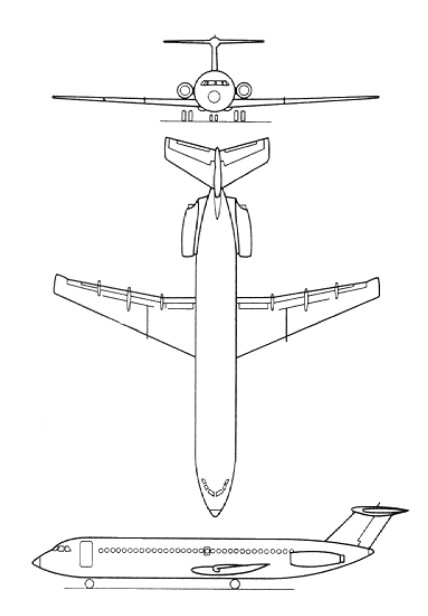
 All Aero