In 1947, commissioned by the Air Ministry, Turbomeca begins the design of a small gas turbine. This gas turbine, TT 782, became the TR 01. The first test application, under the name Piméné, was in a modified Sylph glider on 14 July 1949.
The Palas, then Marbore I and II followed in 1950.
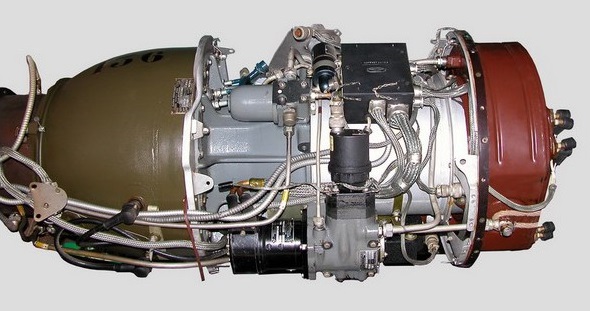
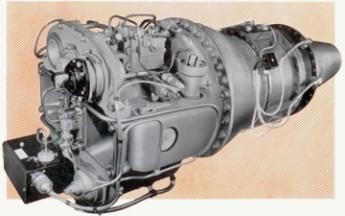
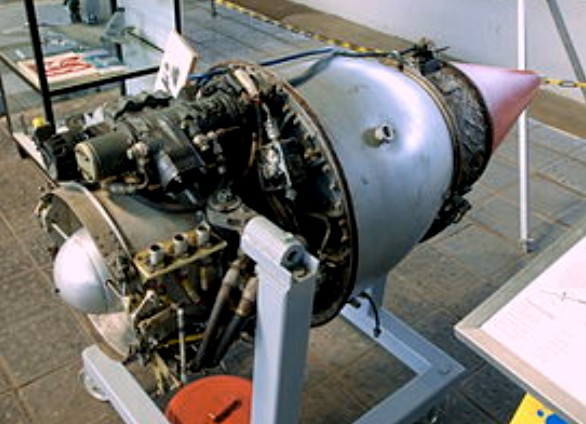
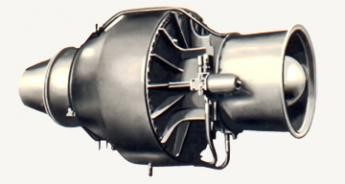
The Turbomeca Palas is a diminutive centrifugal flow turbojet engine used to power light aircraft. An enlargement of the Turbomeca Piméné the Palas has a turbofan with a centrifugal compressor stage, combustion chamber with an annular fuel distribution by injection of a wheel, and having a turbine stage. Two versions have been put on the market, the first (I) delivering 150 kgf and the second (II) delivering 160 kpg
With an annular fuel distribution by the injection of a wheel, this wheel is driven by the turbine shaft which is itself fixed to the compressor. At its periphery is formed a number of leads through which the fuel flows. When fuel is introduced into the interior of the wheel, it is vaporized and discharged in the combustion chamber by the centrifugal force. The fuel flow is regulated by a bypass valve.
The compressor is a single-stage centrifugal, with a compression ratio of 3.95 / 1 and a irflow of 3.2 kg / sec. The turbine stage has 24 (or 25) blades. It is preceded by a stator equipped with a twenty entrys. Kerosene (Jet A1) is provided by a Turbomeca pump of 4 kg. / Cm ² maximum pressure.
It can be equipped with an electric starter Air Equipment (24 volt) or ramp start compressed air. Ignition is via two ignitors and the later versions were equipped with an injection to start directly on Kerosene.
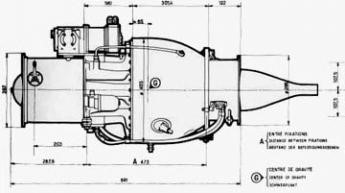
Three anchor points, two above the compressor, behind the combustion chamber, are provided for mounting.
The Palas was produced under licence by Blackburn and General Aircraft in the United Kingdom and Teledyne Continental Motors in the United States as the Continental Model 320.
Blackburn Palas 600
Applications: Caproni Trento F.5 Curtiss C-46 Commando (two under the fuselage, the first flight in October 1952) Curtiss Commando C-46F (2 under the wings) CVV-6 Canguro Palas Douglas DC-3 (as a booster engine) Fouga CM-8 R9.8 Cyclope Fouga CM-8 R8.3 Midget Fouga CM.130 Ikarus 451 Ikarus S451M Ikarus 452M Mantelli AM-12 Miles Sparrowjet Payen Pa 49 Short SB.4 Sherpa SIPA S.200 Minijet SIPA S.300 Somers-Kendall SK-1 Sud-Ouest Bretagne
Specifications Type: Turbojet Length: 1.2 m (47.25 in) Diameter: 405 mm (16 in) Dry weight: 72 kg (159 lb) Compressor: Single-stage centrifugal Combustors: Annular with rotary fuel injection Turbine: Single-stage with 24 or 25 blades Fuel type: Jet A1 Maximum thrust: 1.6 kN (353 lbf) static to 33 800 rpm Rated normal util: 130 kgp Overall pressure ratio: 3.95:1 Turbine inlet temperature: 700°C Fuel consumption: 0.117 kg N-1 h-1 (1.15 lb lbf-1 h-1 ) Fuel burn A Rated normal: 1.13 kg / kgp / hr Thrust-to-weight ratio: 22.2 N kg-1 (2.26 lbf lb-1) Turbine rated speed: 33 800 rpm Temperature before turbine: 700 ° C. Temperature after turbine: 600 ° C.
The Turboméca Marboré was a small turbojet engine produced by Turbomeca from the 1950s into the 1970s. First flown on 16 June 1951, the most popular uses of this engine were in the Fouga Magister and the Morane-Saulnier MS-760. It was also licensed for production in the United States as the Teledyne CAE J69.
Marbore I
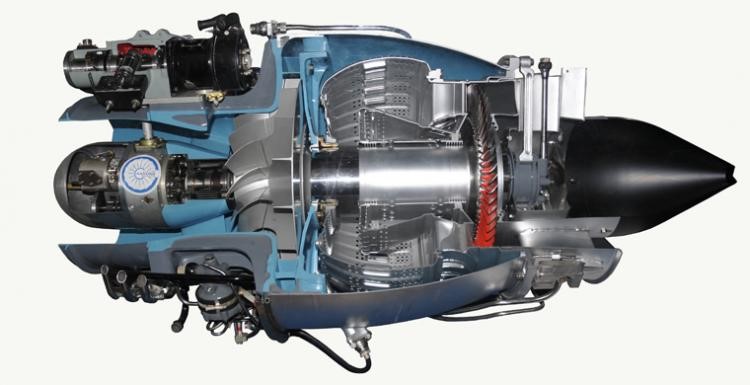
The first major production version was the Marboré II, which had a maximum thrust of 880 lbf (3.9 kN) at 22,500 rpm. In its most basic form, it is a single-spool, centrifugal compressor turbojet. Fuel consumption was rated at 109 gal/h. Variations include military or civilian aircraft, oil tank design, auxiliary equipment, and exhaust pipe configuration. Some variants also included one axial stage compressor for additional performance. The engine dimensions of different variants with different auxiliary components and mounting configurations.
The Marbore II has a single stage centrifugal compressor with with an annular combustion chamber and single stage turbine. Starting is by an electric starter and 2 torch igniters.
Marbore II
Marbore II was fitted on the Nord 2505 (Modified Nord 2503, powered by two 1864-kW (2,500-hp) Pratt & Whitney R-2800-CB17 radial piston engines and two Turbomeca Marboré IIE auxiliary turbojets added).
Turbomeca Marboré IIE
These were eventually replaced by the Marboré VI series which were slightly more powerful at was 1080 lbf (4.8 kN) instead of 880 lbf. Fuel consumption was only slightly higher at 119 gal/h. This was a 23% increase in thrust with slightly more than a 9% increase in fuel consumption. As a result the IV series were used to re-engine many II-series aircraft, and Marboré II engines are still available cheaply as surplus for the experimenter.
Turbomeca Marboré VI
The original Marboré, as well as Marboré III, IV, and V were not produced in significant numbers. A typical weight for this series of engines is 140 kilograms or 310 pounds. Fuel consumption is 190 gallons per hour on the Marbore VI at 15,000 feet, as compared to 138 gallons per hour on Marbore II engines (same altitude). An increase of 27% fuel consumption and a decrease in cruise range capabilities.
Variants:
Marboré I Marboré II Marboré IIC Marboré IIE Marboré III Marboré IV Marboré V Marboré VI Teledyne CAE J69: Licence production and development in the United States.
Applications:
Marboré: Ambrosini Sagittario Bölkow Bo 46 Fouga Magister Fouga Zéphyr Hispano HA-200 Morane-Saulnier MS.755 Fleuret Morane-Saulnier MS.760 Paris Nord Aviation CT20 SNCASO Trident
Specifications:
Marbore I Diameter: 60 cm / 23.4 in Length: 138 cm / 54.2 in Weight: 120 kg / 265 lb
Marbore II Take off thrust: 880 lbs S.F.C: 1,15 lbs/lbs/h Maximum continuous thrust: 705 lbs S.F.C: 1,10 lbs/lbs/h Weight: 322 lbs
Marboré IIC Type: Turbojet Length: 61.7 in (156.7 cm) Diameter: 24.9 in (63.2 cm) Dry weight: 358 lb (162.4 kg) Compressor: Single stage centrifugal Combustors: Single annular combustion chamber Turbine: Single stage Fuel type: Aviation kerosene Air 3405 (JP-1) Maximum thrust: 880 lbf (3.91 kN) at 22,600 rpm Turbine inlet temperature: 650 C Thrust-to-weight ratio: 2.458 lbf/lb (0.024 kN/kg)
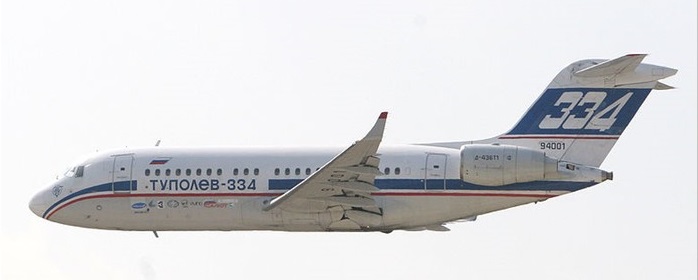
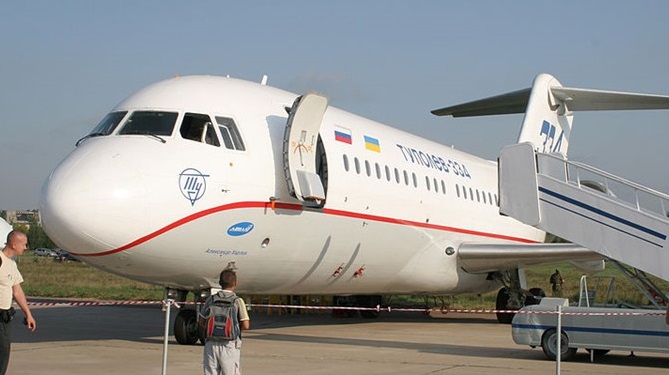
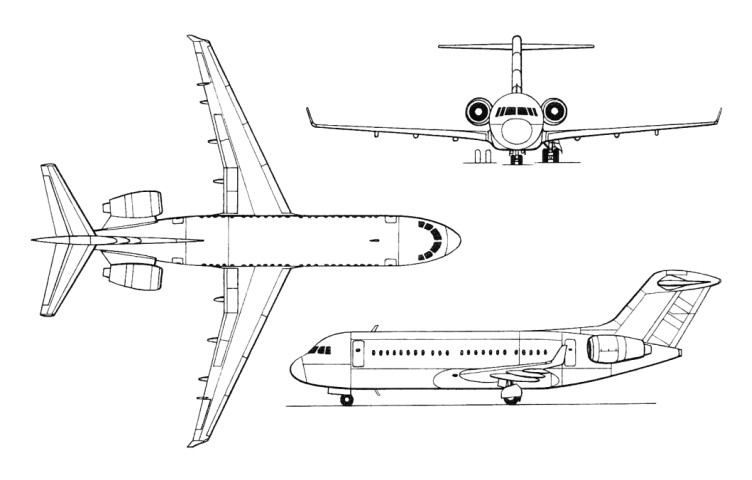
The Tupolev Tu-334 was a Russian short to medium range airliner project that was developed to replace the ageing Tu-134s and Yak-42s in service around the world. The airframe was based on a shortened Tu-204 fuselage and a scaled-down version of that aircraft’s wing. Unlike the Tu-204, however, the Tu-334 has a T-tail and engines mounted on the sides of the rear fuselage instead of under the wings.
Power is from two D-436T-1 turbofan engines with reversers (2×73.6 kN, 2×7500 kgf) produced by Zaporozhie Engine Manufacturing Design Bureau provided . The engine was certified in 2000. Engine is produced in co-operation with “Motor Sich” JSC (Ukrain), “Moscow Engineering Manufacturing Corporation”Salut” JSC (Russia), “Ufa Engine Manufacturing Corporation” JSC (Russia). TU-334 aircraft variants were supposed to be provided with turbofan D-436T-2 engines with thrust of 80.4-83.4 kN (8200 kgf) each.
Work commenced on the Tu-334 in the early 1990s, but proceeded slowly due to funding problems arising from the break-up of the Soviet Union. A prototype was displayed in 1995, but this was little more than a mock-up with few systems installed. A functional aircraft first flew on February 8, 1999, and later that year, agreements were put in place for MiG to undertake part of the production of the airliner. A Russian type certificate was obtained – after some delay – on December 30, 2003.
Since then, development remained slow due to protracted budget problems. In turn, the certification of the aircraft and its planned entry into serial production was delayed multiple times. As of December 2006 there were firm orders for the Tupolev Tu-334 from seven airlines, including Atlant-Soyuz Airlines and there were letters of intent from 24 airlines to obtain another 297 airplanes. Price per unit for the business version is estimated to be around $43–44 million.
Production lines were established for the 102- seat -100 in Aviant’s factory in Kiev, and for the 126-seat -200 in Aviacor’s Samara factory. A second -100 factory was also planned by Tavia at Taganrog. By 1996 series production of the Tu-334 at the Aviant factory in Kiev was 90% ready, but on 05 October 1996 the Russian government decided that Russia’s MIG MAPO was to take over from Kiev the manufacture of the new Tu-334 airliner. MIG MAPO had offered co-operation with Aviant: the Kiev plant would handover production tooling for half the aircraft parts to Moscow, the other half would be manufactured in Kiev and delivered to Moscow. Aviant had no choice since the rights for intellectual property of the aircraft belong to Russia. The assembly shop at the aircraft factory in Lukhovitsy was built especially for its production.
In February 2000 Vladimir Kravchuk, Deputy Director, Tu-334 program said the MiG Aircraft Concern was making production contracts and agreements on Tu-334 program with various aerospace enterprises in Russia and Ukraine. The Company had entered into an agreement with aircraft plants at Taganrog, which were expected to deliver a ready Tu-334 fuselage in March 2000. Ulyanovsk-based aircraft plant was to produce nose parts of Tu-334. These were made identical to nose parts of Tu-204 being mass-produced at Ulyanovsk. Russia’s Government had designated MiG the principle facility for producing Tu-334. The production was to cost 370 mln US dollars. The plan envisages the cost recovery after 7.5 years under production of at least 67 planes.
Serial production of TU-334-100 preparation has started at KAPO n.a.Gorbunov in accordance with Resolution of the Government of the Russian Federation of 15 April, 2005 No.217 “On organization of serial production of TU-334 a/c and its versions at FGUP “KAPO n.a.Gorbunov”. In January 2007 the oil-rich Russian republic of Tatarstan proposed to adopt the twinjet as the vehicle for the upgrade of its Gorbunov Aircraft Manufacturing Association (KAPO) manufacturing plant. The KAPO plant could take over production of dormant twinjet in exchange for $100 million to renovate factory.
In December 2007 it was reported that Iran was ready to make a purchase of up to 130 Tupolev Tu-214 and Tu-334 over ten years. The Iran Aviation Industries Organization (IAIO) was in negotiations to purchase licenses to assemble the aircraft in Iran by 2011 and manufacture them completely by 2015 alongside Tu-214. Nothing concrete became of these negotiations before the cancellation of the Tu-334 programme.
In June 2008 the Russian government bought 6 Tu-334. Four planes were Tu-334-100 with VIP-interiors and two planes were for the Federal Security Service. GTK Rossiya, the Russian government airline that provides flight services to the president and FSO federal security service, selected the Tupolev Tu-334 over Sukhoi’s Superjet 100 and Antonov’s An-148 in a tender for four aircraft, for delivery no later than 2010. Delivery under the state contract was planned as follows: 2010 – one plane, 2011 – two and in 2012 – three. KAPO resumed building Tu 334-100. This is the hull #03 of the experimental batch. While the second aircraft of this batch (#05 built by Aviant Kiev State Aviation Plant) was still flying to extend the certified conditions of operation, this one was likely to become the first Tu-334 sold as a product.
As late as 2008, Tupolev reported that a total of about 100 airlines had expressed an interest in placing orders for Tu-334s.
On 31 July 2008 Sergei Ilyushenkov, managing director of the Tupolev joint-stock company, said commercial production of a new Russian short-haul passenger airliner, the Tu-334, will start within the next six months. The Tu-334, including its business-class version, would be assembled at the KAPO Kazan aircraft plant. The project will be funded by a private investor. He said the Tu-334 business version would cost around $43-44 million, compared with over $60 million for a Bombardier business jet. Ilyushenkov also said the Tu-334’s range could subsequently be increased to 6,400 km by using additional fuel tanks. The aircraft had gone through certification, and can be launched into serial production at a minor expense once there were reliable orders from air carriers.
In 2009, with the project years behind the projected schedule and only two examples built and flying ten years after first flight, the Tu-334 came under review during the rationalisation of the Russian aircraft companies, which led to the formation of United Aircraft Corporation. In mid-2009, the decision was taken to not continue with the Tu-334 programme and instead focus efforts on the Sukhoi Superjet 100 and the Antonov An-148.
TU-334 A state-of-the-art short-haul aircraft designed on the basis of advanced developments in aerodynamics, structure, and avionics ensuring high-level comfort and safety, and high-quality standards traditional for “TUPOLEV” PSC. Various versions, universal layouts and up-to-date avionics allow operators to choose the TU-334 aircraft version that would be ideal for any flight mission.
TU-334-100 A basic version designated to carry 102 passengers in tourist class. The aircraft is powered by D436T1 engines. In 2003 it was certified against AP-25 Russian Airworthiness Rules.
Tu-334-100 Engines: 2 x Progress D-436T1 turbofans, 7500kg Wingspan: 29.77 m / 98 ft 8 in Length: 31.26 m / 103 ft 7 in Height: 9.38 m / 31 ft 9 in Wing area: 83.23 sq.m / 895.88 sq ft Empty weight: 30,050 kg (66,250 lb) Max. takeoff weight: 47,900 kg / 105,380 lb Payload: 11000kg / 24251 lb Maximum speed: 865 km/h (465 kt, 545 mph) Cruise speed: 820 km/h / 510 mph / 440 kt Service ceiling: 11,100 m / 36,400 ft Range: 2380 km / 1479 miles Passengers: 102 Crew: 2
A medium-range passenger aircraft with 214 seats, designed as a replacement for the Tu-154. First flown on 2 January 1989, the Tu-204 was the first Soviet-built airliner with fly-by-wire controls.
The Tu-214 airliner is based on the Tu-204 but features increased take-off weights and longer range. The first flight of the Tu-214 was in March 1996.
Tu-214
Despite its formal designation as a civilian aircraft, the Tu-214 plane has never truly functioned as a commercial airliner. Instead, it has been produced almost exclusively in niche variants, such as the Tu-214R aircraft for reconnaissance, the Tu-214ON unit for observation, and various government “special mission” aircraft.
Tu-214 passenger jet
In 2014 Kazan Aviation Plant fulfilled only 10% of its production quota for the Tu-214 airliners, delivering just two aircraft instead of the planned twenty. The aircraft are even sent abroad, to Belarus, for painting. With a goal of building 70 Tu-214 units by 2030, manufacturing rates make that deadline highly unrealistic.
Tu-204 Engines: 2 x PS-90A turbofans, 157kN Max take-off weight: 93500 kg / 206133 lb Empty weight: 56500 kg / 124562 lb Wingspan: 42.0 m / 138 ft 10 in Length: 46.0 m / 151 ft 11 in Height: 13.9 m / 46 ft 7 in Wing area: 168 sq.m / 1808.34 sq ft Max. speed: 810-850 km/h / 503 – 528 mph Range: 4600 km / 2858 miles Crew: 2-3 Passengers: 214
Tu-204-120 Engines: 2 x Rolls-Royce RB211-535E4-B Pax seats: 208
Tu-204C-120 Engines: 2 x Rolls-Royce RB211-535E4-B
Tu-214 Maximum take-off weight: 110.7 tons Commercial payload: 25 tons
On 28 November 1967 the Soviet government specified the requirements for a competition for a new strategic bomber. Technical parameters were high. The aircraft was to reach 11000 to 13000 km (5,970 to 7,020 nm) and have a cruising speed of 3200 to 3500 km/h. The maximum range at subsonic speed was to be 16000 to 18000 km (8,640 to 9,720 nm) at high altitude. Basic armament was to be nuclear missiles, including heavy Kh-45 and small Kh-2000s.
Tupolev, which was formally called Moscow Engineering Plant ‘Opyt’ (meaning Test), joined Sukhoi and Myasishchev in the quest for a supersonic strategic bomber. Unlike the others, Tupolev started designing by not aiming at the specifications given by the government. Tupolev thought a Mach 3.0 to 3.2 bomber, compared with a Mach 2.3, did not off-set the cost of construction and technology. In the early 1970s Tupolev prepared a series of flying-wing designs designated 160M, which were based on the contemporary delta-winged Tu-144 supersonic airliner.
In 1972 the air forces selected Sukhoi as the winner, however it was realised a design with these specifications was not possible. So it was decided to start a second stage of the competition. The maximum speed was lowered to Mach 2.3 enabling Tupolev’s 160M flying-wing design to enter the competition. Myasishchev came with the M-18, based on the M-20 design which had a variable-geometry wing. Sukhoi gave up the competition and decided to concentrate on fighter aircraft.
The air force selected the M-18, because of its variable-geometry wing design and the design was supported by TsAGI (large and powerful Soviet technical research institute) and the Technological-Scientific Council of the Ministry of Air Industry. Tupolev’s flying-wing design was a single-mode aircraft and the air force required bomber following a compound flight profile and be able to also land at ‘smaller’ airfield.
Myasishchev’s winning design was developed by the Tupolev bureau, because the former’s team was too small. In 1973 the first design for the Tu-160 was prepared by Tupolev based on the M-18 variable-geometry design. The design was gradually improved and Tupolev began selecting the aircraft systems, together with the scientific and government research institutes. The NK-25 engine of the Tu-22M3 were selected at first, but the high fuel consume rate required a new development. In 1980 the first Nk-32 was test flown on a Tu-142 and production began in 1983.
Aleksei Tupolev (son of Andrei Tupolev, founder of the design bureau) lead the Tu-160 design program during the initial period, in 1975 Valentin Bliznyuk was appointed as chief designer and remained in charge of the program. In 1977 the preliminary design and a full scale mock up were submitted for state committee acceptance. At this stage the aircraft would carry two Kh-45 missiles. During the Strategic Arms Limitation Treaty II (SALT II) talks in the late 1970s, the plans for a new strategic bomber and the name Tu-160 were first revealed to the west.
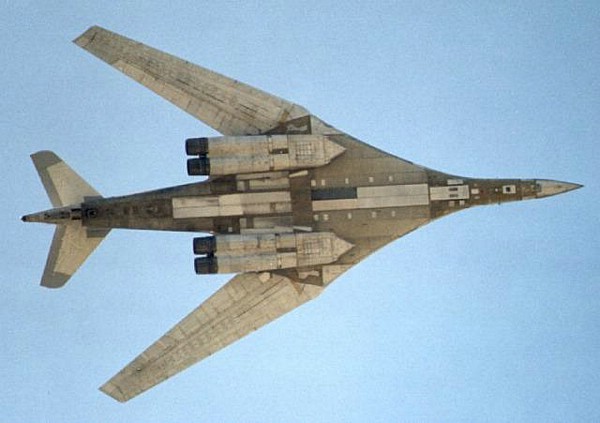
The aircraft has a slender long blended wing-body design with a variable-geometry wing. The four NK-32 afterburning turbofans are arranged in pairs under the mid-wing each with variable-area intakes. The undercarriage consists of one front double-wheel leg and two six-wheel bogies (three tandem pairs), which are located between the engine pairs. Along the aircraft’s centreline between the two gear units there are two weapon bays, which are divided by the wing carry-through structure.
The nose of the aircraft contains the Obzor-K (Survey) radar, which is used for both ground and air observation. It also contains another radar, the Sopka (Hill), which is used for terrain following when flying at low altitude. The upper center part in front of the windscreen contains the retractable inflight refuelling probe. Under the front fuselage there is a forward looking OPB-15T optical bombing sight and video. Behind the sight, there is the nose gear. The four man crew enters the cabin through the front gear bay. The pressurized cabin has four fighterjet-like K-36LM ejection seats. There are two control sticks for commander pilot (front left) and co-pilot (front right). The Tu-160 has a conventional flight deck, which is divided by a central console with the thrust and flap selection levers for the co-pilot. Behind the pilots there is the navigator/offensive weapons operator (left) and the navigator/electronic warfare and communications operator (right). Behind the crew there is corridor leading to a galley and a toilet.
The weapons carried in the weapon bays comprises of six (or a maximum of 12) Raduga Kh-55SM (NATO AS-15B ‘Kent’) cruise missiles, which are launched from two six-round MKU6-5U revolving launchers located in the forward area of each bay. The nuclear warhead loaded Kh-55SM is a development of the subsonic Kh-55 cruise missile. For guidance of the Kh-55SM the Tu-160 is equipped with the Sprut-SM (Octopus) navigation/attack system, which automatically aligns the coordination axes of both aircraft and weapons. It also generates a digital map of the terrain which is transferred from the aircraft to the missile before launch. Alternatively the Tu-160 can be equipped with up to 24 Raduga Kh-15 (NATO AS-16 ‘Kickback’) short-range attack missiles (SRAM) or Kh-15P anti radiation missiles, which are both launched from up to four MKU6-1U revolving drums. However reportedly the Kh-15 capability has not been implemented on any production aircraft.
The variable-geometry wing has three positions. 20 degree sweep for landing, 35 degree for cruise and 65 degree sweep for high speed flight. The inner portion of the wing forms a vertical plane for directional stability when the wings are fully swept backwards. When the wing is swept forwards this portion lies flat to fill the gap between wing and fuselage and forms the most inner part of the flap.
The Tu-160 houses a Baykal self-defence systems of which most systems are located in the ‘carrot’ tail cone. These systems include a Mak (Poppy) infra-red missile launch sensor, radar warning receiver, electronic jammer and a battery of APP-50 chaff/flare dispensers. The underside of the tailcone houses the brake chutes. Directional control is provided by an all moving fin.
When the Soviets learned about the American AGM-86 ALCM-B cruise missile, the requirement of the Kh-45 as main armament for the Tu-160 was dropped and a strategic (nuclear) version of the Kh-55 cruise missile was developed. The Tu-160 armament would now consist of 12 Kh-55SM missiles, with 12 to 24 Kh-15 being the alternative. Although there was enough time to design the weapon bays after the plans for Kh-45 were dropped, the Tu-160 design held its long weapon bays. The Kh-55SM and Kh-15 are much shorter, and can be launched with only the forward longer doors openened (each weapon bay has four doors). Initially a traditional self-defence system was proposed for the Tu-160, including a tail turret with a 30mm GSg-6-30 cannon. However the designer replaced the plans later during developed with the Baykal system. Also the plans for R-77 medium-range air-to-air missiles were abondoned.
The program was accepted in 1977 and Tupolev began production of three prototypes. Although the aircraft were assembled at Tupolev’s workshop at Moscow, the sub-assemblies were built at other production plants.
The first prototype 70-01 intended for flight testing the basic flight characteristics had incomplete equipment. Prototype 70-02 was built for static tests. Prototype 70-03 was practically an equivalent of series production aircraft. 70-01 was completed at Zhukovskity in January 1981. On 14 November, the aircraft taxied the airstrip for the first time, after months of testing. On 25 November 1981 a picture was taken of the aircraft near two Tu-144 by a US reconnaissance satellite, this was the first picture of the Tu-160 revealed to the world, at that time designated ‘RamP’.
On Friday 18 December 1981 Tu-160 70-01 made its maiden flight. Three months later the first supersonic flight was achieved. And during one of the test flight the top speed of 2200 km/h was reached. The 70-01 can be distinguished from the other Tu-160 by having a long probe at the nose tip. Internally there are greater differences in equipment and structural elements. Work on new materials and engineering methods, lead to postponement of the 70-03 prototype, which did not take off until 6 October 1984.
Although there are some differences between the first prototype, the development and the production aircraft, only one variant of the Tu-160 entered production. NATO codename for this variant is ‘Blackjack-A’.
Series production was started at Ulyanovsk production plant, but was soon replaced to KAPO (Kazan Aviation Production Association) in favor of the An-124 production. The first series Tu-160 took off from Kazan on 10 October 1984. The first aircraft to enter service took off from Kazan on 15 August 1986.
On 23 April 1987 this aircraft as well as a second example were delivered to the 184th Heavy Bomber Regiment of Guards, based at Pryluky airfield in the Ukaine. The squadron had previously been operating the Tu-16 Badger, so it obtained a small number of Tu-22M3 ‘Backfire-C’ to train the crew on high supersonic bombers, with a variable-geometry wing. Later the Tu-134UBL dedicated trainer for the Tu-160 replaced the Tu-22Ms. At the end of 1991, the 184th regiment had two squadron and a total of 19 Tu-160 were delivered.
The first time the Tu-160 was shown to the public was on 20 August 1989 flying over Tushino airfield in Moscow. The first ground presentation was in August 1992 at MosAeroshow held at Zhukovskiy. It made its international debut at the Paris Airshow in June 1995, were it was presented as space carrier for the Burlak space vehicle with a mock up of the Burlak under its belly.
After the break up of the Soviet Union the Ukrainian parliament took all military units based in its country under control. At first this had no effect on the 184th bomber regiments. But in 1992 25% of the pilots and personnel swore oath to the Ukraine. At Engels airbase in Russia, the first Russian Tu-160 regiment was formed. Russia had just three Tu-160 remaining at the Kazan factory. On 16 February the first arrived at Engels AB, but because of lack of pilots it was not until 29 July 1992 when the first Tu-160 took off from Engels. The production at Kazan continued for a short while until the air force ran out of money and in June 1994 the sixth and last Tu-160 left the factory for Engels. Four unfinished airframes remained at Kazan.
The Ukrainian 19 Tu-160 from the 184th regiment were flown only a small number of sorties, before they were grounded because of lack of technical support from Tupolev and manufacturer, lack of spares and lack of fuel. Also the Ukraine did not have areas suitable for training with strategic missiles. The Ukraine could not sustain the aircraft and had no need for them, so they started negotiations with Russia in 1991. When in 1998 no agreement was reached, Ukraine decided to scrap the aircraft. The first Tu-160 was cut up in November 1998.
In April 1999, Russia proposed buying back eight Tu-160 and three Tu-95MS ‘Bears’ which were in the best technical condition, as well as 575 Kh-55 and Kh-55SM missiles, documentation and ground equipment. On 6 October 1999 an agreement was signed and a total of US$285 million was deducted from the Ukraine’s outstanding payments to Russia for the supply of natural gas. On 5 November the first two bombers, a Tu-160 and a Tu-95MS, landed at Engels AB. The last two Tu-160 ‘Blackjacks’ arrived at Engels on 21 February 2000. All the aircraft were overhauled at the Kazan factory during 2001. On 5 May 2000, another aircraft that was nearly finished aircraft was commissioned into service at Engels as ’07’.
The 182nd Heavy Bomber Regiment of Guards operated 15 Tu-160 ‘Blackjacks’ after all eight Ukrainian Tu-160 were returned into service. In September 2003 one Tu-160 bomber was lost in a fatal crash. Reportedly production restarted work on another one of the unfinished Tu-160 airframes at Kazan to replace the lost bomber. This is the second Tu-160 bomber to be lost in a crash, in 1987 the first Tu-160 (a series production test aircraft) crashed due to an engine problem.
The total number of Tu-160 Blackjacks built was 35 at the end of 2000, comprising of 3 prototypes built in Moscow and 32 series aircraft built in Kazan. Three unfinished aircraft remain at the Kazan factory today. Of the 11 Tu-160 airframes that remained in the Ukraine 1 serves as a gate monument, while the remaining 10 were cut up. The last Ukrainian Tu-160 was cut up in 2001.
The Russian Air Force was planning a limited upgrade for their Tu-160 fleet. First stage of the upgrade was to equip the aircraft with the conventional armed Kh-101 and Kh-555 cruise missiles and a new fire control system for these missiles, called Sigma. The Kh-101 uses a electro-optical terminal homing system and the Tu-160 will be able to carry up to 12 of these missiles. The Kh-555 is a reworked Kh-55SM with uses the Kh-101 homing system and replaces the nuclear warhead with a conventional one. Second stage of the upgrade was to include upgraded mission equipment and a new search-attack radar. Besides the Kh-101, this will enable the Tu-160 to be equipped with the Kh-102 strategic missile, medium range subsonic Kh-SD and a medium range supersonic weapon, presumable designated the Kh-41. Other upgraded system include navigation, communication and self-defence systems. The upgrade was to be carried out by KAPO at Kazan and would extend the service life of the Tu-160 until at least 2020-2025.
The Soviet Union flight tested a modified Tu-154, designated Tu-155, incorporating engines fueled by liquid hydrogen and natural gas. The Tu-155 first flew 1988. The Tu-155’s NK-88 engines were developed by Nikolai Kuznetsov’s design engineering team. The engines and other new systems and components have been tested on specially designed rigs, with particular attention being given to fire and explosion protection.
The airframe iyself is the work of the Andrei Tupolev experimental design office in conjunction with the aeronautical industry’s Institute of Science. The cryogenic fuel tanks, which necessitated development of over 30 new systems, are installed at the rear of the passenger cabin.
Photos show two external ducts, located immediately above and below the cabin windows.
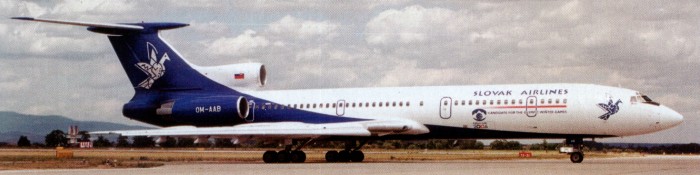
The Tu-154, announced Spring 1966, was intended to replace the Tu-104, IL-18 and An-10 on medium/long stage lengths of up to 6,000km with 128/158 passenger. With a high lift wing and six-wheel bogie undercarriage it is able to operate from airfields with a class B surface, including packed earth and gravel 7,000 ft runways. Normal flight can be maintained after shutdown of any one engine. Single-engine flight is possible at a lower altitude.
The Tu-154 is a three-crew, three-engined jet, designed for medium to long-range operation up to 3700 statute miles, with a load capacity of 16-18 tons over 1800-3000 mile stage lengths. Its design is claimed to conform with ICAO, CAB and ARB, as well as Soviet, requirements. Its first test flight is expected in 1968, with entry into service in 1970.
The three NK-8-2 by-pass engines, each of 21000 lb thrust give a cruising speed of 420-490 kt; reverse thrust is to be fitted. Cruise consumption at 36,000 ft is of the order of 0.58 1b/1b thrust. Engine TBO was expected to be 2 000-3 000 hours.
The cabin has a working pressure of 9 lb/sq.in. Cabin rate of change is regulated so as not to exceed 0.018 mmHg/sec (equivalent to 400 fpm at sea level). Hot or cold air can he fed to the cabin while on the ground. This is done by a small gas turbine which is also used for starting purposes and drives an alternator (40kVA) and a 1.2kW dynamo.
There were to be four versions of the aircraft. The first is the basic tourist variant with 49 seats in the front cabin and 104 in the rear; the second is the economy variant to take 164 passengers; a mixed version to take 24 tourist and 104 economy class passengers; and the freighter to take 20-25 tons (later 30 tons). The freight hold capacity will be 1596 cu.ft. The aircraft could also take the load in 13 containers, each of 64cu.ft capacity.
The seat layout will be: first-class, four seats per row, pitch 41 in; tourist-class, four seats per row, pitch 32 in; economy class, six seats per row, pitch 29.5 in (gangway 157 in).
The cabin height will be 82.7 in; the passenger entry doors measure 65 by 31.5 in and the freight doors 47 by 51 in.
The wing has 35 degrees sweepback, measured at 0.25 chord. It is fitted with slots over 80 percent of the span. There are triple slotted high efficiency flaps, and three spoilers on each side; the inner pair serve as air brakes and lift dumpers; the middle ones can be used in flight as air brakes and the outer ones can be used to decrease exposed aileron area. The slots can be controlled independently or be used in conjunction with the flaps. De-icing is by hot air bled from the engines for leading edge, fin and tailplane. The slots are electrically heated.
The main undercarriage legs each carry six wheels mounted in three consecutive pairs. The twin nose wheel is steerable up to 55 degrees either side.
The a.c. system is three-phase 3 by 200/115V. The source is three alternators of 3 by 40 kVA engine driven by means of a constant-speed hydraulic drive and with a constant frequency of 400 cycles ± 2 cycles. From this main source 28 V is also obtained. For the operation of the main gyro instruments there is an additional auxiliary circuit operated by two transformers of 115 V.
The instrumentation and navigational equipment of the aircraft will, in the first phase (1970) permit approach and landing with cloud base of 100 ft and 1300 ft visibility; in the second phase there will be full automatic landing facilities under nil visibility.
The hydraulic system is used for undercarriage operation and for the flying controls; there are three independent servo-mechanisms with automatic change-over. Each servo-mechanism has two hydraulic pumps giving a working pressure of 3 000 lb/sq.in.
The first of six prototype and preproduction models flew for the first time on 4 October 1968. The seventh Tu-154 was delivered to Aeroflot for initial route proving and crew training early 1971 between Moscow and Tbilisi. Mail and cargo flights began in May.
Regular services began 9 February 1972, over the 1,300km route between Moscow and Mineralnye Vody, in the North Caucasus. International services began with a proving flight between Moscow and Prague 1 August 1972.
Balkan Bulgarian took delivery of the first export Tu-154 in 1972, and went on to build up a mixed fleet of 25 B- and M-models by 1990. CSA Ceskoslovenske Aerolinie took delivery of seven Tu-154Ms between 1987 and 1990. The Czech Government bought six Tu-154B/Ms for VIP services.
The Tu-154M is a completely upgraded version, originally designated the Tu-164.
Tu-154M 101
A freighter version has also been produced from earlier Tu-154 and Tu-154A airframes.
It quickly became the standard medium range equipment for most of the socialist countries, with over 850 in service by 1992; this number included about 750 with Aeroflot.
Tu-154 Empty weight, 86 420 lb APS weight, 89 300 lb Max- fuel, 48 500 lb Max. take-off weight, 173,000 lb (Later 187,500 lb) Max. landing weight, 147,700 lb Cruise, 477 kt Mean operating Mach No., 0.9 Approach speed 119-125 kt Range 173,000 lb, 477 kt., 36 000 ft. 1 hr res, 2 100 st. miles Range 187,500 lb, 3,730 st. miles Take-off distance 173,000 lb MSA, 4 400 ft Landing distance (ICAO) at 60 tons, 4,760 ft Landing distance (ICAO) at 66 tom 5,100 ft
Tu-154A Engines: 3 x Kuznetsov NK-8-2U turbofans, 102.9kN Max take-off weight: 94000 kg / 207236 lb Empty weight: 50775 kg / 111940 lb Wingspan: 37.55 m / 123 ft 2 in Length: 47.9 m / 157 ft 2 in Height: 8.2 m / 27 ft 11 in Wing area: 201.5 sq.m / 2168.93 sq ft Cruise speed: 900 km/h / 559 mph Range w/max.payload: 2750 km / 1709 miles Crew: 3-4 Passengers: 140-180
Tu-154M Engines: 3 x Rybinsk D-30KU-154II turbofans, 24,000 lb
Tupolev’s son, Alexei A Tupolev, was primarily responsible for the design of the Tu 144 supersonic transport, begun in the early 1960s, the prototype being flown on 31 December 1968.
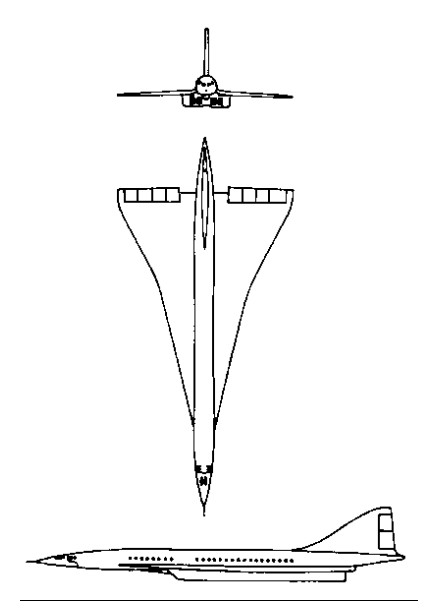
The aircraft has an ogival delta wing with the powerplants grouped at the rear of the wing and a drooping nose to improve the pilot’s view in low-speed regimes. The Russian jetliner also featured a nose that is lowered hydraulically 12 degrees to improve cockpit vision during takeoff and landing. The wings are of double-delta design with a sweep-back of 70-75 degrees on the inboard portions and about 40 degrees on the outboard sections. The main landing gear had 12 tires each (three rows of four). The tall, spindly nose gear had just two wheels. A maximum 130 passengers could be accommodated in an all-economy version, but the initial model seated 98 in mixed classes (18 in first class and 80 in tourist).
It flew at Mach 1 four months before the Concorde and at Mach 2 six months before its western rival (May 26, 1970); moreover, the entire test programme up to the autumn of 1971 had been carried out by a single prototype.
The first airliner to have exceeded Mach 2. In May 1971 it made its first appearance outside the USSR, at the Paris Air Show.
The Tu-144 was reported to be in production with design changes incorporated following the tragic crash of a prototype aircraft at the 1973 Paris Show.
The production version had a flight crew of three and 140 passengers as standard, and began 50 proving flights with cargo between Moscow and Alma Ata, the capital of Kazakhstan, on 26 December 1975. The distance of 1,864 miles (3000 km) was covered in a flight time of 1 hour 59 minutes. This variant also had retractable but non-moving canard foreplanes, lengthened fuselage, redesigned intakes, increased span and removal of pilots’ ejection seats.
Almost five years behind schedule, supersonic passenger services with the Tupolev Tu 144 were inaugurated by Aeroflot between Moscow and Alma Ata on 1 November 1977. 102 revenue services were flown before operations ended prematurely on 1 June 1978 after a fatal accident.
The air conditioning system needed to keep the airframe cool at Mach 2 was ineffective and the cabin was uncomfortably hot. It was also so noisy, along with the engines, that passengers were issued with earplugs during flight.
A modernised and modified version, the Tu-144D, with new engines, entered service in June 1979, with more economical Kolesov turbofan engines.
The last of 17 production models were the five Tu-144Ds, which had larger engines and greater range. Most had been retired by the late 80s, with only a handful retained for various research tasks at Zhukovskii.
The NATO reporting name is ‘Charger’.
In November 1996 a converted Tu-144D flew again as the Tu-144LL, used thereafter for an international High-Speed Civil Transport research program to assist in the development of a next generation supersonic transport.
Engines: 4 x Kuznetsov NK 144 afterburning turbofan, 38,580 lb (17,500 kg) Wing span: 90 ft 8.5 in (27,65 m) Length: 190 ft 3.5 in (58.00 m) Height: approx 43 ft 3 in (13.20 m) Wing area: 438 sq.m / 4714.59 sq ft Gross weight: 395,000 lb (179,150 kg) Empty weight: 85000 kg / 187394 lb Fuel capacity 209,440 lbs Operating altitude 18000 m / 59,000 ft Max cruising speed: 1,550 mph (2,500 km/h) at 65,000 ft (20,000 m) Range: 3510 nm / 4,040 miles / 6,500 km with 121 Passengers Takeoff distance (balanced) 9,845 ft Landing roll 8,530 ft Accommodation: Crew of 3 and up to 130 passengers.
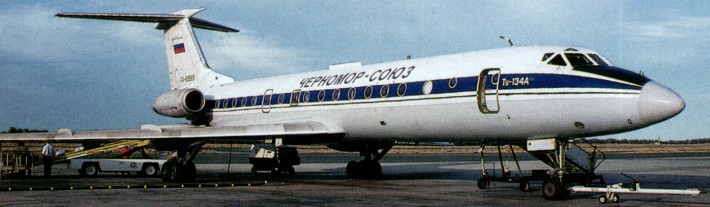
Known originally as the Tu-124A, this aircraft is a rear-engined twin-turbofan development of the Tu-124. The new aircraft, designated Tu-134, also had a T-tail and the same basic wing, with an extended centre section. Its joint military/civil design resulted in the aircraft retaining a glazed ‘bomb aimer’ nose until the early 1970s.
First flown in July 1963, it had completed more than 100 test flights when first details and photographs were released in mid-September 1964. The prototype was followed by five preproduction aircraft and the Tu-134 then went into series production at Kharkov.
It entered international service on Aeroflot’s Moscow-Stockholm route in September 1967, after a period on internal services, and was joined by the `stretched’ Tu-134A in the Autumn of 1970. Nato code name Crusty, early models seated 72 passengers, whilst the stretched A-model had a 96-seat capacity. Thrust reversers were also fitted to the twin Solviev D-30 turbofans and the landing gear strengthened.
It has been widely exported despite its high operating costs and lack of cargo/baggage storage capability, and remained in widespread service on thin routes. Aeroflot still had some 400 Tu-134s in service at the beginning of 1992, including a substantial, but unquantified, VIP fleet.
Production ceased in 1985 after 852 had been built.
Tu-134A Engines: 2 x Soloviev D-30-II turbofans, 30.26kN / 14,990 lb Wing span: 95 ft 1.75 in (29 m) Length: 122 ft 0 in (37.1 m) Height: 29 ft 7 in (9.02 m) Wing area: 127.3 sq.m / 1370.24 sq ft Empty weight: 29050 kg / 64045 lb Max TO wt: 103,600 lb (47,000 kg) Max level speed: 540 mph (870 kph) Length: 37.05 m / 122 ft 7 in Cruise speed: 605 mph Range: 3280 sm Ceiling: 11890 m / 39000 ft Range w/max.payload: 1890 km / 1174 miles Pax capacity: 96 Crew: 3
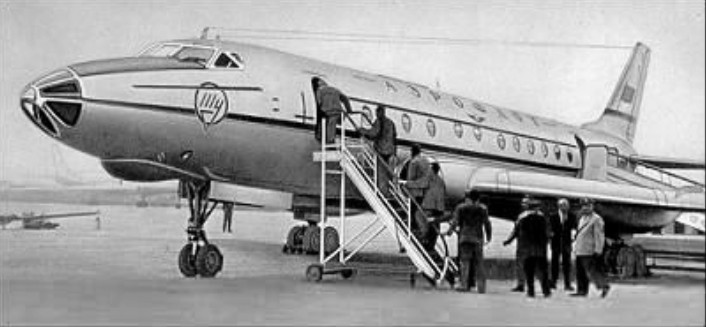
Aeroflot’s requirement for a short/ medium-range airliner to replace the llyushin IL-14 led to the design of what was basically a reduced-scale version of the Tu-104. A smaller jet, with better short-field capability, and 44-seat, the original Tu-104 was scaled down by about three-quarters and powered by two new purpose-designed turbofans.
The prototype Tupolev Tu-124 was first flown in June 1960 and introduced aerodynamic and system refinements, plus the Soloviev D-20P twin-spool turbofans.
The Tu-124 entered service with Aeroflot on 2 October 1962, but the major production version was the 56-seat Tu-124V.
Variants included the Tu-124K and Tu-124K2 with de luxe seating for 36 and 22 passengers respectively.
About 100 were built, this number including three for CSA in Czechoslovakia and two for Interflug in East Germany, but Aeroflot has now retired its Tu-124s. A small number entered military service, and it is believed that some were used for research and test purposes. The NATO reporting name is ‘Cookpot’.
Versions: Tu-124- serial variant with 44 seats Tu-124- project for 48 or 52 seats Tu-124- for 60 seats Tu-124V- serial variant for 56 seats Tu-124B- version with D-20P-125 engines Tu-124K- saloon version Tu-124TS Tu-124SPS Tu-124- VSTOL version Tu-124Sh-1 Tu-124Sh-2 Tu-127- military transport
Tu-124B Engines: 2 x Soloviev D-20P turbofans, 52.9kN Max take-off weight: 38000 kg / 83776 lb Empty weight: 22500 kg / 49604 lb Wingspan: 25.55 m / 84 ft 10 in Length: 30.58 m / 100 ft 4 in Height: 8.08 m / 27 ft 6 in Wing area: 119.0 sq.m / 1280.90 sq ft Ceiling: 11700 m / 38400 ft Range w/max.payload: 1220 km / 758 miles Crew: 3 Passengers: 44-56















 All Aero