de Groof Machine Volant

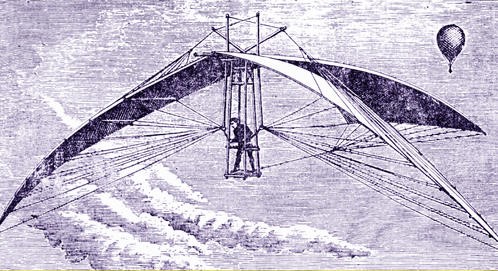
In 1864, a Belgian shoemaker named Vincent de Groof designed an apparatus which was a sort of cross between beating wings and a parachute. His plan was to cut loose with it from a balloon, and to glide down in a predetermined direction by manoeuvring the supporting surfaces. He endeavoured to make a practical experiment, both in Paris and in Brussels, but it was only in 1874 that he succeeded in doing so in London.

The apparatus consisted of two wings, each 24 feet long, moved by the arms and the weight of the operator, and a 20 foot long tail which could be adjusted using one’s feet.

De Groof first went up on June 29, 1874, from Cremorne Gardens, London, attached to the balloon of Mr. Simmons. He came down safely, and claimed to have cut loose at a height of 1,000 feet. Subsequently however, it was stated by others that in fact he had not, on this occasion, cut loose at all, but had descended still attached to the balloon. In any event, he went up again on July 5 following, with the same balloon, and on this occasion he really did cut loose. The result was disastrous. In his descent, as soon as pressure gathered under the moving wings, they were seen to collapse together overhead into a vertical position, bringing De Groof down like a stone and killing him on the spot.
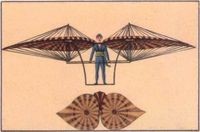
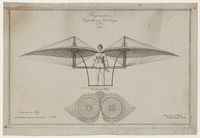
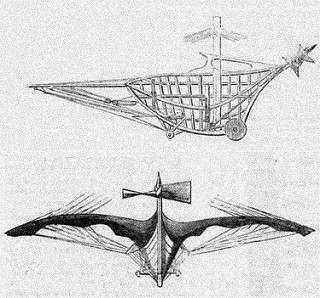
Degen 1807 Flugmachine

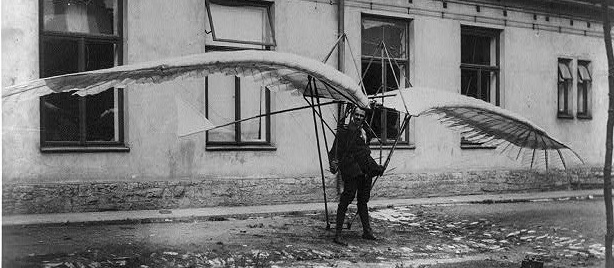
Ornithopter built by Jakob Degen – a Swiss watchmaker living in Vienna – first drafted and published in 1807. Degen made his earliest somewhat successful flights by using a counterweight to assist his lift, indoors at the Winter Riding School of the Spanish Riding School in Vienna on April 18, 1808. That same year, on November 13 and 15, he gave two outdoor performances with his Flying machine at the Wiener Prater using a small hydrogen-filled balloon to aid his ascensions. Later on over the years, three times Degen staged his performance in Paris and is also known to have visited Berlin with his apparatus. These attempts generally resulted in complete failure accompanied with personal injury.

Danilewsky Pilstrem

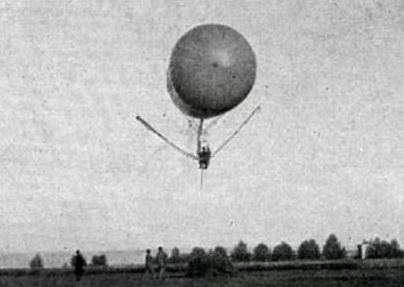
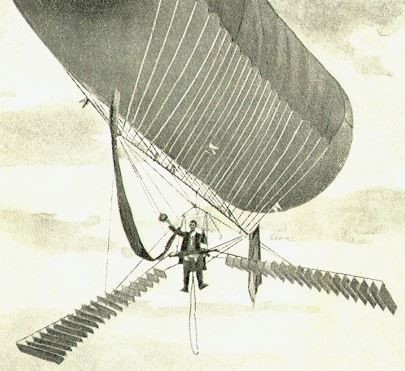
The second man-powered airship constructed by Dr. Konstantin I. Danilewsky of Charkov, Russia (now Ukraine). Supported by industrialist A. A. Pilstrem, and flown by the 20-year old engineer-aeronaut Peter Koziakov it made its first ascent on 18 June 1898. It was controlled by fans, or wings, up to 16′ 4″ long, which could be opened over an arc of 90 degrees. It was trial-flown with some success, making several ascents in alternate configurations, and demonstrated before a Russian board of inspection on 15 August 1898.

Costello Flapper

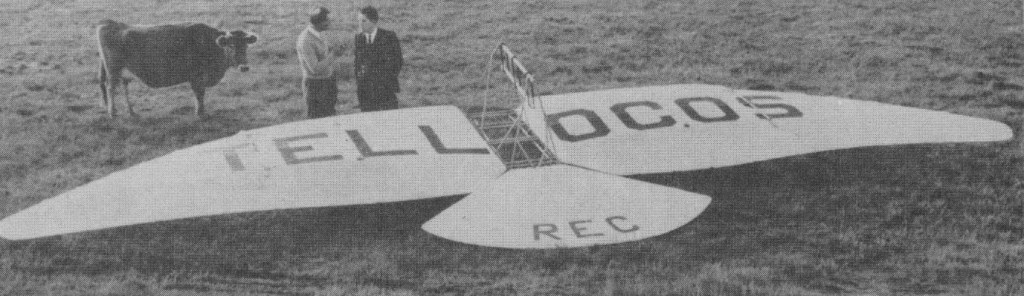
Australian Ron Costello, 46, of Victoria, designed and built this pedal-powered flapper in 1964. The tail is controlled ‘string’, with the pilot standing on a narrow platform.

Costello worked for the Civil Aviation Department and government buddies notified him officially by letter that man-powered craft don’t always work.

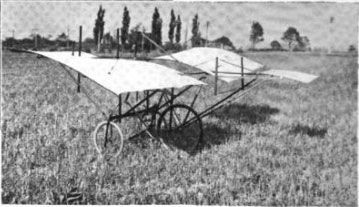
Clark & Fitzwilliams Cycloplane

The Clark & Fitzwilliams Cycloplane of 1910 was built in Buffalo, New York, USA. The pedal-powered Cycloplane (sometimes Cycleplane) was 16 feet long spanning 15 feet, weighing about 55 pounds; with approximately 100 square feet of wing surface. Warping wings, front elevator and rear plane with rudder, were all controlled by levers on the frame. It is claimed that flights of 100 feet with a 119 pound pilot were made.

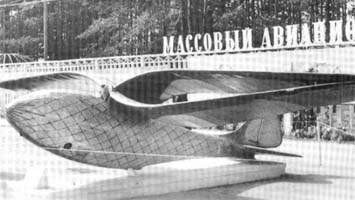
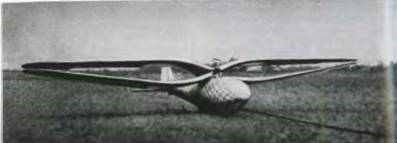
Cheranovski BICh-18 Muskulolet

In 1921, 1934 and 1937 Boris Cheranovski developed experiments related to the construction of ornithoptera or flap-wing aircraft. The third of his designs was the BICh-18(Russian: Черановский БИЧ-18).

The BICh-18 was designed as a biplane with pivoting wings driven by the energy of its pilot. On the fuselage, the wings were fixed to the same joint, on which the movement was carried out according to the double scissors system. The movement was carried out by means of the variation generated by the wings when approaching and moving away.

The wingspan of the planes reached 8 meters with a wing area of 10 m². The surface of both planes was similar. The relative load on each square meter of the wing did not exceed 13 kg.

The control surfaces of the BICh-18 were of the classic type. Control was carried out by means of a steering pole. The wings were put in motion by the push made by the pilot on the pedals.

The tests of the BICh-18 were carried out according to a special program, which initially conceived its flights in the form of a glider and the subsequent step to the tests as an ornithopter.

On August 10, 1937, the Muskulolet BICh-18 made its first flight. On that day the pilot RA Pishuyev made four flights. During these glider flights the aircraft demonstrated excellent stability conditions, regardless of the position of the wings.

The second stage of testing went smoothly, but the flapping wings were shown to barely improve glider flight. Among the main causes were the fixed angle of curvature of the wings during movement and their strict aerodynamic profile.

Later a set of improvements such as the installation of new elastic wings were introduced, but during the flight tests significant vibrations were appreciated.

The tests of the BICh-18 were never completed. It has been said that the BICh-8 managed to fly up to 430 meters with the energy generated by the feet of its pilot.

BICh-18 Muskulolet
Wingspan: 18.00 m
Wing area: 10.00 m²
Length: 4.48 m
Empty weight: 72 kg
Maximum take-off weight: 130 kg
Wing loading: 13 kg / m²
Accommodation: 1
Observed range: 430 m

Carlingford Aërial Chariot / Aerhedon

In 1856 Godwin Swift of Kilkenny, Ireland, aka Viscount Carlingford patented an aeroplane both in England and France, resembling in outline a falcon gliding downward with partially closed wings, described by the inventor as follows: “The aerial chariot in form is something in the shape of a boat, extremely light, with one wheel in front and two behind, having two wings, slightly concave, fixed to its sides”. “A tail can be raised and lowered at pleasure by means of a cord. The chariot is drawn forward by an ‘aerial screw’ in front thereof, which screws into the air at an elevation of 45°, turned by means of a winch acting on three multiplying wheels.” The machine was built and tested by swinging it from a rope. The propeller and a wheel are preserved at the Rothe House Museum of Kilkenny.

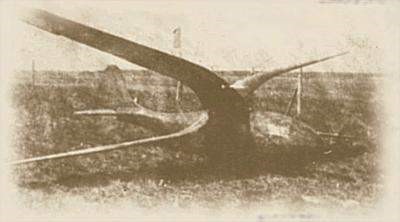
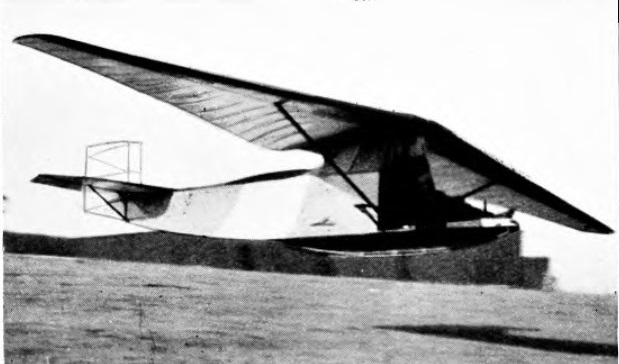
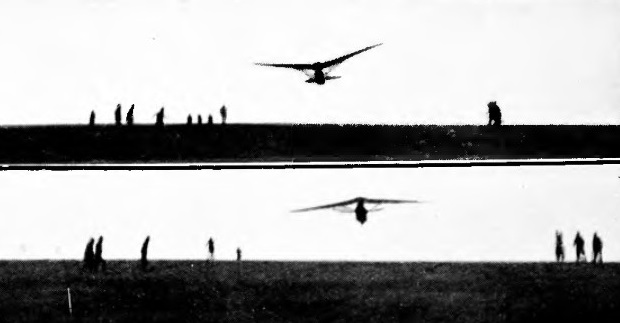
Brunsmann 1928 Ornithopter

Erhard Brunsmann had built a flapping machine with which short flights were made during 1925. Encouraged by this, he built a sailplane of 44 ft span with a wing area of 130 sq.ft by 1928.

The machine has tapered wings and a usual tail unit, but the main planes are hinged at the centre ao allow up and down movement and are braced by a pair of struts, one to each wing, attaching just behind and below the pilot.

No lateral control was provided, but side movement of the control column actuated the rudder.

The sailplane was first tested as a normal glider, and had similar performance, after which flapping flights were carried out, which increased the speed and about doubled the distance possible with fixed wings.

The machine was being tested at Wasserkuppe in 1931.

Bossi-Bonomi Pedaliente

Enea Bossi and Vittorio Bonomi’s Pedaliente had a wingspan of 17.6 m (57¼ ft) and had two chain driven contra-¬rotating propellers. Thanks to the Italian government’s ruling that all man powered aircraft contestants had to conform to conventional airworthiness standards, the Pedaliente was far too heavy, weighing nearly 100 kg (220 lb), and could manage only downhill glides even after a bungee launch.

A 1936 human-powered aircraft, designed by Enea Bossi. Built by Vittorio Bonomi, flown by cyclist Emilio Casco, 80 flights made.

Empty weight 97 kg (213 lbs)
Wingspan 17.7 m