Gossamer Condor II

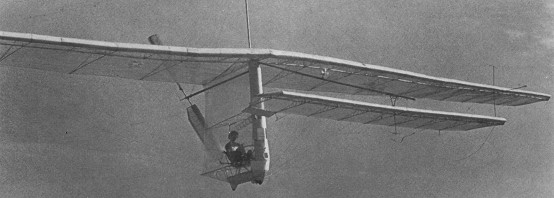
After the Condor, a new design went together at Shafter, a new base in Central Valley. It was called number two because it represented a major change in some ways. Paul MacCready kept the basic wire-braced tube-structure concept, but aspect ratio was increased from 8.3 to 12.8 and the wing loading raised from 0.22 to 0.26 lbs/sq.ft. A thick, double-surface airfoil was computer-designed and only a single tube along the centre of pressure was used for the spar. By eliminating the rear spar, enough weight was saved to permit use of more closely-spaced ribs and a cardboard leading edge. The pilot’s seat and chain-wheels were enclosed by a streamlined plastic envelope.
The result was that Greg Miller and Tyler MacCready almost immediately doubled their duration times. But making a turn and control of the new machine in bank had yet to be accomplished. Beyond a quarter turn the drag was too high creating reversal at low speeds.
Opposite-action wing warp was one of the final keys to success. The drag of the inner wing (due to its increased angle of attack) swings that wing back, but also adds just enough lift to keep it from dropping. The result – a perfect turn. The pilot just clicks a lever into the notch and the wings are held in a twist for a turn with no other action necessary until the ship is straightened. Then he lifts the lever into neutral and goes his way. The Condor can turn about in only 180 feet. The wings were slightly swept back to aid stability, and the foreplane could be banked and its angle of incidence in¬creased to start a turn, with the innermost wing warped to provide additional lift and thus balance the turn and prevent that damaging slip into the ground which had wrecked previous man powered aircraft.
By the summer of 1977 the Gossamer Condor had made more than 430 flights and had accumulated more time in the air than all previous man powered aircraft com¬bined.
On 23rd August 1977, for the 223rd flight, in ideal conditions with a windspeed of less than 2 knots, Bryan Allen made a 30ft take-off run toward the north pylon on Shafter Airport runway. After a 500ft cruise Bryan cleared the Tee bar on the start line and observer Bill Richardson clicked his stopwatch. Bryan was soon into the first, right turn after 250 more feet and he made a 425ft diameter 180 degree sweep around the marker to head for the south pylon, 2,640ft away. It was a smooth cruise of almost three minutes, then another sweeping left turn to re-trace his course back northwards. As he neared the original take-off point, eager followers yelled encouragement and with one last effort Bryan took the Condor over the Tee bar to finish at precisely 6:22.5. He had traced an almost perfect figure eight, the flightpaths 9ft 7in. apart on the start/finish line and met all the conditions of the famous contest.
On 31st December 1977, Gossamer Condor was aired for the last time before moving across the USA to be hung in the Smithsonian Institute at Washington DC. Rough weather over Christmas almost prevented this ‘last fling’ but fate decreed a dead calm end to the momentous year.
Less than a month after the Gossamer Condor’s record-setting flight, the manpowered airplane was flown by Maude Oldershaw whose husband was the Condor’s mechanic.
The Gossamer Condor, winner of the Kremer Prize for man-powered flight, in 1978 was being moved to the National Air and Space Museum, in Washington, D.C.

Aspect ratio 12.8.
Height 18 ft.
Length 30 ft.
Span: 96 ft.
Wing area: 760 sq.ft.
Canard area: 93 sq.ft.
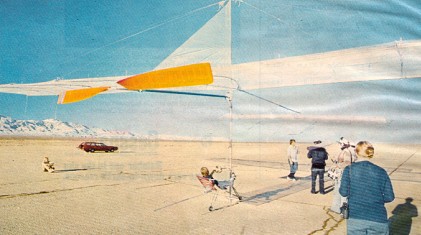
Gossamer Condor I

In 1976 Paul MacCready was thinking about trying for the £50,000 Kremer Prize for manpowered flight. The wing loading would be very light and that it would operate a lift coefficient of only .9 (compared to 1.4, or better, for previous MPAs). This meant a single-surface airfoil would have low drag.
Construction began in the Rose Parade float shed down in the Arroyo Seco not far from Pasadena. Two inch diameter .035in. thick alloy tubes in 12ft sections that were joined to make an 88ft span wing.
On 9th October 1976, though the lightly misting rain added a lot of weight, the craft acted more like a balloon than an airplane. They walked with it at 5 mph; it lifted easily and strained at the ropes attached to all corners. Nothing broke. The structural idea was reasonable.
The 96ft span craft was moved to Mojave Airport soon after the tubing was chemically milled down from 22 thousandths at the centre to 14 thousandths of an inch at the outer sections of the wing.
First flights with Paul’s son Tyler (a hang glider pilot) on board were promising. Tyler pedalled rather easily making 45-second flights with a push start. Greg Miller, a new rider of racing cyclist championship quality could take off on his own and, after a good deal of flying practice, made a tremendously encouraging flight of two-and-a-half minutes while covering over a thousand foot distance.

The next time, MacCready measured and marked the one-mile figure-eight course, practised taking off and flying over the 10 ft barrier, and called out the officials. After several trials, Greg’s best flight was 2 minutes and 30 seconds. It had to stay up three times longer, and the matter of control was even more critical – a full turn had yet to be made. Winds of 2 to 4 mph and the slightest gustiness would limit flights to only 30 or 40 seconds. Thin, single-surface airfbils have low drag at only one angle of attack. For the Condor, a low-drag spike occurred at about 8.2 mph. Above or below that speed, the drag rose impossibly high.
The Condor I conducted 332 flights.

With budgetary problems NASA was having trying to keep its space program alive and well, NASA/ Dryden Flight Research Center established a NASA test program is to study the unusual aerodynamic performance, stability and control characteristics of large but very lightly-loaded and slow-flying aircraft. Data acquired will be used in the design of future aircraft for extremely low-speed flight at any altitude, and particularly for low-power flight in very low densities at high altitudes up to 100,000 feet. Not that they expect Bryan to crank his way into the stratosphere – they just wonder what it would be like to f ly a homebuilt aircraft like the G.A. in the thin air of Mars.
Under Project Manager Dale Reed, in mid February 1980 the 55-pound man-powered aircraft finally got off the ground, between midwinter rains, with Bryan Atlen doing the legwork.
When the rains let up, they hooked up an electric motor and to make it an EPA (electric powered aircraft), preparatory to installing solar cells on the wings.

Aspect ratio: 8.3.
Span: 96 ft.
Chord: 115 in.
Wing area: 1056 sq.ft.
Prop dia: 12 ft.
Weight: 84 lb

Gatling 1873 Aeroplane

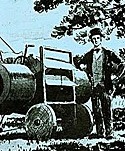
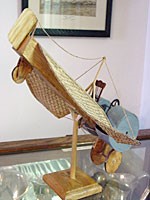
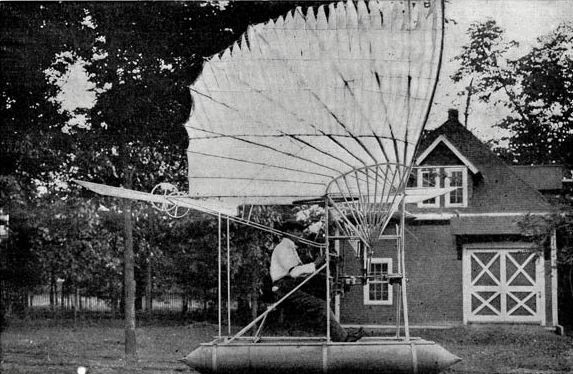
Designed and built in North Carolina by James Henry Gatling, the brother of Richard Jordan Gatling, the inventor of the infamous machine gun, the aeroplane, also called the “Turkey Buzzard”, is the first known man-powered aircraft built and flown in America. On a brisk Sunday afternoon in the fall of 1873, Gatling, sitting in the cockpit of his invention, with hands and arms furiously turning the cranks of his fan blowers, reportedly glided a little over 100 feet from a platform constructed approximately 12 feet above the ground.

Replica

Gammeter Orthopter

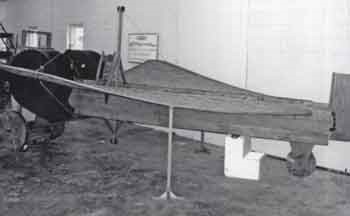
Built by Harry C Gammeter in 1907, the single place Orthopter had bamboo-and-silk flapping wings, double-hinged to the fuselage and flapping 75 strokes per minute. It reportedly “took-off in unmanned tethered flight” after developing a thrust of 24 lb, but was not developed further. “Originally, a horizontal flywheel turning at 1500rpm was used for stabilization but was later removed.”

It was listed as an entrant in Flying Machine events at 1907 Intl Aeronautic Tournament in St Louis MO, 21-24 Oct 1907. Gammeter was member of Aero Club of America and president of Aero Club of Cleveland about that time, also invented and patented in 1903 the multigraph duplicating machine (“Ditto machine”).

Engine: Curtiss, 7hp @ 1200rpm
Wingspan: 30’0″
Length: 12’0″
Gross wt: 440 lb

I am trying to find if a Gammeter orthopter or ornithopter still exists in an old barn or hangar somewhere. Harry Gammeter was my greatgreat uncle. Thank you.
Roger Gammeter
rkgam1972@twc.com
17 Mar 18

Freymann Ornithopter

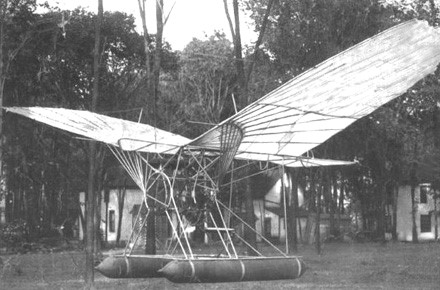
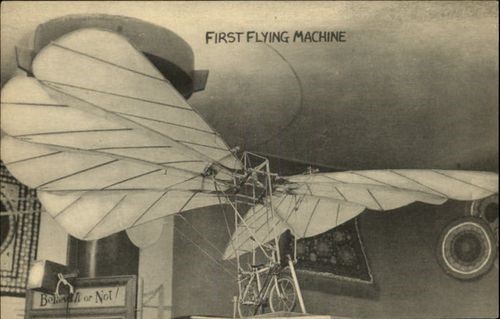
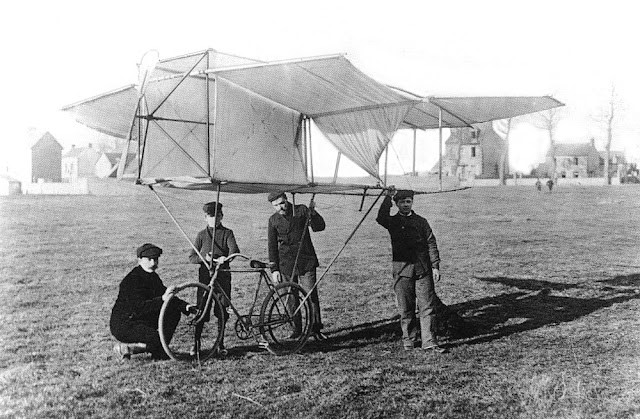
As a youth living in Russia, Oskar Freymann had observed eagles in flight and determined to build a flying machine based on the actions he saw. After emigrating to America in 1895 he worked in a bicycle shop in Brooklyn. Freymann soon built his flying machine, with four wings operated by the pedaling action of a bicycle, and handle bars that moved a rudder at the rear. In November 1896, Freymann and three other men trucked the machine to an open field in Flatbush. He claimed to have pedaled furiously and flown the ornithopter to an altitude of 14 feet – but this is quite doubtful. In any event the machine was damaged during the trial and never rebuilt. Freymann ultimately planned on building a larger, gasoline-powered ornithopter on a tricycle, but ran out of money and abandoned the project. The model – seen here in 1939 on display at the Ripley’s “Believe It or Not!” Odditorium in New York – was built by Freymann in 1895, to help him work out the wing-flapping system. It currently resides at the Cradle of Aviation Museum in East Garden City, New York.

de Puiseux Aéro-Cycle No. 5 La Mouche

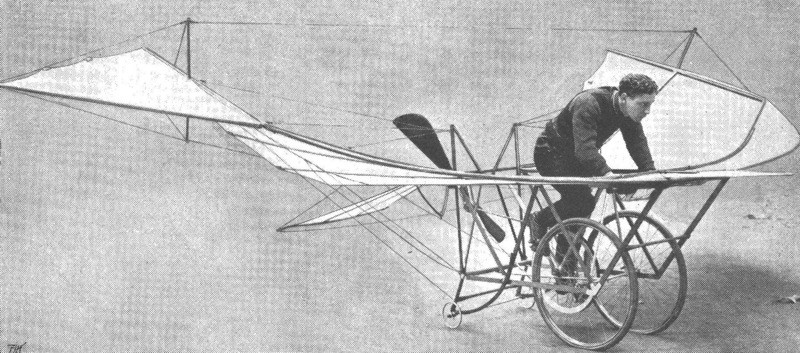
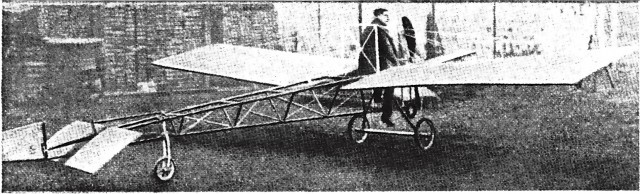
This was the ultimate development of Comte Gustave de Puiseux’s ambitions of 1911/1912 to create a successful human-powered airplane. At least one source quoted that it flew 16 meters. The machine, which had a wing span of some 6,5 m and a length of 5.5 m had a tractor propeller driven by the human cyclist, pedalling via chains. It is unlikely that a powered version was ever made, since this was more work than just installing an engine and the Count had no experience with engines.

de la Hault Ornithopter

Ornithopter No.2

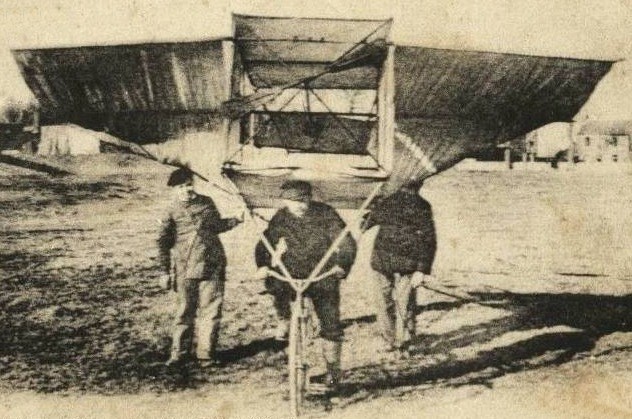
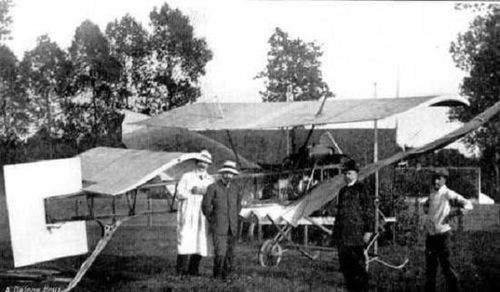
In 1908, at the workshops of Julius Miess in Brussels, De la Hault built a lemniscate paddle-wing ornithopter, his No.1, which was tested with encouraging yet unsuccessful results. This was followed by his second attempt in 1910. In the photograph, De la Hault stands second from the right, while helicopter pioneer Henri Villard is seen on the far left.