In 1912 French automobile manufacturers Peugeot, launched a 10,000 franc competition for the first man powered man to fly 10 m (323 ft) without a motor. The prize was not won until 9 July 1921 when Gabriel Poulain made two dawn flights on his ‘aerocycle’ at Longchamps racetrack, travelling about 10.6 m (35 ft) at a height of 1 m (3¼ ft). Peugeot immediately posted a 20,000 franc reward for a 50 m (164 ft) flight, but it was never claimed.
Human
Pons Velocípedo Aéreo
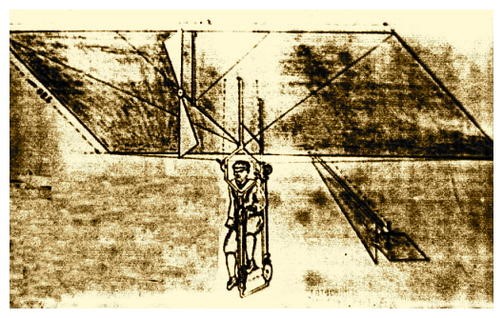
The first attempt to create the planes in Cuba dates back to 1893, when the leader of Cuban independence Jose Marti Patriot was approached Arturo Comas Pons, Cuban agronomist and journalist, to create a flying machine “to make it applicable to uses of war “, steel and aluminum.
Perkins & Lock New Horizon
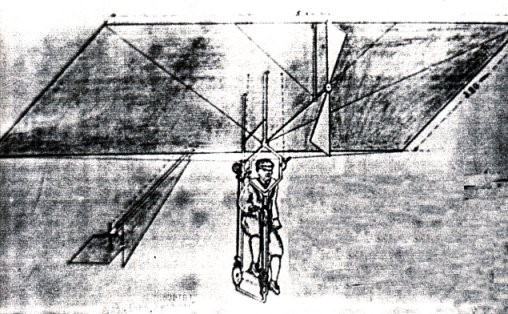
Designed and built by D. Perkins and A. Lock in 1958, the New Horizon was a tail-less, parasol wing monoplane, with a pusher propellor and tricycle undercarriage. It featured an inflatable wing.
Man-powered, it was unsuccessful in flight trials inside the Cardington airship hanger.
Development of the inflatable wing concept did lead to the ‘Reluctant Phoenix’.
Perkins Reluctant Phoenix
After gaining experience with his ‘New Horizon’, D. Perkins went on to design a tail-less delta inflatable man powered aircraft which he called ‘Reluctant Phoenix’.
It first flew inside the Cardington balloon hanger on 18 July 1966 and went on to make 97 similar flights, all of which were only in ground effect.
Wing span: 27.00 ft
Wing area: 250 sq.ft
Pedal Aeronautics Toucan
Built by Pedal Aeronautics at the Handley-Page plant at Radlett, the Toucan used a Mellinex covered metal tube fuselage of egg-shaped section. Two pilots were seated in tandem under a fully enclosed canopy in the extreme nose.
The mid-set, high aspect ratio wing, was tapered from mid-span. Fitted with a four-unit tails surfaces, with a pusher propellor mounted behind them. A tandem undercarriage was fitted.
It was first flown from Radlett on 23 December 1972.
Wingspan: 123.00 ft
Wing area: 600 sq.ft
Aspect ratio: 25:1
Empty weight: 145 lb
Nihon University Stork
The opening up of the Kremer competition to the world brought forth Professor Hidemasa Kimura and students from the Nihon University in Tokyo and a series of man powered aircraft, one of which achieved a straight line flight of 2095 m (2290 yards) in January 1977.
Professor Kimura’s balsa wood and rice paper Stork had by 1977 doubled John Potter’s record in Japan and was in the running for the Kremer prize.
Myers Sky Cycle 3

The third “Sky Cycle” built by Carl E. Myers of Frankfort, New York, in controlled, man-powered flight at the St. Louis Exposition and Music Hall Coliseum where the machine made over 120 ascensions during a single engagement in 1900.
The Sky-Cycle (C. E. Myers) was patented in the USA with number 581,218 on April 20, 1897.
Meusnier 1784 airship
In 1784, less than a year after the first balloon flights, Jean Baptiste Marie Charles Meusnier de la Place presented a plan for a military dirigible, driven by men turning a hand crank to operate a propeller. It would have been the world’s first airship, but it was never built.
In 2002 the BBC series “Building the Impossible” set out to recreate Meusnier’s design to find out whether it would have worked. Cameron Balloons constructed the replica which was filled with helium for safety, instead of the flammable hydrogen proposed by Meusnier. A speed of about three miles per hour was achieved, although the steering sail was too small and steering was difficult.
Meusnier, Jean-Baptiste
Jean Baptiste Marie Charles Meusnier de la Place (1754 — 1793) was a French mathematician and engineer. In 1784, less than a year after the first balloon flights, he presented a plan for a military dirigible, driven by men turning a hand crank to operate a propeller. It would have been the world’s first airship, but it was never built.
In 2002 the BBC series “Building the Impossible” set out to recreate Meusnier’s design to find out whether it would have worked.
Massachusetts Institute of Technology Daedalus
In 1988, the purely human powered Daedalus, a light-weight aircraft built by a team at the Massachusetts Institute of Technology, flew 71.5 miles from the Greek island of Crete to Santorini. The 69 lb craft, peadeled by a Greek Olympic cyclist, got caught in turbulence as it approached the beach at Santorini. It crashed in the sea a few yards from shore.
 All Aero