Tatlin Letatlin

The “Letatlin” during a gliding parade in Moscow in 1933

The ornithopter designed by Vladimir Tatlin from 1929 to 1932 and Tatlin built three versions of his machine. The word Letatlin is formed from the verb letat (fly), associated with the name of its creator, Tatlin. In the Stalin years, Tatlin, one of the major artists of the constructivist movement of the Soviet revolutionary years, designed his ornithopter inspired from birds.

Tatlin had carried out a trial flight that hadn’t worked out.

The ornithopter designed by Tatlin from 1929 to 1932 had disappeared. It had been more or less abandoned for twenty years in a warehouse belonging to the Molino Russian Federation Central Air force museum, next to Star City, the Youri-Gagarin cosmonaut training center fifty kilometers away from Moscow. It was the KSEVT, team, the space culture center in Slovenia, that by chance came across the machine in a precarious state during a protocol visit to the Monino museum in 2014. In February 2014, they were taken to the historical part of the Monino museum where one can see pioneers’ flying machines, since the Russians went into aeronautics very early. Miha Turšič, director of KSEVT until 2016, member of the collective Postgravityart, spotted the Letatlin in the corridors of the Monino museum in April 2014.

While the group was in discussion, Miha Turšič went ahead, getting a bit lost in the aisles of the museum, and suddenly I found myself face to face with a machine that looked like a plane but wasn’t one. He knew of the Letatlin and there it was right in front of him. We immediately asked if they knew what they had there, one of the most iconic works of 20th century art. They told us: “Yes, it’s an old Russian artist who built sort of flying machines rather like Leonardo de Vinci.” They had no idea of the importance of the piece. They considered it as best as an experimental flying machine that had never flown. Tatlin was mentioned, but with no context.

It was Letatlin n°3 that was found. It would have reached Monino in 1996 after being damaged on the way back from a presentation in an exhibition in Athens and was left there, abandoned in the context of complicated years following the collapse of the USSR.

Restoration of the “Letatlin”

The Molino Air force museum had just retrieved it a year earlier from the museum storeroom where it lay in bits in a corner, deteriorated, really damaged, and they had reassembled it to hang it in their museum.

The “Letatlin” restored in the Tretiakov gallery in Moscow

It was obvious that a renovation was necessary for the Letatlin. The Monino museum and the Tretiakov gallery finally found an agreement for its renovation. Turšič went to Moscow at the end of December 2017 to meet the curator of the museum and saw it displayed in the 20th century art collection.
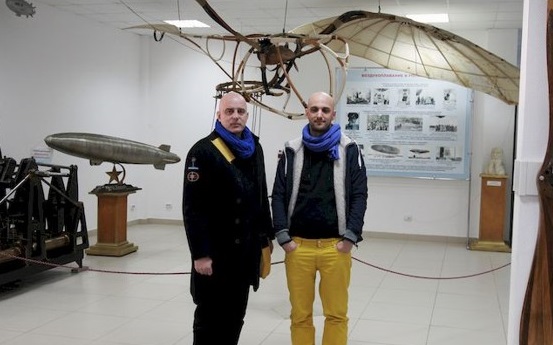
Dragan Živadinov and Miha Turšič in front of the “Letatlin” at the Monino museum on April 11, 2014.

The Letatlin finally found the perfect place for its presentation to the public.

Suter Lenkballon 1901

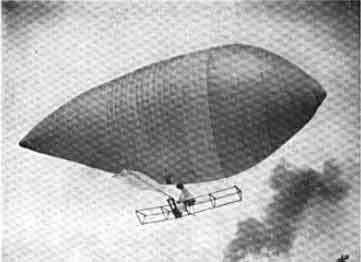
Inspired by the experiments of Graf von Zeppelin, Heinrich Suter of Arbon, Switzerland, built an airship of 40 metres length. The Paris-made, cigar-shaped, 5-chamber envelope had a reported volume of 1000 m³. The movements of the LTA/HTA craft were carried out by propellers, while the balloon was used only to lift the machine and aeronaut. On a wooden pole under the balloon hung by a ball joint, was the actual flying machine, which enabled a free, independent movement of the two parts. Suter’s connection of a balloon with a flying machine was based on the principles of Ingenieur Kreß of Vienna. In Gustav Adolf Saurer, the founder of the “Ersten Schweizerischen Velociped-Fabrik Arbon”, Suter found the perfect construction partner. Inside the metal structure that connected to the ball joint, he built a velo-drive. Pedals drove outside of the “cage”, mounted and by hand, a pivotable double propeller. In this way, Suter believed to be able to control the occurrence of different air currents, while the position of the steering sail could also be altered manually. On April 19, 1901, from the purpose-built shed at the Hotel “du Lac” the inflated airship was pulled to the shore of Lake Constance. Many curious onlookers as well as journalists were in attendance to witness the spectacular event. At first everything went according to plan – Suter increased the pressure on the pedals and circled the steerable airship over Steinacherbucht bay. Suddenly the wind shifted, and at low altitude drove it into the branches of a tree on the Steinach shore, ending the maiden voyage. As for Suter, he lacked the funds to conduct further tests and the project was terminated shortly thereafter.

Southend MPAG Mayfly

An advanced two-seat man-powered aircraft completed by the Southend Man-Powered Aircraft Group, UK. The pilots were located in the nose, side-by-side, beneath a fully enclosed cockpit. A tractor propellor was mounted above the pilots. The fuselage was circular section, with conventional tail surfaces at the extreme rear. A high mounted wing had considerable taper to the tips. The construction was metal tube with balsa non-load carrying parts. The covering was aluminium foil. Tricycle undercarriage.

The project was abandoned after early tests showed mechanical drive problems.

Wingspan: 90.00 ft
Wing area: 400 sq.ft
Aspect ratio: 20:1
Empty weight: 156 lb

Southampton University MPA / SUMPAC

Built specially to compete for the Kremer prize of £5,000 for man-powered flight, design started in July 1960 and actual construction in January 1961. It was finished in September 1961.

First flown on 9 November 1961 at Lasham, the first flight was about 50 yds at a height of about six feet over level ground and in still air. A single seat, fixed wing monoplane with the propellor driven by pedalling.

By 1962 SUMPAC was flying up to 650 yds and executing turns.

In 1964 it was modified in various details and given a different belt drive mechanism. In flight test it was damaged after a stall at about 30 ft.

The machine was donated to the Shuttleworth Trust where it was displayed at Old Warden. It was allocated BAPC.7.

Wingspan: 80.00 ft
Wing area: 300 sq.ft
Aspect ratio: 21:1
Empty weight: 128 sq.ft

Shaw Aerial Velocipede

California lighthouse keeper Shaw’s “aerial row boat” consisted of two cartridge-shaped balloons of oiled silk, kept in position by ash frames. The buoyant power was barely sufficient to lift the apparatus and one’s weight. The conical ends pointed in opposite directions, and the two balloons were kept a few feet apart by strong connecting pieces of ash. Between the ash pieces was arranged a seat and footrest. This apparatus would support one in the air and locomotion was by oars. It was reportedly successfully tested in New York’s Central Park sometime during the 1860s.

Schädler Brothers Human-powered

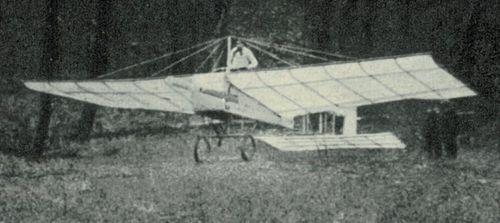
The three Schädler brothers in Landstuhl in Pfaltz had already in 1912 had begun the construction of a human powered aircraft. With the assistance of a teacher living locally, they began work began in their father’s carpentry workshop. The resulting machine was a light monoplane of 12.50m span and 5.50m length. The fuselage had a big nose, and a large propeller of approx. 1.8m, made of alder wood, driven by pedals connected to a gearbox. In the autumn of 1912, the first rolling tests, in order to test the traction of the propeller, were carried out. Since these proved satisfactory, they moved on to actual flight testing. The youngest of three brothers, Eugen Schädler, succeeded in making a flight at a height of approximately 1 – 1.50m above the ground, and flying for a distance of 70m. On landing, the right wheel of the undercarriage broke. According to reports by Anton Schädler, further tests were to be carried out, but the advent of the war meant those plans had to be cancelled. The first pilot of a human powered aircraft died as a soldier in France on 28.6.1916.

Rousson Zeppy

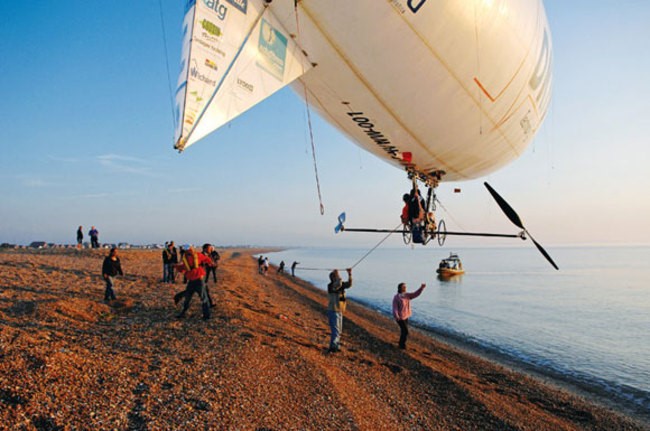
Rousson’s blimp, a crank-driven zeppelin known as Zeppy, is 16-meters-long with a 5-meter diameter, and a maximum speed of 20 kph. The craft’s forward momentum and steering come from a pair of 10-foot movable propellers turned by a recumbent bike hanging from the ship’s belly and pedalled.

Rousson, a 39-year-old Frenchman, attempted to cross The English Channel in a pedal-powered airship on 28 September 2008. He was forced to deflate his blimp and continue to France in a boat after a shift in winds made it impossible for him to progress, no matter how hard he pedalled.

“We were about three-quarters of the way across but the wind was flowing in the wrong direction for me to make it across,” he said. “I’m not disappointed. I feel happy because it had nothing to do with any technical failure, it was purely the wind that got in the way of this achievement.”

The failure is strike two for Rousson, whose June attempt to cross the Channel was also foiled by winds. This time around, he waited more than a week for the right conditions, but was doomed by a light breeze that picked up while he was in flight. “What feels breathlessly still to most people feels like a storm when you’re trying to fly a pedal-powered airship,” he says.

Rousson’s singular focus on flight also seems to be taking over his life. “All of my money has gone into this,” he says. I’m in quite a bit of debt.” He was also dumped by his girlfriend; presumably he loves his blimp more than he loves her.

Ritchel Dirigicyle / Flying Car

Connecticut inventor Charles F. Ritchel made his mark in aviation history—and the cover of Harper’s Weekly magazine—by building a dirigible of his own and sponsoring the first controlled flight of a dirigible in America in Hartford in 1878.

Having been first flown outdoors less than two weeks before by Mark Quinlan in Bridgeport, Connecticut; Charles F. Ritchel began exhibiting his flying machine – also known as the Dirigicyle, or Flying Car – at Boston’s Tremont Temple on June 24, 1878. The demonstration, arranged by William McMahon, who played a major role in introducing Edison’s phonograph to the public, was a complete success. In addition to the indoor flights, Quinlan made an exciting ascension from Boston Common. Once in the air, the propeller gears jammed, allowing the balloon to rise dangerously high. Without a valve to relieve the increased pressure of the expanding lift gas, the envelope swelled, breaking several of the bands from which the frame was suspended. Quinlan could not slit his envelope, for there was no netting in which the fabric could gather to form a parachute. He had little choice but to tie one hand and ankle to the frame, then drop beneath the craft to make repairs with a jackknife as his only tool. He finally descended at Farnumsville, 44 miles from the Common, after a flight of one hour and twenty minutes.

Reynolds Man Angel

Man Angel No.1

Baldwin’s Aerial Rowboat proved a remunerative attraction, though a short-lived one: One night its hydrogen inexplicably ignited, destroying the craft.

That didn’t deter Alva L. Reynolds from launching his own version at nearby Fiesta Park the same year. Thirty-four feet long and 14 feet in diameter, Man Angel had a four- by 10-foot wooden gondola, a 3,000-cubic-foot gas envelope, and a weight of only 18 pounds. Like Baldwin’s craft, it was propelled by oars.

The earliest of six neutral-buoyancy man-powered dirigibles designed and built by Alva L. Reynolds of Los Angeles, California, trials performed above Fiesta Park, Los Angeles, where the aerial rowboat was first flown by Herbert Burke on July 27, 1905.

Reynolds claimed that just about anyone could operate Man Angel. To prove it, he allowed 17-year-old Hazel Odell to take the helm. According to a reporter at the Los Angeles Herald Examiner:

“Miss Odell entered the car and…raised herself to 100 feet. After slight effort she was able to propel the airship in any direction and control its ascent and descent at will. When asked for her motive for performing the feat Miss Odell said: ‘Why should I not? Other people have done it and I was not afraid.’ ”

Reynolds built six Man Angels and leased them to fairs in Kansas, Arizona, and Texas. He also opened a flying school, where he gave twice-daily demonstrations.

Man Angel No.2

The 1905 “Man Angel” hydrogen-filled balloon was 34 feet long and carried an 18 pound frame in which a man sat using ten foot long oars to row across the sky.

Man Angel No.2

The U.S. government investigated purchasing one.

That October, Reynolds challenged Baldwin to an airship race. When Baldwin’s pilot, the balloonist Roy Knabenshue, asked for $20,000 in expense money, Reynolds said Knabenshue was “afraid to race.” In 1906, to keep up interest (and revenue), Reynolds challenged an automobile to a 30-mile race from Chutes Park to Pomona. So confident was Reynolds that Man Angel No. 6 would win, he gave the Herald Examiner $1,000 to hold as prize money. On the day of the race, Man Angel faced such strong head winds it was handily beaten. In a subsequent race, the airship got caught on a telephone wire and crashed into a treetop.

Reynolds never raced Man Angel again. He returned to inventing, and found a method for generating electricity from ocean waves.