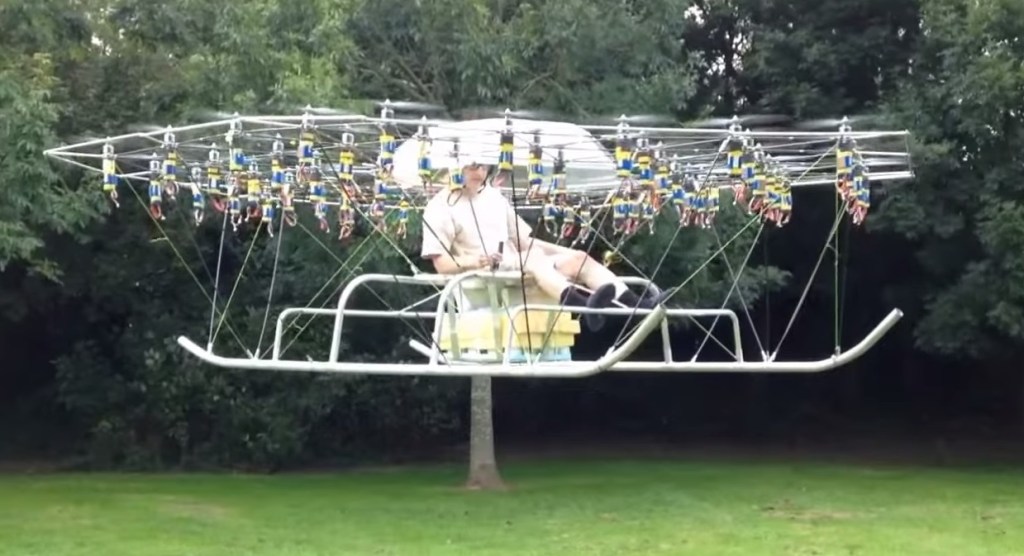
A man living in the UK known only as “Gasturbine101” created a 54-propeller drone not only capable of sustaining ordinary flight, but sustaining flight with him on board.
The drone contains 54 counter-rotation propellors and six grouped control channels with Hobbyking KK2.15 stabilization. The craft’s maximum takeoff weight is around 148 kg (326 lbs) while possessing the ability to sustain flight for roughly ten straight minutes. Power is approximately 22KW.
The Swarm cost about £6,000 to build and is powered by four cell batteries.
There is a flaw in the design of the vehicle. The large number of props running at high speed means the net torque reactions are relatively low, so the craft has little yaw authority. It probably needs a tail rotor for spot turns.
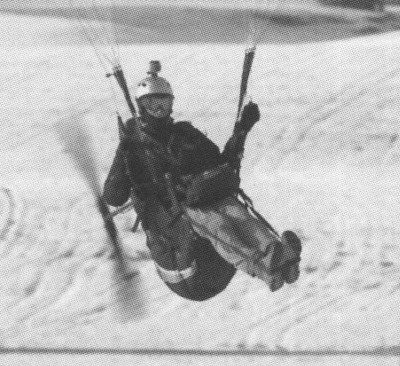
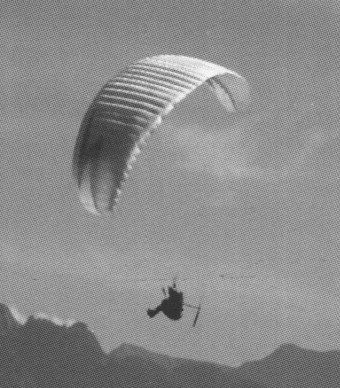
In the northern spring of 2011, a new electric paramotor was introduced. Developed by Werner Eck, Geiger Engineering, Electric Sports, Flytec, and Charly Produkte, the Scott-E uses Flytec’s electric drive system.
The benefits of electric are many; vibration-free, very quiet take-off and flying without CO2 emissions. No fuel and oil Stench during transport. After flight, there are no hot engine parts that dirty your hands or burn your fingers.
The electric drive system, developed by Geiger/Eck and produced by Flytec, has an engine power of approximately l kW per 0.33 kg weight, it achieves an energy conversion efficiency of approx. 94% (a common gas engine is just 5%).
The brushless HM 10 engine is maintenance free. There are no engine parts subject to mechanical abrasion. The complete drive system is protected worldwide by several patent records.
Batteries can be charged from any domestic socket and last for approx 1000 charging cycles.
The Scott-E features an optimised propeller for performance efficiency and it has a minimal noise level which is far below the legal requirements. It is also retractable for the speed range and built for the stresses and strains characteristic for paragliding.
Charly Produkte has designed an innovative all-round harness specifically for to the Scott-E which provides full comfort and safety to the pilot during motor – as well as during free flight use.
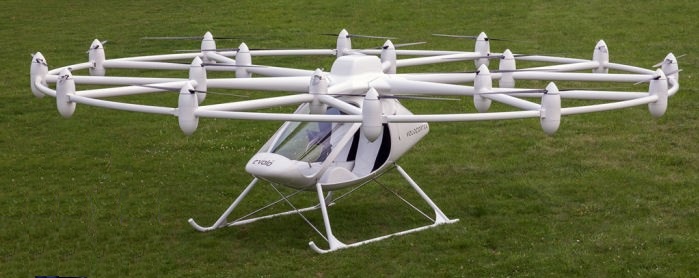
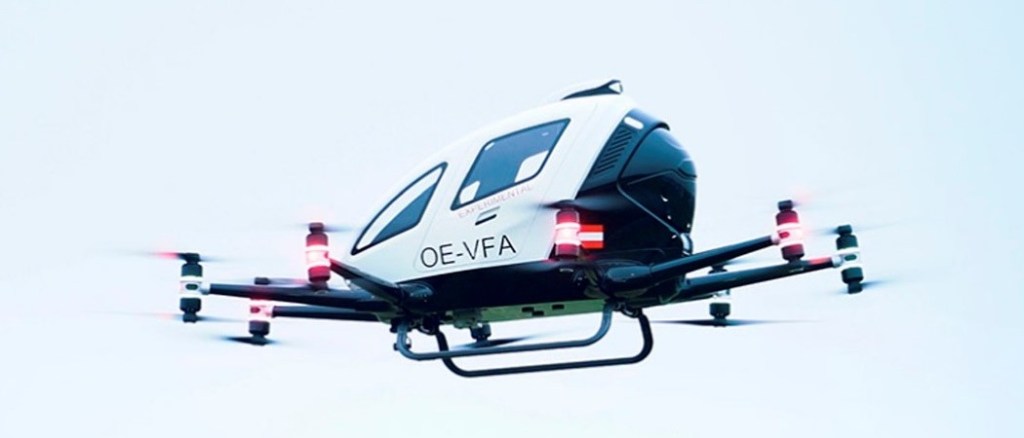
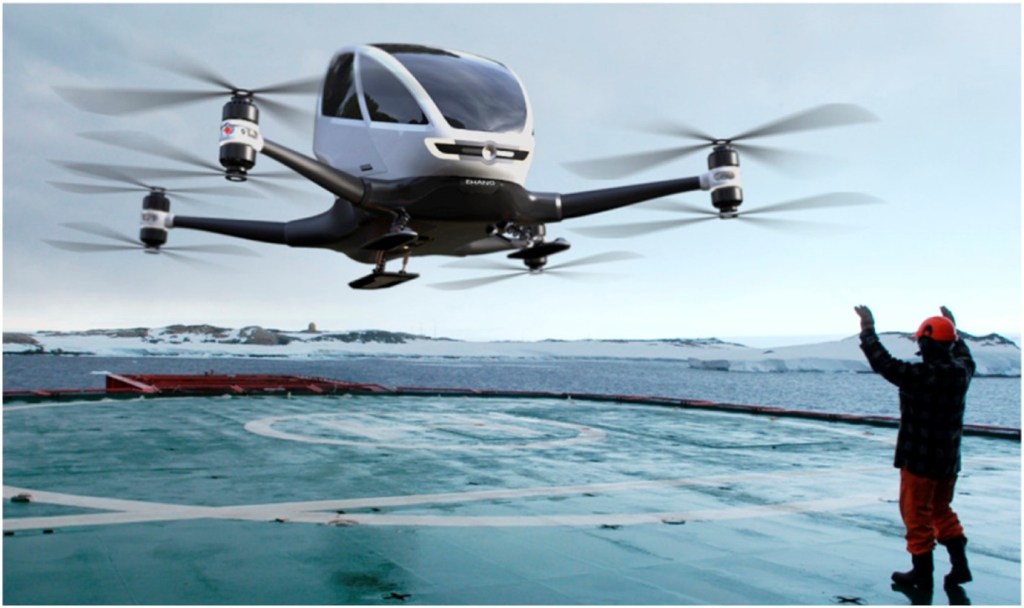
Premiere in April 2017, E-Volo celebrated the first series model of a passenger multicopter. Also known as MultiCopter, the Volocopter is a personal aerial vehicle made of fiber composite material in light-weight design. It runs on an all-electric propulsion system for its 18 rotors powered by 9 independent batteries.
The 2X is the consequent evolution of the VC200 prototype towards everyday use. Its battery replacement system makes it ready for operation again in only a few minutes. The sporty design includes a cockpit that comfortably seats 2 adults. Developed from the VC1, a radio controlled VC200 performed a first flight on November 17, 2013 in the dm-arena in Karlsruhe. The flight with the VC1 in October 2011 lasted precisely 90 seconds. Following several indoor-flights of several minutes’ duration with a number of gentle starts and landings, all the expectations upon the Volocopter are exceeded.
The innovative concept of the electric VTOL aircraft was able to so convince the German Federal Ministry of Transport that it resolves upon a trialing scheme spanning a period of several years for the creation of a new aviation category for the Volocopter. The DULV (The German Ultralight Association) is commissioned with drafting a manufacturing specification, operating regulations and the training scheme for the future pilots in cooperation with e-volo in January 2013.
The Volocopter VC200 received the permit-to-fly as an ultralight aircraft from German aviation authorities in February 2016. The first manned flight took place on March 30, 2016.
Evektor presented at Europe’s 2012 AERO show an electric-powered prototype, the EPOS. Even though strictly for showcase, 10 people offered to buy one on the spot.
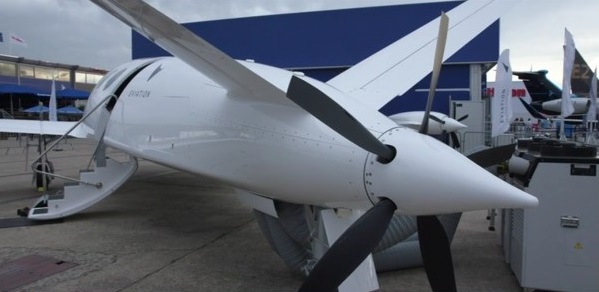
In June 2019 Eviation Aircraft was preparing to start flight testing Alice, its new all-electric regional airliner, in the U.S. En route to its U.S. base in Prescott, Arizona, the Israeli start-up company brought its full-scale prototype of the nine-seat, all-composite design to the Paris Air Show in June 2019 and announced a “double-digit” launch order for the $4 million aircraft from U.S. operator Cape Air.
In June 2019 Eviation Aircraft was preparing to start flight testing Alice, its new all-electric regional airliner, in the U.S. En route to its U.S. base in Prescott, Arizona, the Israeli start-up company brought its full-scale prototype of the nine-seat, all-composite design to the Paris Air Show in June and announced a “double-digit” launch order for the $4 million aircraft from U.S. operator Cape Air.
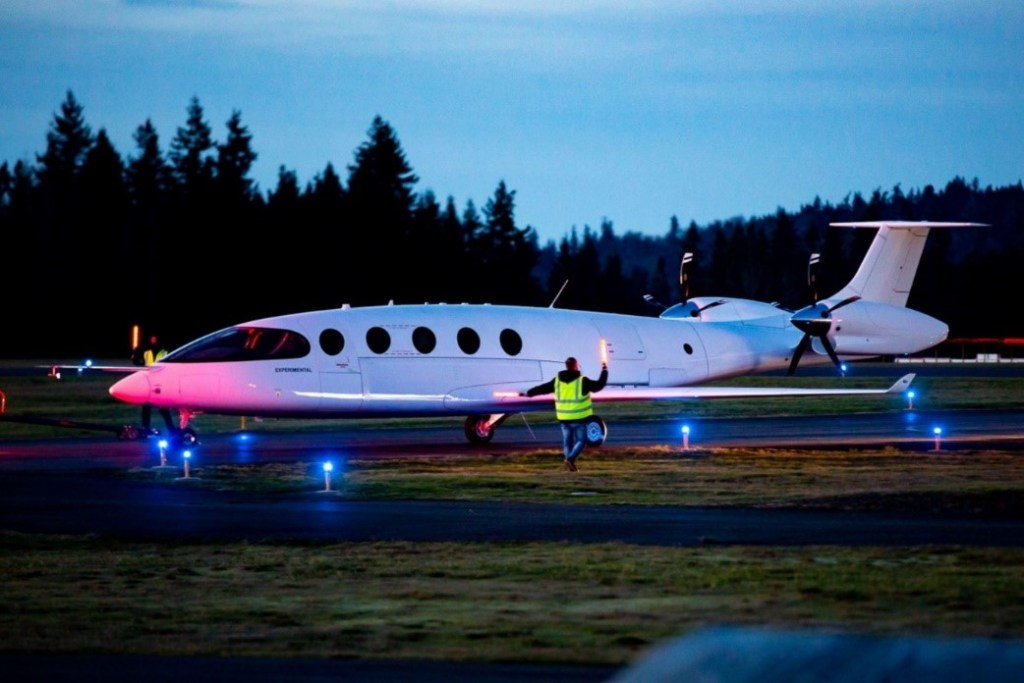
On 27 September 2022 the Alice first flew, from Grant County International Airport, Washington State, USA.
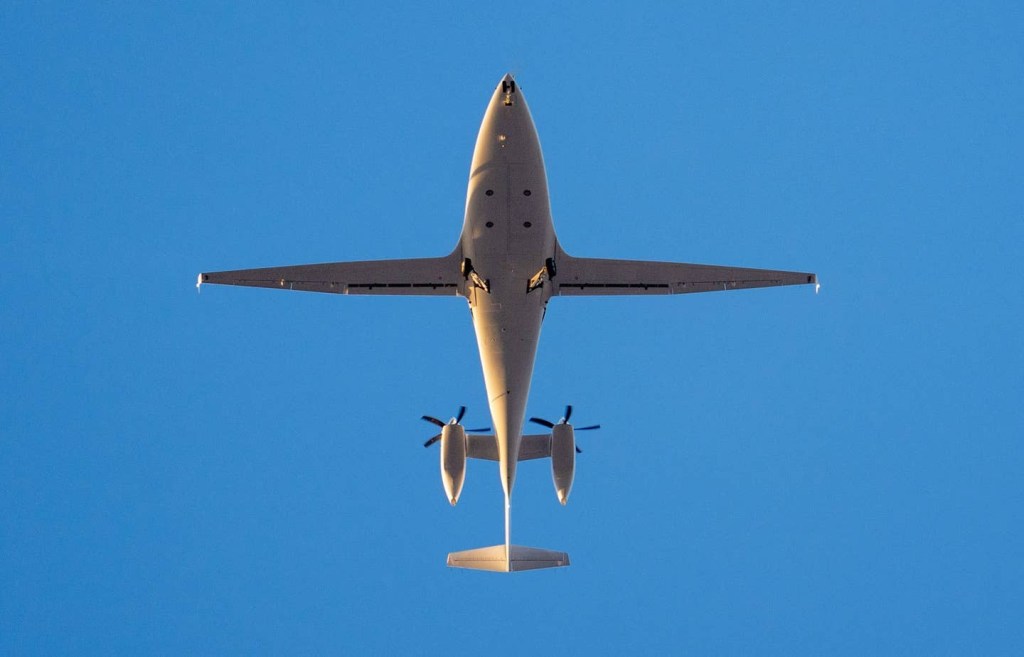
The world’s first flight was for eight-minutes. The successful maiden flight reached an altitude of 3,500 feet (1,067m) and the zero-emissions plane was powered by two 640-kilowatt electric motors.
Eviation expected the path to FAA Part 23 type certification to take between 24 to 30 months after the Alice achieves its first flight by the end of 2019, allowing for entry into service by the end of 2022. It was set to be the first Part 23 all-electric aircraft and the first with full fly-by-wire flight controls. The manufacturer claimed it was fully funded through to the start of series production.
The requirements for an all-electric plane are very different from those of conventional aircraft. The biggest challenge is weight, thanks to the fact that batteries provide considerably less mileage to the pound compared to energy-dense jet fuels.
That makes slashing the weight of other components a priority and the plane features lightweight composite materials “where no composite has gone before,”. Eviation has also done away with the bulky mechanical systems used to adjust control surfaces on the wings, and replaced them with a much lighter fly-by-wire system that uses electronic actuators controlled via electrical wires.
The company’s engineers have had to deal with a host of other complications too, from having to optimize the aerodynamics to the unique volume and weight requirements dictated by the batteries to integrating brakes designed for much heavier planes.
Eviation says the Alice will be comparable in price to similar sized turboprop aircraft like the Beechcraft King Air and cheaper than small business jets like the Embraer Phenom 300. And crucially the relative simplicity of electrical motors and actuators compared with mechanical control systems and turboprops or jets means maintenance costs will be markedly lower.
In Feb 2022 the first commercial all-electric passenger plane was just weeks away from its maiden flight, according to its maker Israeli startup Eviation. If successful, the nine-seater Alice aircraft would be the most compelling demonstration yet of the potential for battery-powered flight.
The Alice was undergoing high-speed taxi tests at Arlington Municipal Airport close to Seattle. This involved subjecting all of the plane’s key systems and fail-safe mechanisms to a variety of different scenarios to ensure they are operating as expected before its first flight. The company was five or six good weather days away from completing those tests, after which the plane should be cleared for takeoff.
The Alice should ultimately be capable of cruising speeds of 250 knots (463 kph) and a maximum range of 440 nautical miles (815 km).
The company has already received advance orders from logistics giant DHL and Massachusetts-based regional airline Cape Air.
Conceptual rendering of Eviation’s Alice, the first commercial all-electric passenger plane, in flight.
Even accounting for the need to replace batteries every 3,000 flight hours, Eviation expects Alice’s operating costs to be about half those of similar sized aircraft.
Eviation’s all-electric Alice makes its first and only test flight in 2022.
In 2025 Electric aviation’s prospects took a hit after a leading developer paused work on its prototype aircraft. Eviation laid off the majority of its staff and halted development of its all-electric Alice, designed for two crew and as many as nine passengers. The manufacturer struggles to secure funding to keep the project alive. Founded one decade ago, Eviation unveiled its first one-quarter-scale Alice prototype, “The Orca,” at the 2017 Paris Air Show. At the 2019 event, it revealed the first full-scale prototype of the regional commuter aircraft. Since then, though, the model has undergone more redesigns (two) than test flights.
Alice was conceived as a middle-mile aircraft, designed for short-hop, city-to-city flights spanning about 250 nm. Its two electric engines produce zero emissions. According to the company, they are cheaper, quieter, and require less maintenance than combustion engines. The aircraft can carry nine passengers or up to 2,500 pounds of cargo, with a top speed of 260 ktas.
Eviation has taken more than 600 orders for Alice, including from DHS Express, Air New Zealand, and GlobalX.
The program would not be fully shut down but did not elaborate further.
According to SMG Consulting’s Advanced Air Mobility (AAM) Reality Index, which tracks investments in manufacturers of electric and other AAM aircraft, Eviation has received $200 million in funding. Its last funding raise was in 2019.
Engines: 2 x Magni 650, 640 kW Wingspan: 62 ft 10 in / 19.15 m Length: 60 ft 9 in / 18.52 m Height: 14 ft / 4.28 m MTOW: 16,500 lb Payload (Commuter): 2,500 lb Typical Cruise Speed: 250 kts Max cruise speed: 250 kts Max Range: 440 NM Climb Rate: 2,000 ft/min Landing Distance: 2,040 ft Take-off Distance: 2,600 ft
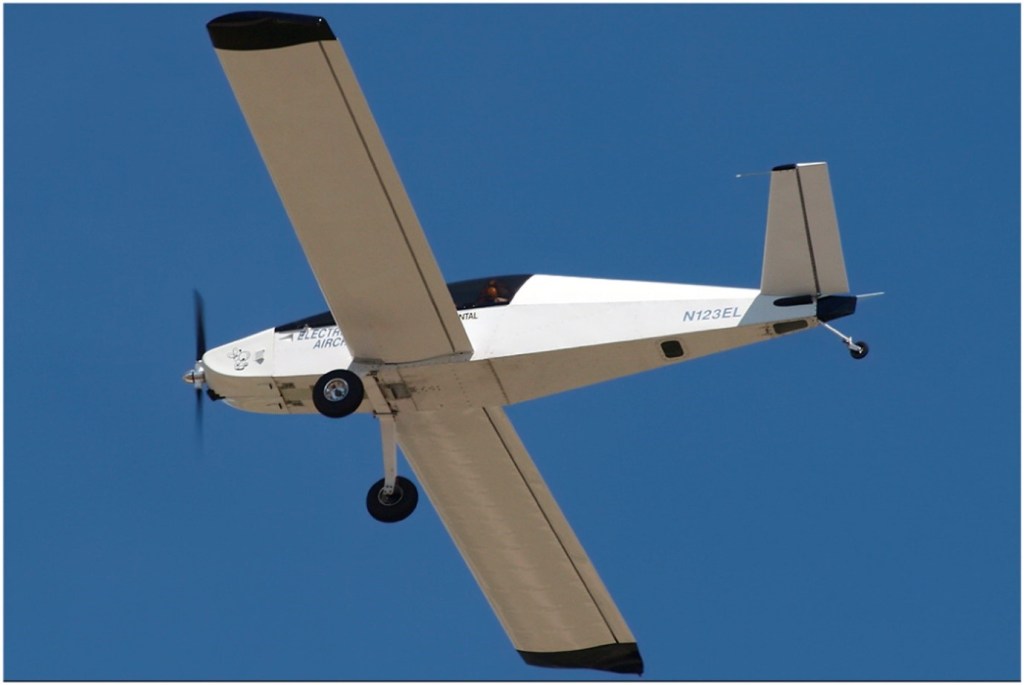
ElectraFlyer-C flown at Oshkosh AirVenture, August 2008.
In 2008 was the debut of the ElectraFlyer-C at the Experimental Aircraft Association AirVenture in Oshkosh. This all-electric, single passenger aircraft, fitted with a custom-built lithium polymer battery pack was able to cruise at 70 mile/h for 1–1/2 to 2 h and charged in as little as 2 hours.
The ElectraFlyer-C was designed and built as a prototype and proof of concept for economical electric flight.
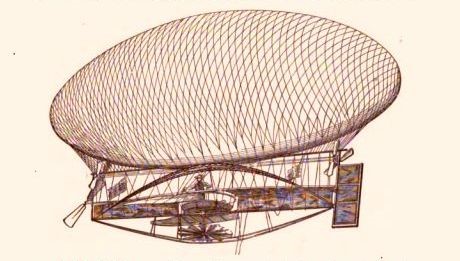
Powered by an Edison electric motor, its 18,000 cu. ft. envelope supplied by Carl E. Meyers, and built a cost of $2500 by the Novelty Air Ship Company of Brooklyn, N.Y., for Professor Peter C. Campbell; the first flight of which was made December 8, 1888 from Coney Island to Sheepshead Bay, piloted by Carlotta the aeronaut – the wife of Carl Meyers. At this time the motive of power is reported to have been bicycle pedals and multiplying gears. The Campbell Air Ship was lost at sea July 16, 1889 while being flown by Professor E. D. Hogan, a Canadian professional aerobat/parachutist, during an exhibition flight originating from the Nassau Gas Works. Intending to make a trip around New York, then to pass over to New Jersey and into the country, five minutes into the flight the 8 foot diameter lower propeller, with which Hogan was to raise and lower the Air Ship gave way and fell to the ground. To make matters worse, it was observed that the steering propellers did not seem to work as no revolutions were discernible, leaving Hogan at the complete mercy of the wind.




 All Aero