Lange Antares 20E / Antares 23E / E1 Antares

The E1 Antares is a composite single-seat self-launching powered glider with an electric motor. The E1 Antares (also known as the “Antares 20E”) is an all new design with a shoulder-mounted 20 metre span wing with flaperons and winglets. The aircraft is constructed from CRP/GRP-composites, with a T-shaped horizontal tailplane with fin and elevator, Schempp-Hirth airbrakes on the upper wing, and wing water ballast tanks. The retractable landing gear is equipped with brake and spring suspension.

The EA 42 electric drive system consists of the electric motor EM42, power-electronics LE42, engine control system EDCS2 and the sensor, data and power cables. The 42kW brushless DC electric motor is powered by a SAFT lithium-ion battery system, spilt into two packs positioned in the leading edge of both wings and composite two-blade fixed-pitch two metre diameter propeller.

E1 Antares EASA Type Certificate A.092, and includes the EA 42 engine based on EASA Type Certificate E.015 and the LF-P42 propeller based on EASA Type Certificate P.015.

The Lange EA 42 is an electrical aero engine designed for self launching gliders. It is produced in Germany by Lange Aviation for their Antares 20E glider.

E1 Antares
Engine: Lange EA 42
Propeller: Lange LF-P42
MCTOW: 660 kg (with water ballast)
MCTOW: 602 kg (without)
No. of Seats: 1
La Mouette Samson

The La Mouette Samson is a French electric-powered ultralight trike, designed by Gérard Thevenot and produced by La Mouette of Fontaine-lès-Dijon. The aircraft was designed to comply with the Fédération Aéronautique Internationale microlight category as a single- or two-seater, and also to comply with the US FAR 103 Ultralight Vehicles rules when flown as a single-seater.

It features a cable-braced hang glider-style high-wing, weight-shift controls, a two-seats-in-tandem open cockpit, tricycle landing gear and a single electric motor in pusher configuration.

The aircraft is made from bolted-together aluminum tubing, with its single surface wing covered in Dacron sailcloth. Its wing is supported by a single tube-type kingpost and uses an “A” frame weight-shift control bar. Powerplant options are electric motors of 14 hp (10 kW) for solo use and a 19 hp (14 kW) motor for dual use. Due to its simple design the Samson can be folded up and stowed in the trunk of an automobile, with the wing carried on the roof rack. The aircraft has an empty weight of 70 kg (154 lb) and a gross weight of 220 kg (485 lb), giving a useful load of 150 kg (331 lb).
The aircraft can be fitted with up to three batteries that give an endurance of 40 minutes at full power, or 80 minutes at normal cruise. The standard wing supplied is a 19 m2 (200 sq ft) La Mouette design.

The aircraft is supplied as a complete ready-to-fly-aircraft.

Powerplant: 1 × Electric motor, 14 kW (19 hp)
Batteries: up to three of 40 Ah capacity
Wing area: 19 m2 (200 sq ft)
Empty weight: 70 kg (154 lb)
Propellers: 2-bladed composite
Endurance: 40 minutes at full power
Rate of climb: 1.0 m/s (200 ft/min)
Crew: one
Capacity: one passenger, maximum of 150 kg (331 lb) total

Kitty Hawk Heaviside

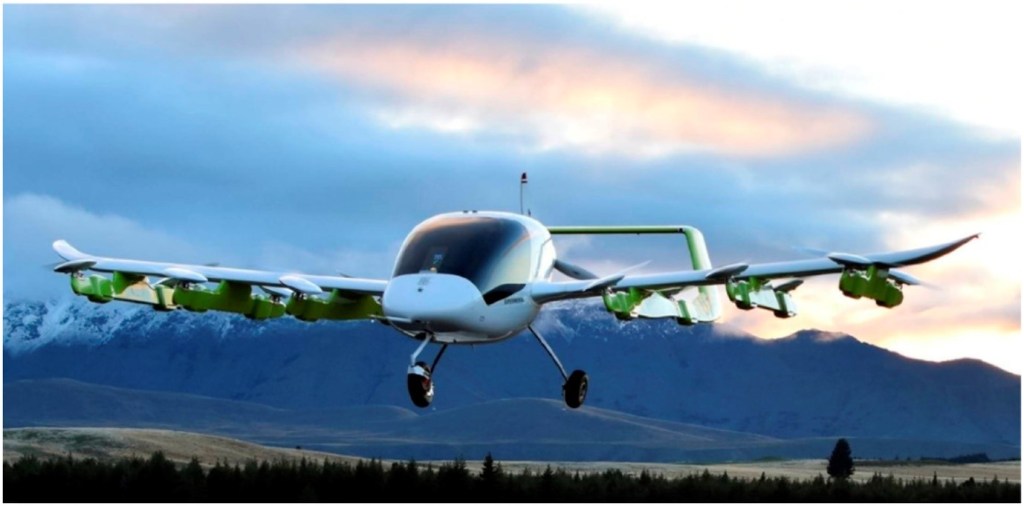
Kitty Hawk revealed on 3 October 2019 that they had been secretly developing a single seat electric aircraft known as the Heaviside. The Heaviside features a front wing with two propellers, six propellers on the main forward swept wing, and a fairly conventional empennage. The propellers are all behind the wings and tilt downward for vertical flight. Later in October 2019, a software timing error lead to a crash of the Heaviside during flight testing.

Kitty Hawk Flyer

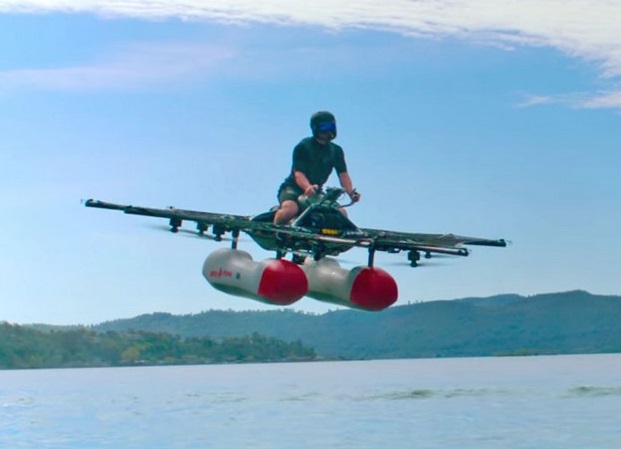
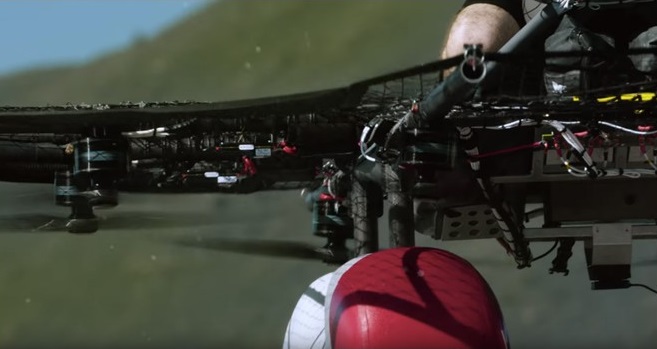
The Kitty Hawk Flyer flying car startup Google’s Larry Page is backing was first publicly demonstrated in April 2017. An aerospace engineer working for Silicon Valley company called Kitty Hawk piloted the Flyer above a lake about 100 miles north of San Francisco. It is an open-seated, 220-pound Flier with room for one person, powered by eight battery-powered propellers that howled as loudly as a speedboat.

The Flyer one-seat, propeller-driven vehicle is meant for a short flight across lake when you’re at the cottage, not commuting to work. During his test flight, Cameron Robertson, the aerospace engineer, used two joystick-like controls to swing the vehicle back and forth above Clear Lake. The flight, 15 feet above the water, circled over the lake about 20 or 30 yards from shore, and after about five minutes Mr. Robertson steered back to a floating landing pad at the end of a dock. The flyer is controlled by two handlebars and what looks like a giant touchscreen. It travels at up to 25 miles per hour at a max of 15 feet above water.

The vehicle is designed to fly above fresh water with two pontoons at its bottom. The prototype Kitty Hawk is showing off “looks and feels a lot like a flying motorcycle,” according to Cimeron Morrissey, who tested it.

They are flying under a special Federal Aviation Administration category for ultralight aircraft that does not require a pilot’s license and is intended for recreational flying in uncongested areas. To add an extra margin of safety, the Kitty Hawk engineers are sticking to flying over open water.

Gallery

Keli SkySpark

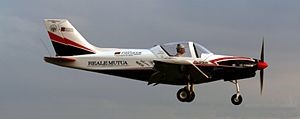
This aircraft was designed and built by the Italian astronaut Maurizio Keli (Italian: Maurizio Cheli), with the assistance of the Turin Polytechnic Institute, DigiSky and several other companies (Sparco, Sicme Motori). As a prototype, an Alpi Pioneer 300 aircraft was used. June 10, 2009 made the first flight. The main design feature is electric traction. A battery pack weighing more than 70 kg is installed on the machine. The power of this electric motor is 75 kW.

SkySpark June 12, 2009 set a world speed record for this type – 250 kilometers per hour.

Keil-Myers Ballo-plane

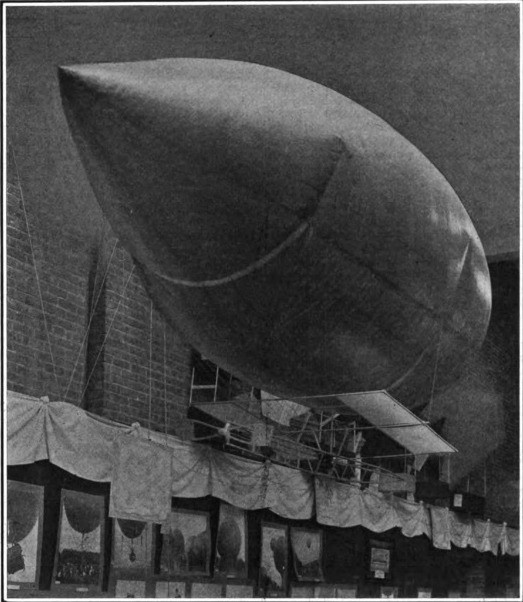
An electrically-propelled dirigible balloon combined with lifting aeroplanes. Its envelope constructed by Carl E. Myers at his balloon farm at Frankfort, N.Y. for Mr. W. M. Keil of Tuxedo Park, N.Y., this Keil-Myers HTA/LTA airship was presented the week of January 13, 1906 at the 69th Regiment Armoury Auto Show in Manhattan, of which the aviation exhibition element was put on by the Aero Club of America. Nothing is known of its existence afterwards.

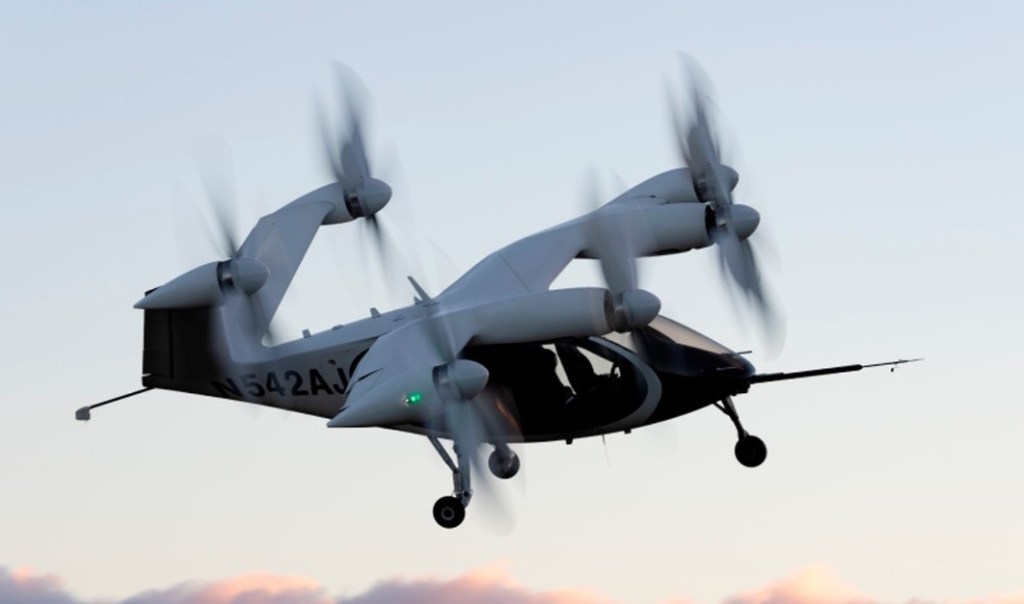
Joby Aviation S4

The Joby Aviation S4 air taxi 2.0 is a five seat eVTOL (one pilot and four passengers) vectored-thrust aircraft using six tilting propellers which are located on both the fixed wing and its V-tail. Four propellers tilt vertically including its entire motor nacelle, and two of the propellers tilt vertically with a linkage mechanism. The aircraft has large windows for spectacular views and has a tricycle-type retractable wheeled landing gear.

The company reports their aircraft is 100 times quieter than a helicopter during takeoff and landing with a near-silent flyover.

The Joby S4 four passenger eVTOL aircraft was revealed in January 2020 and the first to receive U.S. Air Force airworthiness approval in December 2020.

Jaskiewicz Electric

In September 1973 the Liverpool Echo covered a story about a man who was building an aircraft to be powered by a form of electric motor. Jan Jaskiewicz was the designer and builder, although at the time he was employing two women to do the fabric work for him. He had leased an old school for his workshop in Great Homer Street, Liverpool, UK.

The aircraft was of tubular steel construction and employed a large amount of glass-fibre areas. Empty weight was quoted at 300 lb. At that time a professional-looking fuselage had been completed and the wings were about to be worked on. The exact nature of the engine, which the designer referred to as a battery engine”, was not revealed.

Glasflugel 304 / 402

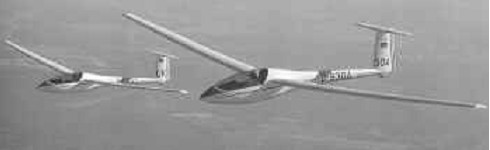
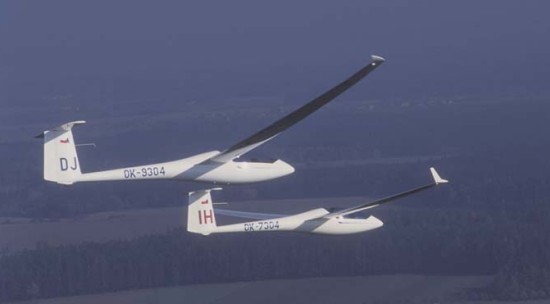
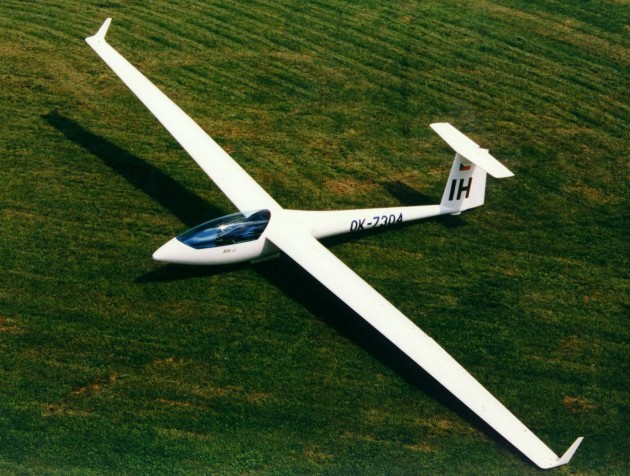
Intended to succeed the Mosquito B, the 15m span Glasfliigel 304 single-seater is a new design very similar to the Mosquito, work on which began in the autumn of 1979 by a team under Martin Hansen.

Construction is of glassfibre, with no carbon-fibre employed, although the 304/17 (now known as the Glasflugel 402), which has detachable wing tips to give a span of 17m, has largely carbon-fibre wing tips. It employs a new 16.4% thickness/chord ratio wing profile developed by Akaflieg Braunschweig and extensively tested and refined on a Mosquito. It features Glasflugel trailing edge dice brakes and interconnected variable camber flaps, a parrallogram control stick, T-tail with fixed stabilizer and elevator, and automatic connection on assembly of all flight control. The fuselage is similar to the Mosquito’s but with a more pointed nose; the monowheel is retractable. The instrument panel can be tipped up, together with the front-hinged upwards opening canopy, with which it is integral, to allow the pilot more unobstructed entry. Up to 253lb of water ballast can be carried.

The prototype, D-9304, first flew on 10 May 1980. Production of the 304 started in the spring of 1981.

Glasflugel 304 CZ

HPH Ltd. took over the original molds and drawings for glider Glasflugel 304 from Mr. George Brauchle in 1998.

Glasflugel 304 C

Gallery

Glasflugel 304
Wing span: 15m / 49.2ft
Wing area: 9.88sq.m / 106.3sq.ft
Length: 21 ft 2in
Height: 4 ft 5.5 in
Empty Weight: 235kg / 518lb
Payload: 215kg / 298lb
Gross Weight: 450kg / 992lb
Wing Load: 45.55kg/sq.m / 9.3lb/sq.ft
Water Ballast: 115kg / 254lb
Aspect ratio: 22.78
Max speed: 156 mph (smooth air)
L/DMax: 43.1 at 116 kph / 63 kt / 72 mph
Min sinking speed: 2.26 ft/sec at 58 mph
Airfoil: HQ 10-1642
Seats: 1
No. Built: 62
Glasflugel 304 CZ
Wing span: 15m / 49.2ft
Wing area: 9.88sq.m / 106.35sq.ft
Empty Weight: 235kg / 518lb
Water Ballast: 115kg / 253.5lb
Aspect ratio: 22.78
L/DMax: 44
MinSink: 0.68m/s

Glasflugel 304C
Wing span: 15m
Wing area: 9.9sq.m
Empty Weight: 235kg
Gross Weight: 450kg
Wing Load: 45.45kg/sq.m
Water Ballast: 115kg / 253.5lb
Aspect ratio: 22.8
MinSink: 0.57 m/s @ 77 kph

402
Span: 55 ft 9.25 in
Length: 21 ft 2in
Height: 4 ft 5.5 in
Wing area: 114 sq ft
Aspect ratio: 27.3
Empty weight: 518lb
Max take-off weight: 992lb
Max speed: 156mph (smooth air)
Min sinking speed: 2.26ft/sec at 58mph
Best glide ratio: 43:1 at 72mph