
The Opener BlackFly is an American electric-powered VTOL personal air vehicle designed by Canadian Marcus Leng and under development by his company, Opener, Inc of Palo Alto, California. It was publicly introduced on 12 July 2018, after nine years of development.
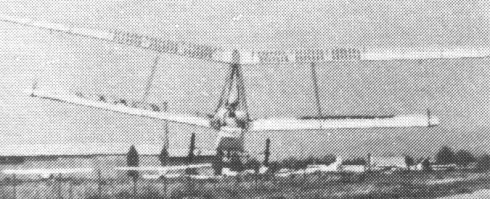
The first proof-of-concept version was flown on 5 October 2011, in Warkworth, Ontario, Canada, by Leng. He flew the next model, named the BlackFly, in August 2014 and then relocated the company to Palo Alto, California in September 2014. In February 2016, the second BlackFly prototype was first flown. By September 2017, the prototype had flown 10,000 mi (16,093 km) in a series of flights of at least 30 mi (48 km) each. The first pre-production aircraft was flown in October 2017.
The design is intended for the FAR 103 Ultralight Vehicles category in the US and the Basic Ultralight Aeroplane category in Canada. The US version and international versions were to have different ranges, speeds and weights to comply with national regulations. The aircraft is intended to be supplied complete and ready-to-fly.
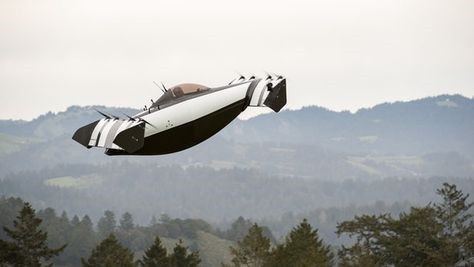
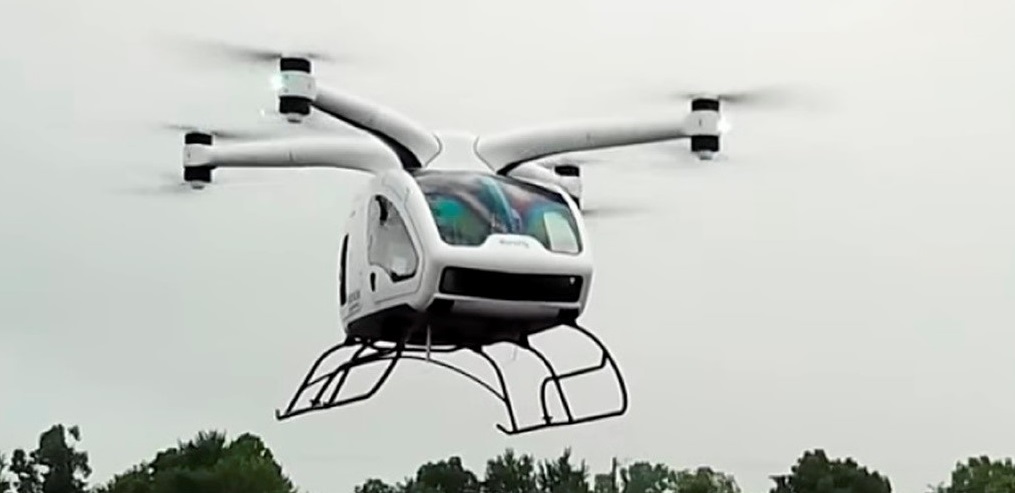
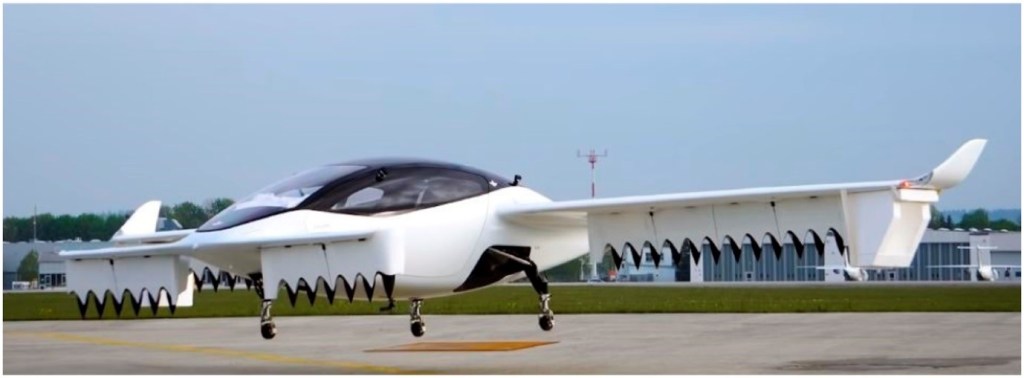
The aircraft is made from carbon-fiber reinforced epoxy with all-electric battery-powered propulsion. It has two 13.6 ft (4.15 m) cantilevered tandem wings, on the front and rear of a short fuselage. The fuselage has a single-seat cockpit under a bubble canopy. The forward wing is low, and the rear wing high, giving the cockpit good forward visibility. Each wing has four tractor configuration contrarotating propellers powered by electric motors. The tractor configuration prevents the flexible propellers from contacting the airframe. Each wingtip has winglets to improve lateral stability and reduce vortex drag. The aircraft weighs 313 lb (142 kg) empty and can carry a pilot and baggage totaling 250 lb (113 kg). It can accommodate a pilot of up to 6.5 ft (1.98 m) in height. A ballistic parachute is optional.
The aircraft is not a tiltwing, tiltrotor or ducted-fan design. Instead, the entire aircraft changes pitch. When the aircraft is parked, both wings and their motors are canted up at about 45 degrees. To ascend vertically, the aircraft pitches up 45 degrees, so that the propellers pull vertically. The wing-mounted tractor propellers move air over the wings, reducing stall speeds. So, at pitch angles near zero degrees, the aircraft can fly slowly with high angles of attack. For efficient horizontal flight, the aircraft pitches down 45 degrees, canting the wings and propellors to an optimal angle of attack. The forward wing has a slightly lower angle of attack to aid stall recovery. At low speeds the forward wing will stall first, causing the nose to fall, increasing air speed and exiting a stall.
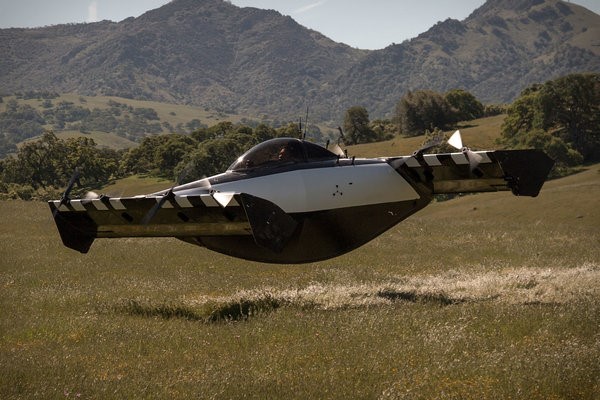
The take-off and landing distances are 36 inches. The landing gear consists of a rub-strip on the bottom of an amphibious hull and a small rubber bumper on the rear of the fuselage. The lower edge of the winglets are skids that limit the vehicle’s roll when parked. The vehicle is designed to fly from a grass surface, but can also be flown from fresh water, asphalt, snow and ice.
Pilot controls are a joystick with a thumb control for altitude. Flight controls are triple-redundant fly-by-wire controlling the motors and dual elevons on the outer edge of both wings. Differential motor speeds provide control authority in pitch, roll and yaw. Elevons also permit control in an efficient unpowered glide mode. The elevons are in the prop-wash of the outer propellers, enhancing their roll and pitch authority at low speeds. Flight stability is software-controlled, with modes for cruise-control, “return-home,” auto-land and geo-fencing.
Most flight testing was unmanned, operated by software with a test weight in place of a pilot. Each motor weighs 4 lb (2 kg) and produces 130 lb (59 kg) of thrust. There are two batteries per motor, located in the wing, behind each motor. Adjacent batteries can be cross-connected for redundancy. The batteries are software-monitored. Avionic include Full authority autopilot, Remote controls, and VHF airband radio.
The manufacturer claims that the design is the world’s first ultralight fixed-wing, all-electric, vertical take-off and landing aircraft. Investors in the company include Google co-founder Larry Page.
The craft was still under development in 2018.
Opener has donated a first-generation BlackFly personal ultralight aircraft to the EAA Aviation Museum in Oshkosh, Wisconsin. According to Opener, BlackFly vehicles have flown over 2,300 flights, including 900 made on preproduction models since the aircraft appeared at Oshkosh in 2018.
Opener was displaying the production version of BlackFly at the AirVenture Innovation Showcase from July 22 to July 28, 2019.
Powerplant: 8 × 112 lb thrust/engine electric motors, 42.0 hp (31.3 kW) each
Propellers: 2-bladed, 3 ft (0.91 m) diameter
Wingspan: 13 ft 7 in (4.14 m)
Length: 13 ft 5 in (4.09 m)
Height: 5 ft (1.5 m)
Empty weight: 313 lb (142 kg)
Gross weight: 563 lb (255 kg)
Fuel capacity: 12KWh
Cruise speed: 80 mph (130 km/h, 70 kn)
Range: 40 mi (64 km, 35 nmi) plus reserves
Rate of climb: 1,000 ft/min (5.1 m/s)
Rate of sink: 1,000 ft/min (5.1 m/s)
Crew: one
 All Aero