The Yuneec Power Drive 40 is a Chinese electric motor for powering electric aircraft and motorgliders, designed and produced by Yuneec International of Kunshan, Jiangsu.
The Power Drive 40 is part of a family of scalable electric motor designs produced by Yuneec. The family of engines is designed to use the company’s own power controller, Lithium polymer battery pack and charger, as an integrated package of components. This ensures that all components are compatible and also removes the need for aircraft builders to separately source components.
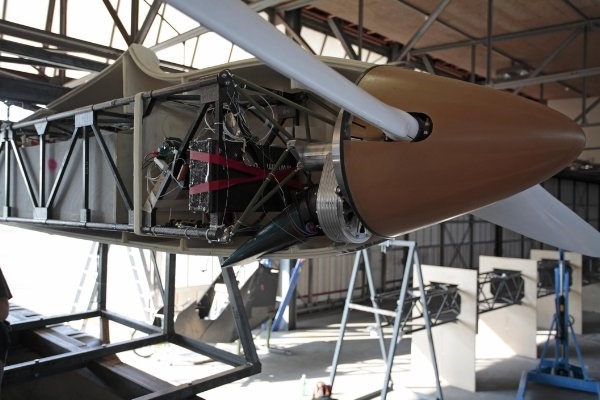
The Power Drive 40 is a brushless 133 volt design producing 40 kW (54 hp), with an outrunner. The low working rpm of the engine means that it can turn a propeller at efficient speeds without the need for a reduction drive.
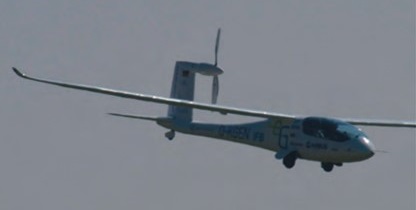
Applications: Yuneec E430 Yuneec EViva
Specifications: Power Drive 40 Engine type: Brushless electric aircraft engine Length: 163 mm (6.4 in) Width: 240 mm (9.4 in) Height: 240 mm (9.4 in) Weight: 19 kg (42 lb) Coil type: Outrunner Bearings: 2 Reduction drive: none Cooling: air Voltage: 133 nominal Current drain, maximum: 285 A Current drain, cruise: 180 A Power: 40 kW (54 hp) at 2400 rpm Power to weight: 2.1 kW/kg
The Yuneec Power Drive 10 is a Chinese electric motor for powering electric aircraft, designed and produced by Yuneec International of Kunshan, Jiangsu. Major applications are paramotors.
The Power Drive 10 is part of a family of scalable electric motor designs produced by Yuneec. The Power Drive 10+ produces the same power but at a reduced rpm.
The family of engines is designed to use the company’s own power controller, Lithium polymer battery pack and charger, as an integrated package of components. This ensures that all components are compatible and also removes the need for aircraft builders to separately source components.
The Power Drive 10 is a brushless 67 volt design producing 10 kW (13 hp), with an outrunner. The low working rpm of the engine means that it can turn a propeller at efficient speeds without the need for a reduction drive.
Variants:
Power Drive 10 Model that produces 10 kW (13 hp) at 2400 rpm, with a weight of 4.5 kg (9.9 lb).
Power Drive 10+ Model that produces 10 kW (13 hp) at 2000 rpm, with a weight of 6.0 kg (13.2 lb).
Applications: Yuneec International EPac paramotor Yuneec International ETrike ultralight trike
Specifications: Power Drive 10 Engine type: Brushless electric aircraft engine Length: 114 mm (4.5 in) Width: 160 mm (6.3 in) Height: 160 mm (6.3 in) Weight: 4.5 kg (9.9 lb) Coil type: Outrunner Bearings: 3 Reduction drive: none Cooling: air Voltage: 67 nominal Current drain, maximum: 180 A Current drain, cruise: 55A Power: 10 kW (13 hp) at 2400 rpm Power to weight: 2.2 kW/kg
Founded in Hong Kong in 1999, Yuneec International Co. Ltd. became a leader in electric aviation.
With hundreds of patents filed, Yuneec’s core technologies power its manned aircraft as well as its drones and its line of radio controlled aircraft for the hobby market.
The company was constructing a 260,000 square foot (25,000 sq m) factory to produce the E430 aircraft in Shanghai that was expected to open in October 2009.
In 2009 the rights, tooling and parts inventory of Flightstar Sportplanes of South Woodstock, Connecticut, were sold to Yuneec International of China when Flightstar Sportplanes’ business was wound up.
17 November 2013 was the first flight of the two-seat Volocopter VC200 aircraft. The VC200 was able to hover indoors and by February 2014 the VC200 transitioned to forward flight.
The Volocopter VC1 would conduct the first manned flight of an electric multicopter according to the Guinness Book of World Records. The VC1 was flown by Volocopter co-founder, primary designer, inventor and builder, Thomas Senkel on 21 October 2011.
The contemporary engraving shows the Tissandier electric dirigible scale model – similar in appearance to the Giffard airship of 1852 – at the Conservatoire des Arts et Metiers in Paris. Seen at the Exposition d’électricité in 1881, the aérostat électrique was a demonstrative model of the later constructed full-scale Siemens electromotor-driven Tissandier airship. The model’s all important electromotor was designed and built by French inventor Gustave Trouvé.
In 1882 the Tissander brothers built a 92 ft long airship. At 37,000 cu.ft capacity, it was powered by a Siemens electric motor of 1.5 hp driving a primitive two-bladed airscrew, which drew its power from twenty-four bichromate of potash cells weighing 500 lb, contained in the car suspended by netting below the fuselage.
The first trial took place on 8 October 1883 when, despite a fair breeze, a measure of control was achieved with the aid of the sail rudder. A second trial on 26 September produced better results although due to the low power of the engine the craft was unable to make any headway in a wind of any magnitude and the brothers ended their works.
The Solar One, made its public debut June 1979. 750 solar cells charge 24 accumulator cells to drive four electric motors linked together for a combined 4 hp. The aircraft, which looks like a conventional glider but with a pylon mounted power unit located on the nose immediately forward of the pilot, takes off at 20kts and has reached a maximum of 42kts.
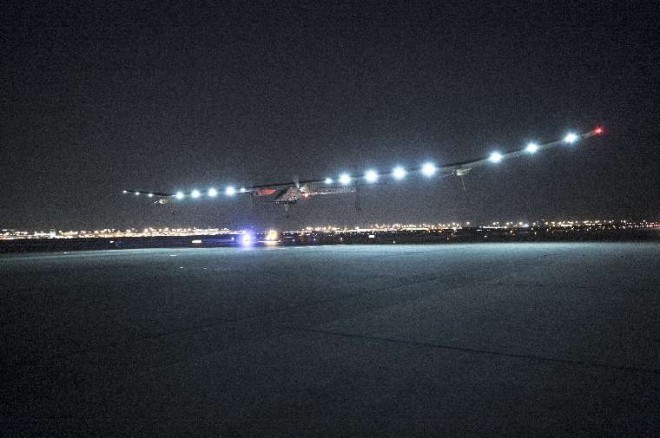
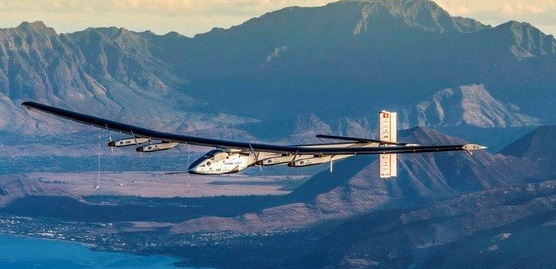
Solar Impulse is a Swiss long-range solar powered aircraft project developed at the École Polytechnique Fédérale de Lausanne. The project eventually hopes to achieve the first circumnavigation of the Earth by a piloted fixed-wing aircraft using only solar power. The project is led by Swiss psychiatrist and aeronaut Bertrand Piccard, who co-piloted the first balloon to circle the world non-stop, and Swiss businessman André Borschberg.
Piccard initiated the Solar Impulse project in 2003. By 2009, he had assembled a multi-disciplinary team of 50 specialists from six countries, assisted by about 100 outside advisers. The project is financed by a number of private companies. The four main partners are Deutsche Bank, Omega SA, Solvay, and Schindler. Other partners include Bayer MaterialScience, Altran, Swisscom and Swiss Re (Corporate Solutions). Other supporters include Clarins, Semper, Toyota, BKW and STG. The EPFL, the European Space Agency (ESA) and Dassault have provided additional technical expertise, while SunPower provided the aircraft’s photovoltaic cells.
The first aircraft, bearing the Swiss aircraft registration code of HB-SIA, is a single-seater monoplane, capable of taking off under its own power, and intended to remain airborne up to 36 hours. This aircraft conducted its first test flight in December 2009, and first flew an entire diurnal solar cycle, including nearly nine hours of night flying, in a 26-hour flight on 7–8 July 2010. Piccard and Borschberg completed successful solar-powered flights from Switzerland to Spain and Morocco in 2012, and conducted a multi-stage flight across the USA in 2013.
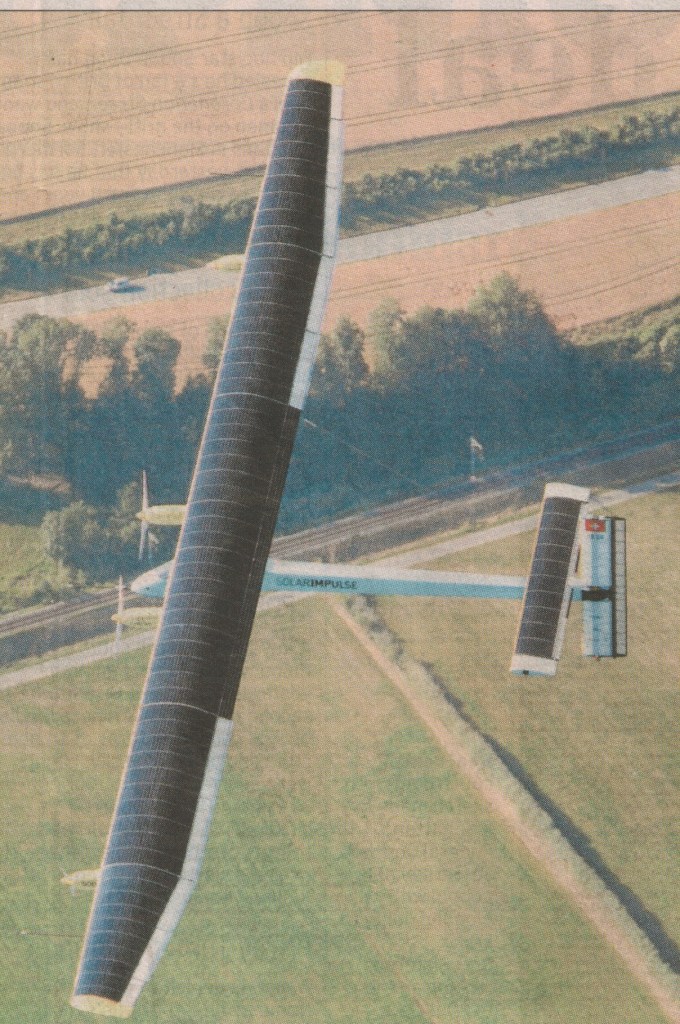
With a non-pressurized cockpit and a limited flight ceiling, the HB-SIA is primarily a demonstrator design. The plane has a similar wingspan to the Airbus A340 airliner. Under the wing are four nacelles, each with a set of lithium polymer batteries, a 10 hp (7.5 kW) motor and a twin-bladed propeller. To keep the wing as light as possible, a customised carbon fibre honeycomb sandwich structure is used.
Under the wing, 4 nacelles are fixed, each containing a 10-HP motor, a set of lithium polymer batteries and a management system that controls the maximum load and temperature limit. Thermal insulation is conceived to conserve the heat released by the batteries and thus allows them to function despite the -40 ° C encountered at 8500 meters. Each motor is provided with a reducer that limits the rotation of a propeller with two blades of 3.5 meters in diameter to 200-400 revolutions / minute.
11,628 photovoltaic cells on the upper wing surface and the horizontal stabilizer generate electricity during the day. 10,768 solar cells on the wing and 880 on the horizontal stabilizer. 200 cubic meters of photovoltaic cells and 12% of the total efficiency of the propulsion chain, the average power generated by the 4 engines of the plane, does not exceed 8 CV or 6 KW. These both propel the plane and charge its batteries to allow flight at night, theoretically enabling the single-seat plane to stay in the air indefinitely. The 11628 150 micron thick monocrystalline silicon cells have been selected for their quality of lightness, flexibility and efficiency. At 22%, its performance could have been even better, but its weight would then have been excessive, penalizing the aircraft during night flight. As this phase is the most critical, the main difficulty of the project is at the level of energy storage in polymer lithium batteries.
Reaching a 63.40 m wingspan for a fully equipped 1600 kg is a challenge never before experienced in aeronautics in terms of rigidity, lightness and flight control. Solar Impulse is built around a structure in composite materials made up of carbon fiber and honeycomb assembled in a sandwich. The upper surface of the wing is covered with a skin composed of encapsulated solar cells, and the underside of a high resistance flexible film. 120 carbon fiber ribs distributed all 50cm outline these two layers to give them their aerodynamic shape.
The aircraft’s major design constraint is the capacity of the lithium polymer batteries. Over an ideal 24-hour cycle, the motors will deliver a combined average of about 8 hp (6 kW), roughly the power used by the Wright brothers’ pioneering Flyer in 1903. As well as the charge stored in its batteries, the aircraft uses the potential energy of height gained during the day to power its night flights.
On 26 June 2009, the Solar Impulse was first presented to the public in Dübendorf, Switzerland. Following taxi testing, a short-hop test flight was made on 3 December 2009, piloted by Markus Scherdel. André Borschberg, co-leader of the project team, said of the flight:
"It was an unbelievable day. The airplane flew for about 350 metres (1,150 ft) and about 1 metre (3 ft 3 in) above the ground ... The aim was not to get high but to land on the same runway at a speed to test its controllability and get a first feeling of its flying characteristics ... the craft behaved just as the engineers had hoped. It is the end of the engineering phase and the start of the flight testing phase."
On 7 April 2010, the HB-SIA conducted an extended 87-minute test flight, piloted by Markus Scherdel. This flight reached an altitude of 1,200 m (3,937 ft). On 28 May 2010, the aircraft made its first flight powered entirely by solar energy, charging its batteries in flight.
On 8 July 2010, the HB-SIA achieved the world’s first manned 26-hour solar-powered flight. The airplane was flown by André Borschberg, and took off at 6:51 a.m. Central European Summer Time (UTC+2) on 7 July from an airfield in Payerne, Switzerland. It returned for a landing the following morning at 9:00 a.m. local time. During the flight, the plane reached a maximum altitude of 8,700 m (28,500 ft). At the time, the flight was the longest and highest ever flown by a manned solar-powered aircraft; these records were officially recognized by the Fédération Aéronautique Internationale (FAI) in October 2010.
On 13 May 2011, at approximately 21:30 local time, HB-SIA landed at Brussels Airport, after completing a 13-hour flight from its home base in Switzerland. It was the first international flight by the Solar Impulse, which flew at an average altitude of 6,000 ft (1,829 m) for a distance of 630 km (391 mi), with an average speed of 50 km/h (31 mph). The aircraft’s slow cruising speed required operating at a mid-altitude, allowing much faster air traffic to be routed around it. The aircraft was piloted by Andre Borschberg. The project’s other co-founder, Bertrand Piccard, said in an interview after the landing: “Our goal is to create a revolution in the minds of people…to promote solar energies – not necessarily a revolution in aviation.”
A second international flight to the Paris Air Show was attempted on 12 June 2011, but the plane turned back half-way and landed back in Brussels, where it had taken off, due to adverse weather conditions. In a second attempt on 14 June, André Borschberg successfully landed the aircraft at Paris’ Le Bourget Airport at 9:15 pm after a 16-hour flight.
On 5 June 2012, the Solar Impulse successfully completed its first intercontinental flight, flying a 19-hour trip from Madrid, Spain, to Rabat, Morocco. During the first leg of the flight from Payerne, Switzerland, to Madrid, the aircraft broke several further records for solar flight, including the longest solar-powered flight between pre-declared waypoints (1,099.3 km (683 mi)) and along a course (1,116 km (693 mi)).
On 3 May 2013, the plane began its first cross-US flight with a journey from Moffett Field in Mountain View, California, to Phoenix Sky Harbor International Airport in Arizona. Successive legs of the flight took the Solar Impulse to Dallas-Fort Worth airport, Lambert–St. Louis International Airport and Washington Dulles International Airport; it finally concluded at New York’s John F. Kennedy International Airport on 6 July. Each flight leg took between 19 and 25 hours, with multi-day stops in each city between flights.
After the first leg to Phoenix, the aircraft completed the second leg of its trip on 23 May, landing at Dallas-Fort Worth International Airport. This flight, which covered 1,541 kilometres (958 mi), set several new world distance records in solar aviation. On 4 June, the plane landed in St. Louis, Missouri. It departed for Washington DC on 14 June, briefly stopping in Cincinnati, Ohio, to change pilots and avoid strong winds. On 16 June, the plane landed at Washington Dulles International Airport in Virginia. On 6 July 2013, following a lengthy layover in Washington, Solar Impulse completed its cross-country journey, landing successfully at New York City’s JFK International Airport at 11:09 p.m. EDT. The landing occurred three hours earlier than originally intended, because a planned flyby of the Statue of Liberty was cancelled due to severe damage to the aircraft’s left wing. The Solar Impulse was placed on public display at JFK after its landing.
Solar Impulse pilot André Borschberg completed the record-setting flight after flying more than 950 miles on solar power alone. Borschberg landed in Dallas with his batteries at about 60 percent, and used that juice to begin the third leg of his journey. As the headwind exceeded the speed of the airplane at times, Borschberg traveled backward relative to the ground. At one point, a little less than three hours before he actually landed, he was only 20 miles or so from Dallas/Fort Worth International Airport and found himself lined up with runway 13L, where he planned to touchdown. Landing on 13L required closing the runway, and there was simply too much commercial traffic. It was after midnight before air traffic control allowed him to land, so he spent the intervening hours in a holding pattern above the runway. As he descended, the windspeed increased and he encountered a 25- to 30-knot wind at 2,000 to 3,000 feet. This meant Borschberg had to be careful not to turn downwind, because he would be blown too far north and would have to make another approach to land, covering the ground at less than five miles per hour with the headwind. The sideways translation eventually brought him over the top of runway 13L, where he touched down 23 May 2013, at 1:08 a.m. local time, 18 hours and 21 minutes after departing Phoenix.
The flight to Dallas was fairly smooth, with just a few sections of turbulence. Flying 832 nautical miles (957 miles) broke the team’s own distance record for a solar powered airplane (and for any electric airplane). It also provided valuable experience and expand the Solar Impulse team’s flight techniques for future flights — including their planned circumnavigation of the world in a larger aircraft in 2015.
Construction of the second Solar Impulse aircraft, carrying the Swiss registration HB-SIB, started in 2011. The wingspan of HB-SIB will be 80.0 m (262.5 ft), slightly wider than an Airbus A380, the world’s largest passenger airliner, but unlike the 500-ton A380, the carbon-fibre Solar Impulse will weigh little more than an average automobile. It will feature a larger, pressurized cockpit and advanced avionics to allow for transcontinental and trans-oceanic flights. Supplemental oxygen and various other environmental support systems will allow the pilot to cruise at an altitude of 12,000 metres (39,000 ft).
Completion was initially planned for 2013, with a circumnavigation of the globe in 20–25 days in 2014. However, following a structural failure of the main spar during static tests in July 2012, a more likely date for the circumnavigation is 2015. The flight would circle the world in the northern hemisphere, near the equator. Five stops are planned to allow changes of pilots. Each leg of the flight will last three to four days, limited by the physiology of each pilot. Once improved battery efficiency makes it possible to reduce the aircraft’s weight, a two-seater is envisaged to make a non-stop circumnavigation.
Solar Impulse II
The Solar Impulse II landed in Hawaii on July 3, 2015, after breaking a five-day flight record and nights (117 hours and 52 minutes) in the air and about 8900 km from Japan. However, the long journey took its toll and the plane suffered damage to the battery due to overheating.
It remained grounded at the airport Kalaeloa during the northern hemisphere winter. Between February and mid-April, 13 test flights were conducted to ensure the proper functioning of the cooling system for the newly integrated battery.
Specifications – HB-SIA Powerplant: 4 × electric motors, powered by 4 x 21 kWh lithium-ion batteries (450 kg), 7.5 kW (10 HP) each Length: 21.85 m (71.7 ft) Wingspan: 63.4 m (208 ft) Height: 6.40 m (21.0 ft) Wing area: 200 sq.m (2,200 sq ft) Loaded weight: 1,600 kg (3,500 lb) Max. takeoff weight: 2,000 kg (4,400 lb) Take-off speed: 35 kilometres per hour (22 mph) Cruise speed: 70 kilometres per hour (43 mph) Stall: 35 km / h Endurance: 36 hours (projected) Service ceiling: 8,500 m (27,900 ft) Maximum altitude of 12,000 metres (39,000 ft) Crew: 1
Safran’s ENGINeUS smart electric motor, the ENGINeUS 100, has been in the works over at French aerospace company Safran since 2021. It should serve the needs of aircraft ranging from personal transporters to medium-sized commercial planes, either by completely electrifying their powertrains, or by becoming part of some sort of hybrid system.
The ENGINeUS 100 comes with built-in power and control electronics, thus making it suitable for use in passengers aircraft that can carry as many as four people, or even in larger one that can fly 19 people on a regional trip.
The air-cooled motor, light and compact as to be easily integrated into existing designs, can generate a maximum power of 168 hp. That number translates into a weight-to-power ratio of 5 kW/kg.
Safran wasn’t the only one involved in this. The EASA got into the testing of the engine as well (over 1,500 hours of certification tests were performed, but also 100 hours of actual flight), because it too had to learn what airworthiness rules the tech must follow for it to be certified.
Now that it got the certification it was after, Safran announced that it will start producing the ENGINeUS 100 in 2026. Two facilities, one in Niort, France, and the other in Pitstone, UK, will be tasked with making the motors, and they should roll out a combined 1,000 electric motors each year.
It’s not exactly clear when the first aircraft powered by the ENGINeUS will take to the sky or what plane that will be.






 All Aero