McCready Solar Challenger

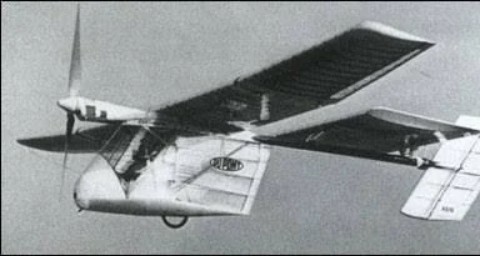
The Solar Challenger was a solar-powered aircraft designed by Paul MacCready’s AeroVironment. The aircraft was designed as an improvement on the Gossamer Penguin, which in turn was a solar-powered variant of the human-powered Gossamer Albatross. It was powered entirely by the photovoltaic cells on its wing and stabilizer, without even reserve batteries, and was the first such craft capable of long-distance flight. In 1981, it successfully completed a 163-mile (262 km) demonstration flight from France to England.
The Solar Challenger was designed by a team led by Paul MacCready as a more airworthy improvement on the Gossamer Penguin, directly incorporating lessons learned from flight testing the earlier aircraft. As with the Gossamer Penguin, construction was sponsored by DuPont in exchange for publicity for the company’s patented materials incorporated in the design. AstroFlight, Inc. supplied the motors and solar panels, designed by Robert Boucher. The plane’s wings carried 16,128 solar cells yielding a maximum solar power of 3,800 watts. It was flight tested in Western USA in winter 1980–1981.

First flown on 6 November 1980, at Shafter, California, the Solar Changer then made several training flights including one of 90 minutes on 14 November 1980 reaching 1600 ft / 488 m. For these initial flights an electric battery was carried providing for an output of 3 hp for less than 30 minutes, the remainder of the flight using soaring techniques. Subsequently 15,000 solar cells were fixed to the wing and tailplane with the capability of producing similar power, and further flights were made in December 1980 including one of nearly 2 hrs and another to 3500 ft / 1067 m.

All flights to February 1981 were made by Janice Brown.

On July 7, 1981, the aircraft flew 163 miles from Pontoise – Cormeilles Aerodrome, north of Paris, France to Manston Royal Air Force Base in Manston, United Kingdom, staying aloft 5 hours and 23 minutes, with pilot Stephen Ptacek at the controls. Currently the plane is owned by the Smithsonian Institution’s Air and Space Museum.

The Solar Challenger was designed to be sturdier, more powerful, and more maneuverable than the Gossamer Penguin so as to be able to withstand sustained high-altitude flight and normal turbulence. It was over three times as heavy (without pilot) as the Gossamer Penguin and had a shorter wingspan, but was proportionately more powerful, with electricity supplied by 16,128 solar cells powering two three-horsepower motors. The solar panels were directly affixed to the wing and large horizontal stabilizer, both of which had to be flat on top to accommodate them. The two motors, each 3 inches wide and 17 inches long and incorporating samarium-cobalt permanent magnets, operated in tandem on a common shaft to drive a single, controllable-pitch propeller. The design incorporated advanced synthetic materials with very high strength to weight ratios, including Kevlar, Nomex, Delrin, Teflon, and Mylar, all supplied by the aircraft’s sponsor, Dupont.

Powerplant: 1 × solar-powered electric motor, 2.75 hp (2 kW)
Wingspan: 47 ft 0 in (14.3 m)
Length: 29 ft 0 in (8.8 m)
Empty weight: 205 lb (90 kg)
Gross weight: 350 lb (159 kg)
Maximum speed: 40 mph (64 km/h, 35 kn)
Service ceiling: 14,300 ft (4,360 m) demonstrated
g limits: +6, -3
Rate of climb: 150 ft/min (0.765 m/s)
Seats: 1

Electra EL-2 Goldfinch

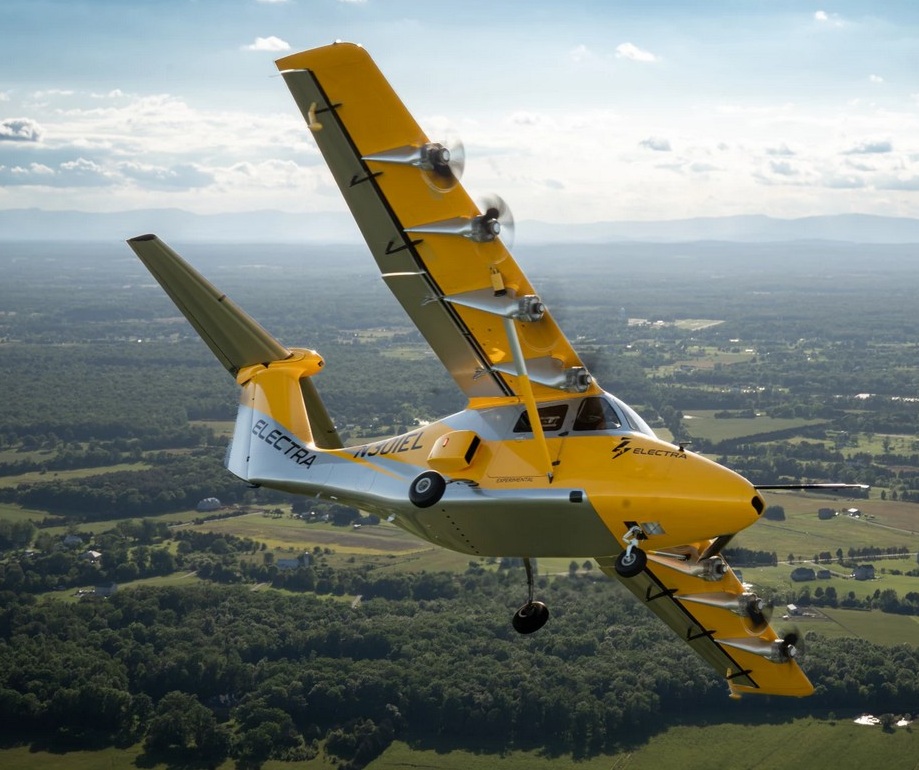
The Electra STOL (short take-off and landing) aircraft features eight electric props along the front edge of its wings. To help achieve the blown lift effect – which results in lift off at relatively low speeds of 35 mph (56 km/h) along a short runway – the aircraft sports large flaps at the rear edge of the wings.

The eight small-diameter, five-bladed propellers along its wing run on quiet electric motors, fed by a big enough lithium battery pack to allow fully-electric takeoff and landing, and quiet flight over populated areas. Electra promises just 75 decibels at a distance of 300 ft (91 m).

In August 2025 Electra demonstrated at Virginia Tech take off and land using an airfield that’s one-tenth the size of a standard runway demonstrating “blown lift” aero and hybrid-electric propulsion capabilities. Power for take-off is provided by onboard batteries, with the system switching to a small turbogenerator for cruising or topping up the batteries while in the air.

The company has been test flying the two-seat EL2 prototype since at least May 2024, but the flights at Virginia Tech – in partnership with Surf Air Mobility – represent the first series of public demonstrations.

Though the prototype did take-off and land utilizing a 300 x 75-ft (91 x 23-m) paved surface at the expansive Blacksburg campus, the EL2 showed off its flexibility by tackling other surfaces too. These included an access road in cooperation with Virginia’s Department of Transportation, and a grass field at the university’s Corporate Research Center.

The company has notched up more than 2,200 orders from over 60 operators around the globe, and is looking to start commercial flights of the EL9 Ultra Short nine-passenger aircraft by 2029.

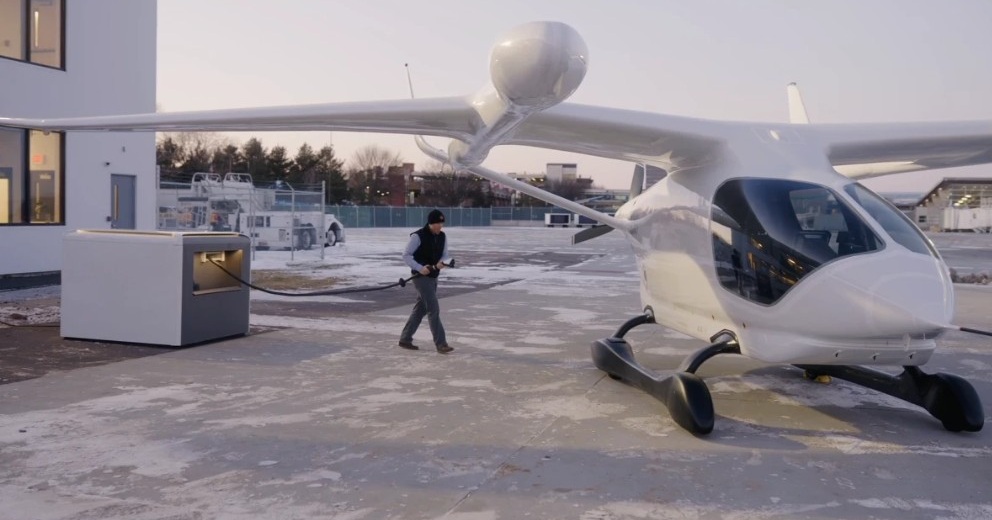
Beta Technologies Alia

Alia-250

The Alia-250 was inspired by an Arctic tern and features a 50-foot (15-m) wingspan and an in-house-built electric propulsion system powered by high-density lithium batteries. Beta estimates a 250-mile (402-km) range and top speed of 138 mph (222 km/h).

In 2021 Beta Technologies received the very first military airworthiness approval for manned electric aircraft flight, meaning the Air Force was confident enough to put its own pilot in the seat and take flight. A few months ago, Beta delivered the Alia platform (in conventional takeoff and landing/CTOL form) to the US Air Force at Florida’s Eglin Air Force Base.

Beta completed a full transition from VTOL hover to wing-borne cruise, and then back to hovering for landing, becoming the first company ever to demonstrate that feat with a pilot on board. Beta test pilot Nate Moyer took the helm at New York’s Plattsburgh International Airport, guiding the Alia-250 straight upward off the ground via its four horizontal electric propellers in April 2024.

Once it was high enough, the rear propeller kicked in, and as the aircraft gained enough speed for the wing to take over, the wing-top propellers slowed to a stop for a short cruise flight. Shortly thereafter, it turned around, the four propellers flipped back on, and it glided down toward the airstrip before coming to a mid-air halt and gently dropping straight down for the landing.

Alia-250

This ALIA CX300 electric conventional take-off and landing aircraft has kicked off Norway’s Test Arena for Zero & Low Emission Aviation after completing a weeks-long tour of major European countries in 2025.

ALIA CX300

In 2025 BETA Technologies has delivered its ALIA CX300 electric CTOL to the company’s first customer. The short-hop passenger aircraft will now be used to evaluate use cases and possible routes for zero-emission operation in the Nordic region.

Unlike its electric vertical take-off and landing counterpart – the A250 – the ALIA CX300 gets in the air and lands using a runway. It’s designed to carry five passengers plus a pilot over short distances between airports, and features an electric motor driving a single five-blade prop to its rear. According to the spec sheet, its onboard batteries should be good for more than 300 nautical miles between one-hour top-ups.

ALIA CX300

The aircraft’s very first passenger pioneers were flown from Long Island to the John F. Kennedy International Airport, staying in the air for 45 minutes. Now the first ALIA CX300 has been delivered to Bristow Norway AS, a subsidiary of US helicopter operator, the Bristow Group.

The delivery to Stavanger Airport in Western Norway’s Rogaland county also marks the end of a weeks-long 6.976-km (4,335 mile) demonstration tour of seven EU countries by the aircraft, which began in Ireland and closed in Norway. It also signals the start of operations for Norway’s Test Arena for Zero & Low Emission Aviation.

The first test flight by a BETA-trained Bristow pilot was also undertaken at the launch event, following on-site instruction at BETA’s Vermont headquarters recently. Bristow pilots and aircraft maintenance personnel will now undertake further demonstration flights over the next six months, in cooperation with Avinor and the Civil Aviation Authority of Norway, as part of a “six-month regulatory sandbox evaluation project.”

BETA ALIA CX300

The battery-electric aircraft, manufactured by BETA, seats two crew and up to 5.6 cubic metres of cargo on missions for up to approximately 398km.

The ALIA CX300 first took off in New Zealand on 17 October 2025, flying in New Zealand from Tauranga to Hamilton after a sunrise blessing ceremony.

Skyfly Technologies Axe

Aviation history was made by Banbury based Skyfly Technologies in 2025, when its Axe aircraft travel from Turweston Aerodrome in Northamptonshire to Bicester Airfield in Oxfordshire, and back again. Europe’s first airfield-to-airfield flight of a fully electric vertical take-off and landing (eVTOL) aircraft.
Skyfly’s chief technical officer and test pilot, Dr William Brooks, piloted the prototype craft for the test flight.
The outbound journey took 12 minutes and the return took eight minutes and Mr Brooks said the aircraft “performed very well”.
He added: “It has a gentle feel in turbulence, giving the impression of more span because of the motor masses at the tips.
“The comfort, outstanding view and lack of noise make for enjoyable flying.”
The aircraft can take off and land both vertically and conventionally and received the necessary UK Civil Aviation Authority clearance for flying in 2024.
The Axe features eight electric motors – two on each wingtip enclosed in a single nacelle – powered by high-capacity lithium batteries housed within the fuselage. These batteries are swappable and removable for convenient charging.
The prototype has now been readied for a trip to the United States at the end of July, where it will appear at EAA AirVenture in Oshkosh – an event for experimental aircrafts.

Specifications:

Aircraft type: eVTOL passenger aircraft (and has a hybrid-electric VTOL option)
Piloting: 1 pilot
Capacity: 1 pilot and 1 passenger (or 2 passengers when the aircraft becomes autonomous)
Cruise speed: 161 km/h (100 mph)
Range (batteries): 161 km (100 miles)
Range (with generator, a range extender): 322 km (200 miles)
Flight time: Unknown
Empty Weight: 182 kg (401 lb)
Maximum payload: 172 kg (379 lb)
Maximum takeoff weight: 600 kg (1,323 lb)
Propellers: 4 propellers
Electric motors: 8 electric motors
Power source: Batteries or batteries with a generator to produce electricity
Fuselage: Carbon fiber composite
Window: Canopy over cockpit
Wings: Canard wings (2 wings)
Tail: 1 rudder
Landing gear: Fixed tricycle wheeled landing

Alef Aeronautics eVTOL A

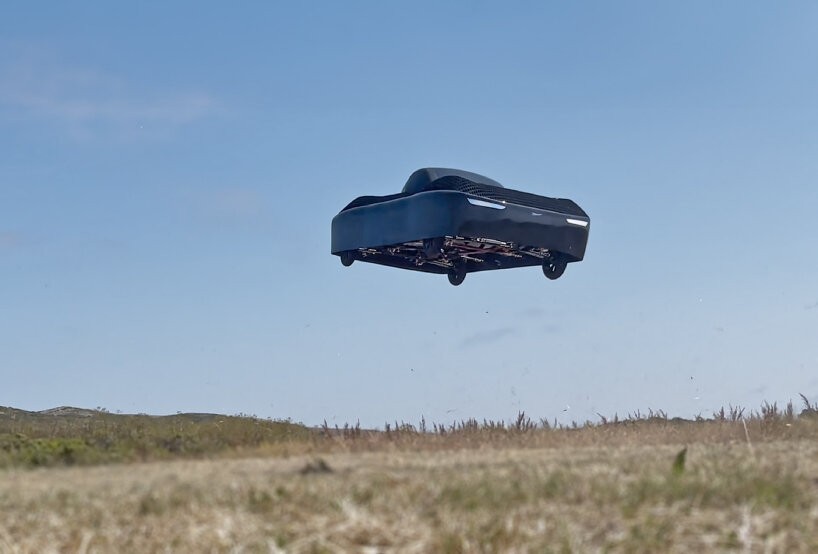
Alef Aeronautics offers its own eVTOL A flying car, a concept flying car that would have a driving range of 200 miles and a flight range of 110 miles.

The design has a car-like exterior, and does not have any exposed propellers for added safety and to drown the loud whirring sounds and also save space. The Alef flying car is all-electric and anchor key components such as Distributed Electric Propulsion (DEP) – which helps the airflow be evenly distributed – triple to octuple redundancy of all key components, real-time and pre-flight diagnostics to always keep the drivers informed of their drive or flight, glide landing, and even a full-vehicle parachute in case of emergencies.

Alef Aeronautics shares in the release that the 300,000 USD (2025) Alef flying car would be developed using the latest hardware and software technology and end up being lightweight packs with long-lasting components, software simulators and analysis, and rigorous flight testing. The team is planning to begin production and deliver the first batch in 2025.

Alef Aeronautics’ drivable flying car takes its maiden flight in a city field. On February 19th, 2025, its test model takes off, even flying over another vehicle. In a LinkedIn post, Alef Aeronautics CEO Jim Dukhovny writes that the video showcasing the flight is ‘the first documented, verifiable flight of a flying car (an actual car, with vertical takeoff, non-tethered).’

Maiden flight on February 19th, 2025

The vehicle comes with a gimbaled cabin design to keep it stable as it moves through the air as well as an elevon system to control the vertical and horizontal movement of the Alef Aeronautics flying car and its tilting.

Presently, the Alef Aeronautics flying car is the first vehicle with vertical takeoff to receive FAA permission to fly in the US (FAA Special Airworthiness Certificate).

While the Alef Model A is the commercial version, the test model is the Alef Model Zero. It is solely used for research and development in the hopes of becoming the actual Alef Model A.

Gallery

Archer Midnight eVTOL

The company’s Midnight flagship air taxi broke cover in November 2022, sporting 12 rotors mounted along its wings – six dual-blade types at the rear locked in upward configuration plus six five-blade versions to the front capable of tilting for forward flight. Archer was aiming for top speeds of 150 mph (241 km/h) and a per-charge range of 100 miles (161 km).

By early 2023, a Midnight prototype was built and ready start test flights, which began in October. Its first transition from vertical hover to forward flight followed in July of last year, but May 2025 the pilot seat has been empty.

Archer’s five-seat Midnight air taxi rose vertically from the tarmac in the latter half of 2023, following years of testing and tweaking of prototypes like the two-seat Maker demonstrator.

In May 2025 Archer was testing the piloted conventional take-off and landing (CTOL) capabilities of its Midnight aircraft. Archer has released video footage of the first flight of its Midnight eVTOL with a pilot at the controls, though the aircraft rolled down a runway to take off rather than using its rotors to lift it vertically.

With chief test pilot Jeff Greenwood in the cockpit taking the aircraft prototype down a runway and up into the air to “demonstrate the robustness of Midnight’s landing gear” during conventional take-off and landing operations.

Chief Test Pilot Jeff Greenwood at the controls of the Midnight aircraft

The pilot managed to get the eVTOL in CTOL testing mode up to 125 mph (over 200 km/h) and reached a maximum altitude of more than 1,500 ft (~460 m) above ground level.

Yvon Perret EViva

The Yuneec EViva was originally designed by Martin Wezel in conjunction with the Czech company Composit and initially intended to be powered by a 50 hp (37 kW) Rotax 503 two-stroke or 60 hp (45 kW) HKS 700E four-stroke powerplant.

The aircraft was designed to comply with the Fédération Aéronautique Internationale microlight rules. It features a cantilever wing, a T-tail, a two-seats-in-side-by-side configuration enclosed cockpit under a bubble canopy, retractable monowheel gear with wing tip and tail casters, and a single electric motor in tractor configuration driving a folding propeller.

The design was purchased by Yuneec, development shifted to China and the aircraft was adapted for electric power.

The aircraft is made from composites. Its 17 m (55.8 ft) span wing has an area of 14.2 m2 (153 sq ft) and upper wing telescopic air brakes as well as flaps. The wing is derived from the Wezel Apis 2 wing. The standard engine fitted is the 40 kW (54 hp) Yuneec Power Drive 40 electric motor, controlled by a Yuneec Power Block 40 400 Amp power controller and powered by two Kokam Lithium polymer battery packs of 31 Ampere-hours (Ah) each (62 Ah total). The engine weighs 23 kg (51 lb), the controller 7 kg (15 lb) and the batteries weigh 67 kg (148 lb) in total. The propeller folds aft into the engine cooling vents when not in use and deploys automatically on engine start. The batteries are charged by a Yuneec E-Charger that can run on 110-240 volts and charge in 3–4 hours.

First flown in 2012, the projected price in 2011 was €91,000.

Powerplant: 1 × Yuneec Power Drive 40 electric motor, 40 kW (54 hp)
Battery packs: two Kokam Lithium polymer packs of 31 Ah each (62 Ah total)
Propeller: 2-bladed folding carbon fibre
Prop diameter: 1.60 m (5 ft 3 in)
Wingspan: 17 m (55 ft 9 in) / 11.6 m with wing tips removed
Wing area: 14.2 m2 (153 sq ft)
Length: 6.9 m (22 ft 8 in)
Height: 2.65 m (8 ft 8 in)
Empty weight: 225 kg (496 lb)
Gross weight: 472.5 kg (1,042 lb)
Maximum speed: 180 km/h (112 mph; 97 kn)
Cruise speed: 160 km/h (99 mph; 86 kn)
Stall speed: 65 km/h (40 mph; 35 kn) flaps down
Never exceed speed: 230 km/h (143 mph; 124 kn)
Endurance: 1.3 hours on batteries
Maximum glide ratio: 38:1
Rate of sink: 0.65 m/s (128 ft/min) at 85 km/h (53 mph)
Wing loading: 33.3 kg/m2 (6.8 lb/sq ft)
Crew: one
Capacity: one passenger

Yuneec E-430 / GreenWing International GW430

The Yuneec International E430 is a Chinese two-seat electric aircraft designed for commercial production by electric model aircraft manufacturer Yuneec International.

The E430 is a two-seat, V tailed, composite aircraft with a high-aspect ratio wing. Take-off speed is 40 mph, cruise speed is 60 mph, and max speed is 95 mph.

The company claims that the battery packs have an expected lifespan of 1500 hours and cost US$7000 each, with the aircraft carrying 3-5 battery packs, giving two to two and half hours endurance. The batteries can be recharged in 3–4 hours from a 220v outlet.

The aircraft was being developed as a kit aircraft for the US market. The development of the E430 was being funded entirely by Yuneec CEO Tian Yu.

The aircraft was first flown on 12 June 2009 from the Yuneec factory near Shanghai, China, and then shipped for further testing to Camarillo, California. On 14 July 2009 the prototype aircraft was registered in the USA as N386CX and on 18 July 2009 it was given a Certificate of Airworthiness by the Federal Aviation Administration and further test flights were carried out, totalling 22 hours. The prototype E430 was then shipped by truck to Wisconsin and displayed at EAA AirVenture Oshkosh in July 2009. It was also on display at that venue in summer of 2010.

In July 2009 the company estimated that the price for a commercially available light sport aircraft production version of the E430 would be US$89,000.

At AirVenture 2010 the company announced that it would start accepting orders for the aircraft after the show. At that date the aircraft was advertised as having an endurance of 2.25 to 2.5 hours with a useful load of 390 lb (177 kg). The E430 was named the winner of the Lindberg prize for electric aircraft at AirVenture in 2010. The Lindbergh Electric Aircraft Prize (LEAP) was awarded by Erik Lindbergh, the grandson of Charles A. Lindbergh and Anne Morrow Lindbergh. In the same year it was named Brit Insurance Design of the Year in the transport category. Deliveries were initially scheduled for late 2011, but by the end of 2012 there was no indication that more than prototypes had been completed.

Yuneec International, created GreenWing International and in June 2013 it was announced that their GW280 (eSypder) and GW430 (e430) airplanes will be produced, marketed and supported by GreenWing International, however that company went out of business in about 2014.

By December 2012 a total of two examples had been registered in the United States with the Federal Aviation Administration. The first one was the initial prototype shipped to the US, registered in the Experimental – Exhibition category on 14 July 2009, although its registration expired on 31 March 2012. The second was registered in the Experimental – Research and Development category on 26 January 2011 to Flying Tian of Monterey Park, California.

E430
Engine: 1 × Yuneec Power Drive 40, 40 kW (54 hp)
Batteries: Yuneec OEM Lithium Polymer, 13 kg (28.6 lbs), 66.6V (30 Ah) each
Propeller: 2-bladed fixed pitch
Length: 6.98 m (22 ft 11 in)
Wingspan: 13.8 m (45 ft 3 in)
Wing area: 11.37 sq.m (122.4 sq ft)
Empty weight: 250 kg (551 lb) with batteries
Gross weight: 470 kg (1,036 lb)
Maximum speed: 150 km/h (93 mph; 81 kn)
Cruising speed: 90 km/h (56 mph; 49 kn)
Stall speed: 70 km/h (43 mph; 38 kn)
Range: 227 km (141 mi; 123 nmi)
Maximum glide ratio: 25:1
Rate of climb: 3.5 m/s (690 ft/min)
Wing loading: 41.3 kg/sq.m (8.5 lb/sq ft)
Seats: 2

Yuneec eSpyder / GreenWing International GW280

The Flightstar is a large family of single and two-seat, high wing, single engined kit aircraft that was produced by Flightstar Sportplanes of South Woodstock, Connecticut. In 2009 the rights, tooling and parts inventory were sold to Yuneec International of China when Flightstar Sportplanes’ business was wound up.

In April 2014 Yuneec International of China debuted its eSpyder electric at the AERO event in Germany. The eSpyder is a reworked Flightstar ultralight from the 1980s. Flight Design USA’s Tom Peghiny, producer of the Flightstar for many years, sold the design to Yuneec but continued helping with development. The eSpyder, has completed Germany’s DULV aviation standard.

In July 2009 a new single seat model was exhibited at EAA AirVenture Oshkosh. The aircraft is intended to be developed into a commercially available kit and forecast to be available for under US$25,000.

The e-Spyder is an electric-powered and beefing up (enlarging and strengthening) version of the Flightstar Spyder. The aircraft replaces the Spyder’s two-stroke engine with a Yuneec Power Drive 20 20 kW / 27 hp electric motor and two 28 lb (13 kg) Lithium polymer battery packs which provide a 40-minute endurance.

e-Spyder

The E-Spyder, a single seat electric powered aircraft featuring the PowerDrive 24 propulsion system integrating the Motor, Motor Controller, 75 Volt Battery, and Charger, received the world’s first type certification for an electric aircraft from Deutschen Ultraleichtflugverbandes (DULV) E.V in 2013.

Yuneec International created GreenWing International to further develop and market their GW280 (eSypder) and GW430 (e430) airplanes. GreenWing International went out of business in about 2014.

GreenWing International had announced the release of its first 50 eSpyder single-seat electric planes, which were to be sold as build-it-yourself kits for for under US$40,000. The company was to ship 25 eSpyders in the United States at a cost of US$39,990. Another 25 were to be sold in Europe for €34,990 each.

Power: PowerDrive 24, 24 kW / 32 hp
Battery: 75 Volt, 13-kWh lithium
Wingspan: 10.1 m / 33.1 ft
Length: 5.9 m / 19.4 ft
Height: 2.4 m / 7.9 ft
Empty weight: 186 kg / 410 lb
Max cruise: 68 mph / 109 km/h
Economy cruise: 38 mph / 61 km/h
Standard flight time: 60 – 90 min
Battery recharging: 2 – 3 hr