Grumman LM / Lunar Module

The Apollo Lunar Module (LM /ˈLEM), originally designated the Lunar Excursion Module (LEM), was the lunar lander spacecraft that was flown between lunar orbit and the Moon’s surface during the United States’ Apollo program. It was the first crewed spacecraft to operate exclusively in the airless vacuum of space, and remains the only crewed vehicle to land anywhere beyond Earth.

Everyone called the vehicle the ‘LEM’ throughout most of its development life until May 1966 when a memo from the NASA Project Designation Committee officiously changed the name simply to ‘LM’.

Structurally and aerodynamically incapable of flight through Earth’s atmosphere, the two-stage Lunar Module was ferried to lunar orbit attached to the Apollo command and service module (CSM), about twice its mass. Its crew of two flew the Lunar Module from lunar orbit to the Moon’s surface. During takeoff, the spent descent stage was used as a launch pad for the ascent stage which then flew back to the command module, after which it was also discarded.

In November 1962 Grumman won the contract for the Lunar Module. Overseen by Grumman, the LM’s development was plagued with problems that delayed its first uncrewed flight by about ten months and its first crewed flight by about three months. Regardless, the LM became the most reliable component of the Apollo–Saturn space vehicle. The total cost of the LM for development and the units produced was $21.65 billion in 2016 dollars, adjusting from a nominal total of $2.29 billion using the NASA New Start Inflation Indices.
Ten lunar modules were launched into space. Of these, six were landed by humans on the Moon from 1969 to 1972. The first two flown were tests in low Earth orbit: Apollo 5, without a crew; and Apollo 9 with a crew. A third test flight in low lunar orbit was Apollo 10, a dress rehearsal for the first landing, conducted on Apollo 11. The Apollo 13 lunar module functioned as a lifeboat to provide life support and propulsion to keep the crew alive for the trip home, when their CSM was disabled by an oxygen tank explosion en route to the Moon.

The six landed descent stages remain at their landing sites; their corresponding ascent stages crashed into the Moon following use. One ascent stage (Apollo 10’s Snoopy) was discarded in a heliocentric orbit after its descent stage was discarded in lunar orbit. The other three LMs were destroyed during controlled re-entry in the Earth’s atmosphere: the four stages of Apollo 5 and Apollo 9 each re-entered separately, while Apollo 13’s Aquarius re-entered as a unit.

Height: 9 ft 3.5 in (2.832 m)
Width: 14 ft 1 in (4.29 m)
Depth: 13 ft 3 in (4.04 m)
Mass, dry: 4,740 lb (2,150 kg)
Mass, gross: 10,300 lb (4,700 kg)
Crew cabin volume: 235 cu ft (6.7 m3)
Habitable volume: 160 cu ft (4.5 m3)
Crew compartment height: 7 ft 8 in (2.34 m)
Crew compartment depth: 3 ft 6 in (1.07 m)
Atmosphere: 100% oxygen at 4.8 psi (33 kPa)
Water: two 42.5 lb (19.3 kg) storage tanks
Coolant: 25 pounds (11 kg) of ethylene glycol / water solution
Thermal Control: one active water-ice sublimator
RCS propellant mass: 633 lb (287 kg)
RCS thrusters: Sixteen × 100 lbf (440 N) in four quads
RCS propellants: Aerozine 50 fuel / Dinitrogen tetroxide (N2O4) oxidizer
RCS specific impulse: 290 s (2.8 km/s)
APS propellant mass: 5,187 lb (2,353 kg) stored in two 36-cubic-foot (1.02 m3) propellant tanks
APS engine: Bell Aerospace LM Ascent Engine (LMAE) and Rocketdyne LMAE Injectors
APS thrust: 3,500 lbf (16,000 N)
APS propellants: Aerozine 50 fuel / Dinitrogen Tetroxide oxidizer
APS pressurant: Two 6.4 lb (2.9 kg) helium tanks at 3,000 pounds per square inch (21 MPa)
APS specific impulse: 311 s (3.05 km/s)
APS delta-V: 7,280 ft/s (2,220 m/s)
Thrust-to-weight ratio at liftoff: 2.124 (in lunar gravity)
Batteries: Two 28–32 volt, 296 ampere hour Silver-zinc batteries; 125 lb (57 kg) each
Power: 28 V DC, 115 V 400 Hz AC
Crew: 2
Goodyear Type ZRS / USS Macon / USS Akron

ZRS-4 Akron

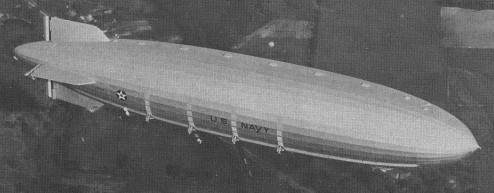
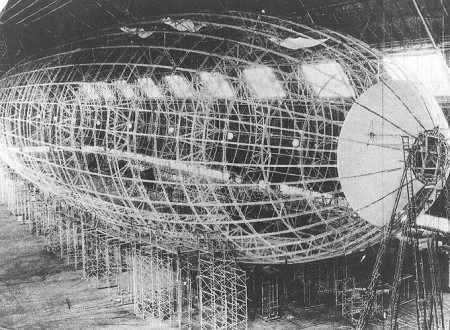
As an extension of the Type ZR programme, the Navy was granted authority in 1926 to procure two large American-built rigid airships for long range scouting purposes. A design competition was announced which was subsequently won by Goodyear Zeppelin. In 1928 the company began the construction of the first ship, the ZRS 4, U.S.S. “Akron”, of 612 million cubic feet capacity. It was an advanced airship design in many ways, being conceived from the start to make use of safe non inflammable helium gas as the lifting agent. This made it possible to contain, within its length of 785ft, a hangar, 60ft by 75ft, capable of housing four small scout or fighter type aircraft. These could be launched and recovered in flight by means of a retractable trapeze device beneath the airship that was engaged by a hook on the aeroplane. The airship was powered by eight German built 560 h.p. Maybach engines which were mounted within the hull and drove their propellers through shaft drives and gearing. These propellers could he used not only to provide normal longitudinal thrust,’ forward and reverse, but could also be swivelled vertically upwards or downwards to give greater control of the ship during take off and landing.

USS Akron under construction in the Goodyear-Zeppelin airdock in Akron, Ohio

“Akron” was commissioned on October 27, 1931, and made numerous long flights, experimenting with her unique aircraft squadron carried on board, and engaging in exercises with surface vessels of the U.S. Navy. Her range of over 5,000 miles and her complement of four Curtiss F9C 2 “Sparrowhawks” added a new dimension to naval air operations; the flying aircraft carrier. But the success was to be short lived. Stationed at Lakehurst, “Akron” made 73 flights before being lost at sea in a violent storm on the night of April 34, 1933, with the loss of all but three of her crew. She had completed 1,695 flying hours.

N2Y-1 training plane beneath trapeze and T-shaped opening of Akron’s hangar deck

Just two months later, on June 23, 1933, her sister ship, the ZRS 5 U.S.S. “Macon”, was commissioned and went into service at Naval Air Station Sunnyvale, California. (Moffett Field). Apart from some minor modifications, she was a copy of ZRS-4, and carried the same number of Curtiss F9C 2 fighters. The experiments and the development of new operational techniques were resumed with good results and the future looked bright for the naval rigid airship.
While engaged on a naval exercise off the coast of California on February 12, 1935, “Macon” suffered a structural failure of the dorsal fin which resulted in the rupture of several gas cells in the stern of the ship. The airship began to descend, and despite all the efforts of the crew to regain control, she hit the sea and sank forty minutes later. Thanks to the safety precautions taken after the loss of “Akron”, adequate survival equipment was on board, and of the 83 crew only two were lost.
This second major accident did not immediately bring to an end the U.S. Navy’s rigid airship programme. A new training rigid of 3 million cubic feet (ZRN) was planned for service in 1938 40, and a giant 912 million cubic feet design, (ZRCV), capable of carrying nine Douglas Northrop BT 1 dive bombers, was projected in 1937. In the event no funds were made available to build these ships, but as late as 1940 Goodyear were proposing 10 million cubic feet ships for use by the Navy. These were to be built in three forms; a hospital version (G.A.C. 1940 project number GZ 1); a carrier version (GZ 2); and a cargo version (GZ 3). Political and military considerations ruled against such projects being proceeded with, although some interest was shown in a revival of the ZRCV strike aircraft carrier concept in 1942.

Gallery

XRS 5 U.S.S. “Macon”
Engine: 8 x 560 h.p. Maybach VL II.
Length: 785ft.
Maximum Diameter: 133ft.
Volume: 6,500,000 cu ft (95% full).
Maximum speed: 87 mph.
Cruising speed: 63 mph.
Range: 5,940 miles at 63 m.p.h. / 7,268 miles at 53 m.p.h.
Endurance: 108 hours at 63 m.p.h. / 158 hours at 53 m.p.h.
Fuel: 16,000 Imp.Gal.
Useful load: 160,644 lb.
Total number of flights: 54.
Total flight hours: 1,798.2.

Gasturbine101 The Swarm

A man living in the UK known only as “Gasturbine101” created a 54-propeller drone not only capable of sustaining ordinary flight, but sustaining flight with him on board.

The drone contains 54 counter-rotation propellors and six grouped control channels with Hobbyking KK2.15 stabilization. The craft’s maximum takeoff weight is around 148 kg (326 lbs) while possessing the ability to sustain flight for roughly ten straight minutes. Power is approximately 22KW.

The Swarm cost about £6,000 to build and is powered by four cell batteries.

There is a flaw in the design of the vehicle. The large number of props running at high speed means the net torque reactions are relatively low, so the craft has little yaw authority. It probably needs a tail rotor for spot turns.

FFG Prag Fg227

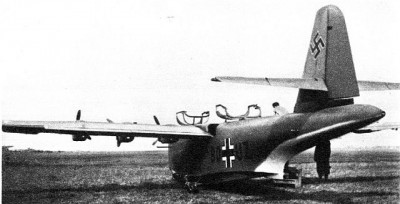
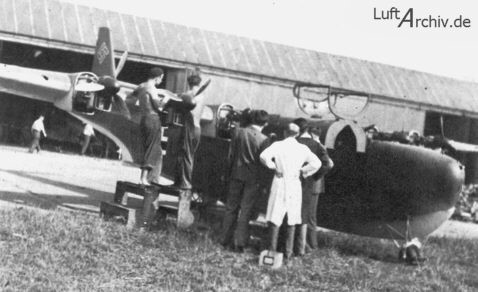
The quarter scale FFG Prag Fg227 was powered by 6 ILO 2 stroke engines rated at 21hp each. It was a ¼ scale BV.238 built by students at Prag under the direction of Dipl.Ing. Ludwig Karch.

A quarter-scale testbed called the FGP 227, registered as BQ+UZ, was deemed necessary to test the aerodynamics and water handling.

Intended to allow flight tests to commence from the manufacturers airfield, the FGP 227 refused to take-off from the grass airfield.

The aircraft was dismantled and transported to Erprobungsstelle See, Travemünde (E-Stelle – flying boat testing station). During transport French prisoners of war loading the wing onto flat-bed trucks allowed it to fall from a crane causing damage which was not repaired until September 1944.

Flight tests commenced in September 1944 as soon as the repairs were completed, but all six engines stopped due to fuel starvation soon after take-off, resulting in a heavy landing on the water. The FGP 227 was again repaired after which the aircraft flew several more times. By this time construction and testing of the BV 238 had started, so no useful data was gleaned from the programme.

Powerplant: 6 × ILO F 12/400 air-cooled two-stroke piston engines, 15.7 kW (21.1 hp) each
Propellers: 3-bladed fixed pitch propellers
Wingspan: 15.25 m (50 ft 0 in)
Length: 11.95 m (39 ft 2 in)
Height: 3.54 m (11 ft 7 in)
Wing area: 24.24 sq.m (260.9 sq ft)
Empty weight: 1,250 kg (2,756 lb)
Gross weight: 1,640 kg (3,616 lb)
Crew: 2

Entwicklungsring Sud Arbeitsgemeinschaft / EWR VJ-101C

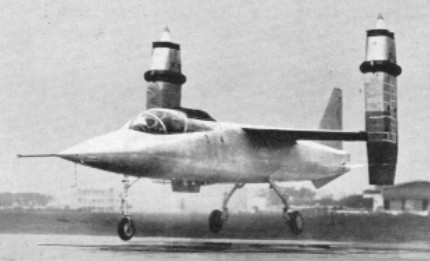
In 1959 the design teams of the German companies Bolkow, Heinkel and Messerschmitt were formed into a consortium named Entwicklungsring Sud to develop a Mach 2 VTOL interceptor for the Federal German defence ministry. Heinkel left the consortium in 1964 and in the following year it was re-formed as a company with the title Entwicklungsring Sud GmbH, EWR.

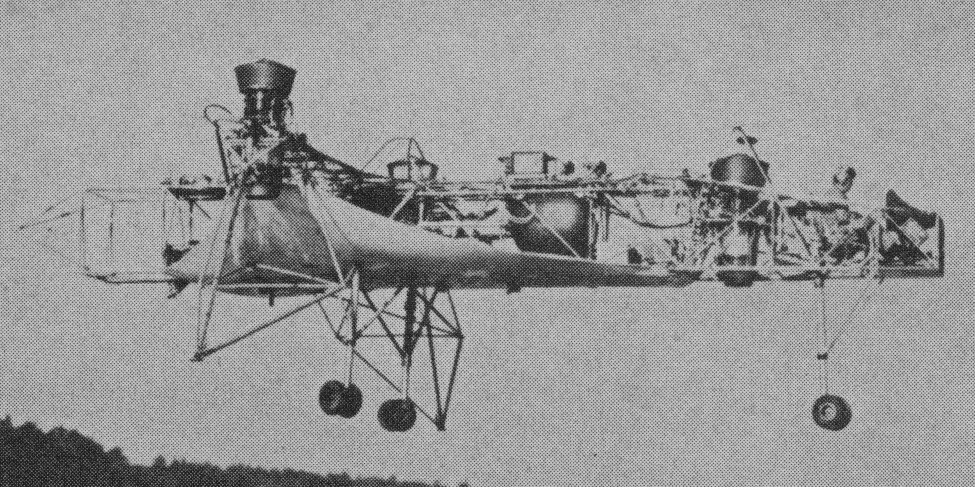
115 foreign companies’ participed including 35 in England, 60 in the US and 20 in France. A test rig built had three 2200 lb thrust Rolls-Royce engines installed in the same geometric arrangement as the VJ-101. Latter two 2759 lb thrust Rolls-Royce RB 145s in each of the two wing tip pods plus another two installed vertically in the fuselage were installed.

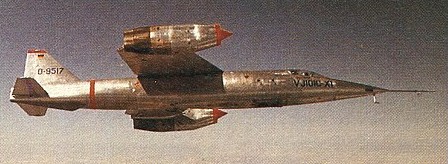
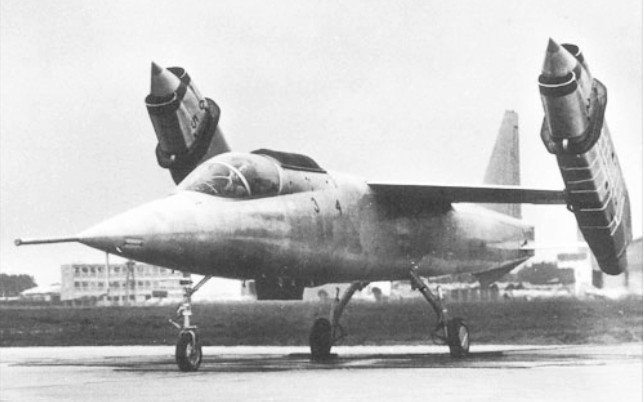
Two prototypes of the EWR VJ 101C single-seat experimental VTOL aircraft were built. Generally similar, they were both of high-wing monoplane configuration, primarily of light alloy construction, had retractable tricycle landing gear and accommodated the pilot in a pressurised cockpit, seated on a Martin-Baker ejection seat. Powerplant comprised six 2750-lb (1247-kg) thrust RB.145 turbojets, developed jointly by Rolls-Royce and MAN-Turbomotoren, with two mounted vertically in the fuselage, immediately aft of the cockpit, and two in a swivelling pod at each wingtip.

Those in the fuselage were used only for VTOL and low-speed flight, those in the wingtip pods for VTOL, low speed, transition from vertical to horizontal flight, and high-speed flight. Control of the aircraft in flight had been explored by a hovering rig powered by three Rolls-Royce RB.108 lift-jets, and by May 1963 this had made a total of 70 flights.

The VJ 101C X-1 prototype was flown for the first time in free hovering flight on 10 April 1963. It had exceeded a speed of Mach 1 several times before it crashed, following a vertical take-off, on 14 September 1964.

Flying the EWR VJ-101C Article

The VJ 101C X-2 differed by having afterburning engines in the wingtip pods, providing greater power (3550-lb / 1610-kg) for take-off and landing, and this made its first hovering flight on 12 June 1965. Four months later, on 22 October, the X-2 achieved the first full transitions from vertical to horizontal flight and vice versa, but development was discontinued soon after.

In absence of support by US Defence department or private manufacturers, the German government indicated in 1964 it won’t continue with a production version. Flight tests of the VJ.101C, including low supersonic advancement with afterburners fitted to the RB.145 engines, was continuing.

Production of a single-seat interceptor was planned, under the designation EWR VJ 101D, but this would have differed considerably from the research prototypes. VTOL lift would have been retained by a battery of Rolls-Royce/ MAN RB.162 lift-jets in the fuselage, but primary propulsion would have come from two Rolls-Royce/MAN RB.153 turbofans mounted in the rear fuselage, these relying upon thrust deflection for control purposes. None of these aircraft was built.

Gallery

EWR VJ 101C X-1
Engines; 6 x Rolls-Royce/MAN RB.145, 1247kg / 2750-lb
Max take-off weight; 6000 kg / 13228 lb
Wingspan; 6.61 m / 21 ft 8 in
Length; 15.70 m / 51 ft 6 in
Height; 4.13 m / 13 ft 7 in
Max. speed; 1.08M
Crew; 1

Dornier Do-31

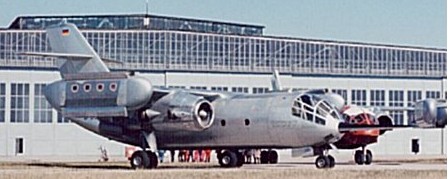
In 1962, the German Federal Ministry of Defense awarded Dornier a design contract for the Do 31 V/STOL transport aircraft. Under this experimental program, the production program covered a small and a large hovering rig for studying design principles, an airframe for structural testing, and a systems test stand for hydraulic and electric systems. Two prototypes were built and a third airframe was completed for static tests.
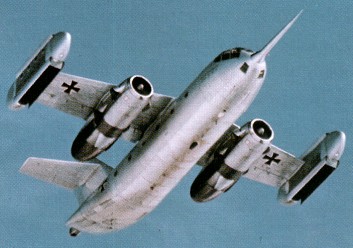
The Do 31 E-1 was equipped with two engines providing power for cruising flight as well as lift during takeoff and landing via vectored nozzles. To support the cruise engines in hover flight another eight engines were installed in nacelles at the wing ends. By tilting the cruise engine nozzles, the Do 31 was accelerated to the speed of approximately 250kph required for aerodynamic horizontal flight, and the eight lift-producing engines were stopped again after 20 seconds.
In the two prototypes, the main cabin was occupied by test equipment, but the fuselage volume of 1,765 cu ft (50.0 cu.m) would be equivalent, in a production version, to accommodation for 36 people. The Do 31 E was preceded by a small flying bedstead test rig, which in its one year’s flying made 247 test flights with nine different pilots; and then, in January 1967, by a larger rig which immediately preceded the first flight of the Do 31 E1 on 10 February 1967.

The first Do 31E1 first flew on 10 February 1967 with two Pegasus vectored-thrust turbofans in underwing nacelles and two removable wingtip pods each containing four 4400-lb (1996-kg) thrust RB.162 turbojets.
During its three year test programme, the Do 31 investigated problems associ¬ated with all weather flying and opera¬tional noise levels, as well as those con¬cerned with VTOL operation.
The Do 31, which established several world records during its ferry flight to the 1969 Paris Air Show.
The Do 31 E concluded its test flying programme in April 1970, exactly six years after Dornier’s first little test rig made its original flight.

Do-31 E3
Engines: Two 15.500 lb (7,000 kg) st Rolls Royce Bristol Pegasus 5 2 vectored thrust turbofan for propulsion, plus eight 4,400 lb (2.000 kg) st Rolls Royce RB.162 4D lift jets in wing tip pods.
Wing span: 59 ft 3 in (18.06 m).
Length: 68 ft 6 in (20.88 m).
Height: 8.53 m / 27 ft 12 in
Wing area: 57.0 sq.m / 613.54 sq ft
Gross weight: 60,500 lb (27,500 kg).
Empty weight: 22453 kg / 49501 lb
Max. cruising speed: 400 mph (650 km/h) at 20,000 ft (6,000 m).
Ceiling: 10515 m / 34500 ft
Accommodation: up to 36 fully equipped troops.
Crew: 2

Dornier Do-X

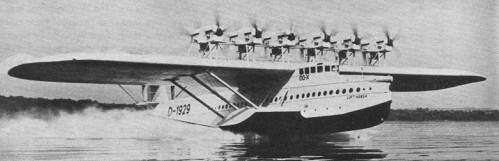
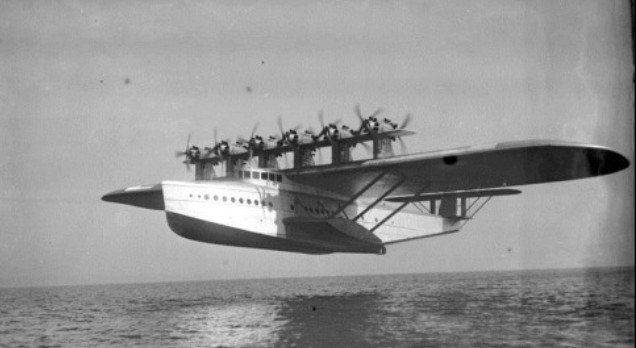
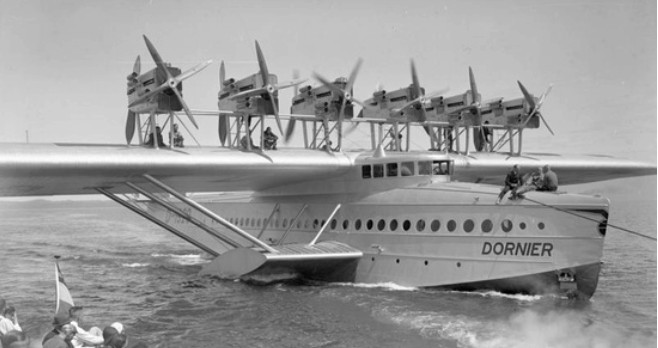
First conceived by Dr. Claudius Dornier in 1924, planning started in late 1925 and after over 240,000 work hours it was completed in June 1929. The Dornier Do X weighed 62 tonnes (61 tons) loaded, spanned 48 m (157 ft), had three decks, carry 100 passengers, and was powered by 12 Siemens built Bristol Jupiter radial engines of 550 hp mounted in tandem pairs atop a forest of struts above its wing. The three decks included a lounge, smoking room, bathroom, kitchen and dining room as well as individual sleeping cabins. Fully loaded, the maximum speed was only 160km/h.

The luxurious passenger accommodation approached the standards of transatlantic liners. On the main deck was a smoking room with its own wet bar, a dining salon, and seating for the 66 passengers which could also be converted to sleeping berths for night flights. Aft of the passenger spaces was an all-electric galley, lavatories, and cargo hold. The cockpit, navigational office, engine control and radio rooms were on the upper deck. The lower deck held fuel tanks and nine watertight compartments, only seven of which were needed to provide full flotation.

The Do X was financed by the German Transport Ministry and built in a specially designed plant at Altenrhein on the Swiss portion of Lake Constance. This, in order to circumvent the Treaty of Versailles which forbade any aircraft exceeding set speed and range limits to be built in Germany after World War I. The Dornier Do X was the largest, heaviest, and most powerful flying boat in the world when it was produced in 1929.

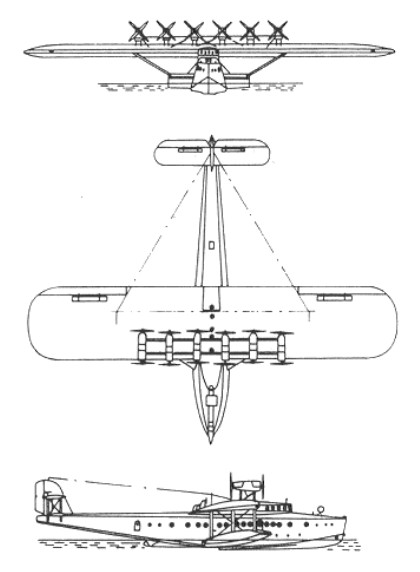
The Do X was built in Switzerland by Aktiengesellschaft fur Dornier-Flugzeuge at Altenrhein, was launched on 12 July 1929, and first flew off the Bodensee on 25 July 1929 with a crew of 14. The Do X is a semi-cantilever monoplane, an all-duralumin hull, with wings composed of a steel-reinforced duralumin framework covered in heavy linen fabric, covered with aluminum paint.

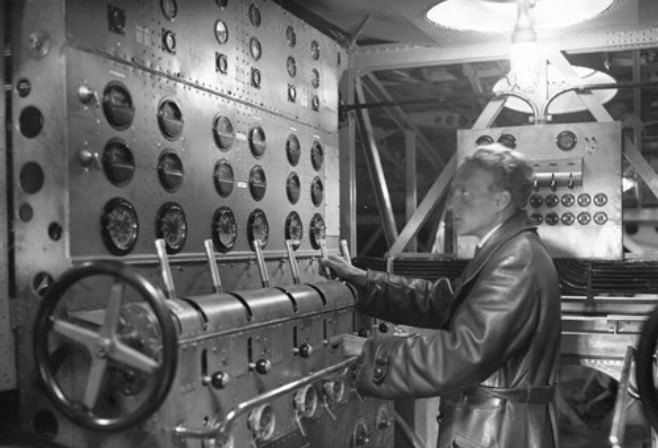
It was initially powered by twelve 391 kW (524 hp) Siemens-built Bristol Jupiter radial engines (six tractor propellers and six pushers), mounted in six tower nacelles on the wing. The nacelles are joined by an auxiliary wing whose purpose was to stabilize the mountings. The air-cooled Jupiter engines were prone to overheating and proved to only be able to lift the Do X to an altitude of 425 m (1,400 ft). The engines were supervised by an engineer, who also controlled the throttle. The pilot would ask the engineer to adjust the power, in a manner similar to that used on maritime vessels.

The engineer in the machine centre operated the throttles of the 12 engines

On its 70th test flight on 21 October 1929 there were 169 souls on board; 150 passengers (mostly production workers and their families, and a few journalists), 10 aircrew and 9 “stowaways”, who did not hold tickets. The flight broke the then world record for the number of persons carried on a single flight, a record that was not broken for another 20 years. After a takeoff run of 50 seconds the Do X slowly climbed to an altitude of only 200 m (650 ft). As a result of the ship’s size, passengers were asked to crowd together on one side or the other to help make turns. It flew for 40 minutes (Flug Revue claims it was the 42nd flight and lasted 53 minutes, and historical film shows “fliegt mit 170 personen”) at a maximum speed of 170 km/h (105 mph) before finally landing on Lake Constance.

But the Dornier was barely able to climb above 400 m (1312 ft) because of the poor cooling of the rear-mounted sextet of Jupiters, which sharply reduced their power output.

After completing 103 flights in 1930, the Do X was refitted with 455 kW (610 hp) Curtiss Conqueror water-cooled 12-cylinder inline engines. Only then was it able to reach the altitude of 490 m (1,610 ft) necessary to cross the Atlantic. Dr. Dornier designed the flying boat to carry 66 passengers long distance or 100 on shorter flights.

During a visit to England in 1930 it was piloted for 10 minutes by the Prince of Wales.

To introduce the airliner to the potential United States market the Do X took off from Friedrichshafen, Germany on 3 November 1930, under the command of Friedrich Christiansen for a transatlantic test flight to New York. The route took the Do X to the Netherlands, England, France, Spain, and Portugal. The journey was interrupted at Lisbon on 29 November, when a tarpaulin made contact with a hot exhaust pipe and started a fire that consumed most of the port side wing.

After sitting in Lisbon harbor for six weeks while new parts were fabricated and the damage repaired, the flying boat continued along the Western coast of Africa and by 5 June 1931 had reached the Capverdian Islands. Taking off from Las Palmas in the Canary Islands in high seas the hull took such a beating that another three months were wasted for repairs. Eventually it reached Natal, Brazil after crossing the Atlantic at an altitude of 6 m (20 ft) and with half her crew of 19 and much of her cargo of mail left be¬hind to save weight.

The new engines, while giving more power than the radials, burned fuel at the rate of 1820 litres (400 Imperial gallons) per hour, which meant that every non essential item had to be sacrificed. At length, on 27 August 1931, the Do X came to New York’s Battery to a ticker tape welcome, ten months after setting out from Germany.

Dornier Do X

The Do X and crew spent the next nine months there as its engines were overhauled, and thousands of sightseers made the trip to Glenn Curtiss Airport (now LaGuardia Airport) to tour the leviathan of the air. The economic effects of the Great Depression dashed Dornier’s marketing plans for the Do X, however, and it departed from New York on May 21, 1932 via Newfoundland and the Azores to Müggelsee, Berlin where it arrived on 24 May and was met by a cheering crowd of 200,000.

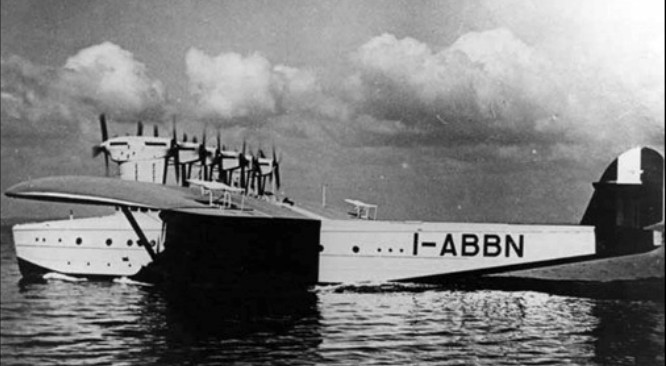
Two further Do Xs, the Umberto Maddalena and Alessandro Guidoni, were built for the Italian air force.

Germany’s original Do X was turned over to Deutsche Luft Hansa, the national airline at that time, after the financially strapped Dornier Company could no longer operate it. After a successful 1932 tour of German coastal cities, Luft Hansa planned a Do X flight to Vienna, Budapest, and Istanbul for 1933. The voyage ended after nine days when the flying boat’s tail section tore off during a botched, over-steep landing on a reservoir lake near the city of Passau. While the fiasco was successfully covered up and the Do X was repaired, it was then flown to Berlin, where it became the centerpiece of Germany’s new aviation museum Deutsche Luftfahrt-Sammlung at Lehrter Bahnhof, opened in 1936.

The Do X remained an exhibit until it was destroyed in an RAF air raid during World War II on the night of 23-24 November 1943, by 383 aircraft – 365 Lancasters, 10 Halifaxes, and 8 Mosquitos. Fragments of the torn off tail section are on display at the Dornier Museum in Friedrichshafen. While never a commercial success, the Dornier Do X was the largest heavier-than-air aircraft of its time, a pioneer in demonstrating the potential of an international passenger air service. A successor, the Do-XX, was envisioned by Dornier, but never advanced beyond the design study stage.

Gallery

Do XIa
Data from Flight 1930
Length: 40.1 m (131 ft 4 in)
Wingspan: 48 m (157 ft 5 in)
Height: 10.25 m (33 ft 7 in)
Wing area: 450 m² (4,844 ft²)
Empty weight: 28,250 kg (62,280 lb)
Max. takeoff weight: 56,000 kg (123,460 lb)
Engines: 12 × Curtiss Conqueror, 455 kW (610 hp)
Maximum speed: 211 km/h (131 mph)
Cruise speed: 175 km/h (109 mph)
Range w/max.fuel: 3600 km / 2237 miles
Range w/max.payload: 1100 km / 684 miles
Ceiling: 420 m / 1400 ft
Wing loading: 19.3 lb/sq ft (at 46 tons weight)
Crew: 10-14
Capacity: 66-100 passengers

Dassault Mirage IIIV-01

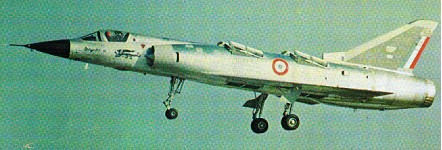
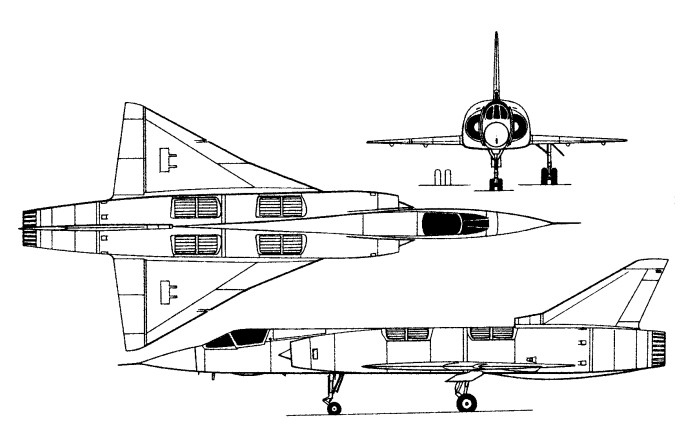
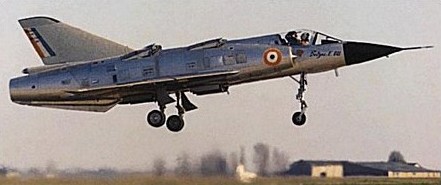
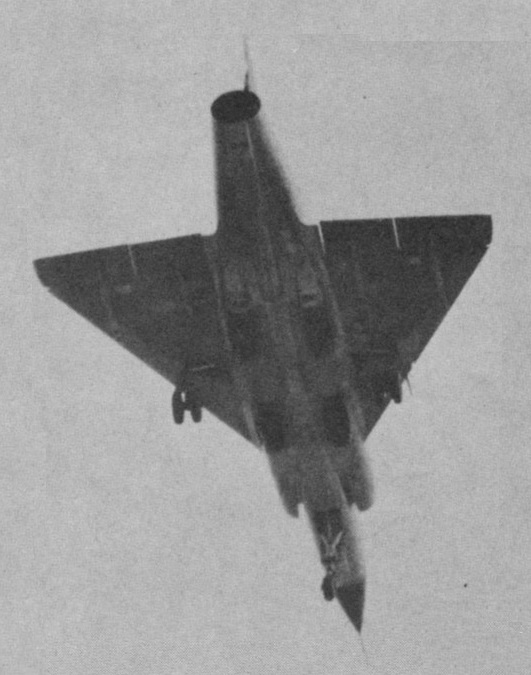
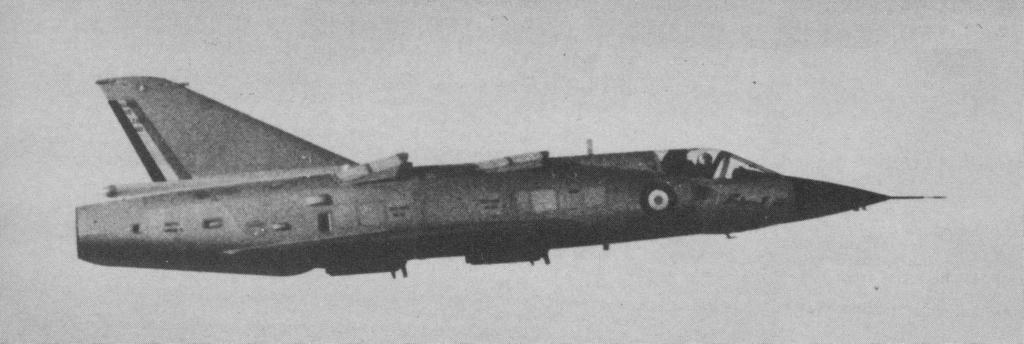
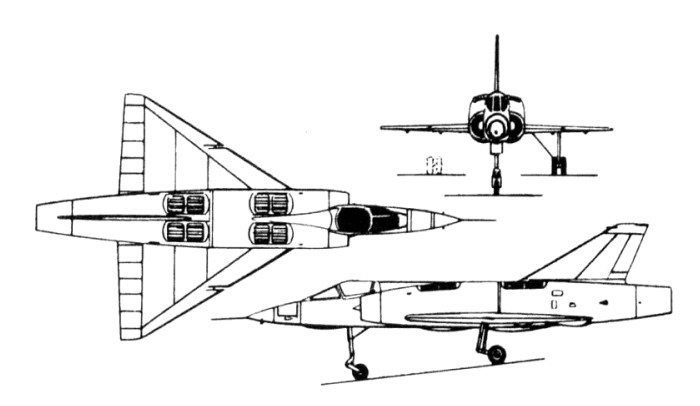
The Dassault Balzac test programme confirmed the viability of the lift/propulsion arrangement, and Dassault moved forward to the Mirage III-V based on the Mirage IIIE strike fighter with its fuselage lengthened to accommodate eight 3525-lb (1600-kg) thrust Rolls-Royce RB.162-1 lift jets.

Evolved to meet the requirements of NBMR (NATO Basic Military Requirement) 3, and the first of two Mirage IIIV-01 prototypes effected its first hovering trial at Melun-Villaroche on 12 February 1965, in a tethered flight later followed by a free flight.
The first IIIV was powered by a SNECMA modified Pratt & Whitney JTF10 turbofan redesignated TF-104B and providing (18,520-lb /8401-kg) cruise thrust. The eight RB162 engines mounted in pairs in the centre fuselage. Wing root chord was increased by comparison with that of the non-VTOL Mirage, resulting in compound sweep.
Following replacement of the 6300kg TF-104 by the TF-106A3 offering 7600kg, the IIIV effected its first transition to horizontal flight on 24 March 1966 and reached speeds up to M1.35.
The second prototype was flown on 22 June 1966. This was powered by an 8400kg TF-30 propulsion turbofan, and side-hinged doors rather than aft-hinged grills covered the lift engines. On 12 September 1966, this second aircraft attained M=2.04 in level flight, but 11 weeks later, on 28 November, it was destroyed in a crash.
The development programme was suspended after the loss of the second aircraft, but was finally abandoned in favour of the Mirage Fl, that had been produced to test the armament and propulsion systems for the planned Mirage III-V variant.

Mirage IIIV-01
Engines: 1 x SNECMA modified Pratt & Whitney TF-104B turbofan, 18,520-lb /8401-kg
8 x thrust Rolls-Royce RB.162-1 3525-lb (1600-kg) lift jets
Wing span: 28 ft 7.5 in (8.72 m)
Length: 59 ft 0.5 in (18 m)
Height: 5.55 m / 18 ft 3 in
Max TO wt: 29,630 lb (13,440 kg)
Empty weight: 10000 kg / 22046 lb

Mirage IIIV-01
Engines: 1 x SNECMA modified Pratt & Whitney TF-106A3 turbofan, 7600-kg
8 x thrust Rolls-Royce RB.162-1 3525-lb (1600-kg) lift jets
Wing span: 28 ft 7.5 in (8.72 m)
Length: 59 ft 0.5 in (18 m)
Height: 5.55 m / 18 ft 3 in
Max speed: M1.35

Mirage IIIV-02
Engines: 1 x TF-30 turbofan, 8400kg
8 x thrust Rolls-Royce RB.162-1 3525-lb (1600-kg) lift jets
Max speed: M2.04

Dassault Balzac

Dassault started work on vertical take-off and landing (VTOL) at the beginning of the 1960s and elected to modify the original Mirage III-001 prototype for VTOL research. This used the cockpit, wings and vertical tail of the Mirage III married to a similar but new fuselage containing a 4850-lb (2200-kg) thrust Bristol Orpheus turbojet for forward propulsion and eight 2160-lb (980-kg) thrust Rolls-Royce RB.108 turbojets mounted vertically for direct lift. These were installed in four groups of two on each side of the centreline fore and aft of the centre of gravity. These lift engines featured retractable intake grilles and the exhausts were covered by fairing doors during normal forward flight.

After tethered hovering trials, the Balzac – as it was renamed – made its first free hovering flight on October 13, 1962 and its first transition on March 18, 1963.

Its career was interrupted by a crash landing on January 10, 1964 but it was subsequently repaired and flew again by the next August. The Balzac provided Dassault with a great deal of information on stabilization in hovering flight and led to the Mirage III-V.

The Balzac was capable of Mach 2 flight.

Gallery

Engines: 1 x 4850 lb, 4 x 2200 lb