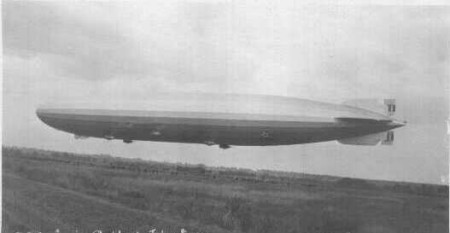
Lakehurst Naval Air Station Shenandoah / ZR-1 / Goodyear Type ZR / ‘LZ’ Class

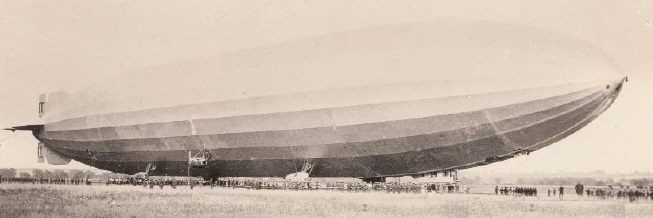
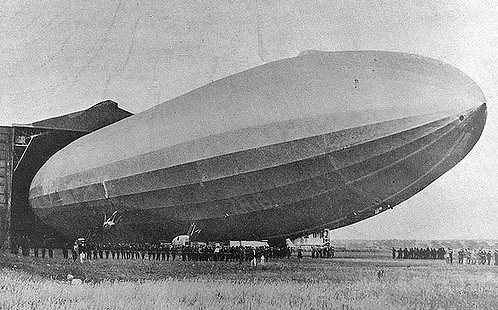
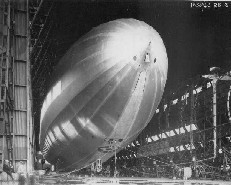
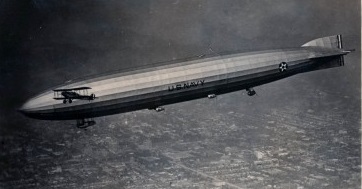
USS Shenandoah was the first of four United States Navy rigid airships. The design was based on Zeppelin bomber L-49 (LZ-96), built in 1917 which had been forced down intact in France in October, 1917 and carefully studied. L-49 was a lightened Type U “height climber”, designed for altitude at the expense of other qualities.

The L-49 was one of the “height climbers” designed by the Germans late in World War I, when improvements in Allied fighter aircraft and anti-aircraft artillery made it necessary for Zeppelins to climb to great altitudes to avoid being shot down. For the Zepeplins to rise to greater heights on a fixed volume of lifting gas, however, the weight and strength of their structures were dramatically reduced. This decrease in strength was accepted as a wartime necessity, since a structurally weaker Zeppelin flying above the reach of enemy aircraft and artillery was safer than a stronger Zeppelin that could be easily attacked.
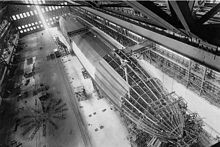
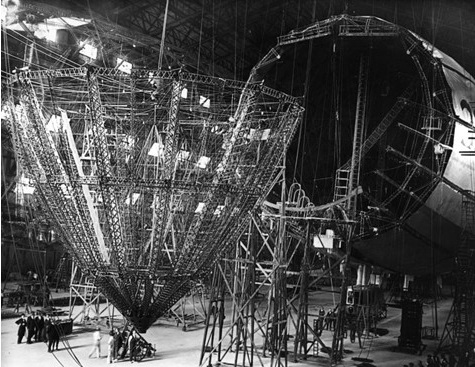
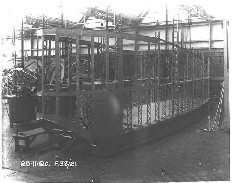
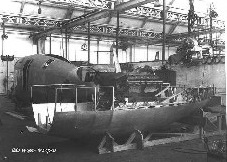
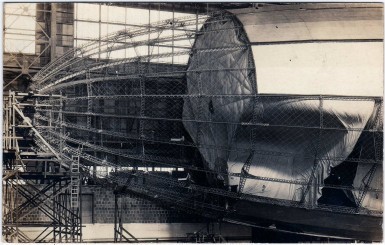
Shenandoah under construction at Lakehurst in 1923

The design was found insufficient and a number of the features of newer Zeppelins were used, as well as some structural improvements. The structure was built from a new alloy of aluminum and copper known as duralumin. Girders were fabricated at the Naval Aircraft Factory. Whether the changes introduced into the original design of L-49 played a part in Shenandoah’s later breakup is a matter of debate. An outer cover of high-quality cotton cloth was sewn, laced or taped to the duralumin frame and painted with aluminum dope.
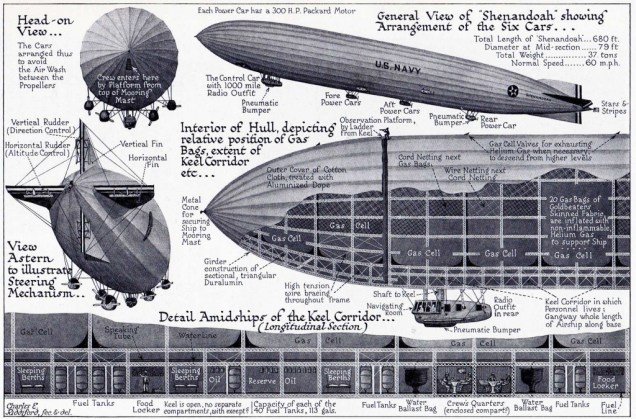
The gas cells were made of goldbeater’s skins, one of the most gas-impervious materials known at the time. Named for their use in beating and separating gold leaf, goldbeater’s skins were made from the outer membrane of the large intestines of cattle. The membranes were washed and scraped to remove fat and dirt, and then placed in a solution of water and glycerine in preparation for application to the rubberized cotton fabric providing the strength of the gas cells. The membranes were wrung out by hand to remove the water-glycerine storage solution and then rubber-cemented to the cotton fabric and finally given a light coat of varnish. The 20 gas cells within the airframe were filled to about 85% of capacity at normal barometric pressure. Each gas cell had a spring-loaded relief valve and manual valves operated from the control car.
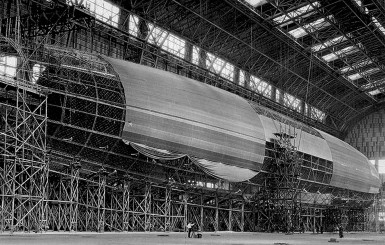
Shenandoah was originally designated FA-1, for “Fleet Airship Number One” but this was changed to ZR-1. The airship was 680 ft (207.26 m) long and weighed 36 tons (32658 kg). It had a range of 5,000 mi (4,300 nmi; 8,000 km), and could reach speeds of 70 mph (61 kn; 110 km/h). Shenandoah was assembled at Naval Air Station Lakehurst, New Jersey in 1922–1923, in Hangar No. 1, the only hangar large enough to accommodate the ship; its parts were fabricated at the Naval Aircraft Factory in Philadelphia. NAS Lakehurst had served as a base for Navy blimps for some time, but Shenandoah was the first rigid airship to join the fleet.

Like all previous zeppelins, ZR-1 had been designed on the assumption that the ship would be operated with hydrogen, but the fiery crash of the U.S. Army airship Roma in 1922 convinced the U.S. government to operate future airship’s with helium, despite the high cost and very limited supply of the gas.

As the first rigid airship to use helium rather than hydrogen, Shenandoah had a significant edge in safety over previous airships. Helium was relatively scarce at the time, and the Shenandoah used much of the world’s reserves just to fill its 2,100,000 cubic feet (59,000 cu.m) volume. Los Angeles—the next rigid airship to enter Navy service, originally built by Luftschiffbau Zeppelin in Germany as LZ 126—was at first filled with the helium from Shenandoah until more could be procured.

Shenandoah was powered by 300 hp (220 kW), eight-cylinder Packard gasoline engines. Six engines were originally installed, but in 1924 one engine (aft of the control car) was removed. The first frame of Shenandoah was erected by 24 June 1922; on 20 August 1923, the completed airship was floated free of the ground. Helium cost $55 per thousand cubic feet at the time, and was considered too expensive to simply vent to the atmosphere to compensate for the weight of fuel consumed by the gasoline engines. Neutral buoyancy was preserved by installing condensers to capture the water vapor in the engine exhaust. The need to preserve helium had many operational implications, including the timing of flights to coordinate with changes in ambient temperature.

The Navy also had to learn how to use helium to operate a large rigid airship, which had never previously been attempted. The need to conserve the expensive and scarce lifting gas required flight operations which differed considerably from the techniques which had been developed for operating airships inflated with easily-replaced hydrogen. For example, while the Germans typically began a zeppelin flight with gas cells inflated to 100% capacity, and then valved hydrogen (either manually or automatically) as the ship rose, the Americans — unable to afford the loss of precious helium — had to operate with lower inflation levels, and therefore less lift, and had to be more careful about valving gas to descend or to maintain aerostatic equilibrium.

Shenandoah first flew on 4 September 1923. ZR-1 made a series of test and demonstration flights in September and early October, 1923 — including an appearance at the National Air Races in St. Louis and flights over New York and Washington.
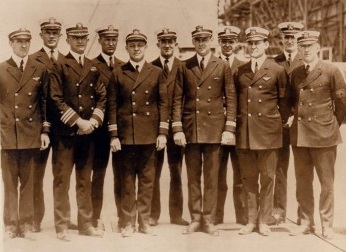
Officers of the USS Shenandoah on her first flight (left to right): Lieut. A.R. Houghton, Lieut. L.E. Mueller, Cdr. J.H. Klein, Lieut. C.E. Rosendahl, Lieut. Cdr. M.R. Pierce, Lieut. J.C. Arnold, Lieut. E.H. Kincaid, Lieut. H.V. Wiley, Lieut. R.J. Miller, Lieut. R.F. Tyler, Lieut. J.B. Andserson
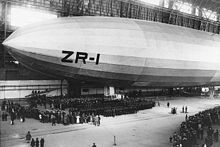
Christening ceremonies for USS Shenandoah (ZR-1)

It was christened on 10 October 1923 by Mrs. Edwin Denby, wife of the Secretary of the Navy, and commissioned on the same day with Commander Frank R. McCrary in command. Mrs. Denby named the airship after her home in the Shenandoah Valley of Virginia, and the word shenandoah was then believed to be a Native American word meaning “daughter of stars”.
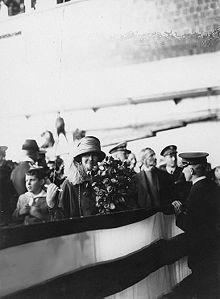
Mrs. Edwin Denby ready to christen USS Shenandoah, October 1923

Shenandoah was designed for fleet reconnaissance work of the type carried out by German naval airships in World War I. Her precommissioning trials included long-range flights during September and early October 1923, to test her airworthiness in rain, fog and poor visibility. On 27 October, Shenandoah celebrated Navy Day with a flight down the Shenandoah Valley and returned to Lakehurst that night by way of Washington and Baltimore, where crowds gathered to see the new airship in the beams of searchlights.
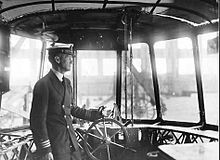
1923 control gondola of the USS Shenandoah. Commander McCrary, the ship’s commander, at the wheel.

At this time, Rear Admiral William A. Moffett—Chief of the Bureau of Aeronautics and staunch advocate of the airship—was discussing the possibility of using Shenandoah to explore the Arctic. He felt such a program would produce valuable weather data, as well as experience in cold-weather operations. With its endurance and ability to fly at low speeds, the airship was thought to be well-suited to such work. President Calvin Coolidge approved Moffett’s proposal, but Shenandoah’s upper tail fin covering ripped during a gale on 16 January 1924, and the sudden roll tore her away from the Lakehurst mast, ripping out her mooring winches, deflating the first helium cell and puncturing the second. Zeppelin test pilot Anton Heinen rode out the storm for several hours and landed safely while the airship was being blown backwards. Extensive repairs were needed, and the Arctic expedition was scrapped.
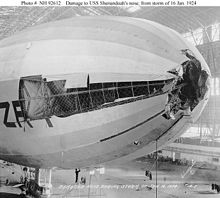
Shenandoah’s damaged bow following the January storm

On February 12, 1924, while it was undergoing repairs, Shenandoah received a new commanding officer, Lt. Cdr. Zachary Lansdowne.
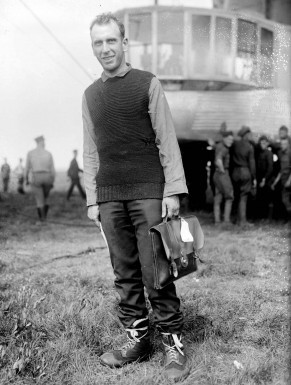
Zachary Lansdowne in front of R-34

Lansdown, a 1909 graduate of the United States Naval Academy, was one of the Navy’s first officers trained in lighter-than-air aviation. He trained with the crew of the British airship R-34, and became the first American to cross the Atlantic nonstop by air as the American naval observer aboard R-34’s 1919 transatlantic flight. After service as a White House aide, Lansdowne was the Assistant Naval Attache in Germany in 1922-1923, where was involved with the negotiations for the construction of the LZ-126, which became the ZR-3 USS Los Angeles.

The ship was grounded for repairs until May 22, 1924, when it was returned to service with reinforcements to its mooring assembly, nose, and fins. The sixth engine in its control car was also removed and replaced with radio equipment, including a long distance direction finding set.
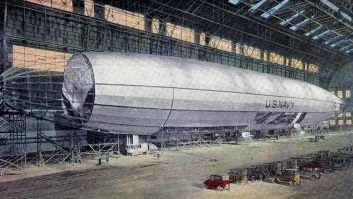
Airship USS Shenandoah during repairs, March-April, 1924.

Shenandoah’s repairs were completed in May, and the summer of 1924 was devoted to work with its engines and radio equipment to prepare for fleet duty. In August 1924 it reported for duty with the Scouting Fleet and took part in tactical exercises. Shenandoah succeeded in discovering the “enemy” force as planned but lost contact with it in foul weather. Technical difficulties and lack of support facilities in the fleet forced it to depart the operating area ahead of time to return to Lakehurst. Although this marred the exercises as far as airship reconnaissance went, it emphasized the need for advanced bases and maintenance ships if lighter-than-air craft were to take any part in operations of this kind.

In July 1924, the oiler Patoka put in at Norfolk Naval Shipyard for extensive modifications to become the Navy’s first airship tender. An experimental mooring mast 125 ft (38 m) above the water was constructed; additional accommodations both for the crew of Shenandoah and for the men who would handle and supply the airship were added; facilities for the helium, gasoline, and other supplies necessary for Shenandoah were built, as well as handling and stowage facilities for three seaplanes. Lansdowne conducted pioneering operations in which he moored Shenandoah to a mast installed on the support ship Patoka, to show the possibility of underway replenishment and supply to extend the ship’s range and allow an airship to work closely with the fleet, and Lansdowne conducted operations with surface ships such as the battleship USS Texas whenever possible. The first successful mooring was made on 8 August. During October 1924, Shenandoah flew from Lakehurst to California and on to Washington State to test newly erected mooring masts. This was the first flight of a rigid airship across North America.
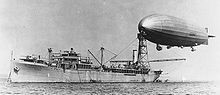
Shenandoah moored to the oiler Patoka

1925 began with nearly six months of maintenance and ground test work. Shenandoah did not take to the air until 26 June, when it began preparations for summer operations with the fleet. In July and August, it again operated with the Scouting Fleet, successfully performing scouting tasks and being towed by Patoka while moored to that ship’s mast.
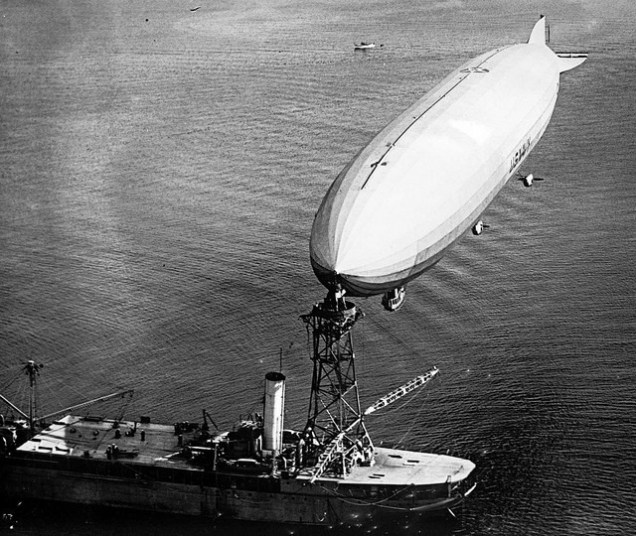
ZR-1 Shenandoah moored to USS Patoka at sea

Shenandoah made one of its most impressive demonstrations in October, 1924, when the ship made a difficult 19-day journey across the United States from Lakehurst to San Diego, via Forth Worth, and then traveled up the west coast to Seattle and back to San Diego, before returning to Lakehurst via Fort Worth. Shenandoah logged 235 flight hours on its headline-making journey across the country, and captured the enthusiasm of both the American public and also leaders in the field of aviation around the world.

Upon Shenandoah’s return to Lakehurst the ship was was deflated so that its helium could be transferred to the newly arrived ZR-3 (soon to be commissioned USS Los Angeles) which had just been delivered to Lakehurst by Hugo Eckener and his German crew; the supply of helium was so scare in 1924 that the United States did not have enough of the gas to inflate two large airships at the same time.
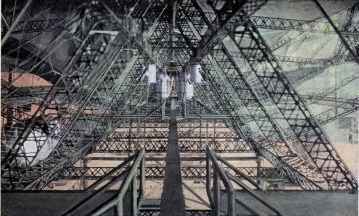
Keel of the U.S. Navy Airship Shenandoah

During Shenandoah’s lay-up, Zachary Lansdowne made a decision which would later be highly controversial. In order to limit the loss of helium by leakage through the automatic valves, and to eliminate several hundred pounds of weight, Lansdowne ordered the removal of 10 of the ship’s 18 automatic gas valves. These valves automatically released helium when as the ship climbed, to avoid over-expansion of the cells at higher altitude, which could damage both the cells themselves and the surrounding framework. Lansdowne’s modification limited the amount of gas that could be valved in a given time, and meant that Shenandoah’s valves could not keep up with an increase of altitude greater than 400 feet per minute; at any higher rate of climb, the ship could not release enough helium to keep up with the expansion of the gas cells.

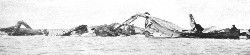
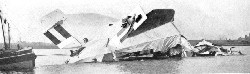
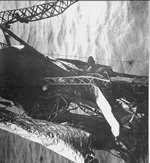
On 2 September 1925, Shenandoah departed Lakehurst on a promotional flight to the Midwest that would include flyovers of 40 cities and visits to state fairs. Testing of a new mooring mast at Dearborn, Michigan, was included in the schedule. While passing through an area of thunderstorms and turbulence over Ohio early in the morning of 3 September, during its 57th flight, the airship was caught in a violent updraft exceeding 1,000 feet per minute that carried it beyond the pressure limits of its gas bags to an altitude over 6,000 feet. Twisted by the storm, and the ship finally suffered catastrophic structural failure, breaking in two at frame 125, approximately 220 feet from the bow. The aft section sank rapidly, breaking up further, with two of the engine cars breaking away and falling to the ground. It crashed in several pieces near Caldwell, Ohio. Fourteen crew members, including Commander Zachary Lansdowne, were killed. This included every member of the crew of the control cabin (except for Lieutenant Anderson, who escaped before it detached from the ship); two men who fell through holes in the hull; and several mechanics who fell with the engines.
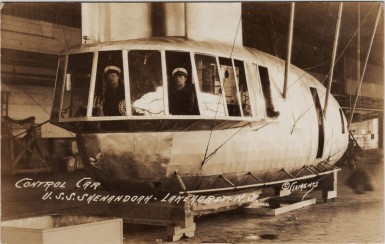
Control car of USS Shenandoah

There were twenty-nine survivors, who succeeded in riding three sections of the airship to earth. The largest group was eighteen men who made it out of the stern after it rolled into a valley. Four others survived a crash landing of the central section. The remaining seven were in the bow section which Commander (later Vice Admiral) Charles E. Rosendahl navigated as a free balloon. In this group was Anderson who—until he was roped in by the others—straddled the catwalk over a hole. Without the weight of the control car, the bow section, with seven men aboard, including Navigator Charles Rosendahl, ascended rapidly. Under Rosendahl’s leadership, the men in the bow valved helium from the cells and free-ballooned the bow to a relatively gentle landing.
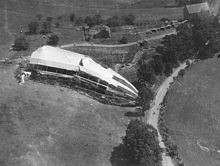
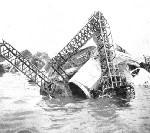
The wreck of the Shenandoah Crash Site No. 3

The Shenandoah Crash Sites are located in the hillsides of Noble County. Site No. 1, in Buffalo Township, surrounded the Gamary farmhouse, which lay beneath the initial break-up. An early fieldstone and a second, recent granite marker identify where Commander Lansdowne’s body was found. Site No. 2 (where the stern came to rest) is a half-mile southwest of Site No. 1 across Interstate 77 in Noble Township. The rough outline of the stern is marked with a series of concrete blocks, and a sign marking the site is visible from the freeway. Site No. 3 is approximately six miles southwest in Sharon Township at the northern edge of State Route 78 on the part of the old Nichols farm where the nose of the Shenandoah’s bow was secured to trees. Although the trees have been cut down, a semi-circular gravel drive surrounds their stumps and a small granite marker commemorates the crash. The Nichols house was later destroyed by fire.

The crash site attracted thousands of visitors in its first few days. Within five hours of the crash more than a thousand people had arrived to strip the hulk of anything they could carry. On Saturday, 5 September 1925, the St. Petersburg Times of Florida reported that the site of the crash had quickly been looted by locals, describing the frame as being “[laid] carrion to the whims of souvenir seekers”. Among the items believed to have been taken were the vessel’s logbook and its barograph, both of which were considered critical to understanding how the crash had happened. Also looted were many of the ship’s 20 deflated silken gas cells, each worth several thousand dollars, most of them unbroken but ripped from the framework before the arrival of armed military personnel. Looting was so extensive that it was initially believed even the bodies of the dead had been stripped of their personal effects, and that operatives from the Department of Justice were being sent to investigate. That this was happening was soon denied by those publicly involved in the incident, however. Still, a local farmer on whose property part of the vessel’s wreckage lay began charging the throngs of visitors to enter the crash site at a rate of $1 (equivalent to about $13.60 in 2015) for each automobile and 25¢ per pedestrian as well as 10¢ for a drink of water.

On 17 September the Milwaukee Sentinel reported that 20 Department of Justice operatives had indeed been summoned to the site and that they along with an unspecified number of federal and state prohibition agents had visited private homes to collect four truck loads of wreckage along with personal grips of several crew members and a cap believed to have belonged to Commander Lansdowne. Lansdowne’s Annapolis class ring had also been thought to have been taken from his hand by looters as it was not then recovered-it was found by chance in June 1937 near the crash site # 1. No one was charged with any crime.

Two schools of thought developed about the cause of the crash. One theory is that the gas cells over-expanded as the ship rose, due to Lansdowne’s decision to remove the 10 automatic release valves, and that the expanding cells damaged the framework of the airship and led to its structural failure.

Official inquiry brought to light the fact that the fatal flight had been made under protest by Commander Lansdowne (a native of Greenville, Ohio), who had warned the Navy Department of the violent weather conditions that were common to that area of Ohio in late summer. His pleas for a cancellation of the flight only caused a temporary postponement: his superiors were keen to publicize airship technology and justify the huge cost of the airship to the taxpayers. So, as Lansdowne’s widow consistently maintained at the inquiry, publicity rather than prudence won the day. This event was the trigger for Army Colonel Billy Mitchell to heavily criticize the leadership of both the Army and the Navy, leading directly to his court-martial for insubordination and the end of his military career. Heinen, according to the Daily Telegraph, placed the mechanical fault for the disaster on the removal of eight of the craft’s 18 safety valves, saying that without them he would not have flown on her “for a million dollars”. These valves had been removed in order to better preserve the vessel’s helium, which at that time was considered a limited global resource of great rarity and strategic military importance; without these valves, the helium contained in the rising gas bags had expanded too quickly for the bags’ valves’ design capacity, causing the bags to tear apart the hull as they ruptured (of course, the helium which had been contained in these bags became lost into the upper atmosphere).

After the disaster, airship hulls were strengthened, control cabins were built into the keels rather than suspended from cables, and engine power was increased. More attention was also paid to weather forecasting.

Several memorials remain near the crash site. There is another memorial at Moffett Field, California, and a small private museum in Ava, Ohio.

Gallery

ZR-1 USS Shenandoah
Length: 680 feet
Diameter: 79 feet
Gas capacity: 2,115,000 cubic feet
Useful lift: 48,774 lbs
Maximum speed: 58 knots
Crew: 40 officers and men
First flight: September 4, 1923
Crashed: September 2-3, 1925
Total flight hours: 740:09

Kitty Hawk Flyer

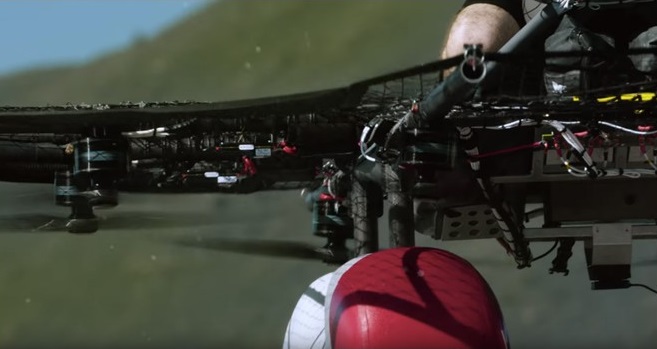
The Kitty Hawk Flyer flying car startup Google’s Larry Page is backing was first publicly demonstrated in April 2017. An aerospace engineer working for Silicon Valley company called Kitty Hawk piloted the Flyer above a lake about 100 miles north of San Francisco. It is an open-seated, 220-pound Flier with room for one person, powered by eight battery-powered propellers that howled as loudly as a speedboat.

The Flyer one-seat, propeller-driven vehicle is meant for a short flight across lake when you’re at the cottage, not commuting to work. During his test flight, Cameron Robertson, the aerospace engineer, used two joystick-like controls to swing the vehicle back and forth above Clear Lake. The flight, 15 feet above the water, circled over the lake about 20 or 30 yards from shore, and after about five minutes Mr. Robertson steered back to a floating landing pad at the end of a dock. The flyer is controlled by two handlebars and what looks like a giant touchscreen. It travels at up to 25 miles per hour at a max of 15 feet above water.

The vehicle is designed to fly above fresh water with two pontoons at its bottom. The prototype Kitty Hawk is showing off “looks and feels a lot like a flying motorcycle,” according to Cimeron Morrissey, who tested it.

They are flying under a special Federal Aviation Administration category for ultralight aircraft that does not require a pilot’s license and is intended for recreational flying in uncongested areas. To add an extra margin of safety, the Kitty Hawk engineers are sticking to flying over open water.

Gallery

Kalinin K-7

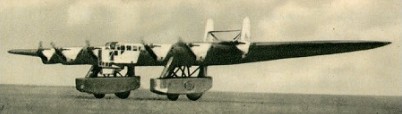
The K-7 was an exceptionally large experimental bomber of 1933, having two faired underslung tandem-wheel landing-gear units and six engines. Designed by World War I aviator Konstantin Kalinin, the K-7 was one of the biggest aircraft built before the jet age. As originally designed the K-7 was to have engines in the undercarriage sponsons. As completed the bomber had gun positions, the bomb load and an internal staircase as well as two large wheels in each massive sponson.

It was powered by seven engines, six pulling on the wing leading edge and one pushing at the rear. The K-7 was one of the first metal aircraft with a twin-boom layout. The K-7’s control surfaces were all deflected by the use of large trim tab surfaces mounted on struts.
The K-7’s very brief first flight showed up instability and serious vibration caused by the airframe resonating with the engine frequency. The solution to this ‘flutter’ was thought to be to shorten and strengthen the tail booms, little being known then about the natural frequencies of structures and their response to vibration. On the 11th flight, during a speed test, the port tailboom vibrated, fractured, jammed the elevator and caused the giant aircraft to plough into the ground. The K-7 was said to have had a pilot, 18 crew members and one passenger when it crashed, killing all but five crew.
Undaunted by this disaster, Kalinin’s team began construction of two further K-7s in a new factory, but the project was abandoned.

Engine: 7 x M34F, 550kW
Max take-off weight: 38000 kg / 83776 lb
Empty weight: 24400 kg / 53793 lb
Wingspan: 53.0 m / 173 ft 11 in
Length: 28.0 m / 91 ft 10 in
Wing area: 454.0 sq.m / 4886.81 sq ft
Max. speed: 234 km/h / 145 mph
Cruise speed: 180 km/h / 112 mph
Ceiling: 4000 m / 13100 ft
Range: 3030 km / 1883 miles
Crew: 12
Passengers: 128

Junkers Ju.390

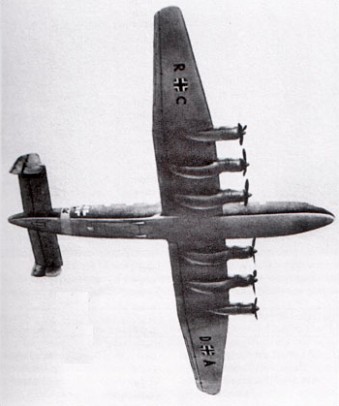
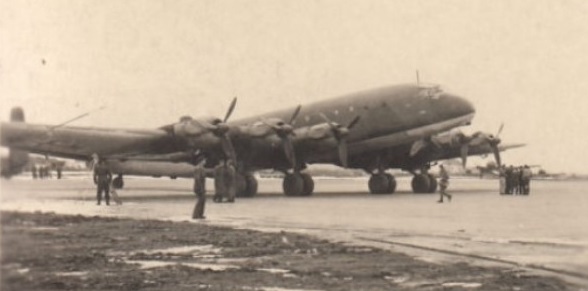
The German Junkers Ju 390 long range heavy bomber aircraft design was intended to be able to strike at locations along the east coast of the United States during World War 2. The Ju 390 itself was a further development of the Junkers Ju 290 and was also tasked to fulfill the roles of maritime reconnaissance and transport in addition to its bombing duties. The Ju 390 – also known under the unofficial name of “New York Bomber” – was developed as two working prototypes, effectively making the idea of transatlantic bombing theoretically possible for Hitler and his Luftwaffe. The Ju 390 was part of the failed “Amerika Bomber” project considered by the Germans, this including the Messerschmitt Me 264 and Focke-Wulf Ta 400 designs.

The Junkers Ju 390 heavy bomber appeared when general German wartime philosophy was still centered around medium-class bomber aircraft. Full developmental resources were never really delegated to the Ju 390 project en mass and the entire program was slow. With origins in the Ju 290 airframe, the Ju 390 basically saw its wings lengthened via extensions fitted to help accommodate the additional engines (three to a wing for a total of six installations). The fuselage was also applicably lengthened for the long-range bombing role. Defense was supplied by a pair of 13mm machine guns in a gondola position as well as 2 x 13mm machine guns in beam positions. A pair of 20mm cannons would have been mounted to a dorsal turret and a single 20mm cannon would have been installed in the tail. Crew accommodations would have amounted to ten personnel made up of the flight crew and dedicated gunners. The heavy transport model was given the proposed designation of Ju 390A-1 while the maritime patrol and long-range heavy bombers would have been assigned Ju 390B and Ju 390C respectively.

Ju.390 V-1 GH+UK

Power for the Ju 390 V01 prototype was supplied by 6 x BMW 801D radial piston engines, of 1,730 hp. Maximum speed was listed at 314 miles per hour with a range of approximately 6,030 miles. The service ceiling was a reported 19,700 feet. Empty weight was in the vicinity of 87,100lbs while maximum take-off weight topped at 166,400lbs. The Ju 390 maintained a length of 112 feet, 2 inches with a span of 165 feet, 1 inch. Her height was 22 feet, 7 inches.

First flight for a Ju 390 V1 prototype occurred on October 20, 1943, and Ju 390 V2 was also flown in October of 1943 with testing believed having gone into 1945.

An initial order of 26 Ju 390s were ordered for serial production, however, the program was cancelled in June of 1944 to allocate critical wartime resources and development to other more pressing projects. Pparticularly those of defensive in nature. The Ju 390 was officially strickened from Luftwaffe contention in 1945. Ju 390 V1 was destroyed on the ground by the Germans as the American Army closed in on the development facility.

A test flight of a Ju 390 is said to have taken the aircraft from Brest, France, to within 200 miles of New York city, and returned.

In the fall of 1944, Japanese authorities were granted local production rights to the Ju 390, though none were ever started before the Empire capitulated in August of 1945.

Junkers Ju 390 V1 (New York Bomber)
Engines: 6 x BMW 801D radial, 1268kW.
Length: 112.20ft (34.2m)
Width: 165.03ft (50.30m)
Height: 22.60ft (6.89m)
Empty Weight: 87,083lbs (39,500kg)
Maximum Take-Off Weight: 166,449lbs (75,500kg)
Maximum Speed: 314mph (505kmh; 273kts)
Maximum Range: 6,027miles (9,700km)
Service Ceiling: 19,685ft (6,000m)
Armament proposed:
2 x 13mm MG 131 machine gun in gondola
2 x 13mm MG 131 machine guns in waist beam positions.
2 x 20mm MG 151/20 cannons in dorsal turret
1 x 20mm MG 151/20 cannon in tail gun position
Crew: 10

Junkers Ju.287

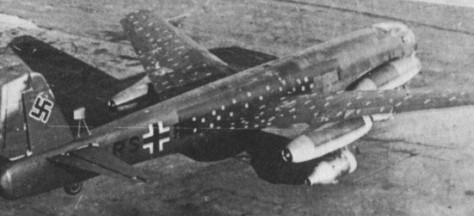
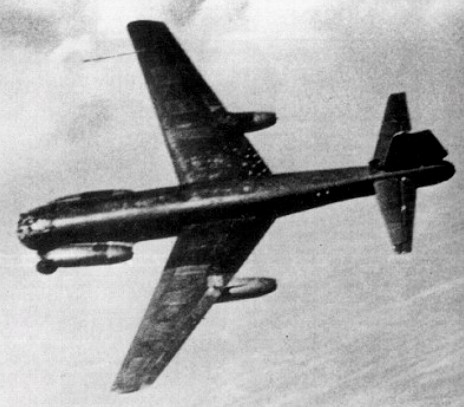
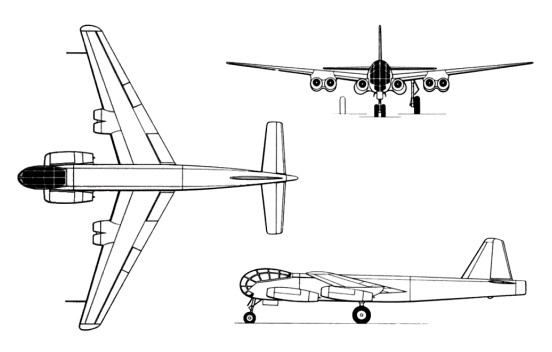
In 1943 the German Junkers com¬pany was given the task of designing a heavy bomber that would be faster than any contemporary Allied fighter. A swept wing planform was essential to reach the speed required, and to overcome the disadvantages of a backward swept wing, the Junkers design team proposed a wing swept forward. In theory such a wing should have the same effect as one swept back in reducing the effective thickness to chord ratio, but would have the highest lift coefficient at the root, decreasing outboard. The wing tips would thus be the last to stall, with aileron control available up to this point. An additional advantage of a forward swept wing was that by freeing the centre portion of the fuselage of wing spars, it facilitated the provision of the large weapons bay called for in the bomber specification, around the centre of gravity.
To test such a wing full scale Ju 287 Vl was produced, under supervision of Hans Wocke. To save time and money this aircraft utilised the fuselage of a Heinkel He 177A, the tail of a Ju 388 and nose wheels salvaged from a crashed Consolidated B 24 Libera¬tor. The forward swept wing, however, was representative of that of the intended bomber.

Power was provided by four Junkers Jurno 004B turbojets, two being attached to the sides of the fuselage nose and two being mounted under the wing. Two Walter 501 rocket units provided boost for take off.
A forward swept wing is structurally unstable; it reacts to increase the loads. As speed increased the forces eventually exceed the strength of the wing. To compensate for this divergence problem, as it is called, forward swept wings have to be very strong in torsion to prevent any twisting that would lead to catastrophic loads.

An indication of the severity of this problem is that on the Ju 287 V1, to preserve the structural integrity of the wing, the main landing gear did not retract into the wing, but was fixed, the wheels being enclosed in fairings.
Seventeen test flights were made by the Ju 287 V1, the first one at Brandis, near Leipzig, on 16th August 1944, in the hands of Flugkapitan Siegfried Holzbaur. The flights proved the aerodynamic advantages of the wing planform; wing tufts confirmed the progressive wing stall from the root to the tip. Lateral control at low speeds was good. However, the trials also proved some of the problems predicted. Two of the most serious were a tendency for the aircraft to Dutch roll in reverse, and for the aircraft to increase g inadvertently during a turn, when the pilot was attempting a steady turn.
Despite the problems, work started on the definitive bomber, the Ju 287¬V2, and final assembly was under way when the factory was seized by advancing Russian troops. The incomplete bomber was transferred to the Soviet Union, together with Hans Wocke and other key members of the Junkers design team, where it was completed and test flown in 1947.

Ju.287

EF.131
Wing span: 78 ft 8.75 in
Height: 26 ft 3 in
Empty wt: 34,838 lb
Loaded wt: 51,341 lb
Max speed: 534 mph
Service ceiling: 43,950 ft
Range 4410 bomb load: 1045 mi

V-1
Wing span: 65 ft 11.75 in
Length: 61 ft 0.5 in
Height: 15 ft 5 in
Wing area: 656 sq.ft
Empty wt: 25,557 lb
Loaded wt: 44,092 lb
Max speed: 404 mph
Max speed at 19,685 ft: 347 mph
Cruise speed: 320 mph
Landing speed: 118 mph
Stall speed: 105 mph
Rate of climb: 1910 fpm
Climb to 19,700 ft: 10 min 30 sec
Service ceiling: 35,425 ft
Range: 932 mi

V3
Engines: 6 x 800kg BMW 003A-1 turbojets
Wingspan: 20.11 m / 66 ft 0 in
Length: 18.6 m / 61 ft 0 in
Wing area: 58.3 sq.m / 627.54 sq ft
Max take-off weight: 21520 kg / 47444 lb
Empty weight: 11920 kg / 26279 lb
Max speed at 16,400 ft: 856 km/h / 532 mph
Cruise speed: 493 mph
Rate of climb: 2885 fpm
Climb to 19,700 ft: 10 min 30 sec
Ceiling: 12000 m / 39350 ft
Range full load: 980 mi
Range half bomb load: 1320 mi
Crew: 4

Joby Aviation S4

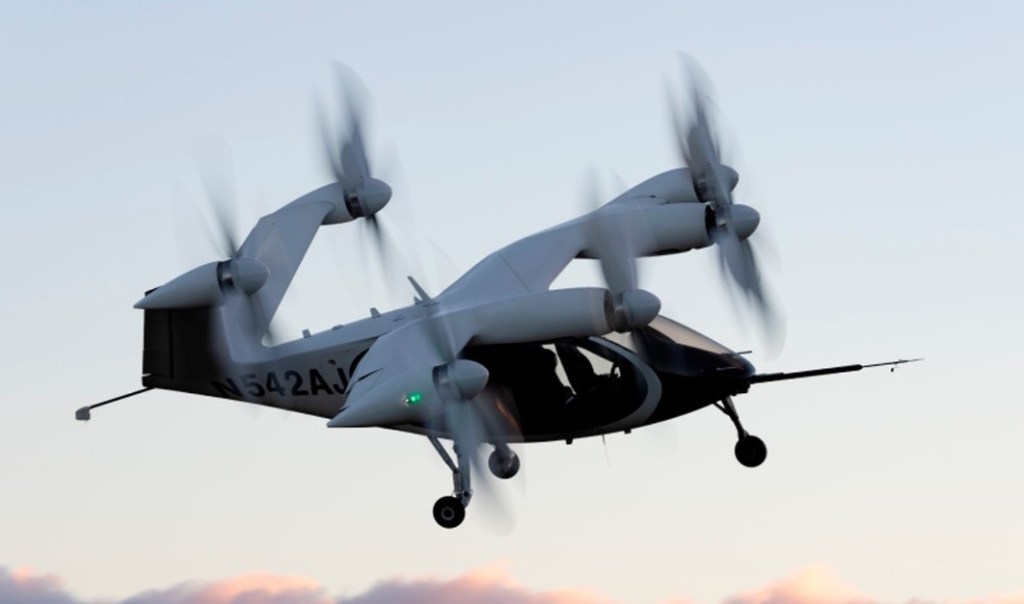
The Joby Aviation S4 air taxi 2.0 is a five seat eVTOL (one pilot and four passengers) vectored-thrust aircraft using six tilting propellers which are located on both the fixed wing and its V-tail. Four propellers tilt vertically including its entire motor nacelle, and two of the propellers tilt vertically with a linkage mechanism. The aircraft has large windows for spectacular views and has a tricycle-type retractable wheeled landing gear.

The company reports their aircraft is 100 times quieter than a helicopter during takeoff and landing with a near-silent flyover.

The Joby S4 four passenger eVTOL aircraft was revealed in January 2020 and the first to receive U.S. Air Force airworthiness approval in December 2020.

Hughes H-4 / HK-1 Hercules / Spruce Goose

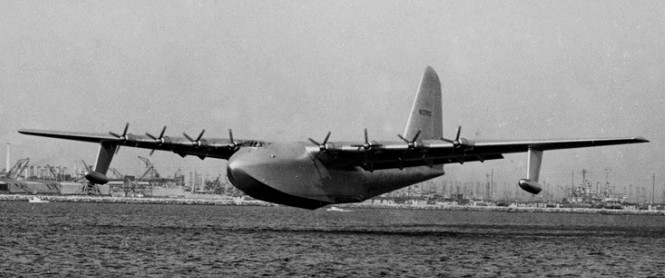
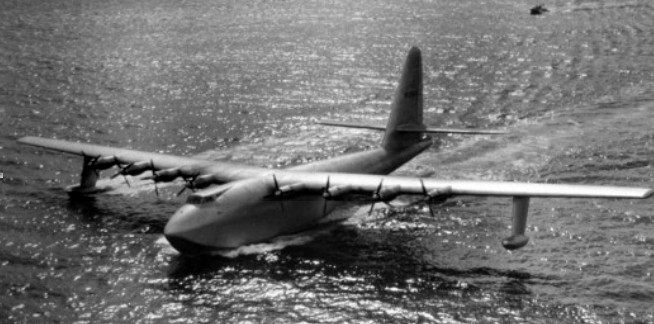
American shipbuilder Henry Kaiser introduced the Liberty ship but the vessels were being sunk prompting him to think of a massive cargo aircraft. Initially rebuffed by the US Government, Kaiser sought a partnership that would lend credence to his plan. That partner was Howard Hughes. Howard Hughes sponsored the Hughes H-4 Hercules. Made entirely of wood, almost entirely of laminated birch, this eight-engined flying-boat had the greatest wingspan (320 ft; 97.54 m) of any aircraft built to date.
The aircraft was not completed until September 1945. The design problems which Hughes and his team encountered in creating a 183 tonne (180 ton) aircraft from non strategic materials delayed the project until after the war, assembly began in June 1946.
House movers being engaged to transport its 66.75 m (219 m) laminated plywood hull along specially laid roads from Culver City, California to Terminal Island, Long Beach where final assembly began.

On 2 November 1947 Hughes boarded the Hercules, started the eight 3000 hp Pratt & Whitney Wasp Major engines and taxied out into the bay, ostensibly for water handling tests. Once on the open water, however, Hughes opened up the Spruce Goose’s and took off, flying for about 0.6 km (1 mile), for less than a minute, at a height of 70 feet (21 m) at a speed of 80 mph (128 kph).

The Hercules never flew again. It was stored in a specially constructed hangar at Long Beach, where it remains today, heavily guarded by Hughes employees, the largest aircraft ever to fly. Some say that having proved his point that the machine could fly, Hughes simply lost interest; others claim that even in those few brief moments of flight the Hercules creaked and groaned and handled so badly that Hughes never dared fly it again.

Engines: 8 x 3,000 h.p. Pratt & Whitney R-4360-4A radial. Replaced in 1951 by P&W Wasp Major TS13-3Gs.
Propellers: 8 x Hamilton Standard 24F60-35s
Prop diameter: 17ft 2in diameter (Engine No 4 had a 16ft 2in-diameter)
Wingspan: 320ft 0in
Tailplane span: 113ft 6in
Wing area: 11,430 sq.ft
Maximum wing thickness: 11ft 6in
Length: 218ft 6.25in
Height overall: 79ft 3 3/8in
Fuselage height 30ft 0in
Payload: 180,0001b
Maximum weight: 400,0001b
Internal fuel: 14,000 USgal
Maximum speed: 218 m.p.h.
Cruising speed: 175 m.p.h.
Alighting speed: 78 m.p.h.
Maximum range: 3,500 miles
Service ceiling: 24,000ft (300,0001b gross weight)
Rate of climb: 700ft/min to 1,000ft/min, depending on weight

Horton Ho VIII

This was to have been a flying model of a proposed six-engined trans-Atlantic passenger transport weighing 100,000 kg. The span was to be 40 m with an aspect ratio of 10 and sweepback of 28 degrees. Power units were six Argus AS 10 C engines.
To make the aircraft attractive to R.L.M. and thus get backing for the project, the Hortens added a rear loading cargo carrying body with an internal space approximately 14’ x 10’ x 6’; this was not part of the design for the full size aircraft. With construction under way, another modification was made (but not disclosed to R.L.M.). This consisted of removing the nose of the cargo body, replacing the nose wheel by wheels on either side of the body and putting a large venturi tube with a 2m x 2.7m throat inside to form a flying wind tunnel. They expected to get about 500 mph airspeed in the throat combined with low turbulence – this they proposed to check by the sphere drag method. Later they hoped to be able to test models of their aircraft which could be made of wood because of the absence of dust in the airstream.
Construction was proceeding at Gottingen and was 50% complete at the cessation of hostilities. The steel tube framework for the venturi center section was finished.
Estimated Weight and Performance Figures
Max. all up weight as a wind tunnel: 9,000 kg
Max. all up weight as a cargo carrier

  • Without takeoff assistance: 15,000 kg
  • With rocket assisted takeoff: 20,000 kg
    At 23,000 kg the sea level rate of climb at full power would be zero.
    At 9,000 kg rate of climb at 180 kph was expected to be 6.5 – 7 m/sec.
    Estimated trimmed CLmax’s were:
  • No Flaps: 1.4
  • With Flaps: 1.6
  • CL for Takeoff: 1.1
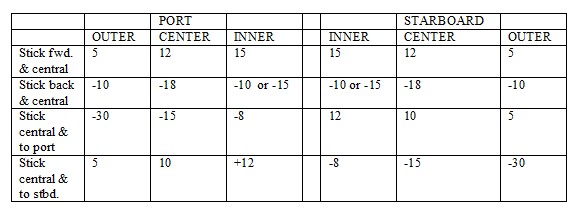
    The design of the wing and controls was similar to that of the Horten IV. Washout was 7 degrees, to give trim without elevator deflection at cruising CL. Elevons were the three stage type with 35% Frise nose on the outer flap, and 22% on the middle and inner flaps. Compensating geared tabs which could also be used a longitudinal trimmers were fitted to the inner flaps. Maximum control deflections were a follows:
    (Note: All figures in degrees)

Trailing edge split flaps with a constant chord of 80 cm were to be fitted between the engines.
Drag rudders were of the H VII “trafficator” type with vent hole balance plus spring centering. Projection was about 1 meter.
Wing Root thickness is about 16%, with the usual reflexed center-line, graded to an 8% symmetrical tip section.
Wing structure was in seven parts; a welded steel center section with pilot and co-pilots seat and three outer wooden wing panels per side. The wooden structure was of single spar D-tube form with subsidiary trailing edge ribs.
At the factory in Gottingen the center section was found in a semi-complete state, D-noses for the inboard wing panels were finished and spars and ply noses for the outer panels were under construction. Much of the work on components such as engine bearers, petrol systems, undercarriage etc., had been completed and the six engines were in crates at the works, with one spare. Unfortunately all drawings had been taken and many of them seem to have been buried by Horten employees near Kilenburg, in the Russian sector.
The fixed main wheels were arranged in tandem pairs on either side of the fuselage and took 85% of the static weight of the aircraft. The castering nose wheel was retractable on the cargo version and had to be mounted on a stalky strut because of the high wing layout. Static ground incidence was 2.5 degrees.

Ho-VIII
Max take-off weight: 8000 kg / 17637 lb
Empty weight: 5000 kg / 11023 lb
Wingspan: 40 m / 131 ft 3 in
Length: 16.5 m / 54 ft 2 in
Height: 3.85 m / 12 ft 8 in
Wing area: 146 sq.m / 1571.53 sq ft
Max. speed: 280 km/h / 174 mph
Range w/max.fuel: 6000 km / 3728 miles
Crew: 3

H.M. Balloon Factory R34 / R33 / Beardmore R34 / Armstrong Whitworth R33

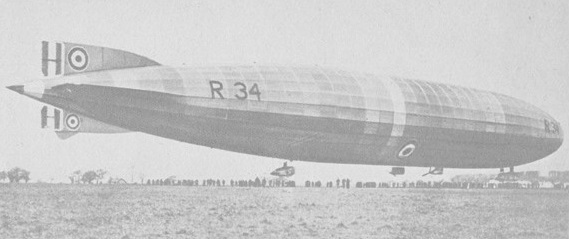
R34

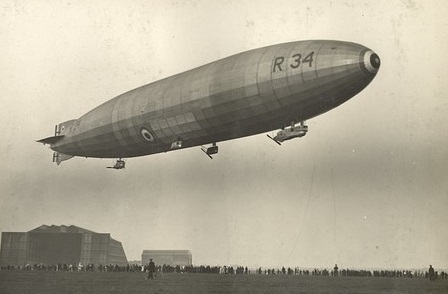
Substantially larger than the preceding R31 class, the R33 class was in the design stage in 1916 when the German Zeppelin L 33 was brought down on English soil. Despite the efforts of the crew to set it on fire, it was captured nearly intact, with engines in working order. For five months, the LZ 76 was carefully examined in order to discover the Germans’ secrets.

The existing design was adapted to produce a new airship based on the German craft and two examples were ordered, one (R33) to be constructed by Armstrong-Whitworth at Barlow, North Yorkshire and the other (R34) by William Beardmore and Company in Inchinnan, Renfrewshire, Scotland.

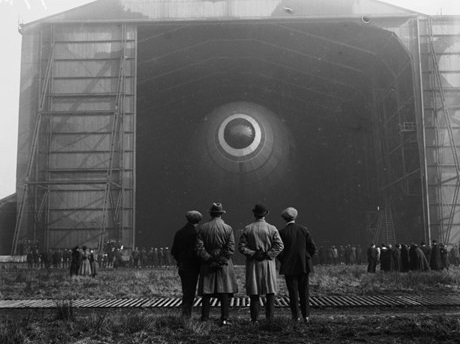
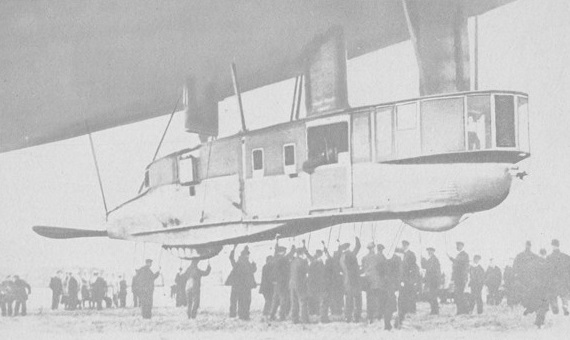
The manufacture of the components for the R33 and her sister ship R34 had begun in the summer of 1917, but the actual construction of the ship in the shed did not commence until the summer of 1918. The ship design was semi-streamlined fore and aft, with a parallel mid-ships section. The main control car was positioned well forward on the ship, and on closer inspection was separated from the engine in the rear of the car by a small gap. The small gap was faired over, so the gondola seemed to be a single structure. This was designed to stop vibrations from the engine car being transmitted down to the forward control car, with its radio detection finding and wireless instruments. Hence, the forward control car and engine car looks as if it is one combined piece, but serviced by two ladders into the hull above.

R34

Two more power cars were suspended in the wing positions further aft along the hull and a single engine aft car was positioned amidships at the rear of the craft. All five engines were 275 hp (205 kW), Sunbeam Maori water-cooled petrol units, with one in the aft section of the control car, two more in a pair of power cars amidships each driving a pusher propeller via a reversing gearbox for manoeuvering, and the remaining two in a centrally mounted aft car, geared together to drive a single pusher propeller. The power cars included two gearboxes for each engine, enabling the engines to be started up and running without the propellers rotating. The ship carried enough fuel for 48 hours engine running, but to increase range it was possible to fly the ship on only 3 engines, giving the ship a speed of some 40 knots with petrol consumption of one mile a gallon. The petrol was held inside the hull and fuel flowed from them by gravity to header tanks in the engine gondolas. The reasoning behind this change of arrangement was to feed a smoother and more precise fuel supply than the older arrangements in earlier ships of direct gravity feed.

The radiators in the forward engine gondolas had the flow of air regulated by the use of movable shutters, however the rear gondolas had the old type of traditional “elevated” radiator. Twenty main frames and thirteen longitudinals made the main structure of the ship. There were 19 gasbags within the hull giving a capacity of 1,950,000 cubic feet of hydrogen giving a disposable lift of almost 26 tons. The total construction of the R33 came to £350,000.

R33 in its hangar before its first flight in Barlow, Yorkshire, March 1919

R33 first flew on 6 March 1919, and was sent to RAF Pulham in Norfolk. Between then and October 14, R33 made 23 flights totalling 337 hours flying time. One of these, a flight promoting “Victory Bonds” even included a brass band playing in the top machine gun post.

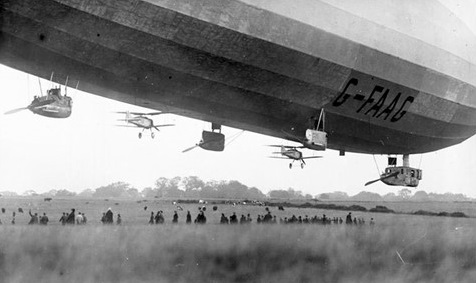
In 1920 she was “demilitarised” and given over to civilian work with the civil registration G-FAAG. This work consisted of trials of new mast mooring techniques using the mast erected at Pulham. On one occasion winds of 80 mph (130 km/h) were successfully withstood while moored. Another experiment was an ascent carrying a pilotless Sopwith Camel which was successfully launched over the Yorkshire Moors. After an overhaul, R33 was based at Croydon Airport, moored to a portable mast. In June 1921 it was used by the Metropolitan Police to observe traffic at the Epsom Derby, and in July she appeared in the Hendon Air Pageant before flying to Cardington, Bedfordshire, where she was laid up for three years.

On 31 May 1921 the British government cancelled all airship development for financial reasons. Military airships were scrapped, but as a civilian airship R33 was mothballed instead. In 1925, after being inactive for nearly four years, the reconditioned R33 emerged from her shed at Cardington.

At 09:50 on 16 April 1925 the R33 was torn from the mast at Pulham during a gale, and was carried away with only a partial crew of 20 men on board. Her nose partially collapsed and the first gas cell deflated leaving her low in the bow. The crew on board started the engines, gaining some height, and rigged a cover for the bow section, but the R33 was blown out over the North Sea. A Royal Navy vessel was readied and left the nearby port of Lowestoft in case the R33 came down in the sea. The local lifeboat was launched, but was driven back by the weather conditions.

Some five hours after the initial break from the mast, R33 was under control but still being blown towards the Continent. As she approached the Dutch coast R33 was given the option of landing at De Kooy, where a party of 300 men was standing by. Late in the evening R33 was able to hold her position over the Dutch coast, hovering there until 5 o’clock the next morning. She was then able to slowly make her way back home, arriving at the Suffolk coast eight hours later and reaching Pulham at 13:50 hrs, where she was put into the shed alongside the R36.

For their actions the airships first officer, who had been in command, Lieutenant Ralph Booth was awarded the Air Force Cross, the coxswain, Flight-Sergeant “Sky” Hunt, was awarded the Air Force Medal, four other crew members were awarded the Meritorious Service Medal and the other crew members were presented with inscribed watches.

In October 1925, following repairs, she was used for experiments to provide data for the construction of the R101 airship. Once these were finished, in mid-October, she was used for trials launching a parasite fighter, using a DH 53 Hummingbird light aircraft. After some near misses, a successful launch and recapture was achieved in December that year. The following year she launched a pair of Gloster Grebes weighing about a ton apiece, the first of which was flown by Flying Officer Campbell MacKenzie-Richards. She was then sent to the sheds at Pulham where she was finally broken up in 1928, after “severe” metal fatigue was found in her frame. The forward portion of R33’s control car is on display at the RAF Museum at Hendon.

Construction of a new nose for the R33, 1925

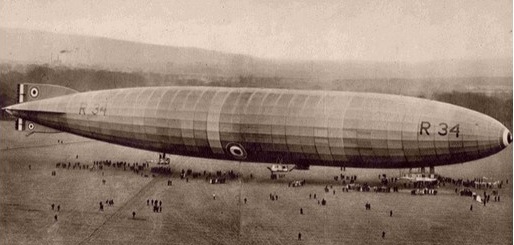
The R33 class of British rigid airships were built for the Royal Naval Air Service during the First World War, but were not completed until after the end of hostilities, by which time the RNAS had become part of the Royal Air Force. The lead ship, R33, went on to serve successfully for ten years and survived one of the most alarming and heroic incidents in airship history when she was torn from her mooring mast in a gale. She was called a “Pulham Pig” by the locals, as the blimps based there had been, and is immortalised in the village sign for Pulham St Mary. The only other airship in the class, R34, became the first aircraft to make an east to west transatlantic flight in July 1919 and by the return flight, completed successfully the first two-way crossing, and was decommissioned two years later after being damaged during a storm. The crew nicknamed her “Tiny”.

Gloster Grebe fighter planes, tethered to the underside of the British Royal Navy airship R33, October 1926

R34 made her first flight on 14 March 1919 and was delivered to her service base at East Fortune on 29 May after a 21-hour flight from Inchinnan: having set out the previous evening, thick fog made navigation difficult, and after spending the night over the North Sea the fog made mooring impossible in the morning, and after cruising as far south as Yorkshire she returned to East Fortune to dock at about 3 pm R34 made her first endurance trip of 56 hours over the Baltic from 17 to 20 June.

R34

It was then decided to attempt the first return Atlantic crossing, under the command of Major George Scott. R34 had never been intended as a passenger carrier and extra accommodation was arranged by slinging hammocks in the keel walkway. Hot food was prepared using a plate welded to an engine exhaust pipe.

The crew included Brigadier-General Edward Maitland and Zachary Lansdowne as the representative of the US Navy. William Ballantyne, one of the crew members scheduled to stay behind to save weight, stowed away with the crew’s mascot, a small tabby kitten called “Whoopsie”; they emerged at 2.00 p.m. on the first day, too late to be dropped off.

R34

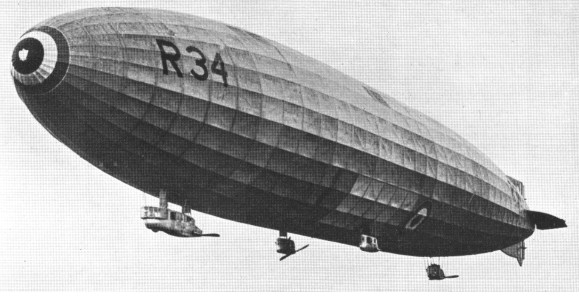
R34 left Britain on 2 July 1919 and arrived at Mineola, Long Island, United States on 6 July after a flight of 108 hours with virtually no fuel left. As the landing party had no experience of handling large rigid airships, Major E. M. Pritchard jumped by parachute and so became the first person to reach American soil by air from Europe. This was the first East-West crossing of the Atlantic and was achieved weeks after the first transatlantic aeroplane flight. The return journey to RNAS Pulham took place from 10 to 13 July and took 75 hours. Returned to East Fortune for a refit, R34 then flew to Howden, East Yorkshire, for crew training.

On 27 January 1921 R34 set off on what should have been a routine exercise. Over the North Sea the weather worsened and a recall signal sent by radio was not received. Following a navigational error the craft flew into a hillside on the North Yorkshire Moors during the night, and lost two propellers. She went back out to sea using the two remaining engines and in daylight followed the Humber estuary back to Howden. Strong winds made it impossible to get her back into the shed and she was tied down outside for the night. By the morning further damage had occurred and R34 was written off and scrapped.

R34, the first airship to make a round-trip flight across the Atlantic.

R34
Engines: 5 × Sunbeam Maori, 275 hp (205 kW)
Length: 643 ft 0 in (196 m)
Diameter: 79 ft 0 in (24 m)
Volume: 1,950,000 cu.ft (55,000 cu.m)
Useful lift: 58,240 lb (26,470 kg)
Maximum speed: 62 mph (99 km/h)
Crew: 26

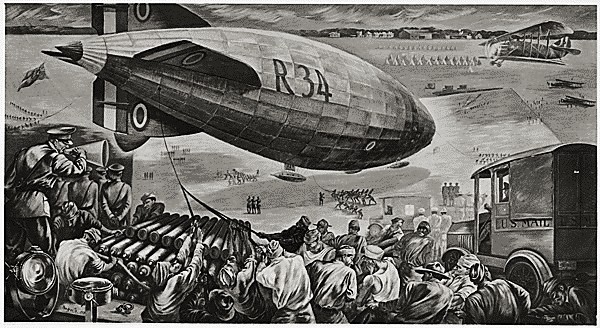
Post Office mural by Peppino Mangravite. 1937

H.M. Balloon Factory R38 / ZR2 / Shorts R38

In June of 1918 the Admiralty made requirements for a ship to be build which would “be required to patrol the North Sea for 6 days without support, as far as 300 miles from a home base.” It was to have a combat ceiling of 22,000ft, and required to carry enough fuel for 65 hours at full speed of 70.6 mph. It was agreed that a further ship be ordered and the new ship, classed as the “Admiralty A Class” was designated the R38. The ship was also to be armed for defence of ships on escort duty and for attacking other aggressors :-

4x 520 lb of bombs
8x 230lb of bombs
1x 1pdr gun on gun platform on the top of the ship
12 pairs of machine guns spread along the top of the ship, the lower gun pit, and through the gondolas.

The order was given to Shorts Brothers at Cardington, and in February 1919 work started on the ship which would become the largest airship in the world.

R 38 Control Car under construction

It was proposed that the R38 order was cancelled, as Cardington had been “Nationalised” under the Defence of the Realm Act. The Shorts Brothers were paid £40,000 in compensation for the cancellation, and the loss of the Cardington premises which became know as the Royal Airship Works.

However, following the Armistice the Americans still wanted a large rigid airship and so to gain experience in this field, the R38 contract was offered to them in October 1919. For the sum of $2,500,000 the British agreed to provide the Americans with a brand new and unique airship, and also offer training for her officers and crews. The contract was agreed, and it was also agreed that each country would equally borne the sharing of any possible loss. In this price was included the use of the R32 and R80 for training the crews. America also had to prepare for the delivery of the worlds largest airship, and advised that they could not expect to receive the ship for at least one year in order that they could make arrangements for it’s housing in the United States.

The whole process of building was restated. Designed as a match to the “Zeppelin Height-Climbers” the R38 was to be a high altitude, high speed airship. Slow progress was made on the ship, and when the contract was originally agreed with the United States, a delivery date of “late 1920” was agreed upon. However. The staff at Cardington were concerned when the work on the R37, which was being built in the bay beside the R38 was halted. The workmen on the R37 were then laid off when it was decided not to progress on the ship.

R 38 Engines under construction

Of course this worried the construction staff working on the R38 as there were no further workorders coming through the airship factory. The ship was finally completed on 7th June 1921. The pressure to get the ship “flying” was noted as there was not time to change the registration of the ship from R38 to the designated the ZRII by the American’s. It was agreed that the ship would fly with this US insignia markings on the outer cover but also with her “British” Registration R38, on her first flight, and have the conversion completed to the ZRII when she reached her Howden base.

First flown on June 23, 1921, R38 was the largest airship in the world to be built as yet, with a length of 694 ft and a diameter of 85 ft. On 23rd June 1921 she was launched from Cardington, and delivered to Howden in Yorkshire. Minor girder damage had been caused in flight by various stresses and the suggestion was made that strength had been sacrificed to achieve lightness. Later test flights were not conclusive about the strength of the ship.

23rd August 1921, the R38/ ZRII was now ready for her 4th trial flight. Now resplendent in her American livery, the ship was to fly from Howden to Pulham in Norfolk and carry our height and speed tests over the North Sea. The Following completion of the trials she flew over the coast to land at Pulham. The original plans were to have at least 150 hours of intensive flight trials for all crews on the new ship, however it was decided that once airworthiness was agreed then the ship be handed over to the Americans with their agreement. This meant that the planned 150 hours were not required and the ship fly down to Pulham, moor on the mast and be loaded up ready for her transatlantic delivery to Lakehurst New Jersey. When the ship flew in low over Norfolk, the airship station was obscured by fog and so it was agreed that the ship would fly our over the North Sea and spend the night over water. When she returned in the morning to the airship station, the airfield was still obscured by thick fog, it was then agreed that the ship return to Howden and carry out more trials en route that day. At approximately 17.00 on the 24th August Disaster struck on a test flight during a tight turn over the Humber near Hull.

Eyewitness reports confirmed that the ship seemed to crumple along mid section and then the front section broke away and detonated. The nose section detonating in two explosions killing 44 crew. Five members of the crew in the tail section were saved from the wreckage as it did not catch fire.

The tail section tilted and fell towards the Humber estuary, but was not alight. The official report attributes structural weakness as the cause of the crash, however the board of enquiry did not offer any technical opinions of the disaster. However the ship had been build far stronger than the comparable L-71, but the L-71 was not capable of being manoeuvred as sharply, and protected from higher stresses as exerted on the R38/ZRII.

44 of the 49 men on board perished in the tragedy. Among them was Air Commodore Maitland and sixteen men from the US Navy training with her.

Wreckage of the R38 being salvaged from the Humber.

In March 1922 the Air Ministry, following Commander Scott’s investigations suggested that the R36 be given to the United States as part compensation. The United States would have to bear the $30,000 expense of repairs and inflation of the ship and upkeep of Pulham after 31st March and the risks of the transoceanic flight. The Air Ministry would not approve the R36 being flown across the Atlantic by an American Crew and so Scott was to be the Commander. The US department of Aeronautics declined the offer. The final interest the US had in the R38 was the settlement of the accounts.

Three quarters of the $2,000,000 of the contract price had been paid with the final $500,000 being due on acceptance of the ship. It was agreed by both Governments that the ship was lost before delivery and hence both were equally liable for the loss. The total loss of the R38/ZRII was calculated at $1,964,334.

Subsequent to the loss of the R101 in 1930 the British Airship Programme was abandoned.

R 38 at Howden shed

Engines: 6 x 350hp
Volume: 2,724,000cft
Length: 695 ft
Diameter: 85.5 ft
Speed: 71 mph