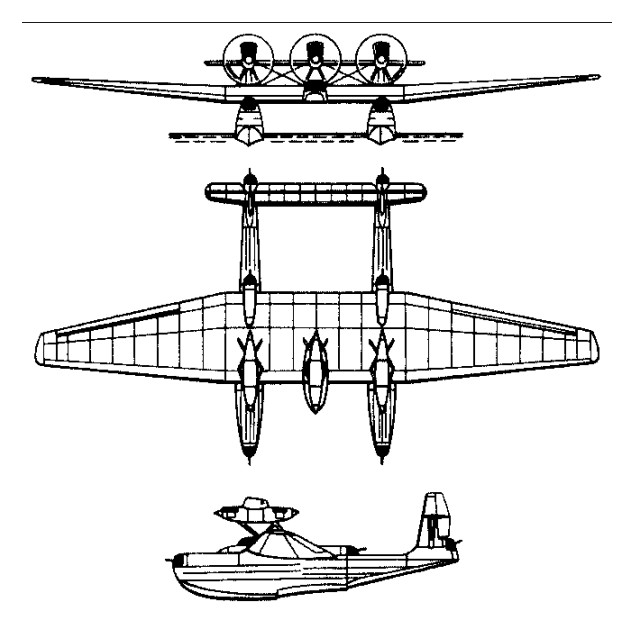
The Tupolev ANT-22 or MK-1 with six 619kW M-34R engines was a long-range bomber reconnaissance flying-boat, with a twin-hull. Test flown for the first time on 8 August 1934, it established several weight-to-height world records in December 1936, but was abandoned soon afterwards.
Armament comprised eight 7.7mm ShKAS machine-guns, one 20mm cannon and a bombload of up to 6000kg.
ANT-22 Engines: 6 x AM-34R Max take-off weight: 33560 kg / 73988 lb Wingspan: 51.0 m / 167 ft 4 in Length: 24.1 m / 79 ft 1 in Height: 6.4 m / 21 ft 0 in Max. speed: 223 km/h Ceiling: 3500 m / 11500 ft Armament: 2 x 20mm cannons, 6 x 12.7mm machine-guns Bombload: 6000kg Crew: 3
Unshaken by this official lack of confidence, Tupolev began planning the world’s largest aircraft and found support in Union of Soviet Writers and Publishers to celebrate the career of the writer Maxim Gorkii (or Gorky). Workers all over Russia donated money for the construction of not just one giant aircraft, but a whole Maxim Gorki Propaganda Squadron of them, for which 6,000,000 roubles were collected.
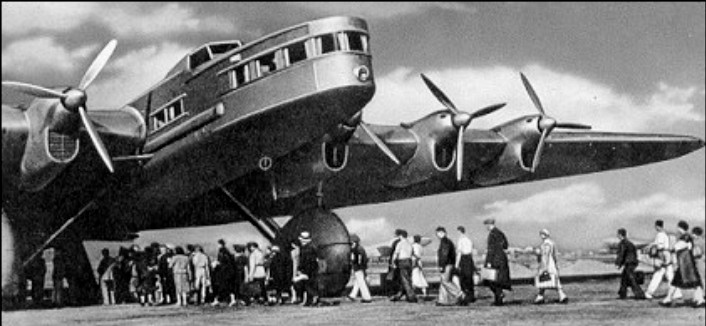
This aircraft flew for the first time on 19 May 1934. When it appeared at Moscow’s Central Airport in the spring of 1934, Tupolev’s first ANT 20 Maxim Gorki spann¬ed 63 m (206 ft), with eight engines totalling 7200 hp, and a gross weight of 52.8 tonnes (52 tons). Within its fuselage and wings were seats for up to 80 passen-gers, a cinema, newspaper office, darkroom, printing press, radio station, buffet bar, toilets, sleeping quarters and an internal telephone exchange. Beneath its wings loud¬speakers and illuminated signs were installed to broadcast political slogans; engineers could walk through the inside of the struc¬ture to attend to its engines.
The six engines originally fitted were not enough and an extra pair were added on a pod above the fuselage. The giant ANT-20 toured the otherwise inaccessible areas of the USSR, bringing the communist message to the masses.
Four smaller auxiliary engines were required to drive various devices, including the giant sound system and a series of lights for displaying propaganda slogans at night. The crew is said to have been up to 23 people, although most of these were associated with the propaganda function. Between eight and 10 crew were involved in actually operating the aircraft.
In 1934 workers at the institute were invited to fly in the giant machine which they had designed and built. Thirty six passengers boarded, along with 11 crew, and Maxim Gorki took off, accom¬panied by a Polikarpov I-5 fighter which was to formate with it for air to air photographs. During the flight the fighter pilot, disorientated during a barrel roll, collided with the Gorki, which broke up in the air and exploded in a fire¬ball, throwing bodies and equipment out in full view of spectators at the airport. The fighter pilot, all 47 aboard the giant aircraft and three bystanders died. The Russians subscribed for three more ANT 20s, with just six engines of greater power, and eventually 16 were built, eight of which survived World War II.
A re¬placement aircraft for the ANT 20 Maxim Gorki, with only six engines but the same dimensions and an even ¬greater all up weight, was built as the PS 124 or ANT 20bis.
ANT-20 Engine: 6 x AM-34FRNV, Max take-off weight: 44000 kg / 97004 lb Wingspan: 64.0 m / 210 ft 12 in Length: 34.1 m / 112 ft 11 in Height: 7.0 m / 23 ft 12 in Wing area: 486.0 sq.m / 5231.26 sq ft Max. speed: 275 km/h / 171 mph Cruise speed: 225 km/h / 140 mph Ceiling: 5500 m / 18050 ft Range: 900 km / 559 miles Crew: 8 Passengers: 64
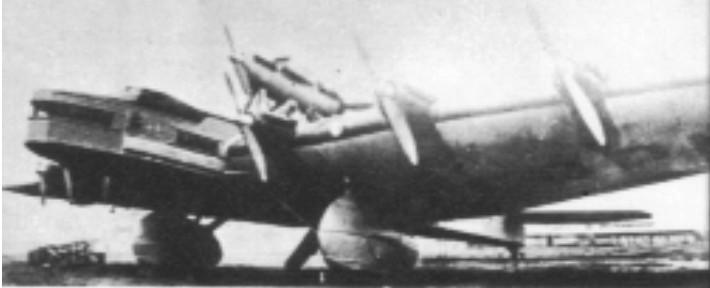
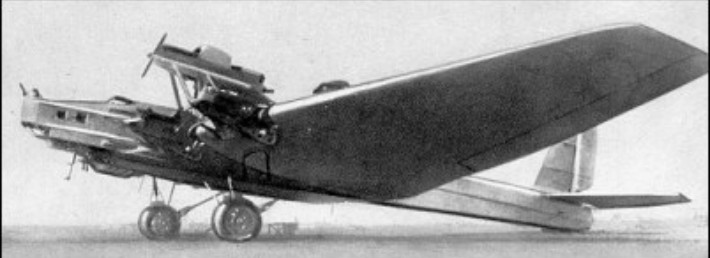
In May 1933 Tupolev’s TB 6 (ANT 16) six engined bomber succeeded the TB 3 as the world’s largest landplane. The Tupolev ANT-16 or TB-4 was a super-heavy bomber powered by six 619kW M-34 engines, two of them mounted in tandem above the fuselage. Armament comprised two 20mm cannon and 10 machine-guns, plus a maximum bombload of 10000kg.
First flown on 3 July 1933, performance was so poor that the Soviet government declined further support for Tupolev’s large aircraft. It did not go into production, but served as the prototype of the even larger eight engined ANT 20 Maxim Gorki, built to commemorate the great Soviet writer’s fortieth anni¬versary.
TB-4 Engines: 6 x AM-34R Max take-off weight: 33280 kg / 73370 lb Empty weight: 21400 kg / 47179 lb Wingspan: 54.0 m / 177 ft 2 in Length: 32.0 m / 105 ft 0 in Height: 11.7 m / 38 ft 5 in Wing area: 422.0 sq.m / 4542.37 sq ft Max. speed: 200 km/h / 124 mph Ceiling: 2750 m / 9000 ft Range: 1450 km / 901 miles Range w/max.payload: 775 km / 482 miles Armament: 4 x 20mm cannons, 10 x 7.62mm machine-guns Bombload: 4000kg Crew: 12
One patriot who felt he could fill this gap and strike a blow at the Kaiser was a Surrey building contractor, W. G. Tarrant, whose company had been involved in wartime contract work manufacturing wooden aircraft components. Tarrant hired Walter Henry Barling to design the aircraft, which was to be a ‘bloody paralyzer’ of a triplane made entirely of home-grown timber and constructed using a largely female work force, according to the terms of the contract issued by the Ministry of Munitions. The massive Tabor triplane was the first and last aeroplane built by W. G. Tarrant Ltd of Byfleet, Surrey. Designed in an attempt to enable Berlin to be bombed from bases in England, and assembled at RAE Farnborough, the aircraft was not completed until 1919.
When it appeared, too late for its intended purpose, it spanned 40m (131 ft 3 in) from tip to tip of its middle wing, and had a 22.25m (131 ft 3 in) fuselage of monocoque construction formed from ply skinning over Warren-girder type circular formers. Serialled F1765, the one and only completed Tabor was powered by a total of six 450 h.p. Napier Lion engines: two pairs in push-pull tandem between lower and middle wings, and another two tractor engines between middle and top planes. The fuselage was of finely streamlined monocoque construction, while the tail consisted of a biplane unit with twin fins and rudders.
The Tabor stood as high as a four-storey house, and its height, and particularly the location of its upper engines, brought about its speedy demise. On 26 May 1919 the giant Tabor was winched out of the balloon shed at the Royal Aircraft Establishment at Farnborough along a specially built railway track. Some 508 kg (1120 lb) of lead was loaded into the nose at the last moment when some final calculations showed that the aircraft might be tail heavy, and the long, wearisome process of hand-starting the six Napier Lions began. With all engines running the pilot, Captain F. G. Dunn, and his co-pilot, Captain P. T. Rawlings, began taxi trials. Also aboard were a technical observer from Tarrant’s, a fitter, an engineer officer, and two foremen from the RAE. When Dunn opened up the top engines, which had previously been throttled back, and the sudden extra thrust so far above the aircraft’s centreline caused it to nose-over and bury its forward fuselage in the earth just as it was about to leave the ground. The two pilots died shortly afterwards of their injuries and Tarrant, perhaps fortunately for other aviators, never again dabbled with aviation.
Construction of a second Tabor was abandoned.
Engines: 6 x Napier Lion, 450 hp Wingspan: 40m (131 ft 3 in) Fuselage length: 22.25m (131 ft 3 in) Weight: 45,000 lb
UK Building contractor of Byfleet, near Brooklands, Surrey, which undertook aircraft component manufacture during First World War. Only aircraft produced was Tabor long range bomber, designed with collaboration from Royal Aircraft Establishment; this six-engined triplane nosed-over and was wrecked in its first attempt to take off in May 1919.
The 1962 Jet-Packet 3400 was a Steward-Davis Jet-Packet 1600 Fairchild C-82A with a single 3250 lb Westinghouse J34-WE-34 or 3400 lb WE-36 jet-pak. At least four were converted.
The Jet-Packet II involved airframe weight reduction to increase cargo weights. With two P&W R-2800CB-16 engines, the application was applied to Jet-Packet 1600 or 3400. At least three were converted, including TWA C-82A Ontos N9701F.
In 1967 Stewart-Davis completed a new version of its C-119 STOLmaster with a Jet-Pak 3402 detachable jet engine under each wing and provision for a third above the fuselage, supplementing the two R-3350-89a piston engines. Each Jet-Pak contains a 3400 lb thrust Westinghouse J34 engine.
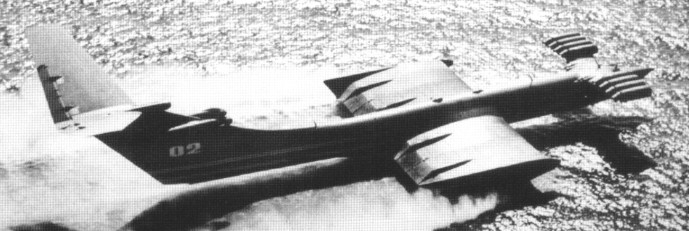
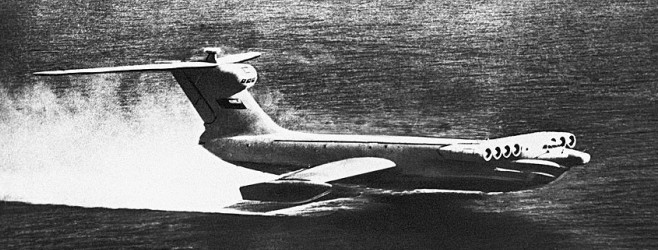
The Monster (its Russian designation was KM, derived from the words Korabl’ Maket or “ship model”) was nothing less than a juggernaut, one of the largest heavier-than-air flying machines ever built. At 500 tonnes it had a 100-tonne MAUW advantage over its fellow winged heavyweight the Boeing 747. No less than ten jet turbines constituted its propulsion system, an array of power used for take-off rather than cruise. Eight turbines were arranged in a shoulder-mounted stub-wing battery just aft of the cockpit. Capable of being deflected under the mainplane where a full-span trailing edge flap would trap their thrust, their combined power could generate an immense lifting force via a hovercraft-like static air cushion to cruise 4 metres above the water
The Lun-class ground effect vehicle (GEV), or sea skimmer, was developed by Russian engineers at the Alexeyev Hydrofoil Design Bureau.
During the Cold War, ekranoplans were sighted for years on the Caspian Sea as huge, fast-moving objects. The name Caspian Sea Monster was given by U.S. intelligence operatives who had discovered the huge vehicle, which looked like an airplane with the outer halves of the wings removed. After the end of the Cold War, the “monster” was revealed to be one of several Russian military designs meant to fly only a few meters above water, saving energy and staying below enemy radar.
The KM, as the Caspian Sea Monster was known in the top secret Soviet military development program, was over 100 m long (330 ft), weighed 540 tonnes fully loaded, and could travel over 400 km/h (250 mi/h), mere meters above the surface of the water.
These craft were originally developed by the Soviet Union as very high-speed (several hundred km/hour) military transports, and were mostly based on the shores of the Caspian Sea and Black Sea. The largest could transport over 100 tonnes of cargo. The only three operational A-90 Orlyonok ekranoplans built (with renewed hull design) and one Lun-class ekranoplan remained at a naval base near Kaspiysk.
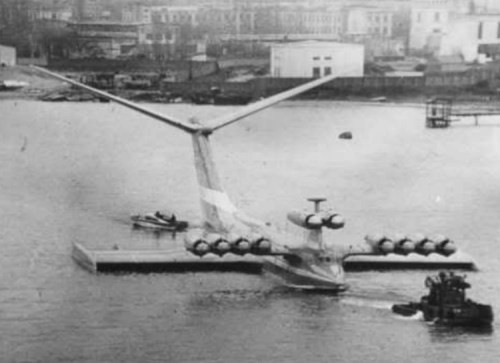
The Lun-class (“Harrier”) Ekranoplan MD-160, dubbed the “Caspian Sea Monster” by US Intelligence services, was one of a kind. It was capable of carrying up to 124 tonnes of troops and equipment, including as many as six nuclear missiles, at speeds up to 560km/h as far as 2000km. Eight Kuznetsov 128.9kN NK-87 turbofans mounted on the front cannards provided the thrust to get the seaplane’s hull up and out of the water and engage the ground effect.
While ground-effect vehicles are a highly efficient way to transport cargo over long distances, the MD-160 had significant drawbacks in its military applications. For one thing, manoeuvrability. Anything resembling a sharp turn was right out, and allowing a wing tip to even sniff the water could result in 500 tonnes of seaplane cartwheeling along the surface of the Caspian. And since the ground effect didn’t actually take effect until the plane was out of the water, the MD-160 had to always take off into the wind.
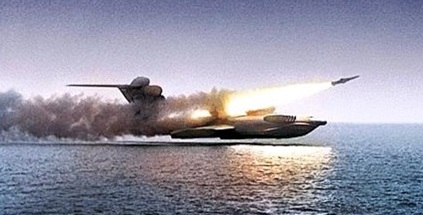
In 1987, the first flight was made by Lun, an ekranoplan-rocket carrier. It was armed with six guided anti-ship missiles “3M-80 Mosquito”.
After the successful completion of state tests “Lun” was in 1990 transferred to trial operation. However, the collapse of the Soviet Union led to the cessation of work in this area and the disbanding of the 11th Air Group of the Black Sea Fleet E-Wing.
So while the MD-160 was thoroughly impervious to subsurface mines and torpedoes, its size and complete lack of manoeuvrability made the planes sitting ducks against Western air forces (hence its NATO designation: Duck), often requiring armed escort and forward scouting boats to avoid obstacles. The Ekranoplan carried anti-ship P-270 Moskit guided missiles in six pairs mounted onto its fuselage as well as a pair of 23mm Pl-23 cannons in a tail turret and forward-facing pair under the forward missile tubes.
Despite the the MD-160’s shortcomings, Soviet high command continued to move forward with the program right up until the Soviet Union fell. A second MD-160, destined to be a mobile field hospital, was 90 per cent complete and another 30 A-90 Orlyonok GEVs, meant to strengthen the Black Sea Fleet, were on order when the program’s funding was cut. The MD-160 currently resides at a naval station in Kaspiysk.
The R31 class of British rigid airships was constructed in the closing months of World War I and comprised two aircraft, His Majesty’s Airship R31 and R32. They were designed by the Royal Corps of Naval Constructors – with assistance from a Herr Müller who had defected to Britain and previously worked for the Schütte-Lanz airship company – and built by Short Brothers at the Cardington airship sheds. The airship frame was made from spruce plywood laminated into girder sections, weatherproofed with varnish, and also fireproofed. These enclosed 21 gas bags. R31 was the largest British airship to fly before the end of the war, and the class remains the largest mobile wooden structures ever built.
As the airships were intended for fleet protection operations, they were to be fitted with defensive machine guns on top of the envelope, at the stern and in the gondolas. A 12-pounder gun was to be fitted in a special position centrally below the airship for use against U-boats. In the event, this armament was only fitted to R31, as R32 was only completed after the armistice with Germany. It had also been intended to fit a bomb load of two 520 lb (240 kg) bombs and four 230 lb (100 kg) bombs. but with the end of hostilities these were never installed on either airship.
R31 made its first trial flight, lasting two hours, in July 1918 under the command of Squadron Leader W.C. Hinks. A top speed of 70 mph (110 km/h) was achieved, well above the expected 50–55 mph (80–89 km/h) and faster than any other airship then in service. It was originally powered by six 275 hp (205 kW) Rolls-Royce Eagle engines, but in view of the performance and to reduce fuel consumption one was removed, reducing the maximum speed to a still satisfactory 65 mph (105 km/h); similarly the R32 was built with six engines and later converted to a five-engine configuration.
The airship was finally commissioned on 6 November 1918, just before the armistice with Germany, after having spent four hours in the air. It set off, again under the command of Squadron Leader Hincks, for the airship base at East Fortune in Scotland. On the journey she encountered bad weather and it was feared that some of the plywood girders were failing, so she diverted to the airship base at Howden in the East Riding of Yorkshire for examination and repair. Unfortunately, the sheds had not been repaired since the R27 had caught fire three months earlier and the roof leaked badly. This caused the glue holding the plywood together to deteriorate; as a result the airship became unairworthy and was beyond repair. In February 1919 it was dismantled. The covering was removed and returned to Cardington while the frames were sold for £200; these were broken up and sold for firewood but due to the fireproofing treatment they had received they would not burn.
R31
After being formally accepted by the Royal Navy, R32 made its first trial flight on 3 September 1919 and then on 6 September went to RNAS Pulham, Norfolk, which at the time was a centre for training and experimentation. On 10 September in formation with the R33 she made a flight over the Netherlands, Belgium and Northern France and back to Pulham. In October 1919 the R32 with the rest of the airship fleet was formally handed over to the Royal Air Force. The ship was flown from Cardington on September 16th 1919 with Major Elmsley in charge. George Meager reports that a week later he was on board as navigator when the R32 flew across to Amsterdam – he recalls another crew member named Scroggs on this flight. He took a further two flights a month later naming Flt Lt Ivor Cecil Little as the Captain and Scroggs as First Officer. The airship was used by the National Physical Laboratory for structural testing. On 20 March 1920 it was flown to Howden to be refurbished and used for crew training by the American party who had come to accept the R38 (ZR-2). When the metal-framed R80 became available, the use of the by now obsolete wooden-framed R32 stopped and, to save money, it was decommissioned and used to assess the effect of a gas-bag bursting. Once the covering had been removed and the engines taken away, cell No.18 was overpressurised until the expansion caused the bracing and structure to fail. The frame was subsequently dismantled.
The R32 leaving the shed at Cardington.
Powerplant: 5 × Rolls-Royce Eagle, 275 hp (205 kW) each Volume: 1,547,000 cu ft (43,976 m3) Length: 615 ft 0 in (187.5 m) Diameter: 65 ft 6 in (19.97 m) Useful lift: 36,960 lb (16,800 kg) Maximum speed: 65 mph (104 km/h, 56 kn)
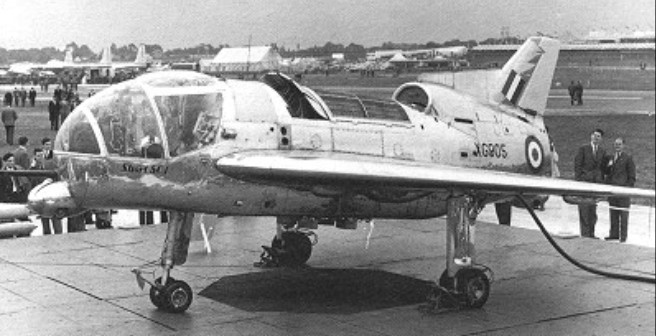
In 1953, the Ministry of Supply issued Specification ER.143 for a research aircraft which could take off vertically by jet lift, then accelerate forward into normal cruising flight.
The SC. 1 was designed to study hover, transition and low-speed flight, and had a fixed landing gear. The Short SC. 1 was powered by four RB.108 lift engines vertically mounted on gimbals in the centre fuselage and one RB.108 cruise engine in the rear for forward flight. Bleeds from the four lift engines powered nose, tail and wing-tip reaction jets for control at low speeds.
The first conventional flight was made on 2 April 1957, first tethered vertical flight was on 26 May 1958, and first free vertical flight was on 25 October 1958. The first transition was on 6 April 1960.
The SC.1 appeared at the Farnborough air show in 1960 and Paris air show in 1961 (for the latter it flew the English Channel both ways).
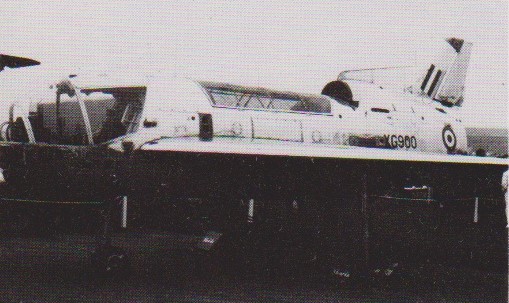
After first flying May 1958, the second Short SC.1 VTOL research aircraft (XG905) crashed at Sydenham airfield, Belfast, on October 2nd, 1960, the pilot, John R. Green, being killed. Equipped with a new auto stabiliser system with which it had begun tests on August 2nd, the SC.1 was hovering at an altitude of 50 ft (15.2 m) when control was lost, the aircraft turning over on hitting the ground. It was rebuilt and the two aircraft continued to fly.
James M. Patton, Jr was a research pilot at NASA Langley, and a guest of the Royal Aircraft Establishment at Bedford in August & September, 1971. He conducted 10 flights in SC-1 XG905 to obtain data pertinent to NASA VTOL research.
One was on display at the Ulster Folk and Transport Museum.
Engines: 4 x 965kg Rolls-Royce RB.108 lift engines and 1 x RB.108 cruise engine Max take-off weight: 3650 kg / 8047 lb Wingspan: 7.16 m / 24 ft 6 in Length: 9.10 m / 30 ft 10 in Max. speed: 396 km/h / 246 mph Range: 240 km / 149 miles Crew: 1








 All Aero