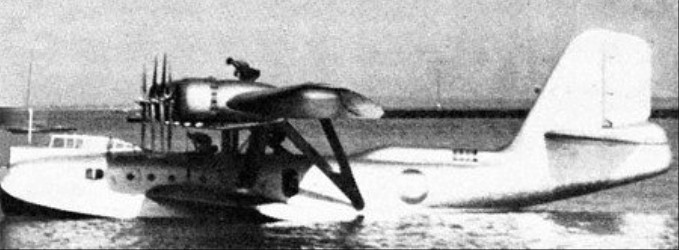
The Savoia–Marshetti S.74 designed and constructed for the Italian airline Ala Littoria. The S.74 could carry between 20 and 27 passengers in the lower compartment with panoramic windows, while the cockpit crew were five metres up. Navigator and radio man were seated in the enclosed nose.
The prototype, I-URBE, was first flown in November of 1934. Only three were built and they saw service from 1935.
After designing the S.38 four-engined patrol flying-boat to Specification R.5/39, Saro built, as a private venture, a two-seat half-scale model as the Saro A.37, often called the Shrimp. The R.5/39 programme did not go ahead, but the Saro A.37 was completed in time to make its first flight in October 1939. Powered by four 63kW Pobjoy Niagara III engines, it was later modified to have a single fin and rudder, and other features representative of the Shetland flying-boat jointly developed by Shorts and Saro. In this guise, it acquired the serial TK580, and was tested from early 1944 until after the war had ended. The Shrimp was dismantled in Felixstowe in 1949.
Saunders-Roe A.37 Engines: 4 × Pobjoy Niagara III, 95 hp / 71 kW Length: 42 ft 3.25 in / 12,89 m Wingspan: 50 ft / 15,24 m Wing area: 340 sq.ft / 31,6 sq.m Height: 12 ft 8.75 in / 3,88 m Empty weight: 4,362 lb / 1,983 kg Loaded weight: 5,700 lb / 2.591 kg Maximum takeoff weight: 6,200 lb / (2,818 kg Maximum speed: 113 kt / 130 mph / 209 km/h Climb rate: 635 m/min / 3,22 m/s Wing loading: 16,8 lb/sq.ft / 82 kg/sq.m Power loading: 0,067 hp/lb / 0,11 kw/kg Endurance: 3 hours Seats: 2
A.33 Engines: 4 x 830hp Bristol Perseus XII Max take-off weight: 18824 kg / 41500 lb Wingspan: 28.96 m / 95 ft 0 in Length: 22.86 m / 75 ft 0 in Height: 6.71 m / 22 ft 0 in Wing area: 110.93 sq.m / 1194.04 sq ft Max. speed: 321 km/h / 199 mph Cruise speed: 280 km/h / 174 mph Ceiling: 4352 m / 14300 ft Armament: 3 x 7.7mm, bombs or deep charges Crew: 7
Designed to ferry a sub-orbital spacecraft between its twin fuselages, the Scaled Composites White Knight Two, first flown in 2008, can ascend to a maximum height of 70,000 feet. The pilot steers from the right fuselage.
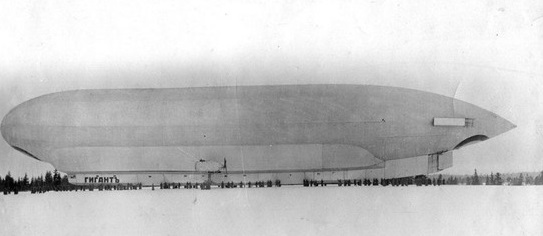
The Gigant was built by engineers A.Kovanko and A.Shabskogo at the Russo-Baltic Wagon Works, Salizi, south-east of St.Petersburg, between 1912 and 1915. It was of 724,060 cu.ft capacity, measuring 374 ft long with a 56 ft diameter, giving a gross lift of 21 tons and a useful lift of 8.8 tons. As originally designed, power was four 215 hp Austro-Daimler eight-cylinder petrol engines, later reduced to two such units mounted in streamlined nacelles positioned amidships above the keel.
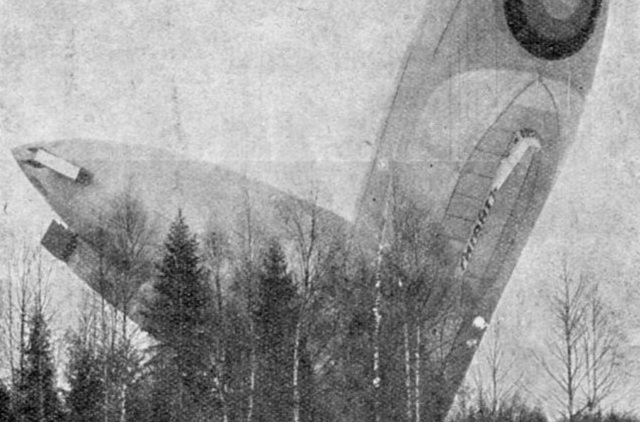
On the first flight, in February 1915, shortly after take-off at low altitude, the airship dipped in the middle, causing the propeller to cut one of the cable braces. The airship, breaking in half, fell to the ground. The crew was not injured.
The cause of the accident was because of the loads imposed by rearranging the engine cars.
The airship was rebuilt, but due to the lack of hydrogen, it was not filled and was scrapped in late 1916.
Engines: 4 x 212 hp Volume: 20,500 cu.m Length: 114 m Diameter: 17 m Max speed: 58 km / h
The Rockwell B-1 resulted from a November 1969 requirement for a medium-altitude with dash capability of Mach 2.2+ for the high-speed delivery of free-fall and stand-off nuclear weapons. Submissions were received from several companies, Rockwell’s design being selected in 1970 as the B-1A. The full-scale design and development programme for the initial production version was soon under way. The initial model was a complex and highly advanced variable-geometry type with General Electric F101 turbofans and fully variable inlets for maximum capability in all elements of the flight envelope.
The first of four prototypes (71-40158) of the Rockwell International B-1 four-turbofan strategic heavy bomber made its maiden flight on 23 December 1974; designed to meet USAF Strategic Air Command’s Advanced Manned Strategic Aircraft (AMSA) requirement, it incorporated variable geometry wings (maximum sweep of 67 degrees), accommodated a four-man crew and had an estimated maximum speed of Mach 2 at altitude.
In June 1977 President Carter decided to scrap the programme in favour of cruise missile development although flight trials with the B-1A aircraft were to be continued for research purposes, the flight testing continued through 1981 with the four prototypes.
Then with the inauguration of President Reagan matters began to look up again, the new administration deciding during October 1981 to procure 100 examples of a much revised B-1B version in the low-level penetration role for high-subsonic delivery of free-fall and stand-off weapons. The B-lB was.therefore a straightforward but nonetheless major adaptation of the B-1A optimized for the low-level transonic role with fixed inlets and revised nacelles (reducing maximum speed to Mach 1.25). But it did have a strengthened airframe and landing gear for operation at higher weights with nuclear and conventional weapons over very long ranges. Other changes were concerned with reduction of the type’s already low radar signature, S-shaped ducts with streamwise baffles being adopted to shield the face of the engine compressors and radar absorbent materials being installed in sensitive areas to reduce electromagnetic reflectivity. The second and fourth B-lAs were used from March 1983 to flight-test features of the B-1B, which first flew in September 1984 with the advanced offensive and defensive electronic systems.
In conjunction with the USAF, Edwards AFB, ASA Dryden Flight Research Center carried out two six-hour flights of the B-1, with the first taking place on 25 March 1981. B-1 number 3, part of the USAF/Rockwell joint test force Bomber Penetration Evaluation was utilised for the two flights. The two supersonic flights evaluated the Structural Mode Control System.
The first production B-1B flew on October 18, 1984, some five months ahead of schedule. Two B-1A development aircraft had previously been converted to B-1B standard, the first flying in B-1B form in March 1983. Production deliveries began in July 1985, to replace B-52Hs in the penetration role, and will continue until 1988.
The ninth B-1B was the first to be fitted with a moveable bulkhead in the forward weapons bay, enabling it to carry eight AGM-86 air-launched cruise missiles (ALCM), short-range attack missiles (Sram), and extra fuel tanks internally. Maximum ALCM loading is eight missiles internally and 14 externally on eight underfuselage hardpoints.
Initial Operational Capability was first achieved on 1 October 1986.
In January 1987 a B-1B successfully launched a short-range-attack missile for the first time, while in April an aircraft from the 96th Bomb Wing at Dyess AFB, Texas, completed a 2l hr 40min mission including five in-flight refuellings (to maintain a high aircraft weight), covering a distance of 15,145km (8,175 nm).
The final B-1B was delivered 2 May 1988.
In 1989, when Neil Armstrong became chairman of AIL Systems Inc., he was invited to fly the B-1 bomber. He later flew the B-1 again for the first flights television series.
The B-1B Lancer were modified and aircrews were trained for the use of conventional weapons, including stand-off and laser guided weapons, and did flew combat missions during Operation Desert Fox.
Also in 1999 the B-1s flew bombing missions using conventional weapons against Yugoslavia as part of Operation Allied Force.
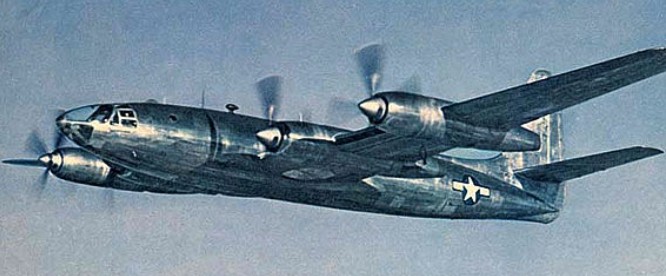
Development of the XF-12 photo-reconnaissance airplane began in 1944 when it appeared that a fast, specialized reconnaissance airplane would be needed during the final stages of the war in the Pacific. The XF-12 was roughly the same size as the C-54, hut it was much heavier and had more than twice as much power. The four turbo¬supercharged, 3,000hp (2,200kw) Pratt & Whitney Wasp Major engines were enclosed in long, slender nacelles that extended well beyond the wing trailing edges. The wing and empennage shared a resemblance with those of the F-84 Thunderjet. The fuselage was a slender teardrop shape, unbroken even by the windshield. Each main landing gear had a very large single wheel to fit inside the confines of the laminar flow wing. The Rainbow had its own darkroom in order to develop reconnaissance images on the way back from a long photo mission.
The first of two XF-12 prototypes was completed and flown on February 7, 1946. Subsequent experimental flight tests showed that it had lived up to its promise, and it passed into the service-test phase in June 1947. The XR-12 delivered to the Air Force crashed on its second test flight. The other Rainbow was sent to a gunnery range.
Unfortunately, the day of high-performance reciprocating engine-powered military airplanes had passed and the anticipated contract for 20 production F-l2As never materialized.
Republic still hoped to make the Rainbow into a 46-seat airliner, which they called the RC-2. Their selling point was speed, for which customers would pay a premium. Unfortunately, the expected postwar boom was not immediate and the airlines bought the slower but roomier DC-4 and Boeing 377 instead.
XF-12 Engine: 4 x Pratt & Whitney R-4360 Wasp Major, 2250kW Max take-off weight: 45950 kg / 101303 lb Wingspan: 39.36 m / 129 ft 2 in Length: 28.59 m / 94 ft 10 in Height: 8.63 m / 28 ft 4 in Wing area: 152.30 sq.m / 1639.34 sq ft Max. speed: 684 km/h / 425 mph Cruise speed: 640 km/h / 398 mph Ceiling: 13000 m / 42650 ft Range: 7000 km / 4350 miles Crew: 5-7
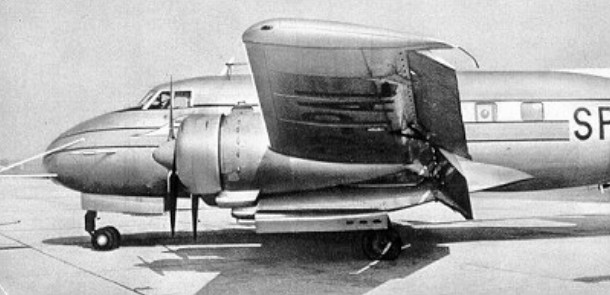
One of the P.Z.L. Mielec early postwar projects was the P.Z.L. Mielec MD-12 short-range light transport, the first of several prototypes flying initially during August 1959.
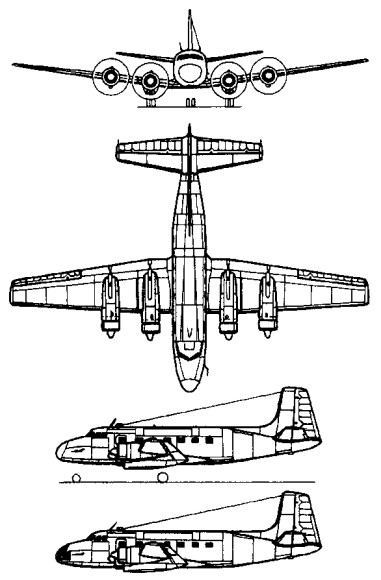
A cantilever low-wing monoplane of all-metal construction, it had retractable tricycle landing gear and was powered by four Narkiewicz WN-3 radial engines in wing-mounted nacelles. Accommodation was provided for a flight crew of two on a separate flightdeck, and the main cabin could accommodate 20 passengers or, when cleared of its easily-removed seating, up to 1900kg of cargo.
Only four aircraft, including one four static trials, were built: 1st prototype SP-PAL, 2nd SP-PBD and the 4th was MD-12F SP-PBL prototype, the one that survived in Krakow Museum.
The MD-12 did not progress beyond the prototype stage, but a photographic survey version was produced in small numbers. Designated MD-12F, and first flown in prototype form on 21 July 1962, this had its internal accommodation arranged for a crew of up to seven, providing four camera positions and a darkroom at the rear of the cabin. Plans was cancelled after the fatal crash of the first MD-12 prototype
MD-12F Engines: 4 x Narkiewicz WN-3, 246kW Wingspan: 23.2 m / 76 ft 1 in Length: 15.8 m / 52 ft 10 in Height: 5.95 m / 20 ft 6 in Wing area: 57.0 sq.m / 613.54 sq ft Max take-off weight: 7000 kg / 15432 lb Loaded weight: 5025 kg / 11078 lb Max. speed: 305 km/h / 190 mph Ceiling: 5200 m / 17050 ft Range w/max.fuel: 2100 km / 1305 miles Crew: 2 Passengers: 20







 All Aero