Short S.5 Singapore I / S.19 Singapore III

Singapore I

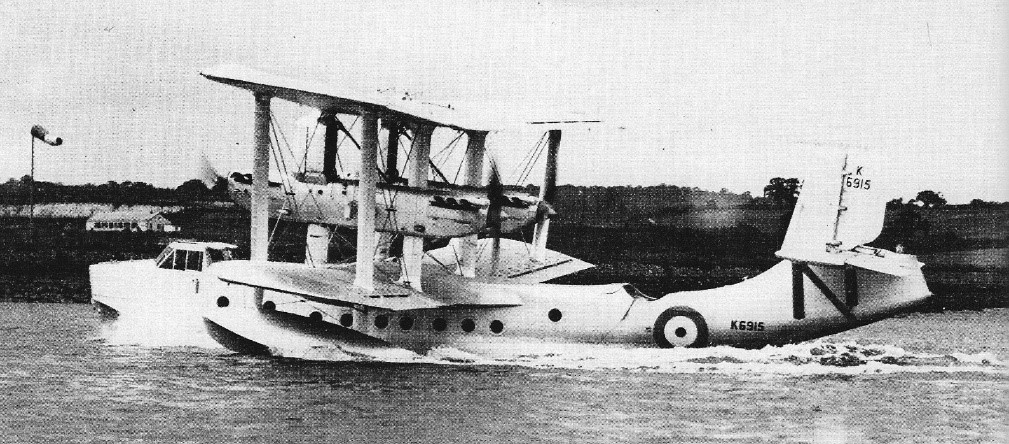
The Singapore III reconnaissance and coastal patrol flying-boat was basically the production version of the earlier Singapore II, itself developed from the twin Buzzard-engined Singapore I of 1926.
Singapore III

The huge biplaned Singapores entered service with the RAF in 1934. Built with a deep, well faired beamy hull constructed of duralium, the boat had a good seaworthy reputation and was quite maneouvrable on the water. While the book claimed a cruise of 105 knots, RNZAF crews seldom watched the wave tops go past at more than 80 knots. The endurance was some six and half hours at around a thousand feet, the low altitudes being little hindrance as the primary observation device in those early days was the Mark One eyeball.

Singapore III

Thirty-seven Singapore IIIs were delivered to the RAF, entering service in the spring of 1935. The last few aircraft were withdrawn in late 1941, when they were transferred to the Royal New Zealand Air Force. Powered by four 730 hp Roll Royce Kestrel VIII/IX glycol cooled engines mounted in two tandem pairs between the fabric covered wings.

Gallery

Short S 19 Singapore III
Engines: 4 x Rolls-Royce Kestrel VIII/IX, 418kW/ 560 hp
Wingspan: 27.43 m / 90 ft 0 in
Length: 23.16 m / 76 ft 0 in
Height: 7.19 m / 24 ft 7 in
Wing area: 170.38 sq.m / 1833.95 sq ft
Max take-off weight: 12475 kg / 27503 lb
Empty weight: 8355 kg / 18420 lb
Max. speed: 126 kt / 233 km/h / 145 mph
Cruising speed: 91 kt / 169 km/h Ceiling: 4570 m / 15000 ft
Range: 869 nm / 1610 km / 1000 miles
Crew: 6
Bomb load: 2000 lb / 907kg
Armament: 3 x .303 MG (7,7mm) Lewis mg

Short S.19 Singapore III

Shinn Meiwa PS-1 / US-1

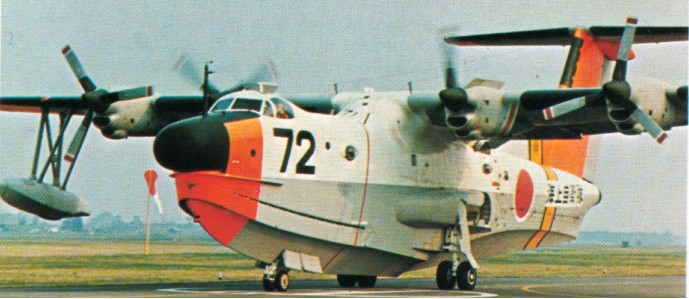
After January 1966, directed attention was put into a new marine aircraft. A Grumman Albatross was rebuilt as a dynamically similar flying model for a projected very large STOL ASW flying-boat for the Japanese Maritime Self Defense Force. The type was developed as the four-turboprop PS-1, but later as the US-1 amphibious search-and-rescue aircraft.

The Shinn Meiwa PS 1, a four turboprop STOL amphibian with an auxiliary engine driving a boundary -layer control pump, has a speed range from 295 knots maximum to a 40 knot stall. PS 1s carry search radar, sonobuoys, MAD and ECM equipment to aid in the search for submarines, and against which they can deploy anti submarine bombs, homing torpedoes, and rockets for surface attack.

Shinn Meiwa PS-1 / US-1 Article

Designed for long-range ASW, the four-turboprop PS-1 flying boat first flew in October 1967, entered service in 1973, and was followed by the US-1 amphibious variant in October 1974.

The first prototype PS-1 was converted later as waterbombing test vehicle.

Production of the PS-¬1 was completed with the 23rd aircraft in 1979. The seventh and subsequent US-1s are fitted with uprated T-64 IHI-10J turboprops and are designated US-lAs. Earlier aircraft are being progressively retrofitted with these engines.

The JMSDF intended to purchase one US-1A SAR amphibian every two years, the next funding was being sought in FY1988.

PS-1
Engines: 4 x T64-IHI-10 turboprop, 3060 shp
Wing span: 108 ft 8.75 in (33.14 m)
Max speed 340 mph (547 km/h)
Crew: 10

Shaanxi KJ-200

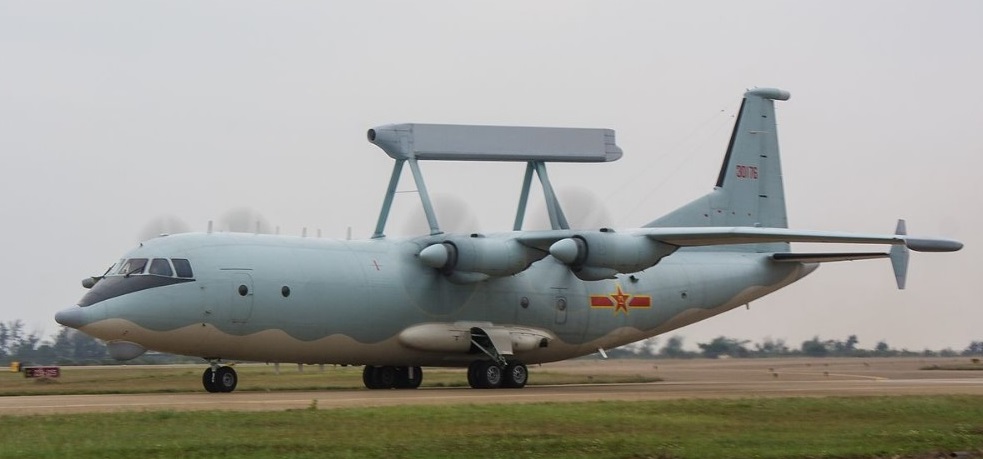
The KJ-200 (Chinese: 空警-200; pinyin: Kōngjǐng Liǎngbǎi; literally: “Airwarn-200”) NATO reporting name: Moth or Y-8 Balance Beam system, is an Airborne early warning and control (AEW&C) program developed by Shaanxi Aircraft Corporation. (KJ is from the first characters of the Pinyin spelling of 空警, (Kōng Jǐng), short for 空中预警 (Kōng Zhōng Yù Jǐng), which means Airborne Early Warning).

The key component of this aircraft is an AESA radar system, visually similar to the Saab Erieye system, mounted on struts above the rear fuselage, as well as ventral sensor domes. The platform of this aircraft is based on the Shaanxi Y-8F-600 and it has been reported that Pratt & Whitney Canada PW150B turboprops and Honeywell avionics have been incorporated.

The general designer of the KJ-200 is Ouyang Shaoxiu (欧阳绍修), the same general designer of the Y-8. According to Ouyang the KJ-200 has been significantly modified (around 80%) from the original Y-8. including the adoption of a glass cockpit.

The project experienced a major setback in 2006, when a KJ-200 crashed into a mountain in Guangde County while undergoing tests.

During the National Day of the People’s Republic of China military parade 1 October 2009, a KJ-200 took the role as a lead aircraft.

In February 2017 a US Navy Lockheed P-3 Orion and a KJ-200 inadvertently came close to each other over the South China Sea. The aircraft were within 1,000 feet (305 meters) of each other.

It is believed 11 have been built.

Shaanxi KJ-500

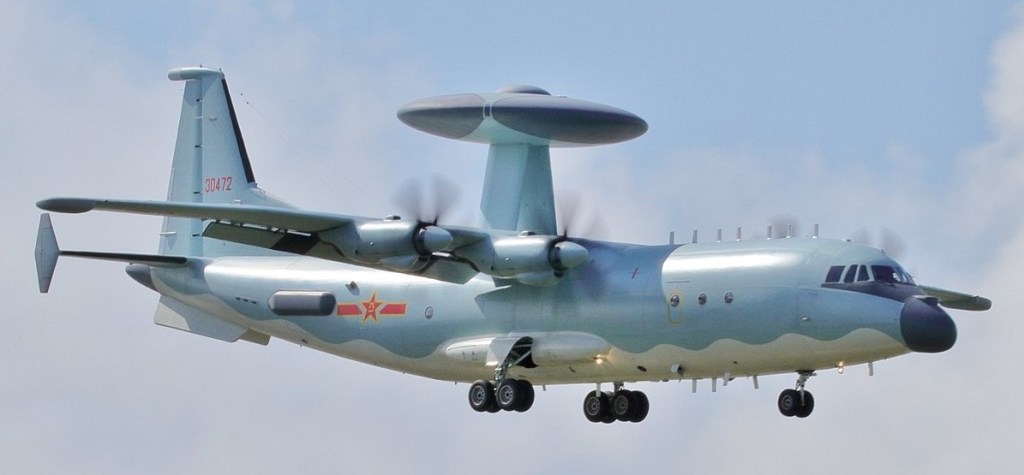
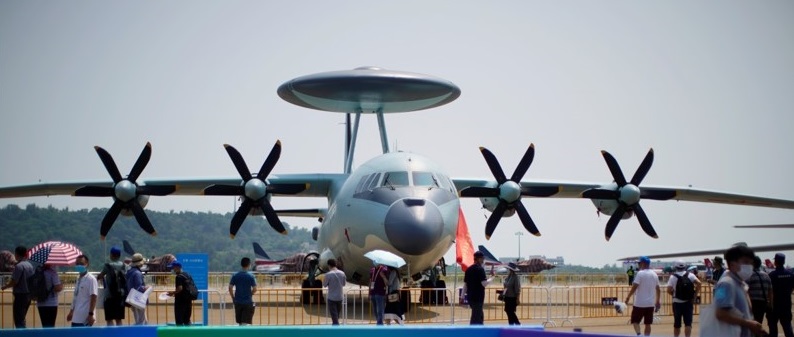
The Shaanxi KJ-500 (Chinese: 空警-500; pinyin: Kōngjǐng Wǔbǎi; literally: “Air Warning 500”) is a third-generation airborne early warning and control (AEW&C) aircraft used by the Chinese People’s Liberation Army Air Force. It was built by Shaanxi Aircraft Corporation, and is based on the Y-9 airframe.

China started the development of the KJ-500, its third AEW&C, in the late 2000s. The KJ-500 was required to have good detection capability, good identification ability, and quick responsiveness. The KJ-500 was also required to be the core force of the information combat system, its equipped technology has four major characteristics, which are networking, multi-functionality, high-integration, and lightweight.

The aircraft carries a fixed dorsal radome containing three AESA radar arrays for 360-degree coverage, and is said to be more efficient than the two-planar ‘balance beam’ array design used on the earlier KJ-200. Production of older AEW&C types reportedly ceased production in 2018 in response to the KJ-500 reaching full operational capability.

The KJ-500 is the base variant with the KJ-500A improved variant with an aerial refuelling probe debuted at the Zhuhai Airshow 2022.

Max speed: 550 km/h
Max range: 5700 km
Max endurance: 12 h
Max takeoff weight: 77 tons
Range against fighter sized targets: 470 km

Science & Technology Agency Asuka

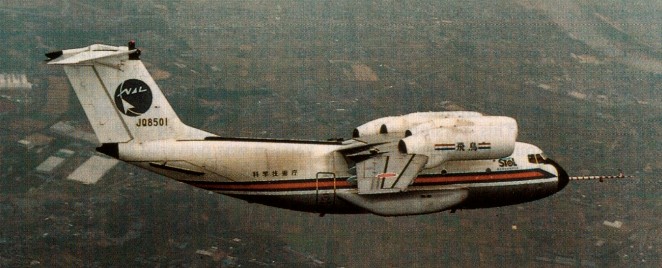
The Asuka, which first flew in October 1985, is a derivative of the Kawasaki C-1 tactical transport. The original P&W JT8D engines have been replaced by four Ishikawajima-Harima Heavy Industries FJR710/600S high bypass ratio turbofans.

The engines are mounted above and ahead of the wing leading edges. The exhaust airflow is directed across the wing extrados and attaches to the trailing edge flaps in whathas been termed “Upper Surface Blowing”. The resulting depression caused by the Coanda effect produces the desired lift force.

The STOL conversion takeoff run to 15m on the first flight was 509m, including a 394m ground run. Takeoff speed was 72 kts. The landing run from 15 m was 439 m, including 320 m on the ground.

STA claims the plane is only experimental and that there are no immediate development prospects.

Schütte-Lanz SL

Conceived from the outset with an alternative construction to rival the metal Zeppelins, the SLs with their rigid ply framework were claimed to be lighter and more flexible than met¬al-framed airships, and most of those in German military service were oper¬ated by the army.

The Navy, responsi¬ble for most of the raids against the British Isles, rightly claimed that wooden vessels were incapable of lift¬ing a sufficiently large bomb load as their weight would be increased by moisture absorbed while crossing the sea.

Wire-braced wooden structures had been used by the Schütte-Lanz company since the design stages of their initial SL 1 that had first flown on 17 October 1911.

SL 11 was accepted by the army in June 1916, and after trials was sent to its operational base at Spich in August. Armament was two 7.92-mm (0.312-in) Parabellum machine-guns on free mountings in single gun position above forward hull, plus bombs. At the end of the month its initial oper¬ational sortie proved abortive because of the weather. The attack at the beginning of September was its first and last, such a brief career resulting in the airship having only one com¬mander, Hauptmann Wilhelm Schramm, who had gained experience in charge of three earlier rigids, all of Zeppelin design.

On the night of the SLll’s destruction, when Schramm died with all his crew, both incendiary and explosive bombs were dropped. The airship’s chief claim to fame lies in that it was the first enemy aircraft of any kind to be brought down on British soil. SL11 was brought down by William Leefe Robinson on the night of 3 September 1916. In recog¬nition Robinson was awarded the Victoria Cross.

SL 11
Type: bombing airship
Engines: four l79-kW (240-hp) Maybach HSLu six-cylinder water-cooled piston
Maximum speed 95 kph (59 mph)
Service ceiling 5400 m (17,717 ft)
Range 3700 km (2,299 miles)
Useful lift 21500 kg (47,399 lb)
Diameter 20.09 m (65 ft 10.9 in)
Length 173.98 m (570 ft 9.6 in)
Volume 31900 cu.m (1,126,540 cu ft)
Armament: two 7.92-mm (0.312-in) Parabellum machine-guns

Schneider Henri-Paul S.3

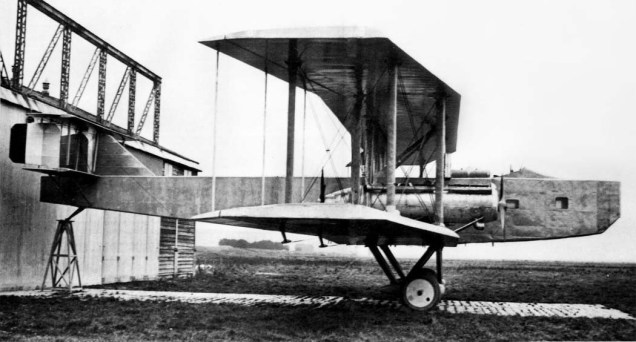
The Schneider Henri-Paul four-seater night bomber was built at Schneider’s Harfleur plant in France. A four-engine biplane with sails supported on steel spars and a grid of aluminum alloy ribs. Equal span, the wings had a central rectangular section and external panels in an arrow. The fuselage was formed by a beam of dural tubes 55 mm in diameter assembled by riveted steel fittings. The front part of the fuselage received a metallic coating, the rear part being simply covered, supporting a fabric empennage. The engines were mounted in pairs on each side of the fuselage, installed in tandem in interplanetary pods, driving four blade propellers of 3.60 m in diameter.

This aircraft made its first flight in September 1922 on the Le Havre-Bléville1 site. It was exhibited at the Grand Palais at the 8th Aviation Show in December 1922, but the program for which it was built had been abandoned.

Engines: 4 x Lorraine-Dietrich 12Da, 370 hp
Wingspan: 30,0 m
Length: 19.89 m
Height: 6.10 m
Wing area: 220.0 sq.m
Empty weight: 6500 kg
Maximum weight: 10,020 kg
Maximum speed: 160 kph
Ceiling: 5,000 m
Range: 750 km
Armament: 2 machine guns
Bombload: 120 kg
Crew: 5
Number built: 1

Savoia-Marchetti SM.95

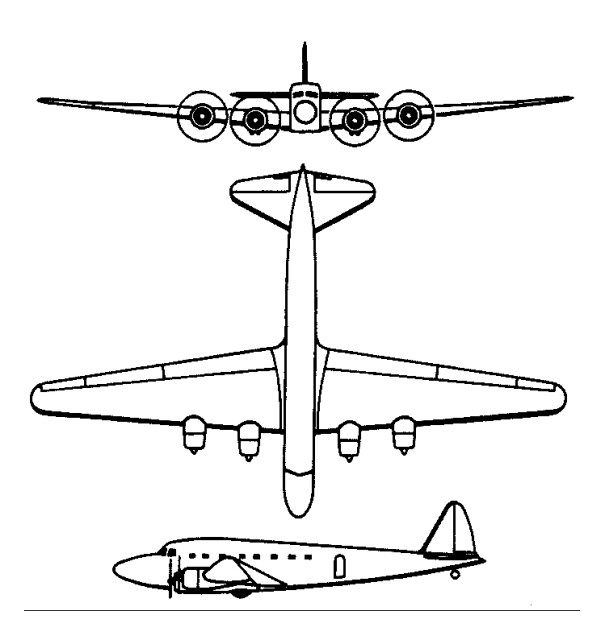
The first prototype flew on May 8, 1943. 23 built.

Milan-Forlanini Airport 1948

Gallery

S.M.95
Engines: 4 x Alfa Romeo 128 RC.18, 641kW
Max take-off weight: 21600 kg / 47620 lb
Loaded weight: 12800 kg / 28219 lb
Wingspan: 34.28 m / 112 ft 6 in
Length: 24.77 m / 81 ft 3 in
Height: 5.7 m / 19 ft 8 in
Wing area: 128.3 sq.m / 1381.01 sq ft
Max. speed: 400 km/h / 249 mph
Ceiling: 6500 m / 21350 ft
Range: 2000 km / 1243 miles
Crew: 4-5
Passengers: 44

Savoia-Marchetti S.M.95