The Solar One, made its public debut June 1979. 750 solar cells charge 24 accumulator cells to drive four electric motors linked together for a combined 4 hp. The aircraft, which looks like a conventional glider but with a pylon mounted power unit located on the nose immediately forward of the pilot, takes off at 20kts and has reached a maximum of 42kts.
4 engines
Solar Impulse S-10
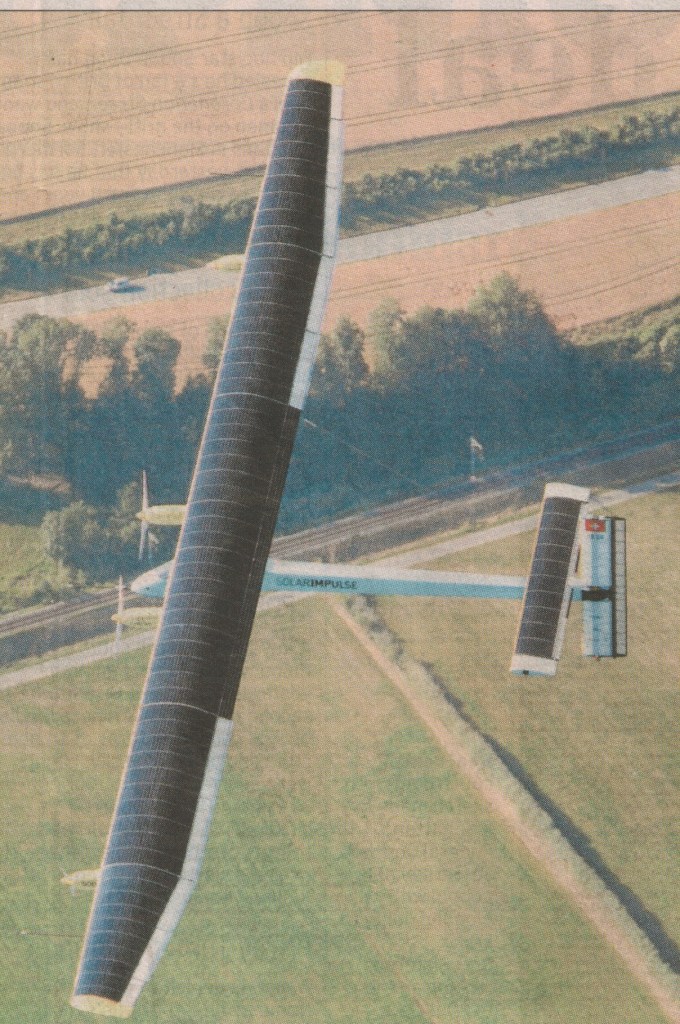
Solar Impulse is a Swiss long-range solar powered aircraft project developed at the École Polytechnique Fédérale de Lausanne. The project eventually hopes to achieve the first circumnavigation of the Earth by a piloted fixed-wing aircraft using only solar power. The project is led by Swiss psychiatrist and aeronaut Bertrand Piccard, who co-piloted the first balloon to circle the world non-stop, and Swiss businessman André Borschberg.
Piccard initiated the Solar Impulse project in 2003. By 2009, he had assembled a multi-disciplinary team of 50 specialists from six countries, assisted by about 100 outside advisers. The project is financed by a number of private companies. The four main partners are Deutsche Bank, Omega SA, Solvay, and Schindler. Other partners include Bayer MaterialScience, Altran, Swisscom and Swiss Re (Corporate Solutions). Other supporters include Clarins, Semper, Toyota, BKW and STG. The EPFL, the European Space Agency (ESA) and Dassault have provided additional technical expertise, while SunPower provided the aircraft’s photovoltaic cells.
The first aircraft, bearing the Swiss aircraft registration code of HB-SIA, is a single-seater monoplane, capable of taking off under its own power, and intended to remain airborne up to 36 hours. This aircraft conducted its first test flight in December 2009, and first flew an entire diurnal solar cycle, including nearly nine hours of night flying, in a 26-hour flight on 7–8 July 2010. Piccard and Borschberg completed successful solar-powered flights from Switzerland to Spain and Morocco in 2012, and conducted a multi-stage flight across the USA in 2013.
With a non-pressurized cockpit and a limited flight ceiling, the HB-SIA is primarily a demonstrator design. The plane has a similar wingspan to the Airbus A340 airliner. Under the wing are four nacelles, each with a set of lithium polymer batteries, a 10 hp (7.5 kW) motor and a twin-bladed propeller. To keep the wing as light as possible, a customised carbon fibre honeycomb sandwich structure is used.
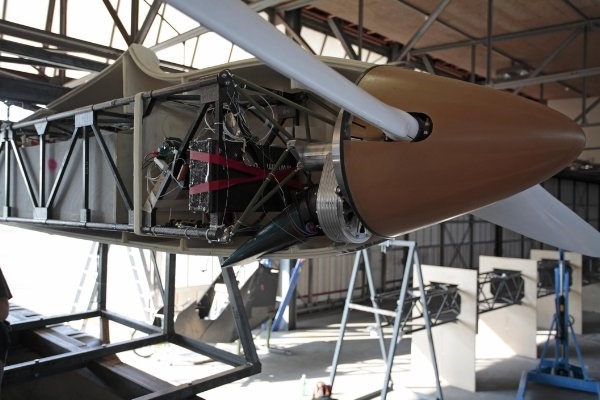
Under the wing, 4 nacelles are fixed, each containing a 10-HP motor, a set of lithium polymer batteries and a management system that controls the maximum load and temperature limit. Thermal insulation is conceived to conserve the heat released by the batteries and thus allows them to function despite the -40 ° C encountered at 8500 meters. Each motor is provided with a reducer that limits the rotation of a propeller with two blades of 3.5 meters in diameter to 200-400 revolutions / minute.
11,628 photovoltaic cells on the upper wing surface and the horizontal stabilizer generate electricity during the day. 10,768 solar cells on the wing and 880 on the horizontal stabilizer. 200 cubic meters of photovoltaic cells and 12% of the total efficiency of the propulsion chain, the average power generated by the 4 engines of the plane, does not exceed 8 CV or 6 KW. These both propel the plane and charge its batteries to allow flight at night, theoretically enabling the single-seat plane to stay in the air indefinitely. The 11628 150 micron thick monocrystalline silicon cells have been selected for their quality of lightness, flexibility and efficiency. At 22%, its performance could have been even better, but its weight would then have been excessive, penalizing the aircraft during night flight. As this phase is the most critical, the main difficulty of the project is at the level of energy storage in polymer lithium batteries.

Reaching a 63.40 m wingspan for a fully equipped 1600 kg is a challenge never before experienced in aeronautics in terms of rigidity, lightness and flight control. Solar Impulse is built around a structure in composite materials made up of carbon fiber and honeycomb assembled in a sandwich. The upper surface of the wing is covered with a skin composed of encapsulated solar cells, and the underside of a high resistance flexible film. 120 carbon fiber ribs distributed all 50cm outline these two layers to give them their aerodynamic shape.
The aircraft’s major design constraint is the capacity of the lithium polymer batteries. Over an ideal 24-hour cycle, the motors will deliver a combined average of about 8 hp (6 kW), roughly the power used by the Wright brothers’ pioneering Flyer in 1903. As well as the charge stored in its batteries, the aircraft uses the potential energy of height gained during the day to power its night flights.
On 26 June 2009, the Solar Impulse was first presented to the public in Dübendorf, Switzerland. Following taxi testing, a short-hop test flight was made on 3 December 2009, piloted by Markus Scherdel. André Borschberg, co-leader of the project team, said of the flight:
"It was an unbelievable day. The airplane flew for about 350 metres (1,150 ft) and about 1 metre (3 ft 3 in) above the ground ... The aim was not to get high but to land on the same runway at a speed to test its controllability and get a first feeling of its flying characteristics ... the craft behaved just as the engineers had hoped. It is the end of the engineering phase and the start of the flight testing phase."

On 7 April 2010, the HB-SIA conducted an extended 87-minute test flight, piloted by Markus Scherdel. This flight reached an altitude of 1,200 m (3,937 ft). On 28 May 2010, the aircraft made its first flight powered entirely by solar energy, charging its batteries in flight.
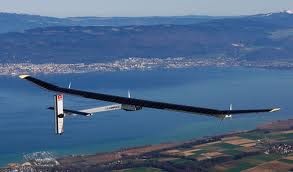
On 8 July 2010, the HB-SIA achieved the world’s first manned 26-hour solar-powered flight. The airplane was flown by André Borschberg, and took off at 6:51 a.m. Central European Summer Time (UTC+2) on 7 July from an airfield in Payerne, Switzerland. It returned for a landing the following morning at 9:00 a.m. local time. During the flight, the plane reached a maximum altitude of 8,700 m (28,500 ft). At the time, the flight was the longest and highest ever flown by a manned solar-powered aircraft; these records were officially recognized by the Fédération Aéronautique Internationale (FAI) in October 2010.
On 13 May 2011, at approximately 21:30 local time, HB-SIA landed at Brussels Airport, after completing a 13-hour flight from its home base in Switzerland. It was the first international flight by the Solar Impulse, which flew at an average altitude of 6,000 ft (1,829 m) for a distance of 630 km (391 mi), with an average speed of 50 km/h (31 mph). The aircraft’s slow cruising speed required operating at a mid-altitude, allowing much faster air traffic to be routed around it. The aircraft was piloted by Andre Borschberg. The project’s other co-founder, Bertrand Piccard, said in an interview after the landing: “Our goal is to create a revolution in the minds of people…to promote solar energies – not necessarily a revolution in aviation.”
A second international flight to the Paris Air Show was attempted on 12 June 2011, but the plane turned back half-way and landed back in Brussels, where it had taken off, due to adverse weather conditions. In a second attempt on 14 June, André Borschberg successfully landed the aircraft at Paris’ Le Bourget Airport at 9:15 pm after a 16-hour flight.
On 5 June 2012, the Solar Impulse successfully completed its first intercontinental flight, flying a 19-hour trip from Madrid, Spain, to Rabat, Morocco. During the first leg of the flight from Payerne, Switzerland, to Madrid, the aircraft broke several further records for solar flight, including the longest solar-powered flight between pre-declared waypoints (1,099.3 km (683 mi)) and along a course (1,116 km (693 mi)).
On 3 May 2013, the plane began its first cross-US flight with a journey from Moffett Field in Mountain View, California, to Phoenix Sky Harbor International Airport in Arizona. Successive legs of the flight took the Solar Impulse to Dallas-Fort Worth airport, Lambert–St. Louis International Airport and Washington Dulles International Airport; it finally concluded at New York’s John F. Kennedy International Airport on 6 July. Each flight leg took between 19 and 25 hours, with multi-day stops in each city between flights.
After the first leg to Phoenix, the aircraft completed the second leg of its trip on 23 May, landing at Dallas-Fort Worth International Airport. This flight, which covered 1,541 kilometres (958 mi), set several new world distance records in solar aviation. On 4 June, the plane landed in St. Louis, Missouri. It departed for Washington DC on 14 June, briefly stopping in Cincinnati, Ohio, to change pilots and avoid strong winds. On 16 June, the plane landed at Washington Dulles International Airport in Virginia. On 6 July 2013, following a lengthy layover in Washington, Solar Impulse completed its cross-country journey, landing successfully at New York City’s JFK International Airport at 11:09 p.m. EDT. The landing occurred three hours earlier than originally intended, because a planned flyby of the Statue of Liberty was cancelled due to severe damage to the aircraft’s left wing. The Solar Impulse was placed on public display at JFK after its landing.
Solar Impulse pilot André Borschberg completed the record-setting flight after flying more than 950 miles on solar power alone. Borschberg landed in Dallas with his batteries at about 60 percent, and used that juice to begin the third leg of his journey. As the headwind exceeded the speed of the airplane at times, Borschberg traveled backward relative to the ground. At one point, a little less than three hours before he actually landed, he was only 20 miles or so from Dallas/Fort Worth International Airport and found himself lined up with runway 13L, where he planned to touchdown. Landing on 13L required closing the runway, and there was simply too much commercial traffic. It was after midnight before air traffic control allowed him to land, so he spent the intervening hours in a holding pattern above the runway. As he descended, the windspeed increased and he encountered a 25- to 30-knot wind at 2,000 to 3,000 feet. This meant Borschberg had to be careful not to turn downwind, because he would be blown too far north and would have to make another approach to land, covering the ground at less than five miles per hour with the headwind. The sideways translation eventually brought him over the top of runway 13L, where he touched down 23 May 2013, at 1:08 a.m. local time, 18 hours and 21 minutes after departing Phoenix.
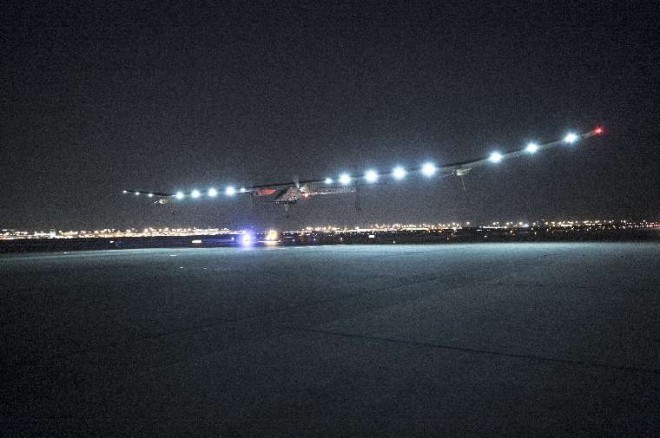
The flight to Dallas was fairly smooth, with just a few sections of turbulence. Flying 832 nautical miles (957 miles) broke the team’s own distance record for a solar powered airplane (and for any electric airplane). It also provided valuable experience and expand the Solar Impulse team’s flight techniques for future flights — including their planned circumnavigation of the world in a larger aircraft in 2015.
Construction of the second Solar Impulse aircraft, carrying the Swiss registration HB-SIB, started in 2011. The wingspan of HB-SIB will be 80.0 m (262.5 ft), slightly wider than an Airbus A380, the world’s largest passenger airliner, but unlike the 500-ton A380, the carbon-fibre Solar Impulse will weigh little more than an average automobile. It will feature a larger, pressurized cockpit and advanced avionics to allow for transcontinental and trans-oceanic flights. Supplemental oxygen and various other environmental support systems will allow the pilot to cruise at an altitude of 12,000 metres (39,000 ft).
Completion was initially planned for 2013, with a circumnavigation of the globe in 20–25 days in 2014. However, following a structural failure of the main spar during static tests in July 2012, a more likely date for the circumnavigation is 2015. The flight would circle the world in the northern hemisphere, near the equator. Five stops are planned to allow changes of pilots. Each leg of the flight will last three to four days, limited by the physiology of each pilot. Once improved battery efficiency makes it possible to reduce the aircraft’s weight, a two-seater is envisaged to make a non-stop circumnavigation.
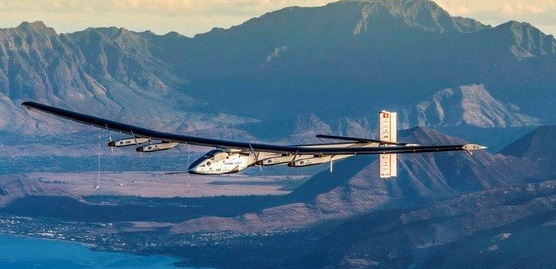
The Solar Impulse II landed in Hawaii on July 3, 2015, after breaking a five-day flight record and nights (117 hours and 52 minutes) in the air and about 8900 km from Japan. However, the long journey took its toll and the plane suffered damage to the battery due to overheating.
It remained grounded at the airport Kalaeloa during the northern hemisphere winter. Between February and mid-April, 13 test flights were conducted to ensure the proper functioning of the cooling system for the newly integrated battery.
Specifications – HB-SIA
Powerplant: 4 × electric motors, powered by 4 x 21 kWh lithium-ion batteries (450 kg), 7.5 kW (10 HP) each
Length: 21.85 m (71.7 ft)
Wingspan: 63.4 m (208 ft)
Height: 6.40 m (21.0 ft)
Wing area: 200 sq.m (2,200 sq ft)
Loaded weight: 1,600 kg (3,500 lb)
Max. takeoff weight: 2,000 kg (4,400 lb)
Take-off speed: 35 kilometres per hour (22 mph)
Cruise speed: 70 kilometres per hour (43 mph)
Stall: 35 km / h
Endurance: 36 hours (projected)
Service ceiling: 8,500 m (27,900 ft)
Maximum altitude of 12,000 metres (39,000 ft)
Crew: 1
Sud-Est SE 2010 Armagnac

In 1946 in France, plans were drawn for three new aircraft including the Sud-Est 2010, for 150 passengers, with delivery at the end of 1948. Fifteen SE 2010s had been ordered for delivery at the end of 1948. However, it was 2 April 1949 before the aircraft, christened the Armagnac, made its maiden flight. Powered by four 3,500-hp Pratt & Whitney Wasp Majors, this was designed to carry 64 passengers (with bunks) on the South and North Atlantic routes, or 107 on shorter runs. Air France, however, refused the aircraft on the grounds that bunks were no longer required, and there was therefore excessive space in the fuselage. Four were bought by Transports Aériens Intercontinentaux for freighting, but after only eight months this company decided that they were not economical. In 1954 they were overhauled and used to transport troops and supplies from Toulouse to fight the war in Indo-China. A further five were also used for this purpose.
Engines: 4 x Pratt & Whitney R-4360 Wasp Major, 3500 hp
Pax cap: 150
Sikorsky S-44 / PBS
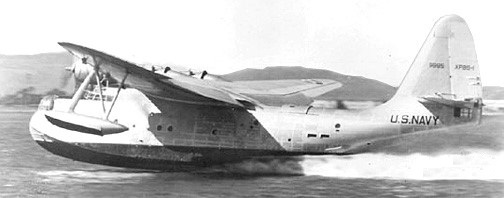
After a two-year construction period the Sikorsky XPBS-1 (Model S-44) 9995 first flew on 23 August 1937. Initial testing with 1050 hp engines revealed a top speed of 227 mph. Stability problems traced to turbulence generated by the wings resulted in the addition of dihedral to the horizontal stabilisers. After being delivered to the Navy in October 1937, the XPBS-1 began competitive trials with the Consolidated XPBY2-1 in mid-1938. Consolidated won a construction order and the XPBS-1 was assigned to Patrol Wing 5 at NAS Norfolk, Virginia, to evaluate long-range patrol-bomber operations until shortly after the US entered World War II. In the spring of 1942 the aircraft was reassigned to VR-2 out of California for transport duties between the West Coast and Hawaiian Islands. On 30 June 1942, while returning from Pearl Harbor, the XPBS-1 struck a log in San Francisco Bay and sank. All on board escaped safely, the passengers including Admiral Chester W. Nimitz, Commander of the Pacific Fleet.
Major elements of the design went into the VS-44A.
Engines: four 1200hp P&W Wasp
Wingspan: 124’0″
Length 76’2″
Max speed: 227 mph
Stall: 64 mph
Range: 4030 mi
Ceiling: 20,800′
Sikorsky X-Wing

The X-Wing was an experimental hybrid helicopter/fixed wing aircraft built in 1986 by Sikorsky for NASA and the US army, it was based on a modified S-72 Rotor System Research Aircraft (RSRA) which could fly with or without rotor blades. The addition of large X-shaped rotor blades would, in theory, allow the aircraft to take off and land vertically. During flight, the rotor blades could be switched off and act as an additional pair of wings to provide lift when moving forward. Despite being built, it was never flown.
Sikorsky S-61F / NH-3

Officially listed as an HSS-2, the U.S. Navy’s BuNo. 148033 was actually a Sikorsky S-61F compound research helicopter sponsored by the Army and Navy. Sikorsky tested the S-61F compound helicopter, an SH-3A with a new, streamlined fuselage, fully retractable undercarriage, swivelling tail rotor and 9.75m span wings supporting two 1350kg Pratt & Whitney J60-P-2 turbojets engines to complement the two 1,200 shp General Electric T58-GE-8B turboshafts. The five-bladed rotor shown here was later replaced by a six-bladed rotor.
First flight as a compound helicopter was on 21 May 1965. This aircraft has reached a level speed of 390km/h.
The fuselage was used as ejection system test-bed for the S-72 RSRA.
Sam Grober, 22.01.2010
I was privileged to fly in that aircraft as a structural flight test engineer. The day I flew in it, we obtained 208kts, indicated, with the main rotor at low pitch, with almost zero MR thrust, with both J60’s at MC HP.
Sikorsky S-42 Clipper
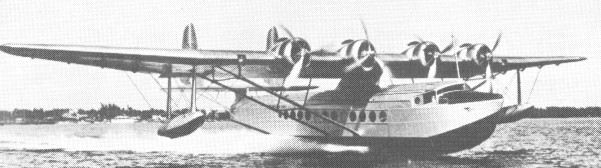
First flown on 29 March 1934, the S-42 was a large 36-passenger commercial flying-boat powered by four 559kW Pratt & Whitney Hornet engines. It differed from earlier Sikorsky flying-boats in having a two-step hull with a long stern which supported the tail unit directly. Full use was made of a hydraulically controlled wing flap which extended across the straight portion of the wing. Within a brief period of time the S-42 had established ten altitude-with-load world records.
Ten S-42s were delivered to Pan American Airways at a price of $197,892, the last three as S-42Bs with increased wing span (from 34.8m) and loaded weight and incorporating refinements in fairing and hull design.
The clipper-type flying boat established a new world load-carrying altitude record in lifting a 16,608 lb load to over 16,000 ft on 26 April 1934 (the mark to beat was 6,561′) piloted by Boris Sergievsky and Raymond Quick, then increasing this record to 20,407′ less than a month later.

Three 1934 S-42 Clipper (ATC 544) with four passenger compartments were delivered to PAA as Clippers, NC822M to 824M.
The last S-42-B, the Pan American ‘Clipper III’, was delivered in mid-1937.
Four S-42-A, NC15373 to 15376, and three S-42-B, NC16734 to 16736, all went to PAA as Clippers in 1935 (ATC 592).

Pan American Airways appreciated the financial poten¬tial of a service across the vast expanse of the Pacific Ocean and ordered two different flying boats; the Martin M.130 and Sikorsky S 42. It was an aircraft of this latter type which carried out the first survey flight from America to New Zealand, while to the Martin M. 130 China Clipper went the honour of the first mail flight across the central Pacific. The original S-42 was used in survey flights across the Pacific in 1935 by Pan American Airways.
The Sikorsky S42B “Pan American Clipper II” surveyed the route from San Francisco to New Zealand, via Honolulu and arrived in Auckland in March 1937. Just under a year later another S42B inaugu¬rated a passenger service, only to explode in midair near Samoa on the homeward journey. PAA suspended their San Fran¬cisco Auckland service.
In 1937 a S-42B was used on the inaugural and scheduled mail and passenger service between New York and Bermuda, the latter shared with Imperial Airways and begun on 16 June 1937. At about the same time the final S-42B delivered to PAA (named Clipper III) made three survey flights across the Atlantic by way of Newfoundland and Foynes.
By the summer of 1937 Pan American began transpacific and transatlantic service with the first “Clipper III” the last of the Sikorsky series.
The four surviving examples continued in airline service until early 1946 and were scrapped soon afterwards.

S-42
Engines: 4 x Pratt & Whitney S-5-D 1G Hornet, 700hp / 515kW
Wing span: 114 ft 2 in (34.8 m)
Length: 67 ft 8 in (20.93 m)
Height: 17 ft 4 in (5.28 m)
Wing area: 123.5 sq.m / 1329.34 sq ft
Empty weight: 3965 kg / 8741 lb
Max TO wt: 38,000 lb (17,250 kg)
Max level speed: 182 mph (291 kph)
Cruise speed: 255 km/h / 158 mph
Ceiling: 4877 m / 16000 ft
Range w/max.fuel: 1930 km / 1199 miles
Crew: 4
Passengers: 32-37
S-42-A
Engines: four 750hp P&W Hornet
Wingspan: 118’2″
Length: 68’0″
Useful load: 16,800 lb
Max speed: 188 mph
Cruise: 165 mph
Stall: 65 mph
Range: 1930 mi
Ceiling: 16,000 ft
Passengers: 37
S-42- B
Engines: four 750hp P&W Hornet
Wingspan: 118’2″
Length: 68’0″
Useful load: 16,800 lb
Max speed: 188 mph
Cruise: 165 mph
Stall: 65 mph
Range: 1930 mi
Ceiling: 16,000 ft
Passengers: 37

Sikorsky S-40
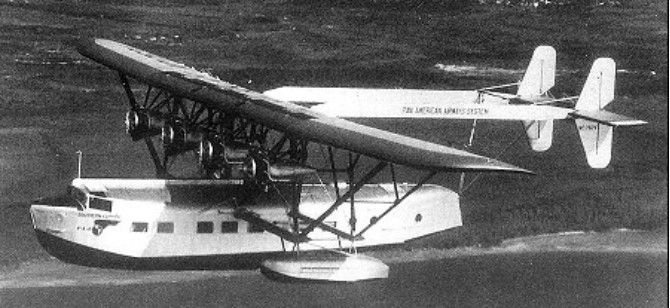
On December 20, 1929, Pan American awarded a contract to build three aircraft as the S-40, with deliveries starting mid-1931. The S-40 featured four engines and a two-step all metal hull, divided into seven watertight compartments, twin-boom, twin-tail and parasol wing. Almost sixty feet in length, accommodation was provided for up to thirty-two passengers and the added luxury of a smoking room with three chairs. Sikorsky selected a monoplane wing with stabalising floats mounted on outrigger booms. When built the Sikorsky S-40 was the largest amphibian in the world.

First flying on 31 August 1931, piloted by Boris Sergievsky and S Gluhareff, flight testing of the S-40 began in early 1931, and it was delivered to Pan American the following October, as soon as the ATC certificate was granted (ATC 454).
The seaplane version had an 11,000 lb load and slightly higher speed.
Selling for $139,000, named “American Clipper” and piloted by Charles A. Lindbergh, the first S-40 inaugurated the Miami-Canal Zone route on 19 November 1931. “American Clipper” pioneered Pan American World Airways mail and passenger routes around the Caribbean and to South America. It was joined by the second, ‘Caribbean Clipper’, later the same year, then by the the third, ‘Southern Clipper’, in early 1932.
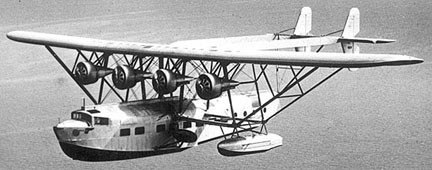
The three S-40s (NC80V, NC81V, and NC752V c/ns 2000 to 2002) established regular airline service between the US east coast and South American destinations such as Rio de Janerio and Buenos Aires, operated without their amphibious gear to improve range as needed. The S-40 carried 40 passengers over distances of 500 mi. at speeds up to 115 mph.
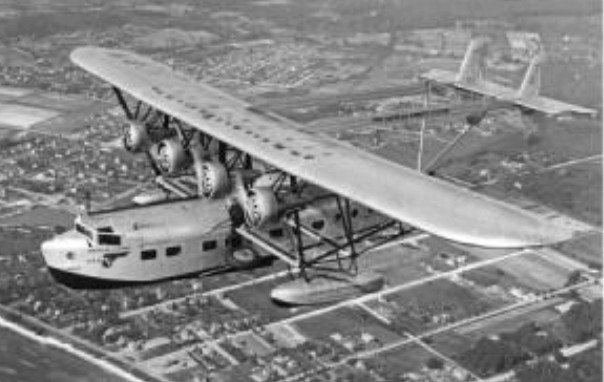
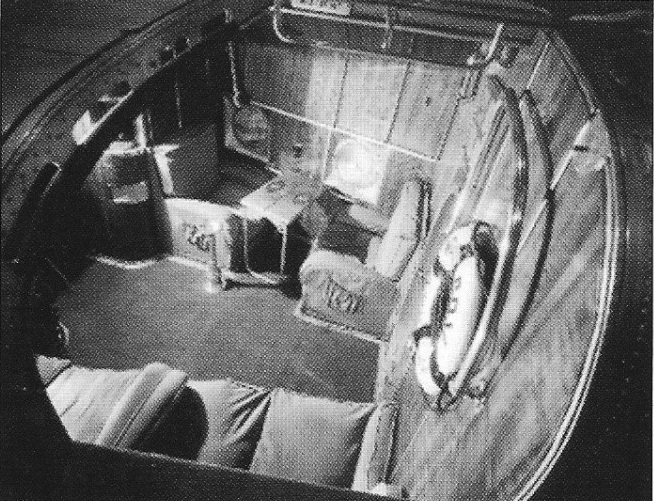
During 1935, after all three had their engines upgraded to super-charged 660hp P&W Hornets, their designation was changed to S-40-A (ATC 562). By the end of 1939 the S-40As had been withdrawn from Pan American service. Caribbean Clipper later served with the Navy as a navigational trainer and is said to have amassed a total of 13,000 flying hours before being scrapped in 1944.
S-40
Engines: 4 x Pratt & Whitney R-1690 Hornet B, 575hp / 425kW
Wingspan: 34.8 m / 114 ft 2 in
Wing area: 174.0 sq.m / 1872.92 sq ft
Length: 23.4 m / 77 ft 9 in
Height: 7.3 m / 24 ft 11 in
Hull length: 48’0″
Max take-off weight: 15400 kg / 33951 lb
Useful load: 9252 lb
Max. speed: 210 km/h / 130 mph
Cruise speed: 185 km/h / 115 mph
Stall: 65 mph
Ceiling: 5550 m / 18200 ft
Range w/max.fuel: 925 km / 575 miles
Crew: 4
Passengers: 40
S-40-A
Engines: 4 x Pratt & Whitney R-1690-44 Hornet, 600 hp
Prop: 2 blade, ground adjustable, metal
Wingspan: 154 ft 0 in
Wing area: 1740 sq.ft
Length: 76 ft 8 in
Max speed: 140 mph
Cruise: 120 mph
Stall: 65 mph
Ceiling: 13,000 ft
Range: 900 miles
Empty weight: 21,000 lb
MTOW: 34,000 lb
Useful load: 10,813 lb

Sikorsky S-22 Ilya Mourometz

In August 1913 a military Voisin biplane broke up in the air over the airfield and its engine fell onto the Grand. Sikorsky subsequently redesigned the aircraft as the Ilya Muromets which was even bigger. Its wing span was 10 ft greater than that of Le Grand and it weighed 10,000 lb.
A four bay biplane with braced extensions of upper wings. With two spar wooden wings and wooden fuselage, all fabric covered, ailerons were fitted to the top wings.
The first flight of Ilya Mourometz No. 1, in January 1914, was made with a skid undercarriage. On 11 February 1914 this machine set a new world record by carrying aloft 16 people and a dog. A familiar picture of it shows the big biplane landing with two fur-coated passengers taking a stroll along its fuselage top promenade. Five months after the first flight, it flew several times as a seaplane.
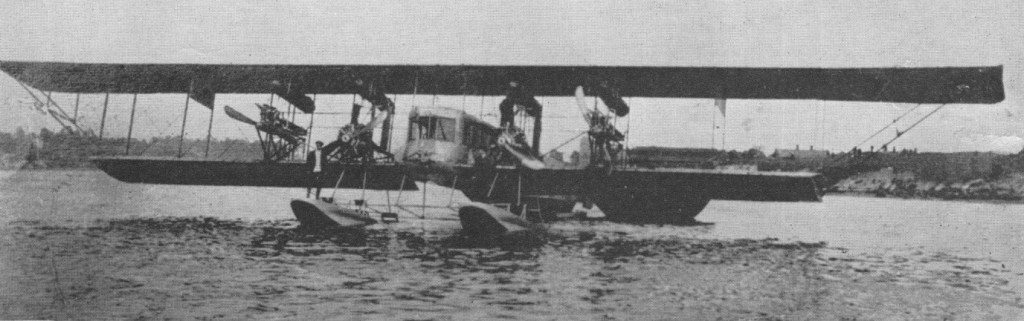
With the threatened outbreak of hostilities ten were purchased by the Russian Army for military trials.
The Ilya Muromets went into production as a heavy bomber for the Imperial Russian Air Service Eskadra Vozdushnykh Korablei (Squadron of Flying Ships) built at the Russo-Baltic Wagon Works. Seventy three were built, and few of these production aircraft were identical, improvement and developing being continuous, and short engines meant they were flown with a variety of powerplant which, in some cases, involved a mix of engines on one aircraft.
The first version used in combat was the Type B, with Salmson engines of 135-200 hp and an armament of only two machine guns. The largest of the series was the Type IMYe2, with a wingspan of 34.50m and a gross weight of 7,000kg.
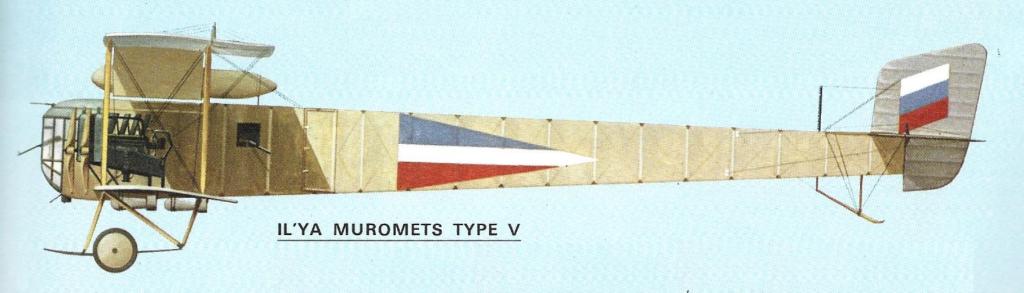
After experimenting with various types of armament and bomb racks it was found to be too slow and with limited altitude for offensive purposes. Sikorsky designed a lighter version, the Il’ya Muromets Type V, and deliveries of these began in early 1915.

Sikorsky S-22 Il’ya Murometz Article
They were so effective on more than 400 bombing raids against Germany and Lithua¬nia in 1915 that Great Britain and France sought permission from Czar Nicholas II to produce the design under licence, though nothing came of the scheme before the 1917 Russian Revolution sent Sikorsky fleeing to the United States.
They made 400 successful raids for the loss of only one aircraft, shot down by German fighters after it destroyed three of the enemy aircraft.
Engines: 4 x Argus, 100 hp
Wingspan: 30.9/22.0 m / 101 ft 5 in / 72 ft 2 in
Length: 17.1 m / 56 ft 1 in
Wing area: 148.0 sq.m / 1593.06 sq ft
Max take-off weight: 5100 kg / 11244 lb
Max. speed: 110 km/h / 68 mph
Range: 600 km / 373 miles
Armament: 8 machine-guns, bombs
Crew: 10
Ilya Muromets E
Engines: 4 x Renault, 200 hp
Props: 2 blade
Wingspan: 102 ft 8 in
Wing area: 20050 sq.ft
Length: 59 ft 8 in
Empty weight: 10,600 lb
MTOW: 17,600 lb
Max speed: 85 mph at 5000 ft’
Endurance: 4 hr
Armament: up to 7 mg
Bombload: 1000-1500 lb
Sikorsky IM-W Ilya Muromet
Engine: 4 x Argus, 138 hp
Length: 56.102 ft / 17.1 m
Wingspan: 97.769 ft / 29.8 m
Wing area: 1345.5 sq.ft / 125.0 sq.m
Max take off weight: 9812.3 lb / 4450.0 kg
Max. speed: 67 kts / 125 km/h
Service ceiling: 12139 ft / 3700 m
Wing loading: 7.38 lb/sq.ft / 36.00 kg/sq.m
Endurance: 5 h
Crew: 5
Armament: 3-7x MG, 700kg Bomb.
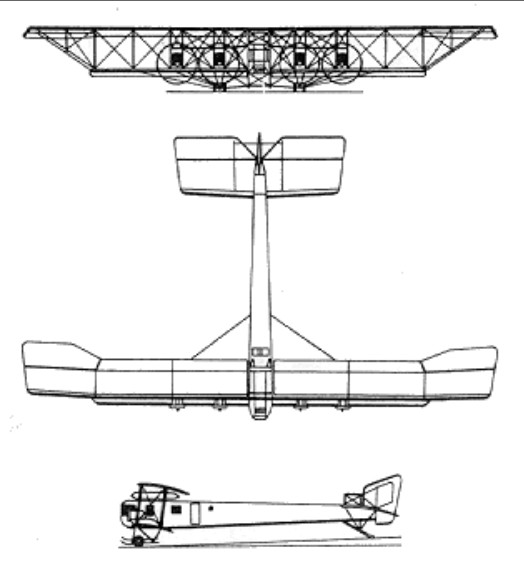
Sikorsky Le Grand / Russkii Vitiaz (Russian Knight)
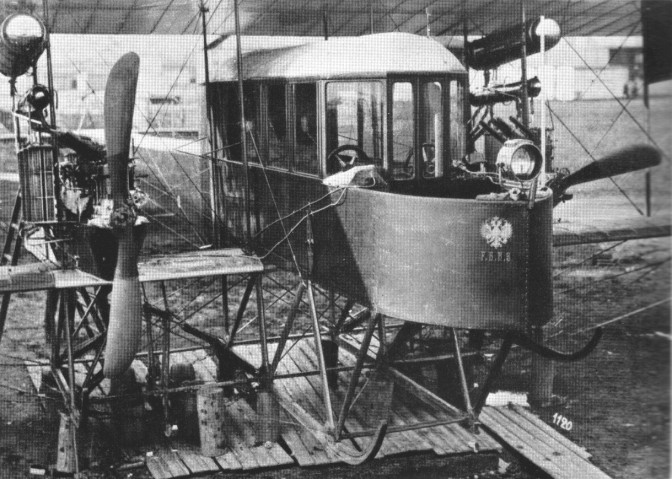
In 1912 Igor Sikorsky began construction of an aircraft with a wingspan of 28 m (92 ft) it was at that time by far the largest heavier than air craft to fly; the first to have four engines; the first with a fully enclosed passenger cabin; and the first designed specifically as an airliner.

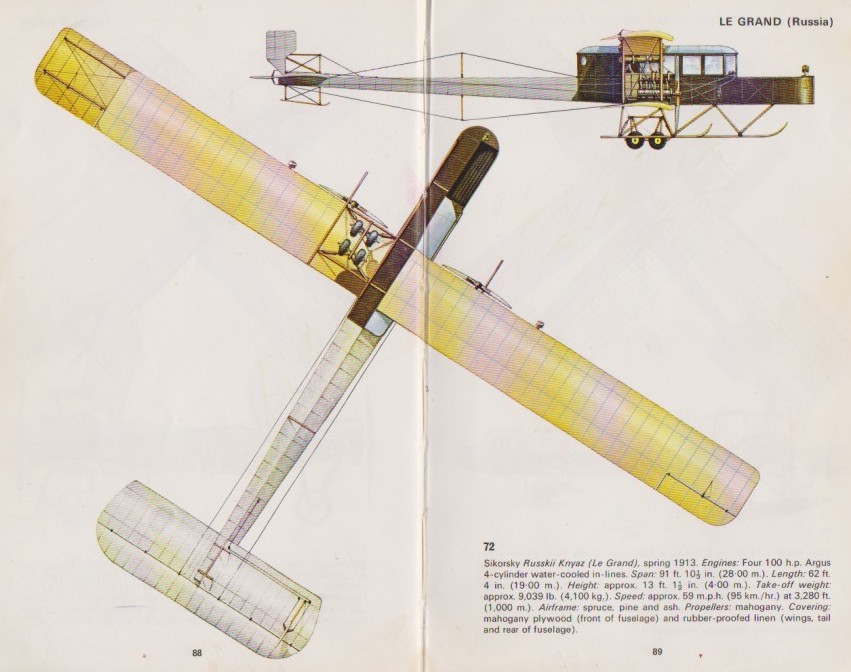
Officially known as Russkii Vitiaz (Russian Knight), the big biplane was dubbed the Grand or Bolshoi before its first flight on 13 May 1913. The Grand weighed 4080 kg (8000 lb) and was powered by four 100 hp water cooled Argus engines arranged initially in tandem pairs, but after the first ten minute test flight the two rear mounted engines were moved outboard on the wings. In June 1914, Sikorsky piloted the 10,000-1b. S-22 named Ilia Mourotz on a 1,600mi. round trip from St. Petersburg to Kiev.

Numerous difficulties were encountered in the design and construction; there were no wheels of adequate size to support the Grand, so a 16 wheel bogie undercarriage had to be built. The cabin incorporated some novelties. At the front was a large open balcony with a searchlight mounted on a gimbal; next came the cockpit with dual controls for two pilots; behind this was the passenger cabin, luxuriously appointed with four seats, sofa, table, washroom and wardrobe.
The Grand flew well and subsequently made 53 flights including a record breaking duration flight of 1 hour 53 minutes with eight people aboard on 2 August 1913. Later that month a military Voisin biplane broke up in the air over the airfield and its engine fell onto the Grand. Sikorsky subsequently redesigned the aircraft as the Ilya Muromets.
Engines: 4 x 100 hp Argus four cylinder in line piston
Wing span: 91 ft 10.25 in (28.00 m)
Length: 62 ft 4 in (19.00 m)
Gross weight: approx. 9,039 lb (4,100 kg)
Max. speed: approx. 59 mph (95 km/h) at 3,280 ft (1,000 m)
Accommodation: Crew of 2 + 8 passengers
Typical endurance: 1 hr 45 min
1913 Sikorsky “Grand”
Span: upper 89′ lower: 66′
Length: 66′
Weight: 8800 lb gross
Speed: 56 mph
 All Aero