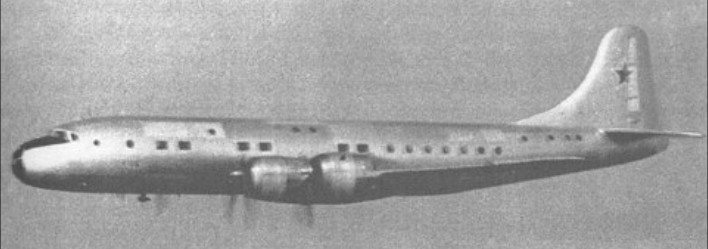
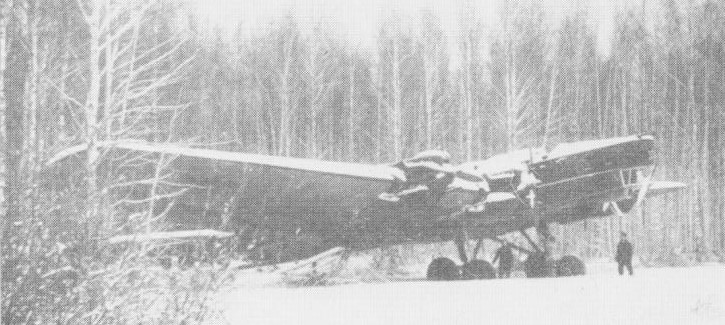
The Tu-70, NATO code name ‘Cart’, was a one-off long range airliner development from the Boeing B-29/Tupolev Tu-4. The prototype, incorporating a B-29 landing gear, tail unit and engines, first flew on 27 November 1946, designed for crew of eight and 48 VIP passengers, but used with crew of six and 72 passengers as staff transport for air force. A new nose with conventional cockpit/flight deck instead of low-drag Superfortress-style nose was built.
Engines: 4 x ASh-73TK, 1770hp Max take-off weight: 51400 kg / 113318 lb Empty weight: 38290 kg / 84415 lb Wingspan: 43.05 m / 141 ft 3 in Length: 35.61 m / 117 ft 10 in Height: 9.75 m / 32 ft 0 in Wing area: 161.7 sq.m / 1740.52 sq ft Max. speed: 560 km/h / 348 mph Range: 4900 km / 3045 miles Crew: 6 Passengers: 48
At the end of the 1940s, Vladimir Dobrynin’s engine design bureau had developed a new air-cooled, twenty-four cylinder in-line piston engine, the VD-4K, which offered a 4,300hp supercharged power output. Dmitri Markov set about designing a very long-range strategic bomber with these engines. Starting from the Tu-80 he began by designing a high-aspect wing with increased span – now it was 55.94m compared to the 43.83m of the Tu-75 and Tu-80, and wing area was 273.6sq.m, compared to 162.7sq.m. Wing aspect ratio was 11.4:1.
This allowed the new aircraft to carry forty-four tonnes of fuel which would give it a range of 12,000km. He streamlined the fuselage, and provided accommodation for a second crew which would be needed with the aircraft’s twenty-six hour endurance capability. Normal crew was eight so the Tu-85 carried sixteen in a pressurised cabin. The Tu-85 was fitted with large four-blade propellers, and it was armed with five turrets each fitted with a pair of NR-23 cannons which could be remotely controlled by a gunner, who had a screen to show the arc of fire from each position a development of the B-29/Tu-4 system.
The Tu-85 was constructed at factory N 156 in 1949 and 1950. When completed, it was brought to Zhukovski aerodrome, reassembled and readied for flight. On 9 January 1951, Aleksei Pereliot was in command as it took off for the first time.
In factory and state tests, it gave excellent results. Although its empty weight was 55.4 tonnes and its normal take-off weight seventy-five tonnes, it could take off at 107 tonnes when necessary, allowing it to carry the enormous fuel load needed to achieve its 12,300km range with a five-tonne payload, or to increase its normal five-tonne bomb load to twenty tonnes. Cruising speed for maximum range was established at 450km/h, but maximum speed was much higher. At low level, it was measured at 563km/h, and at a level of 10,000m it reached 665km/h.
By now, turbine engines were establishing themselves and offering higher speeds with lower fuel burns. The Tu-85 was the end of the line for Tupolev’s piston-engined, and also for Soviet aircraft. Limited flight trials were undertaken but further development was later cancelled. Only one Tu-85, the prototype was built. It was the last large Tupolev aircraft without swept wings.
Engines: 4 x VD-4K piston engines, 3160hp Max take-off weight: 107000 kg / 235896 lb Empty weight: 55400 kg / 122137 lb Wingspan: 55.94 m / 184 ft 6 in Length: 39.31 m / 129 ft 12 in Height: 11.36 m / 37 ft 3 in Wing area: 273.6 sq.m / 2945.00 sq ft Max. speed: 665 km/h / 413 mph Cruise speed: 563 km/h / 350 mph Ceiling: 13000 m / 42650 ft Range: 13000 km / 8078 miles Crew: 11-16
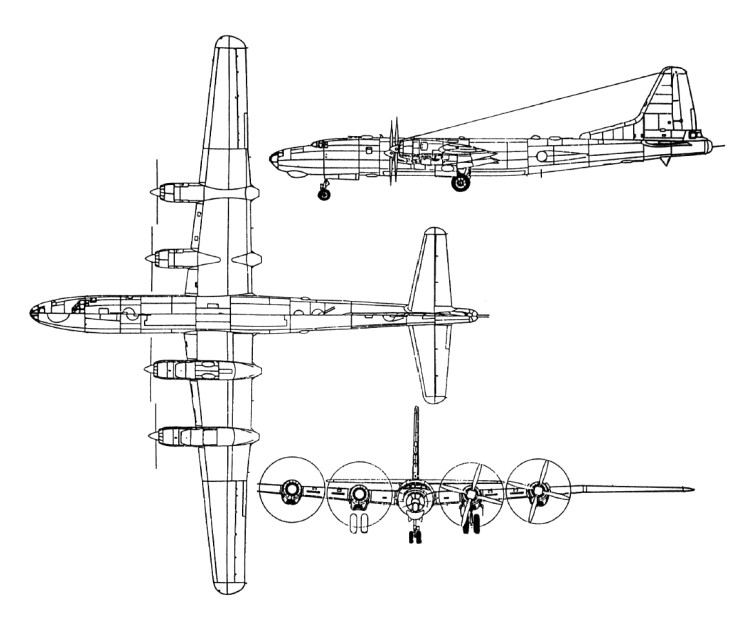
At the end of 1948, just as production Tu-4s were beginning to be delivered to the VVS, Tupolev and Markov began work on a replacement. In a sense, it was an improved B-29 design, with a major programme to trim weight and thus to improve performance.
A new wing with better aerodynamic qualities and with a lighter but stronger spar was developed with integral wing tankage. The fuselage was lightened and the round Tu-4 nose of the same chord as the fuselage was replaced with one in which the cockpit was raised above the nose for improved visibility. A new, more angular tail was also built, with a distinctive dorsal fin. Its engines were four of Shvetsov’s ASh-73TKFNs, a Soviet-built turbocharged version of the original B-29 engines.
All these changes resulted in the Tu-80 being substantially lighter than the Tu-4, and this allowed it to carry more fuel. Its first flight was made on 1 December 1949 from Zhukovski. In state tests, its maximum speed was established as 640km/h. But the Tu-80 was just another step on the way to the Soviet Union achieving a long-range strategic bomber. With the coming of age of turbines, it was not developed beyond its test programme.
Engines: 4 x ASh-73FN, 1770hp Max take-off weight: 67200 kg / 148151 lb Empty weight: 41030 kg / 90456 lb Wingspan: 44.3 m / 145 ft 4 in Length: 36.6 m / 120 ft 1 in Height: 8.91 m / 29 ft 3 in Wing area: 173.1 sq.m / 1863.23 sq ft Max. speed: 650 km/h / 404 mph Ceiling: 11180 m / 36700 ft Range: 7000-8000 km / 4350 – 4971 miles Crew: 11
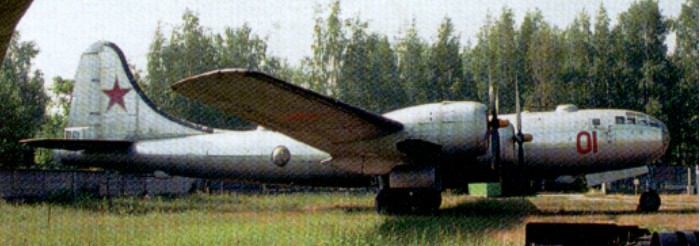
Three examples of the Boeing B-29 arrived in late 1944 (examples of which had made emergency landings in Russia during 1944 in the course of operations against Japan); one being dissected and analysed, and the other two used as crew trainers and evaluation.
The Soviet Union built the Tu-4 by copying them as a virtual exterior clone of the B-29 but with significant interior modifications. It was a heavier aircraft and did not possess either the pressurised tunnel linking the forward to midships crew locations or the integral fuel tankage of the B-29. The first of a 20-aircraft pre-production batch flew on 3 July 1947.
Placed in service in 1948, series production terminated after over 400 aircraft had been delivered in 1952, by which time the Tu-4 was in large scale service with the Soviet DA (Long-Range Aviation), being accorded the NATO reporting name ‘Bull’. Some were used as wingtip-to-wingtip inflight-refuelling tankers, others as conventional HDU-equipped tankers.
It is reported that about 1200 were built.
The type was exported to China where some were re-engined with Ivchenko AI-20 turboprops and were sporadically used into the 1990s as AEW and drone launching platforms.
Engines: 4 x ASh-90, 1705kW Max take-off weight: 61300 kg / 135144 lb Empty weight: 35000 kg / 77162 lb Wingspan: 43.1 m / 141 ft 5 in Length: 30.2 m / 99 ft 1 in Height: 8.5 m / 28 ft 11 in Wing area: 161.5 sq.m / 1738.37 sq ft Max. speed: 570 km/h / 354 mph Ceiling: 11000 m / 36100 ft Range w/max.payload: 5000 km / 3107 miles Crew: 11 Armament: 5 x 23mm cannons Bombload: 5000kg
In December 1934, Tupolev was asked to design a naval heavy bomber (Morksoi Torpedonosets Bombardirovshik = naval torpedo bomber = MTB). With his seaplane specialist Ivan Pogosski dead, he gave the project to Aleksander Golubkov who came up with a more conventional design than the earlier ANT ‘hydroplanes’ – a single hull with a high-wing profile, made entirely from duraluminium. It was an amphibian with a retractable wheeled undercarriage, and the floats, mounted near the wingtips on struts, were load-carrying. Powerplants were four Gnome-Rhone 14Krsds, which gave 810hp each, and were mounted in the wing leading edges. The wing shape resulted in the ANT-44, as the project was designated, being called the Chaika (Seagull).
Construction of the prototype began on 4 October 1935, and the aircraft was manufactured with smooth sheets of duraluminium, which were now becoming available in place of the former corrugated ones. The work was carried out in the TsAGI-ZOK factory N156. It was completed in March 1937, and brought by road to Khodinka, from where it made its first flight on a fixed wheeled undercarriage (because the retractable mechanisation was not yet ready) on 19 April 1937. Its pilot was Timofei Riabenko. State tests were conducted with the undercarriage fixed down; maximum speed was measured at 355km/h, maximum take-off weight at 18,500kg, and range with a bomb or torpedo load of 2,500kg was 2,500km. The state tests were completed in July.
A second aircraft was completed in June 1938. By now the first had its undercarriage modified to retract, while the second aircraft had a retractable one from the start. It had 840hp Mikulin M-87As fitted and was dubbed the ANT-44bis or -44D.
By September, both aircraft were taken on service with the Soviet Navy, as the MTB-2A.
No production was ordered, and they served some operations in the Great Patriotic War from bases in the Black Sea. Led by Ivan Sukhomlin, the MTB-2As were used to bomb oil refineries in Bulgaria and Romania, both then under Nazi occupation.
Before the Soviet Union was invaded by Germany, Ivan Sukhomlin had earned four world records, with the ANT-44bis. In June 1940, he set several records lifting different loads to record altitudes for amphibians, and on 7 October he achieved a record for amphibians by carrying a two-tonne load over a 1,000km closed circuit at an average speed of 241.999km/h. Although this record was not acknowledged by the FAI until after the war, it stood unbeaten until 1957.
MTB-2A Engine: 4 x M-87 Max take-off weight: 21500 kg / 47400 lb Wingspan: 37.0 m / 121 ft 5 in Length: 24.0 m / 79 ft 9 in Height: 9.0 m / 30 ft 6 in Wing area: 144.7 sq.m / 1557.54 sq ft Max. speed: 350 km/h / 217 mph Cruise speed: 250 km/h / 155 mph Ceiling: 7200 m / 23600 ft Range: 4500 km / 2796 miles Range w/max.payload: 2500 km / 1553 miles Crew: 4-5 Armament: 6 x 7.62mm machine-guns Bombload: 2000kg
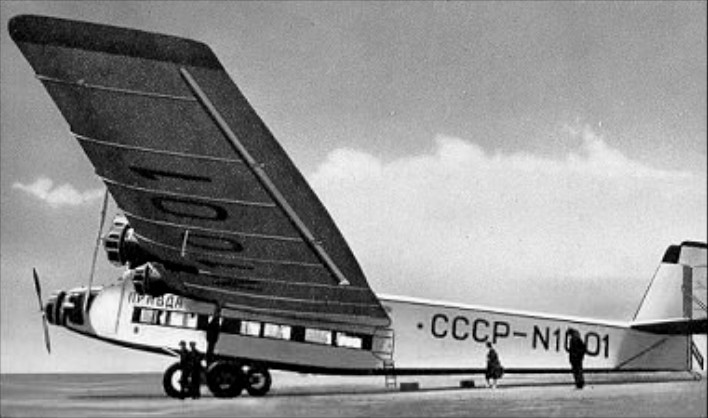
Andrei Nikolaevich Tupolev designed the ANT 14, a five engined airliner powered by Soviet built 358kW Bristol Jupiter radial engines: this spanned 40 m (132 ft) and could carry 42 people over 1200 km (745 miles), sufficient to fly in stages from Moscow to Vladivostock.
The one-off ANT-14 Pravda, served as flagship of the propaganda squadron. The ANT 14 was modestly successful, serv¬ing on the Moscow Berlin route and on scientific explorations in Siberia and the Arctic.
Pravda carried over 40,000 passengers before being grounded in 1941.
ANT-14 Engines: 5 x Gnome et Rhone Jupiter 9AKK Max take-off weight: 17146 kg / 37801 lb Empty weight: 10650 kg / 23479 lb Wingspan: 40.4 m / 133 ft 7 in Length: 26.5 m / 87 ft 11 in Height: 5.4 m / 18 ft 9 in Wing area: 240.0 sq.m / 2583.34 sq ft Max. speed: 236 km/h / 147 mph Cruise speed: 195 km/h / 121 mph Ceiling: 4220 m / 13850 ft Range: 1200 km / 746 miles Crew: 4-5 Passengers: 36
The Tupolev TB-3 all-metal cantilever monoplane was the most advanced four-engined heavy bomber in service in the world in the early 1930s. First flown by M M Gromov on 22 December 1930, it was Tupolev’s first stake to the claim of having built the world’s largest landplane.
The first TB 3s closely resembled the TB 1, and carried the same bomb load, but were more powerful and more heavily armed. The 1936 version, powered by M 34FRN engines, established a number of weight lifting records for the USSR in that year, and in May 1937 four unarmed TB 3s airlifted the Schmidt Polar Expedition to the North Pole.
Production began at the end of 1931, continuing through many modifications until early 1937 when a total of 818 had been built.
Tupolev TB-3 (ANT-6)
For many years the TB-3 was the backbone of the VVS (Soviet air forces) heavy bomber units. A number retained the bureau designation ANT-6 and were used for transport. As the first four engine cantilever monoplane production bomber; it carried 4,410 pounds of bombs and became famous as the carrier craft in the world’s first mass paratroop exercises.
In 1938-39 TB-3s were used operationally against the Japanese, but by the time Germany invaded the Soviet Union in 1941 most had been converted as paratroop or freight transports under the designation G-2. A squadron of six TB 3s, each carrying two fighter bombers, was used against the advancing Germans in 1941.
TB-3 August 1941
Other uses then consisted of night bombing and transport work of all kinds, including the carriage of vehicles or tanks between landing gear legs, and glider towing.
Experiments started with two I 16 fighters, and slowly worked up to five, four of which were rolled up ramps on to cradles fixed to the bomber’s wings, while a fifth joined up in flight, hooking on to yet another version of the trapeze gear used in British and American experiments. To help get this heavy formation airborne the engines of the wing mounted fighters were run up at take off, and once up, the TB 3 could just maintain altitude under its own power.
Use in parasite fighter experiments led in 1941 to Black Sea Fleet TB-3s being used to launch two Polikarpov SPB dive-bomber versions of the I-16 fighter, for raids on pinpoint targets in the Ukraine and Romania.
Variation Grojovski G-52 Flying Battery
TB-3 Engines: 4 x M-17F Max take-off weight: 17047 kg / 37582 lb Wingspan: 39.5 m / 130 ft 7 in Length: 24.4 m / 80 ft 1 in Height: 8.5 m / 28 ft 11 in Wing area: 230.0 sq.m / 2475.70 sq ft Max. speed: 182 km/h / 113 mph Ceiling: 3600 m / 11800 ft Range: 2200 km / 1367 miles Armament: 4 x 7.62 mm machine-guns, 3000kg of bombs Crew: 8
ANT-6 Engines: 4 x AM-34, 830 hp Wingspan: 132 ft 10.5 in Max speed: 155 mph
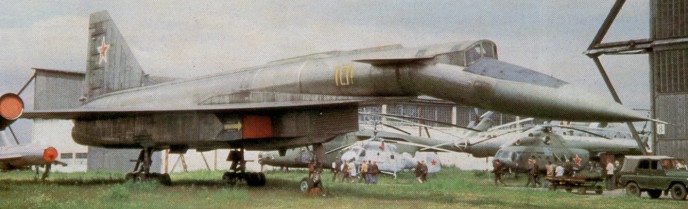
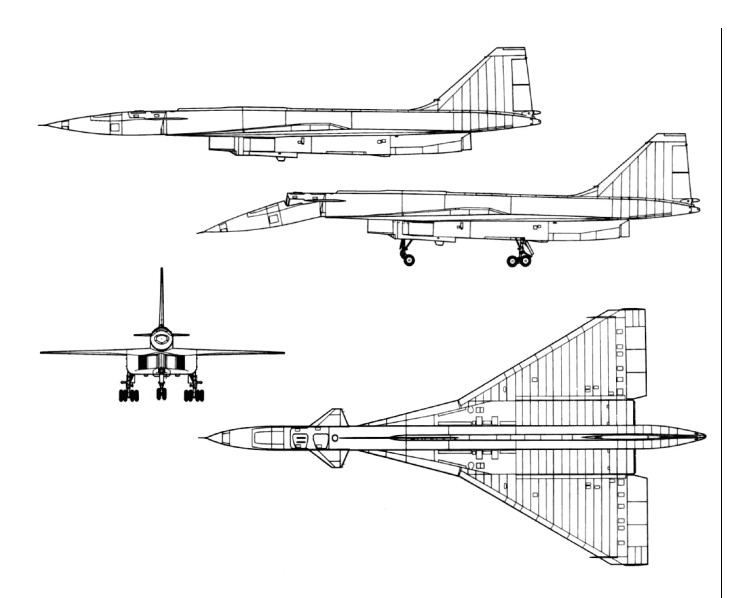
This project was triggered in December 1962 by the need to intercept the B-70, SR-71, Hound Dog and Blue Steel. At an early stage the mission was changed to strategic reconnaissance and strike for use against major surface targets. It was also suggested that the basic air vehicle could form the starting point for the design of an advanced SST. From the outset there were bitter arguments. Initially these centred on whether the requirement should be met by a Mach-2 aluminium aircraft or whether the design speed should be Mach 3, requiring steel and/or titanium. In January 1963 Mach 3 was selected, together with a design range at high altitude on internal fuel of 6,000km. General Constructors Sukhoi, Tupolev and Yakovlev competed, with the T-4, Tu-135 and Yak-33 respectively. The Yak was too small and did not meet the requirements, and the Tupolev was an aluminium aircraft designed for Mach 2.35.
From the start Sukhoi had gone for Mach 3, and its uncompromising design resulted in its being chosen in April 1963. This was despite the opposition not only of Tupolev but also of Sukhoi’s own deputy Yevgenii Ivanov and many of the OKB’s department heads, who all thought this project an unwarranted departure from tactical fighters. Over the next 18 months their opposition thwarted a plan for the former Lavochkin OKB and factory to assist the T-4, and in its place the Boorevestnik OKB and the TMZ factory were appointed as Sukhoi branch offices, the Tushino plant handling all prototype construction. A special VVS commission studied the project from 23rd May to 3rd June 1963, and a further commission studied the refined design in February-May 1964. By this time the T-4 was the biggest tunnel-test project at CAHI (TsAGI) and by far the largest at the Central Institute of Aviation Motors. The design was studied by GKAT (State aircraft technical committee) from June 1964, and approved by it in October of that year. By this time it had outgrown its four Tumanskii R-15BF-300 or Zubets RD-17-15 engines and was based on four Kolesov RD-36-41 engines. In January 1965 it was decided to instal these all close together as in the B-70, instead of in two pairs. Mockup review took place from 17th January to 2nd February 1966, with various detachable weapons and avionics pods being offered. Preliminary design was completed in June 1966, and because its take-off weight was expected to be 100 tonnes the Factory designation 100 was chosen, with nickname Sotka (one hundred). The first flight article was designated 101, and the static-test specimen 100S. The planned programme then included the 102 (with a modified structure with more composites and no brittle alloys) for testing the nav/attack system, the 103 and 104 for live bomb and missile tests and determination of the range, the 105 for avionics integration and the 106 for clearance of the whole strike/reconnaissance system.
On 30th December 1971 the first article, Black 101, was transferred from Tushino to the LII Zhukovskii test airfield. On 20th April 1972 it was accepted by the flight-test crew, Vladimir Ilyushin and navigator Nikolai Alfyorov, and made its first flight on 22nd August 1972. The gear was left extended on Flights 1 through 5, after which speed was gradually built up to Mach 1.28 on Flight 9 on 8th August 1973. There were no serious problems, though the aft fuselage tank needed a steel heat shield and there were minor difficulties with the hydraulics. The VVS request for 1970-75 included 250 T-4 bombers, for which tooling was being put in place at the world’s largest aircraft factory, at Kazan. After much further argument, during which Minister P V Dement’yev told Marshal Grechko he could have his enormous MiG-23 order only if the T-4 was abandoned, the programme was cancelled. Black 101 flew once more, on 22nd January 1974, to log a total of 10hrs 20min. Most of the second aircraft, article 102, which had been about to fly, went to the Moscow Aviation Institute, and Nos 103-106 were scrapped. Back in 1967 the Sukhoi OKB had begun working on a totally redesigned and significantly more advanced successor, the T-4MS, or 200. Termination of the T-4 resulted in this project also being abandoned. In 1982 Aircraft 101 went to the Monino museum. The Kazan plant instead produced the Tu-22M and Tu-160.
Engine: 4 x Kolesov RD-36-41, 159.3kN Max take-off weight: 135000 kg / 297626 lb Empty weight: 55600 kg / 122578 lb Wingspan: 22.0 m / 72 ft 2 in Length: 44.5 m / 146 ft 0 in Height: 11.2 m / 37 ft 9 in Wing area: 295.7 sq.m / 3182.89 sq ft Max. speed: 3200 km/h / 1988 mph Cruise speed: 3000 km/h / 1864 mph Ceiling: 25000-30000 m / 82000 – 100000 ft Range w/max.fuel: 7000 km / 4350 miles Crew: 2
Ordered by the French Ministère de l’Air (Ministry of Aviation) the S.E.1010 high-altitude photographic survey aircraft was designed and constructed by the SNCASE (Société Nationale de Constructions Aéronautiques du Sud–Est) at Marignane.
Powered by four 1,590 hp SNECMA (previously Gnome–Rhône) 14R-28/29 radials and registered F-WEEE, the aircraft was first flown from Marignane by a crew led by test pilot Jacques Lecarme on 24 November 1948.
Intended for high-altitude photography, The SE 1010 was based on the 1944 SE 1000 trans-Atlantic postal aircraft project. Intended foe the Institut Geographique National, the aircraft was complete with darkroom. It carried seven cameras of which four could be used simultaneously from two vertical and two oblique stations.
The SE 1010 was intended to operate from short fields under primitive conditions and provision was made for the carriage of tools, engine and prop parts, and even spare main an tail wheels.
The crew of 4-6 were in pressurised accommodation, and the aircraft was entirely metal.
The aicraft used Mercier wing tip ailerons with hinge lines at approximately 45 deg to the fuselage centre line, these permitting the installation of flaps along almost the entire trailing edge of the wing.
Four aircraft were ordered and construction of a small production batch was started in 1949. The first, F-WEEE, was flown for the first time on 24 November 1948.
During a test flight on 1 October 1949, the aircraft entered a flat spin, from which it did not recover, the six crew were killed, including test pilot Henri Vanderpol. Subsequently the Ministère de l’Air revised its opinion of piston engines on future aircraft and the project was abandoned.
Engines: 4 x Gnome-Rhone 14R 28/29, 1590 hp Wingspan: 101 ft 8.5 in / 31 m Wing area: 1251.84 sq.ft / 116.2 sq.m Length: 71 ft 6.5 in / 21.81 m Height: 17 ft 0.75 in / 5.2 m Empty weight: 39,022 lb / 17,700 kg Normal loaded weight: 60,186 lb / 27,300 kg Max speed: 323 mph / 520 kph at 26,250 ft / 8000 m Eco cruise: 249 mph / 400 kph at 26,250 ft / 8000 m Max range: 3915 mi / 6300 km
The 1962 Jet-Packet 3400 was a Steward-Davis Jet-Packet 1600 Fairchild C-82A with a single 3250 lb Westinghouse J34-WE-34 or 3400 lb WE-36 jet-pak. At least four were converted.
The Jet-Packet II involved airframe weight reduction to increase cargo weights. With two P&W R-2800CB-16 engines, the application was applied to Jet-Packet 1600 or 3400. At least three were converted, including TWA C-82A Ontos N9701F.
In 1967 Stewart-Davis completed a new version of its C-119 STOLmaster with a Jet-Pak 3402 detachable jet engine under each wing and provision for a third above the fuselage, supplementing the two R-3350-89a piston engines. Each Jet-Pak contains a 3400 lb thrust Westinghouse J34 engine.












 All Aero