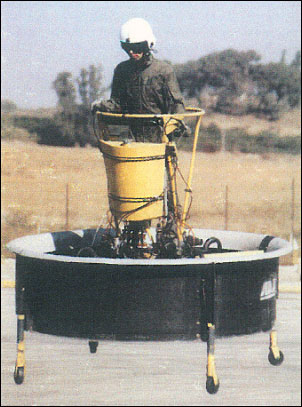
Launched as private venture, reviving concept explored by US Hiller VZ-1 in the 1950s but incorporating new features. The first (tethered) hovering flight was made on 28 August 1997; and the first free (untethered) flight (4X-BEB) 4 October 1998. Availability in kit form was originally planned for 2000.
A naturally stable VTOL platform which can be flown by persons with limited piloting experience. The Hummingbird has full engine redundancy, and can continue flying safely throughout full flight envelope after a single engine failure (initial hovering flights used approximately half of total available power). Air duct has outwards-curved lip on upper surface and diameter to length ratio of approximately 2.75:1.
Vertical speed (rise/descent) is controlled by pilot increasing or reducing rotor rpm via a twist-grip throttle with the left hand. Lateral (sideways) and longitudinal (fore/aft) motion is achieved simply by the pilot tilting his body slightly in desired direction. Maximum allowable speed is attained when pilot’s body reaches limit imposed by circular railing at waist height. The ‘Nose’ of vehicle can be turned by a small lever at pilot’s right hand.
The engines are mounted on four sides of a square gearbox which also serves as pedestal supporting the occupant. Rotors extend from the lower end of gearbox. The engines and propellers are off-the-shelf ultralight components and the circular outer duct is of graphite/epoxy construction.
Four non-retractable, free-castoring single wheels, each with shock-absorbing oleo that can withstand vertical impacts of up to 3.7m/s serve as landing gear.
Four 16.4kW Hirth F33-15A single-cylinder piston engines, each with dual ignition, own carburettor and own fuel line are coupled through torsional dampers and one-way clutches. These drive, via an AD & D gearbox equipped with a chip detector, two three-blade contrarotating propellers/rotors which are synchronised to obtain practically zero yawing moment at all throttle settings.
The Hummingbird accomodates a pilot only, standing inside tubular metal frame.
AD & D Hummingbird
Engines: 4 x Hirth F33-15A, 16.4kW
Diameter: 2.2m
Height overall: 1.9m
Empty weight: 145kg
Max T-O weight: 260kg
never-exceed speed: 74km/h
Hovering ceiling, IGE: 2440m
Hovering ceiling, OGE: 1525m
Range, standard fuel: 31km
Endurance, standard fuel: 30min
Standard fuel capacity: 19 litre
 All Aero