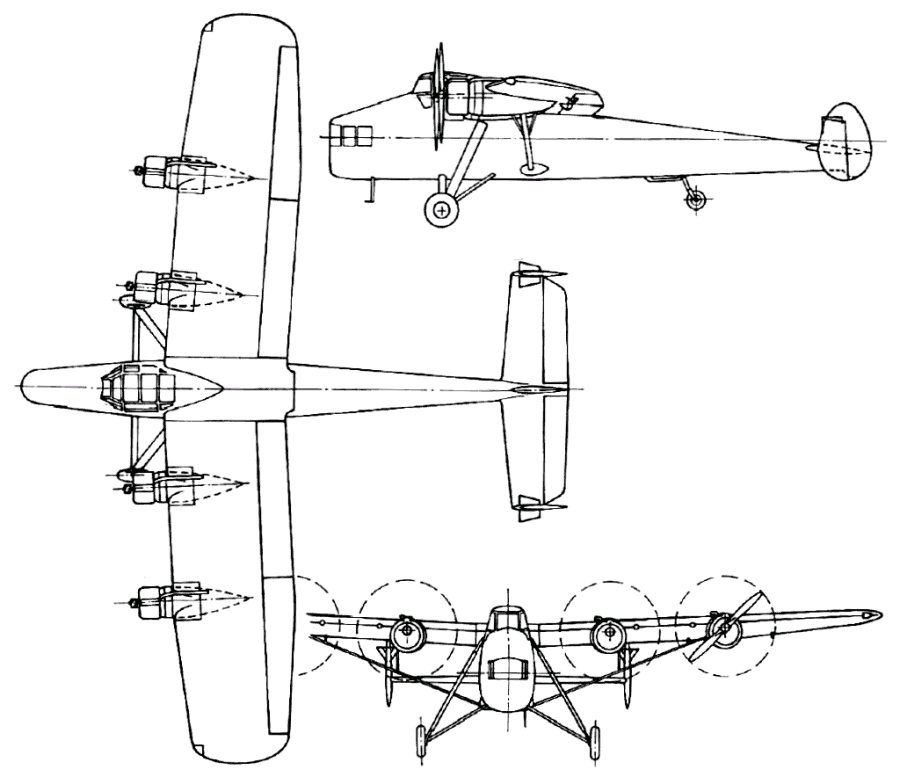
In 1937 the British Admiralty envisaged a need for an aircraft that could shadow enemy fleets at night and drafted Specification S.23/37 calling for a slow-flying silent aircraft with a long range, capable of operating from an aircraft carrier flight deck. The specified performance was to be a speed of 40 knots / 70kph at 500m for not less than 11 hours with accommodation for a pilot, observer and radio operator. Five companies showed interest – Percival, Short Brothers, Fairey Aviation, General Aircraft Ltd and Airspeed. Two prototypes were built, the Airspeed A.S.39 (serial N1323) and the General Aircraft G.A.L.38 (P1758). The A.S.39 design was a high-wing aircraft with four 130 hp Pobjoy Niagara V engines with fixed pitch propellers, extensive slats, flaps and drooping ailerons, fixed landing gear and an observer’s position in the nose. As for other aircraft carrier planes, the wings folded for storage. The Airspeed Fleet Shadower had a metal fuselage and three small fins. The two prototypes flew after the out break of the Second World War, the AS.39 flying on 17 October 1940. The aircraft met the requirement but the Admiralty changed their minds about the desirability of such an air¬ craft and scrapped this pro¬gramme in 1940 due to the introduction of radar.
Engines: 4 x 130hp Pobjoy Niagara V Max take-off weight: 3147 kg / 6938 lb Empty weight: 2083 kg / 4592 lb Wingspan: 16.25 m / 53 ft 4 in Length: 12.2 m / 40 ft 0 in Height: 3.17 m / 10 ft 5 in Wing area: 43.85 sq.m / 472.0 sq ft Max. speed: 201 km/h / 125 mph Ceiling: 1830 m / 6000 ft Crew: 3
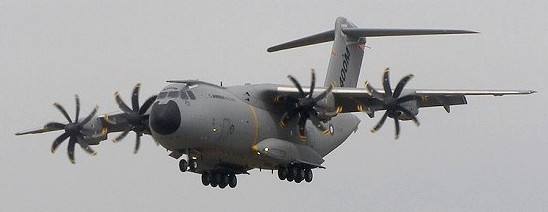
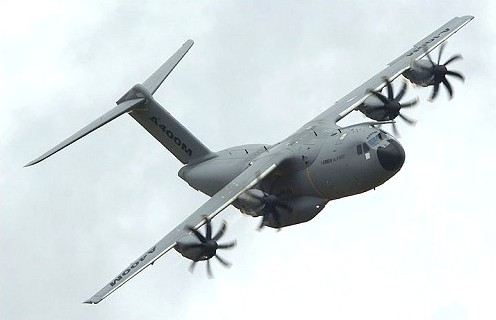
The Airbus A400M, also known as the Atlas, is a multi-national four-engine turboprop military transport aircraft. It was designed by Airbus Military as a tactical airlifter with strategic capabilities. The aircraft’s maiden flight, originally planned for 2008, took place on 11 December 2009 in Seville, Spain.
Engines: 4 x 8250kW Europrop TP400-D6 turboprops Wingspan: 42.4 m / 139 ft 1 in Length: 45.1 m / 148 ft 12 in Height: 14.7 m / 48 ft 3 in Max Take-off weight: 141000 kg / 310853 lb Empty weight: 76500 kg / 168655 lb Payload: 37000kg / 81571 lb Ceiling: 11300 m / 37050 ft Range w30 tonne: 2450 nm Range w20 tonne: 3550 nm Crew: 3-4
A400M Engines: 4 x Europrop TP400-D6 turboprops, 11,060 hp / 8250kW Wingspan: 42.4 m / 139 ft 1 in Length: 45.1 m / 148 ft 12 in Height: 14.7 m / 48 ft 3 in Max Take-off weight: 141000 kg / 310853 lb Empty weight: 76500 kg / 168655 lb Payload: 37000kg / 81571 lb Maximum Speed: 485mph (780kmh; 421kts) Ceiling: 11300 m / 37050 ft Range w30 tonne: 2450 nm Range w20 tonne: 3550 nm Maximum Range: 5,412miles (8,710km) Crew: 3-4
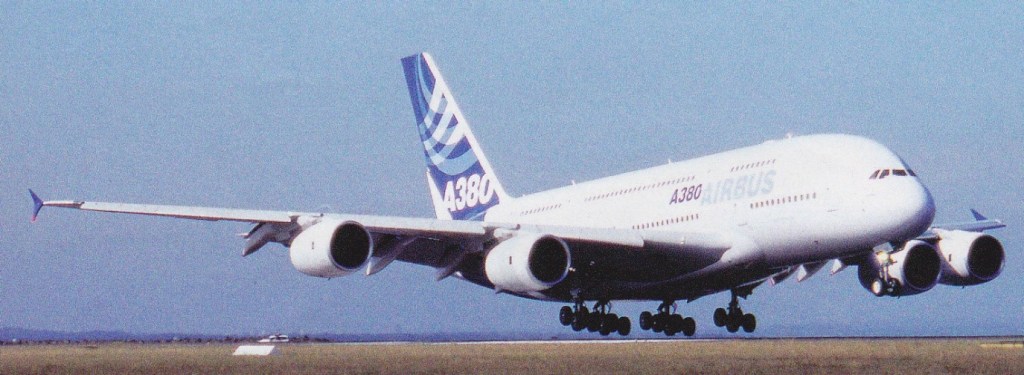
After years of research Airbus decided to proceed with the 8.8 billion A380 project in 1999, the final budget settling at about 12 billion. The double-decker layout would provide higher seat capacities and, hence, cost savings over a traditional design.
Originally known as the A3XX, the A380 is a double-deck, four-engined airliner. Airbus began engineering development work in June 1994 with key design aims including the ability to use existing airport infrastructure with little modifications to the airports, and direct operating costs per seat 15-20% less than those for the 747-400. With 49% more floor space and only 35% more seating than the previous largest aircraft, Airbus is ensuring wider seats and aisles for more passenger comfort. Using the advanced technologies, the A380 is also designed to have 10-15% more range, lower fuel burn and emissions, and less noise.
The A380’s wing has been designed to cope with a MTOW of 590t, albeit with some strenghtening required, allowing for a future stretch. The stronger wing and structure is used on today’s freighter version, the A380-800F. This approach sacrifices some fuel efficiency on the initial passenger model but the sheer size of the aircraft coupled with the significant advances in technology over the years should provide lower operating costs per passenger than the 747.
With orders and options from nine customers (Air France, Emirates (the first customer), Federal Express (the cargo model launch customer), International Lease Finance Corporation, Lufthansa, Qantas, Qatar Airways, Singapore Airlines, and Virgin Atlantic), the Airbus A380 was officially launched on December 19, 2000, and production started on January 23, 2002.
The upper deck extends the entire length of the fuselage allowing for a three-class configuration to seat 555 people, up to maximum of 853 in full economy class configuration. Airbus made the cockpit layout, procedures, and handling characteristics similar to those of other Airbus aircraft to reduce crew training costs. Accordingly, the A380 features a glass cockpit and side-stick flight controller driving the airplane by fly-by-wire technology.
Airbus operates 16 manufacturing sites across Europe, most of which produce parts for the new A380 airliner. First, the front and rear sections of the fuselage are loaded on an Airbus RORO ship, Ville de Bordeaux, in Hamburg, northern Germany, and are shipped to the United Kingdom. There the huge wings, which are manufactured at Filton in Bristol and Broughton in north Wales, are transported by barge to Mostyn docks where the ship adds them to its cargo. In Saint-Nazaire, western France, the ship trades the fuselage sections from Hamburg for larger, assembled sections, some of which include the nose. The ship unloads in Bordeaux. Afterwards, the ship picks up the belly and tail sections in Cadiz, southern Spain, and delivers them to Bordeaux.
From there the A380 parts are transported by barge to Langon, and by road to an assembly hall in Toulouse. New wider roads, extra canal systems, and barges were developed to deliver the massive A380 parts. After assembly the aircraft are flown to Hamburg to be furnished and painted. Final assembly began in 2004, with first aircraft (MSN001) displayed in January 2005. The first A380 prototype was unveiled during a ceremony in Toulouse, on January 18, 2005. Its manufacturer’s serial number is 001, and is registered as F-WWOW.
The airliner took off for its maiden flight at 8:29 UTC (10:29 a.m. local time) on April 27, 2005, from runway 32L of Blagnac International Airport in Toulouse, France, taking off with a flight crew of six, 22 tons of flight test instrumentation and water ballasts.
The crew was made up of French test pilots Jacques Rosay (captain for the take-off and the initial part of the test flight) and Claude Lelaie (captain for the second part of the test flight including the landing), as well as three flight test engineers (Spanish, French, and German), and one French test flight engineer. With the recent Franco-German controversy over the leadership of EADS still fresh in mind, Airbus issued a statement to make it clear that the crew had been chosen not based on nationality, but based on competence.
The takeoff weight of the aircraft was 421 tonnes (464 US tons), or about 75 % of its maximum takeoff weight for commercial flights. This was the heaviest takeoff weight of any passenger airliner ever created. After takeoff the jet headed west toward the Bay of Biscay, then south over the northern Pyrenees Mountains and concluded with a low altitude fly-by over the town of Toulouse. The 233 minute flight involved conducting tests on its engines, hydraulics, and electronics, while the on-board test equipment recorded measurements for 150,000 different parameters and sent data back to computers on the ground.
The A380 was powered by Rolls-Royce Trent 900 engines and by mid-October 2005 had logged more than 100 flights and 350 hours in the air.
The second A380 first flew on 18 October 2005 followed by the third on 3 November.
The A380-800 has a maximum range of 15,000km (sufficient to fly from Chicago to Sydney nonstop), and a cruising speed of 1,050km/h.
The first A380 was revealed to the world in front of 4500 guests at Toulouse on 18 January 2005, dignitaries including the British and Spanish Prime Ministers, French President and German Chancellor.
In March 2006 Airbus successfully completed a passenger evacuation test of the A380 with 853 passengers, two pilots and 18 cabin crew evacuating an aircraft well within the required 90 seconds. The test was conducted in darkness and with half of the doors inoperative. The doors were not known in advance.
The Airbus A380 reached 1000 flying hours, the first aircraft reaching the milestone during a flight test on 27 April 2006. In December 2006 the A380 was awarded joint US and European certification.
Sixteen airlines had ordered the A380 as of June 18, 2005, including an order from AIG’s aircraft leasing unit, ILFC. A380 orders standing at 159, included 27 freighter versions. Break-even was estimated to be at 250 to 300 units. Airbus CEO, Noel Forgeard, had said he expected to sell 750 of the aircraft. Official prices have been withheld but it was estimated at $264 million.
Interestingly, the A380’s horizontal stabilizer measures 30.4 meters (100 feet), during takeoff the A380 wings flex upward by more than 4 meters (13 feet), and the external paint (primer and topcoat) on an A380 weighs 531 kg (1,171 lbs).
A380 F-WXXL cn002 at Sydney November 2006 after non-stop route proving from Johannesburg via the South Pole.
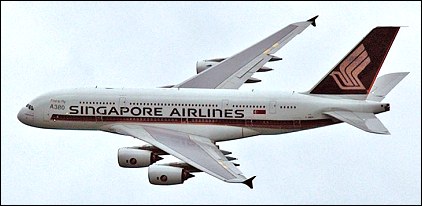
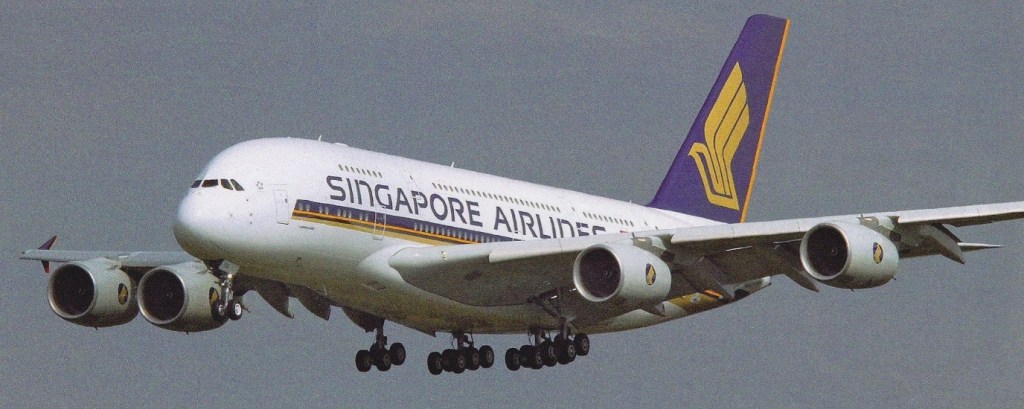
The first A380 commercial service was flown on 25 October 2007 with Singapore Airlines 9V-SKA.
First commercial flight
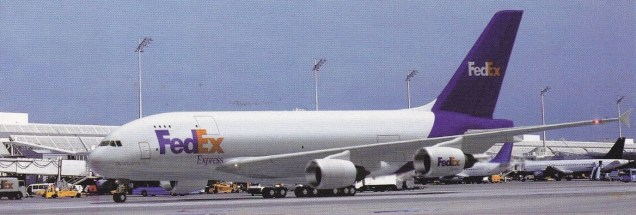
As launch customer for the A380-800F FedEx Express was to take delivery of three aircraft each in 2008, 2009 and 2010 followed by one in 2011.
After producing 251 A380s, production ended in 2021.
A380-800 Engines: 4 x Engine Alliance GP7270 or Rolls-Royce Trent 970/B turbofan, 72,000-84,000lb thrust Wing span: 79.8m / 261ft 10in Length: 73m / 239ft 6in Height: 24,1 m / 79ft 1in Operating weight empty: 275,000kg / 606,000lb Maximum Take-Off Weight: 1,234,589lbs (560,000kg) Maximum Speed: 634mph (1,020kmh; 551kts) Max cruising speed: M 0.88 / 903 kmh / 561 mph Long range cruising speed M 0.85 Maximum Range: 9,445miles (15,200km) Initial climb rate: 2,300 fpm Service Ceiling: 43,028ft (13,115m) Seats: 555 Cargo capacity: 38 LD3s or 13 pallets. Crew: 2
A380-800HGW Max takeoff weight: 560,000kg / 1,235,000lb Max cruising speed M 0.88 Long range cruising speed M 0.85 Range 15,100km / 8,150nm Service ceiling: FL430 Crew: 2
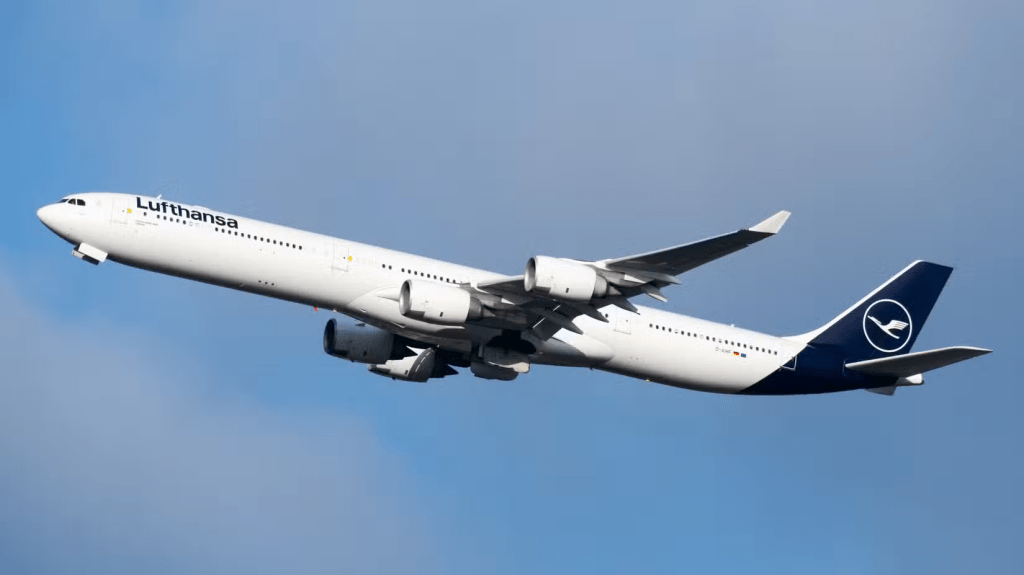
Lufthansa exercised a decisive influence on the basic parameters, such as passenger capacity, range and engine choice, and, together with Air France, became the launch customer. Lufthansa first opted for the longer range, shorter fuselage A340-200, but soon supplemented them with the higher capacity extended fuselage A340-300.
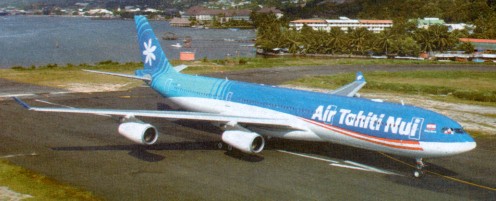
Launched simultaneously in June 1987 with the A330, the A340-300 first flew on 25 October 1991 and the type entered service with both Lufthansa and Groupe Air France on 1 March 1993 accommodating 250-440 passengers. Sharing near identical systems, airframe, cockpit and wings with the A330, the twin-engine A330-300 is the same length as the A340-300 The four-engined A340-300 is the standard fuselage long-range aircraft (seating 295 with a range of 6,750 nm), while the A340-200, which first flew on 1 April 1992, is 4.27 m shorter (260 seats) and is an ultra-long-range version (7,550 nm). Airbus’s ultra-long-range A340-500 has been granted type certification by the European Joint Aviation Authorities (JAA). The aircraft, which has a shorter fuselage and a longer range than the A340-600, first flew on 11 February 2002 and since then the two test aircraft have accumulated some 400 flight hours in more than 150 flights during the certification campaign. The -500 is capable of flights ranging over 8,650 nm and both the -500 and -600 versions of the A340 are powered by Roll-Royce’s Trent 500 engines. The first aircraft was scheduled for delivery to Air Canada in early 2003. The A340-600 is a long range, high capacity model, first flown on 23 April 2001. The -600 utilises LCD displays and taxi cameras.
A340-600
Lufthansa was the first operator of the Airbus A340. It first flew the Airbus A340-200 in 1993, later retiring all eight of its examples by 2003. It’s also the largest operator of the A340-300, still flying in 2025 17 out of the 30 examples it took, and ordered 24 Airbus A340-600s, though only eight of these still fly for the German flag carrier.
Airbus prepared a corporate A340-600 for the Saudi Arabian oil company the Saad Group with a range of 8500 nm / 15,745 km carrying 90 passengers.
A340-200 Engines: 4 x GE/SNECMA CFM56, 32,200 lb thrust Length: 195 ft Wingspan: 198 ft MTOW: 566,590 lb Max Ldg wt: 399,00 lb Payload: 95,000 lb Full load range: 7350nm
A340 211 Engines: 4 x CFM56 5C2F
A340-300 Engines: 4 x CFM-56-5-C4, 34,000 lb thrust Max ramp wt: 275.5 tonnes MTOW: 275 tonnes Vmq: 350 kt / M 0.86
A340-300 Engines: 4 x CFM International CFM56-5C-2 turbofans, 138.8kN Wingspan: 58.65 m / 192 ft 5 in Length: 63.65 m / 208 ft 10 in Height: 1.74 m / 5 ft 9 in Wing area: 361.6 sq.m / 3892.23 sq ft Take-off weight: 251000 kg / 553363 lb Empty weight: 125500 kg / 276682 lb Max. speed: 910 km/h / 565 mph Range: 12325 km / 7659 miles Crew: 2 Passengers: 335
A340-500 Engines: 4 x Rolls-Royce Trent 500
A340-600 Engines: 4 x Rolls-Royce Trent 500 Length: 247 ft Range: 7500 km
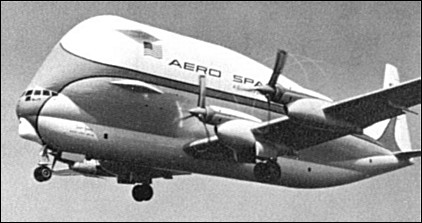
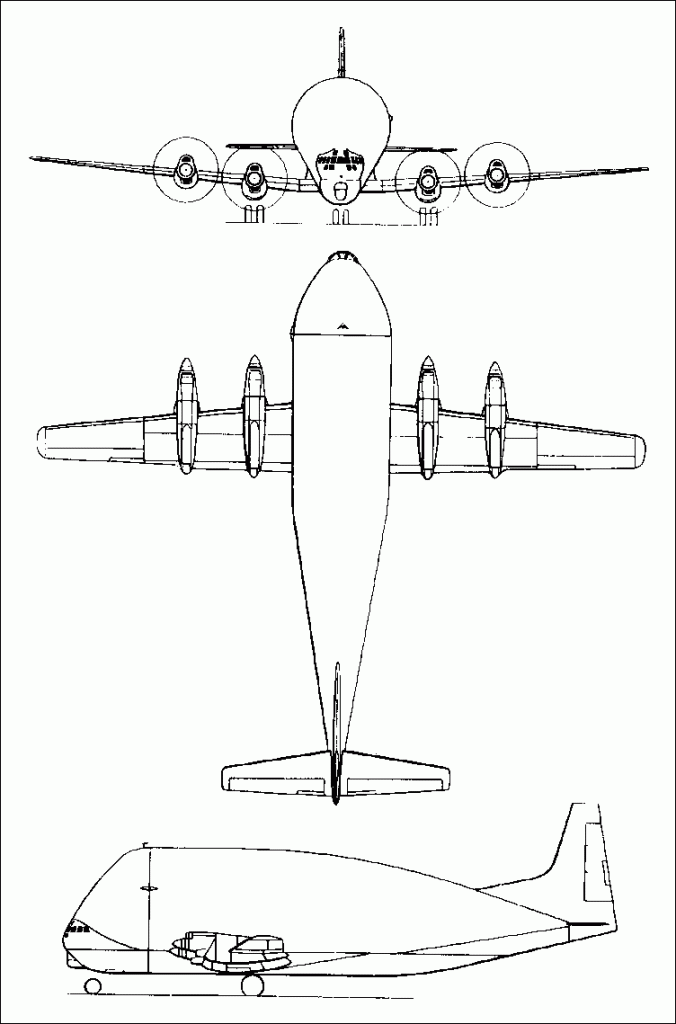
Aero Spacelines developed the turboprop conversion on the 377MGT first, then used the same conversion on the more successful Super Guppys.
The 1970 Guppy-101 was from a rebuilt from Boeing Stratocruiser with four 4900hp Allison 501-D22C turboprops. It was the first with the opening nose section.
The 377MGT Mini Guppy Turbine, first flew on March 13, 1970, but was involved in an accident at Edwards Air Force Base on May 12, 1970. With the crash of the 377MGT and the shrinking budgets, Aero Spacelines found itself no customers for the 377MGT.
Guppy-101 Engine: 4 x Allison 501-D22C turboprops, 3510kW Take-Off Weight: 81500 kg / 179678 lb Empty Weight: 41270 kg / 90985 lb Payload: 28500kg / 62832 lb Wingspan: 47.6 m / 156 ft 2 in Length: 41.3 m / 135 ft 6 in
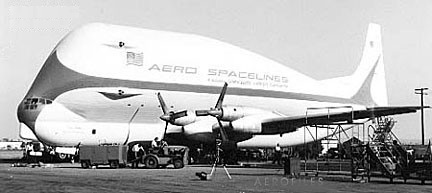
The 377MG Mini-Guppy was the first of the Guppys that was built using an entirely new fuselage to connect the existing Stratocruiser sections. Stretched ex-USAF C-97 modified by addition of new upper fuselage lobe with interior radius of 18′; swing-tail for cargo loading. This removed the Stratocruiser’s limitation of a 2.4m wide floor, and allowed a 4m wide cargo floor and a maximum inside diameter of 5.5m with the constant section measuring just over 22m long. The aircraft featured a swing tail for loading cargo.
The first flight as 377MG Mini-Guppy, christened “Spirit of Santa Barbara”, was on May 24, 1967. Two days later on May 26, the Mini-Guppy was used for its first cargo flight, flying a Budd Company Skylounge to the 1967 Paris Airshow. While in France, the Mini-Guppy was flown south to Toulouse for a demonstration for Aerospatiale officials.
Two were built; N1037V and N111AS, the first aircraft powered by R-4360s, second by Allisons taken from Lockheed Electras.
Crashed at Edwards AFB on 5/12/70 after engine failure, crew of four perished.
377MG “Mini Guppy” Engine: 4 x Pratt-Whitney R-4360, 2575kW Take-Off Weight: 64770 kg / 142794 lb Empty Weight: 41275 kg / 90996 lb Wingspan: 43.0 m / 141 ft 1 in Length: 38.7 m / 126 ft 12 in Height: 11.6 m / 38 ft 1 in Cruise Speed: 400 km/h / 249 mph Crew: 3
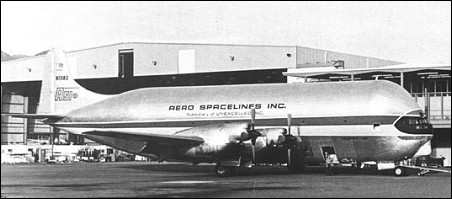
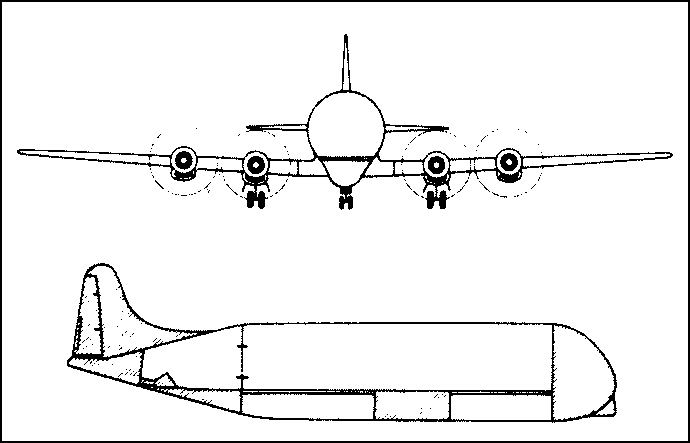
Following the B-377PG Pregnant Guppy was the larger B-377SG Super Guppy of 1965. Ex-USAF YC-97J was modified by adding wing root plug, stretching fuselage 30’10”, and adding huge new upper fuselage lobe with interior radius of 25′. Nose of fuselage pivoted to allow cargo loading. This featured an outsize fuselage with a cargo compartment measuring 33.17m in length, 7.62m in width, and 7.77m in height, and an increased wing span and four 5220kW turboprop engines.
The sole Guppy-201 built, N1038V, first flew on 31 August 1965.
Super Guppy SG N1038V
The only aircraft able to carry the third stage of a Saturn V launch vehicle, and the Lunar Module adapter, this Super Guppy was also used in the American space programme.
Displayed at Pima County Air Museum, Tucson AZ.
377SG “Super Guppy” Engine: 4 x Pratt-Whitney T-34P7 turboprops, 4500kW Take-Off Weight: 79400 kg / 175048 lb Empty Weight: 47600 kg / 104941 lb Payload: 18500 kg / 40786 lb Wingspan: 47.7 m / 156 ft 6 in Length: 43.1 m / 141 ft 5 in Height: 11.7 m / 38 ft 5 in Max. Speed: 480 km/h / 298 mph Ceiling: 6000 m / 19700 ft Crew: 3-4
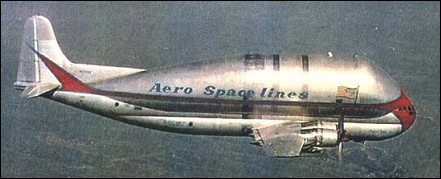
Aero Spacelines started work in 1961 on the conversion of a Boeing B-377 Stratocruiser to an outsize cargo aircraft able to airlift large booster rocket stages being employed in the American space programme, for the transport of aircraft assemblies, oil drilling equipment, and any other items too large to be carried by any then existing aircraft.
Designed by Jack Conroy, the fuselage of ex-airline Boeing 377 N1024V was extended by 5.08m aft of the wing, and a new ‘bubble’ structure was added over the top of the fuselage to allow the loading of items up to 6.02m in diameter. Capable of carrying 34,000 lb of cargo, the resulting B-377PG Pregnant Guppy was flown for the first time on 19 September 1962, and was used from the summer of 1963, under contract to NASA, for the transport of space programme hardware. Aircraft was loaded by removing the tail section just aft of the wing trailing edge.
377PG “Pregnant Guppy” Engines: 4 x Pratt-Whitney R-4360, 23500hp / 625kW Wingspan: 43.05 m / 141 ft 3 in Length: 38.71 m / 127 ft 0 in Take-off weight: 60200 kg / 132719 lb Empty weight: 41200 kg / 90831 lb Payload: 13100kg / 28881 lb Speed: 240 mph
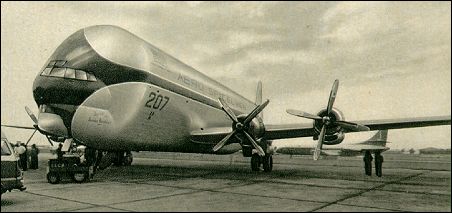
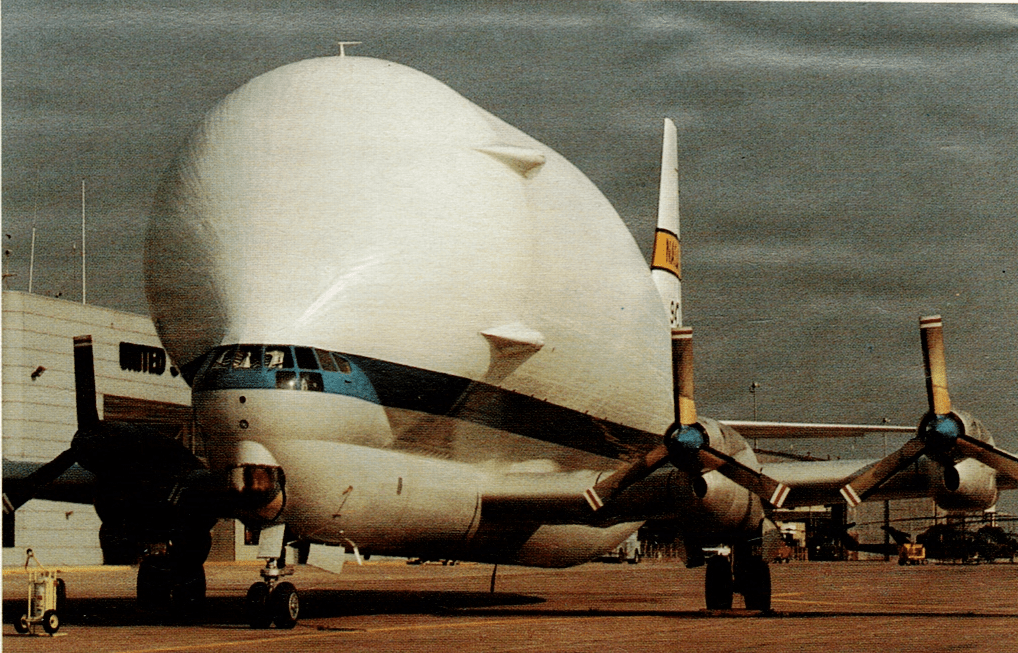
The Guppy 201 utilizes the lower fuselage, wings, tail unit and cockpit of a Boeing 377/C 97, with portions of the lower fuselage of several aircraft being joined to provide a larger cabin with interior diameter of 25′. Upper fuselage lobe added to stretched C-97 fuselage, plus parts from Airbus, Concorde, DC-10, and TriStar; engines from retired Lockheed Electras.
Although this Super Guppy is very close in dimensions to the original Super Guppy, the shape of the fuselage has a smoother flow and engine nacelles are completely different.
The first 377SGT Super Guppy Turbine flew on August 24, 1970. After success with the first of the 377SGTs, Aero Spacelines built a second 377SGT and it flew exactly two years later on August 24, 1972.
Aero Spacelines originally planned to build and operate the MGT and SGT aircraft but after the company got into serious financial trouble a decision was made to sell the SGT to Airbus Industrie.
Two were built by Aero Spacelines in early 1970s, N211AS and N212AS, and sold to Airbus Industrie/Aérospatiale to haul components of A300Bs and Concordes.
Two were built in early 1980s for Airbus by UTA Industries in France. Retired by Airbus in early ’90s; reportedly three went to European museums, and the last one was bought by NASA.
The Super Guppy Turbine (NASA’s B377SGT), super-sized cargo plane flown since 1980 was acquired by NASA in 1997. Its home base, was the Ellington Field, near the Johnson Space Center in Lancaster, California.
Guppy 201 Engines: 4 x Allison 501-D22C, 3663kW / 4912shp Take-Off Weight: 77111 kg / 170002 lb Empty Weight: 45359 kg / 100000 lb Payload: 25000kg / 55116 lb Wingspan: 47.63 m / 156 ft 3 in Length: 43.84 m / 143 ft 10 in Height: 14.78 m / 48 ft 6 in Wing Area: 182.51 sq.m / 1964.52 sq.ft Max. Speed: 460 km/h / 286 mph Cruise Speed: 407 km/h / 253 mph Ceiling: 7620 m / 25000 ft Range W/Max.Payload: 813 km / 505 miles






 All Aero